




Abstract
COVID-19 has inflicted unprecedented damage on the entire concept of work and has prompted a paradigm shift in workplace relations. Many work environments have faced a context in which on-site work has been restricted and telework has been the only viable option. In countries like Spain, the pandemic has forced the Public Administration to opt for this way of working in order to continue operating. Therefore, this study aims to determine the catalysts and blockers for Spanish civil servants wanting to telework. To achieve the study’s objectives, descriptive statistics were obtained using the multiple linear regression technique, with a model building system known as backward stepwise. The identification of these catalysts and blockers will help to facilitate human resource management based on teleworking in the public sector. This study’s findings could help to recommend possible actions to improve the employees’ teleworking experience at the Spanish Administración General del Estado. These actions include investing in equipment, providing training in information and communication technologies, and defining human resources policy to promote the work-life balance.
Introduction
The sudden emergence of compulsory teleworking for the global workforce has represented a unique opportunity to study this method of working.
Teleworkers have been gradually increasing over the last two decades. Jonathan Boys states that this increase is as much as 80% and highlights four factors that could explain this shift: (1) technology, mainly concentrated in laptops; (2) a change in the profile of the workforce, which continues to age in Western countries. Executives and older workers are two groups who are using this way of working; (3) an increase in commuting time; and (4) the cost pressures that influence all types of companies (Boys, 2020).
COVID-19 has inflicted unprecedented damage on the entire concept of work and has prompted a paradigm shift in workplace relations (Martínez & Diez, 2020). After a century of labor relations based on: (a) the definition of a specific place where the worker goes regularly and, by contractual agreement; (b) the provision of resources and tools to perform the tasks assigned; (c) the face-to-face contact with their managers and colleagues; and (d) a division between work and personal and family life conditioned by the sex of the members of the coexistence nucleus, the pandemic has forced a disruptive change in this paradigm. Nevertheless, teleworking has been permitted to overcome this unprecedented situation. Teleworking has improved the flexibility, autonomy, and work-life balance of the workforce from the end of the last century. However, workers’ mental, emotional, and physical well-being are being analyzed (Khalil et al., 2020). The strategies and action plans to implement all of them (flexibility, autonomy, work-life-balance, workers’ well being) have been assumed by the human resources departments.
In this scenario, teleworking has been offered as an alternative to the global workforce. This has not been in vain; in the first half of 2020, 93% of the working population (Monitor, 2020) lived in countries with some type of restriction to access the workplace. Home has become a central hub of work and family life. Women, who have traditionally carried the burden and responsibility for domestic duties, regardless of whether they work within or outside of this environment (Ryu &Kim, 2020) have to contemplate the sudden combination of managing their careers, childcare, elder care, and managing home and family needs, all within the same environment.
The disruptive emergence of teleworking has promoted the definition of some fundamental recommendations, as set out by the International Labour Organization (Organización Internacional del Trabajo, 2020), among which are the following: (a) support from management; (b) adequate tools and training; c) clear expectations and rules for both parties; (d) a strategy for improved working at home (space and hours); and (e) trust at all levels of the company’s organizational structure. In addition, this pandemic has provided an interesting case study for analyzing this way of working in different employment sectors and from different points of view.
One of the sectors of activity common to all types of countries is the public sector. The public sector has attempted to resolve the social, technological, and organizational challenges facing society. One of these challenges has been the sensitivity toward promoting the compatibility of work, family, and personal life. One of these responses is teleworking (Caillier, 2013; Henderson & Dennson, 1989). This research aims to analyze what motivates Spanish civil servants to telework and discusses how this varies depending on their home setting, work organization, resources available, and relationship with the environment.
The Spanish public sector is made up of three categories (Ministerio de Política Territorial y Función Pública, 2020): (a) Sector público estatal (Spanish public administration depending on the government is divided into two groups: (a1), Administración General del Estado, -hereinafter AGE-; and (a2), Armed Forces and Law Enforcement forces and agencies); (b) Comunidades Autónomas (regional government); and (c) Administración Local (local government). Each of them has other entities through which they carry out part of their activities, such as public companies, foundations, consortia, and other public entities. Table 1 shows the number of people working in the three categories of the Spanish public sector we mentioned, although our research is only focused on the first one, AGE.
Staff Working in Public Sector in Spain in July 2020.

Source. Prepared by the authors based on the Ministerio de Administración Pública y Politica Territorial data.
This research focused on the first group, AGE, Administración General del Estado, the Spanish General State Administration, depending on the government. The civil servants were teleworking during COVID-19, the same as the rest of the Spanish working population. From September 2020, this workforce could telework three times a week.
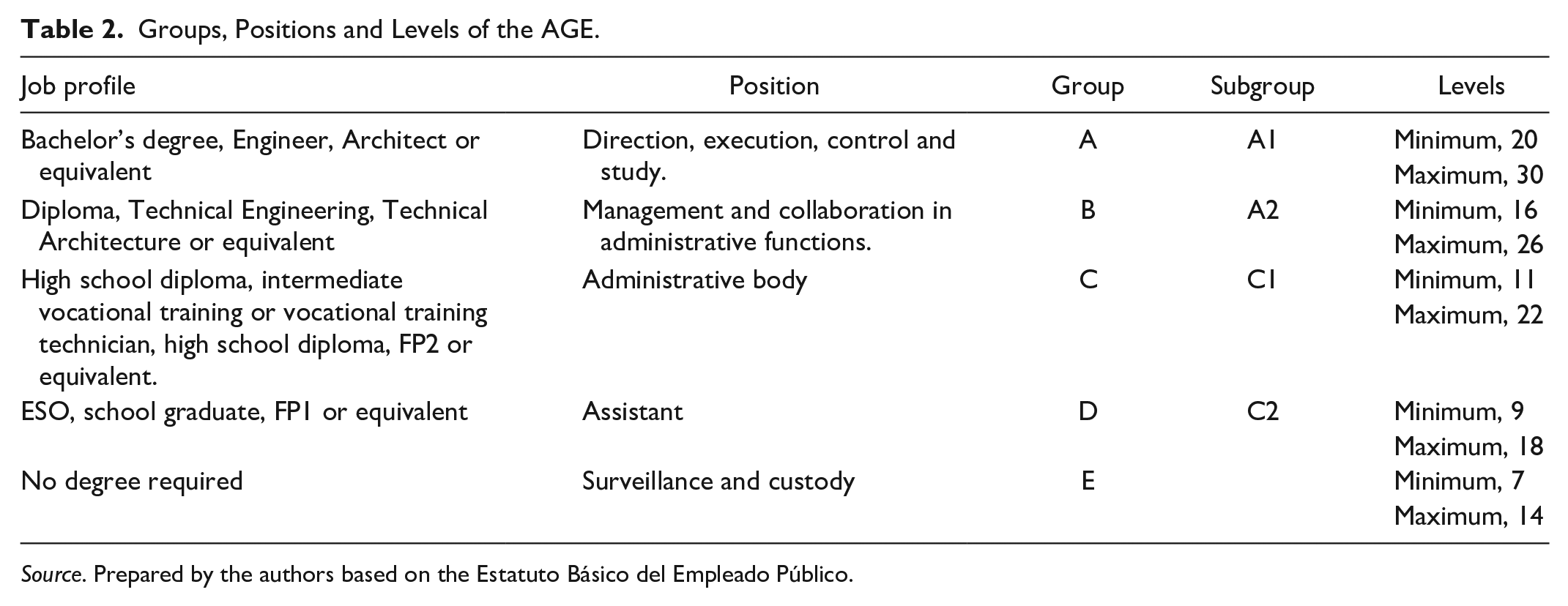
AGE has to execute the administrative policy of the Spanish government. Articles 75 and 76 of the Estatuto Básico del Empleado Público (Basic Statute of Public Employment) describes how the organization is defined. The structure of the civil service is composed of groups, positions, and levels, as shown in Table 2.
Groups, Positions and Levels of the AGE.
Source. Prepared by the authors based on the Estatuto Básico del Empleado Público.
AGE also showed interest in teleworking prior to the outbreak of covid-19. This is mentioned in the Plan Concilia (2005). It aims to provide a comprehensive approach to work-life balance in the public administration. In May 2006, the e-book on the Plan Concilia “Timetables and Teleworking” was published. This document includes a technical report called “Pilot plan for the application of teleworking techniques in the civil service” which makes a study on the suitability and conditions for the application of teleworking in the Spanish civil service, in relation to the objectives set out in the Plan Concilia. Nevertheless, there was any mention in the Estatuto Básico del Empleado Público (2015). As a consequence of covid-19, an agreement was signed on 22 June 2020. Furthermore, different resolutions deepened the previous resolution. The most noteworthy is the inclusion of the regulation of teleworking in public administration in Article 47.bis of the Texto Refundido del Estatuto Básico del Empleado Público. Teleworking is defined as “that modality of remote service provision in which the competency content of the job can be developed, provided that the needs of the service allow it, outside the premises of the Administration, through the use of information and communication technologies” (Estatuto Básico del Empleado Público, 2015). A voluntary and reversible nature was established. The specific conditions for teleworkers who use it compared to those who work in person are also mentioned.
The structure of the document is divided as follows: first, the analysis of teleworking and literature review. This is followed by the method of analysis used, both in terms of database management and modeling. Third, the main results of this study are presented. Finally, the discussion and conclusions are presented. Figure 1 summarizes the conceptual framework followed in this research.

Conceptual framework of the research.
Analysis of Telework and Literature Review
This chapter is organized as follows: first, the organizational and structural conditions of teleworking are explored from three different perspectives: the company perspective, the person profile and from the perspective of jobs that can be done from home; second, the group of factors that support or hinder telework are shown these include workspace, resources, domestic settings, working organization, and social isolation; and third, telework in Europe and Spain. The approach and comparison to teleworking in the Spanish public sector introduces a general overview of teleworking statistics in Europe at the end of 2020 and is then compared to the teleworking situation in the Spanish public sector.
Organizational and Structural Conditions to Telework
Usually, the adoption of telework is linked to a company’s strategic decisions (Bailey et al., 2002). This represents organizational change. It involves moving away from “managing by wandering around” (Peters & Waterman, 1984). However, managers need to be involved in the details (Buckner, 2008). Nevertheless, it is necessary to introduce three topics to determine how some factors can influence the decision makers in a company to establish teleworking as a method, as follows: company profile, person profile, and jobs that can be done at home.
(a) Company profile. Different multinational companies, especially in the IT sector, have been teleworking for several years. Companies such as Apple, Facebook, Microsoft, or Twitter (USA Today, 2020), decided that their employees could work from home as a result of COVID-19. Zuckerberg announced that in 10 years, 50% of Facebook employees would be working from home.
Companies that opt for telework should consider (Vargas Llave et al, 2020) the following matters: (1) a goal-based corporate culture and a management focus that supports this, (2) tactical and express support from senior management, (3) line managers who lead by empowering teleworkers, and (4) implementing awareness and education measures that support managers using this management style.
(b) Person profile
The methods of talent attraction are based on different types of tests that measure, among other things, skills, knowledge, and personality. In some cases, the analysis of personality traits helps to create specific working teams. Telework involves a combination of individual and group work. The teamwork model was disrupted. Informal communication is transmitted through the platforms. In this respect, predictor variables have been identified within a personality and the explanatory cognitive style of the preference for working in virtual teams or working alone remotely (Luse et al, 2013). In contrast, Krumm et al. (2016) did not find any differences in personality between the traditional and virtual groups.
This approach has changed profoundly, and because the findings are mixed, it is necessary to gain a better understanding as to whether individual personality traits affect telework as Beño (2021) introduced when he highlighted that this way of working is not appropriate for all sectors or people.
(c) Jobs that can be done at home
The emergence of telework as a result of Covid-19 has been disruptive. There were no other options available. The definition of household roles has changed as a result of the pandemic. It is necessary to design new occupations in the domestic setting, and in the future, it will be necessary to study whether the partial or complete return to the physical workplace creates conflict at home or even at a social level.
The academic literature has presented a detailed description of the factors that have an impact on voluntary implementation of telework as an alternative. Mokhtarian et al. (1988) highlighted the nature of work and the suitability of the technologies that can be used as deciding factors for a person when it comes to adopting teleworking. The same author also states that a good predictor could be examining specific details of the roles.
By focusing on the type of job, Dingel and Neiman (2020) calculated that 37% of the jobs carried out in the United States could be done from home. Professions with a greater number of people teleworking in North America are educational services, professional services, scientific and technical services, business, finance, insurance, and information management. A smaller percentage (30%) was calculated by Anghel et al. (2020). Dey et al. (2020) believe that it is possible that 45% of the American workforce could telework, with this being a factor when considering that unemployment shows no mercy, especially among those occupations in which it is not possible to telework. Randstad (2020) estimates that there are four main groups of workers who could carry out their jobs from home: scientific and academic professionals, accounting, administrative and other office-based employees, directors and managers, and support staff.
Regarding the Spanish public sector, Pastor y Nogales (2019) questioned its future and concluded that “it is not sustainable let alone fit for purpose for the future”. These authors hypothesized the disappearance of a million jobs in the public sector and the need to include digital profiles due to the implementation of robotics and artificial intelligence, which will also result in the emergence of new professions. Anghel et al. (2020) estimated that 34.3% of people in the Spanish public sector can work remotely, significantly higher than the 3% who were doing so prior to the outbreak of the pandemic.
From the worker’s perspective, the contrast between whether teleworking is effective or not appears to have a positive bias. An analysis of tweets supports this finding. Carroll et al. (2020) reported a figure of 78.6% of positive tweets relating to teleworking. This figure has increased by 8 percentage points compared to the period before the outbreak of the pandemic. The Instituto de Ingeniería del Conocimiento analyzed the frequency of the use of teleworking on Twitter and the sentiments that were associated with it, between March and May 2020. The researchers designed 16 categories relating to different aspects that could be assessed in relation to organizational climate. Thirty-one percent of the tweets analyzed were associated with positive sentiment, while 22% were negative. The sentiment varied throughout the period that was analyzed based on the inputs and news that arose. Teleworking trends are increasing (Gallup, 2020), which can help attract talent. However, McGregor and Doshi (2020) reflect that teleworking can be less motivating than working from an office.
Finally, from a business perspective, the aim is to achieve the best possible results at a cost which, at the least, does not exceed those for being physically present. Additionally, it is needed to add the regulatory influence. While the pandemic had increased, the most advanced countries pushed forward with legislation and, in particular, determining who should pay the costs that are incurred.
Factors that Support or Hinder Telework
Different studies prior to Covid-19 have addressed both the factors that help or support teleworking, as well as those that impede or hinder it. Many authors (Mokhtarian &Salomon, 1994, 1996a, 1996b; Mokhtarian et al., 1998; Rastrollo, 2020) have outlined a list of factors that contribute to the decision of whether to support teleworking. Filardi et al. (2020) complied with the advantages and disadvantages of telework, both for employees and employers. Table 3 summarizes the most mentioned ones from either group.
The Advantages and Disadvantages That Were Most Mentioned in the List by Filardi et al. (2020).

Source. Prepared by the authors based on Filardi et al., 2020.
There are a group of factors that impact teleworking and influence decision making. These factors are as follows: workspace, resources, domestic settings, working organizations, and social isolation. The main key points are as follows.
(a) Workspace. The availability of space for use as a home office (Baruch, 2001) is a basic requirement. A specific area is required with furniture and a suitable temperature, and if possible, it should not be used for any other purpose. A new trend seems to suggest that teleworking will be substituted by working from anywhere, thanks to the support of electronic resources and different types of devices (Choudhury et al., 2019; Crichton, 2020). Although the demand for office space is reduced, more space at home is required (Behrens et al., 2021)
(b) Resources. Teleworking uses the electronic resources and storage. It is based on the requirements for physically being present in an office, such as having personal computers, printers, mobile telephones, tablets, and good internet connections. According to the Observatorio Nacional de las Telecomunicaciones y de la SI (2020), 87% of Spanish companies provide their employees with portable devices connected to the Internet for business use. In terms of the size of the business, companies with more than 250 employees provide 97% of their workers with mobile internet connections, while medium companies provide them to 88%, small companies 71%, and micro-enterprises 40%. This requires employees to have experience using information and communication technologies and the ability to self-manage when it comes to dealing with minor issues that may arise from their use or wear and tear, which means taking on more work (Dos Santos Soares, 1995; Tremblay, 2002). The lack of technology infrastructure (Nogueira & Patini, 2012) becomes a negative factor when it comes to teleworking. A company investment is needed (Beltrán et al., 2020) and in Spain, a better understanding of the rights and duties of companies is necessary to provide sufficient resources to employees to who telework (Barandiarán, 2021) and thus avoid ambiguity.
(c) Domestic settings. One of the main ones is the presence of young children at home (Huws et al., 1990; Kinsman, 1987), which can provide distractions (Mokhtarian & Salomon, 1994; 1996a) and affect the time spent with family (Bailey & Kurland, 2002; Baruch, 2001; Moktarian & Salomon, 1996a, 1996b). Teleworking is a good opportunity for mothers with young children and those with a predisposition to accept lower salaries in return for being able to work from home (Mas & Pallais, 2017).The flexibility that teleworking provides is linked to employment among women (Goldin, 2014). For them, the time saved from working away from home translates into time to be able to carry out domestic chores and look after children (Noonan & Glass, 2012; Offer & Scheineder, 2011). In the case of men, this improvement leads to more time spent working or more spare time. Thus, teleworking can exacerbate household inequality. This can be an inequality in terms of carrying out domestic chores, looking after children or older family members, and the quality of time spent working. The more time the mother spends, the greater the emotional tension (Mattingly & Sayer, 2006; Milkie et al., 2009). Multitasking and work interruptions can also exacerbate the tensions associated with the change in roles and conflict of roles (Greenhaus & Beutell, 1985; Hilbrecht, et al., 2008). If a household is made up of a family, a positive factor that emerges from teleworking is the ability to spend more time with the family (Nohara et al., 2010; Nogueira & Patini, 2012), which results in an improved balance between work and family life (Mas & Pallais, 2017; Nohara et al., 2010).
(d) Working organization. Mokhtarian and Salomon (1996a) identified office discipline as an important factor, which in the case of telework requires self-control, self-discipline, and organization of the work itself. Harpaz states that the key advantages of teleworking for individuals are autonomy and flexibility. In general, specific virtues are associated with telework, such as flexible hours or greater productivity (Nogueira & Patini, 2012; Eom et al., 2016). Middle managers are willing to use teleworking (Adams-Prassl et al., 2020; Holgersen et al., 2021) than in any other workforce. However, the lack of control over workload is also highlighted as a barrier for both workers and the management of a specific area of responsibility.
(e) Social isolation. This factor can hinder teleworking (Dos Santos Soares, 1995; Eom et al., 2016; Olson & Primps, 1984). The workplace emerges as a place where decisions are influenced by the environment (Las Heras & Barraza, 2020; Martínez-Sanchez et al., 2008) and if the workers are alone, it is very difficult to find a joint decision-making process.
This study also adds a further factor, intrinsic characteristics. This includes age, previous experience with teleworking, and personal opinions related to teleworking.
Telework in Europe and Spain: Approach and Comparison to Teleworking in Spanish Public Sector
Teleworking has seen a sudden boom at a global level, but it should not be diminished as it is an existing phenomenon and has been analyzed for more than 30 years (Nilles, 1988). In the last decade, specifically since the 2008 financial crisis, it has gained momentum. Europe is not an exception to this. The increase in teleworking has been greater than in Spain over the last 10 years (Anghel et al, 2020). The latest data show that 12% of the working population in the EU-27 is regularly teleworking by 2020 (Eurostat, 2020). Table 4 shows that Finland, Luxemburg, and Ireland are at the top of the telework ranking in Europe.
Countries With a Higher Percentage of Employed Males and Females Over the Total Number of the Corresponding Sex Employed Between 15 and 64 years old Working From Home in 2020.

Source. Prepared by the authors based on Eurostat data.
Prior to the impact of Covid-19, 4.8% of Spain’s working population teleworked, with an identical figure for men and women. This is far lower, not only than the countries that use this method, but also for the European average by gender, and for women in particular. The European average for female teleworkers in EU-27 was 5.7% (Eurostat, 2020). The Spanish public sector accounted for 3.1% of its workers with some sort of teleworking experience (Anghel et al., 2020). According to 20 minutes, a Spanish online newspaper, the number of civil servants teleworking was 5%, before covid-19. During covid-19, the number of teleworkers grew up to 63%, and at the end of the year, the percentage was 22%. Fifty-seven percent were women, and 43% were men.
Research Objectives
The objective of this research is to determine the factors that motivate or hinder teleworking. The selected working population has been Spanish civil servants working in AGE. This research was considered from a multifactorial factor approach. These factors have been extracted from the academic literature, namely: (1) resources, (2) domestic settings, (3) work organization, (4) social isolation, and (5) intrinsic characteristics. A limitation of the study is that the workspace has not been included as a factor to be analyzed.
Methodology
The data used in this study were obtained through a survey that was designed and carried out entirely by the Spanish Association for Women in the Public Sector (Asociacion de Mujeres en el Sector Público) between the 23rd April and 1 May 2020 during the state of alarm period (declared by the Spanish authorities on 14 March 2020 and lasting 98 days). Access to the data was granted following a request from the Association for Women in the Public Sector (Asociacion de Mujeres en el Sector Público).
This survey was conducted using a simple random sampling method and, in order to be completed, respondents were required to confirm that they worked in the public sector, specifically at levels A1, C2, or equivalents, thus ensuring that the people who responded were civil servants. The original design of the survey was based on a question relating to the responder’s family situation (living with a partner and children, living with or without a partner but without children, living without a partner but with children) in order to ask specific questions. The survey was completed by 1134 people in total (Figure 2).

Sample distribution based on household type and age.
Once the data had been gathered and combined, 1,091 records were included in this analysis, excluding those who stated that they had not been working remotely during the alarm period. A total of 656 people stated that they lived with a partner and children, 335 lived with or without a partner but without children, and 100 people lived without a partner but with children.
To respond to the study’s objectives, descriptive statistics were obtained using the multiple linear regression technique, with a model building system known as backward stepwise. This classic technique (Henderson & Denison, 1989) continues to be prominent in the area of study known as human resources analytics (Edwards & Edwards, 2019). The necessary data requirements were validated for the selection of this technique. To exclude variables from the backward stepwise building system, the exit criteria of excluding any of those variables with a higher F-distribution, always higher than 0.1, were applied. This building system initially includes all the variables in the model and starts excluding variables one by one, at each step, if they meet the exit criteria. This enables the predictive capability (or lack thereof) of all the variables to be observed at each stage of building the model.
To obtain the corresponding descriptive statistics and to build graphs and regression models, R v4.0.2 and SPSS v26 statistical programming languages were used.
With the aim of further enriching the study, individual models have also been built for a specific group of civil servants who live with their partner and children and the group who do not have children, who were also the most represented in the sample that was obtained.
The dependent variable, “I would like to continue working remotely when this situation is over” was evaluated on a 5-point Likert scale, with 1 meaning people strongly disagree and 5 meaning they strongly agree. The main descriptive statistics for the dependent variables are presented in Table 5.
Main Descriptive Statistics for Dependent Variable.

The independent variables included in each of the models, and their possible values, are detailed in the corresponding appendix.
Results
Before starting to build the corresponding models, the following figures are highlighted which represent the group of civil servants that formed part of the sample. 38.6% stated that they occupied a managerial role; 72.7% had never previously worked remotely, compared to 21.9% who had occasionally and 5.3% who had regularly; 40.7% had children under the age of 12, 34.4% had children over the age of 12, 1.9% had children with special needs, 77.9% lived with their partner, 10.3% said they received outside help with domestic chores, 43.5% said they spent more than 2 hours per day on average helping their children with school activities; and 75.25% stated that domestic chores usually take between 1 and 3 hours on a normal day.
Figure 3 shows the standardized histograms for the distribution of the level of agreement with the questions that were asked. Most of them have a left-heavy distribution, with the exception of opinions about mental burden and long-term changes. In contrast, among those who disagreed are the statements that telework involves having more time for everything, giving up sleeping or work hours, problems meeting deadlines, not noticing the difference the change has made, or the situation favoring women more.

Level of agreement with the different questions from the survey.
General Model
First, it is important to indicate that the resulting model is significant and obtains an adjusted R-squared value of 0.376. In this model, 1,096 is the sample size, with 11 variables that have been included in the model: (1) age range; (2) previous experience with telework; (3) the opinion that it has more time for everything; (4) the opinion that it is harder to meet deadlines/objectives; (5) the opinion that it is easier to be more organized than when physically in the office; 6) the opinion that they concentrate less than when they are in the office; (7) the opinion that there are communication problems; (8) the fact that technological resources are shared between other people in the household; (9) the opinion that this situation will lead to changes in the long-term; (10) the opinion that it favors women; and (11) the opinion that it has negative impacts on conciliation/joint-responsibility (Tables 6–8).
General Model.

Note. Dependent variable: Opinion [I would like to be able to continue teleworking when this situation is over].
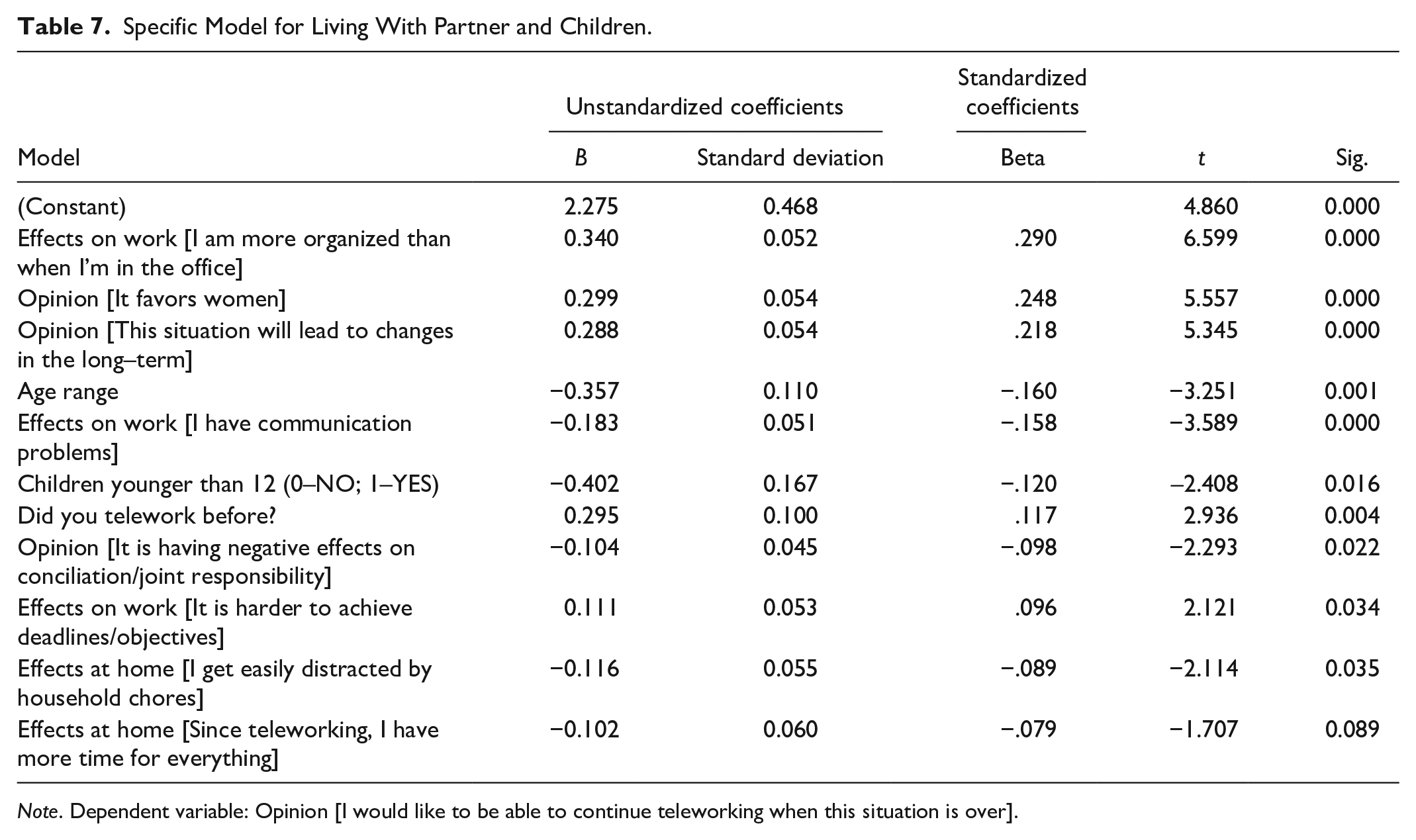
Specific Model for Living With Partner and Children.
Note. Dependent variable: Opinion [I would like to be able to continue teleworking when this situation is over].
Specific Model for Living With or Without a Partner, But Without Children.

Note. Dependent variable: Opinion [I would like to be able to continue teleworking when this situation is over].
In terms of predictive capability, the variable with the greatest ability to infer the civil servant’s intention to want to continue teleworking is whether they believe it helps them to be better organized, with there being a direct correlation, which is followed by the person’s opinion that it favors women more and the belief that the time spent working remotely during the state of alarm will lead to changes in the long-term. These are all direct correlations.
Certain inverse relationships stand out. In particular, the belief that working remotely means having more time for other things is a surprising result. Furthermore, the fact that technological resources that are used for teleworking are shared by other members of the household.
Another surprising result is the positive correlation between believing that it is harder to achieve deadlines/objectives and wanting to continue working remotely.
Age stands out as a factor that has a negative relationship with wanting to continue teleworking; the higher the age, the lower the intention to continue teleworking. Furthermore, if there was previous experience with teleworking, there was a higher preference for wanting to continue.
The output order of the model’s non-predictor variables is presented in the corresponding appendix, with 11 variables not included. The first three are: occupying a managerial role, cutting back on working hours, and having problems organizing work time. At the opposite extreme, this being the variable that is close to remaining in the final predictive model, is the variable relating to the belief that it is easy to get distracted by household chores.
Specific Model for Living With Partner and Children
Similar to the general model, the model that is built is significant, obtaining a very similar adjusted R-squared value of .365. In this model, the sample size was 656. There are also 11 variables that have explanatory power over the dependent variable.
The variables that are predictive in this model, and not in the general model, are the opinion on being easily distracted at home and having children younger than 12. In both cases, these relationships are negative, with the latter being especially noteworthy. Having children younger than 12 years discourages people from wanting to continue teleworking.
The variables that are not included in this model (as they do not have predictive capability over the dependent variable) but are in the general model are the opinion on concentrating less on work and the fact that technological resources for telework are shared.
This model coincides with the general model in terms of the three variables with the greatest predictive capability over the dependent variable: whether they believe it helps them to be better organized, people’s opinion that it favors women more, and the belief that the time spent teleworking during the state of alarm will lead to long-term changes. The authors find it interesting to highlight two relationships that might have been unexpected regarding wanting to continue teleworking: (1) thinking that it makes it harder to achieve deadlines; and (2) thinking that they have less time for everything.
The model’s non-predictor variables are presented in the corresponding appendix, with 20 variables that are no longer included. The first three that emerge are the job level, being a woman, and having a managerial role. At the opposite extreme, the two variables that are close to remaining in the final predictive model are the variables that consider whether the person has to share the technological resources required for telework amongst the household and the one that considers whether the person receives outside support within the home. In this last case, the relationship is negative, indicating that having such support leads to less interest in teleworking.
Specific Model for Living With or Without a Partner, But Without Children
In this case, the model is also significant, with an adjusted R-squared value as high as 0.477. In this model, the sample size was 335. Nine variables have predictive capabilities.
In terms of the general model, three variables are not included (as they do not have predictive capability over the dependent variable). These are: age range, the opinion of having more time for everything, and the feeling that it is harder to achieve deadlines/objectives. In the first case, this is attributable to the greater homogeneity of age (younger) among this group. This model also includes a new variable compared to those included in the general model: the feeling that the mental burden of the new domestic structure falls exclusively on that person. As a result, this relationship is negative, and as long as the person believes that they share the mental burden of the new domestic structure, they will have a greater interest in continuing to telework when the situation is over.
In the same way as the other previous models, there are the same three variables with the greatest predictive capability: whether they believe it helps them to be better organized, people’s opinion that it favors women more, and the belief that the time spent teleworking during the state of alarm will lead to long-term changes.
Finally, it is important to indicate that the model excluded 16 variables. The first three are the amount of time that domestic chores take, the age range, and occupy a managerial role. As was the case with the specific model for living with a partner and children, the last variable that is excluded from the model, and therefore the last one that remains, is receiving external help.
Discussion
This study shows the motivations and limitations of implementing telework among the workforce in the Spanish public sector. To examine the factors that affect it in greater detail, a split was made based on domestic settings, specifically: (1) General model, not considering domestic settings, (2) Specific model for living with a partner and children, and (3) Specific model for living with or without a partner, but without children.
In terms of the main catalysts, the three models are aligned such that this way of working enables people to be better organized at work. The profile of the respondents can probably be considered a determining factor: a greater level of knowledge and training that usually corresponds positively with discipline and self-control when it comes to organizing their own work, without penalizing the lack of specific planning. In contrast to the discipline that emanates from working in an office, Filardi et al. (2020) establish self-control, self-discipline, and organization of one’s own work as aspects that need to be considered in order for telework to bear fruit. This self-management of work should bring advantages, such as autonomy and flexibility (Baruch, 2001). In addition, the shared belief emerges that mandatory teleworking will promote changes in the long term. Filardi et al. (2020) show how a possible change in an organization’s structure as a result of implementing telework could be seen, a priori, as being negative. In this case, faced with a low starting base of people working remotely in the Spanish public sector, and being so disruptive compared to the previous way of working, this new initiative is perceived as a possibility for future change. Finally, an agreement in opinion regarding telework favoring women is presented. Women, who have a higher tendency to work part-time compared to men, have become protagonists for flexibility, which is seen as an advantage of teleworking (Goldin, 2014). The time that women save by not physically working away from home is spent on domestic chores and looking after children (Noonan & Glass, 2012; Offer & Scheneider, 2011), tasks which are typically associated with them. Women have found themselves balancing their professional lives, looking after elderly relatives or children, and managing their homes in the same space, for which they already had full responsibility, whether or not they worked away from home (Ryu & Kim, 2020).
Conversely, and shared across the three models, a blocker for wanting to telework is the possible difficulty with communication, something which several other studies have also highlighted (Baruch, 2001; Dos Santos Soares, 1995; Eom et al, 2016; Martínez-Sánchez et al., 2008). Isolation would explain the difficulty in maintaining the same level of communication as there would be a physical office. The second issue is the ability to maintain conciliation and joint responsibility at home. This is a conflict that has been addressed (Nohara et al., 2010), which on one hand is probably related to the convergence of work, personal, and domestic lives in the same space, something which does not occur when working somewhere away from the home. With regard to joint responsibility, Spanish women have suffered greater mental fatigue and more stress than men during the lockdown period in Spain, due to the excessive amount of work caused by having to look after children and dependents (Las Heras & Barraza, 2020). The belief that teleworking favors women contrasts with the high percentage of women in the survey. It also contrasts with the fact that it is predicted to have negative effects on work-life balance or mental workload. Both factors are made easier if the partner is sensitive to the situation or if they receive outside help.
Regarding the unique characteristics of each model, previous experience with teleworking was a catalyst in the general model. In terms of the factors that drive people to telework in the Spanish public sector, experience is a motivating factor; however, in this case, the application of this method has been scarce in Spain. 4.8% of the working population in Spain and 3.1% of the people who work in the public sector saw no change in their way of working as a result of the state of alarm that was declared on 14 March 2020. Telework remained the main way in which they carried out their paid work. They had been used to routines, habits, and resources to use, and they had chosen to do so voluntarily. The flexibility for organizing work provided by this approach is seen as a benefit (Baruch, 2001). In the model for living with a partner and children, there are two specific obstacles: having children younger than 12 and being easily distracted at home. The presence of young children at home can have an effect that can equally lead to domestic distractions (Mokhtarian &Salomon, 1994, 1996a, 1996b; Rastrollo, 2020). However, it highlights a few aspects to consider: (1) The presence of children has had the biggest impact on fathers’ work, despite the greater amount of time mothers spend looking after them. (2) The interferences at home which women typically suffer from more than men, caused by children or adult dependents (Las Heras & Barraza, 2020).
In the final model, living with or without a partner but without children, the belief that the mental burden of the new way of working falls exclusively on the person themselves, is highlighted as an additional blocker that is exclusive to this model. People without partners and children have seen their situation worsen, as they have no escape routes: everything is based at the same location and they do not interact with others, something which works in an office provides.
When examining the general model and comparing it to the one for living with a partner and children, being older, and the belief that it does not result in having more time also emerge as obstacles. In terms of age, in this case, there was a negative relationship. However, data from Eurostat (2) highlight that people aged between 50 and 64 make more use of telework (6.4%) compared to those aged between 25 and 49 (5%), or even the youngest group aged between 15 and 24 years (1.8%). (Boys, 2020), also states that the older workforce is among the most common users of this work method. A possible explanation for the resulting data which is not consistent with the reference literature, has two distinct focuses: (one hand, the lack of experience that has been accumulated makes it difficult to draw reliable conclusions, and on the other hand, the low usage levels of technological resources in the Spanish public sector. At an older age, there is greater resistance to using technological resources (this is probably a cultural factor), and therefore, the option of being in the office is preferred, as this provides support in the event of an incident.
When comparing the general model with the one for living with or without a partner and without children, sharing technological resources within the household emerges as an obstacle. The sudden emergence of telework has not allowed for the provision of adequate technical infrastructure, neither in terms of communication networks nor in terms of sufficient equipment. Both situations negatively impact a household with children, due to the need to have a device per person and a sufficient network to power the entire household. As a result, the lack of technological infrastructure (Nogueira & Patini, 2012), leads to not wanting to work remotely, as this is a major problem.
Conclusion
The Spanish public sector, as an agent handles communication and relationships with its citizens, and has for many years been implementing ways to streamline both processes. Certain types of processes have improved quality and efficiency by using chatbots or other types of digital resources. Telework, which has low levels of take-up among civil servants or administration staff in the public sector, represents a challenge in terms of overcoming certain cultural barriers and customs that have been around for many years.
This study provides an initial approach for the reality of teleworking in the Spanish public sector, seen from the point of view of the people who work in it. This overview addresses the state of telework in Spain prior to Covid-19 and how it has progressed following the onset of the pandemic.
The objective of this study was to determine the drivers and obstacles that are crucial for workers in the Spanish public sector to consider teleworking positively. The three variables with the greatest predictive capability, specifically, the freedom that telework brings in terms of being better organized, the fact that it helps women and the fact that the period of compulsory telework as a result of the pandemic will lead to changes in the long-term, suggest that telework brings greater confidence for working more autonomously and could ensure that women consider it to be a tool that enables them to juggle work, family, and personal life, which are all their responsibilities at home. Finally, although it is not a factor as such, it is important to highlight that telework has emerged as a clear alternative for society, based on the most practical example: it has been applied. The assumption that something will change in the future will make it possible to implement changes and ensure that these overcome variables that slow down any advances.
This study has shown a series of important conclusions: (1) The pandemic has catalyzed the public sector to rely on telework, and there is a perception that this change is for the long-term; (2) Telework seems to be in favor of women in particular; (3) Telework could have an impact regardless of the domestic settings, meaning that there is a negative impact in those with children under the age of 12 and/or other dependents, and is worse in situations where technological resources are shared; and (4) Age could have a negative influence on people in the later stages of their careers. It is therefore necessary to take steps to invest in equipment, provide training in information and communication technologies, and raise awareness in terms of balancing someone’s work, family, and personal life in order to counteract the negative impact of these variables.
This study has limitations in terms of the gender of the participants. The majority of respondents in the survey were women. Another limiting factor is that the costs associated with teleworking have not been addressed. This is explained by the unexpected nature of the situation. This factor is corrected by the legislation approved in September 2020 which will help to understand the opinions of people who have made use of telework. However, the results are not invalid as a result of this, as they show similar trends and behaviors to those that are observed in similar studies. Both open the doors to future studies that address, among other topics, the most efficient way of increasing the implementation of teleworking in the Spanish public sector or the type of roles in the public sector that are likely to be carried out by teleworking.
Supplemental Material
sj-docx-1-sgo-10.1177_21582440221079843 – Supplemental material for Teleworking in the Public Administration: An Analysis Based on Spanish Civil Servants’ Perspectives During the Pandemic
Supplemental material, sj-docx-1-sgo-10.1177_21582440221079843 for Teleworking in the Public Administration: An Analysis Based on Spanish Civil Servants’ Perspectives During the Pandemic by José M. Ortiz-Lozano, Pedro C. Martínez-Morán and Víctor L. de Nicolás in SAGE Open
Footnotes
Acknowledgements

Declaration of Conflicting Interests
The author(s) declared no potential conflicts of interest with respect to the research, authorship, and/or publication of this article.
Funding
The author(s) received no financial support for the research, authorship, and/or publication of this article.
Supplemental Material
Supplemental material for this article is available online.
References
Supplementary Material
Please find the following supplemental material available below.
For Open Access articles published under a Creative Commons License, all supplemental material carries the same license as the article it is associated with.
For non-Open Access articles published, all supplemental material carries a non-exclusive license, and permission requests for re-use of supplemental material or any part of supplemental material shall be sent directly to the copyright owner as specified in the copyright notice associated with the article.
