




Abstract
The professional growth of midwives, essential for optimizing midwifery leadership globally, can be enhanced through twinning collaborations. How twinning promotes growth is unclear. This case study explores how professional growth is affected by cultural differences between twins. We used a longitudinal qualitative design including data from open-ended questionnaires and focus groups. These data were analyzed using a content analysis. Our findings show that cultural differences were capable of both hindering and facilitating professional growth. Within the complex dynamics of twinning, professional growth was facilitated by twins’ preparedness to bridge cultural differences. Common goals positively influenced this process. Friction was more likely, and professional growth was hindered, when midwives were unprepared to bridge cultural differences. To optimize professional growth through twinning, we recommend a clear focus on common goals and consideration of the interaction between the length of a project and the extent of the cultural differences between twins.
Introduction
Although the global maternal mortality decreased by almost 44% between 1990 and 2015, each day more than 850 women die during pregnancy, childbirth, or soon after (Kuruvilla et al., 2016). In response to this problem, the World Health Organization (WHO) has launched strategies to implement appropriate care for women and their families that is neither “too little too late or too much too soon” (Miller et al., 2016; Mwaniki, 2016; WHO, 2015a, 2015b). These include the deployment of WHO guidelines on antenatal and intrapartum care, ensuring universal access to sexual and reproductive health-care services, and expanded attention on a positive birth experience for women (Kennedy et al., 2018; Renfrew, Homer et al., 2014; Renfrew, McFadden, et al., 2014; ten Hoope-Bender et al., 2014; WHO, 2018b). Trained, registered, and confident midwives, as defined by the International Confederation of Midwives (ICM), are a vital component of the effort to increase women’s positive pregnancy and birth experiences and reduce maternal and new-born mortality and morbidity (ICM et al., 2016; Renfrew, Homer et al., 2014; United Nations Population Fund [UNFPA], 2014; White Ribbon Alliance [WRA], 2019). As a predominantly female profession serving women, gender-based inequities for midwives persist worldwide (Coe, 2019; Homer et al., 2014; UNFPA, 2014; WRA, 2019). Both global and collective commitment to equitable treatment of midwives is required if midwives are to take the leading role that is envisioned for them (Filby et al., 2016; Mosedale, 2014). This can be achieved by legalizing midwifery, educating and registering midwives, addressing economic pay gaps, and encouraging midwives to unify their voice and take on leadership positions (Filby et al., 2016; UNFPA, 2019; Van Lerberghe et al., 2014; WHO et al., 2019).
One way to strengthen midwives’ leadership capacity is through twinning, a program known to enhance the professional growth of participating twins, thus enabling them to take leadership roles (ICM, 2014; Sandwell et al., 2018; WHO, 2018b). Twinning helps people to learn and transform by exploring the unknown and coming out of their comfort zone (Chang, 2010). In this article, we use the term professional growth to include personal growth which incorporates the ability to be impactful as a person involved in decision-making at local, regional, national, or global levels.
The formal definition of twinning is “a cross-cultural, reciprocal process where two groups of people work together to achieve joint goals” (Cadée et al., 2016). WHO (2018b) stimulates the implementation of twinning partnerships through the promotion of “Collaboration, co-development and sharing of both tacit and explicit knowledge.” The ICM (2014) promotes twinning because it encourages leadership skills among midwives through reciprocal learning. The number of twinning initiatives worldwide is rapidly increasing, including the Midwifery Associations of Tanzania and Canada (Sandwell et al., 2018), Japan and Mongolia (Japanese Midwives Association, 2018), the United Kingdom and Uganda (Kemp et al., 2018), the United Kingdom and Nepal (Ireland et al., 2015), the Netherlands and Sierra Leone (Cadée et al., 2013), the Netherlands and Iceland (midwives4mothers Charity, 2019b), and Ghana and Sierra Leone (midwives4mothers Charity, 2019a).
Common to all these projects is the dynamic of the interaction across two cultures. There is a lack of systematic exploration into this dynamic and how it influences professional growth. In this article, we investigate the dynamics of a twinning project with midwives from Morocco and the Netherlands. These midwives were supported while they worked in groups of 2–4 twin pairs on small-scale products. These products served two main purposes, first and foremost the joint products actively challenged twins to work collaboratively and placed them in a position to need to communicate cross-culturally. Second, the end-products aimed to improve midwifery care in each country.
Throughout the project, twins participated in workshops and took part in several exchange visits, where they stayed at each other’s homes and shared their work and private life. All twins attended the ICM Midwives Congress in Prague in 2014. Other contact was through phone, Skype, email, Facebook, and WhatsApp.
The aim of this study was to gain more insight into the dynamics of twinning between midwives from Morocco and the Netherlands, with specific attention to the impact of working cross-culturally on their professional growth.
Methods
This case study is based on longitudinal qualitative data collected between 2013 and 2017 from the 36 midwives participating in the Moroccan-Netherlands twinning project. Participating midwives identified themselves as “twins” and are referred to as such throughout this article.
Participants
Initially, 19 pairs of midwives were recruited from both midwife associations through email and individual selection. We selected the twins based on their various midwifery backgrounds to cover all the different positions midwives can take in their professional field. All participants worked or studied full-time in the field of midwifery. Twins were paired based on their midwifery focus-area, age, and experience: students to students, teachers to teachers, researchers to researchers, practicing midwives to practicing midwives, and so on. The presidents of both professional organizations were also twinned. Two Dutch twins were of Moroccan origin. All twins came from diverse geographical areas in both countries. All Moroccan twins had a good demand of French and Arabic with some English. All Dutch twins had a good demand of English and Dutch with some French. There were two tri-lingual midwife translators present during all workshops and exchange visits.
Data Collection and Analysis
To gain a deeper understanding, we collected survey and focus group data. We started with a baseline open-ended survey in 2013 to ascertain twins’ expectations and what they aimed to achieve. This baseline survey was completed either online or on paper at the end of the kick-off workshop which was held at the start of the project.
At mid-term in 2015 and end 2017, we conducted focus groups to give twins ample space to explore, discuss, and reflect on their experiences, progress and achievements. Because of the projects’ multi-cultural nature and language issues within the group, focus groups per country were chosen as the best way to explore experiences and sentiments in depth (Krueger & Casey, 2009). Focus groups took place in the twins’ country of residence. Twins were randomly divided into four even groups, two in Morocco and two in the Netherlands. The first and second author and, in the case of Morocco, a professional interpreter were present at all focus groups. We formulated the questioning route using the information from the project monitoring and evaluation and from the baseline questionnaire. All methods were aimed to give enough space to both positive and negative experiences. Examples of these questions during the focus groups were as follows: please tell me your personal stories; What did the project bring you?; What could you have done without?; What did you miss? and so on.
In Morocco, the focus groups were held in both French (for twins) and English (for researchers) in the presence of a professional interpreter who transcribed the recordings to English. In the Netherlands, the focus groups were held in Dutch, and the recordings were transcribed into Dutch and then simultaneously analyzed and translated into English. The data from the initial survey and the focus groups were analyzed by means of a thematic content analysis using the online tool Dedoose (Burla et al., 2008; Dedoose, 2016). We used a combination of predetermined codes based on the response to the open-ended questions of the baseline survey that included cultural exchange, midwifery skills, and equity, and emergent codes such as reciprocity, professional growth, and religion. These codes were exhaustive, independent, and mutually exclusive (Burla et al., 2008).
The first author coded the responses to the base-line survey first. Subsequently, she listened to the recordings, read and reread all the transcribed focus groups, and analyzed these making use of the same codes identified during the base-line survey and adding new emergent codes. The second author monitored and checked the coding process. It was not possible to identify individual twins from the recordings of the transcribed and translated focus groups; for this reason illustrative quotes are not identified with a participant number but only with their nationality, M for Moroccan and D for Dutch. Care was taken to give a broad reflection of the themes discussed. There is no reason to believe that the four twins that did not attend the focus groups did so specifically to “not voice” their views. We therefore assume that all views on the twinning project were represented.
Rigor and Reflectivity
We used the COnsolidated criteria for REporting Qualitative research (COREQ) Checklist for the reporting of this research (Tong et al., 2007). The project lead managed the twinning project and simultaneously compiled, gathered, and analyzed the research data from the surveys and focus groups. The research team considered the consequences of the double role of the project manager / first author. The advantage of being part of the project process was that this facilitated the organization of focus groups, and gave the first author familiarity with the project, its settings, and deeper insight into what was going on. There was no indication that this jeopardized mutual trust and open atmosphere during the focus groups. To counterbalance potential subjectivity in observation and analysis, the second author, who was not involved in the project in any way, was present at all the focus groups and provided a critical eye with more distance. The full research team took care to identify and debate any potential pitfalls of the double role. Discrepancies were discussed until consensus was reached.
Ethical Considerations
According to the rules governing research with human subjects in the Netherlands (https://english.ccmo.nl/), this research did not require ethical approval because of its non-invasive nature. Participating midwives were part of a twinning project and explicitly informed and asked for consent to use the data from all the surveys and focus groups at the onset of the project and again before these were performed. The twins were made aware that only quasi anonymity could be guaranteed because of the small size of the group. In Morocco, no medical ethical approval was required for this research because the participants were not medical patients. Permission was granted by the midwives themselves as well as by the board of the association of midwives. All participating midwives were members of the association.
Findings
Nineteen Dutch and 19 Moroccan participants, making 19 pairs, were recruited into the project. Respectively 16 and 19 completed the baseline open-ended survey. Personal reasons accounted for three midwives not to complete this survey, they did participate in the mid-term and end focus groups. One twinned couple dropped out after the first year because of an unbridgeable issue leaving 18 twin couples to complete the project and participate in the midterm and end term focus groups.
At mid-term, half of the twins had been on an exchange visit to their twin’s countries and all twins had attended the 2014 ICM Triennial Congress. The mid-term focus groups took place within 6 months of these activities. One Moroccan midwife was on maternity leave and three Dutch midwives indicated to have other priorities and chose not to attend. During the end focus groups one Dutch twin was on holiday, all the others participated.
Throughout the 4-year project period, all twins participated actively and appeared eager to share their experiences. The data revealed that many twins experienced hindrance to varying degrees from a language barrier. There were a few bilingual twins who had no language issues and some who were proud to have improved either their French or English.
Findings on the dynamics of twinning are described in two parts. The first presents the initial motivation and achievements as voiced by twins through time: at baseline (2013), midterm (2015), and the end of the project (2017). In the second part, we offer a wider picture, with specific attention for the role of cross-cultural collaboration on twins’ professional growth.
From Initial Motivation to Final Achievements
Initial Motivation—Baseline 2013
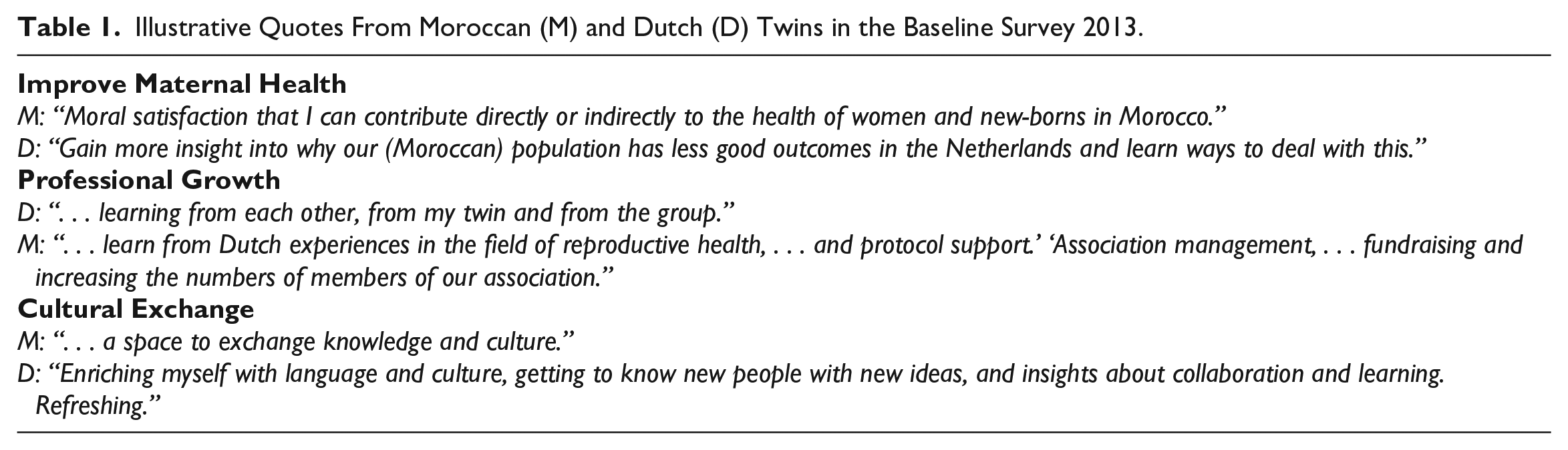
Three main themes—related to the motivation of the twins for participating in the project—emerged from the analysis of the base-line data. These were to improve maternal health, gain professional growth, and experience a cultural exchange.
Wanting to make a positive contribution to maternal health was shared with equal enthusiasm by all twins. Most Moroccan twins voiced wanting to contribute to the improvement of the health of Moroccan women, while many Dutch twins referred to improving the health of the Moroccan immigrant population in the Netherlands. Twins’ focus on professional growth, including their leadership and midwifery skills, was a clear motivator. Most Moroccan twins specifically linked professional growth to midwifery skills, protocol development, and strengthening their midwifery association. Fewer Dutch twins voiced the importance of professional growth for themselves at the onset of the project, nor did they mention their midwifery association. Wanting to experience each other’s cultural differences in the broadest sense during the exchange was described with excitement and curiosity by all (Table 1).
Illustrative Quotes From Moroccan (M) and Dutch (D) Twins in the Baseline Survey 2013.
Gaining Momentum—Midterm 2015
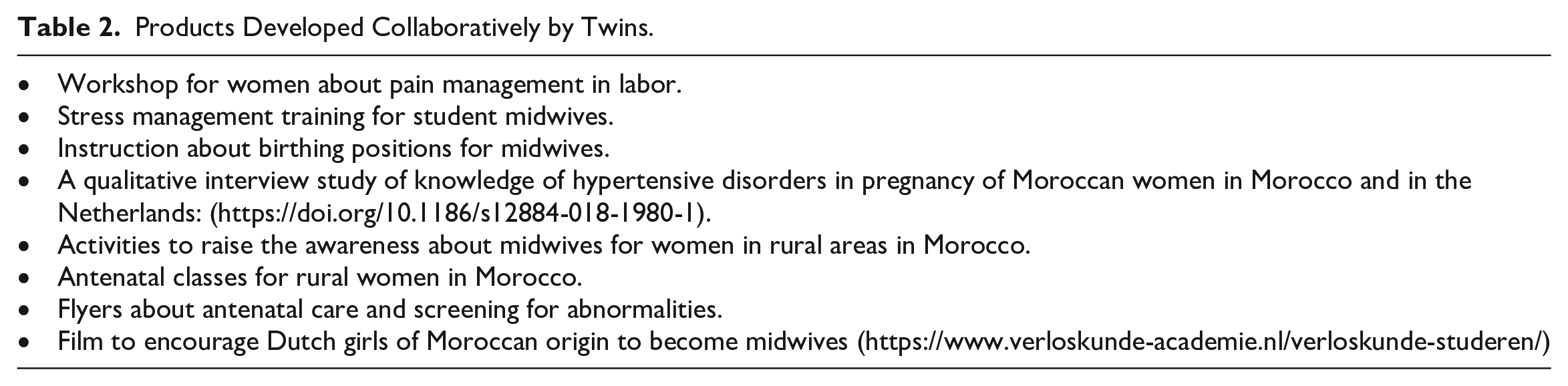
By midterm twins had gained more collaborative experience through working on their joint group products (see list, Table 2). Most twins gave at least 90% of the agreed time, an average of 10 hours a month, to their group project.
Products Developed Collaboratively by Twins.
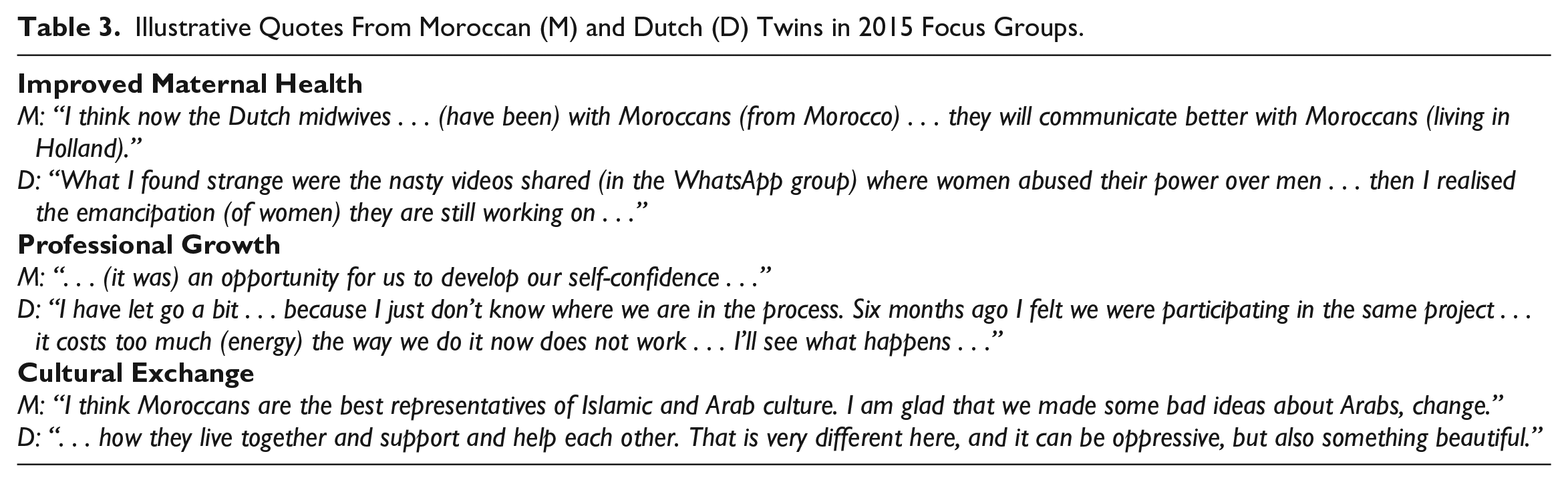
Twins had clearly become more consciousness of each other’s cultural contexts by midterm. Most twins voiced sentiments like being part of a “global midwifery family” and linked this directly to the 2014 ICM Triennial Midwifery Congress in Prague. This international gathering of more than 4,000 midwives was attended by all twins and they reported it to be deeply inspiring. All twins had communicated with each other electronically and half of the group had been on an exchange visit to their twins’ country. Improving maternal health remained a key motivator that united twins in their endeavors. However, their active collaboration did not translate into the same kinds of professional growth for all twins. Most Moroccan twins voiced a steady increase in their professional growth. Many Dutch twins did not refer to growth but instead to “letting go” of initial expectations and saw professional growth in their twins rather than in themselves. Maintaining the good reputation of Islam and Muslims was reported by several Moroccan twins (Table 3).
Illustrative Quotes From Moroccan (M) and Dutch (D) Twins in 2015 Focus Groups.
Reflections on Achievements—End 2017
All twins were satisfied, be it to different degrees, with the outcomes of the project. They were specifically pleased with the midwifery products described in Table 2, which were exhibited both in Morocco and in the Netherlands. The Moroccan twins were satisfied with their professional growth, reporting a steady increase in their leadership capacity. With a few exceptions, the tone among Dutch twins was more negatively critical, some said that twinning had not influenced their growth positively. Moroccan twins expressed pride in their own culture and the opportunity to gain international visibility. For their part, some Dutch twins became more critical of Moroccan culture, while others remained curious (Table 4).
Illustrative Quotes From Moroccan (M) and Dutch (D) Twins in 2017 Focus Groups.

A few twins mentioned the importance of having gained a friend. By the end of the project most Dutch twins experienced the relationship as collegial, whereas most Moroccan twins spoke of the sisterly aspect of their relationship using terms like warmth and love. Here too, exceptions existed. A few Dutch twins mentioned their love for their twin and a few Moroccan twins said to have no inclination to meet their Dutch twin again. When asked if twins would want to be part of the project again, including facing the challenges, both groups became similarly animated and emotional at the thought of missing out on the experience they had shared, seemingly forgetting their earlier mentioned reservations.
The Wider Picture
During the analysis of the midterm and final focus groups, two subthemes emerged under the theme cultural exchange, giving additional insight into the role of cross-cultural collaboration and its influence on the professional growth of the twins. Both themes relate to the differences in culture and the responses those differences engendered. The first theme centers on how the differences in culture afforded an opportunity for professional growth. The responses to these cultural differences were not uniformly positive. A second theme found in our data were accounts of irritation and unresolved differences.
While the idea of a cultural exchange was a motivator for most twins to take part in the project, there was no mention of the possible positive and negative dimensions of working across cultures during the baseline in 2013. Twins showed no awareness of the roles that cultural differences might play in their collaboration.
By 2015, this had changed, with all twins acknowledging cultural differences. Most twins describe these cultural differences as a worthwhile challenge that could potentially facilitate their professional growth. For some Dutch twins, bridging cultural difference was more of a concern, a problem caused by the “other” culture, not their own.
During the midterm focus groups in 2015, Dutch midwives were more likely to mention the negative consequences of cultural differences, expressing irritation and using evasive language during discussions of sensitive issues (observations of first and second author). A Moroccan twin mentioned the seeming inhospitality of a Dutch twin and Dutch twins pointed to the lack of transparency and hierarchical behavior within the group of Moroccan twins. When asked to elaborate both Dutch and Moroccan twins agreed that Moroccan culture was more focussed on the community and the Dutch more on the individual (Table 5).
Illustrative Quotes From Moroccan (M) and Dutch (D) Twins on Cultural Differences in Two Subthemes.

By 2017, the tone among Dutch Twins became more pessimistic to the extent that the adverse consequences of cultural difference emerged as the dominant theme, specifically in one focus group characterized by negativity. A few Dutch twins contacted the first author after this focus group to express their disappointment with this negativity. They had felt unable to mention this during the focus group itself.
Concerns about hierarchy became more prominent among Dutch twins and focussed more on Moroccan society in general. Some of the Dutch twins said that Moroccan twins did not speak their minds openly because of group pressure, going as far as labeling this as dishonesty. Within the Moroccan focus groups, the negative aspects of cultural difference was mentioned a few times, but did not dominate the discussions. Instead Moroccan twins saw these sorts of problems as the inability of individual twins to accept and trust each other.
A few twins considered a lack of equity and reciprocity between them demotivating. Several Dutch twins voiced that they gave more than they received during the project while Moroccan twins voiced concerns about equitable support for them due to reduced capacity on the Moroccan side (Table 5, 2017).
Overall, a noticeable change emerged over 4 years among twins, but this change appeared to be moving in opposite directions. At the onset twins did not mention cultural differences as an item. By 2015 most Moroccan twins noticed cultural differences, saying that some Dutch twins were less tolerant than Moroccan twins, and by 2017, they reported a few negative results of cultural differences, but associated this with individual behavior. Most Moroccan twins were satisfied that the results of the project matched most of their expectations and they reported a steady increase in their professional growth. A few Moroccan twins did disengage from active participation in the project out of personal frustration, and they reported not having experienced professional growth.
For many Dutch twins, a positive view of cultural differences, expressed at mid-term, transformed to a more negative view by 2017, with many indicating that their professional growth had remained unchanged. Quite a few Dutch twins questioned the satisfaction of Moroccan twins about their achievements, labeling it as nothing more than socially acceptable behavior. Some Dutch twins were satisfied with their achievements, even if it did not always match their expectations. These same twins also voiced having experienced professional growth.
Discussion
This study of a twinning project between 18 pairs of Moroccan and Dutch midwives reveals the complex dynamics that make up twinning. The data demonstrate that the experiences of twins changed over time and was positively influenced by sharing common goals. Had the findings been solely based on focus groups at the end of the project, these changing dynamics would not have become apparent. By the end of the project it became clear that cultural differences were capable of both hindering and facilitating the professional growth of twins.
Reflecting on these findings, we make three noteworthy observations after which we will discuss the place of culture in the dynamics of twinning.
Three Observations
First, we observed that twins agreed that Moroccan culture was more focussed on community and the Dutch more on the individual. This has been described in the literature as a difference between individualist and collectivist cultures, with the interest of the individual prevalent in the first, and the interest of the group dominant in the other (Hofstede et al., 2010). In our study, this was reflected in the concerns the Dutch twins had about Moroccan twins being “collectivistic” and therefore not openly speaking their minds, and reporting professional growth when there was none, to protect the image of the group.
Ironically, during the focus groups, the individual Moroccan twins appeared free to voice diverging views while some of the Dutch twins reported feeling uneasy about bringing up negative messaging during their own focus group. Thus, it appears that group pressure also affected Dutch twins, suggesting that the work of the Hofstedes, referred to above, cannot fully account for the variation and complexity reflected in our data.
The tendency to label the satisfaction of Moroccans as a desire to be socially acceptable and to ascribe honesty and transparency to the more individualistic culture of the Dutch is a recognized phenomenon in collaborations between people of different cultures and can best be explained as judgments based on own cultural values (Meyer, 2016).
Our second observation is a response to the Dutch twins’ report that they experienced little professional growth. Other studies show that the “Northern side” in international collaborations generally learns more than is voiced initially (Carbone et al., 2017). For example, it seems Dutch twins failed to see their learning to “let go” as professional growth. “Letting go” can be seen as an important life lesson, an aspect of both personal and professional growth.
Finally, the changing global context likely had an influence on the twins. Most importantly, the growing anti-Islamic sentiments during the time-span of the project affected the relationship between members of both groups. This was most visible in the pride in, and protection of, their religion and culture on the part of the Moroccans and the dismay over the lack of freedom of the Moroccan twins that was expressed by the Dutch participants.
The Place of Culture in the Dynamics of Twinning
As we have seen, the cultural context was referred to by all twins in one way or another and was given much attention during the twinning project workshops. When defining culture, Schein (2010) describes it as the agreed upon behaviors within a group that are passed on to the next generation. His approach to culture helps explain, for example, why one twin may be less confrontational or the other more direct in their feedback, which allows us to contextualize certain comments by twins (Meyer, 2016). An understanding of the way the culture directs behavior is important for successful twinning (Cadée et al., 2018; Cadée et al., 2016). Adler and Gundersen (2007) are critical about any attempt to define culture because, they believe, the effort results in overgeneralizations that are meaningless when we refer to individuals within a culture. We saw this in our study in the individual variation present among twins, regardless of their cultural background.
Following from Schein’s perspectives on culture, Hofstede et al. (2010) developed tools to understand culture to minimize its disruption on multinational corporations. Their acculturation curve helps to explain the acculturation process of immigrants and, in our case, it offers insight into the process we witnessed. We saw the initial general curiosity and enthusiasm of twins in 2013 (Euphoria stage) turn into apprehension and concern in 2015 (culture shock stage) and end in 2017 in either friction (a), bridging a culture-gap (b) adapting as a native (c) (stable state stage; Figure 1).

The acculturation curve P385 (Hofstede et al., 2010).
Hofstede’s curve gives some insight into twins’ changing experience through time; however, it does not account for the individual variations as pointed out by Adler and Gundersen (2007). Eriksen (2017) suggests that culture can also be used unconsciously to disguise personal values and limitations. This may have occurred during this project when generalizations were made, for example, in the case of individualist or collectivist culture that were then used to support value judgments regarding honesty or freedom of speech.
Trying to understand the group dynamics using Hofstede’s five dimensions of cultural difference and the acculturation curve provides a basic understanding of what twins experienced, but its compartmentalization is also dangerous because it is not the complete story. By equating culture with nationality, the complexity of national and cultural diversity is ignored (Baskerville, 2003; McSweeney, 2002). Signorini et al. take Hofstede’s approach to task for its inability to deal with “the innate fuzziness of culture” and for its focus on differences instead of commonalities (Signorini et al., 2009, p. 8). In line with this, our data reveal the flexible and dynamic nature of culture. Twins experience success, not by focussing on their differences, but by focussing on similarities and joint goals.
Two subthemes, that emerged under the theme cultural exchange during the analysis of the midterm and final focus groups, are well-known phenomenon described in the business literature. The first subtheme that centers on how the differences in culture afforded an opportunity for professional growth is commonly described as a culture-gap and is defined as a cultural difference that can be bridged by people being prepared to work on this together (European Community [EC], 1999; Hofstede et al., 2010; Jiang et al., 2012; Meyer, 2016). The second subtheme, which describes differences that remained irritating and unresolved is described as cultural friction, defined as a cultural difference that cannot be bridged or can even cause conflict. The Times Lexicon refers to cultural friction as “the extent to which two or more entities, such as organisations, units, teams, group, and individuals, from different countries culturally resist, think or act in opposition” (Financial Times Lexicon, 2019). In addition to this, Sam and Berry (2010) shows that there is a correlation between how well people bridge a cultural gap and their ability to adapt in general. It is therefore likely that the personal preparedness of twins to accept cultural differences also facilitated their professional growth (Sam & Berry, 2010).
The complex dynamics of twinning are clearly reflected in the data. The time aspect, the cultural context, and the personal characteristics of twins are only some of the many interacting and continually changing factors, making the direction of cause and effect difficult to distinguish. For example, is cultural friction caused by a large culture-gap between twins or by the unpreparedness of twins to bridge this culture-gap? Does cultural friction hinder professional growth or does the lack of professional growth cause cultural friction? Our data expose the complex dynamics of twinning, but is not able to give us a clear answer to these questions. Being aware of the many ways culture shapes, and is used by participants in, cross cultural interactions underscores these complex dynamics.
Conclusion and Recommendations
After 4 years, the expectations of the twins were partially fulfilled with a noticeable difference between the Dutch twins who reported less, and Moroccan twins who reported more professional growth. This growth included their leadership capacity and agency to strengthening their midwifery association and thereby contribute positively to midwifery care. The data indicate that professional growth is hindered by cultural friction and may also be influenced by twins being either prepared or unprepared to bridge a culture gap. A focus on common (midwifery) goals, an adaptable personality, and a reciprocal equitable environment facilitates the preparedness of twins to navigate the culture-gap. Added to this, the dynamics of twinning is impacted by a complex combination of personal values influenced by changing contexts and by twins confusing their personal values for cultural norms. All this said, twinning appears to be worthwhile.
We therefore recommend that initiators of twinning projects may optimize the potential professional growth of twins by being aware of the dynamics through time, matching twins from contexts with a graspable culture-gap, to encourage twins to work on common goals (in this case the midwifery products that contributed to maternal health), and to take into account the preparedness of twins to bridge a culture-gap during their recruitment and throughout the project.
The effect of the intense interaction between individual twins on their own professional growth and the overall complex dynamics of twinning is worth investigating further.
Footnotes
Acknowledgements
Twinning enhances professional growth. The authors would like to thank all the midwife twins who shared their experiences for the benefit of this study.
Declaration of Conflicting Interests
The author(s) declared no potential conflicts of interest with respect to the research, authorship, and/or publication of this article.
Funding
The author(s) received no financial support for the research, authorship, and/or publication of this article.
