



Abstract
Numerous studies recently have explored how personality traits, risk attitudes and gender interact, with ambiguous results for different environmental and cultural contexts. To contribute to the existing literature, this study tests the relationship of individual risk attitudes with personality traits, and other variables, in the Czech Republic using the validated Czech version of the Big Five Inventory instrument. The results of an ordinal logistic regression show that risk aversion relates positively to neuroticism and negatively to extraversion and openness to experience. Furthermore, compared with women, men tend to be less risk averse. This study contributes to a better understanding of the influence of personality traits and demographic factors on risk attitude in the context of a culture with high uncertainty avoidance.
Keywords
Introduction
Risk attitudes generally vary from risk seeking, through risk neutral, to risk averse (Hillson & Murray-Webster, 2007), suggesting that risk seeking and risk aversion are perceived as the more and less risky options, respectively (Weber & Milliman, 1997). Standard economic theories pertaining to this field of study consider risk aversion as an inherent human attitude that depends primarily on the shape that people’s utility functions take. Psychological theory further asserts that people’s financial decisions under uncertainty differ according to their motives for taking economic risks. Influences on risky behavior tend to stem from individual-level factors, with personality as a powerful influence (Nicholson et al., 2005). For example, using a vast, international (53 countries) survey, Rieger et al. (2015) establish cross-national differences in the degree of risk aversion, as well as the influence of economic conditions and cultural factors. Similarly, Liu et al. (2016) indicate that personality traits and risk preferences reflect the influence of social, cultural and economic environments. We thus reasonably anticipate that risk relationships vary across distinct locations and cultures.
There are numerous studies on the relationship between personality traits and risk preference worldwide; however, these studies were conducted mainly in the context of Western, well-developed countries with relatively low uncertainty avoidance, such as the United Kingdom (e.g., Booth et al., 2014; Nicholson et al., 2005), the United States (e.g., Jetter & Walker, 2018; Weller & Tikir, 2011) and Canada (Ashton et al., 2019). Recently, there have been studies in China and Hong-Kong (e.g., Lam, 2015; Liu et al., 2016) that also tend to score low on uncertainty avoidance (Hofstede et al., 2010). On the other hand, there is a lack of similar studies conducted in Central and Eastern European countries, for which a relatively high level of stress in the face of an unknown future is typical (Kolman et al., 2003). A recent study by Çera et al. (2020) also highlighted the effect of culture, including uncertainty avoidance, on the linkages associated with risk tolerance.
Moreover, most of the previous studies on risk attitudes in relation to personality traits and other demographic factors have been conducted in high-income countries. Our study, however, allows us to look at risk attitude in a country with a lower income level than the United States or Western Europe. As already pointed out by Cicchetti and Dubin (1994), because people with a higher income are better able to insure themselves against possible losses, they are more willing to undertake riskier decisions. Hence, if we take into account the relatively high uncertainty avoidance (score of 74) alongside a relatively low income level in the Czech Republic, a generally higher level of risk avoidance can be expected, which in turn can also modify the risk attitude–personality traits-gender nexus.
Crucial to our study are personality assessments. Probably the most frequently used approach, the Big Five Inventory, effectively informs and is associated with risk-taking behaviors (e.g., Becker et al., 2012; Lönnqvist et al., 2015; Nicholson et al., 2005). These five personality traits, presented as conventional descriptors of personality, include openness to experience, conscientiousness, extraversion, agreeableness and neuroticism (often abbreviated to OCEAN or CANOE). There appears to be no study using the Big Five Inventory, narcissism and gender as independent variables to explain risk attitudes, although there are studies using HEXACO (a six-trait personality instrument) in this way. The underlying logic for using this particular combination in this study is that in the Big Five Inventory there is no H (honesty/humility), which would be significantly and negatively correlated with narcissism, therefore it is more likely that narcissism may be significant even in a multi-variate test. Compared to prior studies, our research also controls for accommodation arrangement and settlement size as additional possible determinants of differences in risk attitudes. Accommodation was included to test Weber and Hsee’s (1998) “cushion hypothesis” on a microeconomic level. It is reasonable to expect that respondents who still live with their parents have a different risk attitude than those living alone. In the Czech Republic, there is a popular belief that people in Prague are more risk averse. This study gave an opportunity to test this empirically.
Hence, our study aims to contribute to the existing literature by examining the relationship between individual risk attitudes and personality traits, including narcissism, as well as with other demographic variables, in the context of the Czech Republic.
The next section of this paper contains a review of the literature on the determinants of risk attitude, dealing separately with personality traits and demographic factors. Section 3 introduces the data and methodology, Section 4 presents the empirical results and a detailed discussion and Section 5 ends the paper with a conclusion.
Literature Review
The concept of risk propensity has been subject to investigation at theoretical, methodological and empirical levels in numerous studies. Weber et al. (2002) find that the degree of risk taking is highly domain specific but that perceived risk attitudes are generally consistent across domains. They also establish how personality variables (e.g., sensation seeking, ambiguity tolerance) affect risk perceptions and risk taking but find no impact on attitudes toward perceived risk. Subsequently, Nicholson et al. (2005) suggest that risk taking actually has a dual nature, and its general and specific forms exhibit distinct, strong, personality-related underpinnings.
General risk has been studied more deeply by Dohmen et al. (2011), who indicate that a qualitative, relatively simple survey is able to provide a pertinent measure of risk attitudes across different contexts. Their experiment confirms the behavioral validity of this measure. Lönnqvist et al. (2015) empirically compare the questionnaire proposed by Dohmen et al. (2011) against a lottery choice task. The questionnaire not only demonstrates the expected correlations with a Big Five personality measure but it also correlates with risk-taking behavior in reality. Therefore, we use the questionnaire with general risk questions for our study.
The following review presents findings on the relations of risk attitudes with personality and with demographic factors, especially gender, separately. We focus on studies conducted primarily with samples of university students to achieve comparability, noting the systematic changes in risk preferences that occur over people’s lifetimes (see Schildberg-Hörisch, 2018).
Personality and Risk Attitude
The relation between economic risk aversion and personality type is discussed in detail by Filbeck et al. (2005) regarding investment-oriented decisions. They define personality types according to the Myers-Briggs Type Indicator (MBTI) and use a moments approach to determine each investor’s risk tolerance, as is predicted by expected utility theory (EUT). They find that ex ante tolerance for variance and skew reflect and relate to MBTI measures. Specifically, in finding that personality type can explain individual ex ante EUT risk tolerance, they predict a non-linear relationship of personality type with individual ex ante EUT risk tolerance.
Li and Liu (2008) also use the MBTI to conduct an experiment with 200 first-year undergraduates at Nanyang Technological University. Their results reveal that higher intuition/extraversion and lower judging scores signal consistent risk-seeking behaviors. In contrast, when sensing/judging scores are higher, people tend to exhibit consistent risk aversion. However, these authors assert that solely studying personality cannot establish effective predictions of risk preferences.
Another study with the MBTI offers similar results: respondents (333 business school students) with higher scores on the introversion, feeling, sensing, and judging dimensions also express more risk aversion (Desmoulins-Lebeault et al., 2018). The sensing and feeling effects appear non-linear. These authors suggest a parallel between the identified links of the MBTI dimensions with risk aversion and the links previously established between the Big Five and risk aversion, as has been established in studies using questionnaires and lotteries.
However, comparatively less literature offers empirical evidence that personality can be measured by the MBTI. Therefore, we rely on studies that adopt the Big Five measure for our empirical foundation. This choice is further justified by the partial correlations and overlap between the Big Five and the MBTI in terms of their dimensions (Furnham et al., 2003).
One of the most cited studies in this regard is the one by Nicholson et al. (2005), who investigated personality and domain-specific risk taking among students and executives who had enrolled in graduate courses, as well as company-specific training programs. They found an evident Big Five pattern pertaining to the respondents’ overall risk propensity. This pattern features high extraversion and openness, in combination with low levels of neuroticism, agreeableness, and conscientiousness. Extraversion can be described as openness to social experience (Sneed et al., 1998), whereas openness to experience covers perceptual, cognitive and affective experiences (Soto & John, 2017). Extra, as well as being open to (cognitive) experience, typically seeking adventure, and creativity and tending to be more risk tolerant. On the other hand, neurotic people are more pessimistic and anxious, as well as conscientious, diligent and careful, and accept less risk. This also seems to be the case for agreeableness, where people are usually described as warm, tactful and friendly, in association with efforts to build harmonious interpersonal relationships and team spirit, which can be an obstacle in making difficult or risky decisions.
Subsequent studies, to a greater or lesser extent, have in principle confirmed these relationships. Becker et al. (2012) use laboratory data to study pertinent economic preferences (e.g., time, risk, social) and their connections to conventional personality measures, including the Big Five. A representative, incentivized sample of 489 university students in Germany indicates, however, only a weak association of economic preferences with personality traits. Liu et al. (2016) similarly test the relationship between personality traits and investment risk preferences with 600 university students in Taiwan and Hong Kong. Their questionnaire survey includes the Big Five personality traits, nine items to measure different kinds of risks (e.g., career, financial, safety, social) and people’s orientations toward them, and demographics. According to their findings, people’s personality traits influence their investment-related risk preferences, such that if investors exhibit outgoing, prudential personality traits, they accept more investment risk. Czerwonka (2019), based on her research conducted in two different cultural regions, namely Poland and the USA, concludes that high extraversion and low conscientiousness are predictors of overall risk-taking behavior.
Relative to the traditional Big Five model, the HEXACO personality framework (Lee & Ashton, 2004) introduces a sixth factor—honesty/humility. According to Weller and Tikir (2011), adding this dimension has practical advantages. In a study with 233 undergraduate US university students, some personality dimensions were found to exert overarching influences on risk behavior; some dimensions are unrelated to such behaviors (notably, extraversion has no significant link to any element in the risk model) and others affect risk taking only in specific domains. A review of three HEXACO personality dimensions (honesty/humility, agreeableness, emotionality) is available in Ashton et al. (2014); furthermore, Ashton et al. (2019) provide a comparative analysis of the next version of the Big Five Inventory (BFI-2) relative to a 60-item version of the HEXACO Personality Inventory-Revised (HEXACO-60). Canadian undergraduate students (N = 700) provided self-reports indicating generally close links between these conceptually similar scales. A Czech translation of the HEXACO exists (see hexaco.org) but the translator’s name is not provided, and to the best of our knowledge the HEXACO personality framework has not been validated in a Czech context yet.
With special regard to narcissism, as it seems to be profoundly intertwined with impulsivity (e.g., Crysel et al., 2013; Jones & Paulhus, 2011), the prevailing literature shows the link between narcissism and risk-taking behavior (e.g., Leder et al., 2020). A potential reasoning for such behavior can be found in Foster et al. (2009), who explain that narcissists perceive greater benefits and at the same time less negative consequences from the risks. Evaluation of the influence of narcissism in the context of other personality traits was carried out particularly in connection with the HEXACO personality dimensions, where a correlation between the honesty/humility dimension and narcissism was demonstrated (e.g., Ashton et al., 2014; Hodson et al., 2018). However, according to the best knowledge of the authors, there are few previous studies that would directly and simultaneously address the issue of the influence of narcissism and other personality traits captured by the Big Five Inventory on risk taking of university students.
To sum up, based on the existing body of knowledge and the majority of previous empirical findings, it seems that the personality taxonomy interacts with risk attitudes and explains the differences in risk taking; however, the significance, direction and strengths of particular relations in this regard have not yet reached a general empirical consensus.
Demographic Factors and Risk Attitude
Many authors (e.g., Nicholson et al., 2005) conclude that risk propensity has clear links with gender. Borghans et al. (2009) demonstrate clear gender differences in risk aversion in an experiment with 347 Dutch high-school students. Their findings indicate that women tend to be more risk averse than men. Over an initial range of risk, women do not require further compensation when they encounter ambiguity but men demand such compensation. As the levels of ambiguity rise, however, women and men express similar marginal distaste for the increased ambiguity. Beyond gender, psychological variables also evoke interpersonal variations in risk aversion.
Charness and Gneezy (2012) aggregate data across 15 sets of experiments that adopt the same investment game. In testing the robustness of the findings across these studies, they confirm consistently that women invest less. They use this evidence to posit that women are more risk averse in financial settings than men. However, they are careful not to assert that women are more risk averse than men in all settings.
More dynamic views on this issue come from Booth et al. (2014), who conducted controlled experiments with first-year UK college students, randomly assigned to three versions of weekly classes: only men, only women or coeducational. Initially, the female students indicated a lower likelihood of making risky choices compared with the male students. However, 8 weeks into the courses, the women in the single-gender class became significantly more likely to engage with a lottery relative to women in the coeducational course. Thus, behavioral differences in responses to uncertainty, according to gender, could result at least partly from social learning—which can be modified by environmental designs—instead of from inherent gender traits alone.
Despite substantial empirical evidence that women generally are more risk averse than men (e.g., Croson & Gneezy, 2009), Lönnqvist et al. (2015) find no such evidence in relation to either lottery task choices or responses to risk questionnaires. Similarly, Lam’s (2015) questionnaire-based research with a sample of 100 male and 100 female Chinese university students indicates no gender difference in the level of risk aversion, although men appear to react more to increased risk premiums, in that they prefer options that promise higher expected values.
Filippin and Crosetto (2016) reconsider the conventional wisdom that women are more risk averse through a survey of prior experimental literature. They determine that both the magnitude and the significance of gender differences are actually specific to the task and/or the situation. Jetter and Walker (2018) also test for how gender might influence performance and risk taking in contests. When they are competing with men, women appear to be more aggressive and (marginally) more competitive, as well as taking on more risk.
However, Croson and Gneezy (2009) point out that there is a publication bias in favor of studies highlighting gender differences compared to those that do not, and they state that gender differences in risk taking may differ by ethnic group.
With regard to age, there is relatively strong empirical evidence for a lowering of the willingness to take risks while growing, especially in the young (Paulsen et al., 2011); however, this trend is less pronounced at older age (Dohmen et al., 2017). Age is also identified as one of the main predictors of risk aversion in the study by Twumasi Baffour et al. (2019). In contrast, no significant age trend regarding the risk preferences of 10 to 18-year-olds was detected by Sutter et al. (2013); similarly, Nosita et al. (2020) found age to be insignificant in explaining risk tolerance.
Several studies have also addressed other demographic and social factors affecting risk attitude. In the Swedish context, Irandoust (2017) found that factors such as level of education, income, financial stability and literacy, as well as marital status and size of family, are important determinants of the willingness to take financial risk. Despite some contradictory indications (e.g., Grable, 2000), the prevailing findings link marital status to greater responsibility, which in turn reduces risk tolerance (Nosita et al., 2020). The same is true for the number of family dependents (Irandoust, 2017). Thus, couples with children are less willing to take a risk compared to their childless counterparts (Chaulk et al., 2003).
One of the few studies directly addressing the issue of the impact of the nature of settlement on risk aversion is a study by Tavor and Garyn-Tal (2016), who identified significant differences between big city dwellers and those living in agricultural communities or small cities. In addition, they concluded that aversion to risk is situation-specific.
In summary, despite widespread interest in understanding risk behaviors, we lack any consensus regarding the strength and direction of relationships between risk behaviors on the one hand and personality traits and other factors such as gender on the other hand. Moreover, we know of no studies that focus on Czech university students’ general risk-taking attitudes and relevant determinants, despite the existence of validated Czech versions of the Big Five Inventory.
Based on the mentioned studies, we hypothesize that there is a relationship between personality traits and risk attitude. However, with regard to different cultural contexts, especially the relatively high level of uncertainty avoidance in the Czech Republic, we assume that the magnitude and strength of the relationship of particular descriptors of personality to risk attitude will differ from findings detected in cultures with low uncertainty avoidance. At the same time, we hypothesize that there is a relationship between demographic factors and risk attitude. In particular, in line with previous prevailing empirical considerations, we assume that risk aversion tends to be higher in the case of older people and women, whereas the trend decreases with the size of living arrangement and settlement.
Data and Methodology
Attitudes toward risk, from a broader point of view, can be measured with experiments or self-reported questionnaires. For our study, we used an online questionnaire via SurveyXact and collected data between December 2016 and January 2017. Majority of respondents filled in the questionnaire during a lecture or an exercise, that is, in a serious environment. Additionally, there was enough time given, that is, there was no reason for students to hurry. Therefore, collected data should be at least as reliable as other convenience samples based on university student populations. The respondents were 264 university students from the Czech Republic (who can be described as a homogeneous group of Caucasians) with an average age of 20 years: 117 men and 147 women. With regard to accommodation, 75 lived in a dormitory, 100 lived with their parents, 33 shared an apartment and 48 lived alone or as a couple. Considering their settlement of origin, 34 came from a village of up to 500 inhabitants, 53 from a city of up to 10,000 inhabitants, 46 from a city with up to 50,000 inhabitants, 40 from a city that was a county center and 83 from Prague. Eight students did not answer the risk attitude question, so the effective sample size is 256, which is similar to prior empirical works dealing with similar research questions (e.g., Borghans et al., 2009; Desmoulins-Lebeault et al., 2018; Li & Liu, 2008; Weller & Tikir, 2011).
Considering the growing support for treating risk attitude as a domain-general disposition (Zhang et al., 2019)—such that people’s general risk appetite offers useful predictions of various real-world outcomes (Highhouse et al., 2017)—we adopt this general approach in our study. Inspired by general risk questions validated by Dohmen et al. (2011), we measure attitudes toward risk using a scale adapted from Donthu and Gilliland (1996), with risk seeking coded as 1, risk neutrality as 2, and risk aversion as 3.
The measure of personality traits relied on Rammstedt and John’s (2007) BFI-10. This version of the Big Five Inventory, a shortened version of the one originally developed by John and Srivastava (1999), contains 10 items that have been translated into Czech by Hřebíčková et al. (2016). Because the BFI-10 was not constructed to provide this statistic (Rammstedt & John, 2007), we do not report Cronbach’s alphas for the personality traits.
Following the BFI-10, we assessed the extent to which people believed their own personality “is of a narcissistic nature” (meaning egotistical, self-focused, vain). This measure comes from the Single-Item Narcissism Scale (SINS; Konrath et al., 2014), which is recommended for online studies. The BFI-10 and SINS were measured on a Likert scale of 1–5, where 1 indicates “strongly disagree” and 5 “strongly agree.” The questionnaire also contained other questions unrelated to the current analysis.
We applied an ordinal logistic regression to determine the impact of the six personality traits (extraversion, agreeableness, conscientiousness, neuroticism, openness to experience, narcissism) and demographic factors (including gender) on attitudes toward risk. Additionally, we provide a linear regression model as a robustness test. For these analyses, we relied on SPSS software. For the gender measure, men = 1 and women = 2, but SPSS recoded women to take a value of 0 when calculating the ordinal regression model, while keeping 2 for calculations of descriptive statistics and of correlations. Table 1 reports the descriptive characteristics of the variables used.
Descriptive Characteristics of the Studied Variables.

Table 2 introduces the correlation matrix of the main variables, including Pearson and Spearman correlation coefficients between all pairs of variables. Low, statistically significant correlations were detected between attitude to risk on the one hand and extraversion, neuroticism, narcissism and gender on the other hand. Thus, we presume that more risk-averse people are introverts, neurotics, less narcissistic, and women.
Correlation Matrix.

Note. Spearman’s rank correlation coefficients are below the diagonal and Pearson’s correlation coefficients are above it.
Significant at 5%. **Significant at 1%.
Results and Discussion
Before presenting the results of the regression analysis, we provide a brief note on the current risk attitude of the Czech students that emerged from our research. As shown in summary statistics, the mean value of detected risk attitude is 2.39. It means that the risk attitude of the Czech students predominantly ranges from risk neutral to risk averse; that is in line with our expectations resulting from high uncertainty avoidance and a relatively low income level in the country.
Table 3 provides the parameter estimates of the ordinal regression model, testing the impact of both personality traits and demographic factors on risk attitudes. The overall model achieves significance (p < .001). In terms of its explanatory power, we find that the Cox and Snell pseudo R2 = .230, the Nagelkerke pseudo R2 = .273 and the McFadden pseudo R2 = .141.
Parameter Estimates for Full Ordinal Regression Model.
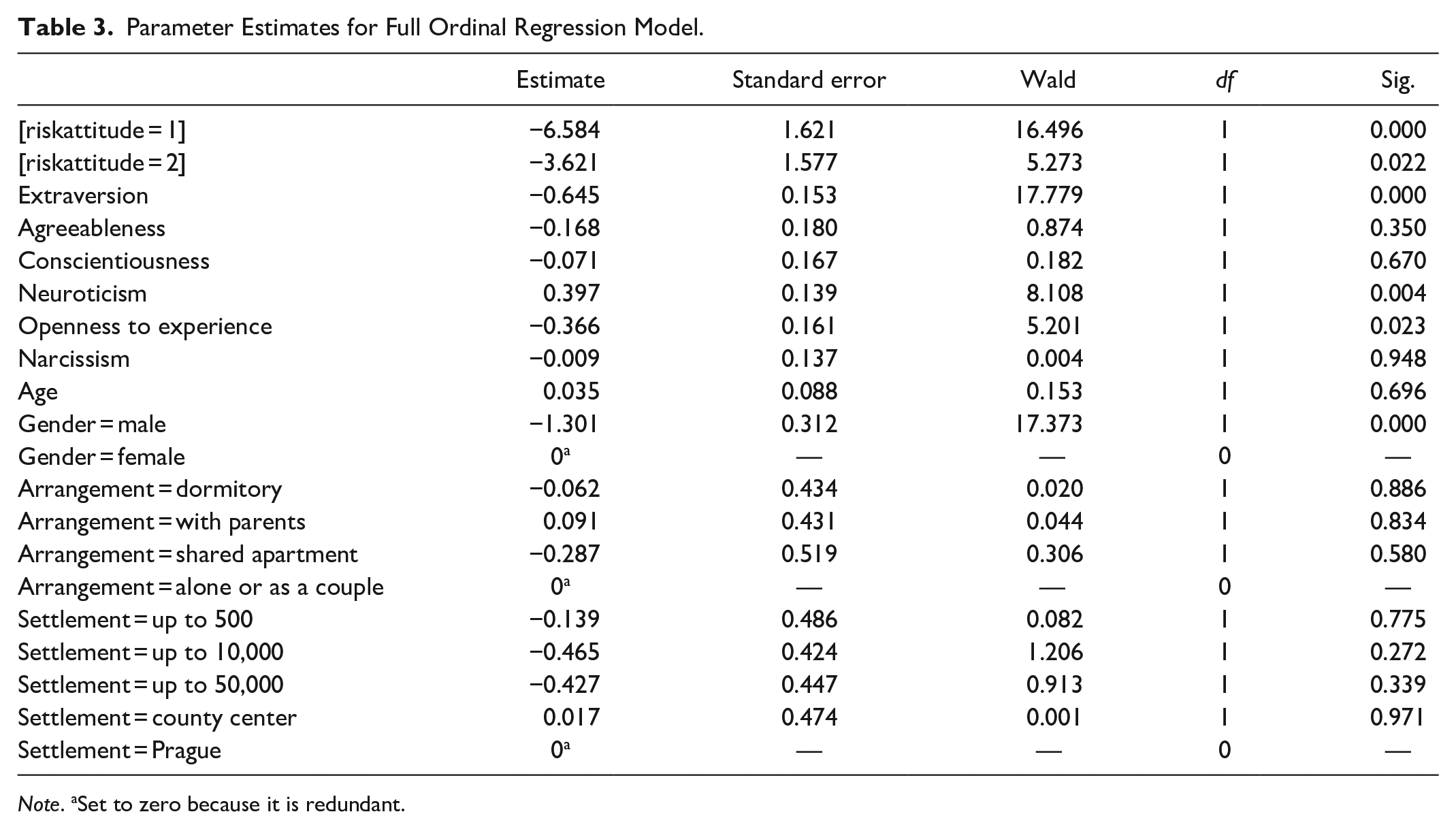
Note. aSet to zero because it is redundant.
For the streamlined model, according to the parameter estimates in Table 4, we again identify significance (p < .001). For its explanatory power, we note that the Cox and Snell pseudo R2 = .213, the Nagelkerke pseudo R2 = .253 and the McFadden pseudo R2 = .130. In addition, extraversion, neuroticism, openness to experience, and gender significantly influence attitudes toward risk.
Parameter Estimates for Streamlined Ordinal Regression Model.

Note.aSet to zero because it is redundant.
For a possible comparison of regression coefficients with other studies, predominantly analyzed using a linear regression and also as a robustness test, we provide the best linear unbiased estimates in Table 5. The overall model achieves significance (p < .001). In terms of its explanatory power, we find that R2 = .219, and R2adj = .170.
Parameter Estimates for Full Linear Regression Model.

Note. aSet to zero because it is redundant.
For the streamlined model, according to the best linear unbiased estimates in Table 6, we again identify significance (p < .001). In terms of its explanatory power, we find that R2 = .206, and R2adj = .193.
Parameter Estimates for Streamlined Linear Regression Model.

Note. aSet to zero because it is redundant.
Ordinal and linear regressions yielded virtually the same results, suggesting the results are robust. Additionally, there is no indication of non-linearity in the identified relationships.
The results of our study on the personality traits-risk attitude nexus confirmed Nicholson et al.’s (2005) conclusions only in part, namely in relation to extraversion, neuroticism, and openness to experience. The findings with regard to agreeableness and conscientiousness are different, showing no significant link with risk-taking behavior. For extraversion and neuroticism, regression analysis confirms the findings of the correlation analysis; the findings also are in line with Oehler and Wedlich’s (2018) evidence that extraverted people tend to be less risk averse, whereas neurotic respondents generally exhibit more risk aversion. Similar results can be found in the studies of Li and Liu (2008), Desmoulins-Lebeault et al. (2018) and Czerwonka (2019). In addition, people open to experiences, are less risk averse, which matches the findings regarding overall risk propensity offered by Nicholson et al. (2005). However, Weller and Tikir (2011) conclude that openness to experience actually is associated with perceived benefits but not with risk perceptions.
On the other hand, agreeableness does not affect risk preference, which is in line with the conclusion of Pan and Statman (2013). However, we are unable to confirm their further assertion, which can also be found in the distinct culture study by Twumasi Baffour et al. (2019), as well as that of Czerwonka (2019), about the link between conscientiousness and relatively low tolerance to risk. Despite evidence that organized, thorough and responsible people tend to achieve objective success in terms of wealth and income (Duckworth et al., 2012), this appears to be the result of their saving and spending patterns and not risk-related operations. This was partially confirmed also by Oehler and Wedlich (2018), who state that more conscientious individuals perceive investments in assets to be riskier. In contrast, the results of our study do not show that more conscientious students are more risk averse, although they are members of a culture with a relatively high uncertainty avoidance.
With regard to narcissism, our multivariate testing did not confirm the prevailing suggestions about its association with riskier behavior, although there is a significant bivariate relationship in our sample. However, based on an in-depth investigation reported by Brunell and Buelow (2017), narcissism only weakly predicts risky decisions when assessed in the general population of young adults. Taking into account the similarity of our results, it can be expected that instances of higher narcissism can be more likely detected in the older population, as this trait is typical of managers, especially Chief Executive Officers (e.g., Campbell et al., 2011; Cragun et al., 2020). Moreover, students involved in our research did not score high in narcissism (2.3 on average on a 5-point Likert scale), which also supported the insignificance of the relationship between narcissism and risk attitude. Hence, future research can be directed to the examination of personality traits based on the Big Five Inventory and narcissism in relation to risk taking within the older population.
Most previous studies have been conducted in a single-country environment, with specific cultural context in terms of ambiguity avoidance. Based on a comparison of results, it is not possible to provide a general answer about the role of cultural influences on the personality traits-risk attitude nexus. At the same time, we cannot agree with the conclusion formulated by Prinz et al. (2014) about the greater significance of environmental factors in comparison to personality factors in affecting risk aversion. According to our results and their comparison, it seems that the positive relation between extraversion and risk seeking is quite stable across various cultures. On the other hand, distinct results with regard to the conscientiousness-risk aversion nexus indicate its sensitivity on environmental factors. Hence, it seems that the relationships of individual personality traits to risk attitude potentially show varying degrees of stability across cultures. These assumptions, however, need stronger empirical underpinning laid within future research.
With regard to gender, our study confirms the prevailing empirical findings detected in a diverse cultural environment that men are less risk averse than women (e.g., Borghans et al., 2009; Charness & Gneezy, 2012; Twumasi Baffour et al., 2019). This finding can be explained to some extent by differences in personality traits between men and women. Previous studies (e.g., Collischon, 2018; Schmitt et al., 2008) confirmed that women exhibit higher degrees of neuroticism and agreeableness. Similarly, we reported a moderate statistically significant correlation between gender and neuroticism, leading to the conclusion that women, having more anxious and sensitive personalities, are also more risk averse. Hence, we acknowledge evidence that the magnitude or significance of gender differences is more likely to be task or situation specific (e.g., Filippin & Crosetto, 2016; Jetter & Walker, 2018) than culture specific.
For the rest of the tested variables, we find no statistically significant impact of these factors on risk attitudes. Especially with regard to age, we are not able to confirm the conclusions of Schildberg-Hörisch (2018) on the changing nature of risk preferences over the lifetime. However, all of our respondents were university students of approximately the same age (between 18 and 26 years old). Thus, the attitude to risk appears to be clearly stable over a specifically shorter period of life. Similarly, Nosita et al. (2020) found no statistically significant association between age and risk tolerance. At the same time, the living arrangement and size of settlement seem not to matter for risk attitude. This can result from the fact that most students are single and live temporarily in Prague while studying, which may reduce the differences in risk attitude.
Conclusion
Attitudes toward risk influence decision making in many realms. This study has focused on the impacts of personality traits and demographic factors, including gender, on risk attitudes, investigated in the context of culture with relatively high uncertainty avoidance and relatively low income level. In line with a recent stream of literature, we measured attitudes toward risk as a general propensity, in contrast with measures of risk taking in specific domains. The data, collected using a questionnaire administered to university students in the Czech Republic, avoids concerns about varying attitudes due to age effects. Our analysis shows that extraversion, neuroticism, openness to experience and gender significantly influence risk aversion. Neuroticism is positively linked and extraversion and openness to experience are negatively linked to risk aversion, with men being less risk averse than women.
The findings contribute to a better understanding of the influences of personality traits and demographic factors on risk attitude in the context of a culture with high uncertainty avoidance. However, our results are largely similar to those found in other countries, especially those scoring relatively low in uncertainty avoidance. Hence, we are not able to provide evidence on significant differences in perceived attitudes to risk that would reflect cultural influences. Moreover, we indicate that individual personality traits-risk attitude nexuses seem to show varying degrees of stability across cultures. We argue that continued cross-country analyses of the relationships of personality traits, as well as other demographic factors, with risk attitudes should account for the potential influences of different cultural contexts.
With regard to Croson and Gneezy’s (2009) concern about publication bias in relation to gender differences, our results provide support for the existence of gender differences in risk attitudes among Caucasians. In our study, there are gender differences even when accounting for personality using multivariate testing.
In hindsight, accommodation and risk attitude probably influence each other. More risk-averse people are likely stay to live with their parents longer, therefore accommodation is probably not the best proxy to test Weber and Hsee’s (1998) “cushion hypothesis” on a microeconomic level. In our study, respondents who still live with their parents were marginally more risk averse than those living alone but the difference is not statistically significant.
With regard to settlement size, respondents from Prague and county centers are marginally more risk averse than respondents from smaller settlements, in line with popular belief, but these differences are not significant.
Several implications can be derived from our findings. Knowing the association between personality traits and risk preference can be important, especially from the point of view of business school students, in terms of selection of their future career direction and development. Another implication is particularly relevant for financial advisors in developing financial recommendations with varying levels of risk, which should be based on the personality profile of a particular client rather than on obvious demographic features. Further implications can be drawn for employers seeking to hire students or graduates in positions associated with risky decision-making processes. As noted by Haylock and Kampkötter (2019) behavioral characteristics, including personality traits, play a significant role in the labor market matching process. For example, neurotic people who tend to be particularly sensitive to environmental stress seem to be more suitable for solving everyday well-structured decision-making problems. On the other hand, people open to experience and those with an extravert personality who tend to be innovative and adaptable to new situations can generate new unconventional ideas that are usually associated with greater risk. Thus, a balance of appropriate personality traits in appropriate positions within working teams can contribute to the overall performance of the organization.
Footnotes
Declaration of Conflicting Interests
The author(s) declared no potential conflicts of interest with respect to the research, authorship, and/or publication of this article.
Funding
The author(s) received no financial support for the research, authorship, and/or publication of this article.
