




Abstract
Controversial topics make discourse complicated and hard to construct. However, through selected linguistic tools, the negativity of controversies can be subdued and reconstructed successfully. In this study, Halliday’s Transitivity System and van Leeuwen’s role allocation were utilized to show how speakers construct social actors in such a discourse to experientially reconstruct controversial topics without evoking negative feelings or creating conflicts. This study examined Jared Kushner’s interview on the peace deal to show how such a controversial topic was constructed. It was noted that Kushner utilized three tools. He (1) foregrounded noncontroversial participants and backgrounded controversial ones, (2) identified actions of noncontroversial participants and suppressed the actions of those who are controversial, and (3) activated positive aspects and passivated negative aspects. In doing so, Kushner evaded controversial arguments by selectively representing participants and their social roles to achieve strategic goals, for example, obtaining a positive response, subduing negativity, and eventually may succeed in encouraging his audience to listen or consider his view.
Introduction
Controversial topics are “those that have a political, social or personal impact and arouse feeling and/or deal with questions of value or belief” (Oxfam, 2006, p. 2). As Dearden (1981, p. 38) argues, a topic is controversial “if contrary views can be held on it without those views being contrary to reason.” Thus, it can evoke feelings, divide the audience, generate heated responses, and make the process of constructing discourse challenging. However, sometimes constructing discourse without discussing, defending, or reconstructing controversial views is not a discourse that can achieve some strategic goals, especially in politics. A successful and good discourse on controversial topics is necessary to achieve its strategic goals, especially when the speaker attempts to persuade the audience or allow them to consider the other opposing opinion. Failing to construct such a successful and inviting discourse can cause conflicts and discourage the audience from listening to the speaker. As such, it is crucial to scrutinize such a discourse, especially when the audience holds an opposing opinion. Johnson and Johnson (1979, 1989) explain that when a speaker’s ideas and opinions are incompatible with those of hearers, yet both (or at the minimum one) seek to reach an agreement, then constructive controversy exists. Accordingly, controversial issues are argued and discussed utilizing various discursive practices and linguistic tools and approaches to avoid offending the audience and creating disputes or disagreements. Johnson and Johnson (2014, p. 422) state that the way speakers structure their topics “determines how individuals interact with each other, which in turn determines the conflict’s outcomes.” Carmer (2011, pp. 3–4) also explains that the choice of a particular linguistic form of expression constitutes some contextual features in communicative interaction. An important aspect of such a discourse, as Carmer (2011, p. 4) points out, is how speakers construct communicative events among interlocutors/participants. According to Kock (2004, p. 104), “there is good discourse and bad discourse, i.e., some properties of public discourse will hinder, and some will serve the functions for which public discourse is needed.” Therefore, since 1960s, as Porto (2007, p. 21) states, new theoretical and methodological approaches have been utilized to scrutinize the subtle tools, practices, and effects of the soft power of discourse (e.g., Chaffee, 1977; Katz, 1980; Martin, 2014; Martin & White, 2005; McLeod et al., 1992; van Dijk, 2018; Zaller, 1996).
Goodnight’s (1991) call for more research on controversy has attracted scholarly attention. Cornfield (1992, p. 47) introduced a narrative analysis methodology to examine the impact and representations of media on political controversies. In addition, Olson and Goodnight (1994) offered a critical approach on how to read social controversy to allow critical inquiry. Porto (2001, 2007) also examined the role of television in framing the main controversies of the 2002 Brazilian presidential election. He proposed a theoretical framework, aka the interpretive controversies model, as “few studies have linked media frames to controversies that take place during elections” (Porto, 2007, p. 21). Johnson and Johnson (2007) developed a theory of controversy to depict how disagreement is structured in discourse. They identified “the process through which constructive controversy creates positive outcomes” and put forward a number of theoretical assumptions (Johnson & Johnson, 1979, 1989, 2007). These macro assumptions are useful blocks to build a deliberate positive discourse, but they do not investigate discursive practices in the critical paradigm that are crucial in constructing controversial topics, for example, framing and representations. Johnson and Johnson (2014, p. 422) structured conflict, disagreement, or controversy, along a continuum. At one end of the continuum, “disagreement may be structured as a constructive controversy to encourage and promote argumentation, [and] at the other end conflict may be covered-up and suppress differences . . . [to] conform or concur with the majority view (i.e., concurrence seeking).” The two ends can promote different interactions and in turn different outcomes. Furthermore, Tenenboim-Weinblatt (2013) investigated the mediated discourse surrounding controversies in terms of media substance and issue substance.
Previous studies (e.g., Carmer, 2011; Cornfield, 1992; Johnson & Johnson, 1979, 1989, 2007, 2014; Porto, 2007; Tenenboim-Weinblatt, 2013) examined how to form and design controversies excluding the role of linguistic choices, which, as van Dijk (1998, p. 25) asserts, “effectively emphasize or de-emphasize political attitudes and opinions, garner support, manipulate public opinion, manufacture political consent, or legitimate political power.” In an attempt to contribute to the available literature on controversial discourse, the current study is interested in how to subdue controversies through representations. Through representations, meanings are created, roles are assigned, and attitudes are formed. Representations are constructed through semantic-pragmatic features, such as metaphors, lexical choices, repetitions, socio-semantic, discoursal features, or grammar, which are capable of constructing an image of an individual, a group, or an idea. One of the most subtle representations is achieved through grammatical features such as transitivity that represents actors and actions. According to Halliday (1994, p. 106), “reality is made up of processes of going on, happening, doing, sensing, meaning, being and becoming.” Transitivity analysis “construe[s] the world of experience into a manageable set of process types” (Halliday, 1985, p. 106). It “shows how speakers encode in language their mental picture of reality and how they account for their experience of the world around them” (Simpson, 1993, p. 82). Such meanings can be achieved through processes, participants, and circumstances or, as Matheson (2005, p. 66) puts it, by “asking who are the actors, who are the acted upon, and what processes are involved in that action?” Most importantly, within the tradition of discourse analysis, transitivity analysis reveals (in)equality in the distributions, actions, and roles being played by social actors in discourse, especially political discourse.
Unfortunately, the available literature on politically controversial topics lacks investigation into how such topics are constructed to address the challenges speakers may face. This lack of studies resulted in a gap in the literature, which requires comprehensive studies to offer a better understanding of such a discourse. Thus, the present study attempts to address this gap by examining the Israel-Palestine conflict, which is one of the pivotal unsolved political issues of modern time that evoke negative feelings, heated arguments, and disagreements. Throughout history, there have been many unsuccessful attempts to resolve it. The latest attempt was carried out by former US President Donald Trump, who announced the peace plan in 2019. By employing Halliday’s (1985) transitivity system and van Leeuwen’s (2008) social actor approach, this research study scrutinized an interview conducted by Jared Kushner, one of former President Trump’s advisors, that has the potential to evoke negative feelings, divide the audience, and generate heated responses. In so doing, (1) the distribution of processes and the roles of participants in each process are identified; (2) the different roles the selected social actors played are examined; and (3) the relations between the social actors, their process, and roles are mapped out.
Halliday’s Transitivity System
Halliday (1967a, p. 199) posits that the clause is “the domain of three main areas of syntactic choice: transitivity, mood, and theme.” Halliday (1967b, p. 199) explains, “transitivity is the grammar of experience, mood is the grammar of speech function, and theme is the grammar of discourse.” Unlike traditional grammar that views transitivity as whether the verb is transitive or intransitive (Halliday, 1976, p. 159), in Systemic Functional Grammar, transitivity is viewed as having a function to fulfill. Hallidayan grammar views language as “a mode of reflection, of imposing order on the endless variation and flow of events” (Halliday, 2004, p. 170). Transitivity system is interested in revealing the different types of processes expressed in a clause, the participants involved in the process, and the various attributes or/and circumstances of the process and the participants.
The notion of process “cover[s] all phenomena. . .and anything that can be expressed by a verb: event, whether physical or not, state, or relation” (Halliday, 1976, p. 159). Processes are divided into principal processes and subsidiary processes. These processes are recognized by the verbs in the clauses. Principle processes are material, mental, and relational. A material process, which is concerned with doing and happening, requires an actor, a process, and a goal. It indicates “the notion that some entity ‘does’ something which may be to some other entity,” as they are interested in our experience of the material aspects of the world (Halliday, 1985, p. 103). A mental process, which is interested in senses such as feeling and thinking, needs a process and a phenomenon. “[M]ental clauses are concerned with our experience of the world of our own consciousness” (Halliday, 2004, p. 197). Nevertheless, they may reveal some abstract doings. Besides, a relational process is concerned with being and having. Halliday (2004, p. 210) argues, “relational clauses serve to characterize and to identify.” They are recognized through the verb “be” in the simple past and present. However, there are three types of relational clauses, that is, intensive, possessive, and circumstantial. The “being” in relational clauses can be construed either in one of two modes: attribution (a carrier and an attribute) or identification (a token has a value).
Furthermore, subsidiary processes are located at the boundaries of the principal processes: “behavioral sharing characteristics of material and mental, verbal sharing characteristics of mental and relational, and existential sharing characteristics of relational and material” (Halliday, 1994, p. 138). Behavioral processes are “processes of (typically human) physiological and psychological behavior, like breathing, coughing, smiling, dreaming, and staring” (Halliday, 1994, p. 139). Halliday (2004, p. 250) explains, “they are partly like the material and partly like the mental.” Typically, such clauses have two participants, that is, the behaver and the behavior. The verbal process, on the other hand, is the process of saying. Such processes create narrative and dialog. Halliday (2004, p. 252) states, “verbal clauses, in news reporting, allow reporters to impute or assign information to sources, including officials, experts, and eyewitnesses.” Finally, the existential process has “no representational function” (Halliday, 1994, p. 142). The function of existential clauses is to introduce “participants as unmarked news at the end of the clause. . . and reinforcing their introduction by taking their existence as the point of departure” (Martin, 1992, p. 164).
Fairclough (1995a) argues that the description of the course of an event through transitivity has cultural, political, and ideological significance. However, ideologies are often embedded in social actors (Fairclough, 1995b). Hence, investigating the roles the social actors play may reveal the authorial ideologies immanent in discourse.
Van Leeuwen’s Role Allocation
Transitivity in van Leeuwen’s (2008) approach is as functional as Halliday’s. It views social actors (participants) as being allocated roles, hence, functions. Thus, examining role allocations can reveal the significance of the participants as well. It is a method to decode the representations of participants, their significance, and their actions.
van Leeuwen (2008) argues that in a text not all participants are represented equally. Frequently, participants as social actors are represented in a text directly or indirectly, hence, included. When participants are not represented at all, they are excluded. However, there are two types of exclusion, that is, innocent exclusion (i.e., backgrounded) or radical exclusion (i.e., suppressed). Furthermore, when social actors are represented and given roles (through participation, circumstantialisation, and possessivation), these roles can be active (agent/actor) or passive (patient/goal). In detail, activation occurs when social actors are represented as active, whereas circumstantialisation refers to social actors who are put within a circumstance. Moreover, possessivation occurs when social actors become the possession of others. On the other hand, passivation is when they are represented as “undergoing” the activity, or as being “at the receiving end of it” (van Leeuwen, 2008, p. 33). Passivation can be realized through subjected (social actors are objects) or beneficialized (social actors benefit from action positively or negatively).
Other methods to activate and passivize social actors are through genericization or specification and assimilation or individualization (van Leeuwen, 2008, pp. 22–24). That is, genericization is achieved through the plural or singular forms or mass nouns (unless the tense is not present). In contrast, specification is realized by utilizing specific nouns or a numerative before nouns. Similarly, assimilation and individualization are achieved by representing social actors as groups or individuals, respectively. However, in this case, actors are either represented as groups (plural forms) or singular forms. Moreover, assimilation is both aggregation and collectivization. Aggregation is realized by utilizing quantifying groups representing them as statistics, whereas collectivization is achieved by employing mass nouns or a noun referring to a group of people. Besides, groups are represented through association and dissociation (van Leeuwen, 2008, p. 39). Association refers to groups that are formed by actors, yet, never labeled in the text. Association can be achieved by parataxis, circumstance of accompaniment, possessive pronouns, and possessive attributive clauses with verbs such as “have” and “belong” (van Leeuwen, 2008, p. 40). On the other hand, dissociation refers to unformed groups (actors) that the text associates and then dissociates them.
Methodology
In this divisive world, more scholarly attention is necessary to investigate how controversial topics/issues can successfully be argued, discussed, and constructed. To define controversial topics, as understood in this study, I adopted the definitions offered by both Dearden (1981, p. 38) and Oxfam (2006, p. 2). Accordingly, controversial topics are those that can influence our lives politically, socially, or personally, have opposing views that are not contradicting reason and logic, may cause disagreements, evoke feelings, and sometimes are related to our values and beliefs. To contribute to this underexamined area of research, this study scrutinized the grammatical representations of the participants to uncover how a controversial topic is structured grammatically to achieve strategic goals, for example, obtaining a positive response and persuading the audience to accept or endorse the speaker’s point of view or at least to listen to the speaker without challenging him.
Data Collection and Analysis
The data of this study comprised the first interview Jared Kushner gave to an Arab newspaper, Alquds newspaper, on June 24, 2018. The interview was published in English in New York Times. Kushner conducted this interview in an attempt to convince the Palestinian people of the new peace plan. Hence, it was necessary to construct a (positive) discourse that could manage and subdue the controversy of his topic. The analysis in this study utilized relevant aspects of both van Leeuwen’s role allocation and Halliday’s transitivity system. It employed quantitative and qualitative methods of analysis to reveal the most frequent processes and social roles.
Analysis Procedures
Transitivity is “the grammar of the clause” that can express a particular range of ideational meanings (Halliday, 1985, p. 101). Thus, the unit of measurement used here is the clause. These clauses are ranking clauses, and they were analyzed as being separate clauses. The questions of the reporter were excluded from the analysis. All Kushner’s answers were included and counted into clauses (306 clauses), all verbs were coded in terms of process, all participants were identified in terms of social roles, and the frequency and percentages were calculated to present a quantitative and qualitative overview. An excel spreadsheet was created, and an independent coder was hired. The two coders coded all the verbs in the interview and the participants (social actors) of the processes. Two rounds of independent coding, and a discussion round, in between the coding rounds, were conducted to compare results and discuss and resolve discrepancies. The agreement between the raters was 77% after the first round, the rate improved to 89% after a round of discussion and separate coding. The interrater reliability between the raters also improved after the second round. In the first round, the agreement was k = (0.40); however, after the discussion round, it was k = (0.98). This indicates perfect agreement, according to Landis and Koch (1977).
Data Analysis
The analysis started with the process types utilized in the interview. Table 1 below shows the different types in the data.
Frequency of Process Types.

The most frequent process is material (transitivity grammar of happening and doing), which occurs 100 times, constituting 33%. The second most frequently employed process is relational (the transitivity grammar of being and having), and it occurs 72 times (24%). Mental processes (sensing) occur 69 times (23%). This process is followed by verbal processes, that is, saying, occurring 25 times (8%). The lowest processes are behavioral processes, that is, behaving, constituting 7%, and existential processes, that is, existing, constituting 6%.
By examining the frequency of the different types of the processes, it is obvious that the social actors in this discourse were represented as having the power of “doing” or at least something was happening (material). In addition, the speaker was interested in what was being in the world (relational), that is, describing the abstract relations of specific social roles. This interview was conducted in 2018 when Kushner was in the process of discussing the deal with the different parties involved. Thus, material and relational processes were more suitable for the interview. Moreover, this discourse revealed aspects of social actors’ thoughts and feelings (mental), which were essential to include in the interview, as the process of finding a solution and a deal needed to address people’s thoughts, fears, hopes, and feelings. In addition, as part of the negotiation, verbal process was necessary, as it reported what social actors said, told, asked, and expressed. It also showed that Kushner was interested in being objective by reporting what different parties said rather than judging them. Thus, he allowed hearers to judge these social actors and reached their own conclusion, even though Kushner, as a speaker, selected whom to report and whom not to report. This discourse also referred to actions done consciously by the social actors that were necessary to expand the speaker’s argument (behavioral). The existential process, on the other hand, enabled the speaker to mention what already existed and was in place.
To better understand these processes, it is necessary to examine the different social actors and their roles in the discourse under examination. Hence, the significant social actors were identified in the coding process, and the frequency was calculated and presented in the table below:
Table 2 below shows that in the material processes, “the American administration,” represented through the neither “identified nor defined” pronoun “we,” and “Israelis and Palestinians” are the main participants. Interestingly, Kushner never attempted to clarify whom he was referring to when he used “we.” From the context, Kushner might utilize both types of “we,” exclusive and inclusive “we.” However, the type of “we” that was more frequently employed is the exclusive and unidentified “we,” which most probably refers to the American administration. On the other hand, the mental processes favor Kushner, “Israelis and Palestinians,” and “the American administration.” In verbal processes, Kushner is the most frequently employed participant. Concerning relational processes, President Abbas and “the American administration” are the most involved participants. In terms of behavioral processes, “the American administration,” “Israelis and Palestinians,” and Palestinians are most frequently utilized. Interestingly, “Israelis and Palestinians” are mainly involved in material process, whereas Palestinians are largely involved in behavioral processes. Lastly, “the deal” is the only significant participant employed in existential processes.
Frequency of Social Participants in the Six Processes.

“The Arab leaders” and “the Palestinian leadership” are involved in fewer processes, whereas “the American administration,” that is, “we,” “Israelis and Palestinians,” and “Palestinians” are involved in three processes. The deal, which is the topic of the interview, is involved in mental, behavioral, and existential processes. Kushner, on the other hand, is mainly involved in mental processes and relational and verbal. However, Kushner is also part of the exclusive pronoun “we.”
To attain a better understanding of the different roles the participants played in the processes above, a qualitative analysis is provided below, including the processes and their most significant participants.
Material Process
Material process is significant in terms of power relations, activation, and ideology. Besides, it has material results and constructs an active agent. That is, it involves an agent (subject), a process (verb), and a goal (object), and it may involve recipients, clients, and scopes. Table 3 below offers an overview of all the selected participants utilized in the identified material processes.
Frequency of Social Participants in Material Process.
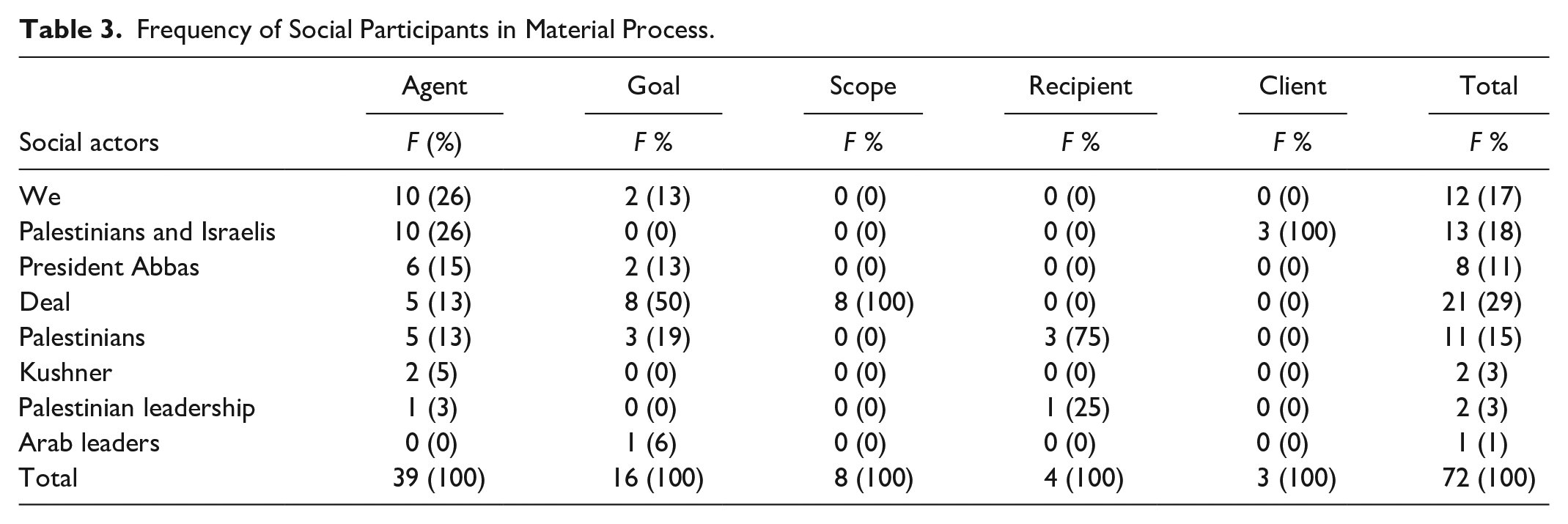
Significant participants were represented as active actors in the material process, however, unequally. The crucial role “the American administration,” or “we,” played is as an agent, which activates their role and presence. It constitutes 26%; they were marginalized by being goals only twice. “The American administration” is the one who was endorsing, planning, and preparing this peace deal. Thus, they have the most effective and active role in this discourse as an actor/agent. Below are some illustrative examples:
The leaders [object] we [agent] met [material] with all care a lot about the Palestinian people
We [agent] have done a lot of listening and have spent [material] our time focusing on the people and trying to determine what they actually want.
I think the Palestinian leadership is saying those things because they are scared, we [agent] will release [material] our peace plan [goal] and the Palestinian people [senser] will actually like it [phenomenon].
The economic plan we are working on can show what comes as part of a deal when it is achieved with some massive.
In these examples, Kushner represented “we” as active and doing. They met with leaders, spent time, and will release their plan. Hence, “we” was activated as a participant, yet, passivated through the generic personal pronoun “we,” assimilation, to identify interpersonal relationships. The pronoun “we” here is exclusive and establishes power. In addition, the pronoun concealed who was working on the deal, or avoided naming Trump or “the American administration” and in turn evoking negative feelings. It is worth noting that the first use of the unidentified exclusive pronoun “we” appeared in the second sentence of the interview (example 1) (More discussion is provided when the deal as a participant is investigated).
Equally important to “the American administration” is “the Israelis and Palestinians” because in Table 3, “the Israelis and Palestinians,” as one expression, is a collective, inclusive NP. The examples below are representative:
To make a deal, both sides [agent] will have to take a leap and meet [material] somewhere between their stated positions.
Both parties [agent] will gain [material] more than they give.
And both parties will feel confident that the lives of their people will be better off in decades from now because of the compromises they [agent] make [material].
The Israeli and Palestinian people [agent] to be the closest of allies in combating [material] terror.
In these examples, “the Israelis and Palestinians” were represented equally as active and acting. One of the strategies to subdue negativity is to establish a common ground or a “win-win” situation that the audience cannot challenge. Thus, Kushner represented both parties, who comprise part of the problem and the solution, equally. According to Kushner, both groups need to compromise and meet to gain more than they give and combat terror together. This discourse sounds empowering as both parties are equally involved and powerful to make a change and decide their own future and convince the Palestinians to act accordingly. Thus, it is hard to refute part of his argument without refuting the whole argument. Accordingly, such a representation could suppress negative feelings that may arise from such a topic.
Another role the Palestinians and Israelis played in the material process is a client. The number of occurrences is insignificant; yet, it is significant to explore it because they are the only participants who played this role.
1. This will lead to increases in GDP, and we also hope that a blanket of peaceful coexistence can allow the governments to divert some of their funds from heavy investments in military and defense into better education, services, and infrastructure for their people [client].
2. President Trump cares a lot about the Palestinian people, and so yes we are looking very closely at Gaza and have spent a lot of time with our partners and hope to put forth ideas to relieve some of the pressure and try to change the trajectory of the situation for the people [client].
In these examples, Kushner indicated that this plan was designed for the people, as clients, thus, the peace plan was represented positively. According to Kushner, as clients, Palestinians and Israelis were described as “people,” attempting to represent the deal as equally designed for the masses, excluding politicians, glossing over the different interests, downplaying separation, and intensifying unity or at least conveying a sense of common interest.
In contrast, the Palestinian people by themselves were represented as recipients. Although clients and recipients are benefactive (passivating), the difference is ideologically significant. Below are some examples:
3. The leaders want a deal where the Palestinian people can live in peace and be [recipient] afforded the same economic opportunities as the citizens of their own countries.
4. I believe that Palestinian people are less invested in the politicians’ talking points than they are in seeing how a deal will give them [recipient] and their future generations [recipient] new opportunities, more and better-paying jobs and prospects for a better life.
5. Israel’s prosperity would spill over very quickly to the Palestinians [recipient] if there is peace.
The difference between a client and a recipient is crucial to the representations of the participants and the implications of the speaker. In the representations of the participants as clients and recipients, the peace deal was constructed positively. However, the recipient is the one that goods are given to, while the client is the one that the service is done for. Thus, the peace plan was a good given to the Palestinians, whereas the same peace plan was a service done for the people, both Palestinians and Israelis. Being a client is more empowering than a recipient, even though both passivate and background participants. Nevertheless, as agents/actors, Palestinians were actively involved in this discourse.
The Palestinians are also more frequently represented in this discourse as agents and goals; hence, they are activated and passivated, respectively. The following examples are illustrative:
6. Think about the prospects for the Palestinian people over a 5 to 20 year horizon if they [agent] get [material] massive investments in modern infrastructure, job training, and economic stimulus.
7. There have been countless mistakes and missed opportunities over the years, and you, the Palestinian people, [agent] have paid [material] the price.
8. Let them know your priorities, and [you: agent] give [material] them the courage to keep an open mind toward achieving them.
These examples represented the Palestinians as active, that is, agent; yet they were passivized indirectly: example 6 is a process of happening; example 7 represents the Palestinians as victims to some extent; example 8, which is imperative, is a process of doing in which the Palestinians were giving their own authority the courage to achieve the Palestinians’ priorities. Interestingly, these three examples painted a picture of the future (what the deal will give them), past (what they paid), and the present (what they need to do now), respectively. Establishing uncontroversial facts, especially the representations of the past and the present, helped in establishing a common ground and allowing the audience to agree with the speaker. It is worth to note that Israelis were never treated as a participant by themselves. When they were, they were always connected with the Palestinians.
The fourth most frequent participant is “the deal,” “the peace plan,” “peaceful coexistence,” or “a package.” Its leading roles are goals and scopes, which suit it as an object. The deal was also personalized to create a more active role. Below is a discussion of both roles.
9. The leaders want to see a deal [senser/agent] that respects [mental] the dignity of the Palestinians and brings [material] about a realistic solution [goal] to the issues that have been debated for decades.
10. I believe that Palestinian people are less invested in the politicians’ talking points than they are in seeing how a deal [agent] will give [material] them [recipient] and their future generations [recipient] new opportunities, more and better-paying jobs and prospects for a better life.
11. I believe that for a deal [goal] to be made [material].
12. I think the Palestinian leadership is saying those things because they are scared we [agent] will release [material] our peace plan [goal] and the Palestinian people will actually like it
13. Not everyone will agree that it’s the right package, but reaching for peace [scope] takes courage and the need to take the right calculated risks.
14. The global community is getting frustrated with Palestinian leadership and not seeing many actions that are constructive toward achieving peace [scope].
The diversity of the roles of the deal as a participant highlights its significance. The main participants were camouflaged by the deal. That is, instead of saying the American administration, the Israelis government, or the Arab leaders, Kushner chose to speak of the deal as an actor. Hence, the deal was represented as a “senser” that would respect the dignity of the Palestinians, bring a realistic solution, and give the Palestinians and their future generations new opportunities as an agent, and the American administration would release it as a goal. Kushner gave reasons why this deal, as a goal, should be made, and the Palestinians should work toward achieving it, as a scope. As an agent, the deal was represented as a human being that was capable of respecting, bringing, and giving. Personification helped to avoid mentioning who would be bringing, giving, and respecting, indirectly representing the deal as a coherent solution rather than consisting of people with different, if not clashing, interests and ideologies. The most frequently employed role is a goal, which was passivated. In more detail, the deal was employed in passive sentences, such as “a deal to be made” and “a deal to make,” allowing Kushner to successfully conceal who would make the deal, as he never said that the American administration would make it.
Relational Process
Relational process is the second most frequent process. Table 4 below is an overview of the frequency and percentage of the participants.
Frequency of Social Participants in Relational Process.

President Abbas and “the American administration” are the most significant participants as carriers. Below are some illustrative examples:
15. President Abbas knows that we [carrier] are open [attribute] to meeting him and continuing the discussion when he [carrier] is ready [attribute].
16. If President Abbas [carrier] is willing [attribute] to come back to the table, we [carrier] are ready to engage; if he [carrier] is not [attribute], we will likely air the plan publicly.
17. We [carrier] are committed [attribute] to finding a package of solutions that both sides can live with.
18. President Abbas says that he [carrier] is committed [attribute] to peace, and I [carrier] have no reason not to believe him.
19. I do question how much President Abbas [carrier] has the ability [attribute] to, or is willing [attribute] to, lean into finishing a deal.
These examples represented the American administration, or the exclusive pronoun “we,” positively, whereas President Abbas was represented negatively utilizing the discourse of the “self” and the “other.” Relational process represents opinions as facts to persuade the audience. The American administration was represented as being open to meeting, committed, and ready to engage. In contrast, President Abbas was not ready for discussion, an idea that was mitigated by saying the American administration would continue “the discussion when he is ready.” Another strategy of mitigation was the conditional clause, for example, “if President Abbas is willing to come back” and “if he is not.” Besides, in example 19, Kushner reported that “President Abbas says that he is committed”; yet, Kushner questioned his ability to finish the deal.
Mental Process
The mental process is the third most frequent process in the discourse under investigation. The frequency of all participants is presented below in Table 5.
Frequency of Social Participants in Mental Process.
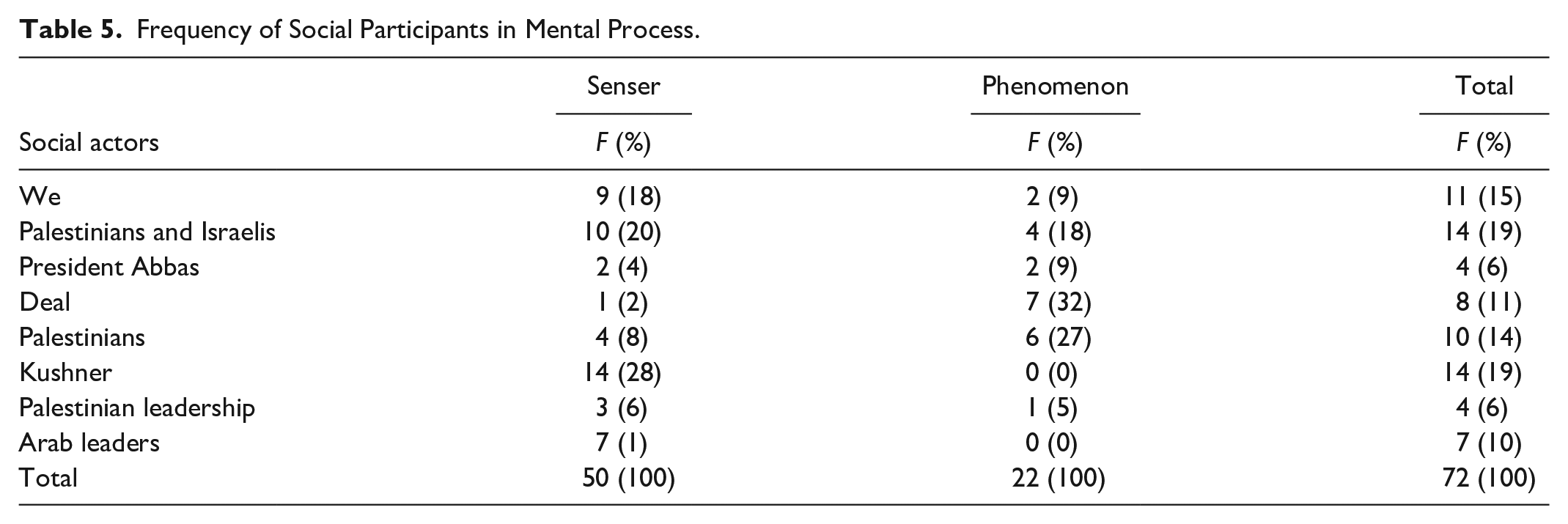
Table 5 shows that Kushner, “Israelis and Palestinians,” and “the American administration” are the most frequently employed participants in the mental process. The mental process allows the audience to access the inner thoughts and feelings of speakers to sympathy with them and persuade the audience or at least help them view the issue from the speakers’ perspectives. Besides, the mental process mitigates meanings by representing them as opinions.
The primary role Kushner plays in this discourse is as a “senser,” which implies that he is mainly involved in assessing the situation and people’s attitudes. Below are some examples:
20. I [senser] believe [mental] that for a deal to be made
21. I [senser] believe [mental] that Palestinian people are less invested in the politicians’ talking points than they are in seeing how a deal will give them and their future generations new opportunities, more and better-paying jobs and prospects for a better life.
22. I [senser] think [mental] the Palestinian leadership is saying those things because they are scared, we will release our peace plan, and the Palestinian people will actually like it because it will lead to new opportunities for them to have a much better life.
23. I [senser] do question [mental] how much President Abbas has the ability to, or is willing to, lean into finishing a deal.
Kushner was represented individually as a senser who assessed the situation and mitigated opinions concerning the situation and people’s attitudes. He was foregrounded by being the main actor/agent of the processes and backgrounded by being part of the pronoun “we.”
Being one of the most frequently utilized participants in the mental process, Israelis and Palestinians are activated as being the senser/the subject of the following statements:
24. [B]oth parties [senser] will feel [mental] confident that the lives of their people will be better off in decades from now because of the compromises they make.
25. The leaders know that the lives of the Palestinian people can only be made better when there is a peace deal that is agreed [mental] to by both sides [senser].
26. Now is a time where both the Israelis and Palestinians [senser] must bolster and refocus [mental] their leadership, to encourage them to be open toward a solution and to not be afraid of trying.
Israelis and Palestinians were actively involved in several processes, including mental processes. In these examples, they were represented as feeling confident that their lives would improve because of the compromise they would make and supporting and focusing their leadership to take the necessary steps when they agree on the deal. In these examples, mental processes mitigated Kushner’s opinions concerning the benefits of the deal and represented it positively to persuade the Palestinians to accept it. It is worth noting that in some examples Israelis and Palestinians were passivated by utilizing assimilations such as both parties and both sides. Kushner might use these referents to include governments indirectly and avoid controversy.
The American administration is the third most frequently employed participant as a senser, thus, it is activated as the main actor in this process. Below are some illustrative examples:
27. We [senser] think [mental] that the deal should be looked at by both sides as a package, and both sides should ask themselves—are we better off with what we are getting in exchange for what we are giving?
28. We [senser] believe we can attract [mental] very significant investments in infrastructure from the public and private sectors to make the whole region more connected and to stimulate the economies of the future.
29. President Abbas has said publicly he will not meet us, and we [senser] have opted [mental] not to chase him.
The examples above represented the American administration as a senser to allow the audience to understand how they think and feel. The American administration believed that both parties need to look at the deal to attract investments. They also chose not to chase President Abbas as he refused to meet them. It should be noted that the American administration and President Abbas were already represented positively and negatively, within the frame of the “self” and the “other,” respectively.
Verbal Process
Verbal process offers recounts of what was said and helps speakers sound more objective by reporting what was said rather than saying what one thinks. Table 6 below is an overview of the frequency of the participants involved in the process.
Frequency of Social Participants in Verbal Process.
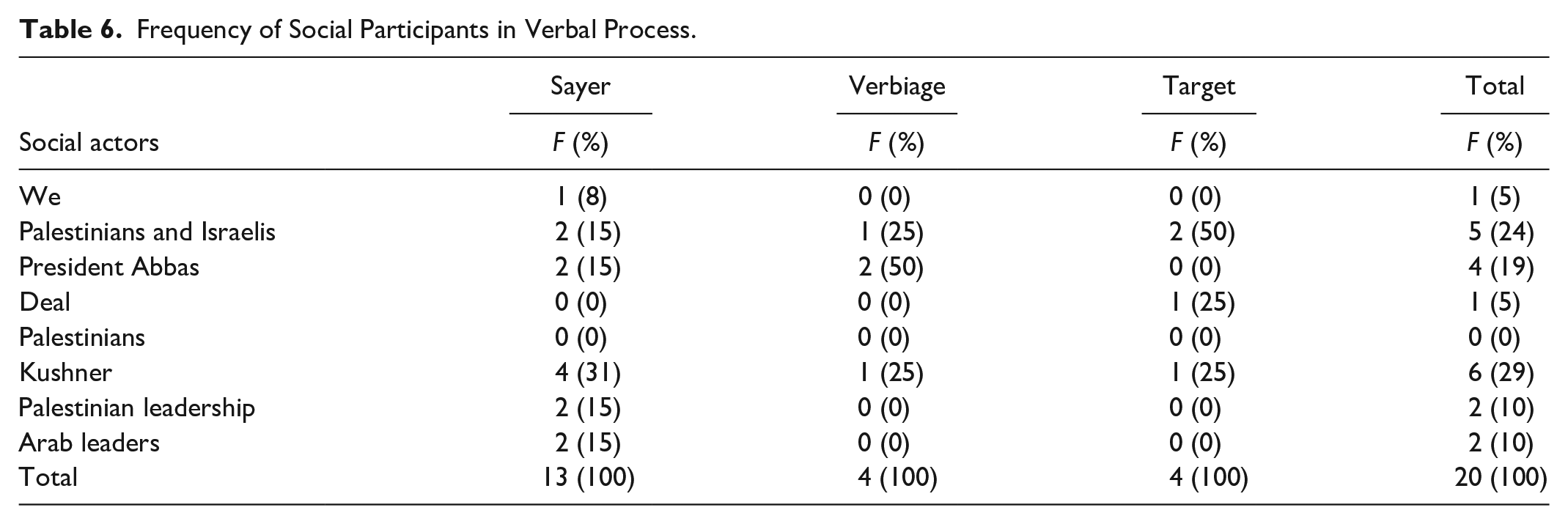
The most frequently employed participant as a sayer is Kushner. Although the occurrence frequency is insignificant, it is important to examine it further, especially because Kushner is the only participant of this process. Below are representative examples:
30. but like I [sayer] said in my speech in Jerusalem
31. I [sayer] didn’t say that, but that’s something that the leadership of both sides should consider doing.
32. I [sayer] didn’t say that he doesn’t have the ability, I said I am not sure.
Kushner is among the participants that are involved in a significant number of processes. In the examples above, he reported what he said and did not say. This process is insignificant compared to other processes because Kushner did not report substantial statements, which is ideologically laden. He was reluctant to name anyone except President Abbas and to refer to other crucial participants he used plural pronouns, mass nouns, and plural nouns, instead.
Behavioral Process
Behavioral process is the fifth most frequent process. It is a process where the action is only experienced by the actors of the process. Table 7 below is an overview of the frequency of the participants in this process.
Frequency of Social Participants in Behavioral Process.

The most significant participants here are the Israelis and Palestinians, the American administration, and the Palestinians. The deal is represented as a range in this process. To examine the processes context, illustrative examples are offered below:
33. We think that the deal should be looked [behavioral] at by both sides [behaver] as a package, and both sides should ask themselves—are we better off with what we are getting in exchange for what we are giving?
34. Without the people [behaver] pushing [behavioral] the politicians to focus on their needs and giving them the courage to take a chance, this will never be solved.
35. However, I am an optimist, and I have met so many people and also have seen so many examples of Israelis and Palestinians [behaver] reaching out [behavioral] to each other and trying to forge bonds to try and circumvent a failed political process.
These examples suggest that Israelis and Palestinians, the people, or both sides, needed to look at the deal, push their politicians, reach out to each other and try to forge bonds and circumvent a failed political process. In this process, the actions of the participants were not felt except by the actors/agents themselves. They only empowered and activated the Israelis and Palestinians, representing them as actors who could act and change things and mitigate the role of governments. Thus, Kushner activated and passivated this social actor once by naming them and once by using assimilations, respectively. In the case of passivation, Kushner might refer to both governments, whom he was reluctant to name, maybe due to the lack of trust of the Palestinians in both governments.
The second most frequent participant is the American administration. Below are some representative examples:
36. We [behaver] have done [behavioral] a lot of listening and have spent our time focusing on the people and trying to determine what they actually want.
37. We [behaver] have continued [behavioral] our work on the plan and on building consensus on what is realistically achievable today and what will endure for the future.
38. If President Abbas is willing to come back to the table, we [behaver] are ready to engage [behavioral]; if he is not, we will likely air the plan publicly.
The American administration, or the exclusive pronoun “we,” in these examples was activated by representing it as an actor. They had done a lot of listening, continued their work on the plan, and were ready to engage with President Abbas if he was willing. These verbs were an attempt to represent the American administration positively as an effective and active participant in making the deal. The American administration was passivated by the pronoun and simultaneously activated by both being the actor and the posseessivation in “our work.” This might be an attempt to hedge and mitigate the role of the American administration.
Equally important to the American administration are the Palestinian people. The following are representative examples:
39. [behaver] Let [behavioral] them know your priorities and give them the courage to keep an open mind toward achieving them.
40. [behaver] Show [behavioral] your leadership that you support efforts to achieve peace.
41. Don’t [behaver] let your leadership reject a plan they haven’t even seen.
42. Don’t [behaver] allow [behavioral] your grandfather’s conflict to determine your children’s future.
The position of the Palestinians in Kushner’s discourse is unique. In the examples above, Palestinians were not mentioned; they were backgrounded. Utilizing bare infinitive clauses, a third person imperative in negative and affirmative forms, Kushner, in example 39, encouraged Palestinians to push their politicians to accept the deal. The choice of “let,” with an implicit agent, gave Kushner an authoritative voice and expressed obligation. Similarly, Kushner in example 42 used an imperative clause addressing the Palestinians implicitly urging them not to allow their grandfather’s conflict to determine their children’s future. These were the only imperatives in Kushner’s interview, and thus they are ideologically significant. Unlike the declarative sentences in which Kushner was represented as the possessor and transfer of information, the imperative structure was endowed with authority; yet, it was empowering the Palestinians as they could change their situation and have a voice. Although it is a persuasive strategy, it is face-threatening. It activated and foregrounded the subject of the main verb, that is, the Palestinian leadership; on the other hand, it passivated the Palestinians by backgrounding them, yet activated them indirectly, by utilizing possessivation, “your.”
Kushner’s discourse is complicated. He passivated participants to activate them simultaneously. The lexical repetition of the possessive pronoun, in example 42, intensified the activation. van Leeuwen (2020, personal contact) indicates that such a structure is complex and “rhetorically motivated.” Kushner foregrounded the Palestinians by utilizing possessivation and a semantic contrast of two opposing phrases while syncretizing syntactically parallel forms. “Your grandfather’s conflict” and “your children’s future” represented the “deal” positively and indirectly drew a comparison between two timeframes, that is, the past and the future and the juxtaposition of “conflict” and “future.” Such a juxtaposition implied that there would be no conflict in the future if the deal was accepted. Thus, the deal might sound feasible, effective, and defensible.
Existential Process
Lastly, the existential process is employed scarcely in the interview. The speaker utilizes the deal as the only participant in this process. Table 8 below is an overview of the frequency of the participants.
Frequency of Social Participants in Existential Process.

The only significant participant in the existential process is “the deal,” that is, the main topic of this interview. The following examples are illustrative:
43. The leaders know that the lives of the Palestinian people can only be made better when there is a peace deal [existent] that is agreed to by both sides
44. There has been no peace deal [existent] achieved in that time.
45. There is a good deal [existent] to be done here from what I assess.
The existential clauses above, which have the deal, as one existence of an entity, began with a dummy subject, that is, “there,” in the affirmative and negative forms. This process essentially indicated that “the deal” did or did not exist. Kushner implied that the chances of having a good deal were there, as a persuasive strategy. Although the deal here was not activated, existential process represented opinions as facts by using the verb to be, in an attempt to achieve the speaker’s goal of the interview.
Discussion
Controversial topics, as noted earlier, are hard to discuss. They make the process of discourse construction complicated, as Kushner’s discourse is. The analysis above offers an overview of how controversial topics, such as the Palestinian–Israeli conflict and the peace deal, can be grammatically discussed, to achieve its strategic goals through effective grammatical representations of the involved participants. The analysis also reveals how to grammatically distribute active and passive roles among significant actors.
As the analysis above shows, a speaker needs to suppress and passivize and activate controversial and noncontroversial participants, respectively. Kushner successfully suppressed and avoided representing controversial actors focusing on his audience and what is relevant to them by activating noncontroversial or positive actors. For example, although the “Palestinian State” and “Al Quds Mosque” are crucial actors and key elements in the deal, they were backgrounded through exclusion. Besides, the Prime Minister of Israel, Benjamin Netanyahu, who is a crucial actor as well, was suppressed and excluded radically from the interview by excluding him. This strategy helps in suppressing negative feelings that might be activated, taking into consideration that Kushner was addressing the Palestinians. Nevertheless, President Abbas, who is not as controversial as his counterpart, Netanyahu, was frequently included, foregrounded, and represented in the discourse.
Meanwhile, Kushner successfully mentioned controversial actors when needed. For example, the Israeli government was excluded by not mentioning it directly as an actor; yet, it was included subtly through passivation as in “both parties,” “both sides,” and “the Israelis and the Palestinians.” Collective nouns (collectivization) helped Kushner to talk about such actors without evoking negative feelings. In contrast, the Palestinian government was included employing different terms, that is, Palestinian leadership, the Palestinian Authority, and President Abbas, and at the same time, it was passivated for ideological reasons. That is, Kushner referred to the Palestinian leadership as a group of participants utilizing assimilation (collectivization) to passivate them. On the other hand, he individualized President Abbas and specified him by referring to him as an individual who was nominated, personalized, and in turn, activated. As such, he succeeded in representing President Abbas as a single entity, who was responsible for specific actions. Another case of personalization was related to “the deal” as an actor. Although “the deal” was not employed as frequently as the other participants, it was activated in the material process as the agent and through personalization.
“The American administration” was the most active actor that was involved in four processes, that is, material, mental, relational, and behavioral, as agents, sensers, and behavers, respectively. “The American administration” is a controversial participant that may evoke negative feelings and cause conflict in this argument. Thus, they were represented by utilizing the generic and exclusive pronoun “we” that successfully suppressed both “the American administration” and Trump to achieve ideological purposes. At the same time, the pronoun “we” set both Kushner and the American administration apart from President Abbas, who was represented negatively.
The representation of the Palestinian people is interesting. They are noncontroversial, positive, and pivotal actors. Hence, they were empowered but only when they were represented with the Israelis. The Palestinian and Israeli people were activated by being agents, sensers, and behavers of material, mental, and behavioral processes, respectively. It is an empowering discourse to show this group as involved in the making of the deal. Kushner activated and foregrounded them by placing them as the main actor. Yet, Kushner passivized the Israeli people, as a controversial actor, by referring to them as a group utilizing (1) assimilation (collectivization), that is, “Israelis and Palestinians,” “both sides,” and “both parties,” and (2) mass nouns (genericization), for example, “the people,” to impersonalize them as actors, avoid controversies, and represent both parties as being equally involved in the peace process. Most importantly, he represented them as a unified group that needs to focus on one goal. Indirectly, Kushner empowered Israelis as well without creating disputes by suppressing the representations of Israelis by themselves as a separate group. In addition, by representing the Palestinian people as a group using the mass noun “people,” Kushner successfully avoided talking about parties within the Palestinian people, who may raise negative feelings and disputes. Furthermore, “Israelis and Palestinians” and “Palestinians,” as two different social actors, were double passivated, once by being represented as a group of participants and once as beneficialized, or clients and recipients, respectively.
The least frequently employed actors were Kushner and Arab leaders. Kushner, as the speaker, was represented through the first-person pronoun and activated as a senser and a sayer. However, he was passivated by utilizing the pronoun “we.” In this sense, Kushner avoided representing himself as the authority while speaking to the Palestinians. Arab leaders, on the other hand, were mainly activated as the main actor, yet passivated through assimilation (collectivization), by treating them as a group of participants and backgrounding their identity to subdue any conflicts. Similarly, the Palestinian leadership and authority were passivated and backgrounded, as a group of participants, that is, assimilation/impersonalization, that is involved in the identified processes. Accordingly, assimilation, a strategy that can build unity and highlight similarities, was employed to avoid creating conflicts and highlighting differences.
Briefly, Kushner’s discourse rhetorically activated and simultaneously passivated participants to achieve his communicative and ideologically loaded goals. They were activated to be represented as being in control yet passivated to represent the deal as being equally designed for the masses, excluding politicians, downplaying differences and separation, and intensifying similarities. In addition, as Pelclová and Lu (2018, p. 5) argue, a discourse can be persuasive when the speaker “manages interpersonal and ideational functions.” The ideational meaning, which mirrors the field (or what’s going on) of a given discourse and the experience of a specific world, describes and discusses events, states, and entities, that is, the experiential meaning. Accordingly, the successful experiential meanings that Kushner built and his effective selections of the actors and their social roles might succeed in persuading his audience to listen and consider his arguments. It is worth noting that speakers sometimes discuss controversial topics to persuade their audience to endorse, adopt, or consider their arguments.
Conclusion
As noted earlier, controversial topics are challenging to construct. In some cases, speakers may attempt to arouse feelings and spark controversies to achieve specific goals. However, in many cases, speakers seek to subdue negativity to construct a successful discourse, manage conflicts, and allow participants to engage in productive interactions. Investigating such a topic is crucial, especially in politics when participants need to discuss controversial topics, resolve or manage conflicts, increase the effectiveness of such a discourse, and reach positive outcomes. In this sense, speakers need to construct constructive controversy utilizing effective discursive strategies.
This article aimed at showing how transitivity, as a discursive strategy, can play an important role in subduing controversies and building a successful discourse. Kushner’s interview on the peace deal is a good case in point. The Palestinian-Israeli conflict is one of the most controversial political topics to discuss. When such a highly controversial topic is discussed, a speaker sometimes needs to spark noncontroversial views, establish shared ground, and represent relevant issues, including significant participants in an unchallenging and challenged manner, to construct a successful discourse. Unfortunately, controversial discourse is undertheorized, and the literature lacks studies that aim at uncovering the different discursive strategies, practices, and linguistic tools that construct controversies in a manner that allows speakers to control and manage negativity and encourage hearers to listen cooperatively. This lack of studies neither allowed the findings of the current study to be compared against those of other studies nor to contribute to previous existent knowledge. This paper was limited to one interview conducted with Jared Kushner. Yet, the findings support Goodnight’s (1991) call for more research on controversy and controversial discourse and encourage researchers to explore this topic along the continuum suggested by Johnson and Johnson (2014) to reveal the various discursive practices used by speakers on both ends to offer a better understanding of how to construct discourse on controversial topics successfully.
Footnotes
Acknowledgements
I would like to thank the editor and the anonymous reviewers. I do appreciate the time and effort they put into reading and commenting on this manuscript. Their thorough review and constructive feedback improved the quality of this paper.
Declaration of Conflicting Interests
The author(s) declared no potential conflicts of interest with respect to the research, authorship, and/or publication of this article.
Funding
The author(s) received no financial support for the research, authorship, and/or publication of this article.
