



Abstract
Over the last few decades, the available literature on environmental economics hosts numerous environmental issues and underlines their reasons, calling for instant action on carbon dioxide emissions (CO2e). In the same context, the recent article develops a new framework that extends the pertinent literature by linking commercial policies, globalization, labor force, GDP growth, fossil fuel, and renewable energy consumption with consumption and production-based CO2e (CCO2e and PCO2e). To this end, the sample of developing economies is utilized from 1991 to 2016. Further, several advanced techniques are applied for robust findings. The findings reveal that the expansionary and contractionary commercial policies significantly affect CCO2e and PCO2e. Likewise, import taxes also have a significant association with CCO2e and PCO2e. Additionally, the results determine that globalization, labor force, GDP growth, fossil fuel, and renewable energy consumption are the essential drivers of environmental pollution. Besides, the panel causality test establishes a one-way causality which runs from commercial policies, import taxes, globalization, labor force, GDP growth, fossil fuel, and renewable energy consumption to CCO2e and PCO2e. Based on the findings, some relevant implications are also suggested.
Introduction
Over the last few decades, the contemporary world has been confronting several challenges, while environmental degradation is one of these pressing challenges. Since ecological deterioration possesses a significant linkage with the billions of human lives, this exigency has grabbed considerable attention from environmentalists and academia (Chishti et al., 2020; Nasir et al., 2021; Nguyen et al., 2021). To cope with climate catastrophe, the world economies took a significant step, and the 21st climate change conference was held in 2015 after two decades of contentious and comprehensive debates (Nasir et al., 2019; Pham et al., 2020). In order to attain a long-term sustainable environment, it is essential, as emphasized by Paris Agreement, that greenhouse gas (GHG) emissions should reach their peak in the early 2020s; accordingly, by the end of the century, the global atmosphere will become carbon neutral (International Energy Agency, 2017.
Since 1880, the earth’s temperature, has escalated by 1.4° Fahrenheit on account of GHGs. Among these GHGs as Figure 1 depicts, the share of carbon dioxide (CO2) is virtually 81% (United States Environmental Protection Agency, 2020), and therefore, the paramount interest of the recent researchers is to divulge the significant drivers of CO2 emissions for climate policies (Chishti et al., 2020; Shahbaz, Kablan, et al., 2020; Shahbaz, Nasir, et al., 2020; Ullah et al., 2020). Concurrently, it is equally crucial to discern how CO2 emissions (CO2e) are measured. In this regard, Shao et al. (2016) state that mainly two methods are utilized to calculate human-induced CO2e: production-based CO2e (PCO2e) and consumption-based CO2e (CCO2e) approaches. PCO2e computes the emissions that stem from fossil fuel combustion within territorial boundaries. So far, the measurement of GHGs emissions of all nations, following the intergovernmental plan’s recommendations on climate change (IPCC), is based on the PCO2e method. However, this method possesses some disadvantages. For instance, it does not include the emissions of sea transportation and international air. Also, it does not incorporate the carbon leakage in which energy-intensive firms, on account of strict carbon emission policies, have to move to the economies having flexible environmental policies with low production cost. However, after production in the territories with fewer carbon restrictions, the goods are exported to the territories with tight carbon policies. This process leads to a high carbon emissions ratio in one economy by decreasing the emissions in other countries. Hence, the PCO2e method is castigated by several scholars due to many downsides in measuring the environmental pollution (Franzen & Mader, 2018).

The share of CO2e among GHGs in 2018.
Therefore, the environmentalists suggest to utilize CCO2e method due to the capability to take care of the problems mentioned in PCO2e method. Further, it comprises all emissions, directly and indirectly, stemming from the production to the final consumption of the product (Afionis et al., 2017; Peters & Hertwich, 2008); hence, CCO2e is the better measure of pollution as proxy for environmental quality as compared to PCO2e. Generally, the economies that outsource the emissions to the underdeveloped economies get significant benefits based on the PCO2e method. Thereby, the economies hosting the emission-intensive exports object and demand for bearing the responsibility from the importers of the emissions-intensive products (Fellows & Dobson, 2017). For example, the economy enduring the massive trade deficit seems to have more CCO2e than PCO2e. Contrarily, the economies which export high energy-intensive goods and import low energy-intensive goods seem to have low CCO2e than the PCO2e. Thus, some economies enjoy the benefits of this outcome, while some other territories may face disadvantages.
Summarizing the above discussion, the majority of the studies related to carbon emissions analysis and atmospheric policies are predominantly based on the PCO2e method, following the production-based perspective. The current research proclaims that the analysis based on the PCO2e method may be misleading and incomplete since this method passes over the environmental effects of consumption and trade perspectives. On the contrary, CCO2e comprises all emissions, directly and indirectly, stemming from the production to the final consumption of the product. Hence, all the previous literature’s findings based on PCO2e as a proxy for environmental quality may be misleading and biased. This gap raises a question: do the both proxies (CCO2e and PCO2e) demonstrate the significant differences while measuring the environmental degradation? This query encourages us to deploy both PCO2e and CCO2e proxies to assess their response to different macroeconomic indicators in order to make a more useful comparison for suitable policy recommendations.
Economic Policies-CO2e Nexus
The recent study’s primary aim is to inspect the potential effects of newly explored variable “commercial policies” on production-based and consumption-based CO2e, with the consort of some controlled variables, viz, taxes on imports, fossils fuels energy, globalization, renewable energy, labor force, and economic growth. The commercial policies influence the environmental quality in the following way. The decision-making authorities often employ commercial policy for managing and stimulating its international trade flows. As the commercial policy has a direct link with the trade; subsequently, this tool is used by governments to trigger economic growth (Melvin & Boyes, 2011). Additionally, the promotion of trade openness encourages foreign direct investment (FDI); hence, the commercial policy also causes to increase in the FDI, as pointed out by Liargovas and Skandalis (2012).
To provide incentives to local and foreign firms, policy-makers decide to squeeze the tax ratio on exports. The decrease in tax on exports expands the production process due to the low production cost. This high volume of low-cost production attracts international consumers that upraises those goods’ demand. Accordingly, this process uplifts foreign consumption by increasing exports, which raises local producers’ income and results in economic development. On the other hand, an upsurge in export taxes, as whenever decided by authorities to restrict the exports, puts the pressure on local producers to lower the production of goods. The domestic producers have to endure the high production cost due to an increase in the taxes on exports, which decline the production volume. The exports ratio falls as the foreign consumers look for substitutes for high-priced exports by decreasing their demand. Consequently, the high tax ratio process reduces the production and consumption level and ultimately disrupts economic growth (Laborde et al., 2013).
Considering the aforementioned elucidation, it can be inferred that oscillations in the commercial policy can affect industrial production, aggregate consumption, and international trade. Since commercial policy directly links with production and consumption sectors, it’s absolutely rational to compute the possible effects of commercial policy on environmental pollution by considering its both categories: PCO2e and CCO2e.
Hence, this study presents its central contribution to the existing literature in three ways. Firstly, to the best of our knowledge, there is only one study by Qingquan et al. (2020) for Australia that explores the effects of commercial policies on CO2e and less attention is paid to this side. Thus, our study examines the plausible effects of commercial policies on the environmental quality. Secondly, to the best of our knowledge, this is the first article that splits commercial policies into expansionary and contractionary policies to capture the effects of rise and fall in exports taxes on the environment. Thirdly, our study also develops a conceptual framework to understand the theoretical influence of expansionary and contractionary commercial policies on the environment. Fourthly, our study also checks the effects of imports taxes on environment. Fifthly, based on the discussion mentioned before, we use both proxies, that is, production-based and consumption-based CO2e in order to do comparison for policy recommendations. Lastly, this is the first study in the context of developing economies that explores the effects of commercial policies on the carbon emissions.
The remainder of the article possesses the following sections. The section 2 documents the previous literature review. In section 3, the theoretical justification of the variables is elaborated. The section 4 underlines the proposed econometric tests and techniques. In the section 5, the results are discussed in detail. Section 6 provides the summary of the findings followed by policy recommendations and some limitations.
Literature Review
This section of the paper elucidates the effects of international trade, fossil fuels energy, globalization, renewable energy, monetary policy, and income on CO2e briefly, explored in the erstwhile research.
Income and CO2e
The well-known EKC hypothesis, propounded by Grossman and Krueger (1991), is based on the nexus between income growth and atmospheric degradation. According to the hypothesis, environmental pollution tends to expand on account of an increase in per-capita income initially, obtains a certain threshold, eventually contracts (Chishti et al., 2020).
To date, although there are several academic articles that are based on the rigorous investigation of the EKC notion, however, the results are mixed and still inconclusive. Hence, the argument postulated in the EKC hypothesis is confirmed for selected Asian economies (Pandey et al., 2020); Spain and Portugal (Moutinho et al., 2020); China (Xin & Zhang, 2020); the 50 largest countries ((Mendonça et al., 2020); Brazil (Ben Jebli & Ben Youssef, 2019); China (Ahmad et al., 2021) and Qatar (Mrabet & Alsamara, 2017). On the contrary, the outcomes of some recent studies did not support the validation of the EKC notion for OECD (Ahmad et al., 2020); India (Alam & Adil, 2019); the selected developed and developing economies (Arminen & Menegaki, 2019); ASEAN-8 (Ahmed et al., 2017) and European economies (Fotis & Polemis, 2018). In addition, these studies argue that a predefined threshold is yet not achieved to support the EKC hypothesis; therefore, the conjecture remains invalid in the aforementioned economies.
International Trade and CO2e
Another widely recognized driver of CO2e is international trade (Cole, 2004). According to the previous research, international trade enhances the world output by manifold by escalating the nations’ flow of goods. Since the rapidly expanding volume of international trade involves high manufacturing rates; accordingly, it leads to high energy combustion and carbon emissions. Further, on account of international trade, heavily contaminating industries are transferred to other economies with less stringent atmospheric protection regulations. Trade openness is bifurcated into imports and exports, as many current studies have done while exploring the nexus between international trade and CO2e for gaging the effects of subcomponents of international trade on CO2e.
Even though many scholars have focused on divulging the trade-CO2 emissions nexus, only a few researchers take the variable of CCO2e for the empirical analysis (Khan et al., 2020). For example, Fernández-Amador et al. (2017) deduce that the ratio of CCO2e increases on account of imports, while the exports exhibit the opposing effects in selected 23 economies. The same findings are also reported by Knight and Schor (2014). Another study by Khan et al. (2020) for G7 economies finds that the imports are accountable for polluting the atmosphere, arguing that the G7 economies have to endure consumption-based carbon emissions due to importing the energy-intensive intermediate products. Also, the study confirms the negative impacts of exports on CCO2e. Besides, Hasanov et al. (2018) assert that the import function and CCO2e possess a direct relationship since the consumption level rises because of the high volume of imports. On the other side, the high volume of exports, which necessitates the rapid and high production level, intensifies the exigency of PCO2e. In a similar vein, Lamb et al. (2014) believe that the trend of CCO2e plummets as more goods are exported. Hence, it is inescapable to ignore the separate effects of exports and imports on PCO2e and CCO2e.
Fossil Fuel Combustion and CO2e
In recent decades, environmentalists have paid considerable heed to the production and combustion of fossil fuels since they are accountable for virtually 90% of the CO2e (Buhari et al., 2020; Ullah et al., 2020). On account of increasing the CO2e significantly and contributing to the environmental deterioration and global warming intensively, several substantial measures have been taken by authorities in order to curb the production/consumption of fossil fuels through different steps (Ahmed & Bhattacharya, 2020). For instance, renewable energy, nuclear energy, and efficient deployment of energy are mitigation strategies to disrupt the CO2e (Spliethoff, 2010). The biggest source which generates CO2e is coal, followed by oil and natural gas as the coal, oil, and natural gas contribute to the environmental degradation by 90% (virtually 25 kg C/gigajoule), 80% (virtually 20 kg C/gigajoule), and 59% (virtually 13 kg C/gigajoule), respectively.
Considering the aforesaid sources’ emanation capacity, it is cogent to presume that dire steps must be taken to lessen and eradicate fossil fuels’ deployment for alleviating the exigency of GHGs in the long-run (Lashof & Tirpak, 1990). The erstwhile literature on the linkage between fossil fuels and CO2e demonstrates the consensus on the deleterious repercussions of fossil fuels’ usage (Ahmed & Jahanzeb, 2021). Some of those studies are Ahmad and Khattak (2020) for South Africa, Lu et al. (2020) for China, Hanif et al. (2019) for Asian countries, and Mensah et al. (2019) for South Africa.
Globalization and CO2e
Another essential determinant of CO2e is globalization that possesses noteworthy linkages with environmental quality. The reason being, it affects the GDP growth by fostering FDI, international trade, tourism, and transfer of technology which entail the extravagant use of energy (Ahmed et al., 2016); subsequently, it leads to amplify the difficulty of CO2e (Figge et al., 2017). Exploring the other side of the coin, Cavlovic (2000) argue that globalization can disrupt the increasing ratio of CO2e by transferring knowledge and technologies that boost the economy’s green efficiency; ultimately, the environmental quality gets an improvement.
Accordingly, the studies on the interesting debate on the globalization-CO2e nexus can be classified into three bunches. The first bunch of studies, including Lv and Xu (2018) for 15 emerging economies, You and Lv (2018) for 83 selected economies, asserts the positive association between CO2e. However, in the second bunch, Salahuddin et al. (2018), Twerefou et al. (2017), and Le and Ozturk (2020) for 44 SSA economies, 36 SSA economies, Japan, and 98 selected economies, infer that the ratio of CO2e declines on account of globalization. Interestingly, the third bunch contains the studies (viz, Chishti et al. (2020) for South Asia, Ahmed et al. (2016) for Malaysia, Figge et al. (2017) for 171 economies, and Doytch and Uctum (2016) for 191 countries) which claim that globalization is the mixed blessing for the economies. Thus, such indecisive findings invigorate on more rigorous investigation regarding the dynamic nexus between globalization and CO2e.
Renewable Energy (REC) and CO2e
In the previous literature, another widely divulged topic is the dynamic impacts of REC on CO2e. Since energy is an indispensable driver of GDP growth and the use of fossil fuels, the largest energy source, intensifies the problem of environmental pollution. Approximately, the entire literature on the REC-CO2e nexus for different economies and regions supports the stance that the ratio of CO2e abates when REC is used for production. For instance, Chishti et al. (2020) for BRICS, Khan et al. (2020) for G7 economies, Bhattacharya et al. (2020) for selected 70 economies, Ahmad et al. (2020) for OECD countries, and Baek (2016) for the USA deduce that the employment of renewable sources is significantly eco-friendly.
Commercial Policies and CO2e
The main focus of the current article is to explore the nexus between commercial policies-CO2e. In this context, there is only study by Qingquan et al. (2020) for Australia that divulge the nexus between commercial policies-CO2e. Using the exports taxes as a proxy for commercial policy, the findings show that environmental quality possesses a significantly negative link with contractionary commercial policy, while positive link with expansionary policy. Since, the less attention is paid to this area and commercial policy is a newly explored drive of CO2e, thus, it is imperative to examine its effects on environment on broader level. Hence, the current study aims at seeking the likely effects of commercial policies on CO2e in the developing economies.
Theoretical Underpinning
Following the study of Ram (1987), the determinants of national income of an economy can be written as:

In equation (1),
Since the exports are the primary factor of production, theoretically, it is rational to assume that any fluctuation in the exports tends to create a tremendous change in the demand side, labor, and capital markets. Furthermore, these variations (increase/decrease) in exports have a direct link to the commercial policy of an economy. Further, tariffs and quotas on exports and imports, export constraints, and trade restrictions are deployed as commercial policy elements. Trade/commercial policy is also used to scrutinize the performance of foreign firms operating within an economy and the norms of trade. A salient facet of trade policy is to protect and support domestic firms by providing subsidies to make them competitive against international competitors. In this way, trade policy causes to oscillate the ratio of exports/ international trade of an economy. Hence, following the work of Zahonogo (2016) and Rodríguez and Rodrik (2000), we replace exports (

Where
As the environmentalists have the consensus on that all the recent economic activities are directly responsible for the pollution emissions, especially CO2e, thus, following the study of Ahmad et al. (2020), the function of CO2e can be presented as:

As discussed before, two main methods, that is, PCO2e and CCO2e are employed to calculate CO2e (Bhattacharya et al., 2020; Shao et al., 2016). Therefore, it is rational to replace CO2e with PCO2e and CCO2e for more informative and robust findings. Supposing that PCO2e and CCO2e are equal to (P,C)CO2e, we get the following equation:

Since

Besides, it is evident that all the capital goods do not deteriorate the environmental quality and these goods can be classified into fossil and renewable capital goods as following:

Replacing

Equation (10) implies that fossil fuels, renewable resources, labor, and commercial policy are the important drivers of (P,C)CO2e.
As the effects of fluctuations in CP, viz., expansionary commercial policy (ECP), and contractionary commercial policy (CCP) on PCO2e and CCO2e are still unexplored, the theoretical and empirical-based integration of ECP and CCP in the model is highlighted hereafter. As stated before, ECP and CCP are the crucial drivers of an economy that influence economic activities by determining the volume of exports. This significant relation creates a sufficient basis to assess the plausible impact of commercial policies on CO2e, considering both measurement methods. To do so, both categories of commercial policy, that is, ECP and CCP, are considered.
ECP is a situation in which monetary authorities reduce exports taxes in order to stimulate the production process, exports, industrial progress, and GDP growth. It indicates that the reduction in the export taxes animates the local producers to boost the production due to the lower cost. Accordingly, producers increase the production, and foreign consumers prefer to purchase these low-cost products that increase the demands of the goods, on the one side and enhance the exports, on the other side. To meet the international demand, producers opt to deploy cheap and environmentally harmful technologies which subsequently, escalates the issue of PCO2e on account of surplus use of non-renewable resources. Concurrently, producers export more products to get more profit, which enhances the exports and fewer goods remain for domestic consumption. Consequently, the trend of CCO2e falls. Further, Figure 2 depicts the theory-based scenario. Thus, it is rational to explore the effects of ECP on PCO2e and CCO2e.
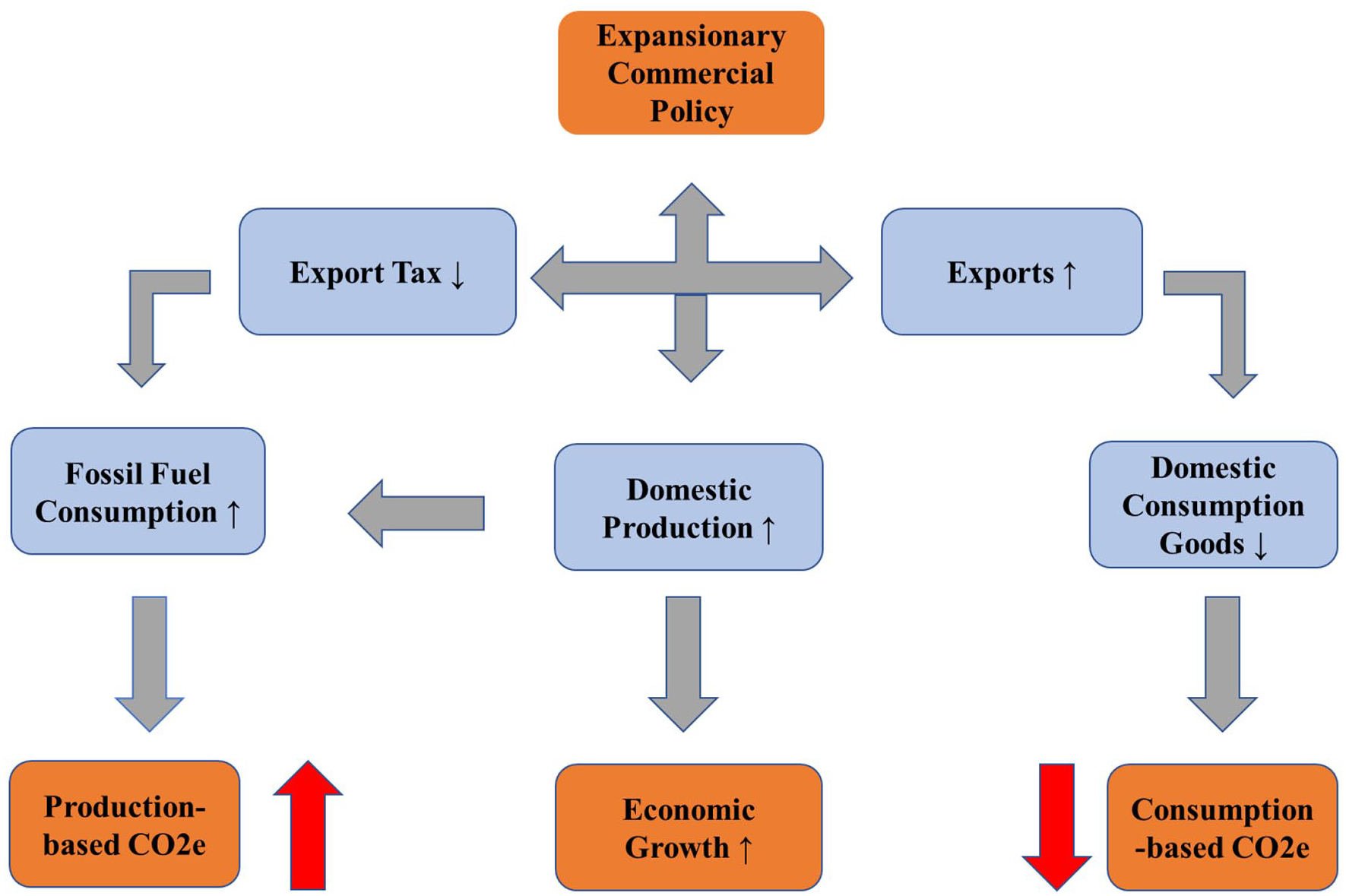
The theoretical impact of ECP on PCO2e and CCO2e.
Contrarily, the CCP is a situation in which the export taxes are increased by monetary authorities to increase national revenues managing oscillations in prices and catering to domestic consumption. The rise in the taxes makes the production process expensive for domestic producers, which curtails the production volume. Meanwhile, foreign consumers start to look for substitutes due to the high prices of the products. This process leads to the contraction of export volume. Also, it reduces the combustion of fossil fuels, which tends to decrease the PCO2e. However, due to a decline in exports ratio, more goods are available for domestic consumption, leading to increased CCO2e, as Figure 3 demonstrates the theory-based scenario. Thus, it is rational to investigate the effects of CCP on PCO2e and CCO2e.

The theoretical impact of CCP on PCO2e and CCO2e.
To insert the expansionary CP and contractionary CP in the model on base of aforementioned theoretical explanation, the following restrictions are imposed on the parameter of CP (Chishti et al., 2020; Qingquan et al., 2020):

Where


Where


After inserting CCP and ECP, the following equation is obtained:

The above equation illustrates that FFC, REC, L, ECP, and CCP are the critical determinants of consumption and production-based environmental pollution, while the other crucial drivers are not disregarded. Thereby, drivers such as imports, GDP, and globalization are also included in the model on the basis of the availability of a comprehensive explanation in the literature. Additionally, imports play a key role in determining the CO2e, and import taxes determine the imports level. So, it rational to analyze the effects of import taxes on (P,C) CO2e, expecting interesting findings. Hence imports are replaced with import taxes. After integration of the variables, we obtain equation (12):

Where

Analytical Framework
The study follows the following steps for analytical findings. Firstly, we apply cross-sectional dependence and heterogeneity tests that provide a rational base for choosing the more appropriate econometric analysis methods. Secondly, the second-generation unit root test is employed. Thirdly, we deploy the Westerlund cointegration test to testify the long-run association among the modeled series. Fourthly, cross-sectional autoregressive distributed lag (CS-ARDL) and common correlated effect mean group (CCEMG) approaches are utilized for the estimation purpose. Also, the augmented mean group (AMG) approach is applied in order to check the robustness of the findings. Lastly, the Dumitrescu Hurlin (DH) panel causality test (Dumitrescu Hurlin, 2012) is deployed to analyze the selected series’s causal nexus.
Cross-Sectional Dependence (CRSD) and Heterogeneity Tests
The cross-section dependence (CRSD) arises in the panel data sets on account of globalization, exports, and imports. Further, the spillover impacts of globalization stem from several global shocks such as oil price shocks and financial crisis shocks. To tackle this issue, the article adopts Pesaran’s (2004) CRSD test for efficient findings, as presented in the following equation:

Similarly, the study applies another important test, that is, slope heterogeneity test by Pesaran and Yamagata (2008) to confirm the heterogeneity among panel data series. Since the traditional test such as SURE (seemingly unrelated regression equation) cannot deal with heterogeneity and cross-sectional dependency, the second generation Pesaran and Yamagata’s test is opted to avoid the biasness in results. The equation of the test can be expressed as:


Where
Second Generation Unit Root Tests (SGUT)
Even though the first-generation unit root tests can be employed to confirm the integration order, these tests lead to inefficient results on account of cross-section dependency among the panel data series. Therefore, the article relies on the second-generation, that is, CIPS test, which provide the reliable findings even in the presence of cross-sectional dependency and heterogeneity (Pesaran and Yamagata, 2008). The equation of CIPS test can be presented as:

Where

Where CADF = cross-sectionally augmented dickey-fuller.
Westerlund Cointegration Test (WCT)
Next, the study deploys the second generation Westerlund (2007) cointegration test to check the long-run nexus among the selected series. The notable feature of this cointegration test is that it can compute the robust outcome in the presence of CRSD and heterogeneity. The Westerlund test’s equation can be expressed as:

Further, the test implies “no-cointegration” if the null hypothesis is accepted and confirms “cointegration” among modeled series if the alternative hypothesis is accepted.
Long-Run Estimates
At this stage, the paper estimates the long-run coefficients of selected variables that potentially affect the CCO2e and PCO2e. According to the pertinent literature, majority of the researchers depend on the first generation long-run estimators (For instance, FMOLS, DOLS, and ARDL), with the assumption of no cross-section dependency. However, this assumption can be objected on the basis of the factors (such as CCO2e, trade, and globalization used in the current article) that can be the cause of cross-section dependence in error terms. These unperceived common factors can concurrently influence both CCO2e and PCO2e. The correlation of these unperceived factors with regressors leads to cross-sectional dependency. In this situation, the application of traditional log-run estimators may produce biased findings, and similarly, in the presence of heterogeneity. To handle these issues, second generation, that is, CS-ARDL and CCEMG techniques are used. The equation of the CS ARDL approach can be written as:

Where

Where
Data
The current article tends to explore the dynamic effects of expansionary commercial policy (ECP), contractionary commercial policy (CCP), fossil fuel combustion (FFC), GDP growth, globalization (GLB), import taxes (MT), labor (L), and renewable energy consumption (REC) on consumption and production-based carbon emissions (CCO2e and PCO2e) for 1991 to 2016. Since the data for exports and imports taxes (the main variables of the study) is available only for limited developing economies, a sample of 10 developing economies (Argentina, Brazil, Dominican Republic, Indonesia, India, Mexico, Malaysia, Russian Federation, Thailand, and Ukraine) is selected on basis of the data availability. Further, export taxes, GDP, GLB, MT, L, MT, REC, CCO2e and PCO2e are calculated by % of tax revenue, constant USD (2010), KOF Index, % of tax revenue, % of total final energy consumption, and metric tons of CO2e emissions, respectively. Figures 4 to 7 depict the scenarios of CCO2e, PCO2e, CCP, and ECP in selected developing nations. Table 1 presents the details of modeled variables along with their sources.

Consumption-based CO2e in Metric tons, 1990 to 2016.

Production-based CO2e in Metric tons, 1990 to 2016.

Contractionary commercial policy.

Expansionary commercial policy.
Data Variables and Sources.

Results and Discussion
Before applying the unit root test to check the modeled series’ integration order, it is imperative to test the cross-sectional dependence and homogeneity among the series that help in adopting the more suitable econometric techniques for analysis. The CRSD test’s outcome confirms the presence of CRSD among the panel series since the test statistics are statistically significant. It rejects the null hypothesis of no cross-sections, implying that the shock in one of the selected economies tends to affect the other economies.
Similarly, the heterogeneity test provides evidence of heterogeneity since the test statistics of both (CCO2e and PCO2e) models are significant. Table 2 illustrates the details of both tests. The evidence of CRSD and slope heterogeneity indicates the traditional unit root test’s invalidity that generates biased results in this situation. Thereby, the study adopts the second-generation unit root (CIPS) test, as Table 3 presents the details. To investigate the selected variables’ integration order, the CIPS unit root test is utilized. This test considers the cross-sectional dependency stem from common factor and produces robust output. Further, it uses the lag of series in order to handle the problem of serial correlation. The CIPS findings exhibit that all the modeled variables tend to be stationary after the first difference that validates the application of cointegration test.
Cross-Sectional Dependence (CRSD) and Heterogeneity Tests.
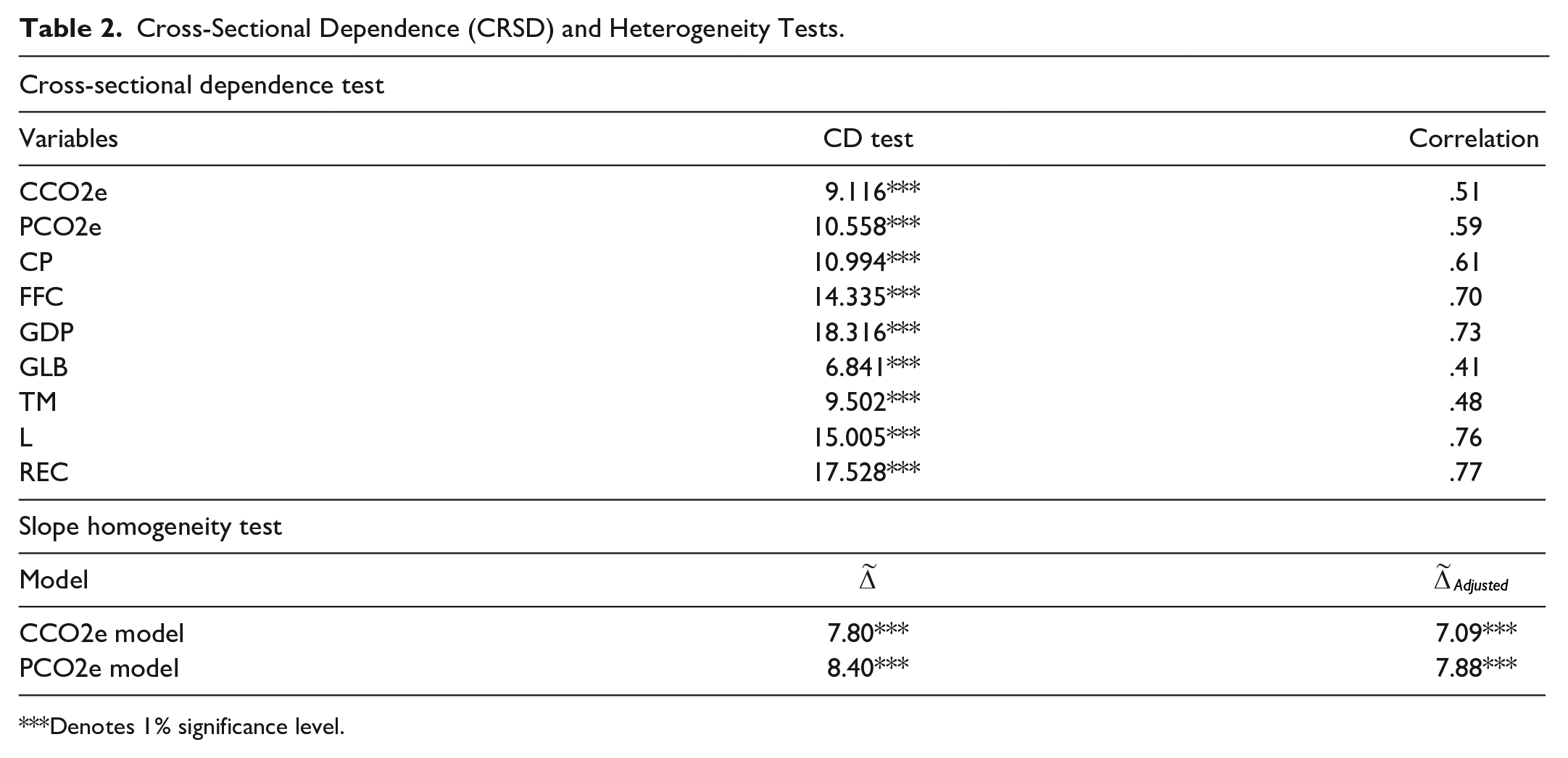
Denotes 1% significance level.
Second Generation Unit Root Test.
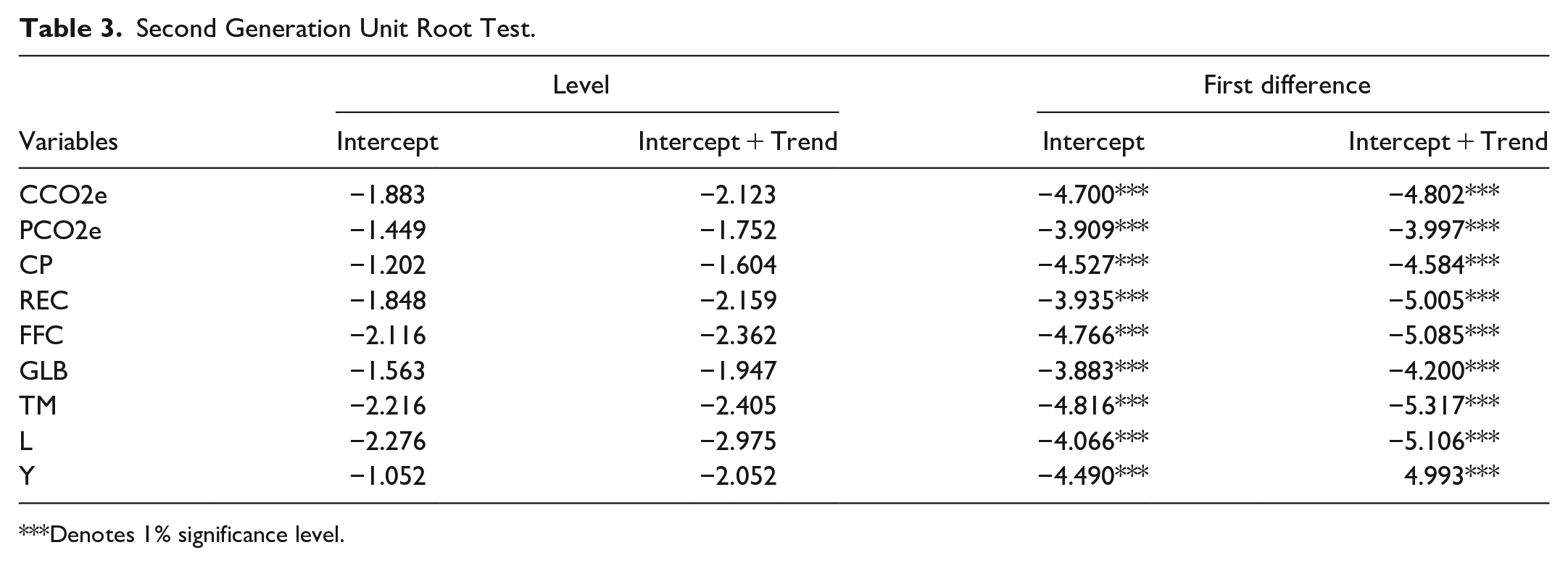
Denotes 1% significance level.
Since the previous tests affirm CRSD and heterogeneity in panel set, the study relies on the second generation Westerlund (2007) cointegration test that can handle the aforementioned issues and presents reliable results. The test’s findings assert the strong long-run association among the selected series of both CCO2e and PCO2e models, as Table 4 depicts. It indicates that any short-run deviation from equilibrium will get the adjustment in the long-run in both models.
Westerlund (2007) Test.

Denotes 1% significance level.
Next, we deploy CS ARDL and CCEMG techniques that produce a robust outcome in the presence of CRSD and heterogeneity in the data, unlike the traditional long-run estimators. Concentrating on the long-run estimates for CCO2e model reported in Table 5, the following interesting results are obtained.
Results of CCO2e Model.

, **, and *** denote the significance level at 1%, 5%, and 10%, correspondingly.
Firstly, the coefficients of CS ARDL and CCEMG determine that 1% increase in ECP tends to ameliorate the harmful repercussions of CCO2e in selected economies by 0.160%, and 0.123%, respectively. It implies that a downfall in export taxes significantly contributes to curbing the CCO2e. The reason being, the decline in the export taxes animates the local producers to boost the production due to lower production costs. Accordingly, foreign consumers prefer to purchase these low-cost products, which increases the goods’ demands. This international demand increases the opportunity of earning abnormal profit for domestic producers. Accordingly, producers enhance the production process to increase the volume of exports. Producers export more products to get more profit, which enhances the exports and fewer goods remain for domestic consumption. Since the increase in exports adversely affects the CCO2e, expansionary CP increases the export volume by reducing taxes on exports and decreases the CCO2e. In the context of the current study, the selected economies are contributing to the global economic growth by producing a large portion of exports (Such as the exports of Russia, India, Brazil, Thailand, Indonesia, and Mexico were $418.8, $322.8, $222.64, $245.3, $183.5, and $472.3 billion, respectively, in 2019). Consequently, these economies are rapidly moving toward sustainable development along-with reaping substantial benefits from exports. Further, the economists believe that such economies have enough potential to lead the globe toward economic development. Observing the exports-based development, these economies have substantially reduced the taxes on exports during the last decade (Gnangnon, 2020). Therefore, the results indicate that more the exports from these economies leads to decline in goods for domestic consumption, resulting in curtailing CCO2e.
On the contrary, 1% increase in CCP leads to intensifying the problem of CCO2e by 0.153% (CS ARDL) and 0.166% (CCEMG). It indicates that the surge in export taxes positively correlates with CCO2e. The plausible reason is that whenever the monetary authorities decide to expand the tax on exports to increase revenue and cater to domestic consumption, it makes the domestic production process expensive and unaffordable. It puts pressure on the producers to cut down the production immediately, on the one side. On the other hand, it makes the exports expensive, and subsequently, foreign consumers start to look for substitutes due to the high prices of the products and the export volume falls. However, due to the decline in exports ratio, more goods are available for domestic consumption, leading to increased CCO2e. Another possible reason is that the developing economies, as in the current study, suffer from the exigency of trade deficit, which indicates the high ratio of imports compared to exports. Since the imports are an integral part of CCO2e, a high rate of imports results in the rise of CCO2e. These are study’s distinctive findings that confirm the significant impacts of ECP and CCP on CCO2e for selected developing economies.
Secondly, the estimates of CS-ARDL and CCEMG reveal that the ratio of CCO2e expands by 0.506% and 0.454%, respectively, as producers of the selected countries enhance FFC by 1%. The reason behind this direct association is that FFC directly contributes in increasing the production-based CO2e that is the part of CCO2e (Bhattacharya et al., 2020). Therefore, FFC demonstrates a positive link with CCO2e. Thirdly, GDP shows a significantly positive link with CCO2e, indicating that 1% growth in GDP is responsible for 0.618% (CS-ARDL) and 0.615% (CCEMG) upsurge in CCO2e. The association of GDP growth with rapidly increasing CCO2e is a severe threat to developing economies’ environmental quality. Also, the same findings are reported by Khan et al. (2020) for G7 economies, Bhattacharya et al. (2020) for selected 70 countries.
Fourthly, globalization is among those factors that deteriorate the climatic quality as the estimates of CS-ARDL and CCEMG unveil that the CCO2e level rises by 0.219% and 0.122%, respectively, on account of 1% increase in globalization. Fifthly, the CS-ARDL and CCEMG methods confirm that the detrimental effects of CCO2e diminish by 0.303% and 0.284%, respectively, on account of 1% increase in import taxes. Apparently, most of the imports of under-developed economies are sensitive to the import taxes. Therefore, an increase in import taxes declines the import volume that is an integral part of the CCO2e. Consequently, the consumption-based CO2e tends to fall.
Sixthly, the labor force serves as an effective instrument that assists in mitigating CCO2e by 0.536% and 0.465% when the labor force increases by 1%. This outcome suggests that the people of growing economies are aware of the importance of environmental quality and prefer to consume environmentally-friendly goods. Lastly, the CS-ARDL and CCEMG estimators exhibit that an increase in the use of REC by 1% will disrupt CCO2e by 0.061% and 0.088%, respectively. This finding is in line with the results of Khan et al. (2020) and Ding et al. (2021). Beyond that, the short-run estimates of CS-ARDL demonstrate that an increase in CCP, FFC, GDP, GLB, and IM by 1% is responsible for generating the adverse effects of CCO2e by 0.182%, 0.472%, 0.802%, 0.113%, and 0.261%, respectively. Furthermore, the value of ECM is 0.583, suggesting a speedy recovery from any short-run disequilibrium in the long-run.
As for the long-run estimates for the PCO2e model, the study infers the following interesting results as Table 6 reports. Firstly, the coefficients of CS-ARDL and CCEMG state that the deleterious effects of PCO2e scale up by 0.232% and 0.174%, sequentially, on account of the rise in ECP by 1%. It signifies that a decrease in export taxes leads to an increase in production-based CO2e. Possibly, the reduction in export taxes urges boosting the production process due to lower production costs, on one side. On the other side, international consumers also enhance the demand for low-priced goods, which attract domestic producers to increase the export volume by increasing production. The whole process expands the FFC that triggers the PCO2e. Another possibility is that domestic producers deploy dirty and less-environmentally-friendly technologies to maximize exports for more profits. It also leads to an increase in the issue of PCO2e.
Results of PCO2e model.

, **, and *** denote the significance level at 1%, 5%, and 10%, correspondingly.
Contrarily, CCP significantly reduces the PCO2e by 0.104% (CS-ARDL) and 0.096% (CCEMG) as the export taxes rise by 1%. The rationale behind this is: whenever monetary authorities decide to enhance the taxes in exports to generate more revenue, it makes the exports and domestic production process expensive. Subsequently, the production of goods dwindles that curtails the FFC, resulting in lower PCO2e. These are also remarkable results that affirm the statistically significant link between fluctuations in CP and PCO2e.
Secondly, the results of CS-ARDL and CCEMG report that the ratio of PCO2e inflates by 0.744% and 0.670%, respectively, as the producers proliferate FFC by 1%. Thirdly, the GDP rise by 1% signifies the environmental threat for developing economies by increasing the PCO2e by 0.712% (CS-ARDL) and 0.681% (CCEMG). These findings are consistent with erstwhile studies by Ding et al. (2021) and Bhattacharya et al. (2020). Fourthly, the estimates of CS-ARDL and CCEMG reveal that globalization significantly degrades the climate as PCO2e tends to increase when globalization improves by 1%. It seems that globalization causes to boost competition among local manufacturers, especially in profits and low prices. To this end, domestic manufacturers deploy cheap and dirty methods to produce low-cost goods. This process causes to intensify the PCO2e.
Fifthly, the import taxes demonstrate a sensitive association with PCO2e such that 1% upsurge in import taxes leads to reduce production-based CO2e by 0.108% (CS-ARDL) and 0.083% (CCEMG). The likely reason is that the high ratio of taxes on imports makes the raw material expensive for producers. Due to this, producers disrupt the production process that results in low PCO2e. Sixthly, the findings show the negative association between the labor force and PCO2e, since 1% increase in labor shrinks the production-based CO2e by 0.408% (CS-ARDL) and 0.375% (CCEMG). This outcome implies that the labor force prefers to work in such firms that employ environmentally-friendly technologies. Lastly, the coefficients of CS-ARDL and CCEMG exhibit that the trend of PCO2e ratio plummets as producers enhance the use of REC by 1%. Besides, the short-run estimates of CS-ARDL are also reported in 6. The findings determine that pernicious effects of PCO2e enlarge by 0.271%, 0.878%, 0.862%, and 0.265% on account of an increase in ECP, FFC, GDP, and GLB by 1%, respectively. Also, a speedy recovery from any short-run disequilibrium is observed.
To confirm the robustness of the estimates of both models, the current paper deploys AMG technique as Table 7 depicts. Fascinatingly, the coefficients of AMG substantially support the estimates of CS-ARDL and CCEMG methods. The estimates of AMG seem smaller than that of CCEMG since the later technique generates larger elasticities than the former. To be specific, the elasticities of ECP, CCP, FFC, GDP, GLB, MT, L, and REC for CCO2e model are −0.103%, 0.149%, 0.434%, 0.583%, −0.104%, −0.264%, −0.427%, and −0.078%, respectively. Further, the elasticities of ECP, CCP, FFC, GDP, GLB, MT, L, and REC for PCO2e model are 0.165%, −0.075%, 0.573%, 0.662%, −0.132%, −0.073%, −0.350% and 0.048%, respectively.
Robustness Test.

, **, and *** denote the significance level at 1%, 5%, and 10%, correspondingly.
Finally, the estimates of DH causality test unveil that ECP, CCP, FFC, GDP, GLB, MT, L, and REC granger cause CCO2e and PCO2e in selected developing economies. This one-way causality indicates that any policy used to target these determinants significantly affects the CCO2e and PCO2e. However, any policy shocks targeting the CCO2e and PCO2e do not possess any impact on these factors. Interestingly, the results confirm that expansionary and contractionary commercial policy significantly granger cause the CCO2e and PCO2e as Table 8 reports the details.
Dumitrescu Hurlin Panel Causality Tests.

Conclusion
The current article extends the existing literature introducing expansionary and contractionary commercial policies (ECP and CCP) as new drivers of environmental quality, and examines their plausible effects along-with some other controlled variables on both CCO2e and PCO2e for the selected developing economies. Several second-generation tests (CRSD test, slope homogeneity test, and CIPS test) and techniques (CS-ARDL, CCEMG, and AMG) are employed to tackle cross-sectional dependency and heterogeneity in panel data. The estimates of CS-ARDL and CCEMG techniques determine several interesting findings. As for the CCO2e model results, ECP, labor, import taxes (MT), and renewable energy consumption (REC) significantly mitigate the detrimental effects of CCO2e. However, CCP, GDP, globalization, and fossil fuels are responsible for exacerbating the CCO2e.
In the case of the PCO2e model, ECP, GDP, FFC, and globalization significantly increase the ratio of PCO2e in developing economies. On the other hand, CCP, labor, MT, and REC play a critical role in disrupting the PCO2e. Beyond that, the short-run findings of CS-ARDL for CCO2e and PCO2e are consistent with the long-run estimates of CS-ARDL, correspondingly. Also, the robustness check of the AMG approach significantly supports the previous results. The application causality test confirms the one-way causal relationships which run from independent to dependent side variables.
Based on the results explained above, the study suggests the following recommendations. Firstly, EPC significantly ameliorates the environmental quality, while CCP deteriorates it. Our findings suggest to implement “green and eco-friendly commercial policies.” In other words, the monetary authorities should target only those manufacturers that deploy cheap and dirty technologies for production and impose higher exports taxes on them. Also, Govt should introduce a “green subsidy program” for encouraging exporting-producers to use green technologies for the production process. Secondly, import taxes improves the green environment by curtailing CCO2e and PCO2e. It does not mean to impose a high tax ratio on imports since this step may negatively affect the trade agreements. Instead, the authorities should target only such imports that cause harm the environmental quality by levying higher taxes. Also, govt should acquaint the public with the importance of the green environment and motivate them to demand and consume eco-friendly goods. It will result in encouraging the importers to import the green-consumers’ goods.
Thirdly, GDP growth and FFC are the basic and significant contributors to CCO2e and PCO2e. To handle this situation, govt should launch a “green energy program” at a large scale to persuade the producers to deploy environmentally-friendly production methods. The producers using green technologies, that is, renewable energy, should be substantially compensated through subsidies that may be an effective step toward green environment. Also, a low-tax scheme for green-technology using producers to enhance the green-production may also play a considerable role in reducing environmental pollution. Lastly, globalization degrades the environment by increasing CCO2e and PCO2e in developing economies in our case. The authorities should prefer to allow such international investors and multinational companies that deploy green energy technologies on a priority basis.
Besides, there are some limitations in the current study, which may assist in divulging some new dimensions for future research. This paper concentrates on the sample of selected developing economies by introducing new determinants of the environmental quality; however, the same model can be testified for G7, G20, and OECD economies. Further, the current findings are based on a linear model; the application of non-linear modeling can be utilized to check the likely asymmetric effects of commercial policies on CCO2e and PCO2e in the future. The researcher can also enrich the current study model by including some other factors (such as financial innovation, global value chain, consumer behavior, tourism, and real interest rate).
Footnotes
Declaration of Conflicting Interests
The author(s) declared no potential conflicts of interest with respect to the research, authorship, and/or publication of this article.
Funding
The author(s) received no financial support for the research, authorship, and/or publication of this article.
