



Abstract
In second language teacher education programs microteaching has always been a significant technique to help bridge theory to practice and prepare the trainees for real classroom contexts. The expected benefits from 10 to 15 minute-microteaching sessions are the communication among the trainees and supervisor, collaboration with each other, and reflection on the teaching. However, due to some constraints such as limited time and big class size, these benefits may not be derived easily. Therefore, this study aims to explore how the effect of a designed Internet-based instructional learning environment (hereafter iBILE) was perceived by the participating preservice teachers on developing their communication, collaboration and reflection in microteaching process. In so doing, 52 Kurdish preservice English language teachers were asked to use the iBILE for 6 weeks. Both quantitative and qualitative data were collected from questionnaires, the system analytics, reflection journals, and semi-structured interviews. The results of the data analysis revealed that the designed iBILE has been perceived highly effective in solving the defined microteaching problems by creating unique opportunities for communication, collaboration, and reflection in microteaching process among the preservice teachers.
Introduction
In second language teacher education, one of the major discussions is related to how to close the gap between theory and practice so that teacher candidates become better prepared for real-classroom situations (Burns & Richards, 2009; Ching, 2014; Freeman & Johnson, 1998; Retelj & Puljić, 2016; Ünver, 2014). To this end, microteaching has been employed as a technique to provide a scaled-down teaching context where training is reduced in scope, done for a short period of time (usually 10–15 minutes), normally limited to one skill or lesson aspect at a time (such as teaching vocabulary, or doing only the pre-reading tasks), and the learners being usually fellow trainees (He & Yan, 2011; Roberts, 1998; Singh, 2010). Trainees usually go through four stages in the microteaching process. The first stage is the “preparation” stage in which the trainee receives theoretical information about the skills to be practiced and the method(s) to be used. In the “teach” stage, the trainee is expected to put into practice what s/he has planned and the other trainees play the role of learners. At this stage, the microteaching can be videotaped. The third stage is the “critique” stage in which the trainee’s microteaching is reviewed, analyzed and discussed in a constructive manner. Finally, in the “re-teach” stage, the trainee re-teaches the microteaching, not necessarily immediately, applying those points given in the previous stage (He & Yan, 2011; Wahba, 1999; Wallace, 1991). However, this stage is sometimes not applied due to time pressure or other contextual factors.
Although microteaching is criticized to be artificial and have limited connection to preservice teachers’ real-life classroom practice (He & Yan, 2011), studies have shown that it is still a useful tool for preservice teachers’ professional development as it offers them a safe environment in which they can teach and re-teach until they gain confidence (Fernández, 2010; Legutke & Ditfurth, 2009; Mergler & Tangen, 2010). Nowadays, research has called for a new form of microteaching in a manner that communication and collaboration (Cinici, 2016; Diana, 2013; Kpanja, 2001) and reflection (Amobi, 2005; Donnelly & Fitzmaurice, 2011; I’anson et al., 2003; Lin, 2014) are essential in developing preservice teachers’ microteaching practice. In fact, this recent understanding of microteaching aligns with social constructivist view (based on Vygotsky’s notion of the “zone of proximal development”) as a model of professional development that inspires current trainers in the design of English Language Teacher Education (ELTE) programs.
Microteaching as a component of social constructivist teacher education values the dialog, which is collaborative and task-focused talk, offering at the same time social relationships that support changing views of self as a teacher. Being a member in a “community of practice” (Lave & Wenger, 1991), preservice teachers work together (i.e., mutually engaged) for a joint enterprise (i.e., microteaching) by using a shared repertoire (i.e., commonly accepted terms, strategies, and techniques about teaching). This kind of interactions and relationships with others (i.e., peers and the instructor) helps the preservice teachers construct their professional knowledge and skills as well as their professional identity (Mergler & Tangen, 2010). For example, in the microteaching process, preservice teachers, through their community of practice (e.g., their peers and teacher), communicate and collaborate about and reflect on different microteaching performances, which help them to construct and adopt identity positions for themselves (Bucholtz & Hall, 2005). Additionally, studies have shown that preservice teachers develop and construct an identity of “preferred” or “effective” teacher through the examination of self and peers’ microteaching performances (Bell, 2007; Mergler & Tangen, 2010; Zacharias, 2016).
To increase the opportunities for communication, collaboration, and reflection during the course of learning how to teach, integrating technology into the microteaching process has been reported very effective in the related literature (Bozyiğit, 2015; Ekpo-Eloma et al., 2013; Ostrosky et al., 2013; Punia, 2013; Savas, 2012; Serdar Tülüce & Çeçen, 2018). Justifiably, research has shown that new technology can be considered as a relevant resource to enhance learning interactions and provide students with a great amount of time utilizing learning materials and sharing ideas (Arteaga Sánchez et al., 2014; Lee & Tsai, 2011). The recording feature of technology (e.g., videos) is one of the most common uses of technology in microteaching process, in which preservice teachers share their microteaching videos and then the peers and teacher review them together, gather data from them, and provide constructive feedback to the student who shared the video. This has been confirmed as an effective feature for improving both peer-to-peer and student-to-teacher communication (Bodis et al., 2020; He & Yan, 2011; Tripp & Rich, 2012) and giving and receiving feedback, self-reflection and collaborative learning (Bozyiğit, 2015; Savas, 2012; Serdar Tülüce & Çeçen, 2018). Moreover, the recording feature of technology, combined with the features of the Web, provides far better asynchronous opportunities for communication, collaboration, and reflection among preservice teachers and teacher educators during the practice of microteaching than such opportunities in the traditional face-to-face microteaching. For instance, online microteaching provides learners with self-paced learning and practicing by joining a discussion with partners since they can pause, forward, or rewind a microteaching video clip uploaded on the online platform (So, 2009). Furthermore, online microteaching creates more opportunities for critical thinking and reflective actions among the learners who are observing the practices through reading the comments and responses made by peers in the discussion board (Kusmawan, 2017). To add more, a review by the U.S. Department of Education, Office of Planning, Evaluation, and Policy Development (2009) on studies conducted between 1996 and 2008 about specific design features of online instruction has showed that the presence or absence of specific technology tools like discussion boards and the degree of interaction among students or with teachers are among the determining factors of the success of failure of online instruction. More recently, in their review of studies on the design features of online instructional learning environment Jaggars and Xu (2016) found that the extent to which interpersonal interaction on the learning environment is strong and diverse is an essential design feature of such learning environments.
The English language teacher education (ELTE) program in which this study was conducted is part of a public university in Kurdistan region of Iraq. The program follows the rationalist (Schön, 1983) view of teacher education, that is, the learn-the-theory-and-then-apply-it model (Ur, 1992), which is currently practiced in the public universities of Kurdistan region of Iraq. The duration of the program, like any other ELTE programs in the region, is 4 years. The curriculum accommodates on-campus courses in four major components: language development courses (vocabulary and grammar, listening, speaking, reading, and writing), linguistics-related courses (linguistics, pragmatics, stylistics, lexicology), English literature, and English language teaching methodology. The fourth year courses focus on both on-campus (classroom management, language assessment, materials development) and off-campus courses (school observation and practicum).
English Language Teaching (ELT) Methodology course, which is offered in both semesters of the third year, focuses on the integration of theories and practice to prepare the students basically for their teaching practicum in the fourth academic year and their future career as English teachers in basic and high schools in the region. One of the commonly used tools for bridging theory to practice in the course is microteaching. It is usually practiced for 7 weeks in the spring semester after the provision of theoretical aspects such as understanding learners and teachers, classroom management, and lesson planning.
However, in most ELTE programs, including the one under investigation, in Kurdistan region of Iraq, microteaching is not practiced effectively. Based on the observation of the first author as an insider and teacher educator in the region, ELTE programs follow the traditional and behaviorist practice of microteaching in which the focus is mostly on outcome rather than performance (Ralph, 2014; Wright, 2010). As a result, communication, collaboration, and reflection on the microteaching sessions are extremely limited due to crowded classrooms (usually over 30 students in each classroom) and limited class time (1–2 hours of microteaching per week). These contextual problems were confirmed in informal interviews with two teacher educators who have taught ELT Methodology course and conducted microteaching sessions in the past 3 years in the research context. Other reasons for insufficient practice of microteaching in Iraq and Kurdistan region were reported in some local studies (e.g., Al-Azawei et al., 2016; Ali, 2010) as teacher educators’ improper readiness, discouragement and lack of enough knowledge of using instructional technologies in their teaching process. As a result, the current practice of microteaching is far from the modern and socio-constructivist view of microteaching in which collaborative and reflective practice and integration of modern technology are essential for the preparation of language teachers. Therefore, the preservice English language teachers in the region seem to have been underprepared for both the practicum and future teacher profession.
In order to address this problem, an internet-based instructional learning environment was designed and implemented, and its effects on preservice teachers were explored as regards their microteaching practice. More specifically, the following research question was explored: what are the preservice teachers’ perceptions about the effectiveness of the internet-based instructional learning environment (iBILE) for enhancing their communication and reflection in microteaching practice?
Materials and Method
Research Approach
To address the above-mentioned problem, this study adapted Andriessen’s (2008) model for the research design. The model, which is the combination of both design-based research and action research, consists of two different but complementary streams (Figure 1). The first stream is knowledge stream, which aims to improve the generalizable knowledge that “can help create desired situations. . . preferably in a way that contributes to theory” (Andriessen, 2008, p. 129). In this stream, the design-based research is employed to bridge the gap between theory and practice by designing and implementing an intervention to solve the contextual problem and develop learning and teaching in a particular educational learning environment (The Design-Based Research Collective, 2003). The practice stream, on the other hand, attempts to “contribute to the practical concerns of people in problematic situations, by solving their problems in specific circumstances” (p. 129). In addition, this stream represents the action research since it reflects the practitioner’s (i.e., first author) problematizing stance toward his teaching context, in which he focuses on an area of practice (i.e., microteaching) that is worth looking into more deeply and subject to questioning with the aim of improving it and finding solutions to the problematic area (Burns, 2015).

Adapted version of Andriessen’s (2008) model.
In knowledge stream, agenda setting is related to defining a contextual problem (i.e., insufficient practice of microteaching in this study) which is important in educational settings and solving it will enhance the quality of education in the setting (Andriessen, 2008; Reeves, 2006). Designing stage, furthermore, aims at developing an initial solution concept for the problem. In so doing, the suitable design principles reported in Oliver and Herrington (2001) were integrated into an advanced technological platform (e.g., Schoology) to find possible solutions to the contextual problem. In the diagnosing step, the relationship between the contextual problem and the design solution is checked to see if the problem and the application domain are congruent. At this stage, as Andriessen (2008) recommends, “outsiders” (i.e., people who are not involved in the design) should test the solution concept to check whether “the quality of implementation of the solution concept depends on the knowledge of the designer of the concept” (p. 130). To ensure this, university professors who are experts in the field of Computer Education and Instructional Technology were asked to test and evaluate the designed intervention before the implementation process. The action taking and evaluating stages of the model refer to the implementation of the design solution in the education context and evaluating the effectiveness of the designed solution on solving the contextual problem, respectively. Finally, in the reflecting level, researchers reflect on their analysis of data, and share their experiences and the result of their research so that they guide future research in similar educational practices (Ozverir, 2014).
The Designed Solution Concept (iBILE)
As stated above, in order to improve the microteaching practice, an Internet-based instructional learning environment (iBILE) was designed, following Oliver and Herrington’s (2001) model of web-based instructional learning environment. It accommodated learning resources, learning tasks and learning supports, and was implemented in the research context for 6 weeks. As a platform on which the iBILE was designed and delivered, Schoology was used. The reason for choosing Schoology as the platform was that it was chosen as the best educational learning management system in 2013, 2014, and 2015 (Irawan et al., 2017), and was free of charge.
After the iBILE was designed, preservice teachers taking the Methodology course were asked to create a personal account using their email and password, then enter the access code given by their course instructor. The iBILE comprised five basic sections, which basically represent the stages of doing microteaching process. They were “introduction,” “preparation and planning,” “teaching process,” “giving and receiving feedback,” and “evaluating peers” microteaching’. Firstly, in the introduction section preservice teachers were provided with necessary information about microteaching and using that platform with the help of visuals, written documents and hyperlinks. In the other sections the preservice teachers were exposed to both theoretical knowledge about the topic (i.e., microteaching) through learning supports and learning resources and practical opportunities in a form of learning tasks, collaborative activities, discussion boards, and some assessment tools. It is worth noting that at the end of each section a particular option was given by which the users could ask questions, add comments, and share their ideas and reflections about the topic. Figure 2 presents the details given in each section on the iBILE.
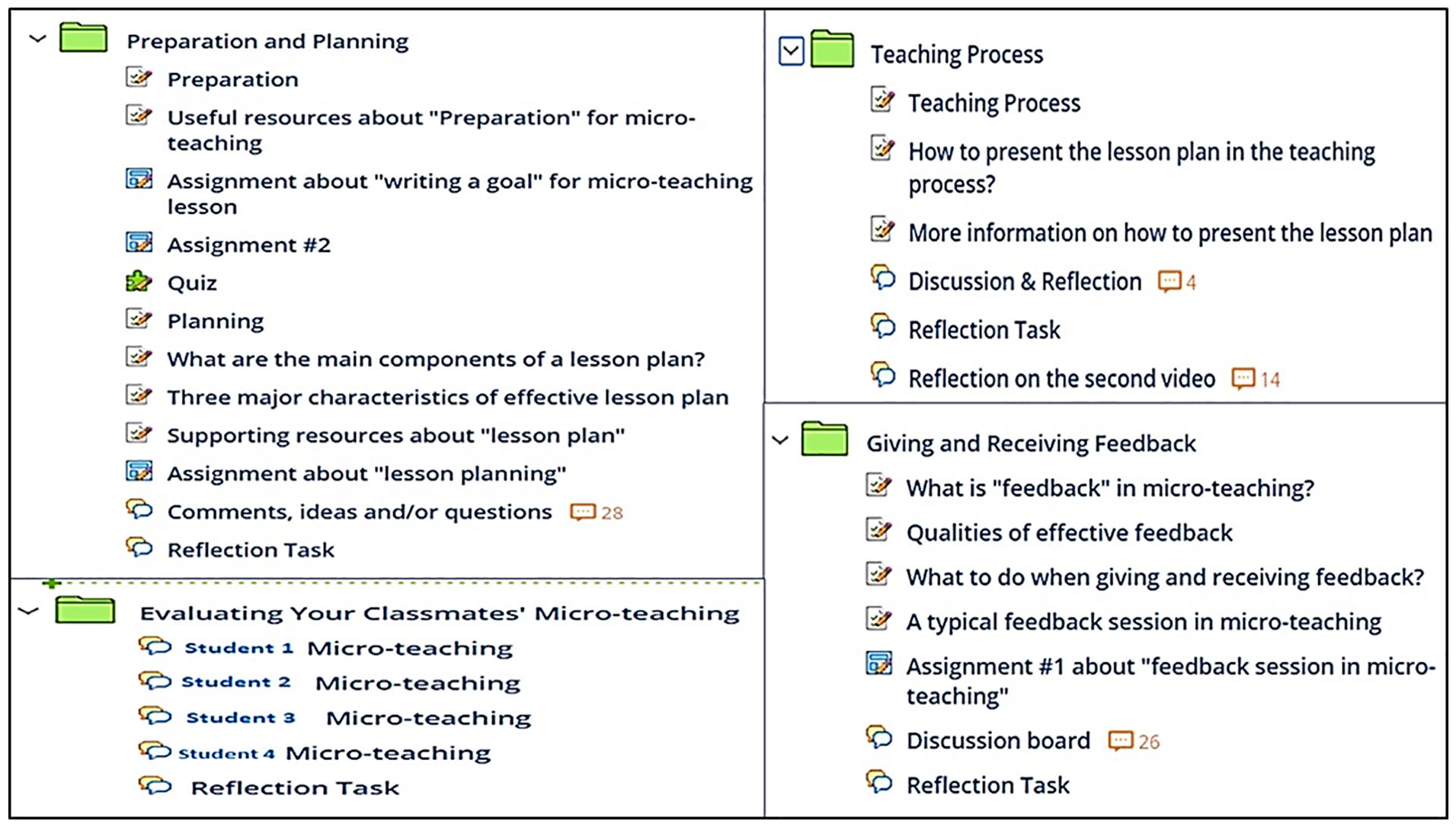
Snapshots of the content of iBILE sections.
In addition, the iBILE also included many tasks and activities to help the preservice teachers enhance their communication, collaboration and reflection about the microteaching process (Figure 3). The tasks and activities were structured in such a manner that necessary and clear instructions and guidance were provided for the preservice teachers about how to do the tasks and activities. In addition, for evaluating the microteaching videos in the reflection tasks, the preservice teachers were required to use a particular checklist provided on the iBILE.

Sample tasks and activities of different sections on iBILE.
Instructional Setting and Participants
The instructional setting of the study was the English language teacher education program in the College of Education at the University of Raparin, a public university located in Kurdistan region of Iraq. The department aims at preparing the students for becoming English language teachers at Intermediate (Grades 7–9) and High (Grades 10–12) schools. The participants were 52 Kurdish third-year preservice English language teachers (23 males and 29 females) and their age range was between 21 and 26 years. As part of the ethical aspects of the research, the participants granted consent for participation after the researchers informed them that their data on the iBILE would be used for the research purposes and their identity would be kept anonymous when reporting the research results. Prior to the participants’ engagement with the iBILE, they were provided with 1-week training session by the first author of this study to familiarize them with the procedures of using the learning environment.
Data Collection
The study utilized a mixed-methods, also known as “multiple methods” (Creswell, 1999), research of inquiry as it involves mixing both quantitative and qualitative methods of data collection and analysis (Creswell, 1999) and includes multiple and various methods for gathering, analyzing, and representing the contextual and educational problem (i.e., insufficient practice of microteaching) within a particular framework (Greene, 2005). There is a wide consensus that using such research method can strengthen a study in a way that since all data collection methods have limitations, the use of mixed-methods can neutralize some of the disadvantages of certain methods and provides deeper understanding of social and contextual issues (Creswell, 1999; Greene, 2005; Greene et al., 1989; Johnson & Onwuegbuzie, 2004). In this sense, one of the data collection methods employed in this study was the quantitative data, which were obtained after the iBILE implementation period (i.e., 6 weeks) from two major sources. First, a self-designed questionnaire was used to gather the participants’ perceptions about the effect of the implemented learning environment. The questionnaire comprised 10 items in a 5-point Likert-scale, ranging from 1 (strongly agree) to 5 (strongly disagree). The items in the questionnaire were adapted from some related studies such as Ismail (2011), Koc and Ilya (2016), Lee and Wu (2006), Okan and Taraf (2013), Sadik (2002), and Savas (2012). Before administering the questionnaire, it was piloted with a group of 28 third-year students to check its reliability. Upon their feedback, a few items were reworded for clarification purposes. Then, the final version of the questionnaire was created and double-checked for the reliability purpose through employing reliability analysis in the Statistical Package for the Social Sciences (SPSS) program Version 20, which produced the Cronbach’s alpha score of .87.
The second source of quantitative data collection was the iBILE analytics, which is a design feature of the learning management system (i.e., Schoology) and provides automatic calculations about the time spent on the online course and number of comments posted by the users. In this source of data, time they spent on communication and collaboration, and the number of discussion and reflection comments they made were calculated as a means of assessing the effectiveness of the learning environment on solving the contextual problem.
The qualitative data, on the other hand, were collected from two different tools. First, the students were required to keep reflection journals during the iBILE implementation period and record their reflections on regular and predetermined intervals (e.g., at the end of every week) about how using the iBILE helped them develop communication, collaboration, and reflection about the microteaching process. The participants were given necessary guidance for writing the journals during the implementation period. It is worth noting that writing reflection journals was part of the students’ evaluation procedure in the ELT Methodology course to encourage them to write genuine and full reflections they had during their experience with the use of the learning environment. At the end of the data collection period, all participants produced six entries in their reflection journals, each entry being around minimum one-page long.
The other tool of qualitative data collection was semi-structured interviews which were conducted after the iBILE implementation period. In this respect, 10 participants were randomly selected for the interviews and asked to share their experience with the use of iBILE by responding to some questions like what have you learned from the use of the iBILE? How has the iBILE helped you develop the practice of microteaching? Do you think the iBILE has created more chances for communication and collaboration with your classmates and teacher? How? The interviews (coded as i1, i2, i3, i4, i standing for the interviewer) were audio recorded and then transcribed for further analysis.
Data Analysis
The quantitative data were analyzed by means of descriptive statistics (i.e., mean, frequencies, and standard deviation) by using the SPSS, Version 20, software program. In order to see the agreed and disagreed items at nominal level more clearly, strongly agree and agree scales as well as disagree and strongly disagree scales were combined. The qualitative data, on the other hand, were analyzed by following Braun and Clarke’s (2006) method of thematic analysis to identify, analyze and report themes (i.e., codes or patterns) within qualitative data. Initially, the whole data were read and reread to get familiarized with it, and notes were taken. Then, ideas were basically coded as positive and negative, which were later organized into themes and sub-themes. The themes were refined by reviewing and checking whether they work in relation to the coded extracts and the entire data set. For the reliability of coding, the first and second authors independently coded half of the data, and then compared their codes and themes. Seeing that the interrater reliability was satisfactorily high (85%), the first author continued conducting the rest of the analysis by himself. Finally, after getting satisfied that the thematic map truly represents the whole data from what the participants shared in their reflection journals and interview transcripts, the reporting stage started.
Results
The analysis of quantitative and qualitative data obtained from the data collection tools revealed the following results. To begin with the quantitative data, the analysis of the questionnaires showed that a considerably high percentage of the participants perceived that the iBILE was highly effective in improving their collaboration and communication for microteaching purposes (Table 1).
Perceptions on the Impact of the iBILE on Improving Communication and Collaboration for Microteaching.

Note. SA = strongly agree; A = agree; N = neutral; D = disagree; SDi = strongly disagree; M = mean; SD = standard deviation.
More specifically, in items 4, 8, and 10, all participants asserted that the iBILE enhanced their communication and collaboration for microteaching between themselves and the teacher (Mean = 1.5, SD = 0.51, % = 100), created an environment for exchanging their ideas about microteaching (Mean = 1.3, SD = 0.48, % = 100), and was a rich multimedia platform for their microteaching purposes (Mean = 1.4, SD = 0.50, % = 100), respectively. Moreover, in both items 2 and 7, a high percentage of the participants held the belief that the iBILE provided a chance to share their ideas about microteaching components with no fear of time limitation (Mean = 1.3, SD = 0.58, % = 95) and created an academic group having the same needs and interests about microteaching (Mean = 1.7, SD = 0.63, % = 90). However, only 1.5% of the participants perceived that the iBILE did not have influence on enhancing their communication and collaboration about microteaching.
As for the results of the iBILE analytics, which was the second source of quantitative data, the total time spent on the iBILE by all participants was 299 hours. These hours represented the total time spent on utilizing the learning environment for reading information and posting and replying comments. Moreover, among these hours, a considerable amount of this time was spent on communication and collaboration activities due to the big number of comments and discussion posts made by the participants. As presented in Table 2, the participants posted a total of 734 discussion comments during their use of the iBILE, in which 426 posts were reflection comments in the reflection tasks provided on the iBILE on each other’s posts and uploaded microteaching videos, and 308 posts were discussion questions, ideas and other comments shared for microteaching purposes.
Analytical Distribution of the Discussion Comments.

It is noteworthy that the participants had more communication and collaboration when reflecting on the recorded microteaching videos because peer discussions and reflection posts occurred in this section more than the other discussion categories.
As for the qualitative data, supporting results were found after the data were analyzed . One of the themes emerged from the analysis of both reflection journals and semi-structured interviews was communication and collaboration with the classmates. For example, one of the participants (coded as p26, p standing for participant) reflected in the reflection journal as: This system [iBILE] was really helpful for sharing my ideas with my classmates and having more time to talk to my friends [i.e., classmates] and share my ideas with them about microteaching issues. Whenever I had a question about microteaching, I could post it and my friends answered it. (p26)
It can be understood from this reflection that the iBILE helped the preservice teachers create opportunities for communication and collaboration about microteaching issues. More specifically, it was extracted in most of the reflections that using the iBILE aided them to stay connected with their classmates mostly outside the classroom, they had continuous communication, and helped each other through exchanging ideas and answering each other’s questions on the iBILE, especially while doing the assignments, reflection tasks, and asking discussion questions. Moreover, another participant wrote in his journal like: This way of doing microteaching [i.e., using the iBILE] was very effective in a way that I felt the microteaching classroom is in my mobile. When I was on the system after the lesson, I saw my friends online and we could share ideas and problems about microteaching issues and help each other by answering questions and in doing assignments. (p44)
It is also apparent from this reflection that the iBILE improved the preservice teachers’ communication and collaboration skills among themselves beyond the classroom boundaries as they stayed connected even outside the classroom for sharing ideas and solving each other’s problems about the microteaching issues. Indeed, such advantages are hardly achieved inside the classroom due to big class size and time limitation of the lectures. Justifiably, one of the interviewees responded to the related interview question as: In the classroom we mostly do not have enough time to share our ideas and comments because we have a crowded classroom; it is also true for microteaching classes. But this system was really great; I could share my comments, ideas and any questions about microteaching any time and everywhere. I felt like the classroom is in my pocket. (i5)
Despite the effectiveness of the iBILE on improving peer-to-peer communication, it was also found that the iBILE also developed student-to-teacher communication and collaboration. For instance, one of the participants showed in her reflection journal as: Sometimes our teacher answered our questions. That was very good because did not need to wait until next class to get the answers and ideas from my teacher. (p13)
Respondents in the interviews also reported that the iBILE was a good opportunity for communicating with the teacher and was available for helping the students and collaborating with them. For example, one of the interviewees responded as: This online system created a lot of communication and collaboration among us and our teacher; everyone could express his or her ideas and comments; we all instructed each other to solve microteaching problems. (i7)
The last theme emerged from the analysis of the qualitative data was developing reflection skills. Most of the participants reported that their reflection skills were developed through the information about the reflection process in microteaching (as a component of the iBILE) and, more specifically, critiquing the uploaded microteaching videos (as either assignments or reflection tasks) given on the iBILE. For instance, in one of the journals, it was reported: By using this internet-based system, I learned how to evaluate somebody’s microteaching and how to give feedback to it. There were many resources about how to evaluate microteaching, and also it included microteaching videos of my friends. I could watch them at home many times to evaluate them, and share my comments with everyone. Maybe I did not have this chance in the classroom. (p38)
Using the iBILE provided an affordance for the preservice teachers to improve their reflection and critique skills through watching the microteaching videos of their peers, evaluating them, and sharing comments about them. Such usefulness was also confirmed by an interviewee who reported as: This website taught me how to give constructive feedback and how to get it from my friends during microteaching. If we did not have this website, we wouldn’t have time for giving feedback to our classmates when doing microteaching; but here we could share our ideas, give comments and feedback to our classmates whenever and wherever we are; even at home. (i8)
As a result, the analysis of both quantitative and qualitative data reveals that the iBILE had a considerable impact on enhancing peer-to-peer and student-to-teacher communication and collaboration and the preservice teachers’ reflection skills. In addition, the iBILE removed both time and place constraints as the preservice teachers and teacher educator could communicate with each other anywhere and anytime outside the classroom.
Discussion and Conclusion
This present study aimed to explore to what degree the designed Internet-based learning environment (iBILE) was perceived to be effective in solving some critical microteaching problems (i.e., insufficient communication, collaboration, and reflection in microteaching process) in an English language teacher education program in a public university in Kurdistan region of Iraq. According to the results obtained from the analysis of both quantitative and qualitative data the iBILE was perceived to be highly effective in solving these problems. More specifically, according to the results of quantitative and qualitative data the iBILE created unique opportunities for peer-to-peer and peer-to-teacher collaboration and communication and improved the preservice teachers’ reflective practice and reflection skills during the microteaching process without the fear of time and place constraints.
Such positive impact of this learning environment was mostly due to its design features like interactivity, flexibility, and accessibility, which eliminated the participants’ time and place constraints on effective reflective practice and group discussions and collaboration about microteaching. Previous studies (e.g., Jaggars & Xu, 2016; Oliver & Herrington, 2001; U.S. Department of Education, Office of Planning, Evaluation, and Policy Development, 2009; Vai & Sosulski, 2011) have emphasized that web-based instruction is a wise choice for those instructors who wish to enhance learners’ interaction and reflection in the teaching process. Furthermore, as presented in the results of the quantitative data, the participants’ reflective notes constituted most of the total comments posted on the iBILE; therefore, it is possible to conclude that the communication and collaboration occurred through using it may have played a role in enhancing their reflective practice in microteaching. This claim, however, may necessitate some more concrete evidence via a follow-up investigation. This point is in line with the conclusions drawn by Lin (2014) and Wright (2010) that reflective practice in microteaching is improved when the preservice teachers engage in the structured conversations of their microteaching performance. In this respect, the iBILE seems to have helped the participants to become “reflective practitioners” in the future. Recently, being reflective has been considered as an essential requirement for effective language teachers in the 21st century because it “assists [their] lifelong professional development, [enables] them to critique teaching and make better-informed teaching decisions” (Burton, 2009, p. 298).
Furthermore, the iBILE could have also played a role in creating a particular “teacher identity” among the preservice teachers. The communicative and reflective activities like sharing ideas, commenting on each other’s’ ideas, analysis of the microteaching videos, and the feedback given by and received from the peers seem to have aided the participants in identifying their strengths and weaknesses and know who they are as becoming teachers. To put it differently, these activities may have raised the participants’ awareness about how they perceived themselves as “becoming teachers” and how they were perceived by their peers and teacher, which might have been little-known to all parties before the microteaching sessions. Justifiably, studies have shown that in the microteaching process, preservice teachers, through their community of practice (e.g., their peers and teacher), communicate and collaborate about and reflect on different microteaching performances, which help them to construct and adopt identity positions for themselves (Bucholtz & Hall, 2005). Additionally, preservice teachers develop and construct an identity of “preferred” or “effective” teacher through the examination of self and peers’ microteaching performances (Bell, 2007; Mergler & Tangen, 2010; Zacharias, 2016). Nevertheless, although the present data seem to support the idea that participants’ 6-week experience (i.e., the relationships and communications they built with others through the iBILE, and the feeling of belonging to a particular group of people who had the same needs and interests) is likely to have contributed to their teacher identity, more evidence is needed to strengthen this claim in the follow-up studies.
It is also implicated in this study that the relationship between technology and microteaching should not be minimized to the recording feature (e.g., video) of technology, as it was the case in many previous studies (e.g., Bozyiğit, 2015; Ekpo-Eloma et al., 2013; Ostrosky et al., 2013; Punia, 2013; Savas, 2012; Serdar Tülüce & Çeçen, 2018), because this can oversimplify the complexity of how preservice teachers use technologies for microteaching purposes. Rather, other affordances of technology like richness of content, interactivity, accessibility and availability play another main role in enhancing the preservice teachers’ microteaching experience in terms of gaining theoretical information and improving communication, collaboration and reflection. Therefore, this study through presenting the iBILE calls for the reconsideration of the relationship between technology and microteaching and technology and pedagogy. Finally, web-based instruction has become a necessary and time-suited alternative to real instruction due to the worldwide lockdown caused by the COVID-19 pandemic. Almost all institutions of higher education all over the world have had to quickly move to online instructional course delivery due to the pandemic, using such online platforms, like the one described in this study, provides more learning experience and teaching practices to the pre-service teachers. This alone is a very important reason why web-based instruction should be re-considered by instructional designers and teacher educators, not as an option but as a necessity, from now on.
Although the iBILE was perceived to be successful in solving the contextual problems, the present study had three main limitations. First, during the implementation period of the iBILE, some participants reported facing full internet access problems due to some contextual factors. This might have limited their use of the learning environment. Second, the iBILE was implemented in only one cycle (6 weeks) due to some uncontrollable factors of the educational context. If it was repeated for another cycle with other participants, the suggestions and recommendations provided by the participants during the implementation period for the improvement of the iBILE would apply to it and thus it, most likely, would produce more positive effects on improving their microteaching experience. In the future, this study can be replicated in another context in two iterative cycles so as to obtain a deeper understanding of how and whether such learning environment produces different results.
Also, this study did not consider the influence of the teacher educator (i.e., the course instructor) on preservice teachers’ learning to teach during the microteaching process. There may or may not be any criteria upon which the instructors at the ELTE programs are appointed to the teacher education (e.g., teaching methodology) courses which have practice of teaching components including microteaching. It is assumed that these instructors’ expertise comes from their own personal experience, and are not trained “how best to instruct and support student teachers” (Calderhead & Shorrock, 1997, p. 220). Therefore, being the main source of information, advice and feedback, teacher educators’ role and potential effects on preservice teachers’ learning to teach need to be explored in further studies. Comparing the findings of this study and those to be revealed in future studies on the issues mentioned above can give more useful guidance to develop the current iBILE, or design another one for microteaching that meets the preservice teachers’ needs and preferences in different educational contexts.
In conclusion, the iBILE described in this study can be considered as a model for developing microteaching practice in any context where the “crowded classrooms and insufficient contact hours” are typical realities which hinder communication, collaboration, and reflection among the teacher candidates. By merging both theoretical and practical knowledge about microteaching with modern technology, a designed Internet-based instructional learning environment like iBILE may contribute to better preparation of the preservice teachers for the practicum and future profession, especially in higher education institutions during the COVID-19 pandemic.
Footnotes
Declaration of Conflicting Interests
The author(s) declared no potential conflicts of interest with respect to the research, authorship, and/or publication of this article.
Funding
The author(s) received no financial support for the research, authorship, and/or publication of this article.
