



Abstract
General education (GE) classes are designed to reflect the mission and goals of the university and to help students become more well-rounded, career-ready, and civically-minded post-graduation. Students’ perceptions of these courses have a significant influence on their capacity to succeed, and ultimately to get the most out of their college experience. Using results from an email questionnaire sent to students at a private university in the western United States, we analyze the relationships between perceptions of the GE experience, sense of community, and academic year, and we find that sense of community is positively associated with perceptions of GEs. These results also show freshmen having a higher sense of community than juniors or seniors, and that scholastic class in school is negatively associated with satisfaction with GEs. Furthermore, we find that seniors generally have a lower perception of the importance of GEs in their lives when compared to freshmen.
Introduction
Interdisciplinary general education programs are required in approximately 95% of undergraduate degree programs throughout the United States (Bittinger, 2017). These programs are intended to communicate the goals and values of the institution through their curriculum, as well as to create well-rounded individuals prepared for the challenges of the modern workforce (Connelly, 2009; Hall et al., 2012; Johnston et al., 1991). Improving general education programs has become a major focus of many educational institutions, yet many of these initiatives fail to investigate how students actually feel about general education (GE) and its desired outcomes (Bittinger, 2017; Johnston et al., 1991; Thompson et al., 2015). Studies investigating how students feel about their GE experiences find that students typically possess more negative feelings than positive ones, though little research examines if or how these perceptions differ by scholastic class (Humphreys & Davenport, 2005; Johnston et al., 1991; Thompson et al., 2015; Twombly, 1992; Vander Schee, 2011). Moreover, the few studies that do consider class standing yield conflicting results, with some suggesting that student age has a positive relationship with GE perceptions, and others concluding class level to negatively associated with GE perceptions (Driscoll, 2014; Vander Schee, 2011). We seek to clarify this contradiction and expect that the latter finding will hold true in this study. In addition, research on the relationship between sense of community (SOC) on campus and perceptions of GE is lacking. While the literature does show that SOC is related to other positive outcomes in college like retention rates and commitment to the university, little is said about how SOC impacts evaluations of GE requirements (Ash & Schreiner, 2016; Drouin, 2008). We theorize that having a strong SOC with the campus may promote more positive perceptions of general education across scholastic class levels and help to unpack the scholastic class variation in student perceptions of GE.
The intention of the present study is to assess the influence that SOC and scholastic class level has on students’ perceptions of their general education experiences. Specifically, we investigate whether students feel that the knowledge gained in their general education courses is important in their life, how satisfied they are with their experience in general education courses, and their perceptions of the importance of receiving a broad college education. We begin with discussing the relevant literature regarding general education, examining its goals and shortcomings, and investigating student perceptions. We then focus on literature that relates to SOC and the ways it affects college student outcomes and campus experiences. Following this, we examine how the factors correlated with SOC and scholastic class influence perceptions of general education at Brigham Young University (BYU). Due to its homogenous student population—a factor which theoretically increases campus SOC (Compas, 1981; McMillan & Chavis, 1986)—as well as its extensive general education requirements, BYU provides an ideal setting for exploring the relationship between general education and SOC.
Literature Review
Goals of General Education
General education (GE) programs include a commonly agreed upon set of required courses that all undergraduate students at a university or college must take in addition to their required major or minor classes (Twombly, 1992). GE is typically seen as providing “breadth,” whereas major programs provide the “depth” of a college education (Fox, 2016). An estimated 95% of undergraduate programs across the United States have these requirements in place (Bittinger, 2017).
While each educational institution has jurisdiction over the requirements of their GE program, there are some distinct similarities among most programs’ overarching goals. Common goals for GE courses include helping students develop capabilities for critical thinking, analytical problem solving, writing, leadership, and general “knowledge for life” (Vander Schee, 2011, p. 382; Fox, 2016; Poondej & Lerdpornkulrat, 2016). Indeed, general education courses aim to provide “an approach to learning” (Fox, 2016, p. 7). For example, one study of 2,105 college professors found that upwards of 90% of the teachers surveyed expressed that “teaching students to think effectively” was a main goal for introductory courses (Stark, 2000, p. 416). Furthermore, the intention of GE courses is that the knowledge gained will contribute to an easier transition to life after college and a better preparation for careers (Driscoll, 2014; Hall et al., 2012; Johnston et al., 1991). Overall, GE requirements seek to create well-rounded and broadly educated individuals, “. . .form[ing] the whole person in addition to learning professional and work-related skills and expertise in a major” (Connelly, 2009, p. 60; also, cf. Brint, 2017).
General education coursework also aims to propel students toward civic engagement and service, rather than exclusively toward monetary rewards (Astin, 1993). While students may enter college with their primary goal being monetary increase (Astin, 1993), higher education institutions have different outcomes in mind. Important goals among GE professors, such as “helping students to clarify values and make commitments,” “helping students learn to make the world a better place to live,” and “teaching students the great ideas of humankind,” aim to orient students toward community involvement and care for other people (Stark, 2000, p. 416). Certain GE courses also focus on cultural awareness in hopes of increasing students’ acceptance of different races and cultures (Connelly, 2009), thus creating more tolerance for diversity (Haynal, 2016). This can aid in the endeavor of developing citizens and spreading shared values in a diversified society (Lin, 2016). Ideally, then, student participation in a liberal education curriculum would expand their view of their education, promote care for others, and encourage them to appreciate learning for its own sake, rather than the prospect of monetary return only (Astin, 1993; Brint, 2017).
These GE goals usually align closely with the shared values and goals of the institution (Bittinger, 2017), and ideally the coursework will reflect this. However, previous research has found that students who are aware of the mission and goals of the school often feel that their experience in general education falls short (Humphreys & Davenport, 2005), which is associated with negative feelings about their overall collegiate and GE experience. Fox (2016, p. 16) concurs with this sentiment, stating that the disconnect between institutional goals for GE programs and their actual execution “serves. . .students poorly.” Blaich and Wise (2011) additionally found that GE courses may not fulfill university missions of increasing students’ critical thinking, leadership skills, or their open-mindedness and positive attitudes toward diversity. They examined several GE learning outcomes, including thinking critically, a need for cognition, interest in and attitudes toward diversity, leadership, moral reasoning, and overall well-being, and discovered that although most participants showed moderate improvements in these areas after taking GE courses, more than a third actually demonstrated declines. Additionally, over half of the seniors graduated with decreased academic motivation and fewer inclinations for diversity than they had when they began their college education. These outcomes suggest that GE programs may not be accomplishing their goals, and that negative student perceptions are associated with experiences in GE classes.
Students’ Perceptions of General Education
Although GE programs are designed for students and decisions about the curriculum most directly affect them, student perceptions of the requirements are rarely prioritized when university faculty and administration adjust the programs (Bittinger, 2017; Johnston et al., 1991; Thompson et al., 2015). Despite evidence that collecting and using data on student perceptions and satisfaction with GE courses could help colleges and universities improve their curricula (Hall et al., 2012; Hendershott & Wright, 1993; Ten Eyck et al., 2009; Witowski, 2008), many administrators or professors simply fail to do so (Thompson et al., 2015).
Of the studies that have been conducted on the topic, few suggest positive student attitudes regarding GE requirements (Shek et al., 2017). The vast majority find that student perceptions and experiences are generally negative. For example, students tend to complain that there are too many requirements that do not pertain to their interests, majors, or career fields, and that GE requirements detract from both their ability to perform in their major classes and from their overall grade point averages (Humphreys & Davenport, 2005; Johnston et al., 1991; Thompson et al., 2015; Twombly, 1992; Vander Schee, 2011). Additionally, Thompson et al. (2015) found that more than two-thirds of their study participants did not value GE courses and preferred instead to take additional courses in their major, even if those courses were more difficult. They also found that half of the respondents agreed that if GE courses were not required at their university, they would not take them at all. Indeed, general education courses are often seen by students as being “hurdles” to courses perceived as being more important (Haynal, 2016).
Students also commonly feel that the information they learn in GE courses does not transfer well to other classes, their careers, or to their lives in general (Benander & Lightner, 2005; Bittinger, 2017). Furthermore, Humphreys and Davenport (2005) found that students who are more career-driven in college and have a clearer vision of where they are going afterward are the least likely to feel that GE courses were appropriate or necessary for their education. Driscoll (2014) likewise found that vocationally focused students typically placed less value on GE courses. Hall et al. (2012) found that negative attitudes toward GEs resulted from students not connecting the relevance of these courses to their future careers. These findings suggest that the perceived lack of applicability to other courses or life after college contributes to negative student perceptions of GE.
Past research additionally shows student satisfaction with their university experience to be negatively associated with student complaints about General Education courses. This is important because satisfied students have a higher likelihood of staying in college and ultimately graduating (Tessema et al., 2012). Satisfied students have an increased likelihood of being committed to continue their coursework than unsatisfied students who, in contrast, are less willing to attend their classes regularly, are more likely to discontinue their studies, and to feel that they do not matter to the university (Borden, 1995; Jamelske, 2009; Lei & Lei, 2019; Ringgenberg, 1989; Schertzer & Schertzer, 2004). Furthermore, Serban (2004) found that students often consider their future satisfaction in classes when selecting their undergraduate courses, showing that negative attitudes can affect students’ decisions and academic exposure in college. Thus, understanding students’ levels of satisfaction with GE programs can provide insight into other areas of academic concern, such as retention rates, sense of belonging, and course selection.
When students are dissatisfied with general education or perceive that it is unimportant, their negative opinions hinder them from taking full advantage of everything GE courses have to offer (Johnston et al., 1991; Vander Schee, 2011). Negative perceptions can also lengthen the amount of time that it takes to obtain a degree (Thompson et al., 2015), while simultaneously contributing to students feeling that higher education is something to “get through” as quickly as possible in order to get a job (Bittinger, 2017; Kirk-Kuwaye & Sano-Franchini, 2015; Thompson et al., 2015). These negative attitudes can spread on campuses, as many students’ ideas and perspectives are influenced by those of their peers (Twombly, 1992). If student rhetoric about GEs is largely negative, this can create an anti-GE culture (Thompson et al., 2015).
However, while there has been a variety of research on students’ satisfaction with their overall college experience or programs of study, relatively little research examines students’ satisfaction with GE programs. Our research aims to fill this gap. In addition, despite past research, relatively little empirical research has investigated how student perceptions of GE may vary by scholastic class, and the few studies that have been conducted have produced contradicting results. It is often assumed that upperclassmen will have lower opinions of GE, yet Driscoll (2014) found that student age was associated with more positive beliefs regarding GE. More predictably, while Vander Schee (2011) found that first year students attributed more importance to GE than did upperclassmen. As such, our research also aims to further clarify the associations between scholastic class and GE perceptions.
Sense of Community on Campus
Another contribution to the literature on GE is to suggest that sense of community (SOC) may provide a lens through which we can better understand perceptions of GE. SOC, a widely referenced concept in community literature, was originally conceptualized by Sarason (1974) to highlight the relevance of individual membership in a larger group for collective well-being (Townley et al., 2013). McMillan and Chavis (1986, p. 9) defined SOC as “a feeling that members have of belonging, a feeling that members matter to one another and to the group, and a shared faith that members’ needs will be met through their commitment to be together.” McMillan (1996, p. 315) later described four key characteristics that foster SOC: “a spirit of belonging together, a feeling that there is an authority structure that can be trusted, an awareness that trade and mutual benefit come from being together, and a spirit that comes from shared experiences.” As such, SOC refers to an individual’s cognitive and affective conception of how well-incorporated or connected they are within a supportive community structure (Soria et al., 2003).
The SOC framework has been widely used, tested, and debated within community psychology (e.g., Cope et al., 2020; Glynn, 1981; Hill, 1996; Long & Perkins, 2003; McMillan & Chavis, 1986; Obst & White, 2004; Perkins et al., 1990; Peterson et al., 2008). For example, studies have shown that SOC is associated with such outcomes as community and individual health, group participation levels, well-being, empowerment, academic success, feelings of belonging, social cohesion in communities, and civic engagement (Chipuer & Pretty, 1999; Cicognani et al., 2008; Jacobs & Archie, 2008; Procentese, De Carlo et al., 2019; Talò et al., 2014; Townley et al., 2013). Although SOC is a concept that traditionally has been evaluated in residential community settings (Chipuer & Pretty, 1999; Prezza et al., 2001), it has more recently been applied in other contexts, including drug abuse recovery centers (Stevens et al., 2011), workplaces (Chipuer & Pretty, 1999), military bases (Wombacher et al., 2010), real and ideal communities (Halamová et al., 2018), and college campuses (Cicognani et al., 2008; Ferguson & Brown, 2019; Flaherty et al., 2014; Jacobs & Archie, 2008; Jason et al., 2015; Lounsbury & DeNeui, 1996; Obst & White, 2004; Procentese, Gatti et al., 2019; Townley et al., 2013; Wallin-Ruschman et al., 2018).
College campuses are especially pertinent places to evaluate SOC (Cicognani et al., 2008; Flaherty et al., 2014; Jacobs & Archie, 2008; Jason et al., 2015; Lounsbury & DeNeui, 1996; Obst & White, 2004; Townley et al., 2013), primarily due to the “mental unity” inherent in campus life (Agnell, 1928, p. 1). Indeed, in McMillan and Chavis (1986) seminal paper defining SOC, they highlight “the university” as a setting where SOC can be clearly observed. Levels of SOC may differ depending on the university and individual, but across the board, SOC is positively associated with student outcomes in several ways. For example, a higher SOC has been found to be positively associated with student retention, expectations to graduate, community service, satisfaction, lower levels of depression, higher self-esteem, increased alumni donations, and involvement and participation within the university (Drouin, 2008; Ferguson & Brown, 2019; Gibson, 2010; Jacobs & Archie, 2008; Mounts, 2004; Procentese, Gatti et al., 2019; Soria et al., 2003; Wallin-Ruschman et al., 2018). Because of these benefits, many campuses work to cultivate a SOC among students through campus events and traditions, volunteerism, student activities, on-campus organizations, experiential learning programs, and political engagement (Cheng, 2004; Elkins et al., 2011; Jacobs & Archie, 2008; Soria et al., 2003; Vander Schee, 2011; Wallin-Ruschman et al., 2018).
Although studies that have focused on SOC on college campuses have addressed a number of relevant academic and social outcomes, one that has been overlooked is student perceptions of general education. It stands to reason that because SOC is positively related with higher overall satisfaction and greater university involvement and loyalty, it may also be positively related to perceptions of GE. Improvements to GE programs have long been a concern of higher education institutions and enhancing campus SOC might be an effective way to achieve this.
We seek to fill current gaps in the literature, as noted by Thompson et al. (2015), regarding students’ opinions and perceptions of GE programs by highlighting how students perceive GE requirements and experiences by scholastic class level. While a relatively small amount of existing literature investigates student perceptions of their GE experience, there is a dearth of research regarding how each individual scholastic class level perceives general education. There is also a lack of research investigating how SOC influences GE perceptions. Our study will marry the literature on GE perceptions, satisfaction, scholastic class, and SOC to assess whether heightened SOC correlates with GE perceptions and satisfaction by scholastic class level. We expect that SOC and GE perceptions will be positively associated, that scholastic class will correlate with both SOC and perceptions of general education, and that SOC will be differentially impactful by scholastic class level.
Study Setting
Numerous researchers have evaluated SOC in educational settings, particularly university and college campuses, largely due to the “mental unity” seen to be characteristic of these settings (Cicognani et al., 2008; Flaherty et al., 2014; Jacobs & Archie, 2008; Jason et al., 2015; Lounsbury & DeNeui, 1996; Obst & White, 2004; Townley et al., 2013). Similarly, this study examines SOC at Brigham Young University (BYU), which is a private, religious institution located in Provo, Utah, USA. As was argued by McMillan and Chavis (1986), common values often contribute to a strengthened SOC (see also Lounsbury & DeNeui, 1996). We assert that due to the students in our sample belonging to an educational community with strict rules governing conduct and a greater part of them being members of the same religious tradition, the SOC should be intrinsically robust in our research setting—that is, greater than in formerly studied settings. This is an advantage. In order to study the relationships between SOC and GE perceptions, it is necessary to examine a higher education setting where both SOC and GE perceptions are strongly present, as long as there is variation across individuals. Although the cultural aspects of BYU theoretically reinforce a strong SOC, we find that there is still variation between students, making it an ideal setting for investigating links between SOC and GE perceptions. Alternatively, if SOC were lacking across campus, then studying its relation to GE perceptions would be very difficult. Thus, while BYU’s culture uniquely contributes to a high SOC on campus, we might expect to find similar correlations between the variation of students’ SOC and the variation in perceptions of GE in other settings.
BYU is owned and operates under the discretion of The Church of Jesus Christ of Latter-day Saints (hereafter “the Church,” see Style Guide of the Church: https://newsroom.churchofjesuschrist.org/style-guide). Thus, most BYU applicants and the student body are members of the Church. Furthermore, the BYU student body is required to adhere to a strict code of conduct, called the “Honor Code,” which adheres to many of the Church’s religious directives. The Honor Code regulates student behavior by outlining very specific standards that students are expected to abide by, including curfew and appearance-related requirements. These regulations help to ensure that students share similar values and social behavior with each other and with others in the community outside of the university (Meinig, 1965).
Outside of BYU itself, most residents in Provo are also affiliated with the Church. The dominance of one religion in a community creates a unique social landscape where interactions center around faith-based events and activities. One of the consequences of having many shared values and beliefs is that the major religion in the area may wield a heavy influence on culture, opinions, and politics (Brehm & Eisenhauer, 2006; Chinni & Gimpel, 2010; Hunter & Toney, 2005). This distinct area of the US, encompassing not just Provo, but most of Utah and parts of Idaho, has been assigned the labels “Mormon cultural region” or “Mormon corridor” by researchers (Brehm & Eisenhauer, 2006; Chinni & Gimpel, 2010; Hunter & Toney, 2005; Meinig, 1965), due to the extensive influence of the Church on the culture of the area. Because religion fosters shared values and perspectives, religion in general has been shown to be correlated with a strong SOC (Bellah et al., 1985). Since so many people in the “Mormon corridor” are members of the same religion, the SOC there may be stronger than in other settings in the U.S., as there is a “strong regional self-identity” associated with the cultural area (Brehm & Eisenhauer, 2006, p. 394). The influence of this regional identity permeates Brigham Young University’s community culture as well.
Communities may be described as geographic areas or relational connections, and are most commonly a mixture of both (Gusfield, 1975; see McMillan & Chavis, 1986). Communities promote a feeling of belonging, where individuals matter to each other, and where members’ needs are met (McMillan & Chavis, 1986; see Sarriera et al., 2015). Previous literature demonstrates that universities and other school settings can be thought of as communities (Tinto et al., 1993), as they incorporate these same characteristics. Based on the established associations between culture, religion, and SOC (see e.g., Bellah et al., 1985; Brehm & Eisenhauer, 2006; McMillan & Chavis, 1986), we theorize that membership in a shared religion may amplify a sense of belonging and allow for needs being better met for students who are a part of this campus community. We further theorize that the presence of such a clear SOC found in the largely homogeneous religious culture at BYU, this setting will allow us to more easily document and understand these relationships because of the relatively lower scale of social complexity than found in larger, more heterogeneous settings.
Data and Methods
Sample
Data used in this paper were gathered as part of a study that was approved and reviewed by the BYU Institutional Review Board. Specifically, data for the study were gathered by way of an online survey documenting student perceptions of and experiences with GE at BYU. Programmatically, GE courses at BYU are comprised of 13 topical areas requiring approximately 39 credits to be completed. Topical areas range from global and cultural awareness, writing, history, science, math, and the arts. While a variety of course options are provided to complete these requirements, each student at the university must complete the same 13 area requirements regardless of their major requirements.
Working with the BYU’s Office of Institutional Assessment and Analysis, we prepared for actual survey distribution by sending out a pilot survey to 200 students that confirmed the instrument was reliable and valid. Reliability was established in two ways: through (1) split-half comparisons of the pilot test respondents and (2) three semi-structured focus groups with subsets of students from the pilot sample. In addition, qualitative evaluations in the focus groups allowed us to assess respondents’ understanding of survey items and instructions, and provided an opportunity to qualitatively measure the content validity of survey questions. Survey items previously validated in other studies were assessed for their criterion validity through inter-item reliability tests on pilot responses. Results were then compared with those reported in existing research. Finally, demographic information collected from the pilot survey was compared with the population parameters of BYU’s undergraduate student body to ensure the adequacy of sampling procedures.
Once pilot testing was completed, and following a request by BYU’s Office of Institutional Assessment and Analysis, data collection was confined to February 2018. Requests to participate in the survey were sent to students’ email addresses, by way of a random sample of 6,000 currently enrolled students which was provided by the Associate Director of the University Office of Institutional Assessment and Analysis. The emails contained a link to a Qualtrics survey, in which a consent form was enclosed that required completion before participating in the questionnaire. Previous research conducted at Washington State University concluded that an average response rate for university on-campus research was about 20% to 30% (Dillman et al., 2009), while another study found that when lottery incentives were included in emailed surveys to university students, the response rates ranged from 24.3% to 40.4%, differing due to the topic of the survey (Laguilles et al., 2011). Other scholars found that response rates for email surveys among university students in the West varied between 23.1% and 26.1% contingent on how personalized the email was and how much information about the survey was included (Trespalacios & Perkins, 2016). Similarly, the typical response rate of the 2017 National Survey of Student Engagement, which was completed at 722 higher education institutions, was 30% (NSSE, 2017). To that end, as is consistent with scientific methods for determining sample size (e.g., Bartlett et al., 2001; Cochran, 1977; Cohen, 2013; Dillman et al., 2009; Fink, 2003; Fowler, 2013), our desired sample size was a minimum of 1,200 respondents. Furthermore, the aforementioned past research methodologies and on-campus research indicated that an estimated 20% response rate was needed for generalizability to the total population of the university. One intention of the survey was to supply detailed information about general education experiences and perceptions to the Office of General Education at BYU. Additionally, the survey aimed to evaluate students’ SOC and to collect demographic information.
The Dillman et al. (2009) multi-wave strategy was used to improve the response rates of our study. This approach consists of an invitation email sent out prior to the survey, explaining the study and survey and requesting students’ participation. Another email followed including the link to the survey. Finally, a reminder was emailed to the students who did not complete the survey within 72 hours after receiving the second email. All participants submitted their informed consent before their involvement in the study. At the end of the survey, every sampled student had the opportunity to request to be in a random drawing for a $20 online gift card. There was a 1 in 40 estimated chance of winning an online gift card. Of the 6,000 students invited to complete the survey, data collection efforts resulted in 1,959 respondents with an adjusted response rate of 32.65%, which is commensurate to former studies within university settings (Dillman et al., 2009; Laguilles et al., 2011; Trespalacios & Perkins, 2016) and surpasses our targeted rates and sample size. By achieving these targets, information regarding students’ SOC and general education experiences is generalizable to the campus population at BYU.
In addition to the achieved sample size and response rate, the demographic characteristics suggest the sample is broadly representative of the student population of BYU (see Table 1). Thus, the sample is mostly homogenous in regard to religion and other demographics: 80.04% of respondents identified as white; 98.4% identified as members of the Church (called here Church Affiliated); 53.3% identified as female; and the median household income of students during high school was between $50,000 and $74,999. However, we do acknowledge a few discrepancies between the population and our sample statistics. First, multiracial data were acquired in the sample by assigning those who identified as “other” or, when prompted, responded “multiracial” or “mixed” race. Of those who identified racially as “other” (n = 43), 41 stated additional race identifications as prompted. We posit that the lack of a “multiracial” response option in the survey understandably reflected lower numbers than those recorded by the Brigham Young University Office of Communications (BYUOoC). Furthermore, we note that a higher number (n = 201) of participants chose not to provide racial or ethnic identification as compared to the information provided by the BYUOoC. In addition, of those 41 participants who gave additional information to their racial identification of “other” (n = 43), many reported identities of, for example, “Human,” “American,” “European American,” “none of your business,” “A Child of God,” or simply, “I refuse to clarify.”
Demographics: Sample Compared to BYU Undergraduate Population.

Provided by the Brigham Young University Office of Communications (BYUOoC).
The BYUOoC did not provide data regarding household income. Data reflecting the BYU population were obtained from the National Center for Educational Statistics. Survey data reported above relied on ordinal response categories for measuring household income.
The broad representativeness of the sample notwithstanding, as a consequence of a greater response rate for female respondents than males, the sample includes a greater percentage of women as compared to the population. This, however, is not abnormal. Recent methodological research (e.g., Lyness & Kropf, 2007; Singer et al., 2000; Smith, 2008; Underwood et al., 2000) has shown that women tend to respond at greater rates than men, both in paper and internet surveys. Additionally, the sample gathered fewer students of color than population proportions show. Again, this is not abnormal. Sheldon et al. (2007) argue that multiple U.S. studies have shown individuals identifying as black or ethnic minorities to be less likely to participate in surveys. They additionally posit that, among students, these decreased response rates could stem from negative perceptions of the institution. Indeed, students of color attending primarily white institutions frequently experience university in significantly dissimilar ways from their white classmates (Ash & Schreiner, 2016); for example, experiencing microaggressions (Harwood et al., 2012) and isolation during social events (Hinderlie & Kenny, 2002), which could serve to strengthen negative views of the institution and diminish response rates to university surveys.
Measures
There are four dependent variables in the analyses, the first of which measures student SOC, while the following three measure different aspects of student perceptions of general education: GE Importance for Life, GE Satisfaction, and GE Importance to Education. SOC operates as a dependent variable in only one set of models to highlight how SOC differs among academic classes, offering a clearer picture of the relationship between the variables for successive models. Since it is better captured as one of our primary independent variables, a detailed description of the Sense of Community Index can be found in a subsequent paragraph.
The first student perception variable, perception of GE importance for life, was measured by asking respondents to assess the degree to which they agree with the statement, “The knowledge I have gained in General Education courses is important in my life.” Response options ranged from 1 to 5 where 1 = “disagree” and 5 = “agree.” To measure GE satisfaction, respondents were asked the following question: “Thinking about your personal experiences, how satisfied are you with your General Education at BYU?” Again, response options ranged from 1 to 5 where 1 = “unsatisfied” and 5 = “satisfied.” Finally, to assess respondents’ perceptions of the importance of GE courses in their education, respondents were asked, “How important is it for students at BYU to receive a broad university education?” As with the other dependent variables, response options ranged from 1 to 5 where 1 = “not important” and 5 = “important.”
One of the key independent variables for our analysis, mentioned above, is a 12-item, unidimensional measure called the Sense of Community Index (SCI). These items are drawn from the scale proposed by McMillan and Chavis (1986) and have been used by a number of researchers (e.g., Mak et al., 2009; Stevens et al., 2011). Ancillary analysis revealed that the unidimensional index best fit our data compared to multidimensional versions of the SCI, as the unidimensional index had the highest alpha score (α = .7652) and insofar as the construct validity of the multidimensional versions of the SCI are contested (e.g., Cope et al., 2020; Flaherty et al., 2014; Lounsbury & DeNeui, 1996; Obst & White, 2004). We made minor modifications to the original SCI questions in order to fit our study setting; specifically, we asked about a respondent’s “university” rather than “community.” Questions asked students to rate to what extent they disagree or agree with these statements:
(1) “I think BYU is a good place for me to go to school,”
(2) “I feel at home at BYU,”
(3) “People at BYU do not share the same values,”
(4) “My classmates and I want the same things from BYU,”
(5) “I can recognize most of the people who go to school at BYU,”
(6) “Very few of the people at BYU know me,”
(7) “I care about what people at BYU think of my actions,”
(8) “I have almost no influence over what BYU is like,”
(9) “If there is a problem at BYU, the people here can get it solved,”
(10) “It is very important to me to be a student at BYU,”
(11) “People at BYU generally don’t get along with each other,”
(12) “I expect to graduate from BYU.”
Response options for each question were on a 5-point Likert scale, with 1 being “disagree” and 5 being “agree.” Negatively worded questions were reverse coded. The unidimensional 12-item measure was designed by creating a composite variable scale based on the means of the variables, resulting in a range of 1.25 to 5.
To further explain the relationship between perceptions of general education and SOC, additional individual-level independent variables were included in our models. These control variables were selected according to models found in previous literature assessing the relationship between SOC and various college outcomes (Ash & Schreiner, 2016; Ostrove & Long, 2007; Rubin, 2012; Sparkman et al., 2012). Academic class level was measured as a series of dummy variables (yes = 1) for freshman, sophomore, junior, and senior. When comparing across these variables, we use freshman as the reference category as they are just beginning their coursework and are primarily taking GE classes. Precollege household income measures the student’s household income when the student was in high school and lived at home and is measured using the following ordinal scale: under $10,000, $10,000 to $19,999, $20,000 to $29,999, $30,000 to $39,999, $40,000 to $49,000, $50,000 to $74,999, $75,000 to $99,999, and $100,000 or more. In our models, we treat precollege household income as a pseudo-continuous measure. Dummy variables for sex (female = 1) and race (non-white = 1) were also included in our models. Unfortunately, due to the rather homogeneous racial composition of the student community, there were not enough students of color in the sample to statistically allow for the inclusion of additional racial categories in the race variable. However, it is widely accepted among scholars that the experiences of white students at majority white universities are qualitatively different from those of minority students in any other racial group (Loo & Rolison, 1986; Rankin & Reason, 2005; Rojas-LeBouef & Slate, 2012; Zea et al., 1997). Thus, the concept of a race dummy variable, theoretically and empirically supported by existing literature, can provide useful understanding about the impact of race on perceptions of general education. Finally, to investigate the influence of shared religious and social culture, we limited the sample in the analyses to only those participants who identified as being a member of the Church, resulting in an analytic sample of 1,624 students. See Table 2 for further descriptive statistics of the analytic sample.
Descriptive Statistics of Analytic Sample.

Note. n = 1,624.
Modeling Strategy
To address our research questions, we specify a series of ordinary least square (OLS) regression models. Before analyzing our three primary dependent variables, to better sensitize our analysis, we begin by specifying an OLS regression model for SOC across class level (Table 3). We then specify individual OLS regression models that predict our GE Importance for Life (Table 4), GE Satisfaction (Table 5), and GE Importance to Education (Table 6) measures. Missing data were dropped from the models through listwise deletion.
OLS Regression Predicting Sense of Community.

Note. n = 1,624.
p < .05. **p < .01. ***p < .001.
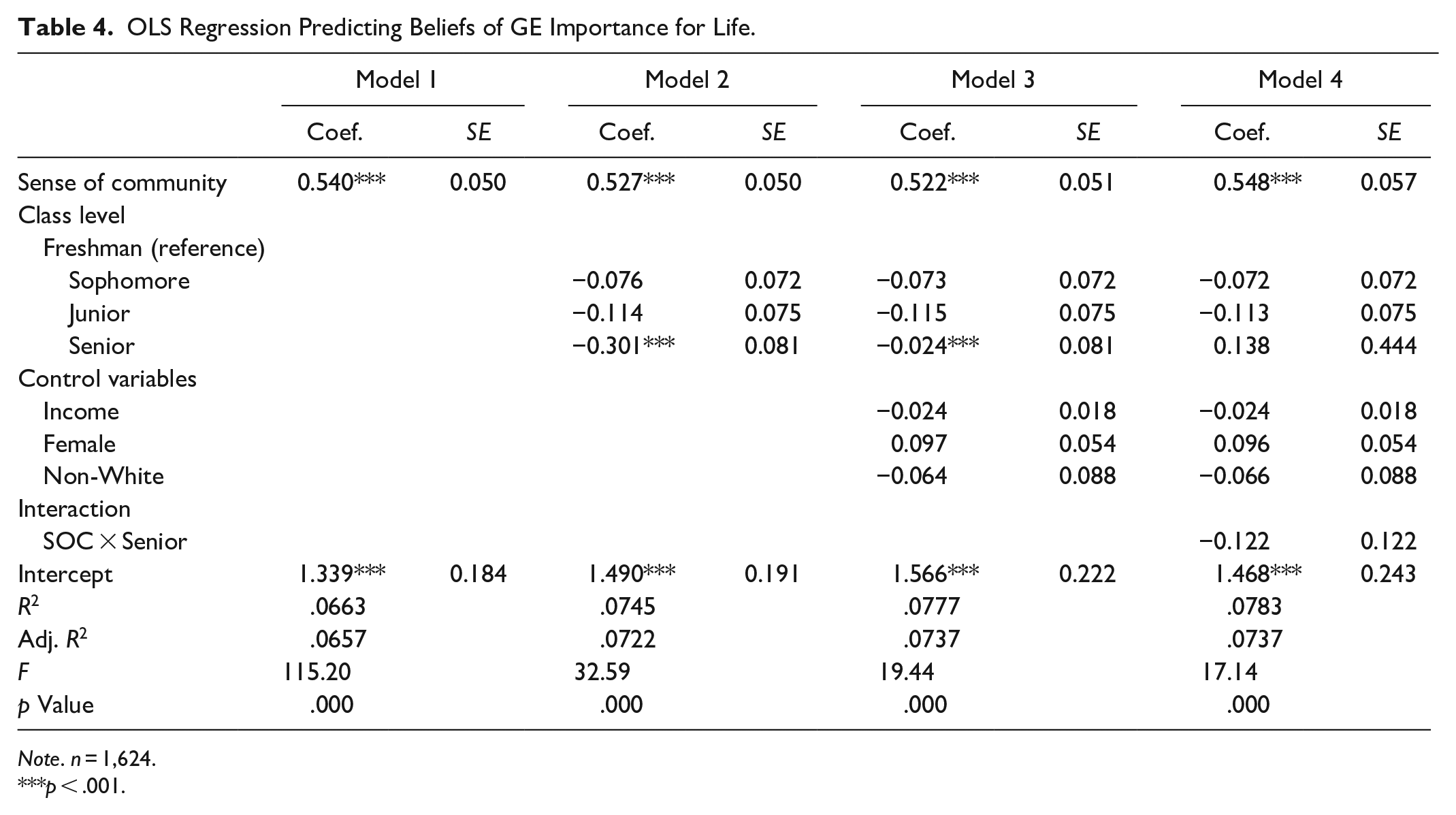
OLS Regression Predicting Beliefs of GE Importance for Life.
Note. n = 1,624.
***p < .001.
OLS Regression Predicting GE Satisfaction.

Note. n = 1,625.
p < .05. **p < .01. ***p < .001.
OLS Regression Predicting GE Importance to Education.

Note. n = 1,624.
p < .001.
Results
OLS regression estimates predicting SOC are reported in Table 3. Model 1 is a bivariate model, showing the association between the mean level of SOC and each class level as dummy variables, with freshmen as the reference category. Compared to freshmen, juniors and seniors had increasingly lower mean levels of SOC. As such, SOC continues to decrease at the junior and senior level. Model 2 shows the relationship between SOC and class level, with controls for race, sex, and household income. We again find that SOC is significantly lower for juniors and seniors. Furthermore, the model suggests that students whose parents had a higher income (i.e., they indicate a marginally significant relationship: p = .054) have a higher SOC on average. Female students are also shown to have had a higher SOC on average. Non-white students, however, are suggested to have had a lower SOC (p = .053). These findings concur with past research (Ash & Schreiner, 2016; Rubin, 2012; Soria et al., 2003).
OLS regression estimates predicting GE Importance for life are reported in Table 4. Model 1 shows a significant, positive relationship between SOC and GE Importance for Life. Model 2 shows that the same positive, significant relationship between SOC and GE Importance for Life is maintained while controlling for scholastic class level. This model additionally shows that compared to freshmen, seniors were significantly less likely to believe that the information they learned in their GE courses was important in their lives, a finding we anticipated. Model 3 again shows that those with a higher SOC believed that knowledge gained in their GE classes was important for life. We again find that seniors have a significantly more negative outlook on the importance of GE for life compared to freshmen. In addition, compared to males, females are suggested to have had a more positive belief in the importance of GE for their lives (p = .079). Model 4 includes the interaction effects of senior class level and SOC in predicting the perceived importance of knowledge gained in GE classes for life. The analysis shows that SOC does not interact with the association between the importance of knowledge gained in GE courses in students’ lives and the fact that they are seniors. Regardless of how strong a senior’s SOC, they were more likely to have negative views of the importance of GE classes for their lives.
Table 5 shows the results of the regression analysis predicting GE satisfaction. Model 1 analyzes the bivariate relationship between GE satisfaction and SOC. SOC is positively associated with students’ satisfaction with general education. Model 2 shows that sophomores, juniors, and seniors all had significantly lower satisfaction with their experience of GEs compared to freshman. The coefficients decrease as class level increases, indicating that students who had completed more of their degree programs felt more dissatisfied with GE classes. This finding is consistent with some previous literature and confirms colloquial understanding about the relationship between class standing and SOC. Model 3 includes the demographic control variables. Students with an increased SOC were more likely to express greater satisfaction with their experience of GEs, whereas sophomores, juniors, and seniors were less likely to express satisfaction with their experience. Although these data do not show individual-level attitude changes over time, the findings suggest that satisfaction with GEs may decrease over the duration of a student’s time at the university. In addition, the model suggests that having a higher household income (p = .051) and being a non-white student are associated with lower levels of satisfaction with general education. Compared to males, females have a higher level of satisfaction with their experience of GEs. Model 4 shows that there are no interaction effects between SOC and scholastic class level on satisfaction with general education.
Table 6 details the relationship between students’ perceptions of GE Importance to Education and SOC. Model 1 shows the bivariate relationship between SOC and students’ perceived level of importance of GEs for receiving a broad college education. We find that having an increased SOC is associated with more favorable perceptions of the importance of GEs as part of a broad college education. Model 2 shows that, unlike in Tables 5 and 6, class level was not associated with perceived importance of GEs as part of a broad education. However, in this model SOC continued to have a significant, positive association with the importance of GEs for a broad education. Model 3 shows that income and race were not associated with perceptions of the importance of GE classes for a broad education, while female students have significantly more positive perceptions of GE importance as part of their broader education compared to males.
Discussion and Conclusion
This study seeks to understand how students’ SOC influences perceptions of their GE experiences, and compares GE perceptions across scholastic class levels The first contribution of this research is that we find that SOC is consistently positively associated with student perceptions of their GE experience. Higher levels of student SOC within the campus are associated with higher levels of perceived importance of knowledge gained from GE courses in their lives, satisfaction with GE classes, and importance of receiving a broad university education (Tables 4–6). Although our statistical models are cross-sectional, and we cannot assert causality, we theorize that the more SOC that students feel, the more they “buy in” to the goals, values, and programs of the university, thus promoting more positive perceptions of the GE program. The data are consistent with that interpretation, and it would be difficult to argue that satisfaction with GE classes is driving SOC (although there certainly could be feedback loops). Furthermore, our findings support past research that upperclassmen’s perspectives of GE are generally more negative (Benander & Lightner, 2005; Bittinger, 2017; Humphreys & Davenport, 2005; Johnston et al., 1991; Thompson et al., 2015; Twombly, 1992; Vander Schee, 2011), even when controlling for SOC, which has been found to be associated with academic satisfaction (Drouin, 2008; Gibson, 2010).
The research additionally contributes to clarifying the associations between scholastic class, SOC, and perceptions of GE. Our analysis finds that, compared to freshmen, SOC declines for each subsequent class level (Table 1). Additionally, we found that seniors predictably had significantly more negative beliefs of the importance of general education in their life compared to freshmen (Table 4). Likewise, compared to freshmen, students in each subsequent class level had less satisfaction with general education (Table 5). In other words, student experiences with general education may not have met their original expectations. Finally, in our regression model of GE Importance to Education, we found that scholastic class level was not significantly associated with student beliefs regarding the overall importance of GEs as part of a broad university education (Table 6). While these findings regarding scholastic class level are expected and align with some established literature (Vander Schee, 2011), they simultaneously contradict other findings (Driscoll, 2014), pointing to the continuing importance of understanding how perceptions of GE are associated with scholastic class level. Our study contributes to this conversation by reinforcing findings that junior and senior class statuses are associated with more negative attitudes about a variety of aspects of GE, as compared to freshmen.
Despite the contributions of this study, several limitations must be acknowledged. First, while we believe the findings may be capturing a broader pattern on college campuses, our findings cannot be statistically generalized to other campuses due to the nature of our case study design. Further, our analyses do not investigate why students had low perceptions of their GE experience or the purpose of the GE program. In addition, since these analyses do not use panel data, we cannot assess how student perceptions of general education change over the duration of their time at the university.
Future research should investigate what students value in GE programs as well as investigate how SOC might mediate or moderate juniors’ and seniors’ perceptions of GE. Furthermore, researchers should investigate why upperclassmen place less importance on GE programs. Due to our consistent findings of positive associations between gender and GE perceptions across models, future research should further examine these relationships as well. Researchers should also incorporate panel data in order to further assess how perceptions of general education change over the duration of a student’s time at the university, comparing student satisfaction with their GE and major experiences, investigating the relationship between the “buy in” to institutional values and goals and program satisfaction, and drawing a larger sample of minority students in order to better understand their experiences. In conclusion, we recommend that universities focus on fostering a healthy SOC for all scholastic class levels in order to improve satisfaction with and the ratings of GE programs. By doing so, other indicators of academic success are likely to rise in association.
Footnotes
Acknowledgements
The authors thank Heidy Comish for help during the data collection and curation phases of the project. The authors also thank Patti Freeman, and Joseph Hanks for their support and input developing the survey instrument.
Author Note
Jorden E. Jackson is now affiliated to Rural Sociology, Demography, Penn State University, University Park, PA, USA and Paige N. Park is now affiliated to Department of Demography, University of California at Berkley, Berkeley, CA, USA.
Declaration of Conflicting Interests
The author(s) declared no potential conflicts of interest with respect to the research, authorship, and/or publication of this article.
Funding
The author(s) disclosed receipt of the following financial support for the research, authorship, and/or publication of this article: This research was funded in part by a grant from the Brigham Young University Office of General Education with additional support provided by a Brigham Young University Mentoring Environment Grant.
Ethics Statement
Data used in this paper were gathered as part of a study that was reviewed and approved by the Brigham Young University Institutional Review Board.
Informed Consent
All persons gave their informed consent prior to their inclusion in the study.

Data Availability
The datasets generated during and/or analyzed during the current study are available from the corresponding author on reasonable request.