




Abstract
Equal access to education is a growing concern throughout the nation. With an increasing amount of programs aimed to support the underrepresented populations on college campuses, first generation college students have grown to be a target population of particular interest. This study examined the relationships between first generation college seniors and applications to graduate or professional programs. The goal of this study was to determine if first generation students are pursuing advanced degrees at lower rates than non-first generation students and if so, attempt to uncover factors contributing to that evidence. Data were gathered from the National Longitudinal Survey of Freshman data set, and variables were analyzed using a binary logistic regression. The results of the study indicate that first generation students are significantly less likely to pursue an advanced degree, even when controlling for race, gender, family income, and cumulative grade point average, suggesting a distinctive impact of first generation status on post-undergraduate aspirations. However, after controlling for the impact of self-reported undergraduate loans, the effect of first generation status was no longer significant. The findings in this study provide an important new perspective in the field of sociology.
Introduction
Much research has been done on first generation college students and their undergraduate experience (Gardner & Holley, 2011). In this regard, research reveals the wide array of struggles faced by first generation students, including poor graduation rates, lack of family support, struggling grade point averages (GPAs), and inability to fully integrate into the campus community (Mehta, Newbold, & O’Rourke, 2011). Thanks to much research in this area, initiatives to assist first generation students from recruitment to commencement have been established. From the 1vyG program at Brown University to the First-Generation Success Program at Clemson University, many colleges all over the country have adapted some form of a “First Generation” program to help these students along their journey through college. But, what happens after these first generation college students graduate? It turns out that, comparatively, very little research has been conducted on the impact of first generation college student status on post-undergraduate aspirations.
With increasing access to higher education, degree inflation is rapidly occurring. The Washington Post claims that “the college degree has become the new high school degree” (Rampell, 2014). This suggests that a bachelor’s degree is no longer as valuable as it has been in years past, and higher demands are being placed on college students to pursue degrees beyond undergraduate education. Furthermore, the unemployment rate of recent college graduates can attest to the fact that a college degree no longer provides the same competitive advantage that it once did (U.S. Bureau of Labor Statistics, 2015). With undergraduate degrees no longer giving students the desired upper hand and job stability that students seek in the workforce, many students are turning to graduate and professional schools to further tailor their skills and become more desirable employees. In 2011, the Survey of Graduate Enrollment and Degrees, an annual study that has been conducted since 1986, showed a 4.3% increase in applications for admission to graduate programs for master’s or doctoral degrees (Kent, 2012). With an increase in the amount of schooling required for the workforce comes an increase in financial investments, higher stakes, increased competiveness, and overall higher demands for students (McCarron, 2012).
The purpose of this study is to explore the relationship between first generation college students and aspirations of attending graduate or professional schools. Although many schools, as stated earlier, are adopting programs to help first generation students have more successful undergraduate experiences, it is hypothesized that first generation college seniors are applying to graduate or professional school programs at lower rates than non-first generation college seniors. This hypothesis is rooted in previous research and empirical findings which suggest that first generation students are less likely to enter graduate programs as compared with their peers (Gardner & Holley, 2011; Mullen, Goyette, & Soares, 2003). This study is of particular importance, because it addresses the question of whether or not first generation programs, as a whole, are making a difference and reversing the disadvantage of being a first generation student. If colleges are improving graduation rates and/or GPAs of first generation students, but not equipping them with the confidence to apply to post-undergraduate programs, these students are still leaving college without reaching their full potential. Also, graduate and professional degrees pay off in terms of salary according to the Census Bureau report which states that workers with a master’s degree earn an average of US$74,217 per year compared with US$58,762 for workers with only a bachelor’s degree (Clark, 2011). Furthermore, the salary gap becomes more drastic when considering professional degrees who earn, on average, an annual US$128,578 (Clark, 2011). Being deprived of this opportunity, for whatever reason, is putting a cap on upward social mobility for first generation students. Although getting an undergraduate degree definitely puts them on the path toward a higher social class, if an undergraduate degree is the “new high school diploma,” as stated in the Washington Post, then children of today’s first generation college students will become the first generation college students of the future, because their parents did not attend a graduate or professional school (Rampell, 2014). Applying and consequently attending graduate or professional school at lower rates than non-first generation college students is perpetuating an economic disadvantage for first generation students.
Literature Review
According to McCarron (2012), first generation college students have paths to higher education much different than their non-first generation peers. In a study of 103 first generation students, McCarron examined the contributing factors of persistence and aspirations in the realm of education attainment of first generation students. Through his results, McCarron discovered that high pre-college aspirations and family support are vital in the persistence of educational attainment and prevention of burnout for first generation students. Based on this research, it could be possible that high pre-college aspirations and family support linger during the undergraduate years and are key in shaping first generation students’ aspirations to pursue advanced degrees (McCarron, 2012).
Although not near as elaborate as in the United States, initiatives to help advance first generation college students exist abroad as well. For example, all state-run universities in Germany, such as Heidelberg University, no longer charge tuition and fees for their students (Fuchs, 2014). In response to the abolition of these fees, Dorothee Stapelfeldt commented that tuition fees “discourage young people who do not have a traditional academic family background from taking up study” (Fuchs, 2014). First generation college students fall into the category of people without a traditional academic family background and are consequently a target audience for this new education policy. Although free tuition is a drastic measure and was not implemented for the sole benefit of first generation college students in Europe, it is a step toward making higher education more equally attainable.
In a more specific study, targeted to uncover results for the Latino/a population, Zavala (2014) determines three major factors that encourage first generation students to pursue advanced degrees. According to Zavala, one’s decision to pursue an advanced degree is dependent on understanding the impact of a higher degree on career marketability, having influential mentors, and having social capital. However, aside from these three factors, Zavala reveals finances as the biggest barrier, suggesting that first generation students are not thrilled about exhausting their financial resources to pursue an advanced degree and, therefore, do not give the possibility much consideration (Zavala, 2014).
The results claimed by Zavala are in disagreement with previous research conducted by Mullen et al. (2003) which shows that college performance (during the undergraduate years) maintains a strong, independent effect on enrollment in graduate school. However, the work completed by Mullen, Goyette, and Soares reveals multiple indirect effects, both social and academic, on graduate school enrollment. In addition, their results concluded that parental education has no effect on student entrance into MBA programs, yet a strong effect on entry into professional and doctoral programs. This suggests that the effect of first generation may appear to be insignificant at lower levels of post-undergraduate levels of education but is exaggerated when considering higher levels of post-undergraduate education that demand more academic motivation, experience, and money (Mullen et al., 2003).
In congruence with theories exploring the influence of capital on aspirations of higher educational attainment of first generation students, research completed by Gardner and Holley suggest a much broader source of this trend (Gardner & Holley, 2011). Gardner and Holley base their research on the conceptual framework completed by Pierre Bourdieu which claims that individuals essentially inherit particular economic, cultural, and social capital as a product of class (Gardner & Holley, 2011). In particular, Gardner and Holley focus on the impact of social capital on first generation students and pursuits of doctoral degrees. In addition to linking first generation status and GPA with lower aspirations, financial resources are considered in their research. Gardner and Holley state that not only are first generation students more likely to report higher debt than their non-first generation peers, they are also more likely to rely on their own resources to support themselves in post-undergraduate programs than non-first generation students (Gardner & Holley, 2011). In addition, Dr. Joseph Soares, professor at Wake Forest University, discusses in his book, The Power of Privilege: Yale and America’s Elite Colleges, the perpetuating social disadvantage of first generation students who lack essential forms of capital due to the socio-economic status and culture which they are born into (Soares, 2007). Similarly, the current study further investigates the impact of forms of capital on first generation student decisions by exploring and isolating possible factors to their lower educational attainment pursuits.
However, Lunceford (2011) gives much responsibility to the power of mentors as influential factors weighing on graduate school aspirations. Lunceford notes that the world of graduate or professional schooling is very much unknown to first generation students, and many of the challenges faced by first generation students in undergraduate education are compounded when they pursue graduate education. According to Lunceford, first generation students need advisers to help them assess their personal aptitude and desire for graduate studies (Lunceford, 2011).
Much previous research has explored the college experience of first generation students and even attempted to explain their motives for choosing whether or not to pursue higher degrees after graduation (Lunceford, 2011; Mehta et al., 2011; Zavala, 2014). However, there is clearly mixed and conflicting evidence in regard to what matters most. Furthermore, there is little research revealing the actual tendencies of first generation students to apply to graduate or professional programs by looking at who applies and who does not, using advanced degree applications as their dependent variables. A study completed by Hayden (2008), using the same data set that is used in the current study, focuses on the disproportionately underrepresentation of first generation students in American graduate education (Hayden, 2008). This study examines parental influence, through forms of capital, on graduate school aspirations of first generation students. The study shows that human, cultural, and social capital transmitted to students is marginally related to graduate school aspirations, regardless of generation status (Hayden, 2008). In addition, Hayden discovers that types of undergraduate institution seem to have little impact on graduate aspirations as well (Hayden, 2008). Although the study does uncover valuable results, the question as to why first generation students are underrepresented in graduate and professional programs is left unanswered.
Analytic Strategy, Data, and Method
The present study uses the National Longitudinal Survey of Freshman data set (NLSF). This data set consists of students from 28 elite colleges and universities who were first surveyed in 1999 and where surveyed again during each spring semester of their college career, until spring 2003 (Massey, Charles, Lundy, & Fischer, 2003). The students were required to be first time freshmen students of college and U.S. citizens or resident aliens to partake in the survey (Massey et al., 2003). Of the 4,573 students notified of the survey, 3,924 completed the entire survey. The final sample was composed of 998 White students, 1,051 African American students, 916 Hispanic students, and 959 Asian students (Massey et al., 2003). Only students who completed the survey were used in this study.
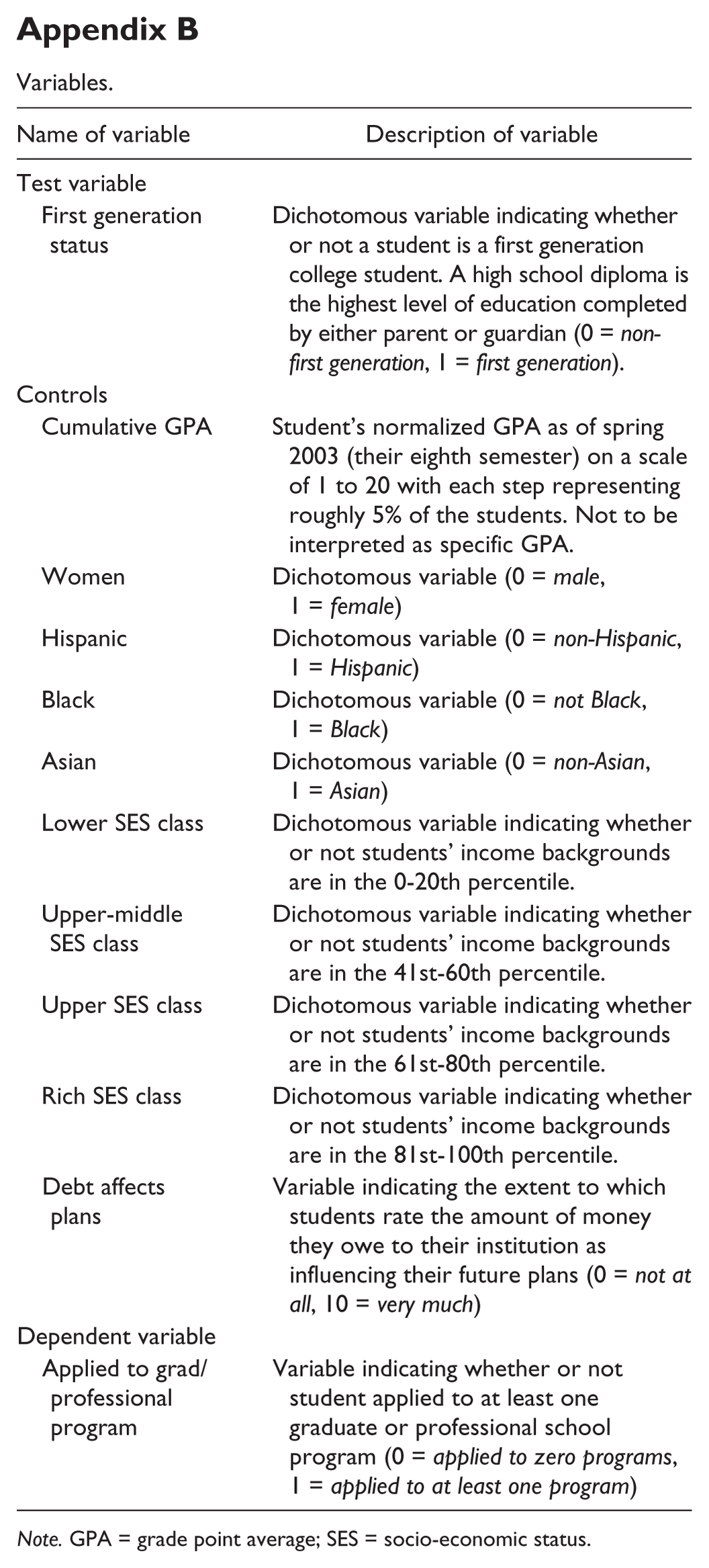
The two variables of particular interest in this study are first generation status and applications to graduate or professional school (Appendix B). As used in this research, the term “first generation college student” is defined as a student whose parent(s) or legal guardian(s) have not completed a bachelor’s degree at a 4-year college or university. This means that the student is the first in their family to attend a 4-year college or university to obtain a bachelor’s degree. By definition, a student may have an older sibling who attends or graduated from a 4-year university and still be classified as a first generation college student. For clarification, there is no income requirement of first generation student classification although many first generation students tend to come from lower socio-economic backgrounds (Gardner & Holley, 2011). Measuring a student’s post-undergraduate aspirations in this study will be measured by applications to graduate or professional school programs (Massey et al., 2003). A graduate school program is structured for students to be able to obtain a master’s (MA, MS) or doctoral (PhD) degree whereas a professional school program is expanded to include graduate-level institutions that prepare students for careers in specific fields (medical school, law school, etc.).
The NLSF data set is an ideal data set for this study, because it is a large sample that contains relatively even samples of each racial group. In addition, the survey is very extensive and allows for a variety of variables to be controlled for to determine more clear and confident associations. The surveys asks students to report the highest level of education achieved by their parent(s) or legal guardian(s) that reveals their status as a first generation college student (Massey et al., 2003). A first generation variable was derived from these questions by coding the students as a 1 for first generation college student and a 0 for non-first generation college student. A student is classified as a first generation college student if neither parent nor guardian achieved education beyond a high school diploma.
Furthermore, the data include multiple questions in regard to post-undergraduate education plans (Massey et al., 2003). For the purpose of this study, the question inquiring how many graduate schools the student applied to during their senior year of college was used. Although the data set does include information regarding official post-graduation plans and whether or not students will be attending graduate school, the decision to apply is of more interest. First generation students could have high acceptance rates for these institutions. However, if they are not choosing to apply at rates comparable with non-first generation students, they are taking themselves out of the race by act of self-selection. During the fifth wave of the survey, as college seniors, the students were asked, “To how many graduate or professional school (did you apply/have you applied)?” (Massey et al., 2003). The responses were coded as 0 translating to no schools and 1 to 20 being equivalent to the number of schools the students applied to. For the particular interest of this study, all responses coded as 1 to 20 were recoded to 1. The question was then rephrased as “Did the student apply to a graduate or professional school?” (with 0 being no and 1 being yes).
The hypothesis proposed for this study was as follows:
This study controlled for gender (using males as reference group), race (using Whites as reference group), cumulative college GPA, and family income (using middle class as reference group). Controlling for race, family income, and college GPA is crucial to this study because first generation students are often low-income, minority students and often struggle with the adjustment of college that affects their GPA. By controlling for such variables, this study will allow us to differentiate, in the case of an existing effect, whether or not first generation students apply to graduate schools at lower rates due to these characteristics or simply due to a distinctive impact of being first generation. The effect of the test variable on each measure was analyzed using a binary logistic regression.
Results
Descriptive Results
Table 1 shows a cross tabulation between first generation college student status and whether or not the student applied to at least one graduate or professional school program. The table shows that of the 589 first generation college students in the survey, only 141 chose to apply to at least one graduate or professional school. However, of the 2,106 non-first generation college students, 659 chose to apply. As a ratio (applied:not applied), first generation students are at approximately 3:10, having nearly three students apply for every 10 students who do not, where non-first generation students are approaching a 1:2 ratio. The descriptive statistics table (Appendix A) shows means and standard deviations for all variables, including test variables and controls.
Cross Tabulation of First Generation Students and Graduate or Professional School Application.

Binary Regression Results
Table 2 shows the binary regression results for the effects of the test variable (first generation) on graduate or professional school application before adding the control variables. This regression shows that first generation students are significantly less likely to apply to graduate or professional school programs (β = −.370, p = .001). More specifically, this model shows that first generation students are 69.1% as likely to apply to graduate or professional school programs as non-first generation students.
Binary Logistic Regression on Measures of First Generation Status and Graduate or Professional School Application.

Significant at p < .05.
Table 3 shows the binary regression results for the effect of the test variable (first generation) on graduate or professional school application with control variables added. This sequence is of interest to see if first generation student status becomes no longer significant once adding in control variables, suggesting that the impact of first generation status on graduate or professional school application decision is mediated by other factors that often coexist with first generation status. The results from this regression model show that even when controlling for cumulative college GPA, race, gender, and family income report, first generation students are still significantly less likely to apply to graduate or professional schools during their senior year of college (β = −.298, p = .024). More specifically, first generation college seniors are 74.2% as likely to apply as non-first generation college seniors. This regression shows that when holding all other variables constant, there is a distinctive relationship between first generation status and fewer applications. Therefore, in a situation of two students of the same race, same family income status, and same cumulative GPA, with the only difference being that one student is a first generation student and the other is not, the first generation student is significantly less likely to apply to a graduate or professional school program.
Binary Logistic Regression on Measures of First Generation Status and Graduate or Professional School Application With Control Variables.

Note. Omitted reference variables include gender, men; race, White; and income, middle quartile. GPA = grade point average.
Significant at p < .05.
Additional information revealed through this regression show effects of GPA on decision to apply and an overall lack of influence by race and family income on decisions to apply. Having a higher cumulative GPA makes a student significantly more likely to apply to such post-undergraduate programs (β = .060, p < .001). This finding is very logical considering that many graduate and professional programs have minimum GPA requirements. In addition, and more surprisingly, being a minority student or from the lower income class does not make a student significantly less likely to apply. This is particularly interesting because both traits are often associated with the first generation student populations (Gardner & Holley, 2011). Showing that neither characteristic is linked to likelihood of applying to graduate or professional school reveals that the mere fact having parents who did not obtain a college degree is the significant link in fewer application from first generation students.
In an attempt to discover a variable that explains why first generation students are less likely to apply to graduate or professional school programs, given that race and family income do not provide sufficient explanations, an additional binary regression was completed. Table 4 shows the binary regression results for the effect of the test variable (first generation) on graduate or professional school application with the student response to “On a scale of zero to 10, where zero means not at all and 10 means very much, to what extent does the amount of money that you or your parents owe affect planning for life after college” (impact of debt on future plan) as an additional control. This variable had to be recoded, scoring responses of do not know or refuse to answer as missing variables. The results show that the extent to which the amount of money owed affects future plans for students is significantly related to decision to apply to graduate or professional school (β = −.087, p < .001), suggesting that as concerns of debt increase, students are less likely to apply to graduate or professional school. When this control is added to the model, first generation status no longer significantly affects application decisions. Therefore, first generation students are less likely to apply to graduate or professional school programs because the amount of money owed to their undergraduate institutions significantly affects their future plans.
Binary Logistic Regression on Measures of First Generation Status and Graduate or Professional School Application With Impact of Debt Added.

Note. Omitted reference variables include gender, men; race, White; and income, middle quartile. GPA = grade point average.
Significant at p < .05.
Furthermore, Table 5 shows a cross tabulation between self-reported impact of accumulated debt on future plans and first generation status. The cross tabulation shows that 274 first generation students reported the impact of their college debt on their future plans as a 5 or higher. Only 160 reported the impact of their debt on the lower half of the scale. However, the non-first generation students are nearly equally split with 576 reporting the impact of their debt on the upper side of the scale (5-10) and 547 reporting its impact on the lower side of the scale (0-4). This distribution of numbers shows that accumulated debt has a more significant impact on the future decision making and plans of first generation students than it has on non-first generation students. To further explore this result, a Pearson’s correlation between first generation status and the extent to which the amount of money owed affects future plans was determined. Results showed that first generation students are significantly positively associated with reporting heavier burdens of financial debt after college that influence their post-graduation decisions, r(1555) = .093, p < .001.
Cross Tabulation of Self-Reported Impact of Accumulated Debt on Future Plans With First Generation Status.

Discussion
In summary, the results from this study reveal that first generation students are less likely to apply to graduate or professional school programs. When holding variables of race, gender, and income constant, the results remain significant, showing that there is some other distinctive characteristic of first generation students that contributes to their lack of aspirations for post-undergraduate education other than the anticipated controls. These results contradict previous studies that deem low academic grades and low socio-economic status as barriers to graduate school (Payne, 2006; Zavala, 2014). Following this finding, a second model, adding the impact of accumulated debt on future planning, was conducted to further improve the study and clarify the results. This model yielded very significant and beneficial results as contributions to the fields of sociology and education. This is consistent with the findings revealing that students with more undergraduate loans are less likely to pursue advanced degrees beyond undergraduate education (Ward & Siegel, 2012).
When the extent to which students use their accumulated debt obtained throughout their college tenure to influence their plans after graduations, first generation status is no longer significantly associated to graduate or professional program applications. This finding suggests that the reason why first generation students are less likely to pursue higher education after obtaining an undergraduate degree is because of the burden of loans and debt. More specifically, undergraduate debt holds first generation students back from pursuing higher education more than non-first generation students, even when students are from the same socio-economic background. First generation students are also significantly positively associated with reporting heavier burdens of financial debt after college that influence their post-graduation decisions. This is likely due to the fact that first generation students have fewer familial resources and are typically solely responsible for paying back their loans (Ward & Siegel, 2012). This finding is also congruent with the study showing that first generation students are more likely to rely on their own financial resources when pursuing advanced degrees (Gardner & Holley, 2011). Therefore, fewer familial resources perpetuate higher reliance on individual financial resources that creates a stressful financial burden for many first generation students. As Soares (2007) suggests, this burden is likely due to a lack of capital, both social and economic, passed down from the parents who did not attend college.
The results from this study have further implication for ways to better assist first generation students. The results show that scholarships and funds directed toward first generation college students would be pivotal in guiding post-graduation aspirations toward higher education. Finishing their undergraduate career with minimal debt would give first generation college students the financial confidence necessary to pursue further education after graduation. It is reasonable to assume that many first generation students are turned away from pursuing graduate or professional schools because they want to start earning a salary as soon as possible and do not perceive non-mandatory education as justifiable. Having parents without college degrees, it is possible that they are independently responsible for paying off their debts, therefore accumulating more debt in graduate or professional school is unthinkable.
As mentioned earlier, many colleges across the country are adapting programs to support first generation college students. Whether the support is monetary or through mentorships, these programs are working to benefit first generation students during their undergraduate careers and help them succeed through education (Shelton, 2011). However, the results of this study suggest that monetary support for first generation students transcends the undergraduate experience and positively affects their future aspirations. Future research could focus on the effect of monetary assistance compared with mentorship and support systems on campus. It would be interesting to compare programs that solely provide financial assistance with those that provide financial assistance coupled with mentorships as well as with those that provide only mentorships to determine the most comprehensive approach to help first generation students reach their full potential.
Footnotes
Appendix
Variables.
| Name of variable | Description of variable |
|---|---|
| Test variable | |
| First generation status | Dichotomous variable indicating whether or not a student is a first generation college student. A high school diploma is the highest level of education completed by either parent or guardian (0 = non-first generation, 1 = first generation). |
| Controls | |
| Cumulative GPA | Student’s normalized GPA as of spring 2003 (their eighth semester) on a scale of 1 to 20 with each step representing roughly 5% of the students. Not to be interpreted as specific GPA. |
| Women | Dichotomous variable (0 = male, 1 = female) |
| Hispanic | Dichotomous variable (0 = non-Hispanic, 1 = Hispanic) |
| Black | Dichotomous variable (0 = not Black, 1 = Black) |
| Asian | Dichotomous variable (0 = non-Asian, 1 = Asian) |
| Lower SES class | Dichotomous variable indicating whether or not students’ income backgrounds are in the 0-20th percentile. |
| Upper-middle SES class | Dichotomous variable indicating whether or not students’ income backgrounds are in the 41st-60th percentile. |
| Upper SES class | Dichotomous variable indicating whether or not students’ income backgrounds are in the 61st-80th percentile. |
| Rich SES class | Dichotomous variable indicating whether or not students’ income backgrounds are in the 81st-100th percentile. |
| Debt affects plans | Variable indicating the extent to which students rate the amount of money they owe to their institution as influencing their future plans (0 = not at all, 10 = very much) |
| Dependent variable | |
| Applied to grad/professional program | Variable indicating whether or not student applied to at least one graduate or professional school program (0 = applied to zero programs, 1 = applied to at least one program) |
Note. GPA = grade point average; SES = socio-economic status.
Acknowledgements
The author would like to thank Dr. Joseph Soares and the Wake Forest University Sociology Department for encouraging her work and funding the publication fee.
Declaration of Conflicting Interests
The author(s) declared no potential conflicts of interest with respect to the research, authorship, and/or publication of this article.
Funding
The author(s) received no financial support for the research and/or authorship of this article.