




Abstract
The study is aimed at determining how structured supervision of influences work attitude and promotes job performance in universities. This is because the success of any academic institution depends on effective supervision of staff. To achieve the objectives, the study adopted survey research design using interviews and questionnaire. Respondents (107) were selected from different units/departments of a public university in Nigeria through stratified sampling technique. Data were analyzed using descriptive statistics. The study revealed that Junior Non-Academic Staff of the university were poorly supervised, leading to poor job performance. The cause of this is non-application of structured supervision. The study believes in structured supervision, which involves elimination of harsh supervision, enthronement of cordial relationship between workers and their supervisors, regular training of supervisors, promotion of exemplary supervision, and provision of institutional policy on supervision. Therefore, there is a strong relationship between structured supervision and high job performance. As a result, it is important that supervisors are regularly trained to imbibe spirit of structured supervision which will help them to lead their subordinates to achieve high job performance.
Keywords
Introduction
Most times, organizational success is based primarily on the performance of its employees and their attitude to work. This is why Berta et al. (2018) explained that the theory of reasoned action pointed out that work outcomes are determined by behavioral intentions. This to a great extent determines the organization’s success and continued existence. Therefore, the survival of every organization depends on the fact that they produce something that the people need and want, at a profit. This has a strong link with satisfying the customers, maintaining their loyalty, and retaining them. All these depend on the organization’s ability and capacity to make good its promises. As a result, there has been constant pressure on the part of supervisors concerning their impact on the job performance of their supervisees. Therefore, the general attitude of supervisors usually have major positive moderating effect on the association between workers’ attitude and job performance especially in educational institutions (Ma et al., 2020). Similarly, Boldureanu et al. (2020) in their recent study provided evidence that job performance should be based on successful role modeling by supervisors. All the same, even though supervisors are regularly criticized, they are indispensible in organizations. This is because supervisors have great duty of uplifting the performance of their supervisees through provision of adequate knowledge and other necessary skills (both technical and interpersonal). To this extent, organizations cannot but have supervisors (Apenteng, 2012). As such, organizational citizen behavior research findings have encouraged educational institutions to improve supervisors’ attitude and behavior in order to increase the performance of the supervisees (de Geus et al., 2020).
It has also been discovered that these days the growth of educational system depends greatly on increasing number of institutions, teachers, and students. It also includes increase in facilities to achieve desired progress in the educational sector. Success can only come in this sphere if we achieve returns to a great extent in terms of effectiveness and efficiency. Therefore, quality assurance in the educational system cannot be compromised. These qualitative and quantitative growths depend on one thing—supervision (Kashyap, 2020).
According to Tappo (2016), the word supervision is derived from two Latin words—super (which means above) and video (which means “I see”). This is why Tappo (2016) defines supervision as a two way dynamic process which is carried out for a particular purpose geared toward fulfilling the goal of the organization. This is achieved by ensuring that quality performance is high by regularly encouraging and supporting the staff to put in their best. Supervision can also be defined in different ways depending on one’s purpose. According to Bernard and Goodyear (1992), supervision is the relationship between the superior and subordinate workers in an organization which evaluates over a period of time, helps to uplift the skills of subordinates, monitors the quantity/quality of job they do, and provide necessary feedback for further action. In other words, supervision means managing others by provision of exemplary actions. Loganbill et al. (1982) views supervision as a serious and important interpersonal relationship whereby a person plays a role in the development of other persons within an organization. Glickman et al. (2004) believes that supervision is the means of controlling the behavior of workers. In such case, the workers are inspected and guided in their daily activities. Here, the emphasis is on constant compliance by the workers with the rules of the organization. This usually hinders the development of innovative abilities and creativity on job.
Similarly, Burton (1930) pointed out that supervision do give accurate guidance to the people being supervised; helping them to initiate new ideas and be responsive enough to move at their own pace. According to him, supervision involves training people, correcting their errors, guiding them in order to turn deficiencies into efficiency in providing necessary services. Papadopoulos (2018) added that while supervisors are useful assets to the educational system, they are involved in leading groups, managing tasks, solving problems and make reports both to their superiors and subordinates. In other words, the qualities of a good supervisor include being thorough, being fair to all, having good initiative, being firm, having strong emotional resistance, and also being teachable (Tappo, 2016).
Mills (1997) pointed out that there is a strong relationship between supervision and job performance of workers. As a result, supervisors give task to staff with clear guide on how to perform the tasks and subsequently expect accurate and punctual performance of such tasks from the assignees. Supervision therefore aims at providing workers with useful knowledge, skills and work behavior, which enables them to be relevant to themselves and their community. In this case, a university becomes the means of expressing the aims of education. The university therefore, shoulders great responsibilities, and any attempt by the university to fail in its services will not only be unacceptable but portrays great setback for the future of the society. It is imperative that a university, which is seen as a factory where human intellectual ability is produced and/or sharpened, gives adequate attention to the issues of supervisors and work supervision.
In their own explanation, Valentino et al. (2016) pointed out that supervision provides a great opportunity for improved instructions. Whenever supervision is structured, the supervisor should make the supervisee understand/articulate the definition of the task, direct them through examples and identify wrong exemplars in the work process. Once the supervisee understands these skills without being harassed, the supervisee may even be asked to explain it to others in the sector. In this way, supervision becomes fun for both the supervisor and the supervisee. A structured supervision apart from being painless, provides ample opportunity of feedback for the supervisor who has time to preplan for the action (Hulse & Robert, 2014).
Another thing that enhances structured supervision is the ability of the supervisor to reduce the time of interaction, criticism and correction of the supervisee. This helps to enhance productivity and remove or lessen tension on the part of the supervisee (Valentino et al., 2016).
Similarly, scholars have noted that as a result of uncertainties, volatility, complexity and ambiguity in the economy and the competitive atmosphere in many work places especially in Nigeria, workers are facing increased levels of pressure and anxiety which negatively impact on their overall job performance. Thus, there is need for an improved pattern of supervision which will not heighten the already existing pressure. The structured supervision which is vale-based is the expected improved pattern (Sisyuk, 2018; Yang et al., 2019).
On the other hand, Nafei (2018) researched on bullying supervision in companies in Sadat City of Egypt. He found that verbal bullying was rampant in organizations. As a result, he recommended that supervisors (managers) should be interested in the affairs of their supervisees and be constantly trained to correct and imbue correctives measures to reduce pressure on supervisees. This is actually a call for structured supervision.
A lot of research has also been carried out on structured group supervision (Borders, 1991; Wilbur et al., 1991). In his study, Wilbur et al. (1991) represented five phases of structured supervision namely; request-for-assistance statement, questioning period and identification of focus, feedback statements, supervisee response, and optional discussion period. In all, the prescribed phases if modified could serve to promote structured supervision in particular. For instance, supervisee’s response and discussion period are necessary ingredients of structured supervision.
Again, House (1971) has earlier proposed a path-goal theory of leadership effectiveness in which he pointed out that motivational roles of the supervisor include assuring subordinates personal rewards for accomplishing a task by first clarifying the paths that lead to their desired rewards and eliminating obstacles on the way to successful job performance, and improve the opportunities for work satisfaction by providing support for subordinates. In other words, the ability of subordinates to successfully perform a job is dependent on the ability of the supervisor to manipulate valences and expectancies as basis of his influence on subordinates’ performance and not coercion. This is the foundation for structured supervision.
In the same vein, Downey et al. (1975) researched on the applicability of path-goal theory which came up as a basic paradigm for behavioral and attitudinal analysis in relationship job performance in industries. The core of the theory is that an individual is compelled by a force which impels him/her to act some level of effort which can enhance job performance. From the study Downey and his colleagues concluded that a supervisor’s consideration or style had a strong influence on subordinates’ job performance. They explained that it is only that style of the supervisor which shows support and concern for subordinates and encourages them to participate in decision making that result in high job performance. In other words, when supervisors cordially lead the supervisee to the path-goal of the organization, the supervisees are said to be supervised without chains. They are not coerced.
It is quite clear that the success of any corporate establishment or academic institution depends on effective supervision of all the employees. Effective supervision has not only created job satisfaction among workers, but has also led to increased productivity and achieved results within the establishment. While past studies by scholars have concentrated attention on separate aspects or off shoots of work-attitude, none has adopted a holistic approach (using both quantitative and qualitative research approaches). For instance, while scholars like Abosede (2014) and Fauziah and Kamaruzaman (2009) in their separate researches concentrated on establishing levels and importance of Job Satisfaction amongst Staff in various Universities in Nigeria or Malaysia, other scholars (Smerek, Ryan and Peterson) assessed the theory of Herzberg in order to increase workers (non-academics) satisfaction on their job at an European university. Their drawn conclusions pinpoint the importance of solid cooperation and unity of effort of both the academic and non-academic staff in the university. However, the fact that this cadre of workers is directly concerned with day-to-day running of the university places their importance scale almost as high as that associated with students in a university. Supporting this view, Abubakar (2018) posited that non-teaching staff of a university are an important segment of the university community and as such their supervision is very important to ensure that the standards set up by the National Universities Commission (NUC) in Nigeria are adhered to. In the process, it is not only the institution’s goals that will be met but also national goals.
Ebonyi State University, Abakaliki Nigeria (the study area) was established under the government decree in 2000. Situated along kilometer 25 Abakaliki-Enugu Express Way, the University has 122 academic accredited programs and staff strength of 2,807 as at the time of this study. Of this number, 909 are academic staff while1,898 are members of non-academic staff. Out of the 1,898 members of non-academic staff, 976 are junior non-academic staff. From above statistics, it is obvious that members this group form the largest number of employed staff in the university. The functions and roles of these members of this cadre of staff are so important that the whole university system usually experiences some hitches anytime they go on industrial strike.
There is no doubt then that proper functioning and growth of the university depends very much on the functional efficiency of the members of this cadre of staff. The performance of this staff which becomes the major focus of this research depends very much on effective supervision. In other words, effective supervision of this segment of staff is very necessary for proper administration of educational institutions including universities (Study.com, 2019). Many existing literature as well as empirical studies agrees that universities being formal institutions are made up of highly enlightened personalities within their domain, and as such, is supposed to be a model to other organizations (Ifedili, 2011). In other words, cooperation among staff, their being punctual at workplace, display of good spirit toward other workers, commitment to duty and high productivity, high level integrity and sense of responsibility are essential requirements from workers. The situation appears real; however, some scholars (Allen, 2015; Ifedili, 2011) posit that jobs have been humanized a lot in many educational institutions as a result of modernity; and as such, organization’s growth and survival presently depends greatly on adequate supervision of organization’s workers and the eagerness of workers in the organization to drop their individual lifestyles and agree to follow the expected behavioral norms of the organization. In support of this view, Hinkle et al. (2010) posited that McGregor’s Theory Y cannot easily work in Nigeria because, productivity can only improve with the application of structured supervision, and this is as a result of differences cultural patterns, educational attainments and how comfortable the people’s lives are. Ifedili (2011) while agreeing to this, added that nonchalant attitude to duty has been observes among university staff in Nigeria. According to him, such lukewarm attitude to work especially among non-teaching staff is source of concern to academic stakeholders. He puts it this way: The non-academic staff who are supposed to be in the office by eight in the morning, hardly open their offices by nine. Not minding their lateness, when they report and sign in, some low cadre workers among them would disappear to their other private businesses; some middle ones move from one office to another chatting, some top ones who are expected to be controlling the junior ones report at times by eleven under the excuse that they either closed late the previous evening or are held up in the traffic. Files pile up unattended for a long time. . . Remuneration for university’s workers has increased, yet the poor attitude persists.
Ifedili (2011) further pointed out that there is a general notion in Nigeria that public service belongs to no particular person and as such workers lack commitment. Nwosu (2012) lends his voice that the problem is an offshoot of colonialism when Nigerian workers delivered in the duties required of them by colonial masters, but were never paid enough to compensate for their effort. According to him, despite the fact Nigerian governments have developed better industrial policies and the minimum wage has been positively adjusted, workers still maintained their colonial work attitude. Furthermore, Ifedili (2011) describes the pattern and style of recruitment into public government universities in Nigeria as a major problem; this is because most times such appointments were not done on merit. Therefore, it promotes mediocrity. According to him, the universities do not observe meritocracy in their employment process but employment is most based on favoritism. The current system encourages favoritism, nepotism and ethnic alignments. It is not surprising that approximately 50% of workers are employed based on these anomalies. Many of them lack integrity, commitment, experience and are not academically sound (Ifedili, 2011). Writing on this, Abosede (2014) observed that more worrisome is the fact that many qualified youths are unemployed due the fact that they do not have “godfathers” who will intercede on their behalf while the unqualified ones are usually recruited. This encourages disobedience and inadequate productivity and can only be managed through effective and properly structured supervision.
Many workers today disobey the rules but cannot be called to order because they are protected by some powers above. Similarly, some of the heads of department/unit in the university are not chosen because they can deliver but on the belief that they would be faithful to the authority. This is why most of them could not easily supervise their subordinates (Abosede, 2014). Hinkle et al. (2010) supports this view and added that the success of supervision is greatly dependent on the process through the worker are recruited. This is why Allen (2015) believes that supervision is the management process through which managers see that their subordinates are working toward achieving effective learning in the universities. It has been reported in a recent study that the excellent attitude to work by non-academic staff in public universities is essential to educational institutions with regards to performance and productivity (Nwosu et al., 2018). As a result, the ongoing debate concerning the rising number of non-teaching staff in universities also confirms the importance attached to this category of staff in the modern setting (Baltaru, 2019).
The study is hinged on Equity theory of motivation, developed J. Stacey Adams in 1960. In it Adams believes that motivation is dependent on what the individual believes to be fair deal in social exchanges. Ideally, every worker wants to be properly compensated for their contributions toward the organization. A person’s beliefs in regards to fairness affect his/her level of motivation, attitudes to work, and general behavior. Equity theory therefore explains why industrial action is still witnessed among well-paid union workers.
The theory posits that one is motivated according to what the person feels is fair in relation to what others actually get. When it is related to work situation, equity theory pays attention to workers’ work-compensation in relation to their job as well as workers’ moves to reduce any level of unfairness that might come up. For the fact that equity theory is concerned with social relationships (in terms of supervisor-supervisee) and level of fairness, it has also been regarded as The Social Comparisons Theory (Apenteng, 2012; Hinkle et al., 2010; Mills, 1997). When related to this study, the theory points out that there is more likelihood that Junior Non-Academic Staff of Universities would perform better on their jobs if supervision is well structured, that is, supervision is fair, cordial, and focused.
People are employed in organizations mainly to render important services which are essential for the success of establishment. This could be visible mostly in higher institutions particularly universities which are believed to be assemblage of intellectuals with the major goal of enhancing knowledge cum research necessary for social growth and development. As a result, the “survival of the fittest” nature of organizations demands that modern institutions act as living organisms by adjusting to changes in their environment. Therefore, supervisors need to be made efficient through regular training. According to Sisyuk (2018) the training that supervisors had before recruitment may no longer be sufficient to meet future needs. New technologies such as mobile phones are rapidly transforming job landscapes and reshaping the way people work in organizations. In other words, regularly trained supervisors will likely imbibe the workings of structured supervision even among junior non teaching staff.
This idea of constant training is echoed by UNESCO (2017) when it stated that the fourth sustainable development goal of the UN is aimed at ensuring inclusive and equitable quality education and provide lifelong learning opportunities for all, supervisors inclusive. This made Sisyuk (2018) to conclude that training of supervisors is a necessity because what a person learns at age 21 will become obsolete in 5 to 10 years later and will have to be replaced or at least refurbished by learning new skills and knowledge especially on how to manage subordinates. As a result, mutual commitment of a supervisor and a subordinate and a good working environment supported by constant training and a peaceful work culture have been associated with influencing job satisfaction and performance (Albao, 2018; Cajander & Reiman, 2020).
Meanwhile, earlier studies (Apenteng, 2012; Mills, 1997) have proved that the job and role of junior non academic workers are crucial in achieving these essential goals of enhancing knowledge and expansion/extension of research and its results. Whereas a lot of research efforts have been undertaken to determine the work attitude of academic staff and senior non-teaching staff in some universities in Nigeria, not much have been done to determine how supervision can be structured to propel the job performance of non-academic staff of universities with regard to its effect on productivity in the universities. This study is imperative because it will go a long way to close the existing gap in knowledge of how to structure supervision in universities with a view of influencing high productivity in the system. As a result, the following hypothesis guided the study: there is no significant relationship between structured supervision and high job performance.
Therefore, the study seeks to determine the level to which Junior Non-Academic Staff of Ebonyi State University, Nigeria are supervised and the influence of structured supervision on job performance. The study is expected to provide measures on how to achieve structured supervision in order to promote cordial and effective supervision of university staff. Apart from this, data from the research would help to advance the role of supervisors. This in the long run will encourage efficient and effective performance by staff. The study will also provide insight for educational institutions and administrators as it relates to structured supervision in various departments and units. This indeed will provide chain reaction as the improvement in staff performance will also help to raise the standard of performance by both students and staff within various sectors of education in Nigeria.
Furthermore, the resultant data will provide additional knowledge to existing literature on the process of supervision as well as workers’ performance with regards to academic institutions and even other sectors of the society. The recommendations provided herein are expected to assist in policy decisions in the area of adequate supervision with the aim of developing organizational climate which supports excellent relationship between supervisors and their supervisees. In all the result of the study will be of immense benefit to educational institutions, industries, supervisors at all levels, academia, industrial sociologists, organizational planners, and various institutions where there is work.
Methods
Research design
The study used descriptive survey design involving both quantitative and qualitative research methods. The survey design is relevant to the study as it is the commonest way of finding out what people think and do; their beliefs, their opinions, actions they have taken, action they are contemplating and so on (Onabajo, 2010). The survey research design actually involves asking people questions and documenting their responses for collation and analysis (Cooper & Schindler, 2003). The study used the survey instruments of interviews and questionnaire, which are aspects of quantitative research method. This helped to establish and provide sufficient empirical data about different types of, and predominant supervision styles among junior non-academic staff of Ebonyi State University, Nigeria.
Research Population, Sample Size, and Sampling Procedure
The study was centered on Junior Non-Academic Staff of Ebonyi State University, Nigeria. It covered the four campuses of the university—Permanent Site, Ishieke, Presco and CAS. The study population as at the time of the study was 315 according to the payroll unit of the university. This population was made up of 138 males while 177 females. The study also covered the various sections/units of the University such as Faculties of Law, Humanities, Social Sciences, Management, Science and Agriculture; Departments of Works, Security, Work & Study, Pre-Degree, Exams and Database. The other units covered include Vice Chancellor’s Office, Registrar’s office and Office of the Bursar.
Putting it differently, the population of the study was 315 Junior Non-Academic Staff as was found from the university pay roll. As a result, Guilford and Flruchter (1973) formula was used to determine the actual sample size for the study.

Here: N stands for population while α means alpha which is put at .05.
The result of the calculated formula yielded 176 samples representing about 55.9% of the total population. However, it was found that out this sample of 176 staff, 39 were on annual and casual leaves. This left a sample of 137 out of which 30 persons declined to participate in the study. Therefore, only 107 respondents participated in the study. This represents about 40% of the entire population. This sample size is acceptable because according to Peretomde and Owojori any sample size that is 10% of the entire population or more is adequate representation of the population. The study made use of stratified random sampling technique to select the participants for the study. From the four campuses of the universities, 107 participants were selected from 10 departments or units. On the other hand, purposive sampling technique was used to select the Vice Chancellor, Registrar, Directors, Deans, and Heads of Departments/units for the interview sections. The interview process was necessary to cross check the information that was obtained from the Junior Non-Academic staff through questionnaire.
Research Data and Instrument for Data Collection
It is important to note that for a study of this nature, the most suitable evidence is primary data. Therefore, a 24 items questionnaire in the form of modified Likert scale was adopted for the study. The Likert Scale was made up of 5-points—strongly agreed, agreed, moderately agree, disagreed, strongly disagreed and this was used to generate data. The questionnaire which was adopted from Nwosu et al. (2019) before it was modified has three sections: demographic characteristics of the respondents, level of job performance and the extent to which structured supervision enhance job performance. Three experts in the area of the research was chosen to face validate the research instrument. To ensure the reliability of the instrument, 20 copies of the research questionnaire were utilized in test—retest reliability study. Similarly, structured interview schedule was also used to collect qualitative data from purposively selected staff of the university. The interview schedule contains 22 items which were grouped into three sections: demographic characteristics of the respondents (5), level of job performance (12) and the extent to which structured supervision enhance job performance (5). It should be noted that descriptive statistics was adopted for analyzing the resultant data.
Measurement of Research Variables
The variables used in this study—structured supervision (SS) and job performance (JP)—were measured through the use nominal scale—the 5-point Likert type rating scale. In specific terms, the respondents were asked to rate each one of the 12 items on level of job performance scale and each one of the five items on structured supervision scale. Responses from the participants were collated, evaluated and utilized to compute descriptive statistics for the variables being assessed. The computed descriptive statistics were in form of frequency, weighted score, mean and standard deviation. At the end a grand mean, that is, single index was established for the variables. Therefore, if any score (whether mean and/or grand mean) is between 1.00 and 1.99, it shows an indication of very low JP and SS; 2.00 to 2.99 was an indication of low JP and SS; 3.00 to 3.49 was seen as indication of moderate JP and SS; 3.50 to 3.99 indicates high JP and SS; and 4.00 to 5.00 was considered to be very high JP and SS.
Thereafter, qualitative research method were adopted in interpreting and proposing the pattern of structured supervision as well as strategies that could be adopted in ameliorating the challenges established to be existing in the system of supervision. The data for this research were also generated from available records in the university’s registry, works department, accounts section, various faculties and offices. Of particular interest to the purpose of this research was the records relating to all JNAS in Ebonyi State University from the years 2010 to 2018. While sourcing library and internet materials as part of our qualitative research approach.
Results
This section presents the results of the study while the discussion of the findings is addressed afterward.
Demographic Characteristics of the Respondents
Table 1 reveals the demographic characteristics of the respondents. In the first instance, the respondents were grouped according to their sex. Data showed that male respondents were 43.9% while the females were 56.1%.
Profile of the Respondents.

It should be noted that 65 (60.7%) respondents which are in majority were within the age bracket of 21 to 30 years. The next group is those who were between the age of 31 to 40 years and they were 21 in number representing 19.6%. Those that fell within the age group of 51 to 60 years were 11 representing 10.3%. Five (4.7%) respondents fell within the age bracket of 41 to 50 and the same number also belong to the group above 60 years of age.
With regards to the marriage status of the respondents, the resultant data showed that 51 (46.7%) were married, and 50 (46.7%) were single. No respondent in the sample was divorced but 6 (5.6%) of the participants were widowed. Furthermore, 104 (97.2%) of the respondents were Christians and 2 (1.9%) were Muslims. In the sample, only one respondent representing 0.9% of the entire sample was practicing traditional religion.
In terms of educational status, data revealed that majority of the subjects of the research (50) representing 46.7% had WASC/SSCE. The participants who had first school leaving certificate were 26 (24.3%) while OND/NCE holders were also 26 (24.3%). The remaining 5 (4.7%) respondents have HND/First Degree. Further analysis of data revealed that most of the participants (62% or 57.9%) were resident within Abakaliki metropolis. This is followed by 39 (39.3%) respondents who lived at the out sketch of the state capital. Data also showed that only few (3% or 2.8%) respondents lived outside Abakaliki town (Ebonyi State Capital).
Junior Non-Academic Staff’s Level of Job Performance
The result indicated the average scores obtained for each of determinants (12) of job performance. Using a 5-point scale system, early completion of task has a mean score of 3.65 and standard deviation (SD) of 1.632; on the quality of job done, the mean is 3.98 with SD of 1.566; on lateness to work, the mean is 4.52 with SD of 0.904; and the mean for over-labor due to unavailability of other staff is 3.99 with SD of 1.575. The data also revealed that the mean for query is 4.21 while the SD is 1.399; the mean for quarrel among workers is 4.29 with SD of 1.381; for disagreement with boss, the mean is 3.74 while the SD is 1.456; and for making private phone calls in the office, the mean is 2.50 with SD of 1.627. In the same vein, the mean for receiving long lasting private calls while in the office is 4.11 while the SD is 1.067; for chatting on social media in the office while in the office, the mean is 4.11 with SD of 1.231; the mean for playing computer games while in office is 4.17 while the SD is 1.397; and for quarreling with students, the mean is 4.58 with standard deviation (SD) of 0.901. The result shows that Junior Non-Academic workers performed very well on each of the seven indicators of job performance. In other words, the workers are not involved in playing computer games while in the office, conflict with students, social media chatting during office hours, excessive lateness to office. They also do not engage in receiving phones calls that take long period while on duty. Data also indicate that most of them have never received queries. On the other hand, there is low performance on the part of Junior Non-Academic staff when it comes to the issues of quality of work completed, early conclusion of assignments, cooperation among staff, undiluted loyalty to their superiors and performing private calls during office hours. In the whole, the resultant data indicated that Junior Non-Academic workers performed creditably well in most of the aspects of their job that do not required intensive supervision as shown by the grand mean of 3.9875 (See also Nwosu et al., 2018) (Table 2).
Respondents Level of Job Performance.
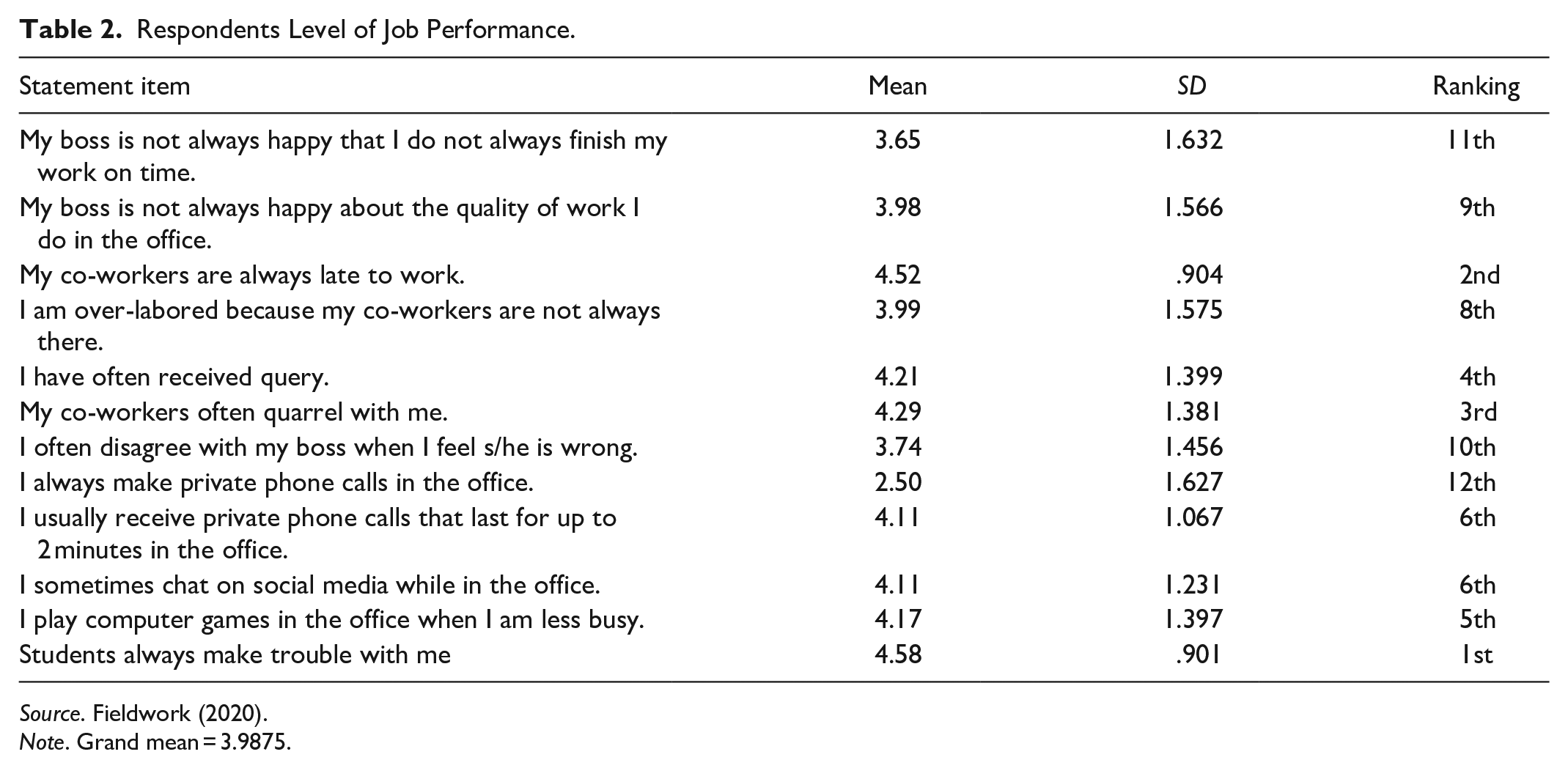
Source. Fieldwork (2020).
Note. Grand mean = 3.9875.
Extent to Which Structured Supervision Enhances Job Performance
The resultant data indicated the mean scores attributed to each of the five items which determines of job performance. Using a 5-point measurement scale, the resultant mean score attributed to adequate policy on supervision is 3.98 with standard deviation (SD) of 0.8049; the mean for adequate supervision is 4.00 while the SD is 0.7935. The mean scores for cordial relationship between supervisors and supervisees is 4.13 with SD of 0.7215; personal discipline by supervisors is 3.67 (SD = 1.0010), improved remuneration of staff is 4.02 (SD = 0.8712), recommending efficient staff for promotion is 3.64 (SD = 1.1116). These results indicate that there is a strong relationship between structured supervision and job performance. Therefore, to achieve excellent job performance, there is need for cordial relationship between workers and their supervisors and adequate supervision of workers. Again, the institution should have adequate policy on supervision, which should be the pivot for better job performance. When supervisor observe personal discipline, their job of supervision will be greatly enhanced because they will be leading by examples. To enhance proper motivation of staff, supervisors should regularly recommend efficient staff for promotion. Generally, the study revealed that structured supervision is the key to achieving excellent job performance by university workers especially Junior Non-Academic staff (Table 3).
Respondents Opinion on Elements of Structured Supervision Which Enhances Job Performance.
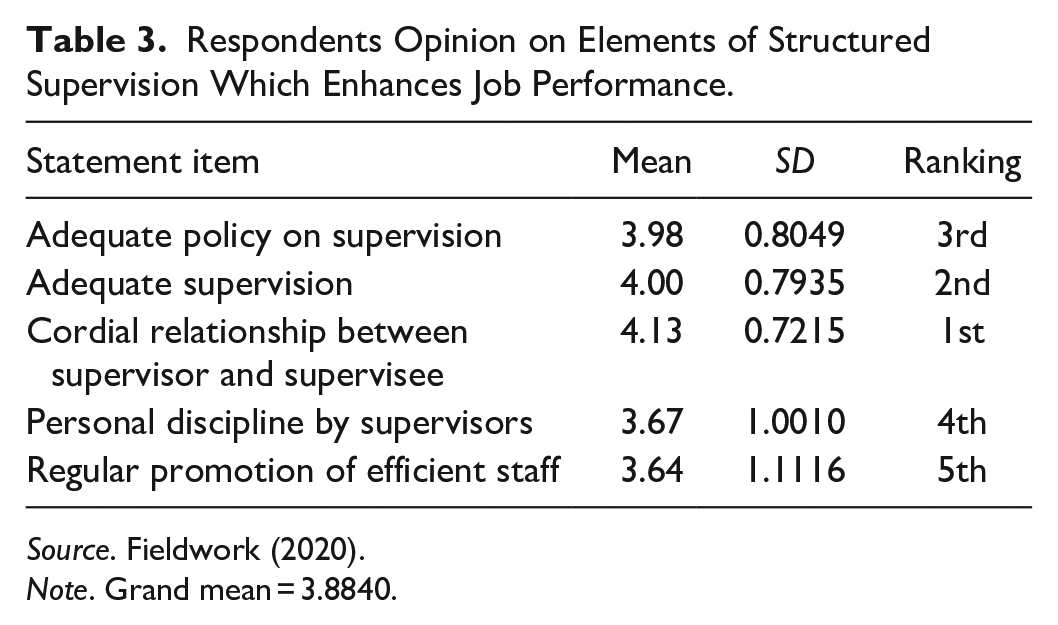
Source. Fieldwork (2020).
Note. Grand mean = 3.8840.
Relationship between structured supervision and high job performance
The result indicates that 91 respondents representing 85% of the entire participants agreed that structured supervision leads to high job performance. The other 14 respondents (13.1%) believed that structured supervision does not lead to high job performance. On cross tabulation of the responses for structured supervision and job performance, it was observed that the mean score is 1.187, the standard deviation is 0.458 while the p-value is .404. In this case, the p-value (.404) is greater than the expected value (.06). As a result, we reject the null hypothesis that there is no significant relationship between structured supervision and high job performance. Therefore, the result reveals a strong relationship between structured supervision and high job achievement and performance. In other words, wherever the principles of structured supervision are applied, there is a high tendency of achieving high productivity (Table 4).
Relationship Between Structured Supervision and High Job Performance.

Source. Fieldwork (2020).
Discussion
Having set out to determine the influence of structured supervision on job performance by staff (junior non-academics) of Ebonyi State University Abakaliki, Nigeria, the study found that the junior staff (non-academics) of the university has been poorly supervised or supervised harshly. This results in such poor work attitude such as not signing of staff movement books and not coming to work on time as well as not being honest at signing attendance register. It was also discovered from the records that it was only one of the departments studied that the supervisor provided staff movement book. The implication of this is that supervisors do not provide the necessary measures to gage the staff activities and movements during office hours. In other words, supervision existed but it is not structured. This results to poor job performance. This is in line with the views of Shahab and Nisa (2014) and Ahmad et al. (2010) when they noted that poor supervision has a significant negative influence on job performance. This view was also shared by Mawoli and Babandako (2011) as they posited that hygienic and efficient supervisory conditions in the university boost staff commitment thereby resulting in high job performance. This finding also supports the view of Tappo (2016) when he noted that whatever is not supervised is not usually done well.
The study investigated the rate of job performance by Junior Non-academic Staff and found that staffs did exceedingly well in many areas of their task. It was learnt through the interview that such performance was achieved through harsh pattern of supervision. This is why the staff lagged behind in the quality of work done and obedience to their bosses; and they make excessive private calls while on duty as soon as the supervisor is not within vicinity. Buttressing this point, during the interview process, most of the heads of departments/units interviewed agreed that their junior non-academic staffs are not totally obedient to their bosses and that they make excessive phone private calls. But they maintained that the quality of work done by these staffs is not as expected. The interviewees posited that poor quality work may be experienced where structured supervision is lacking. This supports the view of Nanjundeswaraswamy and Swamy (2014) that an effective leader has influence on his/her followers to achieve desired goals which is quality work. However, this is contrary to the findings of Shahab and Nisa (2014) that there is no significant correlation between leadership and the performance of the workers. However, the result aligns with the view of Papadopoulos (2018) when he pointed out that a supervisor is a team leader and a task manager. In other words, a good leadership with the ability to inspire, supervise and be responsive do significantly influences the quality of work done by workers. That makes structured supervision a necessity.
The results show that one major strategy toward improving the attitude of workers, particularly junior non-academic staff, in universities is through the application structured supervision. The major indices of structured supervision are cordial relationship between workers and their supervisors, regular training of supervisors, improvement in supervisors’ remuneration and adequate supervision of the supervisors. Other attributes of structured supervision include favorable institutional policy on supervision, excellent working condition and regular recommendation for promotion of efficient staff by their supervisors. These findings are in line with the views of Nanjundeswaraswamy and Swamy (2014) that effective and structured supervision and leadership styles are key ways of generating the best performance from employees. It also agrees with the report of Kashyap (2020) who stated that the current concept of supervision has advanced. It actually requires a super (structural) plus vision which is the hallmark is structured supervision.
The study assessed the strength of the relationship between structured supervision and high job performance. The result of the tested hypothesis revealed that there is a significant relationship between the two variables. In other words, application of the principles of structured supervision (such as adequate policy on supervision, adequate supervision, cordial relationship between supervisors and supervisees, self discipline by supervisors, and regular promotion of efficient staff) definitely lead to high job performance and consequently high productivity. The result supports the views of Yang et al. (2019) and Sisyuk (2018) when they pointed out that structured supervision which is value-base is expected to improve job performance. The result also aligns with the view of Nanjundeswaraswamy and Swamy (2014) that effective and structured supervision and leadership styles are key ways of guaranteeing high job performance among employees.
Conclusion
It can be said that the attitude to work exhibited by staff of the Nigerian university studied was negative to a great extent. Their job performance was relatively low. All these are because supervision was not structured. And because of the haphazard nature of supervision, they did not do well especially in the areas of recording their movements while on duty and punctuality to work. These were actually the result of lack of structured supervision. Again, poor or unstructured supervision results to poor quality of work and poor attitude to duty.
As a result, we can say that structured supervision is the process of inspiring, directing, motivating, appealing, and coordinating the subordinates to perform their duties effectively, efficiently and timely even when the supervisor is not watching. It is not the forceful ordering of subordinates to do work. It involves the supervisor starting the work and/or working cordially with the subordinates. Structured supervision breaks down the barriers between supervisors and subordinates, making the world of work an interesting place with less fatigue.
Similarly, several factors have been adduced to have caused lack of structured supervision and subsequent negative work attitude. One of these factors is lack of training for junior non-academic staff and even the supervisors. Most times the administrators believed that the job of supervision does not require training. But this has been found to be erroneous as training enhances the workers performance and reduces the time spent on a particular task. Putting it differently, one of the necessary prerequisite for structured supervision is guided training and this invariably results in excellent job performance. The more the supervisors are trained, the more they understand better ways of performing their tasks at the minimal cost of time and money; and the more they will able to transfer their knowledge into their supervisory roles. Therefore, it is important that workers should know the actual work they are employed to do and they should be appraised based on such jobs and not on other extraneous jobs that supervisors may impose on them.
Based on the foregoing, it can be said that organizations should adopt not just supervisory policy but structured supervision strategy. This will ensure positive attitude to work by workers and subsequently lead to high productivity. To achieve structured supervision (supervision without threat) in the universities, supervisors should be made to imbibe the character of self discipline. This will enable the supervisors to become team leaders in order to achieve high job performance through their subordinates. Part of what can make structured supervision effective is that the university authorities should ensure that supervisors in all departments/units provide and religiously use staff movement books. This is essential in order to monitor and check the movement of staff whenever they are on duty. It will also help to identify where any worker is in time of emergency. This document is beneficial to both management and supervisors and is a necessary material for sustaining structured supervision in all organizations especially educational institutions.
Again, to maintain structured supervision, there is need to create a special unit or department within the university that will be in charge of monitoring the activities and performance of supervisors. If the supervisors realized that they are under close watch, they will put in their best and live by example. This is the soul of structured supervision. There should also be constant training of supervisors such as heads of departments/units, deans and directors. This will help to equip them with the ideals of structured supervision with hope of establishing a mutual relationship between workers and their supervisors. This is necessary because excellent job performance cannot be achieved under a situation of rancor and acrimony.
Similarly, the study has provided support for equity theory of motivation. The theory emphasized that motivation is dependent on what the individual worker believes to be fair deal in the work place. The study has shown that structured supervision is one of the ways through which management displays fairness in the work place as a social exchange. As such, the study has proved that when workers obtain fair deal in social exchange, they are motivated and their performance improves. As a result, any study on job performance should take cognizance of the attitude of supervisors toward their subordinates.
Footnotes
Acknowledgements
We are grateful to the management and staff of Ebonyi State University, Abakaliki Ebonyi State, Nigeria for their assistance and support which led to the success of the research. We also appreciate the non-teaching staff members of the university in particular for their willingness to participant in the study.
Declaration of Conflicting Interests
The author(s) declared no potential conflicts of interest with respect to the research, authorship, and/or publication of this article.
Funding
The author(s) received no financial support for the research, authorship, and/or publication of this article.
Ethical Approval
The study was assessed and approved by the Research and Ethics Committees of both Ebonyi State University and Alex Ekwueme Federal University Ndufu-Alike. The participants also expressed their consent to participate in the research in writing after the whole essence of the research was explained to them.
