




Abstract
This study examines the future of TV and online video platforms in the evolving Egyptian market through using the predictors of use and interaction. Built on the unified theory of acceptance and use of technology, and the theory of technology discontinuities and platforms development, this study extends its framework to explore the relationship between the intention of use and the interaction with content behavior. A sample size of 396 university students answered the survey questions. Unlike other studies, the study found that the perceived ease of use (PEU) is the only variable that is positively correlated to the intention to use online video platforms, yet it shows a significant positive relationship between consumer characteristics (including instrumental orientation [IO], perceived behavioral control [PBC], online flow experience [FLOW]) and intention to use online video platforms. Results show that people are watching less TV, yet the low disposable income might be a serious challenge toward the growth of video platforms. This study offers valuable indicators about changing consumer behavior in the research-weak transitional Egyptian media system.
Introduction
Online video streaming sites and television websites have attracted large audiences and have been able to maintain viewership within different markets. In 2021, the number of global subscribers to online video streaming service reached 1,060.8 million, with Netflix as the largest player commanding over 204 million subscribers, and Amazon Prime in the second place with 150 million subscribers. Disney+ is the newest and fastest growing service with 94.9 million subscribers gained only in less than 2 years (Wallach, 2021). In the Middle East, video streaming services are also gaining ground. There will be 12.27 million subscriptions across 13 Arab countries by 2025. This is triple from 4.13 million in 2019 (Research & Markets, 2020). The video industry ecosystem encompasses the telecommunication, media and entertainment (TME) industries, which are facing a sharp erosion of their traditional revenue streams and struggling to develop new business models such as pay-per-view and platform exclusive original productions. The video industry is a true example of an industry that needs to embrace the VUCA (volatile, uncertain, complex and ambiguous) world and try to take advantage of the changing environment and the opportunities it offers (Bergek et al., 2013; Cha, 2013; Jarventie-Thesleff et al., 2014; S.-C. S. Li, 2004).
The digitalization of television and expansion of online video platforms (VPs) have led to an explosion of video content. With audience fragmentation, the proliferation of single viewers using multiple screens, and audience interaction (liking, sharing, commenting, etc.), new terms emerged to describe these new phenomena such as prosumers (Toffler, 1980) or produser, which define these new consumers roles where individuals can also be producers instead of passively receiving content, and to define producers who also become consumers of others’ content. Digital consumers for video content are recognized by seven main traits. They are more knowledgeable, more demanding, more empowered, more collaborative, more diverse, more interactive, and more on the move (Dinana, 2019).
Previous studies focused on the extent to which online platforms would cannibalize traditional platforms (Cha & Chan-Olmsted, 2012; Flavian & Gurrea, 2007; Gimpel, 2015), and others focused on how consumer characteristics and perception of VPs could affect TV and online video consumption in the context of developed countries where the economy is stable and telecommunication infrastructure is sustainable (Cha, 2013).
Extant literature has addressed the intent to use television and VPs in many developed countries (Bury & Li, 2015; Cha, 2013; Chalaby & Plunkett, 2020; Gimpel, 2015; Herkman & Vainikka, 2014); however, little is known about the Arab region. This study focuses on Egypt, a developing country with a population of 101.4 million. Egypt is highly connected, boasts a large segment of young consumers (around 60% of the population is 24 years old or younger; Central Agency for Public Mobilization and Statistics [CAPMAS], 2020), and has active social and online media users comparing with others in the region (Media Use in the Middle East, 2017). This study fills the gap and adds to the literature by expanding to the understudied context of the Arab region. The potentially fruitful market and active content suppliers make this study vital to understand which of the perceived characteristics and consumer characteristics are of significance to the teenagers’ intention to use VPs and TV, in addition to examining the relationship between the usage of VPs or TV and content behavior.
The significance of the present study lies also in the remarkable increase of internet users and mobile penetration in Egypt since 2011, and the development that took place in telecommunications infrastructure and the introduction of 4G (fourth-generation) technology that offered better quality and uninterrupted service (Allam & Chan-Olmsted, 2020). As of 2018, internet penetration in Egypt reached almost 50% compared with 35% in 2014. In the same year, mobile penetration reached 102% and mobile internet users reached 44 million. There are approximately 40 million active social media users, representing 40% penetration, and mobile social media users represent 38% of the population (Information and Communication Technology [ICT], 2020). This young nation is connected to the internet using laptops/computers (57%), mobile phones (41%), and tablets (2%). They spend about 8 hr per day using the internet, of which 3 hr are used for social media, 3 hr are spent on video viewing, and 1 hr spent listening to music (Hootsuite, 2018). The study is intended to act as a guide for media decisionmakers and content producers as the Egyptian media market suffers from the absence of an independent audience research centers that would provide data on audience behavior and indicators on consumption pattern.
Based on the changing consumption behavior and improvements in telecommunication infrastructure in the Egyptian market, this article examines the relationship between the perceived characteristics of VPs and consumer characteristics on the intention to use VP and TV. The characteristics of VPs include perceived substitutability (PS), relative advantage (RA), perceived ease of use (PEU), and compatibility (COMP). The consumer characteristics include ritualistic orientation (RO), instrumental orientation (IO), subjective norms (SN), perceived behavioral control (PBC), and online flow experience (FLOW). The study further explores the relationship between the intention to use VPs or TV and the behaviors associated with interaction with content. Content behaviors include time spent on use of TV or VPs, viewing behavior, content sharing, and content creation.
Use of Digital Media in Egypt With Specific Reference to Teenagers
Egypt has a population of 101.4 million, where 49% are females and 51% are males. The median age in Egypt is 25 years, which shows that Egypt has a young population with literacy rate that counts for 71% (CAPMAS, 2020). The total number of internet users on any device counts for 54.74 million, which is 54% of the population, and the growth rate in the number of internet users in 2020 compared with 2019 was 9.8 million users, which represents a significant annual growth rate of 22%.
The percentage of mobile internet users as a percentage of the total internet users is 94%, and the percentage of share on all internet users accessing through smart phones is 91%. Around 47% of the share of web traffic comes from mobile phones, 51% from laptops and desktops, and only 2.3% is shared from tablet computers (ICT, 2020).
Statistics shows that 95% of the online content activities are spent on watching online videos, and 50% from watch vlogs, and 65% for listening to music streaming services, 36% listen to online radio stations, and 39% listen to podcasts (ICT, 2020).
The majority of those accessing the internet range between the age bracket of 18 and 24 years old. Of the 54.74 million internet users, 42 million are active social media users, and 99% of them access the social media platforms through their mobile phones.
The video market in Egypt has witnessed a remarkable increase in the past few years for both the free and subscription platforms. The spread of the VPs is due to the spread of the smart devices that increased from 12.6 million in 2013 up to 28 million in 2018 (CAPMAS, 2020; ICT, 2020) due to the mobile penetration that reached almost 95% of the populations. Therefore, Egypt has a population that shows a strong demand and appetite for the online video content, especially to its high young population. It is important to mention that one of the main challenges that stands against the growth of the video platforms is the low disposable income, yet many bundles between the telecommunication companies and the video platforms to offer affordable packages for audience with different economic standards (Allam & Chan-Olmsted, 2020).
Theoretical Framework and Literature
The proposed model for this study is built on two theoretical foundations that have been extensively studied and reviewed in the literature and discussed by practitioners. The two theoretical foundations are the theory of technology acceptance and use, and the theory of technology discontinuities and platforms development.
The video platforms and online streaming are new technologies that are being adopted and used by different consumers around the globe and this integrated view in studying them will provide more insights to manage the highly dynamic nature of this issue in Egypt that is reshaping many industries such as media, entertainment, and telecommunications.
The Unified Theory of Acceptance and Use of Technology (UTAUT)
Many theoretical models have been proposed to examine consumer acceptance and use of technology and new innovations. These include the Theory of Reasoned Action (TRA), the Technology Acceptance Model (TAM), the Theory of Planned Behavior (TPB), and Model of Personal Computer Utilization (Davis, 1989; Fishbein & Ajzen, 1975; Thompson et al., 1991).
These theories combined different elements such as technology attributes, personal/individual attributes, and contextual factors. After a comprehensive review and synthesis of several theoretical models, Venkatesh et al. (2003) proposed the UTAUT, later modifying it in 2012 and proposing UTAUT-2. Bury and Li (2015) found that technology advancement has led to a change in the modes of viewing as it becomes more diverse and not limited to the traditional TV screens.
Technological Discontinuity and Platform Development
Anderson and Tushman (1990) defined technological discontinuities as “innovations that dramatically advance an industry’s price vs. performance frontier.” Although technological discontinuities do not necessarily mean the development of a totally new technology, they can still represent a major threat to established industry players and can alter their competitive position or even threaten their future survival.
Different studies were conducted to examine the effects of technological changes on industries, originations, and individuals’ roles (Astley, 1985; Barnett, 1990; Brittain & Freeman, 1980; Burkhardt & Brass, 1990; Chandler, 1977; Henderson & Clark, 1990; Karasek, 1979). The combined effects on industries, organizations, and individuals clearly indicate that when technological change represents a technological discontinuity, industry incumbent firms (in this research, companies working in the traditional TV industry) struggle against new entrants (VPs), and according to Bergek et al. (2013), several frameworks have been developed to study the circumstances in which the discontinuous technological change or innovation would have an impact on any firm’s performance.
Generally, discontinuous innovation affects the existing structures of firms and creates pressure to adopt the new changes or risk losing its competitive edge (Bergek et al., 2013; Christensen & Rosenbloom, 1995; Leonard-Barton, 1992).
A body of literature discusses the development of the technological discontinuities and its impact on performance. Back in 1990, Philip Anderson and Michael Tushman argued that technological discontinuities trigger a period of ferment and the adaptation of the new design is affected by political and organizational factors and the technical abilities of an entity (Anderson & Tushman, 1990). Later, Ansari and Garud (2009) found that new technologies do not simply take over older formats.
Bergek et al. (2013) found that some incumbents have the ability to absorb and integrate new technologies into their existing structures through the concept of “creative accumulation.” Lee and Lee (2015) found that when audiences spend more time using online video services, it negatively impacts the time spent on cable TV and games and also the time spent on non-media-related activities. Gillian said that channels should have an appropriate investment strategy to integrate traditional channels with the digital platforms so as not to fall behind.
The technological discontinuities seen in the media industry are evident in the development of internet-based video platforms that enable connectivity, increase variety, match consumers, and set prices (Cusumano, 2010; Eisenmann & Hagiu, 2007). Platforms are the means through which different players communicate and conduct business (Boudreau & Hagiu, 2009; Eisenmann et al., 2011a). For example, YouTube enables consumers, TV producers, and movie studios to carry out business together through its search engine and file transfer system. Netflix also aggregates a variety of content types to satisfy different audience tastes. Chalaby and Plunkett (2020) said that the technology has urged the traditional broadcasters to adapt to the new changes to meet the new standards or else they will be irrelevant by time, and argued that as technology and cultural consumption practices are changing as well, television broadcasting companies need to adjust their model to the new circumstances.
Mikos (2016) believes that the traditional classical television is not disappearing but the digital advancement enforces the TV broadcasting channels to adapt their content to fit the new platforms. Platforms are defined as important technologies or fundamental services that are influenced by the network effects; in other words, their value depends on the number and type of users (Cusumano, 2011; Eisenmann et al., 2011b; Katz & Shapiro, 1994; Rohlfs, 1974; Shapiro & Varian, 1999).

Conceptual framework.
Conceptual Framework
The framework examines the relationship between the perceived characteristics of VPs and consumer characteristics of audience intention to use VPs and TV in the Egyptian market. The characteristics of VPs include PS, RA, PEU, and COMP, and the consumer characteristics include RO, IO, SN, PBC, and FLOW (Appendix B). The study further explores the relationship between the intention to use VPs or TV and content behavior. The use and interaction with content behavior include time spent on use of TV or VPs, viewing behavior, content sharing, and content creation.
This research attempts to determine which of the perceived characteristics of the VP and consumer characteristics are of significance to teenagers’ intention to use VPs and TV. It also examines the relationship between the usage of VPs or TV and content behavior.
The perceived VP characteristics include PS, RA, PEU, and COMP. Based on the literature, the study suggests the following hypotheses:
Perceived Characteristics
PS
The debate of whether a new medium will substitute or replace conventional media is an ongoing one especially when the functionality of the new medium is the same as the old (Cha, 2013; Lin, 2001). Ferguson and Perse (2002) said that to understand the influence of a new medium on an existing one, it is important to examine consumer perceptions of the new medium and the extent to which it can replace the existing one.
RA
Another predictive factor is the RA, which is defined as the extent to which an innovation is considered an improvement to an old medium (Rogers, 2003). Lin (2001) also found that when the RA of a new medium is greater than the old one, consumers opt for the new option. Researchers also found that RA is a significant predictor of when audiences decide to adopt a new communication technology (Cha, 2013; S.-C. S. Li, 2004).
PEU
The PEU was found to be the most significant variable for audience decisions to use an internet-based technology (Gefen et al., 2003). PEU is defined as the degree to which audiences see that the usage of a particular system is free from physical and mental efforts (Davis, 1989).
COMP
COMP is also seen as a critical element in audience decisions to adopt a new internet-based technology (Lin, 2001; Tornatzky & Klein, 1982). Rogers (2003) defined COMP as the degree of consonance between the new technology and previous experiences. Cha (2013) said that the COMP of VPs decreases the likelihood of using television, and Lin (2001) found that the digital system is not in agreement with the traditional system, and accordingly, those who perceive VPs as compatible may consider television as incompatible with their values and experiences.
Consumer Characteristics
The consumer characteristics include IO and RO, SN, PBC, and FLOW. Based on the literature, the study suggests the following two hypotheses:
IO and RO
The IO variable is concerned with audience activity and the degree of involvement with different media platforms. It is divided into two types: ritualistic media use, which defines the media use as a time-filling activity regardless of the content, and instrumental media use, which is more intentional and selective and is used for exposure to a specific content (Blumler, 1979). Studies on media use between television and the internet have different results. Some studies found that the internet is oriented more toward instrumental use (Papacharissi & Rubin, 2000) while others found that there is no significant difference between IO and RO for internet use (Metzger & Flanagin, 2002). Cha (2013) found that RO and IO behind video content consumption are positively related to the intention to use television.
SN
Studies also found that the SN variable has a direct positive impact on the intention to use a particular technology because social factors positively influence the individual’s usage of ICT. This reflects the fact that viewing video content is considered a popular tool for social interaction and social integration (Chug et. al, 2012; Venkatesh & Davis, 2000).
PBC
PBC is the extent to which people believe that they can get involved and engaged in a particular behavior and whether they have the needed resources that are required for engagement or not (Ajzen, 1991). Many studies found that it is an important factor that influences user intervention on digital-based platforms (Gefen et al., 2003). Cha (2013) also found that the PEU of VPs is positively related to user’s intention to engage with VPs.
FLOW
FLOW was found to be another element that affects audience behavior. As a website facilitates the FLOW, the consumers’ frequency and duration of visits to the website increase (Hoffman & Novak, 1997). Shin (2006) found that the flow and satisfaction levels are positively correlated; the FLOW has a positive impact on the intention to adopt online games (Hsu & Lu, 2004; Lee, 2009).
The conceptual framework tests as well the relationship between the intention to use VPs and TV with the use and interaction (viewing, sharing, and creating) with content behavior. The study hypothesizes the following:
Method
Data Collection and Sampling
This study used a quantitative research method by designing a questionnaire to collect data from 396 students currently enrolled at one of the main private universities in Egypt to understand their usage patterns and how these patterns impact audience content behavior.
A pretest was carried out before the main survey was distributed to ensure reliability of the constructs and to check the wording and the flow of the questions to eliminate any misunderstanding or unclear items.
The data for hypotheses testing were collected from April to December 2018 and the institutional review board (IRB) approval was taken. The number of responses collected were 396. As per Uma Sekaran and Roger Bougie (2016), for a population of 1,000,000, a sample size of 384 can be used. Also, the sample size can be calculated based on 10× the number of variables in the tested model. In this study, there are 19 variables; hence, a sample size of 190 can be used. The age range fell between 18 and 22 years. Male students accounted for 65% of the participants, whereas female students accounted for 35%.
The methodology used in this study was based on the extensive literature review completed by the researchers. Most of the studies that cover consumers’ intention to use media products and interaction with media content use quantitative methodology using self-administered questionnaires. Many of the studies reviewed used the methodology and measurement scales adopted in this study, such as, Chan-Olmsted and Chang (2006), Davis (1989), Flavian and Gurrea (2007), Jiyoung Cha (2013), Jiyoung Cha and Sylvia M. Chan-Olmsted (2012), Mathieson (1991), Novak et al. (2000), Rubin (1983), and Taylor and Todd (1995).
Definitions
To avoid confusion or misinterpretations of the survey questions, the study defined some terms for participants. For example, (a) television content is content created to be broadcast within the programming of television channels, or extra content that are offered on the internet; (b) other professional content is content created by other professionals or communication means (video clips, films, trailers, advertising spots . . .). In this research, the term professional does not refer to the quality of the content, but to its origin. For example, we include within this classification a video interview that is offered on a newspaper website, regardless of the quality of the video. (c) Video mixing (REMIX): Making use of content created by professionals, these are the outcome of video mixes made by nonprofessionals (e.g., by dubbing, changing the dialogue of a film); and (d) amateur videos: Videos created by nonprofessionals (commonly known as “home videos”).
Statistical Analysis
Structural equation modeling (SEM) was used to test all of the hypotheses proposed in the model. Before running the structural model to test the relationship between the independent variables, the intermediate variables, and the dependent variables, the model fit of the measurement model was assessed. In addition, a generalized linear multiple regression analysis (GLM) was done to calculate the correlation coefficients between the different variables.
Multiple regression analysis was performed using IBM SPSS software to evaluate covariance of one dependent and two or more independent variables. The path analysis is a form of multiple regression statistical analysis; it is a special case of SEM. So, the method is CB-SEM (covariance based–structural equation modeling).
Integrated Reliability and Validity Testing
Table 1 shows the descriptive statistics for each construct (variable) of the Left Side of the Model (from the independent variables of perceived characteristics of VP and consumer characteristics, to the mediating variables of intention to use) and the Right Side of the model (from the mediating variables of intention to use to the dependent variables of use & interaction with content).
Descriptive Statistics (N = 405).

Note. Reliability values as measured by Cronbach’s alpha for all constructs are acceptable (average .927 for left side of the model and .612 for the right side of the model).
Table 2 indicates highly acceptable reliability and acceptable independent consistency for both models (values >.6 are acceptable). On the basis of the reliability test, it is supposed that the scales used in this study are reliable to capture data for the constructs in the conceptual framework. Because the loadings are above the benchmark of 0.6 for both left and right sides of the model, it could be sure that convergent validity was attained. These results made the questionnaire a reliable and valid instrument for the purposes of this study.
Reliability Measured by Cronbach’s Alpha.
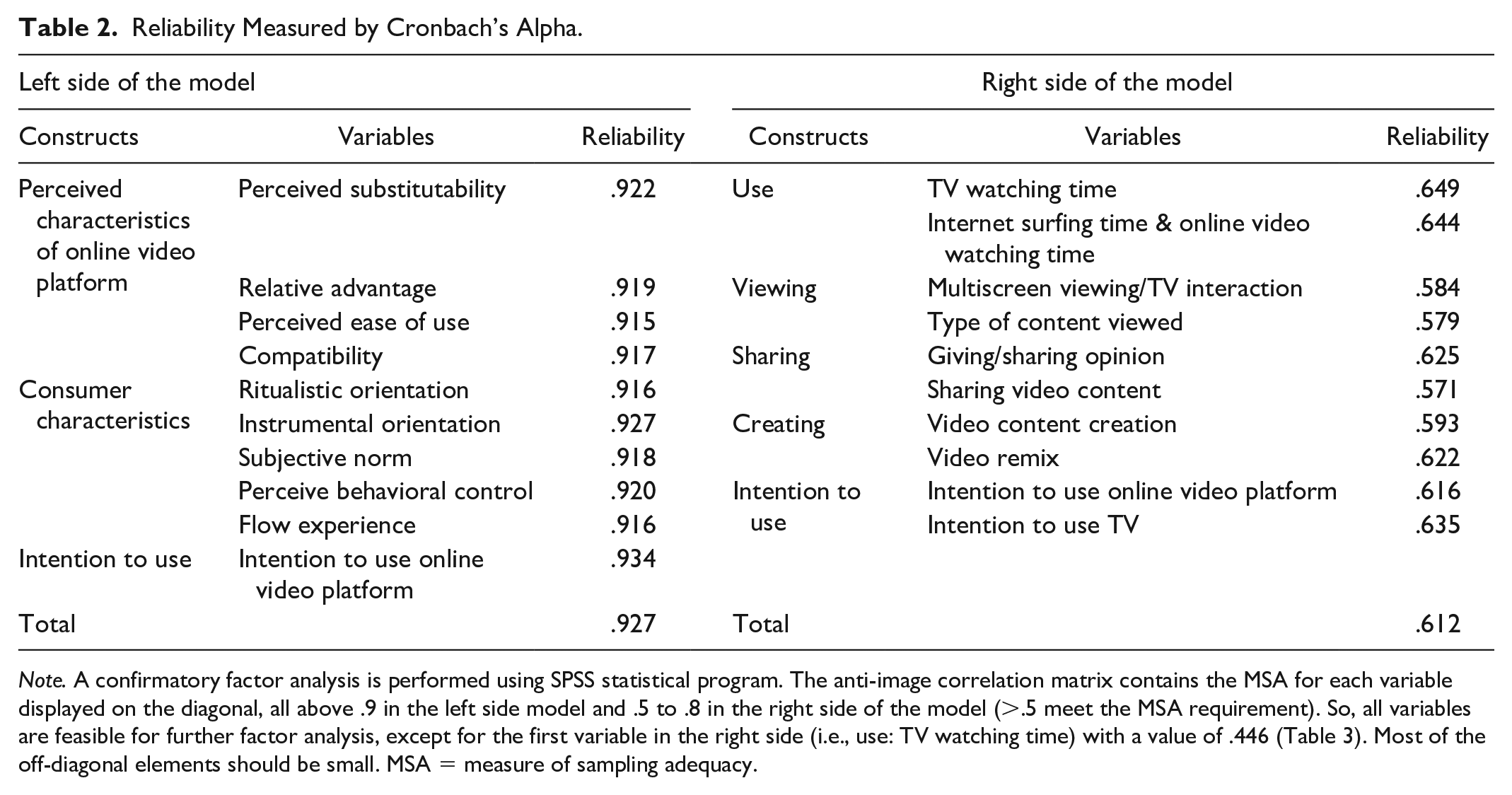
Note. A confirmatory factor analysis is performed using SPSS statistical program. The anti-image correlation matrix contains the MSA for each variable displayed on the diagonal, all above .9 in the left side model and .5 to .8 in the right side of the model (>.5 meet the MSA requirement). So, all variables are feasible for further factor analysis, except for the first variable in the right side (i.e., use: TV watching time) with a value of .446 (Table 3). Most of the off-diagonal elements should be small. MSA = measure of sampling adequacy.
Anti-Image Correlation Matrix of the Right Side of the Model.
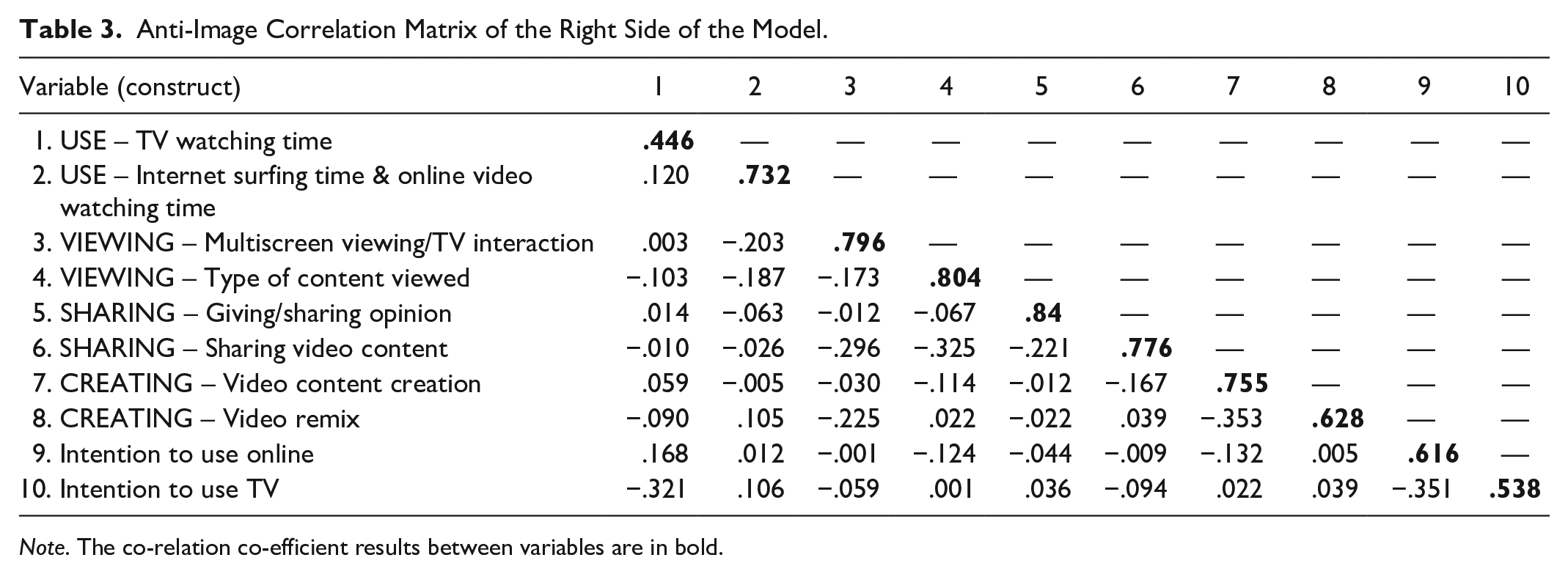
Note. The co-relation co-efficient results between variables are in bold.
Anti-Image Matrix of the Left Side of the Model.
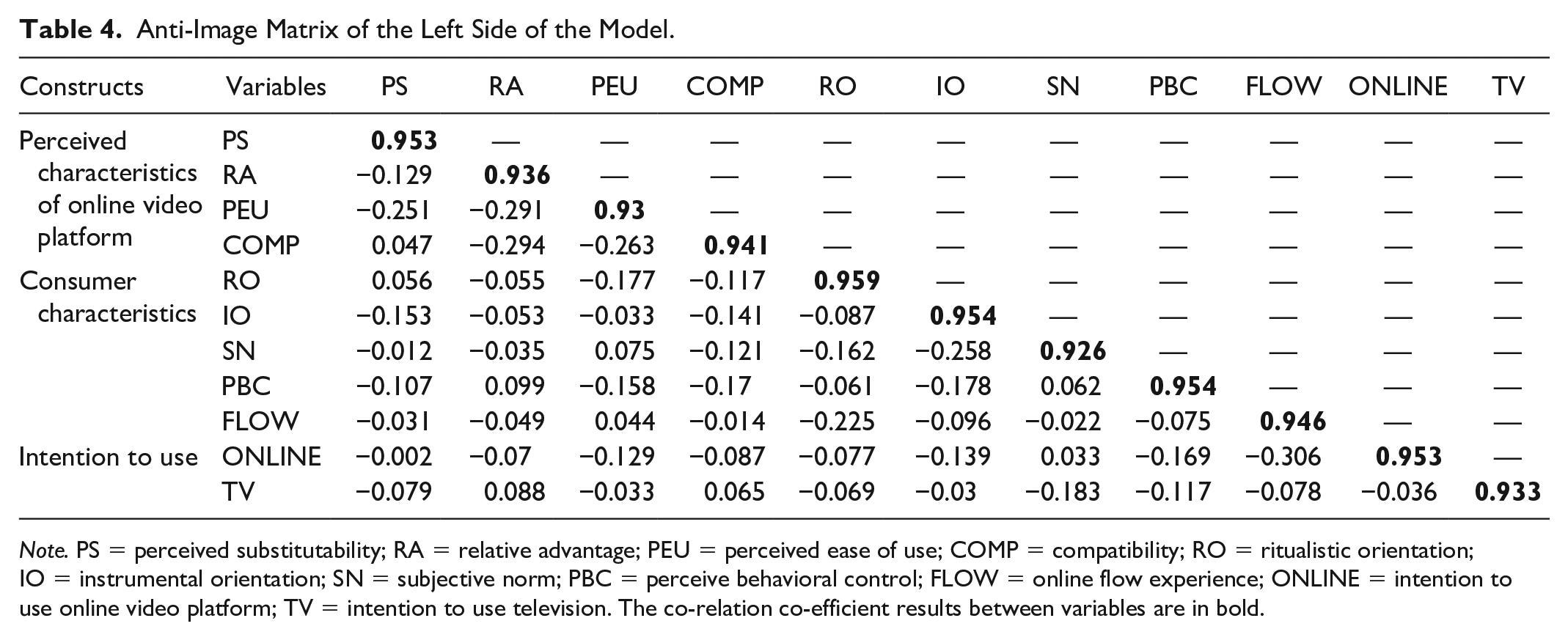
Note. PS = perceived substitutability; RA = relative advantage; PEU = perceived ease of use; COMP = compatibility; RO = ritualistic orientation; IO = instrumental orientation; SN = subjective norm; PBC = perceive behavioral control; FLOW = online flow experience; ONLINE = intention to use online video platform; TV = intention to use television. The co-relation co-efficient results between variables are in bold.
Findings and Analysis
Data Analysis
It is important to note that the usage of the two theories gave a well-rounded picture of why and how Egyptian consumers use the internet or television to watch video content. Using SEM and calculating the path coefficients, the model explained 64.1% of the variance in the intention to use VPs and explained 22.3% of the variance in the intention to use television.
The present study also employed the perceived characteristics of VPs, namely, PS, RA, PEU, and COMP, and perceived consumer characteristics, namely, RO, IO, SN, PBC, and FLOW to measure the intention to use television and to use VPs as they both exist together in the market. This approach enables the researchers to examine and understand the impact of VPs on television use (Appendix A).
Intention to use VPs
With respect to the intention to use VPs, results of the SEM revealed that both the perceived characteristics of VPs (c = 0.399**, p < .01) and the perceived consumer characteristics (c = 0.407**, p < .01) are positively related to the intention to use VPs.
Further analysis of the components of the perceived characteristics of VPs revealed that only PEU (c = 0.152**, p < .01) is positively related to use of VPs. On the contrary, the analysis of the components of perceived consumer characteristics revealed that three components, namely, IO (c = 0.143**, p < .01), PBC (c = 0.163**, p < .01), and FLOW (c = 0.275**, p < .01), are positively related to the use of VPs.
Finally, using Pearson’s correlation analysis, it was found that the correlation between perceived characteristics of VP and intention to use VPs is positive and significant at .719**, and the correlation between perceived consumer characteristics and intention to use VPs is positive and significant at .760**
Intention to use TV
As for the intention to use TV, the SEM found that only the perceived consumer characteristics (c = 0.467**, p < .01) is positively related to the intention to use TV.
Further analysis of the components of the perceived consumer characteristics revealed that SN (c = 0.204**, p < .01) and PBC (c = 0.171*, p < .05) are positively related to use of TV. This contradicts the proposed hypothesis that instrumental viewing orientation will be negatively related to the intention to use television. It is worth mentioning that none of the components of the perceived characteristics of the VPs showed significant correlation to the intention to use TV.
Finally, using Pearson’s correlation analysis, it was found that the correlation between perceived characteristics of VPs and intention to use TV is positive and significant at .334**, and the correlation between perceived consumer characteristics and intention to use TV is positive and significant at .450**. This is lower than the correlation coefficients found for the intention to use VPs.
Testing the moderating effect of age and gender revealed that they do not have any significant effect on the relationship between the perceived characteristics of the VPs, perceived consumer characteristics, and the intention to use the VPs or TV.
Use and interaction with content behavior
Use
Intention to use VPs has a significant negative relationship with TV watching time (c = −0.166**, p < .01), whereas intention to use TV has significant positive relationship with TV watching time (c = 0.366**, p < .01) and significant negative relationship to internet surfing and online video watching time (c = −0.117*, p < .05).
Viewing
Intention to use VPs has a significant positive relationship with multiscreen viewing (c = 0.121*, p < .05) and type of content viewed (c = 0.207**, p < 0.01).
Sharing
Intention to use VPs has a significant positive relationship with giving/sharing opinions (c = 0.116*, p < .05) and sharing video content (c = 0.149**, p < .01), whereas intention to use TV has significant positive relationship with sharing video content (c = 0.124*, p < .05).
Creating
Intention to use VPs has a significant positive relationship with video content creation (c = 0.218**, p < .01), whereas video remix has no significant relationships.
Finally, the frequency analysis provided some more insight on consumer behavior with respect to the use and interaction with video content. The majority of respondents (61%) watch TV less than 1 hr per day, while 49% of them surf the internet more than 4 hr daily. Surfing the internet has significantly affected TV watching behavior, 30.6% of respondents do not watch TV anymore, and 61% watch less TV. Finally, 40% of respondents watch TV content on the internet once or more per day, while 33% watch it once or more per week.
The most commonly viewed genres for those consuming online once or more per day are music (53.1%) and humor (45.5%). They are also the most common genres shared by respondents who view online once or more per day: music (22.1%) and humor (39.4%).
Downloading video content from the internet is commonly done once or more per week (22.7%), or once or more per month (25.4%). Sharing video content on the internet is commonly done once or more per day (31.1%), or once or more per week (31.6%). Sharing content is done using social media apps such as Facebook and Twitter (50.7%), or instant messaging apps such as WhatsApp (32.8%).
Regarding interaction with content, 30.8% of respondents indicated that they would click on like/dislike options once or more per day, while 25.5% never use this option. Only 9.7% would write comments on the viewed content once or more per day, and 49.2% never writes comments.
Multiscreen viewing while watching TV is common among the respondents; 68.3% use their smartphone and 27.5% use their laptops. They watch other videos simultaneously with the TV program they are watching (20.9%) and perform non-audiovisual activities that are not related to the TV program that they are watching (35.6%). Finally, 49% of respondents never make video recordings to post online and 76% never make video mixes using professional images or sounds.
Discussion
This study reveals interesting findings that explain how the development of VPs in the Egyptian market affects television use. The study employed the perceived characteristics of VPs and consumer characteristics to measure their influence on the intention to use VPs and television due to their co-existence in the market. It then measured the relationship between the intention to use VPs or TV with the kind of use and interaction with content behavior.
This study found that among the perceived characteristics, the PEU is the only variable that is positively correlated to the use of VPs. Unlike other studies, such as Cha (2013), which found that besides the PEU, RA and COMP are positively correlated to the use of VPs and Chen et al. or Wu and Wang (2005) who found that COMP has the greatest importance. It means that teenagers prefer to engage with a system that is free from physical or mental efforts, and that they are keen that the activities they are engaged in, such as searching, storing, and downloading videos, should not be complicated. This resonates with Jarvelainen (2007) who said that the acceptance of a new technology is affected by the PEU of this technology. This also matches with the nature of Egyptian users, who are considered relatively new to the technological environment. It is also relevant to the cultural preference of consuming audiovisual content (Allam & Chan-Olmsted, 2020), and the low rate of literacy which makes the ease of use of a new platform an important factor.
In predicting the intention to use a type of VP, consumer characteristics were also among the determinants as were the perceived characteristics. Results show a significant positive relationship between IO, PBC, FLOW, and intention to use VPs.
It is worth highlighting that the PBC is positively related to the intention of both the use of VP and the use of television. This differs from other studies that found PBC is only a predictor of the intention to use VPs (Cha, 2013). One possible interpretation is that teenagers, the study sampled, prefer to engage in activities for which they possess control, and in the case of television, resources might be the available options to record programs or skip advertisements.
Having the FLOW and IO among the consumer characteristics that are positively related to the use of VPs indicates that Egyptian consumers give priority to their surfing experience and their control over content selection above other variables. FLOW deals with the ease of surfing a website with the target of facilitating such a seamless experience that consumers do so unconsciously. Instrumental viewing orientation is concerned with the freedom that users have in choosing and selecting content.
The present study contradicts Cha (2013), and Metzger and Flanagin (2002) who found that ritualistic viewing orientation is a predictor for the use of television. It also contradicts other studies that found SN are a predictor for the use of VPs. As for the findings related to SN, this study found that they are a predictor for the use of television.
The second part of the model further explains the relationship between the intention to use VP and TV with the use and interaction with content behavior (viewing, sharing, and creating). In other words, it delves into the types of content consumed through each platform, which helps content decisionmakers understand genre preferences on each platform.
The results show that people are watching less TV, which supports the hypothesis that there is a significant negative correlation between intention to use VPs and TV watching time. The intention to use VPs has a significant positive correlation with giving/sharing opinions, sharing video content, and creation of video content, but has no significant relationship to video mixes or modification. It is found that people who use VPs and consume less television spend more time on online surfing and online video watching time.
Generally, results show that the traditional television in Egypt is not disappearing, yet it is facing a great challenge especially if the TV broadcasting channels did not adapt to the new changes and were not able to have a presence on the new platforms. The traditional TV will otherwise gradually disappear or, as Chalaby and Plunkett (2020) note, it will become irrelevant. This resonates with Mikos (2016) who said that the traditional TV started to be a secondary medium as technology and consumption culture have changed. In Egypt, the traditional TV might stay a bit longer until it is substituted as it is still popular between the older generations and as the Egyptians’ disposable income is low in general, which makes the consumption of online videos although growing but at a slower rate compared with other developed countries (Allam & Chan-Olmsted, 2020). However, it is important to highlight that the different packages that are developed by the telecommunications companies and video platforms attract more audience to the online platforms and make it urgent for the traditional broadcasting channels to find ways to appeal to the new generations and reach them on the platforms they use. This resonates with the technological discontinuity and platform development theory where it states that any technological discontinuity does not necessarily mean the development of a new technology but it could be a threat to the already established players in the market.
Last but not least, although the study has limitations as the sample was taken from a single university, it offers a useful starting point as it highlights the interaction between VPs and television on consumer use of video platforms. These insights about audience interaction with content add to the literature and fill a void that exists in the Egyptian market where there is little audience research, and accordingly, it has historically been difficult to understand audience interaction patterns and content preferences.
Footnotes
Appendix A
Appendix B
Definition of Variables.

| Measurement scale | Source | Definition | Variable |
|---|---|---|---|
| Flavian and Gurrea (2007) | Kayany and Yelsma (2000); Lin (2001); Ferguson and Perse (2000) | Whether consumers perceive the new medium to be substitutable for—or to be a functional alternative to—the existing one | Perceived substitutability |
| Chan-Olmsted and Chang (2006) | Rogers (1995) | The degree to which an innovation is perceived as being better than the idea it supersedes | Relative advantage |
| Davis (1989) | Davis (1989) | The degree to which an individual believes that using a particular system would be free of physical and mental efforts | Perceived ease of use |
|
Taylor and Todd (1995)
|
Rogers (2003) | The degree to which the adoption of a technology is compatible with existing values, past experiences, and needs of potential adopters | Compatibility |
| Rubin (1983); Flavian and Gurrea (2007) | Rubin and Perse (1987) | Less intentional and nonselective orientation, a time-filling activity and a tendency to use media regardless of the content | Ritualistic orientation |
| Rubin (1983); Flavian and Gurrea (2007) | Rubin and Perse (1987) | More intentional and selective of content, and reflects purposive exposure to specific content | Instrumental orientation |
| Mathieson (1991) | Fishbein and Ajzen (1975) | The perceived social pressure that most people who are important to him/her think he/she should or should not perform the behavior in question | Subjective norm |
| Taylor and Todd (1995) | Ajzen (1991) | Perceived behavioral control refers to the degree to which people believe that they are able to engage in a particular behavior | Perceive behavioral control |
| Novak et al. (2000) | Csikszentmih (1975) | The holistic sensation that people feel when they act with total involvement | Flow experience |
Declaration of Conflicting Interests
The author(s) declared no potential conflicts of interest with respect to the research, authorship, and/or publication of this article.
Funding
The author(s) received no financial support for the research, authorship, and/or publication of this article.
Ethical Approval
Institutional review board (IRB) approval is taken for this research. The committee approval number is 1507.
