




Abstract
The buildup of shared understanding is central to design work. It is particularly important in remote teams, where design work is carried out by participants scattered across geographical locations. We contribute by exploring designers’ perceptions of shared understanding in remote teams. Taking the perspective of individual designers working in remote teams, we pursue two aims: first, to uncover the work elements that are perceived as requiring shared understanding, and second, to identify the perceived enablers of and barriers to the buildup of shared understanding. Albeit under-researched, such individual perceptions are important because they likely shape the scope and extent of the shared understanding built in the remote team. To pursue our aims, we conducted in-depth interviews with experienced designers. Using thematic analysis, we found that team spirit, shared experience, trustworthiness, and transparency, as well as project management and related micro-practices, are perceived as central to building shared understanding in remote design teams.
Keywords
Introduction
January 28, 2021, marked the 35th anniversary of the National Aeronautics and Space Administration (NASA) Challenger disaster. The space shuttle disintegrated a few seconds after the launch, taking the lives of the seven astronauts on board. In the aftermath of the accident, a presidential commission gathered to investigate the causes. It established that the O-rings used to seal the rocket booster were stiffened by the cold weather, causing hot gases to blow through a joint and provoke an explosion. It also established that the Challenger team was aware of potential erosion of the O-rings at cold temperatures and nevertheless decided to launch (Lawrence, 1994). Why did this happen? The flawed decision can be traced back to the geographical dislocation of the Challenger team, which made it more difficult to communicate and build shared understanding of design specifications (Baldoni, 2019).
NASA commissioned Morton-Thiokol to engineer and manufacture the rocket booster, and design communication was carried out remotely across corporate offices. The night before the launch, Morton-Thiokol engineers in Utah became concerned about predicted temperatures. They called a teleconference with NASA in Alabama and Florida. They also sent a viewgraph via fax, but engineering information was poorly displayed and hence was ineffective at sustaining the no-launch recommendation. NASA challenged Morton-Thiokol, whose vice president eventually stated the engineering data were inconclusive and reversed its recommendation from no-launch to launch (Post, 2014).
The construction of a spacecraft such as the Challenger is arguably one of the most complex endeavors in engineering design, with multiple actors, disciplines, and organizations being involved in the design process. This example illustrates the importance of building shared understanding and the difficulties that ensue when design teams are scattered across geographically dispersed locations. As design work is ridden with complexity, the buildup of shared understanding in remote teams is central to sustain their collaboration and effectiveness.
In design research, shared understanding has been explored from different perspectives such as mental models (e.g., Badke-Schaub, Neumann, et al., 2007), transactive memory (e.g., Kleinsmann & Valkenburg, 2008), and framing (e.g., Adams et al., 2018; McDonnell, 2018; Van der Bijl-Brouwer & Van der Voort, 2014). While providing valuable insights on shared understanding in design teams, this previous research has generally assumed or focused on co-located teams. Its findings require further validation if they are to be applied to remote teams, as building shared understanding becomes more difficult when working at a distance (Hinds & Weisband, 2003, p. 21).
Only recently, scholarly attention has turned toward exploring shared understanding in the specific context of remote design teams (Cash et al., 2017; Jordan & Adams, 2016). This follows a growing interest in remote teamwork because it reportedly increases productivity (Choudhury et al., 2021; Sandmann, 2000), employee engagement (Perry, 2019), and work–life balance (Lattemann et al., 2017). Accordingly, prior work has suggested processes to facilitate the buildup of shared understanding in remote design teams (Cash et al., 2017) and more broadly has explored the conditions enabling their success (Jordan & Adams, 2016).
We contribute by exploring designers’ perceptions of shared understanding in remote teams. Taking the perspective of individual designers working in remote teams, we pursue two aims: first, to uncover the work elements that are perceived as requiring shared understanding, and second, to identify the perceived enablers of and barriers to the buildup of shared understanding. Although under-researched, these individual perceptions are important because they likely shape the scope and extent of the shared understanding built in the remote team. We ask the following questions: About what elements of remote teamwork do designers perceive a need to build shared understanding? What are the perceived enablers of and barriers to the buildup of shared understanding in remote teamwork?
To address these questions, we conducted semi-structured, in-depth interviews with designers who are experienced at working remotely. Our findings offer a close-up picture of shared understanding, taken from the perspective of individual designers working in remote teams. For the purposes of our study, we use the term “remote team” (or remote design team) to designate a group of design professionals who work together on a project while being dispersed across geographical locations. In the next section, we review research on shared understanding, with close attention to its buildup in remote design teams. After presenting our methods, we report and discuss findings from thematic analyses of interview data. We conclude by elaborating the theoretical as well as practical implications of our study.
Theoretical Background
Shared Understanding: Mental Models, Transactive Memory, and Framing
A dominant stream of research in design studies has conceptualized shared understanding as the product of team members sharing their mental models (see Badke-Schaub, Lauche, & Neumann, 2007, for an overview). While individual mental models are representations of knowledge that each team member holds independently, a shared mental model (or team mental model) consists of “knowledge or belief structures that are shared by members of a team” (Badke-Schaub, Neumann, et al., 2007, p. 8). According to Badke-Schaub, Neumann, et al. (2007), shared mental models in a design project should encompass knowledge of the team, its task, and competence (especially if members come from diverse backgrounds or show diverse understandings of the task) as well as knowledge of the process for designing and the context of operation, including the team’s “relations to clients and users and a specific market situation” (Badke-Schaub, Neumann et al., 2007, p. 18).
While acknowledging the importance of shared mental models, Boos (2007) criticized Badke-Schaub, Neumann, et al.’s (2007) work for implying that shared mental models are produced through a mechanistic exchange of individual mental models. Instead, she suggested that shared mental models are “negotiated or consensually developed in an ongoing interaction process” (Boos, 2007, p. 23). Dong et al. (2013, p. 3) further suggested that shared mental models evolve over time, as they are “constructed in the course of discursive interactions between team members.” From this perspective, individual and shared mental models coexist and shape each other throughout design work. They are adjusted based on the design problem at hand and integrated to achieve an effective outcome for the teamwork (Xiang et al., 2015). Relatedly, Goldschmidt (2007) foregrounded the enabling role of visual representations in the buildup of shared mental models: Sketches are used to communicate concepts, negotiate solutions, and integrate the mental models of individual designers.
A related stream of research defined shared understanding as a similarity in individual perceptions of the transactive memory system. This “combines the knowledge processed by particular actors with a shared awareness about who knows what” (Wegner, 1986, p. 186). Kleinsmann and Valkenburg (2008), in particular, explored how actors in a design project deal with individual differences while creating a shared understanding (or transactive memory system) of design content and process. They found that the buildup of shared understanding depends not just on face-to-face communication but also on project management and project organization (Kleinsmann & Valkenburg, 2008, p. 385). Using a case study of automotive design, they identified different interfaces that require the buildup of shared understanding, such as, for example, the interface between marketing and development, the interface between the design team and the suppliers, and the interface between the design team and the company (Kleinsmann & Valkenburg, 2008, pp. 380–381).
A related study by Kleinsmann et al. (2007) suggested that the construction of shared understanding in design teams is enabled or hindered by multiple factors on the actor, project, and company level. On the actor level, influencing factors are “the ability of actors to make a transformation of knowledge, and the equality of the language used between the actors.” On the project level, influencing factors are “the efficiency of information processing, and the quality of project documentation.” On the company level, influencing factors are “the organization of resources, and the allocation of tasks and responsibilities” (Kleinsmann et al., 2007, p. 71).
Yet another stream of research in design studies has conceptualized the construction of shared understanding through the lenses of framing (e.g., Adams et al., 2018; Hey et al., 2007; Van der Bijl-Brouwer & Van der Voort, 2014). Here, frames are understood as “underlying structures of belief, perception, and appreciation” (Schön & Rein, 1994, p. 23), or “object-world way[s] of seeing” (Bucciarelli, 1994, p. 18). As explained by Adams et al. (2018, pp. 70–71), building shared frames or frames of reference involves a co-inquiry process whereby team members “share object-world ways of seeing the world [. . .] and collaboratively build coherence among these object-world ways [. . .] to co-construct valid knowledge about a situation of shared interest.” From this perspective, building shared understanding is not so much a social process of negotiation as a social process of building coherence and valid knowledge among co-inquirers.
Van der Bijl-Brouwer and Van der Voort (2014) further explored how designers collectively generate a frame of reference in relation to product use. They underscored the importance of developing an explicit frame of reference—that is, “an external, visible, representation of a frame of reference” (Van der Bijl-Brouwer & Van der Voort, 2014, p. 174). They found that especially the activity of jointly creating an explicit frame of reference of product use contributes to a shared understanding of product use (Van der Bijl-Brouwer & Van der Voort, 2014, p. 186). Additional research clarified that framing processes need effective management to be conducive to successful designing (McDonnell, 2018). In successful cases, the design unfolds in cycles of reflection and framing, followed by further designing and reframing.
Remote Design Teams
Although research on mental models, transactive memory, and framing generally assumed co-located design teams, a few scholars have begun exploring shared understanding in the specific context of remote design teams. This is important, given the increasing interest in designing remotely and the additional challenges that remote design teams encounter as compared with co-located design teams. Comparing remote to co-located teams, Hinds and Weisband (2003, p. 26) highlighted three differences: geographical distance, unshared context (i.e., different work environments), and stronger reliance on communication technology. While Hinds and Weisband (2003) do not focus specifically on design teams, their findings indicate that the buildup of shared understanding in remote teams is enabled by similarity among team members, their base of shared experiences, and their sharing of information (among other factors).
Related research in design studies has suggested that the construction of shared understanding is one of the critical factors for the success of remote design teams (Cash et al., 2017; Jordan & Adams, 2016). Jordan and Adams (2016) found that shared understanding is especially relevant to team communication and process success and in turn is shaped by company and project goals. More broadly, they suggested that the “context in which teams work, the collaborative methods by which teams do their work, and the media by which teams communicate” (Jordan & Adams, 2016, p. 198) are crucial to remote team success. They also noted that technology facilitates the success of remote design teams but cannot replace well-structured team processes.
Cash et al. (2017) identified shared vision, solution understanding, and role distribution as components of shared understanding in remote design teams. They proposed that the previous experience and skills of team members, as well as the task type and organizational context, are antecedents of shared understanding because they shape team communication processes. Using a quasi-experiment as action research, they found that question-asking and feedback are central to team communication processes and hence shared understanding. They also observed a “significant actual improvement in shared understanding” through providing guidance on methods for question-asking and feedback (Cash et al. 2017, p. 163).
Table 1 synthesizes previous research on shared understanding in co-located and remote (design) teams. It highlights current knowledge of the elements, enablers of, and barriers to shared understanding. Much research has focused on co-located (design) teams. Additional research is needed to validate these findings in the specific context of remote design teams. Their geographical distribution, lack of shared contexts, and stronger reliance on technology—combined with the specificities of the design task at hand—might result in different elements, enablers of, and barriers to shared understanding.
Shared Understanding: Elements, Enablers, Barriers.

Specifically, the perspective of individual designers working across geographically dispersed locations has thus far received limited attention (for exceptions, see Cash et al., 2017 and Jordan & Adams, 2016). Yet, the buildup of shared understanding in remote design teams is likely to be shaped by individual perceptions of shared understanding. These include individual perceptions of the work elements that require shared understanding and of the enablers of and barriers to the buildup of shared understanding. In the next section, we present the methods that we used for collecting and analyzing interview data on designers’ individual perceptions of shared understanding in remote teams.
Method
Data Collection Strategy
We conducted in-depth, semi-structured interviews with design professionals who had been working in remote design teams. This choice of method is particularly suitable to gather designers’ perceptions of shared understanding. In-depth interviews, in fact, enable researchers to surface the perceptions of participants by delving into their experiences and interpretations (Saunders et al., 2015). They further provide detailed insights on individual interpretations of social situations and their wider meaning within a given context (Lapan et al., 2011)—for example, remote design work.
Our data collection was informed by an interpretivist approach, whereby meaning is socially constructed in the encounter between the researcher and the participant (Bryman & Cassell, 2006, p. 41). The semi-structured method, in particular, enabled us flexibility in adjusting to the specific circumstances of the interview at hand, “while at the same time ensuring that all the relevant themes are dealt with” (Corbetta, 2003, p. 270). This was appropriate, given our intent to explore predefined themes related to the buildup of shared understanding (elements, enablers, and barriers) and at the same time allow for the emergence of novel themes.
Interview Instruments Design
To familiarize ourselves with the participants’ contexts, we asked for a preinterview questionnaire to be filled out and returned to us in advance of the interview (see Appendix A for the preinterview questionnaire). This preinterview questionnaire was administered through a digital platform. Participants received a link to the questionnaire and submitted their responses online. Apart from demographic questions, the preinterview questionnaire required participants to provide an example of a remote design project in which they had been involved.
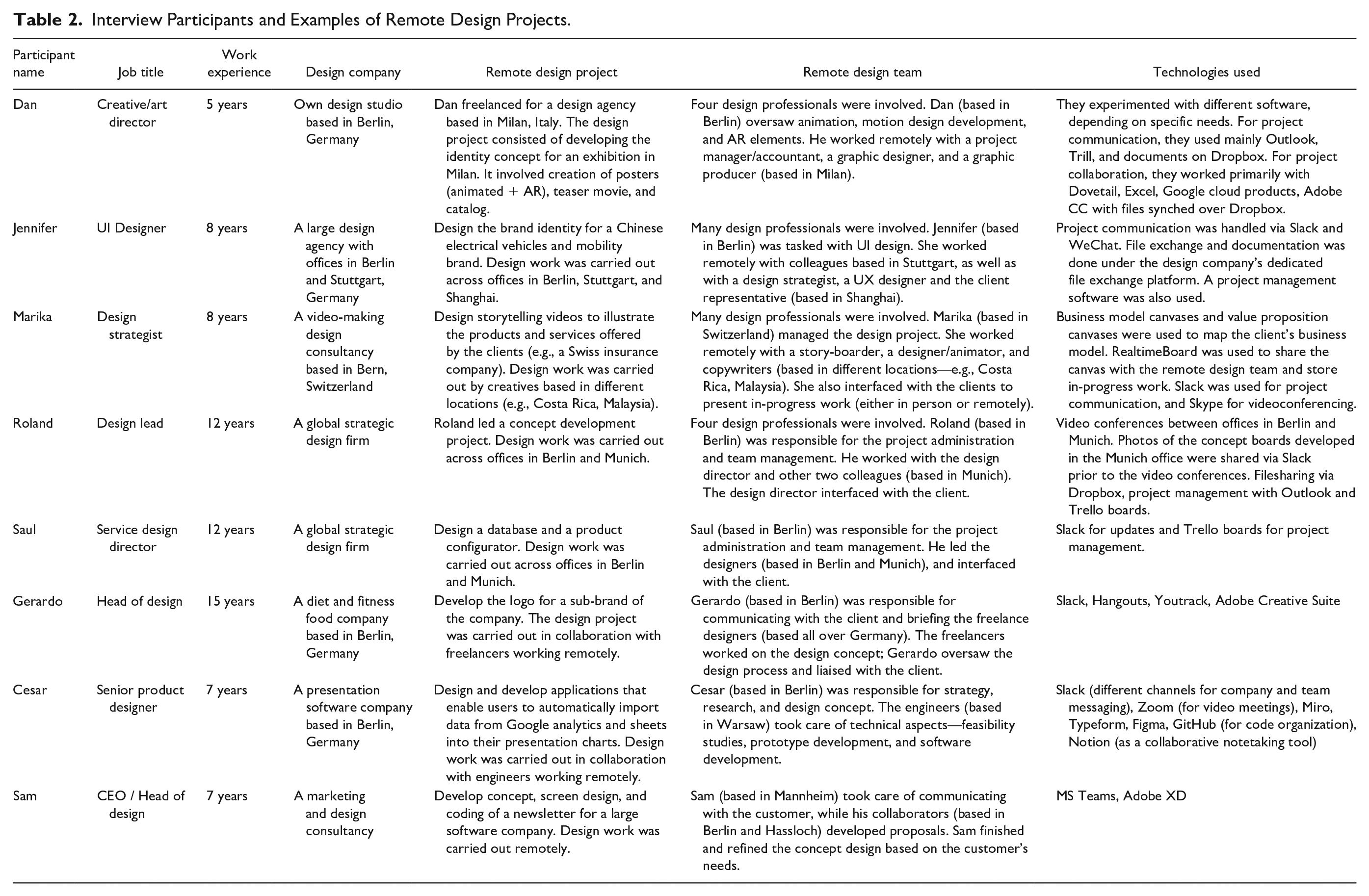
We used these examples as a starting point for conducting in-depth, semi-structured interviews on the perceptions of building shared understanding in remote teams (see Appendix B for the semi-structured interview guide). Specifically, we started the interview by inviting participants to reflect on their experience, with particular attention to the challenges they encountered in building shared understanding. This enabled participants to anchor their perceptions of building shared understanding to their real-life experience of working in remote design teams. Table 2 summarizes the remote design projects described by the participants (along with background information on the participants themselves).
Interview Participants and Examples of Remote Design Projects.
Both interview instruments (the preinterview questionnaire and the semi-structured interview guide) were developed by the first author and refined through interactions with the second author. In designing the interview instruments, we paid particular attention to formulate clear questions and to reduce biases from question-wording. For example, we specifically avoided loaded questions (e.g., “don’t you agree that . . . ”) and double-barreled questions (i.e., questions containing multiple statements but allowing for a single answer only; Bernard, 2013, p. 235). In the interview guide, we used opening questions to build rapport with the respondents, open-ended questions to enable in-depth responses, and probing questions to prompt further elaboration (or seek clarifications; Hoyle et al., 2002).
Sample Selection and Interview Procedures
To increase external validity, we invited designers with different roles and responsibilities to participate in our study. All participants were recruited by the first author, through his professional network. As conditions for participation, we required participants to have had at least 3 years of experience in their design jobs and to have been involved in a remote design project in the last 6 months. This was intended to reduce biases by anchoring the participants’ responses to specific experiences. Eight designers qualified and agreed to participate in our study. As visible in Table 2, they had different job titles (e.g., head of design, service design director, and senior product designer) and offered insights on various types of companies (e.g., design consultancies, freelance agencies, and software companies). Six participants were males and two were females. Their age ranged between 26 and 44 years, while their work experience ranged between 5 and 15 years. Two participants worked for the same global strategic design firm but were involved in different projects. All participants were German nationals.
All interviews were conducted by the first author. Four interviews were conducted in meeting rooms, three in private studios, and one in a quiet open space. They lasted between 30 and 45 min each. All interviews were recorded with consent and transcribed verbatim on the following day. Seven interviews were conducted in English, and one interview was conducted in German and subsequently translated and transcribed in English (as this one participant felt more comfortable expressing themselves in German). During the interviews, notes were taken to capture nonverbal cues, contextual information, and general impressions about the interviews themselves (Saunders et al., 2015). Biases were reduced by paying attention to tone, posture, and voice; misinterpretations were minimized by asking probing questions and inviting the interviewees to reformulate where necessary (Saunders et al., 2015).
Data Analysis, Validity, and Reliability
The interview data were coded and analyzed using thematic analysis and constant iterations between theory and data (Nowell et al., 2017). This analytical approach is systematic yet flexible (Saunders et al., 2015). It enables researchers to complement theoretically derived codes with inductively emerging ones. The first author took the lead in analyzing data and refined his interpretations through interactions with the second author. We first developed initial codes and summaries for each transcript. From these codes, we identified interview-specific themes, which we visualized in thematic maps. We then compared such codes across interviews to identify recurring themes and developed broader thematic maps. Finally, we checked these maps back to the transcripts for internal validity.
We enhanced the reliability of data analysis through collaboration and reflexivity (Nowell et al., 2017). We met to discuss the data analysis and used shared documents to keep track of our evolving interpretations. Differences in interpretation were resolved through conversations and comparisons against the theoretical background. The research findings were further validated through follow-up conversations with the research participants and exchanges with other researchers.
Ethical Concerns
We addressed ethical concerns by informing participants of the purpose of the study and addressing any questions concerning the interview (Saunders et al., 2015). As participants shared sensitive information about their employers, we guaranteed confidentiality of interview data and protection of personal information. We stored transcripts and audio files on a secure hard drive and ensured that participants could not be identified. In accordance with the European Union’s General Data Protection Regulation (GDPR), audio files were deleted after transcription.
Findings
Our findings reveal designers’ perceptions of shared understanding in remote teams. Figure 1 provides a graphical illustration of our findings in relation to our research aims (i.e., identifying the elements, enablers of, and barriers to shared understanding).

Code structure from thematic analysis.
Perceived Elements of Shared Understanding in Remote Design Teams
The first aim consisted of identifying the work elements that are perceived as requiring shared understanding. Three themes emerged from the data analysis: remote environment, remote collaboration, and performance requirements. The remote environment includes the company vision, design brief, timing and process of remote teamwork. Remote collaboration encompasses how to communicate remotely, work across time zones, and handle the ensuing documentation. Performance requirements include not only the work quality but also the efficiency expected from team members.
Remote environment
The interviewees agreed that designers should build a shared understanding of the remote environment in which they work. The company vision is perceived to be central to remote designing. The participants consistently noted that the company vision influences the project vision, which in turn is constructed in conversation with the client. According to Marika, design strategist, “a strong company vision [ . . . ] makes it easier to work on the project.” In her experience, grasping the company and project vision enabled her team to generate a similar mindset regarding their client’s expectations.
The design brief is another aspect of the work environment about which participants felt a need to build shared understanding. As explained by Sam, CEO and head of design, a shared understanding of the design brief involves “having the same idea of what is to be done, how our team works and who is doing what.” This is a basic requirement for remote teamwork. It ensures that remote individuals work as a team (Gerardo, head of design) and directs their attention to “what’s the greater goal and [for whom] it’s being pursued” (Marika). Furthermore, a shared understanding of the design brief is instrumental for team members to gain awareness of the project requirements. According to Saul (service design director) and Roland (design lead), the design brief provides a frame of reference for team members to understand their workload in relation to each other.
A shared understanding of timing and process enables team members to be in control of the project (Dan, creative/art director) by gaining awareness of each other’s workload (Saul) and progress on tasks (Jennifer, UI designer). For Jennifer, this involves being aware of “all the tasks, all the tickets . . . and talking through: What is happening right now? What is the status of the project?” For Dan, this is built through software that enables the team to track time and “see in which stage the project is, what is missing, and what is on hold.” Saul noted that deliverables, in particular, provide a frame of reference to build a shared understanding of timing and process. Roland added that anticipating the workload associated with deliverables enables remote designers to deliver on time.
Remote collaboration
All participants stressed the importance of remote collaboration. A shared understanding of remote collaboration encompasses how to communicate remotely and work across time zones as well as how to handle the ensuing documentation. Like Roland and Saul, Marika noted the importance of a shared understanding of how to manage communication—that is, “knowing when to write and when to call.” As remarked by Cesar, senior product designer, team members must internalize the “unwritten rules of how to communicate.” This is critical in remote teamwork, where it is hard to assess whether someone is available to call or is busy with other tasks. Marika noted that if someone were to join her team, their biggest learning would be “knowing how to communicate remotely. Not in terms of [sharing] ideas, but in terms of switching from tool to tool.”
Relatedly, Marika and Jennifer emphasized the importance of a shared understanding of time differences. Both worked remotely in globally distributed teams with time differences comprised between 6 and 8 hr. Jennifer had “to be aware that China is six hours ahead and hence close to the end of working hours [. . .] and we don’t want to ask the Chinese colleague to work even longer.” Marika added that in a globally distributed team she needs to know every “person’s role—[not just] what they are doing creatively but also where they are located, where they are based, how their daily schedule looks like.”
Many participants noted that a shared understanding of documentation—that is, knowing where to save and find documents—is crucial in remote teamwork. Cesar, Saul, and Roland highlighted the importance of documentation in the internal collaboration of the remote team as well as in its external relations with the client. For Saul, this ensures that all parties are on the same page. He presented a scenario in which failure to follow shared norms for documentation jeopardizes the entire collaboration: Let’s say [. . .] no one can understand the files that you are producing because they are not documented well. Or you are forgetting to . . . for example, every time you do a presentation you have to upload it in this specific format, because the client needs to have access as well. And you forgot that.
Jennifer and Dan added that a shared understanding of “how to save” is also important to access and navigate the documentation. Without such understanding, “it is getting a complete mess, and nobody knows what the most current things are” (Dan). Jennifer illustrated this through a positive and negative case. In the positive case, the team “had a pretty good folder structure. Here, we know what is going on by looking at the folder names. So even if I don’t know [details of] what is happening, I can look through the folders . . . ” In the negative case, lack of shared understanding about document structure inhibited her from accessing information, and hence from identifying team members with whom to complete tasks.
Performance requirements
The participants consistently noted the importance of building a shared understanding of performance requirements, especially in relation to work quality. Saul stated, the most important thing I have to take care for is the quality of the material that comes out [. . .] I give [team members] a briefing of how things work in terms of procedures that can fulfil quality and efficiency standards.
Dan added that failure to build a shared understanding of work quality leads team members to act unilaterally, which potentially undermines the collaboration.
The aspect of work quality is connected to work efficiency. Jennifer illustrated how hard it is to collaborate efficiently: After several years of employment, she is “still trying to figure out how to work efficiently because everyone has different definitions of [it].” To her, efficiency translates into concise online meetings. She understands that some information must be shared with all team members but is frustrated with the amount and length of calls. This resonates with Marika’s statements, and Saul’s remarks that meetings sometimes feel like others “stealing an hour of your life.” He tries to counteract this by declining invitations whenever the required information is available through documentation.
Perceived Enablers of Shared Understanding in Remote Design Teams
We further explored the perceived enablers of shared understanding in remote design teams. We identified five themes. The team spirit, as well as the shared experience, trustworthiness, and transparency of their members are decisive. Project management further enables shared understanding through micro-practices, such as face-to-face meetings, online updates, and information visualization.
Team spirit
The interviewees consistently remarked that team spirit is an important enabler of shared understanding in remote teams. The team spirit translates into a positive work atmosphere, where team members inspire each other, enjoy working together, and feel “that someone is there to [take] things off your hands if necessary” (Gerardo). Dan described this as “riding the same wavelength” and Jennifer explained that “if you have a good vibe, it’s a joy to work together.” Yet the interviewees disagreed on whether they can actively shape the team spirit. Jennifer and Sam believe they can actively shape the team spirit through being in the team and caring about others. Not being able to develop a team spirit affects Jennifer emotionally and makes it harder for her to build shared understanding. Relatedly, Sam emphasized the importance of team-building activities, such as playing remote games or setting up calls to chat about matters that are not work-related.
Saul, on the contrary, noted that team spirit “is something I don’t have much influence on.” In his managing position, he “can steer but can’t tell people how they should feel.” He cannot control whether team members talk to each other or socialize outside of work: Ultimately, “it’s up to them whether they identify with the team or not.” These differences can be explained with reference to the interviewees’ roles. Saul is mainly responsible for overseeing design work. Jennifer and Sam, on the contrary, are working with others on daily operations, and hence might perceive a stronger agency in relation to team spirit.
Shared experience
The participants agreed that shared experience enables the buildup of shared understanding in remote teamwork. According to Sam, it is best if team members have “some experience of working remote together and are familiar with all the tools they need to work remotely.”
Cesar recounted that he did not have any problem shifting to remote teamwork because he had been working with his team members for quite a long time: I know them all very well. And they know me not only as a work person, but as a human as well. I felt comfortable with them already before [going remote] . . . so it wasn’t too much of a problem for me to talk to them just over a screen. But if I had just started and met my colleagues only through a screen, then it might have been a different story.
In recounting a successful example of remote collaboration, Dan stated: “we all had similar experiences before; and we now act on that base.” For him, similar experiences are intended not only in relation to “the client briefs or the size and type of project” but also to the designers’ career journey: “at some stage we were all working independently, then in smaller groups, and finally with agencies.” This shared experience was not communicated through project documents but emerged during informal conversations and was felt as a personal connection. For Dan, it facilitated shared understanding in the current project. Saul added that shared experience is built not just through sharing previous experiences but also through “being in the project”—that is, continuous involvement and reflection on the current experience. Cesar and Jennifer agreed and underscored the importance of sharing personal experiences in addition to professional experiences.
Trustworthiness
Trustworthiness emerged as an important enabler of shared understanding in remote teams. According to Gerardo, mutual trust ensures that feedback is shared openly, and tasks can be delegated if necessary. For Cesar and Jennifer, trustworthiness is strongly connected to work quality. It enables team members to collaborate without having to check on each other, thus improving the collaboration process (Cesar). As added by Jennifer: “if we get to know that a person is really good at writing or illustrating . . . over time we can trust that person and just let them do what they do at best.” Saul and Roland remarked that trustworthiness is built up throughout the project. For Saul, it is “super cool” to work with team members he can trust to handle a given situation or task. Roland experienced remote teamwork in several companies and maintained that “it always came down to being able to work with people you can trust.”
Transparency
The participants consistently remarked that transparency is connected to trustworthiness as being transparent enables being trusted. They stated that transparency on progress and discussions enables shared understanding. Saul noted the importance of progress transparency in design management, and Roland mentioned that “some people are very communicative about what they are doing, and some people are not.” Although he uses check-ins to monitor progress, transparency remains challenging as remote teamwork means “you don’t have a feeling of how the person is at the other end.” He found this true across several projects. Jennifer highlighted the role of communication technology to sustain transparent discussions. Yet this is not unproblematic, as team members need to make a judgment about what information to share in order not to overload communication channels.
Project management
Project management enables the buildup of shared understanding through the provision of a frame of reference for remote teamwork. As Marika puts it, having a “clearly standardised process means that I know what the next steps are going to be.” This requires diligence in documenting decisions, retaining information, and communicating with others (Cesar). Dan underscored the importance of project management in his freelance work. If the agencies for which he freelanced did not engage in project management, he would “try to lead the whole thing . . . give them clear instructions of how things should be done.” He added that project management gives team members an overview of “how the structure works” and enables “policing [ . . . ] if they are following that structure.” Yet designers are often resistant to project management. Saul’s designers would “usually go in their own cave and tunnels. And wouldn’t keep track of what they are doing.” In these cases, putting someone in charge of implementing project management enables team members to work more effectively.
A number of micro-practices related to project management sustain the buildup of shared understanding in remote teams. Roland, Jennifer, and Marika underscored the importance of face-to-face meetings. Because remote teamwork is carried out mainly through videos and chats, face-to-face meetings are an important complement to building shared understanding. In the words of Roland, “when you meet someone in real life . . . this creates trust and a bit of responsibility.” Jennifer would travel long distances to meet her team members: “I cannot imagine how I would be able to work at a distance without knowing the person.” She recounted an example in which she traveled to meet her team in person, as she was struggling with online meetings. Marika mentioned an instance in which her remote team met for a retreat once a year: “That was quite interesting. Suddenly you are face-to-face with people living in different continents [rather than on Skype].” Meeting in person gave team members the chance to talk about personal topics and to find out that they “watched the same series and have the same problems in life.” This created a personal connection, which made it easier to collaborate remotely.
While acknowledging the role of face-to-face meetings, participants disagreed on whether they are enough to get to know each other. For Jennifer, “it takes time before we know each other well, with our strengths and personalities.” On the contrary, Dan felt it is quite easy to spot whether a person has a similar mindset or workflow and how they approach problems or deal with deadlines. Hence, the effectiveness of face-to-face meetings depends on team members and their personal inclinations. For some, getting to know each other takes extensive time and effort, while for others, this can be accomplished in the space of short encounters.
When working remotely, designers coordinate through online updates. As explained by Sam, “in remote teamwork we do a lot of check-ins, because you want to have a shared understanding of how everyone feels and in what situation everyone is.” Jennifer, Roland, Saul, and Marika added that posting information and queries on online platforms is also important to building shared understanding. Such updates complement virtual meetings: Sometimes, “a phone call is too much, or [not] everyone has time in that particular window” (Roland). Roland mentioned that he generally tries “to keep all the information in the discussions available to everyone.” For Saul, accessing online updates should be the first step prior to alignment meetings, as “alignment meetings are [often unnecessary]. The project is running. The documentation is there. Everything is happening is in the documentation.”
Another method to enable shared understanding in remote teams is visualizing information. Marika, Saul, and Roland mentioned this in their interviews. To her clients, Marika provides a “storyline and visual elements so that they can see what the project looks like.” Roland tries to “not just have a written understanding of things, but also a visual one. I think that makes it easier for designers too . . . ” Saul would usually go a similar way by preparing “some material they can look at [. . .] some examples of previous projects [. . .] and a picture of how success looks like.” The use of visual representations also enables team leaders to set the expectations at the beginning of the remote collaboration. To do this, Roland would meet his team and share “visuals or examples of past experiences, saying . . . this is how the user journey should look like and this is [roughly] what we expect you to do in a week or so.”
Perceived Barriers to Shared Understanding in Remote Design Teams
Our study examined not only the enablers but also the barriers to building shared understanding in remote design teams. Three themes were identified, namely, challenges in information sharing, cultural differences, and overruling decisions.
Challenges in information sharing
All participants noted that the main barriers to shared understanding in remote teams relate to information sharing. Saul stated that communication is already complex in co-located settings and even more so in remote settings. According to Gerardo, “you are more likely to communicate when you are in a room together than when you are online.” Remote communication requires “a lot of experience . . . and knowledge of human nature.” Furthermore, some information cannot be captured in remote teamwork. Here, you have “information that doesn’t fit the media” (Saul). Nonverbal communication, for example, is rather difficult or even impossible to grasp in remote settings, making it more challenging to build shared understanding. Hence, “the communication itself starts to be a design project. You’re always planning when to share [information], and how to present and distribute it in a way that [the] team can understand” (Saul).
Jennifer supported Saul’s view of “communication as a design project.” She highlighted the challenge of dealing with the reinterpretation of information. In her view, this is like “the game of Chinese whispers. Someone has a piece of information and then they reinterpret and pass on such information. If I am the last one to receive information, the meaning is no longer the same.” These problems are exacerbated when members find themselves to uphold statements for clients, which were not clearly communicated within the team. Dan added that he was dealing not just with problems of reinterpretation but also with loss of information. In his words: “There is always a loss of information, because of all the people involved.” This happens in two ways: Information is lost from clients to designers and from designers to clients. This is highly challenging for the build-up of shared understanding.
Cesar and Jennifer underscored the challenges of using communication technology to share information in a remote team. Because multiple communication channels are used, it becomes difficult to organize information and know “where stuff goes” (Cesar). Furthermore, remote team members need to strike a balance between flooding their communication channels and keeping information private. In Jennifer’s words, We have a Slack channel where many people are involved. Sometimes this is overloaded because everything is running at the same time. If we used a private channel, people would think it is not transparent and they would miss out on important information . . . It is difficult to balance it out. What should everyone know and what can be discussed privately?
Cultural differences
As she was working in Germany for a Chinese client, Jennifer elaborated on the challenges posed by cultural differences. She stated that “it is difficult for us . . . to work and understand the culture of the client.” Still, her mixed background enabled her to mediate between the Chinese and the German cultures. She had to “reinterpret or explain to the colleagues what was happening” when getting feedback from the client. While in the German culture criticism is usually expressed head-on, in the “Chinese culture we don’t say no, and we don’t criticise in front of each other.” Because of this, there were gaps in understanding between the designers and their clients. Jennifer had to step in to translate between the two parties.
Overruling decisions
The theme of overruling decisions was underscored by Cesar and Roland. For instance, Roland recounted an episode in which a design director—who was co-located with part of the team—rejected prior decisions without notifying remote collaborators. In his words, the director was overruling decisions of which I was not aware . . . people who were not used to remote teamwork did not bother, or just forgot to put me in the loop, even though I was the project lead.
Both the team and the director assumed that Roland—who worked remotely—would have been informed through different channels. The director assumed decisions would have been communicated via the team, while the team assumed decisions would have been discussed between the director and the project lead. This caused a setback for Roland’s leadership and damaged the shared understanding of the team—as parts were in the know and parts were not.
Discussion
Summary of Findings
As shown by the introductory example of the NASA Challenger disaster, a shared understanding of design work is of utmost importance. Yet its buildup entails considerable challenges in remote teams, where members cannot gauge nonverbal communication or walk to their colleagues’ desks for a chat. In this article, we conducted interviews with design professionals to uncover the perceived elements, enablers of, and barriers to shared understanding. As to the elements, the participants reported building a shared understanding of the remote environment in which they operate, the remote collaboration in which they engage, and the performance requirements they are to meet.
In a remote environment, a shared understanding of the design brief is a central element to ensure that team members are on the same wavelength. Further elements of the remote collaboration include how to handle documentation and how to communicate—for example, knowing when a call is needed and when a message is more suitable. A shared understanding of these elements is crucial for team members to work remotely. This is especially important in cases where remote collaboration is performed across different time zones, and team members are not always available for calls.
Relatedly, the participants underscored the importance of team spirit, shared experience, transparency, trustworthiness, and project management as enablers of shared understanding. Transparency and trustworthiness, in particular, appear to be strongly interrelated, the one sustaining the other in the buildup of shared understanding. As the project evolves over time, project management and its related micro-practices (i.e., face-to-face meetings, online updates, and information visualization) enable team members to update their shared understanding of remote teamwork.
Throughout their remote teamwork, the participants perceived barriers in relation to information sharing, cultural differences, and the overruling of decisions. As remote teamwork relies on communication technology, team members struggle to communicate information that is nonverbal, to prevent misinterpretations or information loss, and to transfer the right amount of information over communication channels. Here, the risk of overruling decisions is heightened. In globally distributed design companies, this is further compounded by challenges arising from cultural differences.
Theoretical Contributions
Our study explored the work elements that are perceived as requiring shared understanding. From in-depth interviews, we identified elements related to the remote environment, remote collaboration, and performance requirements of remote design teams. Our findings support the frameworks proposed by Hinds and Weisband (2003, p. 26), Jordan and Adams (2016, p. 10) and Cash et al. (2017, p. 150) while also adding further elements that are specific to design teams—for example, the design brief. Hence, our study contributes by developing an account of what designers perceive as central elements of shared understanding in remote teams. This will be valuable for future research in design.
We further identified the enablers of shared understanding in remote design teams (i.e., team spirit, shared experience, trustworthiness, transparency, and project management). We extend prior research on remote design teams by suggesting that trustworthiness is facilitative not just of team success (Jordan & Adams, 2016, p. 10) but also of shared understanding. Specifically, we suggest that trustworthiness enables the buildup of shared understanding by influencing team members’ perceptions of work quality and efficiency. Considering this connection, our work paves the way for further research to examine in greater detail how trustworthiness and shared understanding influence each other.
We also highlighted the perceived role of project management and related micro-practices such as face-to-face meetings, online updates, and information visualization in enabling the buildup of shared understanding. This resonates with prior research on the success factors of remote design teams (Jordan & Adams, 2016) and advances the agenda of supporting remote designers in their attempts at building shared understanding (Cash et al., 2017). Jordan and Adams (2016, p. 16) underscored the importance of communication media and specific technologies such as conference calls, emails, and file sharing. We add to this by bringing into view the enabling role of information visualization (e.g., visual storylines) and online updates (e.g., through communication channels such as Slack).
Finally, we identified perceived barriers to the buildup of shared understanding in remote design teams—namely, challenges in information sharing, cultural differences, and overruling of decisions. These findings confirm and extend previous research, which has focused on the barriers to shared understanding in co-located teamwork (Kleinsmann et al., 2007; Kleinsmann & Valkenburg, 2008). Importantly, the barriers that we identify arise from the individual perceptions of designers. Such perceptions are important because they likely limit the scope and extent of the shared understanding that is being built in the remote team. As such, they require theoretical and managerial attention.
Hence, our main contribution lies in offering a close-up picture of shared understanding in remote teams, taken from the perspective of individual designers. While much of previous research has focused on shared understanding in co-located design teams, we add to an emergent stream of research that has begun to uncover how designers build shared understanding in their remote teams. We believe this is an important line of inquiry, given the heightened use of remote design teams in response to trends, such as globalization, digitalization, and the COVID-19 pandemic.
Practical Implications
Our findings have implications for design practice. If global design companies are to support the buildup of shared understanding in remote design teams, they should focus on its elements, enablers, and barriers. Based on our findings, we suggest that remote design teams kick off their collaboration by negotiating a shared understanding of their remote environment, remote collaboration, and performance requirements. Because the design brief changes repeatedly in response to the client’s feedback, the remote collaboration should include review points for renegotiating shared understanding. Further actions include:
Establish the ground rules for remote collaboration, for example, by clarifying how to document and report progress via communication channels (e.g., Slack).
Enable team members to develop shared experience, for example, by allowing time for non-work-related online conversations (e.g., virtual coffee breaks and online games).
Promote transparency through a clear allocation of roles and responsibilities, and use information visualizations to clearly communicate milestones and deliverables.
Strike a balance between information overload and information scarcity, especially when using multiple communication channels.
Maintain focus by sharing information visualizations that provide the “big picture” and condensing multiple messages into a clear overview.
Limitations and Future Work Directions
Our sample size is relatively small. Nevertheless, we believe the findings are theoretically generalizable to similar settings in which designers work remotely. After analyzing five transcripts, we noted that additional interviews confirmed rather than changed the findings. We took this as an indication of theoretical saturation. This is in line with Guest et al.’s (2006, p. 59) finding that “basic elements for metathemes” can be “present as early as [in] six interviews.” Future research could refine our findings through additional interviews—for example, covering different countries, industries, and fields of design practice. It could also employ case studies to further explore the connections between the mapped elements, enablers, and barriers. This would allow establishing causal relationships in the buildup of shared understanding.
Footnotes
Appendix A
Appendix B
Acknowledgements
The authors acknowledge the design professionals who participated in this study.
Declaration of Conflicting Interests
The author(s) declared no potential conflicts of interest with respect to the research, authorship, and/or publication of this article.
Funding
The author(s) received no financial support for the research and/or authorship of this article.
Ethics Statement
The data were collected as part of the first author’s MA dissertation. Committee approval was not required for data collection. The participants’ names have been disguised and their companies anonymized.
