




Abstract
This article investigates whether the development of information and communication technology (ICT) contributes to the dispersion of wealthy and talented people and helps prevent the concentration of wealth in only a few cities. In between some authors’ positive speculation on the role of ICT in reducing the necessity of physical distance and others’ emphasis on the vital role of offline interaction, the current research takes a broader view and investigates whether the technology impacts the concentration of jobs across the U.S. cities in the years 2006 and 2016. Using data from Occupational Employment Statistics surveys and the Occupational Information Network, I measure the significance of location for occupations by exploring geographical concentration and the interdependence of occupation dyads. The results show there is no evidence to support the assertion that ICT skills required for occupation were negatively associated with the geographical dispersion of the occupation in the study period. Instead, the research indicates that occupational ICT strengthened the geographical interdependence of occupations. The finds show that, in particular, jobs requiring higher ICT skills continued to be bounded to locations between 2006 and 2016. Overall, the results show there is no evidence for the claim that ICT is associated with the dispersion of geographical locations of occupations. The results suggest that rising communication technology will not necessarily diminish the concentration of good jobs or wealth inequality between cities.
Keywords
Introduction
It has been more than 40 years since the futurists of the 1960s and 1970s predicted that technological developments would make it possible for workers to choose where they want to work (Bell, 1976; McLuhan, 1962; Toffler, 1980). In the current environment, the futurists’ predictions have enough technological merit for this situation to be realized in many sectors, such that face-to-face interaction could essentially be replaced. The current unprecedented crisis with the COVID-19 virus is intensely testing this possibility, as schools and universities move entire classes online, and companies worldwide make telecommuting mandatory. In this transformational moment, people realize how much of today’s work can be done via online videoconferencing platforms, email, and real-time messaging applications. In the 1990s, Castells (1996) perceived a trend of a growing “network society,” where key social structures and procedures would be processed through electronic information networks instead of being dependent on geographical location. In Castells’s view, static and physical interactions would eventually be replaced by dynamic and virtual interactions.
Previous research supports the earlier futurists’ claim that technology would fundamentally transform workers’ face-to-face communication—a sign of being one step closer to what some termed the “death of distance” (Cairncross, 1997). This phrase indicates that physical distance would no longer prevent us from communicating or collaborating with people from afar. Although workers’ physical proximity has been an essential component of coworker communication (Allen & Fustfeld, 1975; Kabo et al., 2015; Sailer & McCulloh, 2012) and fostering innovation (Wineman et al., 2009), advances in information and communication technology (ICT) suggest the possibility of replacing offline interactions with online cooperation and creating knowledge that is different from types produced offline. The tool of virtual communication has already developed enough to replace many types of work interactions (Denstadli et al., 2012). Moreover, this tool has been foundational for creating entire virtual working teams (Townsend et al., 1998). In addition, people with occupations allowing flexible schedules are increasingly conducting their work from home (Alizadeh, 2012; Johns & Gratton, 2013) or multiple locations (Ben-Elia et al., 2014). Internet communities based on experts who may not know one another personally have emerged as new hubs of knowledge creation (Bathelt & Turi, 2011). Hence, in just a couple of decades, the prospect of what ICT could do for many different types of occupations has been dramatically expanded.
That said, what is relatively less studied is whether the advancement in ICT is associated with the actual geographical distribution of jobs across cities in the United States. This is an important question to examine because job opportunities have long been concentrated in a relatively small number of large cities due to the concentration of human, cultural, and financial capital. In the United States, only a few select cities, on the East and West Coasts, including Washington, DC, San Francisco, and New York, have been developing rapidly (Longman, 2015). Worldwide, just a relatively few cities like Hong Kong, London, and Tokyo have become globalization centers, as well as key financial and business hubs (Sassen, 2001). The concentration of resources in a few big cities is problematic because it leads to the polarization of education levels, political participation (Moretti, 2012), and intergenerational mobility (Chetty et al., 2014). If advancing ICT has the potential to distribute jobs to diverse geographical locations, this would seemingly contribute significantly to reducing the polarization of economic resources, education, and political opinion across cities.
This article investigates the issue by focusing on the relationship between an occupation’s ICT level and its boundness to location. Specifically, I ask two critical research questions: First, are occupations with a higher level of ICT associated with an occupation’s low boundness to location? Second, has the progress of ICT positively or negatively influenced the boundness to location over time? To answer these questions, I empirically examine the required ICT skills of occupations and their geographical distribution in U.S. metropolitan areas in the years 2006 and 2016 by using the O*NET data and surveys from the Occupational Employment Statistics (OES). Utilizing these data, I use occupation as this study’s unit of analysis because it includes information regarding required skill sets and geographical boundness. Defining occupation as a set of skills needed to accomplish given tasks, one could arguably assume that, generally speaking, workers laboring in the same occupation would be required to understand and use similar ICT skills.
Following an examination of the data above, I then conceptualize how the occupations are bound to physical locations by investigating two criteria: (a) the geographical concentration of the occupations and (b) the geographical interdependence of the occupations. Geographical concentration refers to how much an occupation is gathered in a few metropolitan areas rather than dispersed. This information tells us which occupations seemingly require specific conditions provided by those physical locations. For instance, if a particular job, such as restaurant server or elementary school teacher, is dispersed across regions, the geographical location would seem to matter less for job holders of that occupation. On the other hand, the geographical interdependence of occupations allows us to measure whether an occupation is independent of other jobs. Thus, when an occupation has little need to be in the same location as other jobs, this indicates less boundness to geographical location. With the measures of required ICT skills and occupation’s boundness to geographical location, I examine whether the location of occupations is independent of ICT. In this work, I analyze data from the years 2006 and 2016, a 10-year period where ICT has advanced remarkably, to ascertain whether a higher level of ICT affects the relationship between the geographical location of occupation and that occupation’s ICT.
Data and Method
Data
To conduct this investigation, I used the Occupational Employment Statistics surveys for the years 2006 and 2016, created by the U.S. Bureau of Labor Statistics, to measure the degree to which certain occupations are bounded to geographical location. Published annually, the OES data include information about employment and wage estimates for approximately 800 non-farming U.S. occupations. Each OES survey covers full-time and part-time wage and salary workers but excludes self-employed and unpaid family workers. I used metropolitan statistical areas (MSAs) as the geographic boundary because they delimit where people can meet for a reasonable amount of time while remaining in the same economic zone. The OES survey uses the Standard Occupational Classification (SOC) system. However, there was an update to the SOC system in 2010. Since the 2006 OES survey used the 2000 SOC system and the 2016 OES used the 2010 SOC, I standardized the three-digit SOC codes according to the 2000 system based on the crosswalk provided by the Bureau of Labor Statistics. For instance, when there were more than two categories from the 2000 SOC that matched a single category from the 2010 SOC, I chose the one job category with the closest job title. I included only the top 70% of occupations (in terms of size) for both time periods because some categories had too few workers to analyze their distributions across the 400 MSAs.
I also collected data to measure the ICT level of occupations from the O*NET program, supported by the U.S. Department of Labor’s Employment and Training Administration (ETA). The O*NET database includes occupation-specific information, such as required tasks, technology skills, knowledge, and work values, as well as wage and employment trends since 1998. Since 2002, all occupation-related descriptions in the O*NET database were collected by surveying occupation holders and having experts analyze the occupations. From the O*NET database archive, I used data version 10.0 (published in 2006) and version 21.0 (updated and published in 2016).
Measures of the Occupation’s Boundness to Location
Geographical concentration of occupations
To measure the extent of occupations’ geographical concentration, I utilized the pre-normalized clustering index developed by Benson (2014), which generalized Duncan’s (1961) dissimilarity index. The clustering index of the occupation, i, was computed using the following formula:

where m indicates the metropolitan area and n specifies the number of workers. Thus, for example,
Geographical interdependence of occupations on other occupations
Following Muneepeerakul et al. (2013) and Shutters et al. (2016), I characterized two occupations as geographically interdependent when the prominence of one occupation in one city continually coincided with the prominence of another occupation in the same city. The degree of interdependence was measured using a formula developed in Hidalgo et al. (2007) and applied to occupations in Muneepeerakul et al. (2013), although the notations were edited to meet the purpose of this work. Thus, we have the following:

where
Next, the interdependence of two occupations, i and j, was defined using the following formula:

where
After obtaining the links between occupations, I computed the degree centrality of the occupation. The degree centrality indicates the number of occupations that are geographically interdependent of a given occupation. When the degree centrality was high, this meant that the occupation was interdependent on many other occupations. However, when it was low, this meant that the occupation was distributed randomly and was unrelated to the location of other occupations.
Measures of the Occupation’s Level of ICT Skills
As key explanatory variables, two items from the O*NET survey were employed to measure an occupation’s ICT level. The first item measured the level of working with computers, from “low” (e.g., entering employee information into a database) to “high” (e.g., the deployment of a new computer system). While this item does not measure ICT directly, it does measure a more comprehensive skill level that includes ICT. The second item I used in the O*NET survey measured the frequency of using email at work on a scale from “never” to “every day.” While using email is a basic form of ICT compared with other types of virtual communication, such as videoconferencing or media-sharing tools, it is the only survey item related directly to a job holder’s ICT use. Given that both items were somewhat limited in inferring the direct use of ICT, I use both to ensure the robustness of the results.
Control Variables
In addition to examining the level of ICT vis-à-vis occupation, I controlled for employment size, the creativity of tasks, and the broad categories of occupations. Information regarding the creativity of tasks was pulled from the O*NET database. In their survey, the creativity of tasks was measured from “low” (e.g., changing the spacing of a printed report) to “high” (e.g., creating new computer software). I controlled for creativity because it represents a level of intellectual activity that might influence the reason why online communications have not yet replaced offline interactions (e.g., Morgan, 2004). Finally, I controlled for the broad categories of occupations because the amount of ICT use or ICT’s impacts might differ with the general type of work. The broad categories were based on the SOC system: management and professional, service, sales and office, farming and fishing, construction trades, and production occupations. The descriptive statistics are provided in the Supplementary Materials.
Method
As discussed, the main aims of this study were first to analyze whether ICT relates to an occupation’s boundness to location and then to ascertain whether the association has changed over time. To pursue these goals, I first analyzed the impact of ICT on the geographical concentration of occupations—as measured by the clustering index—using linear regression analysis. Since the distribution of the clustering index of occupation was positively skewed, I employed a natural log function to the clustering index. I tested two statistical models with different explanatory variables with this dependent variable: level of working with computers, and frequency of email use. I ran these two models for both 2006 and 2016, using the control variables.
Second, I investigated the impact of ICT on the geographical interdependence of occupations, as measured by the degree centrality. I followed the same analytic strategy used to test the clustering index. I used the zero-inflated regression model with the Poisson distribution because the distribution of degree centrality is highly skewed and includes many 0 and positive integers. This model consists of two components that allow for the generation of zeros, structural zeros, and ones created as part of the Poisson distribution. The coefficients of the variables were estimated separately for each component. Here, I included the control variables, as well as the clustering index of each occupation. The clustering index was added to account for the individual occupation’s geographical concentration.
Results
ICT and the Geographical Concentration of Occupations
First, the relationship between ICT and the geographical concentration of work was tested by analyzing the factors that influenced the clustering index of occupations in 2006 and 2016. Models 1 and 2 in Table 1 summarize the coefficients from the linear regression models that explain the clustering index in 2006. After controlling for the other variables, both ICT measures—the level of working with computers and the frequency of email use—were found not to be associated with the clustering index. For 2016, the level of working with computers was found not to be statistically significant. Meanwhile, the frequent use of email decreased the clustering index, thus showing greater dispersion of work; however, the sizes of the coefficients were relatively small. For example, for an occupation with a median clustering index of 0.27, a 10-unit increase in the frequency of email use only decreased its clustering index to 0.268, thus showing no substantive difference.
The Impact of ICT Level on the Geographical Concentration of an Occupation in 2006 and 2016.

Note. ICT = information and communication technology.
p < .05. **p < .01. ***p < .001.
The minimal over-time change is partly due to the minor difference in clustering index between 2006 and 2016. The average clustering index was slightly decreased from .33 to .31, while the standard deviation of the clustering index remains .17 for both years. In other words, because the location of occupations itself had been neither clustered nor dispersed for 10 years, no change in the association between ICT and the clustering of occupations was visible.
In all four models, the control variables showed similar effects on the clustering index. Overall, I found that occupations with large labor forces were more likely to be dispersed. Also, the creativity of tasks did not have a statistically significant effect in Models 1 to 3. However, in Model 4, I found that creative jobs were more likely to be clustered. In addition, production jobs were the most geographically clustered category, while sales and office occupations were the most dispersed.
The main finding from analyzing Table 1 is that there is no clear evidence to support the claim that ICT use is related to the geographical concentration of occupations. While some previous studies have implied that a higher level of ICT use will free people from the physical locations where they need to work, the results suggest that the two factors are not closely linked to each other. In addition, despite the rapid technological advancements, the relationship between ICT usage and the concentration of occupations was neither strengthened nor weakened over the 10 years.
ICT and the Geographical Interdependence of Occupations
In the next stage of analysis, I examined the association between ICT and the geographical interdependence of occupations. Table 2 provides the results from the 2006 data. Each model consisted of two parts: the “count” part, representing the Poisson distribution, and the “zero-inflation” part, showing the process of generating structural zeros. The count part of Model 1 suggested that those occupations with a high level of computer use were more likely to be geographically interdependent. Another measure of ICT—the frequency of email use—was also positively related to the interdependence of occupations. This variable was also statistically significant in the count part of Model 2. A similar implication was found in the zero-inflation part of the models. When a coefficient was positive, it meant that the increase of an independent variable was positively associated with having zero-degree centrality. Thus, interpreting the results, I found that higher computer skill levels and more frequent use of email increased the possibility of having a degree centrality that was not zero.
The Impact of ICT Level on the Geographical Interdependence of an Occupation in 2006.
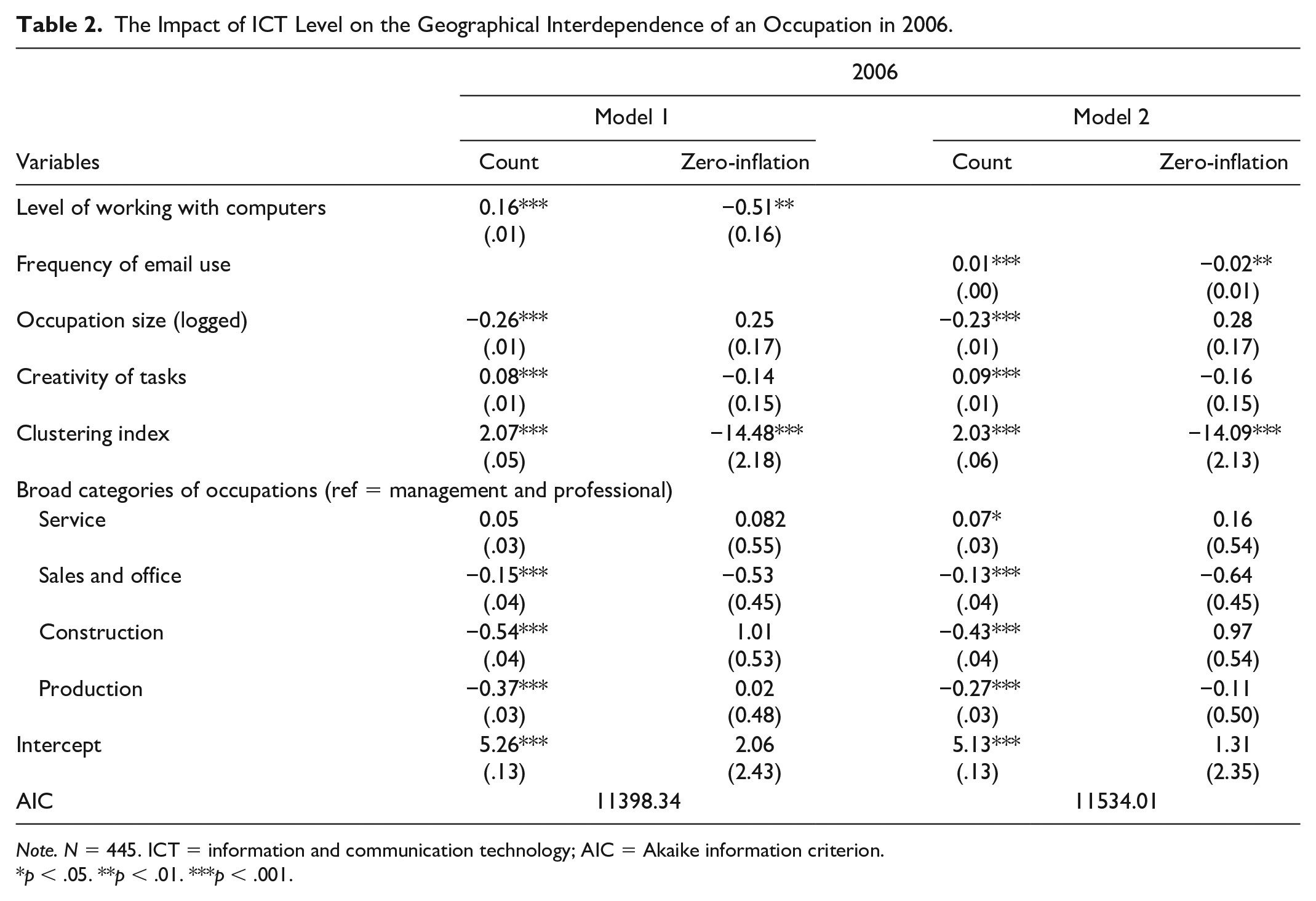
Note. N = 445. ICT = information and communication technology; AIC = Akaike information criterion.
p < .05. **p < .01. ***p < .001.
Regarding the control variables in the count part of Models 1 and 2, a larger occupation size was more likely to decrease the degree centrality. In addition, those occupations that were more creative were more likely to be geographically interdependent with other occupations. This result is aligned with the findings of previous studies, which have shown that face-to-face interaction is not yet wholly replaceable by online communication, particularly for more complicated and nuanced communication, which is often needed to boost creativity at work (Cramton, 2001; Leamer & Storper, 2014; Morgan, 2004). In the zero-inflation part of Models 1 and 2, the control variables did not influence the degree centrality except the clustering index.
Table 3 illustrates the summary of the coefficients from Models 3 and 4. The findings from the 2016 data were similar to those of 2006. Both measures of ICT—the level of working with computers and the frequency of email use—increased the degree centrality in the count and zero-inflation parts of these two models. While it was not possible to compare the sizes of the coefficients between 2006 and 2016 directly, I found no indication of a declining effect of ICT on geographical interdependence during the study period. Instead, I found that the creativity of tasks was statistically significant in the zero-inflation part of the models in 2016, while this was not the case in 2006. The negative coefficient of the creativity of tasks indicates that highly creative occupations are more likely to be geographically interdependent with other occupations.
The Impact of ICT Level on the Geographical Interdependence of an Occupation in 2016.

Note. N = 503. ICT = information and communication technology; AIC = Akaike information criterion.
p < .05. **p < .01. ***p < .001.
Figure 1 summarizes the results of zero-inflated regression models in Tables 2 and 3. This figure illustrates how geographical interdependence changes as the level of working with computers and the use of email increase one standard deviation from the mean in 2006 and 2016. The figure shows that there is no evidence to support the idea that ICT is associated with the low geographical interdependence of occupations in either 2006 or 2016. In fact, the two factors were positively associated meaning that occupations heavily adopting ICT are more geographically related to other occupations. While the impact size of email is consistent in 2006 and 2016, the impact size of computer use slightly decreases in 2016; however, still, the higher level of using computers is associated with higher geographical interdependence of occupations. To summarize, this examination showed that when occupations used higher computer skills or interacted via email more frequently, they were more likely to be geographically interdependent with other occupations.

Predicted geographical interdependence by ICT in 2006 and 2016.
Discussion and Conclusion
In this research, I investigated the relationship between the required ICT level for occupations and occupations’ boundness to location, and whether this relationship changed between 2006 and 2016. Using data from the O*NET database and OES surveys, I defined an occupation’s boundness to the location by measuring the geographical concentration of the occupation and its geographical interdependence on others. Results showed neither a negative nor positive association between geographical concentration and ICT usage. However, the findings did demonstrate that ICT was positively associated with the geographical interdependence of occupations and that this effect was undiminished in 2016.
The lack of association between the geographical concentration of occupations and ICT indicates that the ICT use does not necessarily expand or concentrate occupations between metropolitan areas. Although the use of communication technology can decrease the overall travel distance for work and the preference of some to live in city centers (Kim et al., 2012; Lee et al., 2014; Moos & Skaburskis, 2010), my findings show that the impact of ICT is not strong enough to dispatch jobs to distant cities. In addition, the minor change in this tendency between 2006 and 2016 indicates that higher ICT was uncorrelated with the higher dispersion of occupations across MSAs during the study period.
Furthermore, for both 2006 and 2016, ICT was found to be positively associated with geographical interdependence. This finding was robust with either ICT measure vis-à-vis occupation. Thus, the results suggest that ICT does not help diminish the geographical interdependence of occupations but rather strengthens it.
Combining the above two results, since the trend barely changed over the 10 years, I found no evidence for the claim that ICT was associated with an occupation’s boundness to location. It appears, then, that occupations with higher ICT skills will likely continue to be interdependent with the location of other occupations. This result might be due to the characteristics of certain industries in which most high-ICT occupations belong. As California’s Silicon Valley example illustrates, information and knowledge-intensive industries consist of occupations with high ICT levels, and these industries have been developed based on formal and informal technical communities existing within proximity (Saxenian, 1996). This idea and the findings of this work are consistent with previous literature that emphasizes that physical proximity facilitates communication between workers and aids industrial innovation (Kabo et al., 2015; Powell et al., 1996; Wineman et al., 2009, 2014). In sum, it seems that collective, intelligent energy occurring within a specific region and a regional labor market for highly educated people remain important aspects that, as of yet, cannot be replaced easily by online communication.
One explanation for why ICT does not help spread the distribution of occupations may be that jobs are not the only factor in determining where people choose to live. In addition to occupations, people consider other factors such as natural environment, cultural atmosphere, weather, and neighborhood when they move to other cities (Florida, 2003). Because people having the same occupation share similar cultural tastes, people in these occupations might naturally gather in the same place to live.
This study suggests that regardless of how much ICT is popularized, it does not prevent the concentration of occupations in a few big cities. For example, even if all the tasks and interactions required for software engineers moved to online communication forms, it is still likely that the engineers would want to live and work in San Francisco or Seattle as opposed to Detroit or Pittsburgh. Furthermore, occupations that rely heavily on ICT are more likely to be geographically connected to other occupations. Therefore, considering that people with high-ICT occupations are often more highly educated and well-compensated, ICT does not help spread these types of good jobs to various cities nationwide. This is unfortunate, as if such jobs could be more widely dispersed, this could have a positive effect on reducing wealth inequality between cities.
This research has a limitation in that it focused only on a relatively limited time window: the 10 years between 2006 and 2016. While comparing the data from these two years can give us a hint as to whether a decade of ICT development could begin to bring about the “death of distance,” it is a limited time window, particularly considering the dramatic changes in ICT over the last several decades. Unfortunately, I was unable to analyze earlier data because of inconsistencies in the data collection by O*NET; However, if a comparable data source could be found, it would be helpful to analyze the effect of ICT using a long-term perspective.
Another limitation of this study is that it does not examine how ICT affects the worker’s move within the same metropolitan area. This research used a metropolitan-level region, MSA, as the unit of analysis and focused on the location of occupations across them. Although MSA is defined as the region that shares the same economic core, the size of the MSA and the living costs within the same MSA are quite large. Therefore, ICT may have provided workers more freedom to decide where to live within the MSA instead of across MSAs (Mongey & Weinberg, 2020).
In addition, my ICT measurements only cover relatively simple ICT skills such as the use of e-mail, and do not take into account the various levels of more advanced ICT skills such as the advanced version of the online labor platform. In the case of occupational groups using advanced online labor platforms, there is a possibility that workers may be dispersed to various regions while overcoming barriers of physical distance (Braesemann et al., 2020). However, my research does not measure the use of fine-grained ICT technology–which may be critical for workers to decide where to live–in the process of finding ICT measures that are equally applied to all occupations.
Last but not least, as we are in the midst of a sea change regarding remote working facilitated by the COVID-19 virus, it is hard to know whether this pattern will continue in the future. Many individuals and companies may realize that the amount of work that should be done based on face-to-face interactions is not huge as much as they had previously assumed. The current pandemic forces us to test the various aspects of remote work. Depending on what we learn from the experiment, the distribution of jobs across U.S. cities might be dramatically transformed. This research will benefit from a follow-up study that traces down the impact of the pandemic on the concentration of occupations after a certain time passes.
Supplemental Material
sj-pdf-1-sgo-10.1177_21582440211037663 – Supplemental material for Geographical Locations of Occupations and Information and Communication Technology: Do Online Tools Impact Where People in the United States Live and Work?
Supplemental material, sj-pdf-1-sgo-10.1177_21582440211037663 for Geographical Locations of Occupations and Information and Communication Technology: Do Online Tools Impact Where People in the United States Live and Work? by Lanu Kim in SAGE Open
Footnotes
Acknowledgements
The author thanks Katherine Stovel for the helpful conversation and the article editor for thoughtful and productive comments.
Declaration of Conflicting Interests
The author declared no potential conflicts of interest with respect to the research, authorship, and/or publication of this article.
Funding
The author received no financial support for the research, authorship, and/or publication of this article.
Ethical Statement
An ethical statement is not applicable to this research.
Supplemental Material
Supplemental material for this article is available online.

References
Supplementary Material
Please find the following supplemental material available below.
For Open Access articles published under a Creative Commons License, all supplemental material carries the same license as the article it is associated with.
For non-Open Access articles published, all supplemental material carries a non-exclusive license, and permission requests for re-use of supplemental material or any part of supplemental material shall be sent directly to the copyright owner as specified in the copyright notice associated with the article.
