



Abstract
Hazing is an ancient, universal practice. In past and modern societies, the need to join a group is an aspect of humanity. The process of joining a group frequently includes the need to be hazed to legitimate full membership. This article uses the theoretical frameworks of Foucault and Bourdieu’s perspectives of social order, Tajfel and Turner’s theory of social identity, and Bandura’s theory of moral disengagement to inform the phenomenon of individuals joining groups. In particular, the study has sought to ascertain why those who haze are motivated to act. A grounded theory was developed through interviewing young adults, who planned hazing activities while in positions of leadership as Grade 12 learners in Gauteng schools. The grounded theory shows that hazing although enacted by an individual is not solely driven by that person, but rather hazing is a means of cultural reproduction. The developed theory is grounded and was verified through interviewing stakeholders in the school community who had extensive knowledge of the school culture and of Grade 12 learners.
Introduction
Hazing refers to the negative aspects that arise when an individual, through a process, joins and becomes a fully integrated, functional, and accepted member of a group (Bauer et al., 2015; Hoover, 1999). Hazing is referred to by several terms: initiation, fagging, or ragging. According to Cimino (2017), the definition of hazing may vary and can be both broad and contested. Within the context of this article, the definition used is that proposed by Allan and Madden (2008) which defines hazing as “any activity expected of someone joining a secondary school that humiliates, degrades, abuses or endangers them regardless of their willingness to participate in the activity” (p. 2). The practice was first documented by Plato in Athens in 387 BCE (Ellsworth, 2004) and continues today. In the South African context, according to Huysamer and Lemmer (2013), the term that describes the process of becoming affiliated to and assimilated with a new secondary school, university, or sports team or club is initiation—or ontgroening (Afrikaans translation). At the onset, initiation is not designed to be either a negative or a harmful process, but the neutrality of the process is difficult to guarantee.
When adolescents and young adults are admitted to boarding facilities or residences, the need to belong to a group increases as they are separated from their home environment for extended periods of time. This often results in an increased level of subjectivity of the value of the new group and the level of actions a newcomer is prepared to engage in to contribute to the new group to experience feelings of belonging (De Klerk, 2013). Thus, hazing activities are more likely to occur under these circumstances. According to Vigar-Ellis (2013), in her study on the criteria parents use when choosing a boys’ boarding facility, the single most important factor is a safe environment: an environment free of drugs, alcohol, and abuse. Ironically, while boarding facilities may prohibit the use of drugs and alcohol, they are often the part of a school in which hazing and concomitant negative effects are the most likely to occur.
In recent years, a number of hazing incidents in South Africa have been made public due to the possibility of photographing or filming incidents of hazing using cell phones, media reports, and reporting by concerned parents. Hazing has been documented through the posting of photographs or videos of hazing events on school websites (James, 2013; Jonker, 2017; Joubert, 2008; Katrein, 2018) and in print media (Ritche, 2009; Mtshali, 2012).
The research presented in this article focuses on an aspect of hazing that has not yet been fully understood, namely, the drivers of hazing. The grounded theory method, undergirded by a constructivist standpoint, is well positioned to address this question, because no measurement of hazing or documentation of incidence has been made in South Africa.
Literature Review
Much research focuses on the degree and nature of hazing as opposed to what drives the hazer to action (Allan & Madden, 2012; Allen et al., 2018; Silveira & Hudson, 2015; Strawhun, 2016).
Hazing has played out on the world’s stage for centuries; this is reflected through the plethora of terms used to denote the practice in various countries.
According to Weiss (2002), the term zubur is used to describe hazing documented in Israeli schools, Defense, and Air Force. The World Heritage Encyclopaedia (2016) points to the term “ragging” being used to describe hazing in Sri Lanka, India, Bangladesh, and Pakistan. In Russia, the term dedovshchina describes the brutal and sometimes fatal practice of hazing associated with the Russian military, a trend that is documented and growing at a rate of 150% per annum (Bender, 2014).
Similar to hazing in many respects is the concept of fagging, which is often used synonymously in the United Kingdom. While the Australian equivalent of hazing is “bastardisation,” the literature refers to this being a common practice in the Australian Defence Force, a practice which has been prevalent for at least the last 60 years (Evans, 2013).
As documented by the World Heritage Encyclopaedia (2016), non-English-speaking countries also share in the practice of hazing. Each tends to use an indigenous term to describe hazing. In Europe, the French use the word bapteme and the Dutch use the term doop: both of these words come from the word “christening.” Within these two countries, the words bizutage and ontgroening are also used: they come from words which are closely linked to the concept of a rite of passage in the respective countries. In Finland, the term is moopkaste, meaning a “moped baptism,” stemming from a newcomer being forced to ride a child’s bicycle or tricycle. The Swedish use the term nolling, and the literal translation of this is “zeroing.” In Spain, the term is novatada, meaning “newcomer” and in Portugal, praxa, meaning “habit” or “practice.” Within the Italian military, nonnismo, coming from the term nonno, “grandfather,” refers to soldiers who have completed most of their draft period (World Heritage Encyclopaedia, 2016).
The term “ragging” is used in many countries in the East, including Singapore, Indonesia, Bangkok, Philippines, Java, China, Nepal, India, and Sri Lanka (Gogna, 2016; Lau Lam Tin, 2003; Shakeys & Maskey, 2012). In Japan, hazing among cheerleaders exists, denoted by the term ouenka renshuu (Larson, 2016). This form of hazing is more similar to fagging in the servitude of a junior student in a one-to-one relationship with a senior student. The primary aim is that of mentoring between the two students. The term used to describe this is Senpai Kohai, where the Senpai is the senior and the Kohai the junior in the relationship. While this relationship has a mass of positive consequences, like an orientation program, it often includes the darker and negative attributes of hazing (Aimers, 2014).
Furthermore, the most common manner through which hazing has been studied is from a quantitative perspective. There is a plethora of evidence of information which addresses who is hazed, the degree of hazing, and the amount of hazing. Hank Nuwer (2016) is possibly the most well-known writer and researcher in this field. He has written on hazing for the past 30 years. Nuwer among other researchers has documented hazing deaths in the United States since 1800. Alfred University (1999) also made a significant contribution to the understanding of hazing early on when no quantitative studies had been conducted. They conducted a National Survey which included 2,027 athletes from 224 institutions. They measured specific types of hazing and the frequency with which they occured.
With respect to hazing in high schools, according to the Alfred University study, which followed the 1999 study on hazing within the university athletics arena, in 2000 Alfred University surveyed 1,541 high school students across the United States on their hazing experiences. Their findings showed that hazing was pervasive in high schools across the country with an estimated 1.5 million high school students being hazed annually. The study gave an in-depth look at the nature, degree, gender differences, types of, negative consequences of, lack of reporting of, and students’ inability to identify hazing in high schools (Hoover & Pollard, 2000).
More recent quantitative research includes hazing within universities and colleges, fraternities and sororities, sports teams, Black Greek-Letter Organisations (BGLO), marching bands, and high schools (Ellsworth, 2004; Hughey & Hernandez, 2012; Jones, 2000; Mikell, 2014; Silveira & Hudson, 2015). Furthermore, research reflects current trends of hazing being pervasive throughout the sports world and is often not recognized for what it is (Allan & Madden, 2012; Hoover & Pollard, 1999; Silveira & Hudson, 2015).
In 2008, the landmark study, which was the most comprehensive survey conducted to date and is still reflected in many subsequent researchers’ work, was the Allan and Madden (2008) study. This research surveyed 11,482 and interviewed 300 undergraduates from 53 institutions. The focus of the study was to determine primarily the nature and extent of hazing occurring in institutions in the United States at that time.
Elizabeth Allen has continued to work extensively in the field of hazing, in particular the prevention of hazing, with a career which spans over two decades. She is presently the president of StopHazing Consulting (StopHazing.org, 2021). Mary Madden also co-directed the National Collaborative for Hazing Research and Prevention. Their work in determining the degree of hazing has provided a springboard for many subsequent research papers. Their work remains influential in the current context of hazing and they continue to contribute new findings to the field (Allen et al., 2018).
Cimino (2011, 2013) was a trailblazer when moving research from what was occurring to why hazing was occurring through his research in 2011 and 2013. This research relied on the computerized responses to the hypothetical joining of a group based on how individuals believed they would respond. His research dealt with how one, in theory, would haze and thus did not represent actual lived experience. In contrast, this present study looks retrospectively at actual motivators for hazing in real-life situations.
The theoretical frameworks which underpin this study include the work of Foucault and Bourdieu which examine the dynamics of power in society and cultural reproduction. Thereafter, the work of psychologist, Henri Tajfel, and John Turner, social psychologist, on identity and, in particular, social identity, is examined. Finally, Bandura’s theory on moral disengagement and how this allows one to haze is considered.
Foucault aimed to make sense of cultural reproduction and is associated with his ideas on power (O’Farrell, 2005). To maximize an understanding of Foucault’s views on how culture is reproduced, it is important to consider his views on discourse. Discourse is dependent on power and is a complex social construct referring to ideas that a given group of people have in common, which are then transferred between them through conversations (Foucault, 1972). When a group accepts a particular discourse, the discourse is perceived as factual knowledge and it exercises power over the group as they accept the discourse or knowledge as reality. Power and knowledge are considered opposite sides of a single coin, with knowledge giving rise to power (Foucault, 1977). Those in positions of power decide what is discussed and this becomes the lens through which life is viewed or the reality of a given context is shaped. Foucault (1977) believes that truth, mortality, and meaning are generated through discourse. The created discourse is then transmitted through the society by a predetermined and well-controlled mechanism of transmission with a view to maintaining order and the balance of power.
Foucault shows the relationship between discourse and power, as well as the dependent concepts and mechanisms of discipline, surveillance, hierarchy, and examinations. These act as a means through which power is used to maintain discourse (Foucault, 1977). The concepts of cultural reproduction, discipline, and hierarchy are observed in why hazers haze. They use their relative position of power to ensure that discourse is maintained and hence culture is reproduced and order within this aspect of society is maintained. Their singular aim is not to haze but rather to maintain power and maintain the status quo. The hazers feel duty bound to maintain the system which has so richly rewarded them through recognizing their worth and granting them a position of power in the form of a position of leadership within the hierarchy. Hazing is the means through which the status quo and culture is then reproduced.
Bourdieu suggests that power is symbolically and culturally created. This plays out through habitus, which in turn implies power over cultural and social actions (Navarro, 2006). Having capital translates to having power. The accumulation of capital acts to perpetuate hierarchies. Hierarchies require constant minding and protection to maintain capital differences and to legitimize the hierarchy. Bourdieu views power as a symbolic and cultural creation. Its maintenance is through habitus which is explained as the formal and informal mores which society inculcates into an individual, which in turn guides action. Habitus can be likened to the hidden curriculum within a school context. It links social cause to social action and thus results in society reproducing itself even when what gave rise to the habitus is no longer present. The habitus of the school is not determined by those employed by it nor by those who attend it, but rather by the society in which it is found. The school acts as a means through which the given habitus is reproduced (Bourdieu & Passeron, 1977). Just as genetics is the manner in which biology is transferred, so education is the medium through which culture is reproduced (Bourdieu & Passeron, 1977). It is argued that hazing is the means through which aspects of a school culture, habitus, are maintained.
Social identity theory as a theoretical framework gives meaning as to why a given culture would allow hazing to occur within its midst. Tajfel and Turner (1979) define social identity, as opposed to personal identity, as one’s own concept of self, which depends on the groups to which one belongs. These groups give one a social identity and an associated sense of belonging. As the status of the group shifts, so too does one’s self-image. If one belongs to a group which one perceives to have high status, one would want to help maintain the group’s high status and as a result one’s own positive identity (Tajfel & Turner, 1979). In schools, this would include certain sought-after school and co-curricular activities which enjoy greater status, for example, popular school sports. Hazing is perceived necessary as it is thought to maintain the high status of the group. Hazers falsely believe that part of the high status of the group is as a result of the group being difficult to join rather than reflecting on the limited space in the group or the level of skill required to secure an earned place in the group (Lodewijk & Syroit, 2001).
The final theoretical framework which provides a lens through which to examine hazing is Bandura’s theory of moral disengagement. According to Bandura (2002), one develops one’s own morality and with it an associated perception right and wrong. These perceptions determine one’s conduct as one constantly compares actions to one’s own moral yardstick and accordingly regulates one’s actions. The mechanism through which this cognitive consideration of an action is used is in anticipation of the action rather than retrospectively. This pattern of cognition and resultant action keeps one at peace with oneself. When one is faced with acting inhumanely, one is able to self-regulate through the mechanism described above. Hence, our actions are regulated cognitively through our moral yardstick rather than through dispassionate or abstract reasoning.
Bandura’s moral disengagement theory explains the mechanisms through which self-regulation becomes distorted within an individual’s own perception and inhuman conduct becomes permissible. The processes include moral justification, euphemistic labeling, displacement of responsibility, diffusion of responsibility, disregard or distortion of consequence, dehumanization, power of humanization, and attribution of blame (Bandura, 1999, 2002). When hazers are tasked with acting contrary to their own moral yardstick, they employ one of the afore-mentioned means to normalize a hazing act that they would otherwise not have been associated with.
Method
The empirical study adopted a constructivist grounded theory approach developed by Charmaz (2006), a second-generation grounded theorist. The method is considered a flexible guideline, not a set of rules. The development of a constructivist grounded theory is a temporal process with a beginning, some benchmarks, and an end, which unfolds rather than passes through predetermined consequential steps and produces a theory grounded in the experiences of the participants (Charmaz, 2006). In this study, a theory, grounded in the data, was constructed to explain the actions and motives of Grade 12 learners who had hazed junior learners.
Initially, convenience sampling was used. Participants were selected through convenience sampling. Participants were sought based on their role and position within their school, and ideal participants were identified based on each having had, by virtue of their leadership position, rich experiences of hazing. This was determined through discussion with each participant prior to selection. It was also important to select participants who had had leadership roles not only within the school as a whole but also participants who held leadership positions in a variety of spheres including both sporting and cultural codes. These participants were selected as smaller codes may have showed a greater need which may or may not have been related to their positioning within the social hierarchy.
Once the general steps of hazing motivators were identified, a new sampling strategy was required. Purposeful sampling then allowed for the confirmation of the steps identified through the convenient sampling group. The purposeful sample included individuals who epitomized each of the stages identified and so each stage could be verified and more in-depth insights gained (Patton, 2002).
The final type of sampling required was theoretical sampling. This type of sampling is used to focus and feed data (Birks & Mills, 2011). When it became clear that more data on a particular category was required, theoretical sampling was used. This type of sampling allows the properties of categories to be developed and for the relationships between categories to be illuminated further. To sample theoretically, the researcher makes well-considered strategic decisions as to who will have the most information-rich data required to meet the analytical need at that time (Birks & Mills, 2011). Further theoretically selected samples include all adult participants described in Table 2. The sampling process used for data collection seems complex, but can be summarized as convenience sampling, followed by purposeful sampling and finally theoretical sampling.
Fifteen participants were chosen. The younger group of participants (Table 1) were between 18 and 20 years old, both male and female, had served in leadership positions in schools, and had self-identified as information-rich in terms of the phenomena of hazing. Adult participants (Table 2) were all males, with experience of parenting a child in a leadership position or/and professional experience as headmaster or Head of Pastoral Care.
Description of Schools, Leadership Positions, and Gender of Young Adult Participants.

Description of Adult Participants.

Description of adult participants is summarized in Table 2.
The interview was chosen as the most appropriate means of collecting data (Charmaz, 2000). Three rounds of interviews were held with the young adults (Table 1). The final round of interviews was with the adults (Table 2). Interviews were open-ended, because the information that came to light during the interview could not be predicted as consistent with the grounded theory method. Probing questions were asked but no direct questions as a direct question presupposes an outcome (cf. Glaser, 1998).
Data analysis was done by coding and constant comparative analysis. Coding refers to the repeated occurrence of a phenomenon in the raw data, which is given a conceptual label. Constant comparison refers to comparing each incident with every other incident, each incident with each code, code with code, code with category, and category with category. The coding commenced immediately and complied with the grounded theory methodology. In the final stage of coding, through a process of theoretical integration, the data were transformed into a theory. This was possible through the identification of a theoretical link between the core category, Reproducing, and sub-categories: Belonging, Conforming, and Consenting. Quality of the final grounded theory was ensured by giving attention to the criteria of credibility, originality, resonance, and usefulness (Charmaz & Thornberg, 2020). Limitations of the study included acknowledging that grounded theory is built through the interactions between the participants and the researcher and had different participants or a different researcher undertaken this study, a slightly differently nuanced grounded theory may have been constructed.
Prior to the commencement of the study, ethical clearance was obtained from the College of Education Research Ethics Committee, University of South Africa. Thereafter, all participants gave written consent for participation. Participants were assured of right of withdrawal at any point, anonymity, and confidentiality.
Results
Initial answers by participants as to why they had planned hazing activities tended to explain the outcomes of hazing, namely creating a sense of belonging to the group, getting juniors to conform to the traditions and hierarchical structure of the group, and understanding the need for showing respect and how this should be demonstrated and what the discipline structures within the group were. Hazing reproduces the culture of the given school community. The dependence of reproducing on the pillars of belonging, conforming, and consenting resulted in concept of reproducing being raised as a core category.
Reproduction of Culture as a Core Category
Initiation is required in certain schools as a means of reproducing the culture of the given school community. This is consistent with Bourdieu and Passeron’s (1977) perspectives that schools are the current means through which society is replicated. Hazing usually took place during highly valued sporting activities in the schools: rugby, hockey, water polo, netball, basketball, and cricket. In some schools, rugby was of a higher social standing than basketball. Head of Pastoral Care, participant N5, confirmed, I have had a sense of that, from conversations which I have had with boys, that you see a correlation between those (sporting codes) that are more prestigious practise initiation and those that are less prestigious just tend not to.
Those participants responsible for planning hazing activities were unaware of their role within cultural reproduction per se. They were positioned too close to hazing and could not always recognize how they perpetuated cultural reproduction. The core category arose from what these participants expressed about subcategories, namely belonging, conforming, and consenting.
Belonging
Hazing was motivated by the desire to create a sense of belonging. Participant G2, in explaining his motivation to haze a whole Grade 8 group, at the beginning of the year camp said the following: Before the camp, they (Grade 8 learners) all come divided and after the camp they are all kind of united. They all have a really strong passion for the school. I never forget how after our Grade 8 camp how you started seeing invites on Instagram where they (his contemporary Grade 8 learners) had made their profile picture (the school badge) or something like that. There is that sense of unity. I think they (Grade 8 learners) benefit from that.
Creating unity motivated many participants. Participant B1, when discussing hazing a grade of Grade 8 learners in her role as head girl, referred to hazing activities as “Something we could all (hazer and victim) unite around . . . We have all had it (the experience of being hazed).”
Participant J3 explained that the primary motivator for hazing Grade 8 learners was to create a sense of unity around an ideal of exclusivity and elitism, which positively impacted social identity. This is consistent with Tajfel and Turner’s (1979) social identity theory. Participant J3 said, . . . to make them (Grade 8 learners) feel like there is some sort of exclusivity in it. So if you are just going to come into a group and you just get accepted, then you aren’t going to be as proud of that group as you would have been if you had to go through something together.
In contrast, participant D1, the head chorister at his school and hence leader of a group which does not require hazing to become a member, explained that the choir was a unified group and it was not necessary for members “to jump through any hoops” to become a member of the choir. The only requirement was singing talent.
Tradition is closely linked to social identity theory; it is the belonging which occurs through the sharing of a tradition rather than the action of the tradition. One automatically belongs to a group, if one participates in the traditions of that group and values these traditions. Through participating in traditional behavior, one is also conforming to the ideals of the institution which furthers cultural reproduction. Hence, belonging and conforming are closely connected through the concept of and the enactment of tradition. Participant C1 felt hazing was a tradition: Although I may not necessarily believe in what do you call initiating (hazing) them but it is just something that has been going on for years and years and it was seen as a tradition.
Conforming
Foucault (1977) suggests that a way through which power within society is diffused is through the maintenance of hierarchies. Conforming to and maintaining the hierarchical structures within the learner body was a strong motivator for hazing. Participants wanted to maintain the power that those at the top of the hierarchy possessed, namely the Grade 12 learners. A reason for hazing was to ensure that the Grade 8 learners, the youngest learners in the school, knew that they occupied the lowest rung in the high school hierachy and thus they have the lowest status. Participant F1 passionately explained, So basically, in primary school you are in Grade 7 and you own the entire school and you are this tiny fish in this tiny pond. When you come to high school, you may have that feeling of overconfidence and the process (hazing) in a sense is just to say no, you (Grade 8) are starting out small, you have to work your way to the top basically, that is what I mean by being humbled, you have to realise that you start small, you are not this big fish anymore. Because there are some (Grade 8 learners) who come with this persona like you own the place and no that is not the case, there are matrics (Grade 12 learners). They are the big fish in this pond now, so basically it is starting out small as a unit and then growing.
Participants felt that to maintain the school’s hierarchical structure, which positions Grade 12 learners at the top and moves down to Grade 8 learners at the bottom, was critical to a school. Participant J3, on answering what his school (School X) would be like without the hierarchy, answered: For me, it wouldn’t be School X because the whole thing is you work your way up – that is the way it is. So, when I was in Grade 8 I played or did really, really well so that one day I could be just like that guy. So that I could get full colours or score a goal in front of the whole school, that kind of thing. And without that (hierarchy) it would just be go to class and do well. It wouldn’t have been the experience. For me, you can get that at a co-ed school.
A reason that Grade 12 learners haze is to maintain the hierarchy in a school’s learner body, which they benefit from in a variety of ways; without the hierarchy, hazing would not exist. Participant I3 has a literal but pragmatic interpretation of the need for a hierarchy and said, If it didn’t exist then it would almost be as if I was initiating (hazing) a peer of my own, like a friend, and you would be on the same level and that would not be legitimate.
The hierarchy functions as an inordinately strong tool in bending the will of most adolescents. This concurs with Foucault (1977), who posits that power is used over a group of people through their joint acceptance of how, in this case, to behave, that is, what to conform to.
Conforming also required showing respect. Participants felt that learners in schools in which hazing did not occur displayed a lack of respect for senior learner leaders, the president of the Learner Representative Council, staff, and property. Participant A1 referred to school assemblies in such a school: What I have heard from previous years: whenever the President stands in front of them (the school learner body) in assembly, the learners would throw papers, they would throw things. They would not listen, they would disrespect and things like that. Even when the principal stood there, they would make noise, they won’t concentrate, and they won’t focus.
Participant B1 felt that if hazing did not occur, respect would be lost. The Grade 8 learners at her school were taught to show respect through greeting and standing back for Grade 12 learners: For us, we had a rule of our induction (hazing) that we had to greet all our matrics (Grade 12 learners) and it was quite a good start. They had to stand back for all the girls which, as it is expected in this day and age it is still sometimes forgotten, so for us that doing it like that for two weeks, for the rest of the year if the Grade 8 learners saw us they literally pummelled themselves against the wall so that we could have a way to walk through. So I think for us it was the respect which we would have lost if induction (hazing) did not take place.
As regards conforming, respect, and hazing, hazers would like to be respected and see respect shown. Hazing provides an opportunity to teach and practice respect. Hazers feel that learners have to be taught discipline in the process of practicing respect. Participant F1 spoke of the ways in which discipline is expected of a junior as well as how juniors may be disciplined should they not conform. Often the disciplining comes when juniors do not conform to the expectations of hazing. In this case, the hazing activity included the “wearing of silly things” which reduces status on the hierarchy. This illustrated the strong links between discipline, belonging, and hierarchy which coalesce during hazing. In an attempt to achieve all three, the hazer is motivated to haze as participant F1 demonstrates, When you start (the year), you know there are people older than you who are facilitating things and that are upholding those rules. And if you break the rule, you have to be disciplined in a sense. So when you start out with initiation (hazing) you kind of know that you are starting in this new institution and there are older people who aren’t wearing the silly things and they will discipline you.
Participant B2 linked the acts of hazing to both tradition and discipline: With all inductions (hazing was part of this particular induction), there is always an element of teaching them (Grade 8 learners) the school discipline in a fun way. . .I think in a sense the tradition is always to include something to show them what our school discipline is like.
Avoiding humiliation was the most common technique through which conforming is achieved. If one can potentially be humiliated in front of a group, one approaches each activity with a greater need to conform to traditions to avoid the humiliation. Participant H2, on recalling her own experiences as a Grade 8 learner, said: “I was humiliated, so I was definitely embarrassed that whole week.” As a leader, she endorsed the practice of humiliation to create conformity despite her personal feeling on the matter. She spoke of respect for the new high school hierarchy enforced through humiliation. Moral disengagement theory explains the mechanisms through which self-regulation becomes distorted within an individual’s own perception and inhumane conduct becomes permissible (Bandura, 1999, 2002, 2016). To act to cause another harm or humiliation, one needs to apply a form of moral disengagement.
Participant F1 made a similar value judgment about wearing a ridiculous article in the process of hazing. She understood the consequences achieved by wearing this item. She said, “It is more of a negative thing in a sense, where it could make you feel silly and uncomfortable.” Wearing strange outfits or performing humiliating acts, for example, hugging a tree, are activities reserved for and used to humiliate during hazing.
Newcomers to the school had to practice conforming to the hierarchy and traditions of the school. Participants indicated that this was conveyed during the hazing process. According to Foucault (1977), discipline gives rise to power, which in turn maintains discourse. This perspective links the categories of hierarchy, tradition, and discipline of this grounded theory. When members of a group do not conform, they are disciplined by the structures of the group, usually someone senior in the hierarchy.
Consenting
Consenting is a motivator for parents giving passive consent to hazing activities, as they may benefit from the positive social identity that they gain through their association with an elite group, possibly as a parent of first team rugby players. Adult participants, M5, N5, and O5, felt that parents of members of elite sporting codes benefited from a positive social identity (Tajfel & Turner, 1979), when their sons became members of the first team. Participant I3 knew what lay ahead of him and accordingly gave implied consent: When I was in Grade 8, I knew that it (hazing) would happen. I don’t even know how I just knew. Because you go on a camp in Grade 8, you go on a three-day camp, at the beginning of the year, the week before school starts. I just heard rumours from friends. And they all said those three days are when everything (hazing) happens. So I kind of anticipated it.
Participants seemed to have little or no knowledge that hazing was prohibited. They described how they complied with the expectations of the school; in most cases, the principal or deputy principal gave consent for hazing. Participant B1’s hazing was mild but approved: The Grade 8 leader, she (the teacher) is basically in control of the whole induction process. But we obviously can have input. So she brought us all together, you write down a whole lot of ideas and then you send it to the deputy headmistress and the headmistress. Then the headmistress and the deputy have a meeting about it and then they send it back to us. And say this is what you are allowed to do and this is what you are not allowed to do.
Participant J3 explained, The deputy headmaster, he oversaw the prefects. So he had prefect meetings with us every Monday. We had to update him on what we were doing and he kind of checked up on us. He was the guy who oversaw this.
Participants opined that parents, teachers, and a coach knew specifically about the hazing activities. As minors, both the hazer and the hazed felt that the adults’ knowledge of hazing without putting a stop to the activity implied that the hazing was an accepted everyday practice; this was a form of consenting.
Participant J3 spoke of his mother’s role in Consenting as she also expected hazing and was concerned prior to any hazing event. Responding as to whether his parents would be expecting hazing to occur, he answered: Yes, probably, more so than the kids . . . my mom was really, really worried about me. She always asked, “Is everything okay, have they done things? Do I need to go and report it to someone?” So I would say the parents expect it more than the kids.
Headmaster participant O5 agreed, “Parents also know what is going on but they also don’t want their kid to be identified as they believe there will be victimisation.”
This knowledge of hazing also relates to all teachers and coaches who are in contact with learners in teams which make use of this practice, thus, a large group of consenting adults. In conclusion, most adults appear to be aware of these activities.
Discussion
The primary reason why Grade 12 learners in leadership haze younger learners is to allow for the cultural reproduction of the school or sports team’s culture (cf. 1989; Foucault, 1977). While the research aim was to determine the motivating factors that drive Grade 12 learners to haze, the role that Grade 12 as a social group fulfills within the reproduction of a school culture must, importantly, not be attributed only to Grade 12 learners. Grade 12 learners generally perform this role with the knowledge of and with the tacit consent of all stakeholders in the school community.
Hazing is required in certain schools as a means of reproducing the culture of the school and reproducing the status quo (Foucault, 1977). The grounded theory which emerged is depicted in Figure 1. The cog of Reproducing (illustrated in purple, the core category) is activated through the drivers of the hazing process: Belonging, Conforming, and Consenting (subcategories). Each of these acts as a driver of Cultural reproduction (illustrated in blue). The cogs of Belonging, Conforming, and Consenting are further moved by cultural aspects of the group, namely tradition, hierarchy, respect, and discipline (illustrated in red). The human emotion of experiencing humiliation also functions similarly to ensure that the cogs of tradition, hierarchy, respect, and discipline turn, and in doing so, act to drive this machine of cultural reproduction.
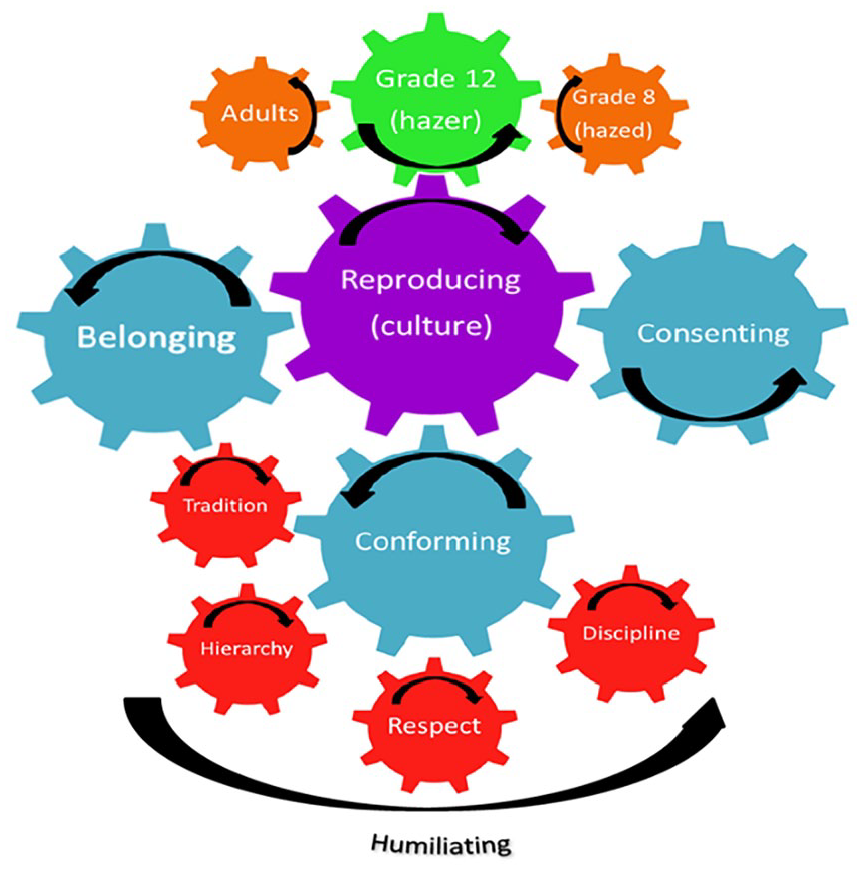
A graphic representation of the grounded theory: Aspects of cultural reproduction facilitated through hazing.
When one considers why a Grade 12 learner, who is a model representative of a school as a leader and exemplary learner, would haze and thus drive such a negative set of behaviors, it seems a contradiction. This grounded theory shows that hazers do not haze in isolation; they are cogs in a machine (green cog in Figure 1) that is much greater than any individual. The Grade 12 learners are fulfilling their role within the system: acting as the system has socialized them to act and as a mere cog in the machine of cultural reproduction. Hence, both Foucault’s (1972) idea of discourse and Bourdieu’s (1989) concept of habitus are reflected concretely in the grounded theory.
Conclusion
The grounded theory informed by the theory of cultural reproduction and power in society (Bourdieu and Foucault) and Tajfel and Turner’s theory of social identity explain the dynamics of the drivers of hazing. In addition, Bandura’s theory of moral disengagement explains how negative behaviors are rendered palatable among perpetrators of hazing who are otherwise outstanding leaders in their community. This makes an important contribution to an understanding of the mechanisms of hazing.
This study aimed to identify what would drive one individual to haze another. Through the grounded theory method, a valid and substantiated result has been achieved. The actions of an individual nor the group who haze act as hazers. It is more accurate to consider the hazer within the hazed-hazer binary who is tasked with acting out the hazing. The hazer is driven by the whole school community with their broad expectations and need for a culture to be both reproduced and maintained. Thus, it falls to each member of a school community to acknowledge his or her role in the hazing process and to take responsibility for it if this age-old practice is to be eliminated.
