




Abstract
Employing social network sites (SNSs) for academic purposes has been investigated in the literature; however, there is not enough scientific knowledge about university instructors’ behavioral perceptions and values that drive their academic use of SNSs. Therefore, a systematic cognitive framework, regarding SNSs academic usage, is beneficial to understand these behavioral perceptions. This research utilizes the means–end chain (MEC) analysis approach to investigate university instructors’ cognitive structure toward the academic use of SNSs. It identifies important requirements for the effective academic use of SNSs by recognizing the relationship between the critical features of SNSs and instructors’ perceived values derived from these features. The findings show that seven significant features of SNSs form 45 MECs that appear to be the most useful features used by university instructors for academic purposes. These seven features were found to be cognitively associated with 10 positive benefits, which are crucial to the fulfillment of nine of the instructors’ personal values. Of the seven features, following others and being a group member were used most frequently by instructors in their academic practices. These two features were of significant value for the instructors to achieve a sense of accomplishment. The findings have practical implications for instructors and educational institution policy makers to enhance the effectiveness of SNSs use in academic settings.
Keywords
Introduction
Social network sites (SNSs) have influenced how people learn, communicate, and share information. Although SNSs are established for purposes that are unrelated to academic work, they have attracted academics and changed how they communicate and engage in educational practices using these sites (Veletsianos, 2011). Appealing variations of SNSs serve different purposes and needs. Some studies have considered particular sites as academic social networks that target scholars specifically (El-Berry, 2015; Elsayed, 2016). The most popular ones are ResearchGate, Academia, Mendeley, and LinkedIn, which are utilized by scholars, researchers, instructors, and students. For example, ResearchGate and LinkedIn have tools that help academics to expand their networks, share their achievements, be inspired by others’ work, keep abreast of current trends and new information, search for academic publications, or publish their own work and achievements (El-Berry, 2015; Elsayed, 2016; Greenhow et al., 2019). However, the remaining SNSs are used by both academics and nonacademics for different purposes. The most popular SNSs are Facebook, Blog, Twitter, YouTube, WhatsApp, Snapchat, Instagram, and Telegram. Each provides specific and unique features to fulfill its users’ purposes. For example, Twitter is a mini blog that works as a personal space for writing, sharing ideas, and communicating with others who have similar interests (Aladsani, 2018). Snapchat and Instagram are famous for sharing videos and photos. Facebook, WhatsApp, and Telegram are the top sites that support the idea of creating and participating in groups. Jordan (2019) stated that SNSs have different features that serve a variety of academics’ needs. He explained that Academia and ResearchGate, for instance, enable academics to publish their achievements. However, their affordances in regard to connecting academics may be limited compared with Twitter, which connects academics to others from similar and different academic disciplines. Thus, academics are advised to use more than one site to present their academic identities (Jordan, 2019).
Previous literature has discussed the different purposes for using SNSs in the academic field. Users typically create profiles that allow them to follow, communicate, and build their academic networks (El-Berry, 2015). Building academic networks can strengthen existing relationships with other academics (Veletsianos et al., 2019). Moreover, the nature of SNSs encourages users to meet new people and form academic relationships (Holmes et al., 2013; Veletsianos, 2011). Building academic networks supports collaborative work between academics (Carrigan, 2016; Jordan & Weller, 2018). For example, a study by Logghe et al. (2016) showed that several researchers collaborated to write a research article using Twitter’s direct-messaging function. Being a member of an academic community on an SNS makes it possible for users to get help from experts or those who are experienced in certain academic fields (Veletsianos, 2011). Through SNSs, academics can communicate with colleagues, students, administrators, policy makers, publishers, and nonspecialist audiences (Carrigan, 2016). Using SNSs pedagogically supports teaching and learning practices. For instance, many SNS features can be utilized effectively to motivate students to be active learners, provide flexible modes of learning, and offer students a wide range of resources and tools that enable them to interact and collaborate with their instructors and peers. Moreover, SNSs allow instructors to create communities in which they can discuss their teaching experiences and enhance their professional development (Greenhow et al., 2019; Veletsianos, 2011). Following and communicating with other instructors and experts can enable users to find a wide variety of up-to-date educational information and resources in their fields (Gruzd et al., 2018; Holmes et al., 2013; Jordan & Weller, 2018). Moreover, communicating with other academics from different disciplines can broaden users’ academic horizons and enhance multidisciplinary thinking outside the instructors’ academic fields (Veletsianos, 2011).
SNSs have the potential to convey instructors’ voices and express their ideas, enabling them to be influencers in their academic communities. Therefore, instructors can establish their academic identities through SNSs. Murthy (2013) emphasized that users (instructors) can present different aspects of their academic identities that are hidden in the offline world. Carrigan (2016) provided suggestions for establishing academic identities on SNSs; for example, academics can add their institutions’ names to their profiles, share their academic and personal interests, and become involved with academic hashtags. An aspect of establishing an instructor’s academic identity is the sharing of academic achievements. SNSs have great potential to increase the visibility of academic achievements (Greenhow et al., 2019; Manca & Ranieri, 2017). Instructors may gain advantage by sharing their academic activities (such as their teaching activities or published articles) on SNSs to solicit reflective feedback on their work (Sugimoto et al., 2017; Veletsianos, 2016). The suggestions they receive can enhance their academic performance as researchers and instructors. In general, building online academic identities reflects positively on instructors’ self-esteem and satisfaction (Nández & Borrego, 2012).
The means–end chain (MEC) analysis method is utilized in this research to examine university instructors’ cognitive structures toward the academic use of SNSs. It identifies the relationship between the critical features of SNSs and instructors’ perceived values derived from these features. MEC analysis offers a method for explaining how and why particular system or service outcomes occur and thus has the potential to provide information for more effective system or service design and delivery (Reynolds & Gutman, 1988). The MEC is the cognitive representation of the connections between a user’s knowledge of particular system or service attributes, his or her perceived positive consequences, and his or her personal values (Gutman, 1982, 1997). A number of studies have investigated the implementation of the MEC framework for understanding users’ cognitive structures regarding several online applications. Jung and Kang (2010) captured user goals in social virtual worlds and provided a rich understanding of how and why users interact in cyberspace. Another MEC study by Lin and Tu (2012) examined the value of college students in business simulation games; the aim was to enrich students’ experiences with the application of strategies and to enhance their decision-making practices in virtual environments. Xiao et al. (2017) adopted MEC theory to develop users’ cognitive goal structures in the context of online group buying and utilized a different approach to explain users’ technology adoption behavior.
Aim and Significance
The aim of this study was to investigate the academic use of SNSs by university instructors to understand their cognitive structures related to SNSs and the values that they derive from using them. This study sought to address several gaps in the literature. First, little empirical research has been conducted on university instructors’ behavioral perceptions of their academic use of SNSs. Most studies have focused on the critical factors influencing instructors’ use of SNSs in academic contexts (Carrigan, 2016; Manca & Ranieri, 2017; Nández & Borrego, 2012; Sugimoto et al., 2017). Other studies focused on instructors’ decisions to accept or reject the use of SNSs using traditional user-adoption theories (Xiao et al., 2017), such as the technology acceptance model (Al-Rahmi et al., 2015a, 2015b). Second, most studies are quantitative in nature and focus on the benefits that SNSs offer users rather than examining what drives users’ behavior (values) in using them (Xiao et al., 2017). Third, although the MEC model has been widely used in business and marketing contexts, few studies have employed it in educational contexts—and even less so in relation to the academic use of SNSs in higher education. To address these gaps and achieve the objective of this study, we employed MEC theory, which represents “values” within a hierarchical cognitive structure of interrelationships. This hierarchical cognitive structure provides an in-depth understanding of user-determined processes (Jung & Kang, 2010).
The significance of this study lies in the exploration of the academic use of SNSs from instructors’ perspective using the MEC model along with the laddering technique, which is qualitative in nature. It provides a systematic cognitive framework for the exploration of the academic use of SNSs from instructors’ perspective, which is timely and critical for university instructors and policy makers. Several reasons exist as to why it is important for policy makers to understand instructors’ behaviors regarding the academic use of SNSs. First, through expanding academic networks, instructors share and exchange academic achievements among university communities, thereby enhancing the reputations of the universities both nationally and internationally. Second, instructors’ establishment of digital identities on SNSs supports the universities’ scientific research systems by expanding opportunities for national and international collaboration and thus obtaining external funding sources for the institutions. Third, by utilizing several features of SNSs, instructors keep abreast of innovations and developments in their fields of specialization, thereby contributing significantly to the development of their skills and raising the quality of their teaching and research performance. Therefore, the findings of this study may advance our understanding of instructors’ requirements and identify ways to meet their needs to offer them a competitive advantage in academia.
The remainder of this research paper is organized as follows. The second section reviews the MEC theoretical framework that is used in this study. The third describes this research methodology, including the participants and procedure, data collection method, and data analysis. The research findings and discussions are presented in the fourth section. Finally, the fifth provides the research conclusions and future implications.
MEC Theory
Gutman (1982) developed the MEC theory, based on the expectancy-value theory, to understand individuals’ decision-making processes (Olson & Reynolds, 2001). The underlying aim of Gutman’s (1982) MEC theory is to provide a cognitive structure that connects individuals’ values to their behavior (Reynolds & Gutman, 1988). As Reynolds and Gutman (1988) articulated, the MEC model focuses on the cognitive linkages between the attributes that exist in products (the “means”), the consequences that the attributes provide for the consumer, and the personal values (the “ends”) that the consequences reinforce (p. 1). Users tend to select products and services that are aligned with their personal values (Xiao et al., 2017). In the context of the present study, the aim of the MEC approach is to understand how university instructors think and feel about their use of SNSs for academic purposes and why such use is of importance or value to them. The focus is on understanding why instructors behave as they do when using SNSs for academic purposes. Instructors use SNSs academically because of the attributes and features that deliver meaningful consequences and advantages that help them fulfill important personal values.
The MEC model is a cognitive structure that is based on the attribute–consequence–value (A-C-V) sequence, which forms chains (Gengler et al., 1999). For example, “size” as an attribute can lead to “convenient” as a consequence, which can then lead to “satisfaction” as a value. The MEC model is hierarchical in nature (Gutman, 1982). The result of an MEC analysis is a hierarchical value map (HVM) that systematically categorizes individuals’ perceptions of a product or service under consideration by analyzing the linkages between attributes, consequences, and the values of individuals (Gutman, 1982; Reynolds & Gutman, 1988). Figure 1 shows an example of the HVM, which represents customers’ use of an online newspaper. The attributes of a product or service (e.g., the online newspaper in Figure 1) are described as the physical or observable characteristics (Gengler et al., 1999) and abstract feelings that are preferred by users (Sun et al., 2009; Veludo-de-Oliveira et al., 2006) such as ease of use, speed, and being online. In SNSs context, attributes are those features offered by SNSs such as broadcasting, media sharing, and bookmarking. The consequences in Figure 1 refer to any advantages or benefits that are perceived by individuals after they experience the product or service (Gutman, 1982; Olson & Reynolds, 1983) such as saving money, optimizing time, and being up-to-date. For instance, in SNSs context, multimedia sharing through SNSs can increase the publicity of the instructors’ academic achievements, thereby resulting in enhanced professional development. Values are defined as “beliefs and relatively stable cognitions that have a strong emotional impact,” and they represent the most abstract level of the HVM (Veludo-de-Oliveira et al., 2006, p. 630). Values reflect goals that individuals seek to achieve (Sun et al., 2009; Veludo-de-Oliveira et al., 2006), such as attachment, security, and belonging (see Figure 1). An example that illustrates the linkage between attribute, consequence, and the value in SNSs is that broadcasting feature can enable instructors to establish and brand their academic identities (consequence), which can fulfill their academic recognition (value).
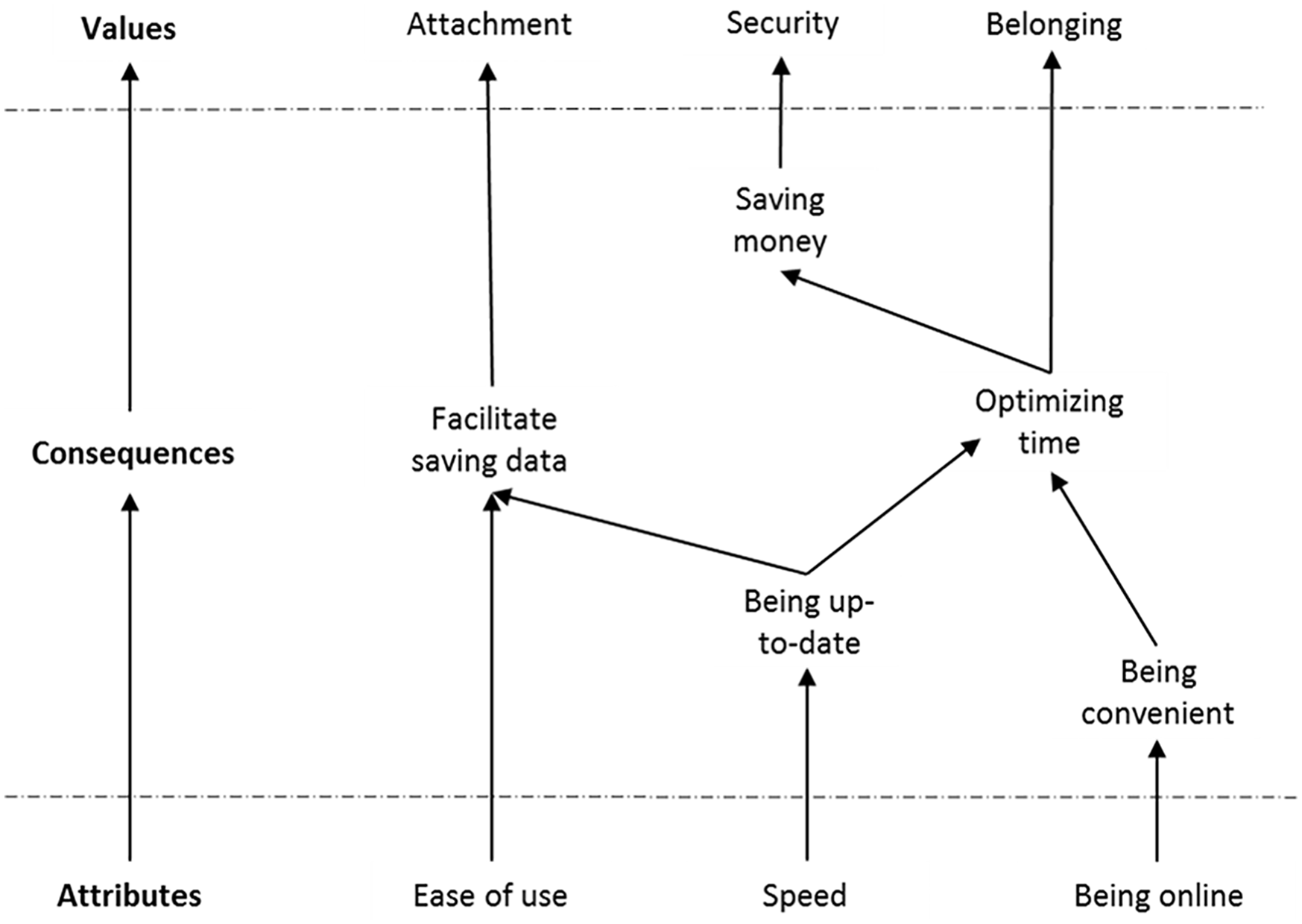
HVM of customer’s use of online newspaper (Leão & Mello, 2007).
The laddering technique is highly recommended in research that investigates personal values according to the models of the MEC theory (Gengler et al., 1999; Reynolds & Gutman, 1988). The laddering technique is an adaptation of Hinkle’s (1965) laddering method and is used in particular to model people’s concepts, beliefs, goals, and values (Veludo-de-Oliveira et al., 2006). Therefore, MEC theory is a useful framework for achieving this purpose because it provides a systematic and hierarchical order that should be followed (Veludo-de-Oliveira et al., 2006). The laddering technique using in-depth one-to-one interviews, constructs meaningful A-C-V sequences (ladders) and serves to identify users’ perceptions of how these three levels associate (Gutman, 1982; Reynolds & Gutman, 1988). During the interview process, the laddering technique is used to apply a number of guided questions (e.g., “Why is this important to you?”) to construct the HVM, thereby illustrating the existing linkages between attributes, consequences, and values and enabling the understanding of how these linkages influence users’ decisions regarding product adoption and use (Reynolds & Gutman, 1988). The following is an example of part of an actual laddering interview acquiring one chain of attributes, consequences, and values, and it shows how it is structured:
You indicated that an important feature of SNSs is that you are able to “follow” others (Attribute). Why is that important to you?
It enables me to view others’ academic achievements so I stay current in my field (Consequence).
Why do you want to stay current in your field?
Being current in the field enhances my professional development (Consequence), which enables me to accomplish my goals (Value).
In this way, different attributes were questioned regarding their importance, and several chains were obtained per respondent.
Research Methodology
Sample and Procedure
In this study, the cognitive structures of instructors using SNSs are captured by the ladders that describe the conceptual linkages between SNSs’ features (attributes) and relevant benefits (consequences) of those features and how these consequences facilitate the achievement of personal values.
The data collection was conducted at King Faisal University in Saudi Arabia over 5 weeks in 2019. The respondents were academic instructors from the Faculties of Art, Education, Agriculture and Food Sciences, Computer Science, and Business. The participant selection criteria were (a) use of three or more SNSs, (b) actual SNSs use for at least 5 years, and (c) use of SNSs for academic purposes, such as teaching, learning, research, and professional development. According to these criteria, 30 instructors were invited to participate, 20 of whom accepted the invitation. Table 1 shows the respondents’ background characteristics. More than half of the participants (n = 12) had more than 10 years of teaching experience. The majority were from the College of Education (n = 15), and most were lecturers (n = 9) and assistant professors (n = 9). The participants used seven SNSs for academic purposes: Twitter, Facebook, Telegram, YouTube, WhatsApp, ResearchGate, LinkedIn, and Academia. For their convenience, the respondents were asked to choose their preferred interview mediums. Accordingly, 18 interviews were conducted face-to-face, and two were conducted by telephone.
Backgrounds of Respondents (n = 20).

Data Collection Method
The laddering method, a common MEC analysis technique that is used for data collection and analysis, proposes the identification of ladders from each respondent and the quantification of the elements (attributes, consequences, values) and their relationships; the aim is to build these connections graphically for each respondent (Reynolds & Gutman, 1988). The respondents may form no ladders or many (Sun et al., 2009). To form ladders, in-depth individual interviews are guided by three main questions: What attribute makes the product or service attractive to you? Why is this attribute important or desirable to you? Why is your response important? There are two types of laddering approaches: soft and hard. Soft laddering is appropriate when the respondent is not restricted to one answer (Henneberg et al., 2009; Walker & Olson, 1991), and the purpose is to reach a profound understanding of individual’s values and the factors affecting these values (Sun et al., 2009). In contrast, hard laddering is when respondents are restricted to one answer on each rung of the ladder (Henneberg et al., 2009; Walker & Olson, 1991), and it is applicable to large samples from questionnaires (Sun et al., 2009). To collect data for this study, soft laddering was used to gain a rich understanding of the perceptions and values of instructors who have utilized several features of SNSs for academic purposes.
To develop sufficient ladders, data were collected from interviews with 20 university instructors; this was considered a sufficient number of interviews according to Reynolds et al. (2001). Each participant generated an average of nine ladders, with mostly three elements of attributes, consequences, and values in each ladder. This produced 540 data points, which exceeded the required amount for constructing useful linkages (Sun et al., 2009). The respondents attended individual interview sessions that ranged in duration from 30 to 50 min. Each of the two authors, who were trained in laddering techniques, interviewed each respondent individually. After the demographic data from the respondents regarding their academic ranks, areas of specialty, and years of experience as university instructors were collected, the respondents were asked to list the SNSs that they used for academic purposes.
The laddering technique started with asking the participants to identify the SNS attributes they used most frequently and why. The question “Why is it important to you?” was asked repeatedly to prompt the respondents to recall their true perceptual orientations regarding the use of SNSs; the aim was to generate the A-C-V ladder. An example of the A-C-V ladder of an e-learning system is represented in Figure 2. In this study, the interviews were conducted as follows. First, the instructors were asked to describe the academic purposes for which they used SNSs, as well as which SNS features were useful. Second, they were asked to articulate why these features were useful for them. Third, they were asked to articulate why they valued these consequences (advantages). Following this interview format, participants were able to express their perceptions of the use of SNSs for academic purposes, thereby enabling data collection.

An example of an A-C-V ladder (Sun et al., 2009).
Six interview techniques suggested by Reynolds and Gutman (1988) were used to redirect participants’ thoughts when they were unable to clearly articulate their perceptions. The six interview techniques were as follows: (a) providing the respondents with realistic occasions on which they would use SNSs; (b) encouraging the participants to explain their perceptions when considering what it would be like to have no SNSs; (c) asking respondents why they did not do certain actions; (d) taking participants back in time to enable them to critically articulate how they feel or behave; (e) eliciting responses from instructors by asking how other instructors whom they knew would feel in similar circumstances; and (f) employing silence to allow respondents to formulate more proper or definitive answers (pp. 5–8).
Content Analysis
The content analysis followed the three steps of Sun et al. (2009): (a) producing a summary content code, (b) constructing a summary implication matrix (SIM), and (c) constructing an HVM. The first step was interview data coding and categorization. Coding was conducted by the two authors independently. The codes were then discussed, and disputed codes were presented to field experts to reach consensus. Table 2 represents the summary content code table of attributes, consequences, and values. In this study, attributes mean the features of the SNSs. Consequences are the advantages from using these features. Finally, values refer to instructors’ personal beliefs that were derived from these consequences. To ensure and verify coding reliability, Cohen’s Kappa inter-coder reliability measure (Landis & Koch, 1977) was applied using SPSS (v. 23). The κ value computed from Appendix A was .86, suggesting that the coding fell within the range of good reliability. The complete coding results are shown in Appendix A.
Summary of Content Codes.

Constructing a SIM
Ladders for each individual respondent were degraded into their direct and indirect components to construct the SIM as a second step of the content analysis. Examples of direct and indirect linkages are shown in Figure 2. The linkage between “e-syllabus” (A) and “autonomy in learning” (C) is direct, while the linkage between “autonomy in learning” (C) and “sense of accomplishment” (V) is indirect. All direct and indirect linkages were recorded between the attributes, consequences, and values to construct the A-C, C-C, A-V, and C-V implication matrices. The A-C and C-V implication matrices, are shown, respectively, in Tables 3 and 4. Each entry (number of relations) in the SIM was presented through numbers in a fractional form, where the number before the decimal point represents the frequency of the direct linkages and the number after the decimal point represents the frequency of the indirect linkages. For example, in Figure 2, the A-C and C-V are both represented in the SIM by the number 1.00 as a direct linkage, while A-V is represented by the number 0.01 as an indirect linkage. The complete SIM is presented in Appendix B.
A-C Summary of Implication Matrix.

Note. A = attribute; C = consequence; V = value.
C-V Summary Implication Matrix.
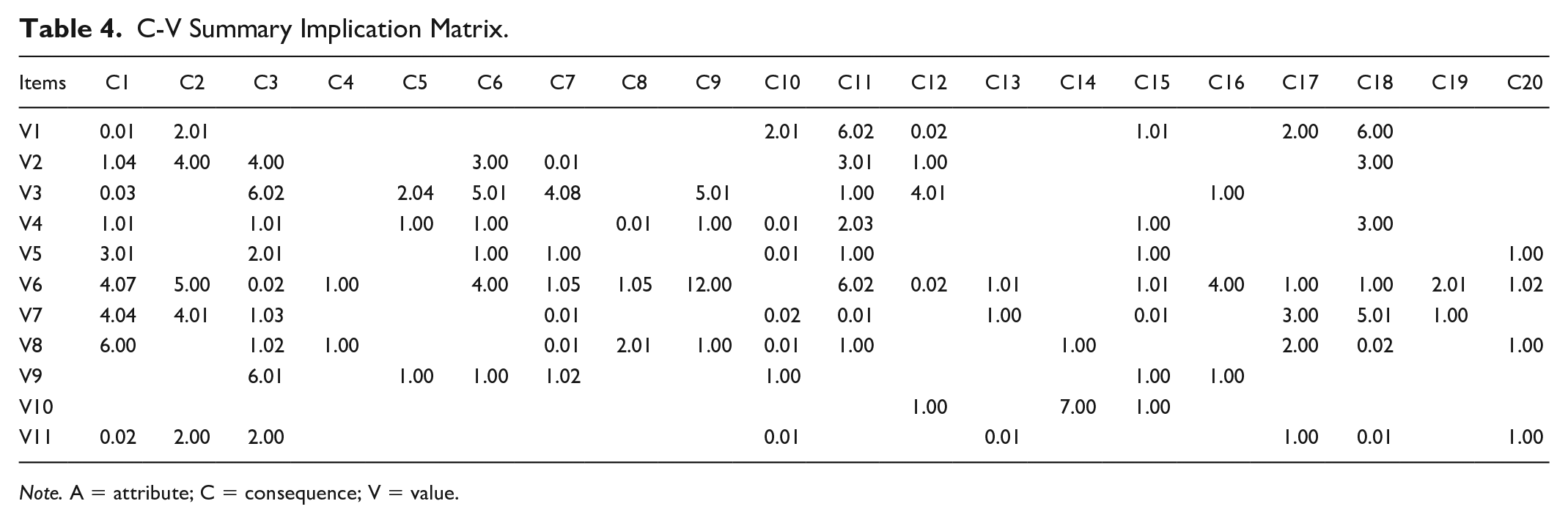
Note. A = attribute; C = consequence; V = value.
Constructing the HVM
In the third step of content analysis, the SIM was converted into an HVM. The purpose of mapping relations in a hierarchical form is to interrelate all important chains in a visual representation to facilitate the understanding and interpreting (Leão & Mello, 2007). A typical approach to build the map is to draw all existing relations above a cutoff level, which Reynolds and Gutman (1988) stated should be from three to five relations. In this study, the total number of ladders was 190, with 540 elements forming a considerable number of direct and indirect relations. Therefore, a cutoff level of three or even four would not generate the most significant and effective connections between the attributes, consequences, and values. Based on the five types of relations described by Reynolds and Gutman (1988), the substantial number of ladders derived from the data in this study, and the number of relations per cell in the SIM, a cutoff level of five relations was considered as the most adequate cutoff level to construct the HVM for this study.
To construct the HVM from the SIM, we started from the lineages in the A-C matrix that exceeded the cutoff level of five relations, and then we moved to the C-C matrix and finally to the C-V matrix (Reynolds & Gutman, 1988). For example, starting from the A1 attribute in Appendix B, the first entry that met the cutoff level of five was (18.01) linked to C1; which led to the examination of the C1 row, where the (8.02) entry linked to C2; which led to the examination of the C2 row, where the (5.00) entry linked to V6; and this continued. By repeating these steps, the HVM represented in Figure 3 was yielded. Figure 3 shows that seven features of SNSs (attributes), 11 consequences, and nine values were derived in this study.

The HVM of academic use of SNSs.
Results and Discussion
The analysis of the research data identified 13 features (attributes), 20 consequences, and 11 values. The SIMs transformed the original data into an HVM (Figure 1) and reduced the number of elements to seven features, 12 consequences, and nine values.
Perceived Important Features of Using SNSs
The seven SNS features illustrated in the HVM were “follow,” “post/broadcast,” “direct message,” “become a group member,” “share media,” “save/bookmark,” and “repost.” We classified these features into two categories: (a) features that support active engagement: post/broadcast, direct message, share media, and repost and (b) features that support passive engagement: follow and save/bookmark. The “being a group member” feature could be in both categories, depending on the interactions of the instructors. Some instructors preferred to be active and share knowledge in their groups, while others preferred to be silent and to only preview information; Wenger et al. (2009) described the latter as “lurkers.” However, according to the data gathered from the study participants, the “being a group member” feature supported active engagement.
Features that support active engagement
Most of the participants who indicated the post/broadcast feature in their interviews explained that they liked to contribute to knowledge building because they felt that they had valuable information to share. This willingness to share information and knowledge arose from their feelings of accountability to their colleagues and academic community. In addition to this sense of accountability, they indicated that their interest in sharing information was related to their love of giving. This finding is supported by Oh and Syn (2015), who found that a sense of achievement and accountability to the community often motivates SNS users to share information with others. Furthermore, some participants explained that they used the post/broadcast feature to establish and brand their academic identities on SNSs. They wanted to be academically recognized in cyberspace and to build their self-esteem. For example, one participant stated, “I tweet a lot about academic research subjects because I want to be recognized in this field and to build my special academic identity. Creating a unique academic identity increases my self-esteem and confidence.” As Coad (2017) indicated, getting involved in conference hashtags enables academics to show their academic identities and reinforce their academic relationships.
Similarly, the participants noted that their willingness to share information was also why they used the repost feature. Most articulated that they reposted others’ threads because they contained valuable information that deserved to be conveyed to their followers. Some participants also noted that they used the repost feature to encourage others’ ideas and support their achievements. For example, one participant stated, “When I find useful information, I repost it because I like to encourage the original writer of the post. Reposting is important because it means empowering this person to continue his or her good work.” The participants believed that when they encourage someone’s achievements, they are making a positive contribution to society by inspiring others to achieve in similar or even better ways. Boyd et al. (2010) emphasized that using the repost feature encourages others’ ideas that can assist less popular or less visible users.
Media sharing was also a common feature mentioned by participants. They liked to upload and share various types of media, such as academic videos, audios, and their curriculum vitae (CVs), published research papers, and overall academic achievements. They explained that through media sharing on SNSs, they enhance their students’ learning. For example, one participant stated, “I created a blog to upload and share educational media that are relevant to my curricula to enhance my students’ learning!” Another reason given for media sharing was the desire to help instructors create and expand their academic networks. The participants explained how sharing media on SNSs supported their new academic friendships or reinforced current ones. For example, one participant noted that when she shared more media, she acquired more followers, consequently expanding her academic network. Several participants discussed how creating and expanding their academic networks provided them with academic recognition and thus made them influencers. Another participant cared about maintaining friendships with her students after they graduated: “Media sharing is important to stay in touch with my students after they graduate. I like to see the impact of my teaching; this helps me feel that I am a successful instructor.” In general, these findings are supported by the literature that highlights the usefulness of SNSs in terms of increasing academic visibility among scholars who may cite their work or engage in conversations with them and help them expand their academic network, in turn providing great opportunities for research collaboration and peer review (El-Berry, 2015; Elsayed, 2016; Greenhow et al., 2017; Manca & Ranieri, 2017).
The instructors mentioned communicating through direct messages as one of the SNS features that were used frequently. Their main reason for using this feature was to maintain their privacy and others’. One participant stated, I use direct messages with my students to prevent them from feeling embarrassed when they present their inquiries publicly in front of their peers. I respect their privacy, which gives them the confidence to ask anything related to their studies.
The participants cited avoiding trouble with other users as another reason for using direct messages. They emphasized that they preferred using direct messages for subjects that might be considered sensitive or controversial in the local culture. Communicating through direct messages seems to be a useful feature that maintains the privacy of both the sender and the receiver. This feature fulfills the value of respecting others who prefer to keep contact private.
The “being a group member” feature encourages both passive and active behavior. The participants noted several reasons for being members of a group: communicating flexibly, staying current in the field, enhancing students’ learning, sharing knowledge, and saving time and effort. Most of the participants who mentioned flexible communication also discussed its value for enhancing their students’ learning. The instructor participants created SNS groups because these are favorable among students and are available on mobile social apps, thus making communication with students easier and more convenient for them. According to one participant, “Students discuss, ask, and answer their peers’ questions. I feel responsible for my students and their academic achievement. This gives me a sense of accomplishment.” Other participants explained their use of groups with other educators. As creating and participating in academic groups on SNSs, rather than using email or other official means, can provide flexible communication, this enables them to accomplish their academic tasks more efficiently. The majority of the instructor participants indicated that their main reason for joining and participating in academic groups on SNSs was their desire to be up-to-date with the current important information provided by their departments and universities. This was based on their keenness and responsibility to get the job done more quickly and efficiently; this, in turn, gave them a sense of fulfillment. Some expressed a desire to be informed of the latest news, which enabled them to feel more secure and not miss any information. Others expressed that being a member of academic groups provided them with a sense of belonging to their academic field. For example, one participant explained how being a member of a Telegram research group helped her to be up-to-date regarding the many new ideas in her field of academic research, and she emphasized how learning new information from these groups improved her professional development, giving her a sense of accomplishment and improving her self-esteem.
Features that support passive engagement
Some SNS features encourage instructors to engage in passive academic behavior. An example is following other academics’ accounts. Donelan (2016) and Jordan and Weller (2018) identified several factors that motivate academic users of SNSs to follow other academics, including the desire to stay up-to-date in the field, to create and expand academic social networks, to exchange knowledge, and to promote their own professional development. The participants in this study explained that being up-to-date in their fields enhanced their confidence and self-esteem because they had access to extensive and up-to-date information. Moreover, many discussed how being up-to-date in their fields helped them feel more secure because they learned fundamental information that they needed in their careers. One participant stated, I follow other academics to see what is new around me. It is important for me to feel that I have a place in the academic world and that I can feel secure as an academic who continues her professional development.
Moreover, the participants indicated that staying current in the field satisfied their need for professional fulfillment. Some explained that they followed others to obtain new information and share it with their students because they felt responsible for their learning and appreciated the value of giving. Gruzd et al. (2018) explained how instructors utilized SNSs to enhance their students’ learning by providing them with various forms of learning resources and materials. Following others on SNSs creates new academic relationships and maintains current ones. One participant explained, “When I follow a senior official on Twitter, he or she would acknowledge me and retweet me. Then, the senior official’s retweet causes the user to gain followers. This makes me feel accomplished.” Another participant added more value-based reasons for expanding her academic network: “I want well-known scholars to follow me back and share my posts because this assists me in being academically recognized and being an influencer in my field.” Thus, accomplishment, academic recognition, and influence were the values that motivated the participants to follow others to create and expand their academic networks.
Saving/bookmarking is another passive feature that does not require instructors to interact on SNSs. Our participants mainly used this feature as a resource repository. Having a place to save resources provides the participants with the potential to retrieve these resources when they are needed (Gorrell & Bontcheva, 2014), which contributes significantly to the effective accomplishment of their academic goals. One participant expressed that Twitter’s “retweet” and “like” features enabled her “to keep the information on my account to find it quickly. I use the retweet as an archive for top priority information, while I use like to save information that is less of a priority.” Our participants emphasized that saving time and effort was an important reason for using the save feature. Sugimoto et al. (2017) stated that social bookmarking offers users a safe place to save publication or educational materials so that they can read them or share them with others.
Perceived Important Values of Using SNSs
The related literature indicates that individual values are considered factors that influence the continued use of any service or system (Chiu, 2005). In terms of SNSs use, previous studies do not evidently indicate which values motivate instructors to use SNSs for academic purposes. The results of this study highlight that fulfillment, accomplishment, academic recognition, influence, self-esteem, accountability, security, love of giving, and respect are the most important values that drive university instructors in this study to use SNSs for academic purposes. Most of these values are mentioned in the literature as significant motives for the general use of SNSs (El-Berry, 2015; Elsayed, 2016; Greenhow et al., 2017; Oh & Syn, 2015). When university instructors use SNS features that fulfill such values, their motivation to use SNSs in an academic setting is enhanced. Therefore, university policy makers could use these research findings to develop professional programs that focus on various SNS features that enhance instructors’ values.
Determining Dominant Perceptual Orientation
The HVM in Figure 3 identifies the most important features that are the focus of instructor participants’ academic use of SNSs and illustrates the relationship between SNS features and instructors’ values. This HVM may help decision makers at universities understand instructors’ SNS use behaviors. Therefore, the developmental policies implemented to enhance instructors’ skills regarding the use of SNSs for academic purposes are framed by decision makers based on the relationships or features that are recognized as the most critical. To this end, Tables C1, C2, and C3 in Appendix C provide a summary of linkages wherein, as stated by Sun et al. (2009), “the ‘to’ column describes the number of linkages linking to this element, and the ‘from’ column shows the number of linkages emanating from this element” (p. 6).
Table C1 in Appendix C shows that the three most important features of SNSs use are “A6: become a group member” (40.72), “A1: follow” (37.51), and “A3: post/broadcast” (26.36). To maximize the efficient academic use of SNSs among university instructors, professional development policy makers should pay attention to the use of these three features for academic purposes, such as teaching and learning, academic research, and academic community engagement. In contrast to the features in Table C1, Table C2 in Appendix C shows that “C1: be current in the field” (82.31), “C3: share knowledge and experience” (77.21), and “C11: create and expand academic social network” (59.2) are the three most important consequences of using SNSs academically. Given that it is relatively common for instructors to contribute academically to their fields, therefore instructors actively interact through using SNSs. The SNSs provide flexible communication functions, and instructors are concerned about how to keep abreast of current trends in their fields and to effectively participate in knowledge construction. Finally, instructors care about whether the SNSs facilitate the building and broadening of their academic social networks, which is a feature that is typically lacking in conventional academic social environments; this therefore motivates university instructors to adopt SNSs. Moreover, Table C3 in Appendix C shows that “V6: accomplishment” (45.64) and “V3: accountability” (28.49) are the two most important values emphasized by instructors. The university instructors perceive SNS features as having significant potential to facilitate their academic goals. In addition, their use of SNSs is driven by their sense of accountability toward their academic community (students, colleges, and scholars) in terms of knowledge construction, learning development, and research enrichment.
The previous analyses illustrate the most important A-C-V chains in the use of SNSs from the instructors’ perspectives. However, to determine which chains in Figure 3 are more significant than others, 45 chains are summarized for this study in Appendix D. Chain 21 has the highest number of linkages, with 201 direct and 84 indirect links. In the HVM (Figure 3), Chain 21 starts from “become a group member” (A6), to “be current in the field” (C1), to “support professional development” (C2), and finally to sense of “accomplishment” (V6). Furthermore, the second-highest number of linkages was for Chain 29 in Appendix D, with 198 direct and 63 indirect links. In the HVM (Figure 3), Chain 29 starts from “follow” (A1), to “be up to date in the field” (C1), to “support professional development” (C2), and finally to sense of “accomplishment” (V6). The two chains show that being current in the field is the main reason why the instructors were interested in participating in academic groups and following others on SNSs. Most of them discussed how being current in the field also supported their professional development, which enhanced their feelings of accomplishment. This finding is in line with the results of a number of studies (Donelan, 2016; Holmes et al., 2013; Jordan & Weller, 2018; Nández & Borrego, 2012) stating that most university instructors are motivated to use SNSs to stay current in their fields and to obtain knowledge about developments in their field to support their professional development (Veletsianos et al., 2019). This finding suggests that among instructors, participating in academic groups and following others’ accounts are the most important SNS features that facilitate their attempts to keep abreast of new trends in their fields. Doing so supports their professional practices, such as teaching and learning, research, and knowledge sharing, which give the instructors a sense of accomplishment. University policy makers should make use of this finding by emphasizing instructors’ engagement in academic groups and encouraging them to expand their academic social networks by following others’ SNS accounts. In addition, university policy makers should focus on other SNS features that support instructors’ professional development and enhance their sense of accomplishment, thus ensuring their continued use of the SNSs.
This finding suggests that the value of “accomplishment” is the most influential factor motivating university instructors to use SNSs for academic purposes. Furthermore, the previous analyses of the features and consequences of the two most significant chains in the HVM represent the quality and advantages of SNSs. Overall, our study provides a useful blueprint for the decision makers in higher education to establish professional development programs and policies that focus on the critical SNS features with a view to promoting academic SNSs usage among instructors.
Conclusions and Implications
Many studies have analyzed the uses of SNSs, focusing on their purposes. These studies have attempted to identify SNS features used in academic contexts without considering users’ related cognitive structures. They have thus failed to identify the most important features that meet users’ needs and values. A major contribution of this research is the application of MEC theory along with the laddering technique to analyze instructors’ cognitive structures related to academic SNSs use to systematically identify the most significant features that meet their values. The study contributes to the emerging SNSs literature by providing a method for identifying significant relationships that influence university instructors’ academic use of SNSs and uncovering their importance, thereby deepening our understanding of SNSs use behavior in academia.
According to our research, seven SNS features form 45 MECs. These seven features—media sharing, following others, saving/bookmarking, being a group member, posting/broadcasting, reposting, and direct messaging—appeared to be the most useful ones used by university instructors for academic purposes. These features were found to be cognitively associated with 10 positive benefits that are crucial to the fulfillment of nine personal values of instructors: fulfillment, accomplishment, academic recognition, influence, self-esteem, accountability, security, love of giving, and respect. Among the seven features, the two that the instructors used most frequently in their academic practices were following others and being a group member. These two features were of great value for instructors in terms of enabling them to experience a sense of accomplishment.
The results of this research have significant implications on two levels: the instructors’ professional level and the institutional level. Instructors have professional values that they want to achieve. The results of this study represented in the HVM, including the 45 behavioral chains, have great importance for understanding the beneficial features of SNSs that enable the achievement of these values. Regarding the institutional level, university policy makers should construct training programs aimed at improving instructors’ skills and practices regarding the use of SNSs for academic purposes. Universities should also conduct seminars, scientific forums, and conferences that support the effective academic use of SNSs. For example, training programs should be constructed based on the 45 behavioral chains introduced in the HVM of this research and should focus on the seven SNS features that achieve the 12 benefits, which in turn satisfy the nine professional values that were outlined. This would make the training more effective and valuable while enhancing motivation. Likewise, if universities want to encourage the continual and efficient academic use of SNS features among instructors, they should formulate their marketing strategies based on the cognitive structures presented in this research. For example, based on the 45 behavioral chains shown in the HVM presented in this research, they should design digital media sources to advertise SNSs that support academic use. Overall, the results of this study provide a useful lens through which to consider future research on understanding university instructors’ academic use of SNSs.
Footnotes
Appendix A
Coding Results.

| No. | Items | A | C | V |
|---|---|---|---|---|
| 1 | Follow | 2 | 0 | 0 |
| 2 | Acquire followers | 2 | 0 | 0 |
| 3 | Post/broadcast | 2 | 0 | 0 |
| 4 | Comment/mention | 2 | 0 | 0 |
| 5 | Direct message | 2 | 0 | 0 |
| 6 | Join groups | 2 | 0 | 0 |
| 7 | Share media | 2 | 0 | 0 |
| 8 | Like | 2 | 0 | 0 |
| 9 | Save/bookmark | 2 | 0 | 0 |
| 10 | Search | 1 | 1 | 0 |
| 11 | Repost | 2 | 0 | 0 |
| 12 | Join hashtags | 2 | 0 | 0 |
| 13 | Start a poll | 2 | 0 | 0 |
| 14 | Be current in the field | 0 | 2 | 0 |
| 15 | Support professional development | 0 | 2 | 0 |
| 16 | Share knowledge and experience | 0 | 2 | 0 |
| 17 | Obtain effective feedback easily | 0 | 2 | 0 |
| 18 | Be available for others | 0 | 2 | 0 |
| 19 | Enhance student learning | 0 | 2 | 0 |
| 20 | Engage in flexible communication | 0 | 2 | 0 |
| 21 | It is a resource repository | 0 | 2 | 0 |
| 22 | Save time and effort | 0 | 2 | 0 |
| 23 | Share academic achievements | 0 | 2 | 0 |
| 24 | Create and expand academic social network | 0 | 2 | 0 |
| 25 | Encourage and support others’ achievements | 0 | 2 | 0 |
| 26 | Enrich teaching | 0 | 2 | 0 |
| 27 | Maintain privacy | 0 | 1 | 1 |
| 28 | Increase collaboration | 0 | 2 | 0 |
| 29 | Increase productivity and quality | 0 | 2 | 0 |
| 30 | Improve standard of living | 0 | 1 | 1 |
| 31 | Establish and brand academic identity | 0 | 1 | 1 |
| 32 | Increase resources credibility | 0 | 2 | 0 |
| 33 | Recognize the personalities of others | 0 | 2 | 0 |
| 34 | Academic recognition | 0 | 0 | 2 |
| 35 | Fulfillment | 0 | 0 | 2 |
| 36 | Accountability | 0 | 0 | 2 |
| 37 | Influence | 0 | 0 | 2 |
| 38 | Sense of belonging | 0 | 0 | 2 |
| 39 | Accomplishment | 0 | 0 | 2 |
| 40 | Self-esteem | 0 | 0 | 2 |
| 41 | Security | 0 | 0 | 2 |
| 42 | Love of giving | 0 | 0 | 2 |
| 43 | Respect | 0 | 0 | 2 |
| 44 | Competitiveness | 0 | 1 | 1 |
Note. A = attribute; C = consequence; V = value.
Appendix B
The SIM: Complete Data Linkages.

| Items | C1 | C2 | C3 | C4 | C5 | C6 | C7 | C8 | C9 | C10 | C11 | C12 | C13 | C14 | C15 | C16 | C17 | C18 | C19 | C20 | V1 | V2 | V3 | V4 | V5 | V6 | V7 | V8 | V9 | V10 | V11 | To |
|---|---|---|---|---|---|---|---|---|---|---|---|---|---|---|---|---|---|---|---|---|---|---|---|---|---|---|---|---|---|---|---|---|
| A1 | 18.01 | 0.11 | 4.02 | 1.00 | 0.01 | 9.04 | 1.03 | 0.01 | 0.01 | 0.01 | 4.00 | 0.06 | 0.02 | 0.04 | 0.01 | 0.02 | 0.05 | 0.02 | 0.04 | 37.51 | ||||||||||||
| A2 | 2.00 | 1.00 | 0.01 | 0.01 | 0.01 | 0.01 | 3.04 | |||||||||||||||||||||||||
| A3 | 1.00 | 2.00 | 7.00 | 2.02 | 1.01 | 2.00 | 1.00 | 1.00 | 1.01 | 0.03 | 8.03 | 0.02 | 0.04 | 0.05 | 0.01 | 0.01 | 0.04 | 0.06 | 0.01 | 0.02 | 26.36 | |||||||||||
| A4 | 0.01 | 0.01 | 3.00 | 1.00 | 2.02 | 3.00 | 4.00 | 0.01 | 0.05 | 0.01 | 0.01 | 0.01 | 0.03 | 0.01 | 13.17 | |||||||||||||||||
| A5 | 3.00 | 1.00 | 2.00 | 8.00 | 1.00 | 1.00 | 0.01 | 0.01 | 0.03 | 0.01 | 0.01 | 0.08 | 16.15 | |||||||||||||||||||
| A6 | 14.03 | 1.00 | 3.03 | 1.02 | 0.06 | 15.03 | 1.00 | 1.08 | 1.00 | 3.00 | 0.01 | 0.02 | 0.01 | 0.01 | 0.01 | 0.02 | 0.03 | 0.11 | 0.04 | 0.10 | 0.04 | 0.06 | 0.01 | 40.72 | ||||||||
| A7 | 0.01 | 0.01 | 4.00 | 1.00 | 4.01 | 2.00 | 6.00 | 4.02 | 0.02 | 0.02 | 0.03 | 1.03 | 0.04 | 0.02 | 0.03 | 0.03 | 0.02 | 0.02 | 0.02 | 0.03 | 0.01 | 22.37 | ||||||||||
| A8 | 1.00 | 3.00 | 0.01 | 0.01 | 0.03 | 0.02 | 4.07 | |||||||||||||||||||||||||
| A9 | 6.00 | 0.02 | 0.02 | 0.04 | 0.01 | 6.09 | ||||||||||||||||||||||||||
| A10 | 2.00 | 1.01 | 1.00 | 0.03 | 0.01 | 4.05 | ||||||||||||||||||||||||||
| A11 | 7.01 | 1.00 | 0.01 | 0.02 | 5.01 | 1.00 | 0.01 | 0.03 | 0.02 | 0.02 | 0.01 | 0.02 | 0.02 | 0.01 | 15.19 | |||||||||||||||||
| A12 | 1.00 | 1.00 | 2.00 | 1.00 | 1.03 | 1.00 | 1.00 | 1.00 | 1.00 | 0.03 | 0.01 | 0.01 | 0.01 | 0.02 | 10.11 | |||||||||||||||||
| A13 | 2.00 | 1.00 | 1.00 | 0.02 | 4.02 | |||||||||||||||||||||||||||
| C1 | 8.02 | 4.00 | 1.00 | 3.00 | 2.00 | 3.00 | 1.00 | 1.00 | 0.01 | 1.04 | 0.03 | 1.01 | 3.01 | 4.07 | 4.04 | 6.00 | 0.02 | 42.25 | ||||||||||||||
| C2 | 1.00 | 4.00 | 5.00 | 4.01 | 2.00 | 16.01 | ||||||||||||||||||||||||||
| C3 | 1.00 | 1.01 | 1.00 | 1.00 | 2.01 | 1.00 | 2.00 | 1.00 | 1.00 | 1.00 | 1.00 | 2.01 | 4.00 | 6.02 | 1.01 | 2.01 | 0.02 | 1.03 | 1.02 | 6.01 | 2.00 | 38.15 | ||||||||||
| C4 | 1.00 | 1.00 | 2.00 | |||||||||||||||||||||||||||||
| C5 | 1.00 | 1.00 | 2.04 | 1.00 | 1.00 | 6.04 | ||||||||||||||||||||||||||
| C6 | 1.00 | 3.00 | 5.01 | 1.00 | 1.00 | 4.00 | 1.00 | 16.01 | ||||||||||||||||||||||||
| C7 | 1.00 | 0.01 | 1.00 | 1.01 | 7.01 | 6.00 | 2.00 | 0.01 | 4.08 | 1.00 | 1.05 | 0.01 | 0.01 | 0.02 | 24.21 | |||||||||||||||||
| C8 | 1.00 | 5.00 | 2.00 | 1.00 | 0.01 | 1.05 | 2.01 | 12.07 | ||||||||||||||||||||||||
| C9 | 1.00 | 5.01 | 1.00 | 12.00 | 1.00 | 20.01 | ||||||||||||||||||||||||||
| C10 | 1.00 | 2.00 | 0.01 | 4.00 | 2.01 | 0.01 | 0.01 | 0.02 | 0.01 | 1.00 | 0.01 | 10.08 | ||||||||||||||||||||
| C11 | 1.00 | 2.00 | 1.00 | 1.00 | 2.00 | 1.00 | 6.02 | 3.01 | 1.00 | 2.03 | 1.00 | 6.02 | 0.01 | 1.00 | 28.09 | |||||||||||||||||
| C12 | 1.00 | 4.00 | 0.01 | 0.02 | 1.00 | 4.01 | 0.02 | 1.00 | 11.06 | |||||||||||||||||||||||
| C13 | 1.01 | 1.00 | 0.01 | 2.02 | ||||||||||||||||||||||||||||
| C14 | 1.00 | 7.00 | 8.00 | |||||||||||||||||||||||||||||
| C15 | 1.00 | 2.00 | 1.01 | 1.00 | 1.00 | 1.01 | 0.01 | 1.00 | 1.00 | 9.03 | ||||||||||||||||||||||
| C16 | 1.00 | 4.00 | 1.00 | 6.00 | ||||||||||||||||||||||||||||
| C17 | 2.00 | 1.00 | 3.00 | 2.00 | 1.00 | 9.00 | ||||||||||||||||||||||||||
| C18 | 1.00 | 3.01 | 6.00 | 3.00 | 3.00 | 1.00 | 5.01 | 0.02 | 0.01 | 22.05 | ||||||||||||||||||||||
| C19 | 1.00 | 2.01 | 1.00 | 4.01 | ||||||||||||||||||||||||||||
| C20 | 1.00 | 1.00 | 0.01 | 1.00 | 1.02 | 1.00 | 1.00 | 6.03 | ||||||||||||||||||||||||
| From | 40.06 | 17.16 | 39.06 | 2.00 | 7.03 | 16.12 | 23.04 | 12.00 | 21.16 | 10.00 | 31.11 | 11.01 | 4.03 | 8.00 | 9.05 | 7.08 | 8.09 | 22.09 | 4.02 | 6.03 | 19.27 | 19.24 | 28.49 | 11.18 | 10.12 | 45.64 | 19.32 | 16.23 | 11.14 | 9.09 | 6.11 |
Note. SIM = summary implication matrix; A = attribute; C = consequence; V = value.
Appendix C
Appendix D
Summary of All Chains.

| Path | |||||||
|---|---|---|---|---|---|---|---|
| No. | → | → | → | To | From | Sum | |
| 1 | A9 | C8 | V6 | 18.16 | 56.64 | 74.8 | |
| 2 | A9 | C8 | C9 | V6 | 38.17 | 68.8 | 106.97 |
| 3 | A9 | C8 | C9 | V3 | 38.17 | 61.65 | 99.82 |
| 4 | A7 | C10 | 32.45 | 10.00 | 42.45 | ||
| 5 | A7 | C6 | V3 | 38.38 | 44.61 | 82.99 | |
| 6 | A7 | C11 | V6 | 51.46 | 76.75 | 128.21 | |
| 7 | A7 | C11 | V1 | 51.46 | 50.38 | 101.84 | |
| 8 | A7 | C11 | V4 | 51.46 | 42.29 | 93.75 | |
| 9 | A6 | C9 | V6 | 60.73 | 66.8 | 127.53 | |
| 10 | A6 | C9 | V3 | 60.73 | 49.65 | 110.38 | |
| 11 | A6 | C7 | V3 | 64.93 | 51.53 | 116.46 | |
| 12 | A6 | C7 | C6 | V3 | 80.94 | 67.65 | 148.59 |
| 13 | A6 | C7 | C9 | V6 | 84.94 | 89.84 | 174.78 |
| 14 | A6 | C7 | C9 | V3 | 84.94 | 72.69 | 157.63 |
| 15 | A6 | C7 | V6 | 64.93 | 68.68 | 133.61 | |
| 16 | A6 | C6 | V3 | 56.73 | 44.61 | 101.34 | |
| 17 | A6 | C1 | V2 | 82.97 | 59.3 | 142.27 | |
| 18 | A6 | C1 | V6 | 82.97 | 85.7 | 168.67 | |
| 19 | A6 | C1 | V7 | 82.97 | 59.38 | 142.35 | |
| 20 | A6 | C1 | V8 | 82.97 | 56.29 | 139.26 | |
| 21 | A6 | C1 | C2 | V6 | 98.98 | 102.86 | 201.84 |
| 22 | A6 | C1 | C2 | V7 | 98.98 | 76.45 | 175.43 |
| 23 | A6 | C3 | V3 | 78.87 | 67.55 | 146.42 | |
| 24 | A6 | C3 | V9 | 78.87 | 50.2 | 129.07 | |
| 25 | A1 | C1 | V2 | 79.76 | 59.3 | 139.06 | |
| 26 | A1 | C1 | V6 | 79.76 | 85.7 | 165.46 | |
| 27 | A1 | C1 | V7 | 79.76 | 59.38 | 139.14 | |
| 28 | A1 | C1 | V8 | 79.76 | 56.29 | 136.05 | |
| 29 | A1 | C1 | C2 | V6 | 95.77 | 102.86 | 198.63 |
| 30 | A1 | C1 | C2 | V7 | 95.77 | 76.54 | 172.31 |
| 31 | A1 | C2 | V6 | 53.52 | 62.8 | 116.32 | |
| 32 | A1 | C2 | V7 | 53.52 | 36.48 | 9.00 | |
| 33 | A1 | C3 | V3 | 75.66 | 67.55 | 143.21 | |
| 34 | A1 | C3 | V9 | 75.66 | 50.2 | 125.86 | |
| 35 | A1 | C11 | V6 | 65.6 | 76.75 | 142.35 | |
| 36 | A1 | C11 | V1 | 65.6 | 50.38 | 115.98 | |
| 37 | A1 | C11 | V4 | 65.6 | 42.29 | 107.89 | |
| 38 | A3 | C3 | V3 | 64.51 | 67.55 | 132.06 | |
| 39 | A3 | C3 | V9 | 64.51 | 50.2 | 114.71 | |
| 40 | A3 | C18 | V1 | 48.41 | 41.36 | 89.77 | |
| 41 | A3 | C18 | V7 | 48.41 | 41.41 | 89.82 | |
| 42 | A11 | C3 | V3 | 53.34 | 67.55 | 120.89 | |
| 43 | A11 | C3 | V9 | 53.34 | 50.2 | 103.54 | |
| 44 | A11 | C12 | V3 | 26.25 | 39.5 | 65.75 | |
| 45 | A5 | C14 | V10 | 24.15 | 17.09 | 41.24 | |
Declaration of Conflicting Interests
The author(s) declared no potential conflicts of interest with respect to the research, authorship, and/or publication of this article.
Funding
The author(s) disclosed receipt of the following financial support for the research, authorship, and/or publication of this article: The Deanship of Scientific Research at King Faisal University under the Grant number [216081].
