



Abstract
The outbreak of Coronavirus pandemic has brought with it stagnation in all sectors of the economy, unemployment and loss of jobs, threats of recession, and annihilation of industries across the world. This paper examined the impact of strategic interfirm alliance on small-scale industries (SSI) amid the threat of COVID-19 pandemic in Nsukka, a local geographic space in Nigeria. A survey research design and a questionnaire survey of 82 SSIs were used in the paper. The data for the paper were analyzed using descriptive statistics while tables and percentages were used to illustrate the results. Results in the study revealed that 15.47%, 22.45%, and 44.20% of the respondents have experienced relative increase, increased, and significant increase, respectively, in COVID-19-induced challenges on their operations. The paper also showed that 24.81%, 25.01%, and 34.64% of the industries have experienced relative increase, increase, and significant increase, respectively, in their operations following their use of alliance, while 5.06% and 10.48% have experienced relative and significant decreases. The paper suggests that SSIs in Nigeria should adopt/institutionalize the use of strategic interfirm alliance in their operations in order to survive the COVID-19-induced challenges which have distrupted their production flow.
Introduction
The outbreak of Coronavirus Disease 2019 (COVID-19) pandemic has brought with it stagnation in the health sector, unemployment and loss of jobs, economic meltdown, and the threats of recession in several economies of the world (Nicola et al., 2020). With over 13 million confirmed cases and 574,464 deaths across the globe (World Health Organization [WHO], 2020a), the pandemic has not only weakened small-, medium-, and large-scale industries across the world; it has brought a number of challenges to their operations as most industries today grabble with COVID-19 protocols of the World Health Organization. The outbreak of COVID-19 has disrupted production flows in small- and medium-scale industries, reduced demand for non-essential goods and services, and forced enterprises to suspend or scale down their operations (Aydın & Ari, 2020; Buheji & Ahmed, 2020; Doern et al., 2019; International Labour Organization [ILO], 2020). For instance, in Iraq, it was found that the COVID-19 outbreak had a significant impact on economic outcomes at the firm level especially in the areas of job losses, inability to purchase raw materials, poor sales, and declining revenues (International Organization for Migration [IOM], 2020). This was also the case in the United Kingdom where a McKinsey online survey showed “that the outbreak of COVID-19 disease has led to challenges such as revenue decline, concerns for defaulting loans, inability to retain employees, and doubt in their ability to sustain their supply chains” (McKinsey & Company, 2020).
In Nigeria, the economic downturn which was occasioned by the dwindling oil prices as well as a plethora of challenges from the Coronavirus outbreak has not only led to a decline in the demand for oil products but have stagnated economic activities in all parts of the country following the enforcement of COVID-19 protocols by government agencies (Ozili, 2020). With over 33,616 effected persons and 745 deaths, COVID-19 pandemic has come hard on SSIs in Nigeria as they have been forced to grabble with social distancing, self-isolation, and restriction in movement including high cost of raw material, high interest rate, poor funds, inaccessible collateral requirements, and among others. SSIs in Nigeria are the worst hits because of their size and relatively low savings capacity and high dependency (Nnanna, 2020; Nseobot et al., 2020). They also have high dependence on daily cash flow transactions where a huge amount of their turnover is plowed back into their industries as re-invested capital, labor, and operational costs. These COVID-19 induced challenges coupled with poor power supply and dwindling economic outlook means that SSIs will either sinks or adapt to the new world order.
Given this turbulent situation, the government and its agencies have provided economic palliative to address some of these challenges. This includes the Central Bank of Nigeria (CBN) 50 billion naira (N50 billion naira) intervention fund which was targeted at providing credit facilities for SSIs at 5% interest rate (Nnanna, 2020). As laudable as this gesture is, it is almost dead on arrival. This is because of the administrative complexities, bureaucratic tussles, and difficulties establishing eligibility which are common issues suffered by such policy initiatives in the past. For SSIs to cope with these challenges posed by the COVID-19 outbreak, they have to embrace innovative management style (Ratten, 2020) by adopting strategies that would allow them leverage on each other’s strengths and capacities. One of these strategies is strategic interfirm alliance.
Strategic interfirm alliance is an agreement between firms, industries, and business institutions with the purpose of achieving gains which cannot be attained on individual basis. Some of these gains include interchanging and co-designing of products, technologies, or services (Nwokocha & Madu, 2020). In view of this, this study is poised to examine the impact of strategic interfirm alliance on SSIs amid the threat of annihilation by COVID-19 pandemic. This will be pursued by providing answers to the following questions:
What are the COVID-19 induced challenges on SSIs?
What are the impacts of strategic interfirm alliance on SSIs?
Literature Review and Theoretical Framework
COVID-19 and the Challenges of SSIs
Before the advent of COVID-19, the world has suffered a number of epidemics such as the Spanish influenza, SARS, MERS, Ebola, swine flu, Zika, and yellow fever (Maital & Barzani, 2020). Humanity however have never faced a pandemic of COVID-19 that has left excruciating socioeconomic setbacks on countries, societies, and economies (Buheji & Ahmed, 2020; WHO, 2020b). According to IOM (2020), the impact of COVID-19 is expected to affect the GDP of most countries in the short term following the disruption and diversion of economic activities as well as in the long term due to reduction in savings, declining investor confidence, and reductions in production or firm-level contractions. The study also found that firm-level contraction can occur through a number of ways. These include internal adjustments, where firms adjust employment or output at existing facilities while continuing to use them, reduction in production lines or diversion by contracting firms while expanding ones may decide to open new ones (investments/disinvestments), and mergers and acquisitions, where large firms use the volatile market to setup or buy control.
Similarly, an online survey by McKinsey in United Kingdom showed that “the effect of the COVID-19 disease outbreak on Small and Medium Enterprises (SMEs) performance is immense.” The result of the study showed that “80% of the surveyed SMEs achieved stable or growing revenue for the year before the pandemic began but have recorded revenue decline since the disease outbreak.” The study also revealed that these SMEs also suffered other COVID-19-induced concerns such as “defaulting on loans (1%), inability to retain employees (24%), doubt in their ability to sustain their supply chains (28%), expectations of reducing headcount in the aftermath of the pandemic (28%) and postponing growth projects (36%).” The study also revealed that the most negatively affected sectors are “logistics, construction, and agriculture which accounted for more than 90% of surveyed SMEs, while the least affected SMEs are those in scientific, finance and insurance as well as education sectors” (McKinsey & Company, 2020). On the other hand, ILO (2020) in their studies found that close to 436 million enterprises worldwide, operated in the four economic sectors which were the worst hit by this crisis. These are manufacturing, accommodation and food services, wholesale and retail trade, as well as real estate and business sector activities. Together, these sectors account for more than 30 per cent of Gross Domestic Product on average.
The United Nations Industrial Development Organization (UNIDO) also found that COVID-19-induced challenges have led to the stoppage of manufacturing in India, except for the rice milling sector where production has reportedly dropped by half. The study showed that in a number of sectors, such as automotive components, micro-, small-, and medium-scale enterprises were already experiencing a pre-lockdown decline in business, due to a stagnating economy, declining market demand, and the disruption of international supply chains due to the lockdown in China (UNIDO, 2020). In China, International Food Policy Research Institute (IFPRI, 2020) found that “the Covid-19 induced challenges/barriers to business operations vary along the supply chain, with upstream firms mainly affected by labour shortages, while downstream firms face more serious challenges related to supply chains and consumer demand.” The study also found that “export firms suffered more than non-export firms because they tend to employ more migrant workers and their suppliers are highly concentrated” (IFPRI, 2020).
Small Scale Industries in Nigeria are manufacturing, processing, or service enterprises that are self-reliant and create opportunity of income as well as employment for people (Obioma, 2017). SSIs are not only instrumental to the economic development of nations; they also help in propelling economic development in any society. SSIs in Nigeria accounts for 46.54% of the country’s GDP in nominal terms and 32,414,884 employments in the country (Ebitu et al., 2016). SSIs, however, have been forced to downsize their workforce, shut down their operations or cope with social distancing and restrictions in the movement of goods and services including high cost of raw material etc. Bartk et al. (2020), in their work which examined the current level of financial fragility among small operations, the extent to which SSIs have already temporarily closed and laid off employees, and expectations about how long the crisis will last, found that the Coronavirus pandemic has already led to large-scale dislocation among small operations. This includes massive layoffs, and closure, financial fragility, and long periods of economic disruptions.
The study also showed that while a large number of business owners expect the pandemic-induced dislocation to last for a long time, they are also adjusting in a variety of ways to overcome the situation. The study recorded that over 70% of respondents anticipate taking advantage of aids such as Paycheck Protection Program (PPP) that is part of the CARES act of the United States program as well as Federally-subsidized aid and business loans. Ozili and Arun (2020:7) also found that the restriction of movement in all facets as well as monetary policy decisions greatly hindered economic activities across space. They also found that imposed restriction on internal movement and higher fiscal policy spending had a positive impact on the level of economic activities, although the increasing number of confirmed corona virus cases did not have a significant effect on the level of economic activities.
Similarly, Fornaro and Martin (2020) found that the outbreak of Coronavirus caused a persistent supply disruption, potentially extending beyond the end of the epidemic. The study showed that the spread of the virus might generate a demand-driven slump for operations, give room for a supply–demand doom loop, and create room for stagnation traps. The study suggested that aggressive policies to support investment in all facets of the economy including operations can reverse the supply–demand doom loop and jumpstart the economies of the world. Hassan et al. (2020), on the other hand, found that Coronavirus-induced pandemic has made most firms’ to primary focused on the collapse of demand, increased uncertainty, and disruption in supply chains. The study also showed that this situation has made firms to suffer capacity reductions, closures, and reduction in employee welfare. The study by contrast found financial concerns as a major issue of firms; however, it showed that firms that have experience with SARS or H1N1 have more positive expectations about their ability to deal with the coronavirus outbreak. Aifuwa et al. (2020) revealed that COVID-19 pandemic harms both the financial and non-financial performance of private operations in Nigeria. They recommended that the government should include privates business in its stimulus packages or palliatives programs to keep private operations in operation after the pandemic.
Strategic Interfirm Alliance and Small-Scale Industries
The specific characteristics of innovative start-ups should enable them to be better prepared to cope with the COVID-19 crisis than other types of firms (Kuckertz, et al. 2020). Strategic alliance as an innovative mechanism is a precondition for industries to be strong, as inventive businesses tend to constantly and continuously predict and adapt to a broad range of challenges (Linnenluecke, 2017, cited in Kuckertz, et al. 2020). Strategic interfirm alliance literature has received much attention by scholars during the last decades. For the past 30 years, strategic interfirm alliance market has grown at a greater rate than the industrial sector in its entirety (Zamir et al., 2014). There are many reasons for this. First, in the 1960s and 1970s, the main medium of competition was that of price quantity prevailed over quality, and there was no need to subcontract parts, components, or sub-assemble to meet specific product characteristics (Gachengo & Kyalo, 2015; Yasar & Morrison, 2009). Over time, research and development (R&D), marketing, and product design became the focus of firms making the importance attached to quantity to be switched away from the means of production resulting in them being assigned to specialist partners in the supply chain (Ahuja & Novelli, 2016; Cabinet Verley, 2002). With the fierce competition in the global market, many firms have been increasingly turning to strategic interfirm alliance to improve their competitiveness.
Alcalde-Heras et al. (2019) found that “SMEs develop more ambidextrous innovation strategies in recession periods than larger firms thorough the capability of top management to anticipate scenarios; and their capacity to acquire adequate external resources through alliance co-operation.” This was corroborated by Osman et al. (2019) who also found that “the internal capacity of firms can be strengthened through a cross-broader strategic interfirm alliance which helps firms and businesses to strengthen new product development, improve their operational productivity, create new value proposition and enhance business strategy through design.” On the other hand, the work of Wasiuzzaman (2019) found that interfirm alliances play an important and positive role in influencing SME access to finance. The study showed that physical asset (asset and cost) sharing fundamentally influences SME access to finance but nonphysical assets such as knowledge and information sharing does not.
Payan et al. (2019), in their work which examined the benefits of collaboration components such as joint activities, economic satisfaction, and social alignment component of collaboration, found that cooperation is an important factor connecting the components of collaboration. This according to the study is because “while cooperation has a positive association with a sub-element of social alignment (non-economic satisfaction), cooperation also has a positive direct association with both sub-elements of action alignment -coordination and economic satisfaction.” The study suggested that managers should place high premium on non-physical collaborations as opposed to physical collaboration activities to boost their results with suppliers.
Similarly, in the work of Subramanian et al. (2018), it was found that technological distance has an inverted u-shaped relationship on interfirm learning. The relationship showed that “the knowledge base homogeneity between partner firms is such that the benefits of technological distance are enhanced and the costs of technological distance are mitigated when the knowledge base homogeneity between alliance partners is high.” Mbau (2016) also found that collaboration among industries creates avenue for industries to go into new markets and the more the level of resource complementarities in the alliance, the more the chances of success. The study also showed that strategic interfirm alliance helps firms to develop new products, gain competitive advantage, and grow and learn through strategic interfirm alliances. Hendu (2020:10) also revealed that strategic interfirm alliance enables airline firms to achieve reduced operational costs resulting from joint purchasing, economies of scale, economies of density, larger profits from pricing on code sharing routes, marketing and branding benefits, control on barriers to entry, knowledge sharing, customer benefits and reducing level of the competition.
Strategic interfirm alliance has also been attributed to competitive advantage (Hung et al., 2015; Talebi et al., 2017; Zhao, 2014), transaction cost reduction (Brouthers, 2013; Geyskens et al., 2006; Meyer & Wang, 2004; Tihanyi et al., 2005), social capital (Ireland et al., 2002, as cited in Talebi et al., 2017), new opportunities (Joshi & Dixit, 2014 as cited in Talebi et al., 2017; Yang et al., 2014), and firm performance (Junaidu et al., 2019; Kim, 2015; Nwokocha & Madu, 2020; Talebi et al., 2017). Consequently, the background thus far has shown that strategic interfirm alliance enables firms and industries including SSIs to adapt and withstand economic challenges. It has also showed that this strategy has the potentials to help SSIs adapt, survive, or evade the threats associated with COVID-19-induced meltdown. Having no record(s) of this study in literature, this article therefore examined the impact of strategic interfirm alliance on SSIs amid the challenges of COVID-19 pandemic.
Theoretical Framework
Strategic alliance has its base in industrial linkages and economies of scale in industrial location theory. Linkages, according to Nwokocha et al. (2015:640), “deal with the concept of externality economies and in particular, in term of the distinction between pecuniary and technological externalities.” Pecuniary externality is generated when the activities of an industry influence the profitability of others industries through market mechanism. There are four important theoretical approaches that explain the concept of strategic alliances. These theories are the transaction cost theory, the strategic approach, the organizational learning/ knowledge-based theory, and the resource-based view theory (Barney & Clark, 2007; Q. Ding et al., 2009).
Transaction cost reduction
This theory stipulates that firms enter into strategic interfirm alliances so as to scale down their production cost. In this theory, the firm’s decision on the mode of transaction is influenced by the minimization of the sum of production and transaction costs (Yasuda, 2005, cited in Lammi, 2012). Strategic interfirm alliance enables industries to complement their weaknesses and to strengthen the competitive advantage of the collaborating companies. This is to promote and maintain a competitive market.
Strategic perspective
Entry into strategic interfirm alliances is targeted at establishing competitive and synergetic advantages. This includes risk reduction and economies of scale which increase the firm’s resource base (Dunning, 2015). In turbulent economic situations, strategic interfirm alliance provides an opportunity (ies) for shared resource pool which is capable of increasing the capacities of partnering industries and operations. In contrast to transaction cost theory, strategic perspective theory places emphasis on the internal aspects of firms and value creation, rather than cost reduction. Strategic alliances are seen as means to gain access to resources the firm might lack and must acquire to be able to continue its operations (Yasuda, 2005)
Knowledge-based theory
Strategic interfirm alliance help industries to acquire and share specialized knowledge as well as maintaining their own skills and capacities. This is such that strategic interfirm alliances create unique learning processes and opportunities for partnering firms. According to Grant (1996), knowledge based view is an alternative perspective on the organization and the competitive advantages of the firm. In view of this, all productivity is knowledge dependent and this means that the competitive advantages of a firm is base on the creation and integration of knowledge. (Grant and Fuller, 1995; Grant, 1996)
Unlike the resource-based view which defined the boundary of the firm by the resource it employs, the knowledge-based view defines the boundary of a firm based on the amount of knowledge it can integrate (Grant, 1996).
Resource-based view
Strategic interfirm alliance enables industries to gain access to other firm’s resources. These resources are both tangible (machines, tools and equipments) and intangible resources (skills, knowledge, expertise, etc.). The theory also stipulates that industries have unique resources that can be difficult for other firms to imitate and firms form alliance in other to have access to these resources. The resource-based view suggests that the rationale for alliances is the value-creation potential of firm resources that are pooled together (Das & Teng, 2000). These pooled resources are based on the differences between firms’ resource endowments which enables them to achieve strong competitive advantages. Competitive advantages are achieved by firms with important resources, which give them favorable and strong strategic positions in the market (Das & Teng, 2000). Resource here could be tangible—finance, machines and equipments, and so on—or intangible resources—brand name, skills and expertise, and so on. These four theories have shown that SSIs can survive turbulent economic situations such as the one created the COVID-19 pandemic if they align and partner each. This study therefore would be pursued from the standpoint of these theories.
Material and Method
Sample Area
This research was carried out in Nsukka Enugu State, a local district in Nigeria as was shown in Figure 1.

Nsukka urban area.
This area is one of the growing industrial hubs in the state and has seen an explosion of industrial activities in the area. This area was chosen because of the growing number of SSIs which have been forced to either shut down because of the outbreak of Coronavirus or offer skeletal services to their customer while observing physical and social distancing protocols.
Sample Size
This study adopted a survey design based on quantitative approach. A purposive random sampling was used to select 126 SSIs from five industrial groups as was shown in Table 1. These SSIs were the ones the researchers could reach out to during the study. Other SSIs were found either closed or not in operation following the government directives on movement restriction.
Industrial Groups and SSIs.

Source. Authors’ field work.
The industrial groups selected were those found maintaining skeletal services as at the time of the field work. Furthermore, survey questionnaire was administered to 126 SSIs and a total of 82 responses which represented (63.5%) were considered valid, with no missing data as shown in Table 2.
Distribution of Respondents From the Selected SSIs.

Source. Authors’ computation
Eighty-two SSIs were used for this study. This level of response was due to the willingness of the business owners to participate in this study.
Data Collection
This study made use of field observation and questionnaire survey of 82- small and medium-scale industries. These data sources produced the primary data used in this study, while published and unpublished data formed sources of secondary data. Direct delivery technique was used in the distribution of the study questionnaire. This was with strict observation to social and physical distancing. The direct delivery was used to obtain information from SSI owners who were engaged in skeletal operations as at the type of the study. This was complemented by telephone call which was used to acquire information from SSIs owners whose operations were completely shut. These two techniques were used in this study to enhance participation. The questionnaire was used to collect data from SSI owners or their managers as applicable. It has a 5-point Likert-type scale as well as open-ended questions. The respondents rated each item by stating the level of agreement ranging from 5 (significantly increased) to 1 (significantly decreased) for all the variables.
Cronbach’s Alpha Reliability Coefficient of Impact of Strategic Alliance on SSIs
Cronbach’s alpha reliability was conducted to ascertain the impact of strategic alliance on SSIs as well as the COVID-19 induced challenges on SSIs. This was to assess the internal consistence of the instrument and variables used in the study. This was done using a 5-point Likert-type scale of 5 (always) to 1 (never). The study used ±0.40 as the cutoff loadings for the study variables. Factors greater than ±0.40 were therefore considered statistical significant for the studies. This is because the higher the factor loadings, the closer they are to the variable. While the measure for the impact of strategic alliance had 10 items generated from the questionnaire, COVID-19-induced challenges on SSIs had 7 items. These items were subjected to factor analysis as was shown in Tables 3 and 4.
Cronbach’s Alpha Reliability for Impact of Strategic Alliance on Small-Scale Industries.

Source. Authors’ computation.
Cronbach’s Alpha Reliability for COVID-19 Induced Challenges on Small-Scale Industries.

Source. Authors’ computation.
A factor loading of between 0.60 and 0.90 indicates that 10 measurement items used for the impact of strategic alliance on SSIs were valid. The Cronbach’s alpha coefficient for the 10 items was 0.95, which means the instrument had a good level of consistency, and fit for use in data collection. Similarly, a factor loading of 0.68 and 0.98 indicated that seven measurement items used by this study were valid for COVID-19-induced challenges on SSIs. The Cronbach’s alpha coefficient for the seven items was 0.72, which means the instrument had a good level of consistency, and fit for use in the data collection.
Methods of Data Analysis
The data for this study were analyzed using simple statistics of mean and standard deviation while percentage and table were used to illustrate the results. Mean and standard deviation were used to analyze the COVID-19-induced challenges on SSIs as well as the impacts of strategic interfirm alliance on small operations. These statistics were used to ascertain the responses of the SSIs managers as well as the relative importance of these variables in the study area.
Result and Discussion
COVID-19-Induced Challenges on SSIs in the Study Area
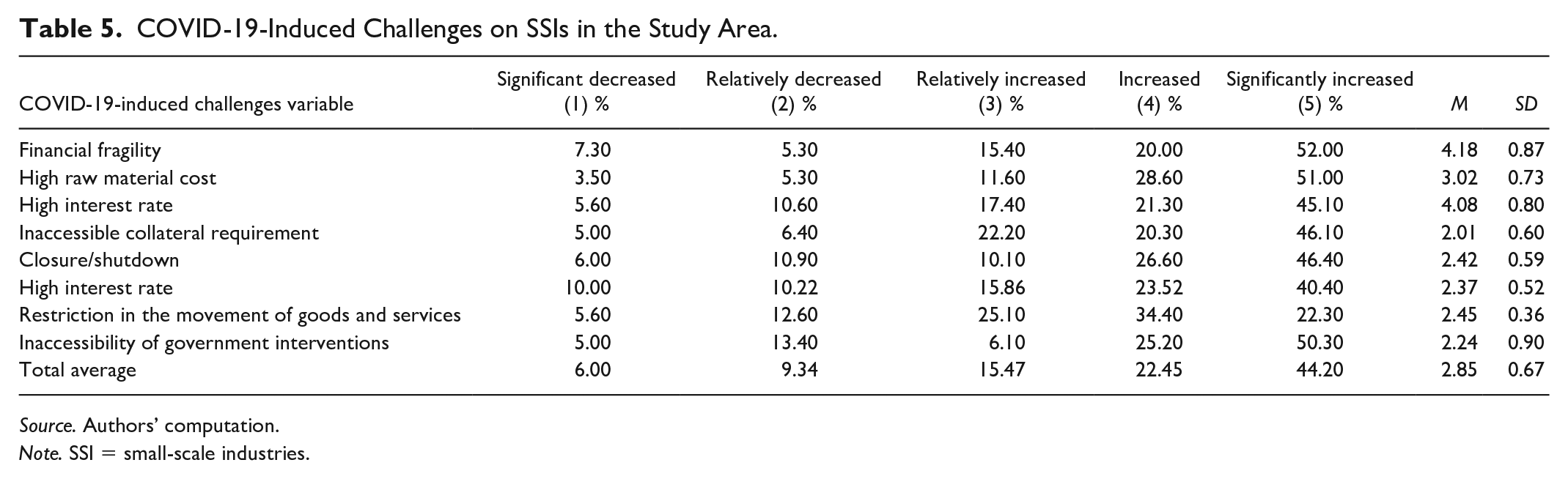
A number of COVID-19 induced challenges were found to be hindering the activities of SSIs in the study area. Consequently, eight common variables were obtained from the questionnaire as COVID-19 induced challenges hindering the activities of SSIs. These challenges were analyzed based on the responses of the SSIs owners who ranked these challenges on a 5-point Likert-type scale ranging from 1 (significantly decreased) to 5 (significantly increased) in relation to what their industries have experience during this period. From the analysis, it was found that all the variables have significantly hindered the activities of the SSIs in the study.
The result revealed that 15.47%, 22.45%, and 44.20% of the respondents have experienced relatively increased, increased, and significantly increased impact, respectively, of COVID-19-induced challenges on their operations in the study area as shown in Table 5.
COVID-19-Induced Challenges on SSIs in the Study Area.
Source. Authors’ computation.
Note. SSI = small-scale industries.
The result also showed that 6% and 9.34% of the respondents have experienced COVID-19-induced challenges on their operations in the study. The result further showed a total average mean and standard deviation of 2.85 and 0.67 which also confirmed that the activities of SSIs have been hindered by COVID-19-induced challenges assessed in this study.
Impact of Strategic Interfirm Alliance on SSIs
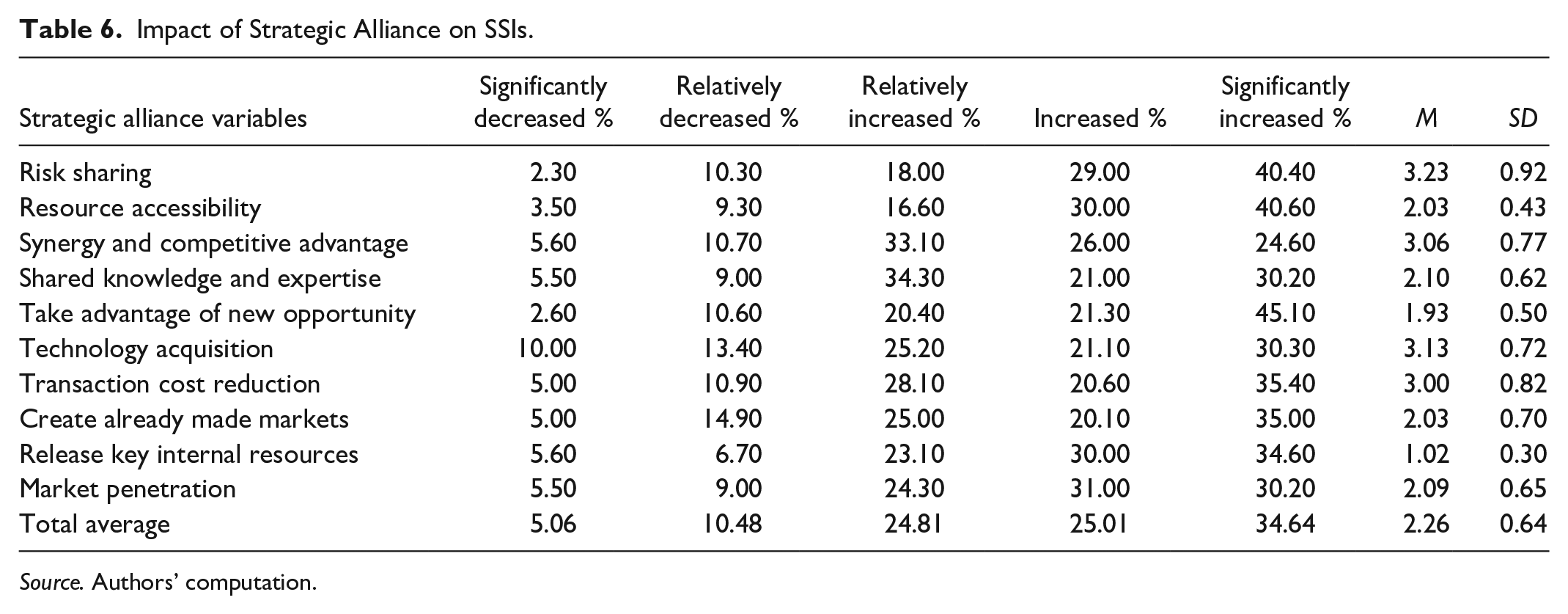
Strategic interfirm alliance has a number of impacts. Based on field observation and extant literature, 10 common variables were examined as the common impacts of strategic interfirm alliance on SSIs in the area. From the analysis, it was found that 24.81%, 25.01%, and 34.64% of the respondents have experienced relative increase, increase, and significant increase, respectively, in the use of strategic interfirm alliance, while 10.48% and 5.06% have experienced relative and significant decreases, respectively, as shown in Table 6.
Impact of Strategic Alliance on SSIs.
Source. Authors’ computation.
The result further showed a positive overall view on the impact of strategic interfirm alliance on SSIs in the study. With mean value greater than 1, the analysis showed that risk sharing, resource accessibility, technology acquisition, synergy and competitive advantage, as well as cost reduction were the common benefits of strategic interfirm alliance in this study. The result also showed that shared knowledge, the creation of already made markets, as well as market penetration were the benefits of strategic interfirm alliance in the study area. These impacts were associated with all the industrial sectors surveyed in this area as they were found to have benefited from strategic interfirm alliance in one form or the other.
For instance, the alliances that existed between SSIs engaged in the production of aluminum products (Roofing sheets) and fabricated metal enterprises created an already made market for the metal enterprises. This is such that the former makes use of the expertise, material and components, as well as services offered by the later, thereby serving as an outlet or markets for their items. In the area of market penetration, it was found that food processing SSIs such as sachet and bottled water enterprises as well as bakeries use brand, reputation, and image licensing agreement with established enterprises to penetrate new markets. This also helped the SSIs not to suffer undue competition in the market. This corroborates the work of Gatoto (2013) who found that the impacts of strategic interfirm alliance are derived from the motives of its formation. These motives are underlined by the quest for competitiveness and firm’s survival in a complex and turbulent business environment. The result also supports the theoretical framework of this article. The result showed that strategic interfirm alliance is structured to build synergetic advantage, reduce cost of business, and reinforce competitive advantage of small operations.
Recommendation
This study has shown that COVID-19 pandemic poses a lot of challenges to industrial activities in Nigeria and the world at large. SSIs, however, can overcome these challenges by adopting the following recommendations.
Adopting/Institutionalizing Strategic Alliance as an Industrial Strategy
Adopting or institutionalizing strategic alliance as an industrial strategy by SSIs in Nigeria will help SSIs cope with the challenges of COVID-19 pandemic. This will not only help them reduce their cost of production, it will also give them access to scare resources which will enable SSIs to remain competitive. Consequently, institutionalizing strategic alliance as a policy to guide SSIs activities in Nigeria would encourage and promote cooperation and interfirm linkages among these industries in this period when importation and exportation of raw materials, parts and components, skills, and finished product by industries are greatly discouraged so as to contain the spread of COVID-19 disease. This strategy will also help SSIs to create a niche market for themselves, grow along with large enterprises due to their increasingly important production linkages, as well as promote local content participation and utilization.
Creation of Strategic Alliance Awareness Among SSIs Owners
Strategic alliance awareness can further improve the use of the strategy by SSIs. The management of the SSIs should be educated on the advantages and benefits of strategic alliance as well as the areas of activities they could establish such arrangement in. This can be achieved through various mechanisms such as seminars, workshops and business fairs among others. While seminars and workshops can be organized by Corporate Affairs Commission (CAC) as well as SME Centers, business fairs can be organized by the State’s ministries of commerce. This is very important for SSIs who from the study experienced relative and significant decrease in their operation during this pandemic.
Future Research
This article was limited to the study of SSIs and how they can cope/brave COVID-19-induced challenges with the adoption of strategic alliance. It was also limited to the study of SSIs that produce goods and services for local consumption. In other words, the effect/impact of COVID-19 induced challenges on large-scale industries as well as exporting industries and the role of strategic alliance in addressing these challenges is largely unknown. Consequently, future research should be targeted at examining this lacuna. This is to add to the existing literature the variations in this area of research across the various scales of industries and to explain and understand the impact of strategic alliance on industries in an event of a pandemic outbreak.
Conclusion
This study has shown that strategic alliance can address the COVID-19-induced challenges on SSIs. Given the usual administrative complexities, bureaucratic hassles, and difficulties establishing eligibility of SSIs in trying to access government economic incentives/packages/palliatives such as grants and interest free loans, SSIs are encouraged to adopt strategic alliance in their operations in order to survive the COVID-19-induced challenges. Again, this study has also shown the importance of strategic alliance to the SSIs. Given the state of most industrial policies in Nigeria, the outcome of this study will help existing and potential SSIs to engage in a systematic interfirm relationship in carrying out their operations for more effectiveness.
Footnotes
Declaration of Conflicting Interests
The author(s) declared no potential conflicts of interest with respect to the research, authorship, and/or publication of this article.
Funding
The author(s) received no financial support for the research, authorship, and/or publication of this article.
