




Abstract
The panic surrounding the COVID-19 pandemic has collapsed world economic systems. Thailand is no exception. Evidently, domestic-industrial activities in many countries have nearly stopped, and international sectors have abruptly disintegrated. Unemployment has become critical, and business viability has run into trouble. This article illustrates the potential solutions to these issues linked to Thailand’s domestic and international-trade economies by econometrically applying sectoral forecasting analyses and simulations because the pandemic has not only caused physical damage, but also a negative chain in worldwide economic systems. Methodologically, dynamic input-output (I-O) analysis is circumspectly employed to obtain foresight on some predominantly industrial sectors that could potentially rescue the Thai domestic economy from the depression of 2020–2022. The I-O tables are sourced from official data of the Asian Development Bank (ADB). For the international-trade scenario, the agent-based model and simulations are used to forecast the future trends of macroeconomic responses. The two methods, dynamic I-O models and agent-based simulations, are the current means capable of sensibly predicting macroeconomic responses for monitoring the upcoming years. The empirical outcomes can clearly predict upcoming events that will be beneficial for policy implementations.
Introduction
The COVID-19 pandemic has been unstoppable. This fact is the inspiration for this article to begin a practical academic investigation from a macroeconomic perspective regarding the “new-normal” world. In economics, recessions are signs that economists can use to beneficially gain critical knowledge. Although the way to completely prevent negative impacts from economic depressions is elusive, it is still worth studying, not only for the current generation, but also for how humankind can survive in the chaotic world of the future. In dynamically estimating the macroeconomic system of the Thai economy using input-output (I-O) analysis, this article helps predict a simulated agent model for displaying structural responses in an international macro economy. Results and critical discussions are expected to be useful suggestions inspiring academic researchers and political authorities to urgently find an equitable solution.
“COVID Economics” is a new area of study, inspired by the medical sciences. In terms of medical situations, the current pandemic directly damages the capacity of examination tables and emergency rooms in hospitals. Moreover, vaccines have arrived but much knowledge about them and their effectiveness long term are currently only in experimental stages. The result is enormous budgets, which inevitably links with political criticism from the public. How many subsidies should be provided for those affected? How long should the aid last? Can medical employees efficiently address the spread? What is the best solution for unemployment, confusion in educational systems, or motionless local commercial activities? These queries are top issues that people need answered. To recover the economic system, forecasting scenarios for monitoring real sectors for the future is essential. The assurance that the dynamic I-O model’s estimation guides the path toward boosting critical sectors in the Thai economy needs two important tools: an agent model and simulation. Basically, this model supports researchers and practitioners in investigating how the macroscopic behavior of a system is dependent on the micro-level properties, constraints, and rules. Agents as objects are typified by specific states and sets of functional attributes, properties, or rules; in short, “behavior” that may trigger special actions through the predefined parameters (Abar et al., 2017). With an ability to better monitor people’s minds and predictively display economic movements, the agent-based simulation model can be applied for guaranteeing the choices of predominant real sectors from the I-O model, which are surely beneficial for the Thai economy in long-run development.
Descriptive Data Analysis for Thailand Macroeconomics
The concept of general equilibrium is employed to cover the whole of the article. Theoretically, macroeconomics involves all sectors activated in economic addresses. Can demands and supplies be substantially met? How many sectors are predominant for positive economic growth? What is the solution if benchmarks for driving an economic system become obstacles? Because the study of macroeconomic policies covers an enormous amount of tax-paying people, the billions of Baht in expenditure will be spread across various types of local sectors. The field of dynamic I-O models, which improves upon the basic static approach from the work of the Nobel Prize–winner in economics, Wassily Leontief (1906–1999), can be the main tool for statistical computations (Leontief, 1986). An input-output analysis of Thailand’s construction sectors officially began in 1995 (Yamazawa, 1998). Since then, unstable growth could often be seen along the trend of Thai GDP between 1991 and 2020.
In particular, two crises in 1998 and 2009, graphically displayed in Figure 1, caused major sectors, such as financial institutions, public debt, and infrastructure projects in Thailand, to suddenly crash (Brunschwig et al., 2011). It was inevitable that real sectors also absorbed damages in a domino effect. Moreover, the pandemic of 2020 stunned the Thai economy into a near downfall (graphically detailed in Figure 1). Many Southeast Asian countries were predicted to experience additional recessions in economic growth (displayed in Figure 2). To recover and survive the uncertainty, a possible solution is to return to thinking from the bottom to the top. Therefore, clarifying and demonstrating real sectors are urgently required. Thus, this implies that the dynamic I-O model is the correct choice for expressing an uncertain situation and providing the requisite point of view for policy implementations.
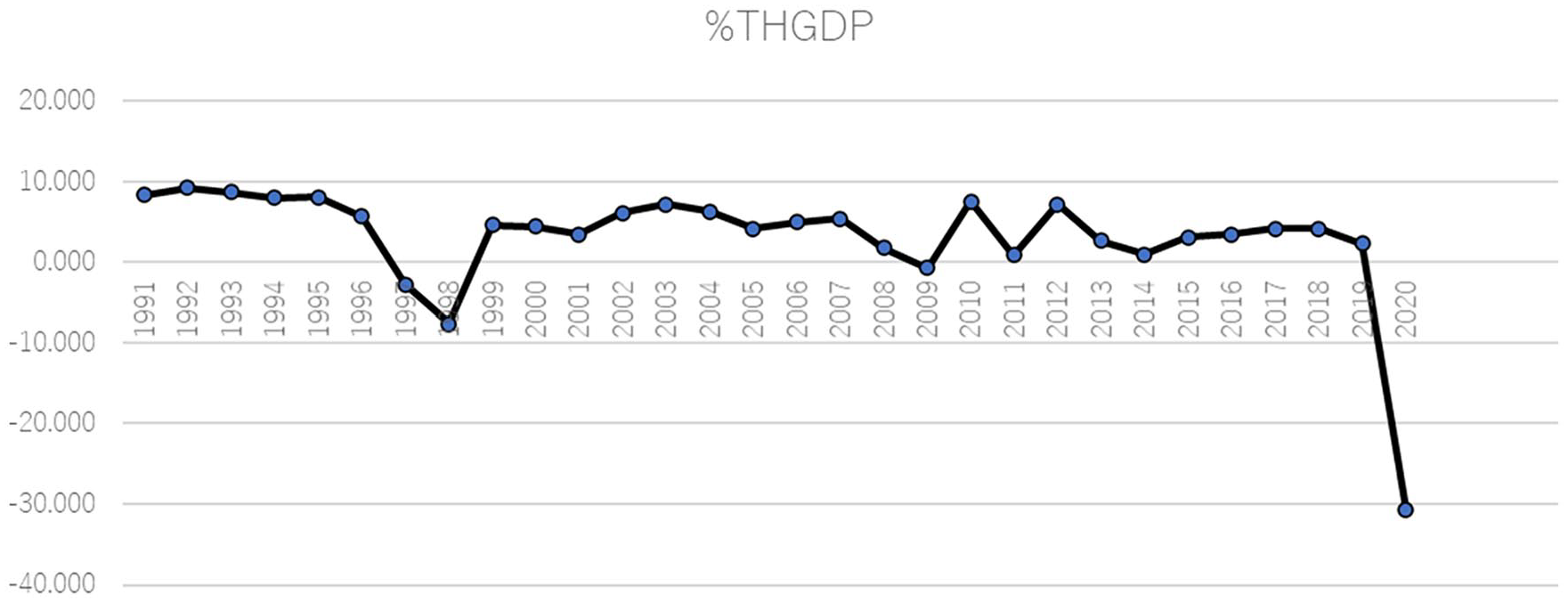
Historical GDP growth of Thailand between 1991 and 2020.

Predicted GDP growth of ASEAN countries in 2020.
Considering each economic sector that exhibits unpredictable disturbances, Table 1 shows unfavorable numbers for economic growth in Thailand. A financial analyst completely agrees that a downfall certainly occurred in 2020. Similarly, the viewpoints of industrial indexes reported by the Office of Industrial Economics show the negative sign for productivity and labor forces. The details are presented in Table 2. On the other side of business sectors pictured in Figure 3, Thailand’s business sentiment index (BSI) also predicted an anxious decrease, and the trend is to continuously decline to a negative rate below 50, which implies business performance is critically problematic. From the report of the tourism sector graphically displayed in Figure 4, the Bank of Thailand officially announced that the predicted trend of tourist arrivals in the country will be scaled down to less than half due to the pandemic impact. It is reasonable to assume that this is a real tourism crisis in Thailand, and it is potentially chronic. Hence, this complexity strongly confirms that the dynamic I-O analysis is necessary for investigating a sectorial solution to recover this economic distress in time.
The Analysts Predict Deep Contraction for Thailand’s Economy in 2020.

Source. Banks, International Monetary Fund, Bloomberg Economics.
Note. IMF = International Monetary Fund; YoY = Year over Year.
% of Manufacturing Sectors’ Productivity and Labor Indexes in Thailand from 2019 to 2020.

Source. The Office of Industrial Economics, Thailand.

One way down and deeper—BSI Business Index in Thailand.

Forecasting tourist arrivals to Thailand caused by COVID-19 case until 2020.
Literature Review
A Concept of Domestic and International Economic Analyses
After recovering from the Asian financial crisis in 1997, a return to international capital and finance markets—an implementation of a social safety net—was vital for Thailand. Targeting inflation turned out to be a difficult task to manage (Jensen, 2001). Thailand seemed to be floating in the stream of capitalism. Simultaneously, the political economy, which shaped foreign economic policy through its domestic structures, was on the rise. The idea of a “state-permeated capitalism,” mentioned in Nölke et al. (2014), is an economic system that rests on a close cooperation between various states and domestic business coalitions at the national and subnational level. This close collaboration leads to the notion of a rather fragmented, yet dynamic, “state-permeated market economy.” Table 3 displays these domestic and international economic activities, which is relevant to the methodological process.
The Main Varieties of Capitalism Applied for Thailand’s Economy.

Source. Modified from Nölke et al. (2014).
The dynamic I-O model for domestic economic activities
After the early invention of the I-O model by Leontief (1936, 1941), I-O analysis has been widely used as an analytical tool for monitoring real sectors in an economic system. However, the static model, which is the main assumption for the original I-O model, seems to be restricted for short-run forecasting, economic planning, and the analysis of economic development (Sharp & Perkins, 1973). Theoretically, the static and dynamic I-O models assume the equality of supply and demand at all time instants, but the dynamic model is, in addition, a description of the capital structure of the economy and reflects the evolution of an economy over time into computational processes. Therefore, the dynamic model is an interesting approach and has advantages over its counterpart (Johnson, 1985). Historically, the dynamic I-O model has been widely applied to numerous branches of empirical research. For environmental management, Dobos and Floriska (2009) applied a generalized dynamic input-output model to define the emission of pollutants for government pollution controls. Dobos and Tallos (2011) used the dynamic I-O analysis to investigate the exhaustion of renewable resources in dependence on the balanced growth rate and on the rate of natural regeneration. For sustainability development, Uehara et al. (2018) developed a fully dynamic ecological-economic model by integrating I-O with system dynamics (SD) for better capturing critical factors of ecological-economic systems in the Haute-Normandie region of France.
In economics, Šafr (2016) employed the field of dynamic I-O models for a stock of gross fixed capital in the economy of the Czech Republic. In addition, Huang (2018) investigated the problem of exhaustible resources using a dynamic I-O model with classical features. Around the same time, Baranov et al. (2018) used the dynamic I-O model to analyze and make a forecast for the Russian economy. In 2019, Gurgul and Lach (2019) employed the dynamic I-O model to predictively see the future behavior of the Hungarian economy.
For the current situation of the COVID-19 pandemic, input-output tables are considered to be a visualization of policy activations. Osotimehin and Popov (2020) contributed a research paper using the I-O analysis for essential sectors facing higher health risk in the United States. Meanwhile, Cakmaklı et al. (2020) quantify the macroeconomic impacts of COVID-19 for a small open economy in Turkey by using the I-O tables. The main target is the optimal policy, which addresses the lowest economic cost and rescues the maximum number of lives underneath a full lock-down of 39 days. In addition, Yu et al. (2020) apply the dynamic I-O model to clarify levels of contraction in economic systems in the Philippines under a lock-down policy. Interestingly, although the original I-O models have been used considerably, the study of Thai economy still lacks the benefit of a dynamic I-O analysis.
The agent-based simulation for international economic predictions
Complexity is ubiquitous in economic problems. Explicitly mentioning how heterogeneous elements dynamically develop each of their behaviors through interaction is a difficult task. The equilibrium is suspicious in a practical sense (Gallegati & Richiardi, 2009; Saari, 1995). To examine impacts of COVID-19 on the Thai economic system, the agent-based model for computational economics is the exploration of economic processes modeled as dynamic systems of interacting agents. In other words, impulse responses of international trades can be included in the agent-based prediction. The model relies upon three crucial ideas. First, a multitude of objects interact with each other and with the environment. Second, the objects are autonomous, containing no center or top and bottom. Third, the results of their interaction are numerically computed. For practical research in macroeconomics, Vermeulen and Pyka (2015) used agent-based models for multiple research objectives: (a) to theorize about causes for empirical realities and (b) to evaluate effects of policy interventions. In addition, Dawid and Gatti (2018) reviewed assumptions of a set of important agent-based macroeconomic models toward identifying a common core through research in different domains of economic policy. Moreover, Schinckus (2019) implemented an agent-based framework to describe economic systems. However, even though the agent-based model has been implemented elsewhere, there is a lack of computational research for reviewing the Thai economy and predominant real sectors.
Data Review
Data of the I-O Table
The scope of observed data is the input-output table (IOT) of the Thai economy, which is officially validated between 2010 and 2017. The idea behind this table consists of the transaction flows across industrial sectors that both produce goods and services (outputs) and consume goods and services (inputs) simultaneously, and this process provides the value-added by industry and final demand. IOT also details a picture of an economic system through the mutual interrelationships among the producers and consumers. This tool is econometrically famous for national accounting, economic planning, and policy analyses. The details by sector in the I-O table are presented in Table 4. Following Uehara et al. (2018), there are several reasons for employing this 2010–2017 I-O table. First, the most updated I-O table for Thailand industrial sectors was officially released in 2017. Each official table is published only every 5 years, and this means that the next updated I-O information would only be published in 2022. Second, the calculation of technical coefficients and random simulations modeled with Microsoft Excel in the novel dynamic I-O analysis can help avoid inconsistencies (e.g., negative values of coefficients) and missing observations that possibly occur with commodity-by-industry I-O tables. Finally, the I-O table used in this analysis is an official data set from the Asian Development Bank.
The Presentation of I-O Data for the Thai Economy.
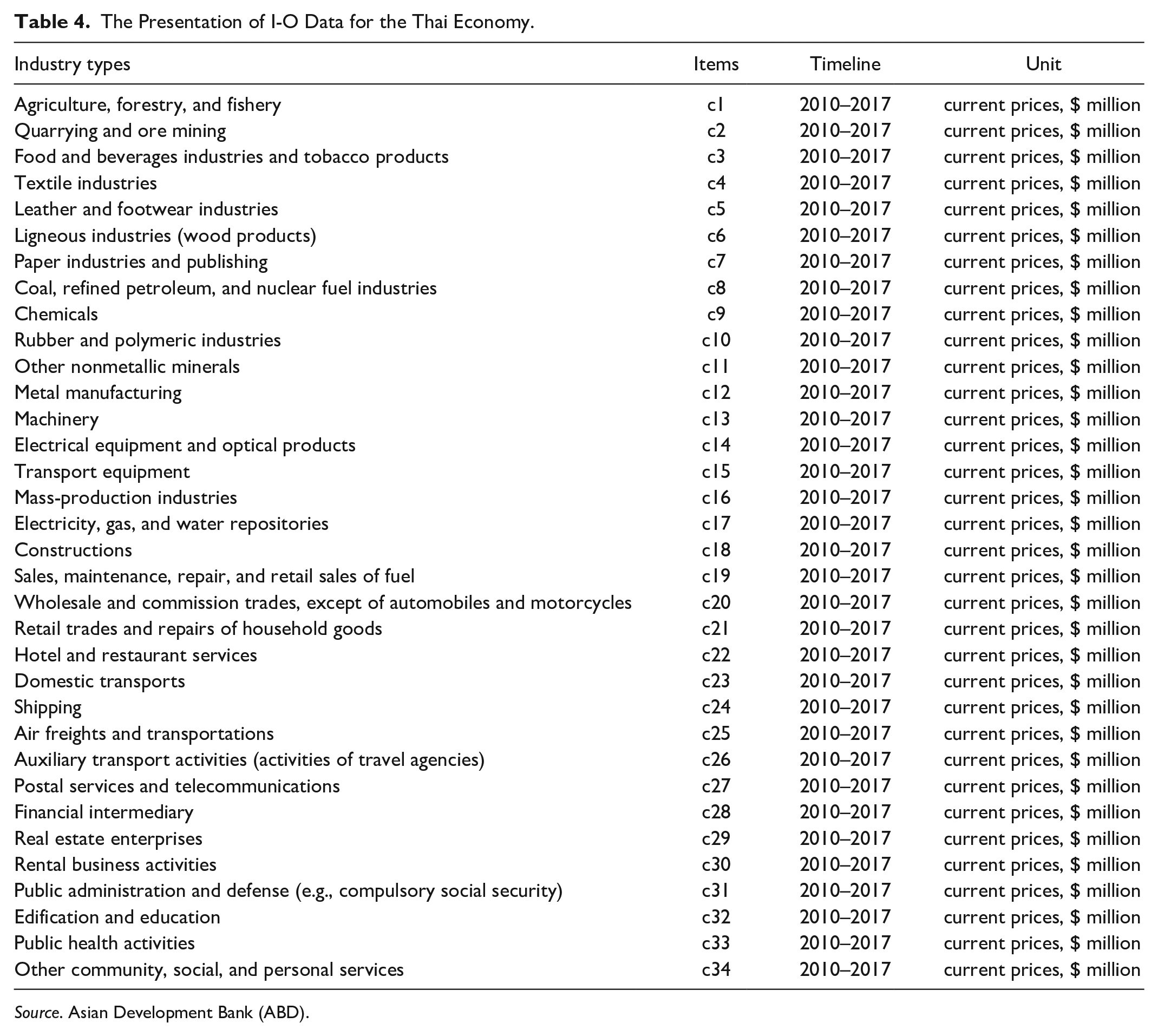
Source. Asian Development Bank (ABD).
Simulation Data for the Agent-Based Model
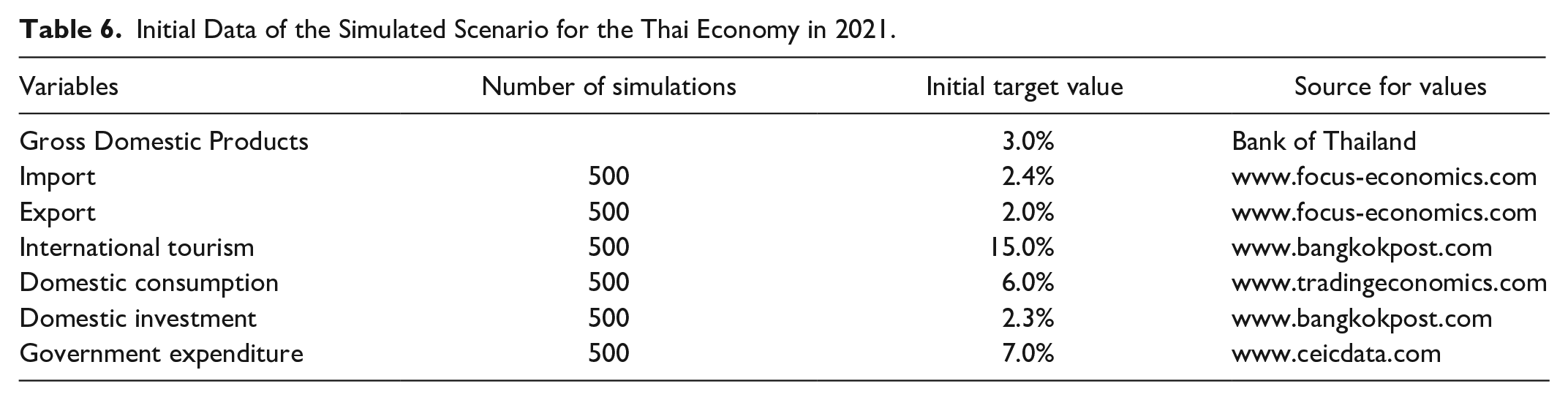
For the open-economy system, a flexible exchange-rate system of the Thailand economy is generated by simulation data. Three scenarios are defined as the predicted situations for the economy from 2020 to 2022. Tables 5 to 7 detail the information simulated for the three different cases.
Initial Data of the Simulated Scenario for the Thai Economy in 2020.

Initial Data of the Simulated Scenario for the Thai Economy in 2021.
Initial Data of the Simulated Scenario for the Thai Economy in 2022.

Method
The Dynamic I-O Model
Because the static input-output model contains an obvious disadvantage in that input coefficients are technically assumed to be fixed, and this method is suitable to estimate only short-run time series, dynamic I-O analysis was developed to overcome the problem, as its improvement allowed scenarios with ratios of input factors fluctuated by time changes. To explain, aij refers to the value of an industrial input i, which is employed as the factor for producing an industrial output j. For the static model, the value of an input i is supposed to be fully used at once, but this does not always happen in reality. For the dynamic model, let the value of an industrial product i, which is kept as the capital input for an industrial product j, equal vij. The value of the total output for j is xij. This can be expressed as

The bij is the capital coefficient, which implies the ratio of measurable capital coefficients used to produce a product. This coefficient is essential for the dynamic I-O model. In the rare case of constant engineering technology, an average capital coefficient is equivalent to an increment capital coefficient. However, technology changes continuously. It is common to state that the average capital coefficient is not parallel to the increment capital coefficient. Hence, the dynamic I-O analysis can be mathematically modeled as

For Equation 4, this implies the total output for an industrial sector i. Following, xi is used to produce in other industries (j = 1,. . .,n), which is valued as

By time changing, a new output i is employed to be the capital input for other industrial lines of an output j. In other words, the increment value of the capital input from the industry i used in response to the increasing production of the industry j is explained by

and this is the final output, which equals



In the case regarding the number of industries as continuously increasing (i = 1,. . .,n), this can be written as the matrix system (linear difference equation) as follows:

Where I: the identity matrix (n×n)
A: the input coefficient matrix (n×n)
B: the capital coefficient matrix (n×n)
Xt: the output matrix at time t (n×n), t = 0,1,. . .,T
Xt+1: the output matrix at time t+1 (n×n), t = 0,1,. . .,T
Yt: the final demand matrix at time t (n×n), t = 0,1,. . .,T.
The Application of Agent-Based Model and Simulations
To summarize, Agent Based Modeling (ABM) is sensibly the culmination of the methods integrating negative details and environmental data, along with behavioral and demographic information regarding offenders and victims to create a platform that can be used for both predictive estimations and theoretical explorations. With the shift in computing performances and languages in this era, the ABM is fulfilled to attempt to capture the behavior of individuals within various environments, especially response scenarios of currency correlations affecting economic visualization. To conceptually clarify the differences between differential equation models and ABM, one mathematical possibility is the theory of mappings. It is, for example, the dynamic system with discrete time t = 1,2,3,. . .,T. The visualized state

The state transitions for all of the agents’ internal states jointly yield the dynamic system’s transition function,

Briefly, the transition function is a combination of all of the agents’ rules
The application codes are shown in the Online Supplemental Appendix. Next, the second step is that algorithm 2 demonstrates the setting of the Thai macroeconomic system. Crucial components such as exports, imports, services, and current balances are dynamically generated in terms of yearly time-series agents. Practical code details are shown in the Online Supplemental Appendix.
Third, when the trade-economic model is set, algorithm 3, presented in the Online Supplemental Appendix, expresses the linear estimation and prediction, which cross-checks the averages of GDP growth rates against the official predicted rates. Ultimately, when the cross-check calculation is confirmed, the fourth step, algorithm 4, shown in the Online Supplemental Appendix, is generated to monitor the impulse response of GDP and inflation rates along a predictive year. This algorithm set is the forecasting example of the 12-months agent model for 2020.
Empirical Results
The Domestic Economy Overview
Dynamic I-O forecasting outcomes for Thailand’s domestic economy from 2020 to 2022
The I-O analysis provides interesting outcomes that strongly support a downsizing period for Thailand’s economy. For 2020, Table 8 represents the most unfavorable result where all industrial sectors are reported as down. Particularly, four predominant sectors such as food industries, metallic productions, transport equipment activities, and hotel-restaurant services are predicted to have had their worst outputs. In other words, a $292.87 million reduction in the agricultural, forestry, and fishery sectors is held at the 1.5% depression in GDP. However, its estimated output is shown to be reduced by about 1.5 times, which is $466.92 million. For metal industries, which are the main production in the Thai economy containing 17.20% as a multiplier effect, more than a 500% depression in the total output is indicated as a $1,491.24 million reduction. Similarly, the transport equipment sector is presented to massively lose product value, equaling $1,969.24 million. Hotel and restaurant services also show a massive reduction, as $12,461.14 million are indicated as the loss in productivity. Ultimately, the summary of total outputs of all sectors shows a decrease of $26,384.16 million. Optimistically, the Thai economy is considered to be in a bruised revival stage for 3% growth in 2021. Table 9 shows some interesting information. Metal industries are the predominant positive response. The total estimated output expands more than 500%. A total of $894.74 million in production growth is reported. In addition, food and beverage production and transport equipment indicate an impressively productive growth. Both total outputs at $2,027.20 and $1,181.54 million increments, respectively, are approximately 500% in higher growth than the standard predicted output. Hotels and restaurants also show a promising increase: $7,476.68 million is three times higher than the 3% GDP predictive output. Over the whole year, the summary total outputs equal $15,830.50 million in production growth. The Thai domestic industrial productions are forecasted in a recovery growth of 4% for 2022. At this stage, all industrial sectors will have seemingly returned to nearly a normal productive function. Metal industries are still the predominant positive response, and this sector is predicted to continue its massive growth, equaling $1,192.99 million or more than 500% improvement from the earlier 3% GDP standard output ($69.36 million). Moreover, the transport equipment sector’s total outputs are presented as a quintuple expansion over the standard output prediction, which is reported as $1,181.54 million. In addition, food industries and hotel-restaurant services are predicted to have total outputs that are more than a triple improvement over the standard prediction, which are $2,027.20 and $7,476.68 million, respectively.
The Domestic Total Outputs of Thailand’s Economic System for 2020 Unit: $ million.
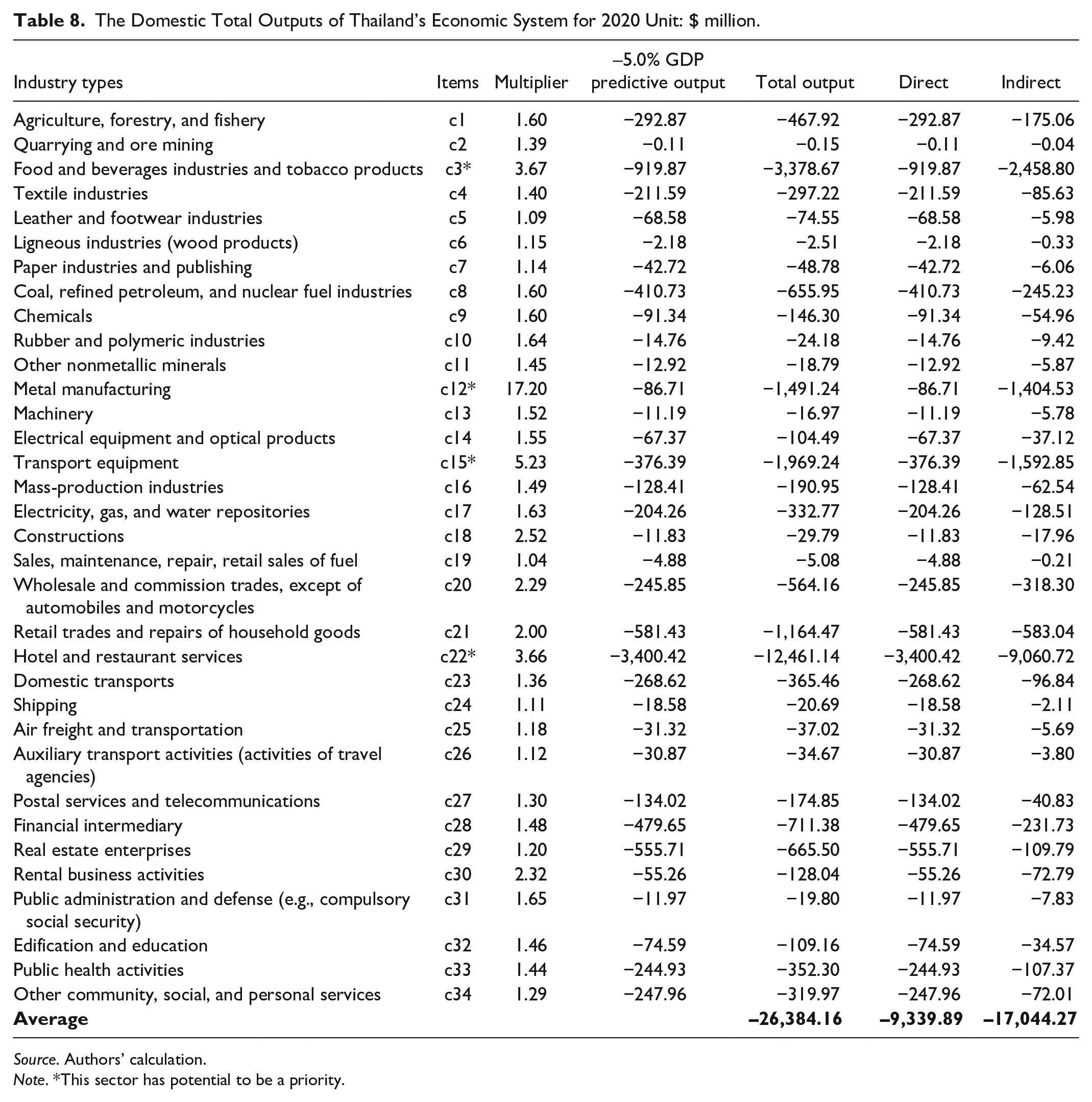
Source. Authors’ calculation.
Note. *This sector has potential to be a priority.
The Domestic Total Outputs of Thailand’s Economic System for 2021 Unit: $ million.

Source. Authors’ calculation.
Note. *This sector has potential to be a priority.
The Domestic Total Outputs of Thailand’s Economic System for 2022 Unit: $ million.

Source. Authors’ calculation.
Note. *This sector has potential to be a priority.
Forward linkage index (FLI) and backward linkage index (BLI) to drive the Thai economy in both demand and supply sides
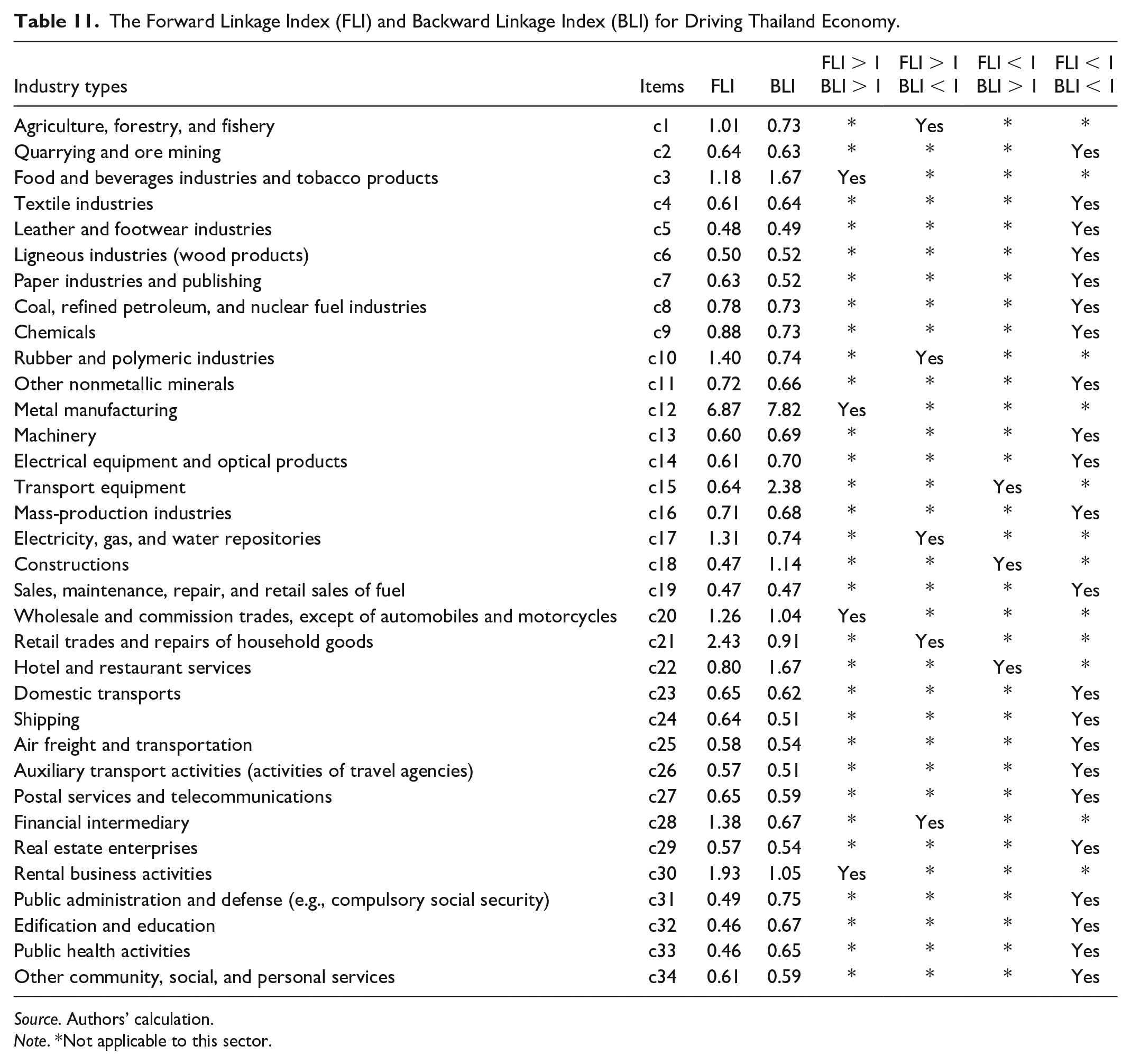
For an urgent recovery of the economy from the effects of the pandemic, the consideration of upstream and downstream linkages is extremely important. Table 11 provides a critical look at the food companies, metal industries, wholesale and commission trades, and rental business activities that are the economic drivers potentially boosting both domestic manufacturing capacity and the commodity market in Thailand. These four industrial sectors are forecasted as a rapid cure for the country’s domestic economic system. Considering sectors that especially drive the commodity-to-commodity linkages, as seen in Table 11, products from agricultural and fishery activities, rubber and plastic industries, mining sectors, retail trades, and financial intermediaries are able to pump up confidence in the viability of the economy. Consequently, this group of industrial sectors can be seen as the domestic-retailing solution. In contrast, transport equipment, construction activities, and hotel and restaurant service can become domestic-suppliers’ answer at improving labor-intensive employment.
The Forward Linkage Index (FLI) and Backward Linkage Index (BLI) for Driving Thailand Economy.
Source. Authors’ calculation.
Note. *Not applicable to this sector.
The International Economy Overview
Results from the dynamic input-output analysis show that the Thai domestic economy needs to be driven by fundamental manufacturing products such as food, beverages, and metals, small- and medium-sized businesses, including wholesale and rental commissions, to recover from pandemic damage. However, these activities will not flourish if a path to internationally export domestic products to other countries is not officially sanctioned. In this section, the agent-based model with simulations provides some critical measures that can act as a guideline for understanding the open-economic system for Thailand over the next 2 years (2020–2022).
The agent scenario with the condition of economic depression in 2020
In the case that Thailand’s GDP was predicted to have a 5% drop because of the pandemic (referring to the official prediction by the Bank of Thailand shown in Table 5), Figure 5 displays the ABM clarification of major international-trade indicators such as imports, exports, and services that will stay in depression during 2020. Consequently, the current account is negatively affected and its trend will reduce the downsizing period during the entire year.

The agent-based simulation for Thailand after pandemics shocks in 2020.
Since the decline of the international sectors, the Thai economy in 2020 was forecasted to be in total depression. Figure 6 shows that Thai GDP continuously declined from −2% to −8%. Moreover, the effect from the pandemic inevitably caused the nation’s purchase power to deeply fall into deflation.

The agent-based prediction for Thailand economy in 2020.
The agent scenario with the condition of economic amelioration in 2021
In the case that Thailand’s GDP was predicted to have a 3% drop because of the pandemic (referring to the official prediction by the Bank of Thailand shown in Table 6), the situation of the open-economy system in Thailand is anticipated to be a step-by-step comeback. The positive sign represented in Figure 7 reports services will recover and imports will be stimulated. However, exports, which are the indicator driving the international economy, are erratic. Because of this confusion, the current account is in fluctuation throughout the year.
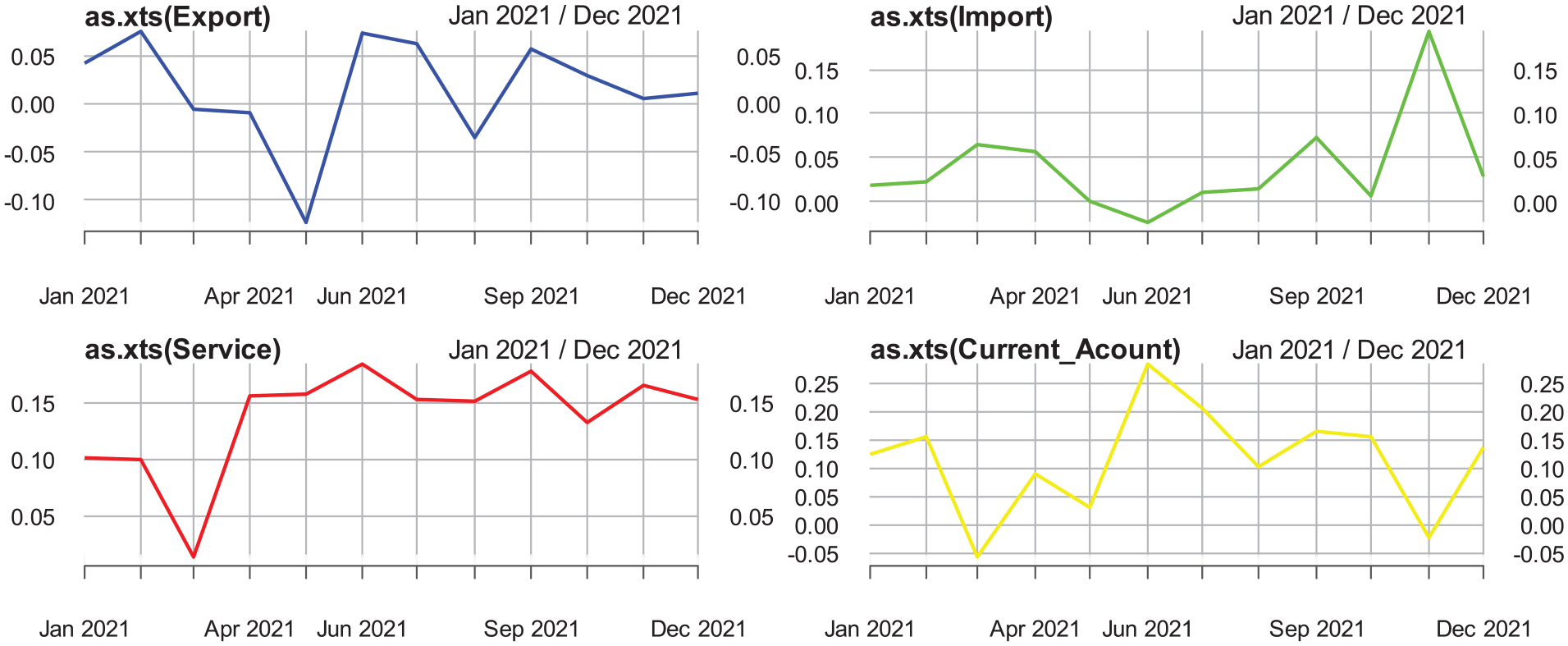
The agent-based simulation for Thailand economic amelioration in 2021.
Optimistically, the recovery of imports and services is the predominant factor that will drive GDP to increase. Figure 8 graphically shows the growth rate continuously improving, approximately from 1% to 6%, and the trend is anticipated to be in strong growth during 2021. This will directly benefit the purchase of domestic commodities through the increment of inflation rates.
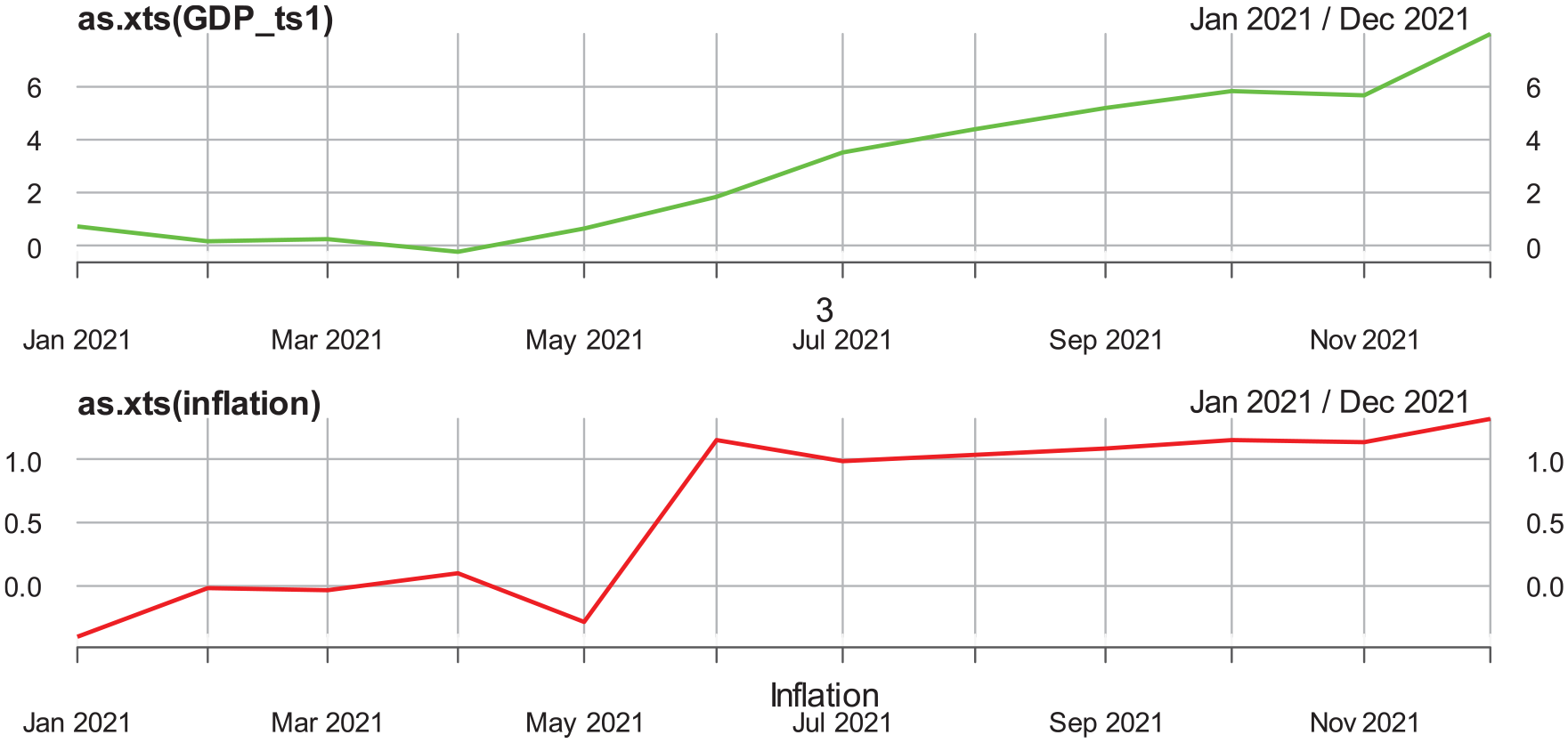
The agent-based prediction for Thailand economy in 2021.
The agent scenario with the stage of economic recovery in 2022
With 4% growth predicted for Thailand’s GDP in 2022 (referring to the official prediction by the Bank of Thailand shown in Table 7), Figure 9 presents the services sector as the predominant response, which indicates a growth of 200%, obviously higher than the previous year. Conversely, imports and exports are not expected to significantly recover yet but maintain the same efficient level. However, the ultimate outcome shows that the current account is stimulated, and that the trend indicates positive growth.

The agent-based simulation for Thailand economic revival in 2022.
The Thai economic overview in 2022 appears that it will be positive. GDP is reported to have a continuous growth from 2% at the beginning to 10% by the end of the year. In addition, the purchasing power is forecasted to increase. Overall, Figure 10 and Table 10 confirm that the Thai economy in 2022 can be defined as in the “stage of recovery.”

The agent-based prediction for Thailand economy in 2022.
Policy Discussion
The impact of the COVID-19 pandemic has clearly been destructive to the Thai economy. Both domestic and international economies are shown to be potentially addressed by a solution that quickly recovers and sustainably maintains economic viability. This article aims to specifically provide critical econometric results and suggestions for the difficult tasks of reviving the Thai economy from the pandemic’s impact. From the investigation of domestic industrial sectors, the dynamic I-O analysis reveals predominantly serious areas that need careful attention. Optimistically, Thailand is one of the countries that can efficiently control the spread of the COVID-19 virus. The empirical I-O result strongly confirms that foods, beverages, metal manufacturing, and tourism services are the key to breathe new life into the economy. Moreover, efficient budgeting should be allocated for tools and infrastructures of logistics and supply chains (transport equipment), which are far more crucial than national security (military expenditures). Furthermore, because the call for “social distancing” has been strictly launched, online deliveries and logistics companies can reap benefits. In addition, small- to medium-sized enterprises (SMEs) should not be neglected. Compared with the policy suggestion by the 2020 report from the United Nations in Thailand, a focus on “micro, small and medium-size firms and domestic-downstream firms” is an urgent strategy of the employment retention scheme (UNIDO Regional Office Hub in Thailand, 2020). The I-O model empirically indicates that wholesale and a commission, alternatively called “locally multiple money,” are ways to energize people’s purchasing power, which is better for a sustainable economic recovery rather than focusing on the nation’s borders. Expressly maintaining affordable prices for essential goods and subsidizing a long-term budget for local people’s purchasing power are extremely necessary. In particular, tourism, which has taken the brunt of the greatest damage, needs an urgent subsidization (Tran et al., 2020). Ultimately, it is time for the country to launch a fiscal budget without any corruption and to fairly and intelligently provide for local areas and people. This idea is related to the macroeconomic study of Chaivichayachat (2020). Most of the sectors in the Thailand economic system are middle- and downstream. To promote economic growth, the policy to enhance the linkage among domestic sectors should be effectively emphasized.
For an overview of the international-trade scenario, the ABM provides some critical outcomes to support the issue regarding all industries needing exports and imports. International trade is referred to as the gate of product flow, alternatively defined as an economic vessel, but now it has been continuously declining. In terms of this difficult situation, there is no simple way to immediately cure Thailand’s economic viability in 2021. However, the ability to forecast with the agent-based model can give a crucial option for the future. With simulations and the concept of subjective thinking, the inspiration to experimentally create various scenarios is supported by the study on climate shocks and migration schemes contributed by Entwisle et al. (2016). To extend the ability of the ABM, time integrations are included in the ABM’s scenarios for dynamic forecasts. Hence, the Thai economy is predicted to recover and be revived within the next 2 years. In 2021, service industries will be the backbone for improving the balance of the national current account and increasing employment rates. This sector will drive the pulse of purchasing power in the economy from 2021 to 2022. Furthermore, emerging financial and tax measures should be carefully implemented for saving SMEs. Three alternative recommendations include the reduction in withholding tax rates and deductions of interest and wage expenses. Especially, small-to-medium tourism industries require effective support. The exemption of annual fees for industrial tourism sectors is a strong option. Global provider of food, the hub of safety logistics, and hygienic and clean hospitality are goals that the Thai government should aim for.
Conclusion
This article was an attempt to search for an urgent solution to save the Thai economy from the impact of COVID-19. Although the lock-down policy was simply used and quickly implemented, it still had disadvantages and criticisms. In terms of domestic and international economics sectors, outcomes trended on the negative side. This article was inspired to econometrically analyze these two sectors and work on predicting sensible scenarios to find a satisfactory solution. In terms of the data used for modeling estimations and predictions, the dynamics of the Thailand domestic industrial sectors were structurally investigated by using the official 2010–2017 I-O tables. For the predicted trend of the international sectors, data scenarios were generated in the agent model by referencing official updated announcements. There is no doubt that the Thai economy, indeed, depends on international factors. Particularly, the empirical results from the dynamic I-O analysis show that the growth of GDP runs parallel to the increase in service (tourism) industries. Also, the engines of the international sectors (exports, imports, and services) must be up and functioning as soon as possible. Ultimately, with the prediction by the ABM, a transparent budget allocation and monetary policies are the most vital keys for smoothly starting to sustainably support the various sectors to alleviate damages from the economic aftershocks.
Limitations of the Study and Guidelines for Future Research
The research has several weak points. I-O tables were last updated from 2010 to 2017. A lack of updated data can potentially affect the ability to capture outliers in current information. With the lack of updated I-O tables, which require an enormous amount of financial support, the huge challenge for macroeconomic researchers is to deal with the new standard of living underlying this post-pandemic period. Moreover, the traditional normal distribution can potentially be a weak point for econometric predictions. Dynamic I-O models and agent-based estimations and simulations are not exempt. A critical solution is a novel quantum distribution, which is another challenge for data analyses in economics. Merging pure physics and applied econometrics is uncertain and lacks academic references. Interestingly, quantum distributions are becoming the key to increasing understanding of behavioral economics. This implies that economists can better comprehend human decision-making, especially when extreme events occur. Consequently, quantum econometrics is the major consideration of future research.
Supplemental Material
sj-pdf-1-sgo-10.1177_21582440211021841 – Supplemental material for The Perspective of Thailand Economy After the Effect of Coronavirus-19 Pandemics: Explication by Dynamic I-O Models and Agent-Based Simulations
Supplemental material, sj-pdf-1-sgo-10.1177_21582440211021841 for The Perspective of Thailand Economy After the Effect of Coronavirus-19 Pandemics: Explication by Dynamic I-O Models and Agent-Based Simulations by Ruoyu Chen, Chukiat Chaiboonsri and Satawat Wannapan in SAGE Open
Footnotes
Declaration of Conflicting Interests
The author(s) declared no potential conflicts of interest with respect to the research, authorship, and/or publication of this article.
Funding
The author(s) disclosed receipt of the following financial support for the research and/or authorship: This work was sponsored in part by Provincial Natural Science Foundation of Anhui (2008085QG344).

Supplemental Material
Supplemental material for this article is available online.
References
Supplementary Material
Please find the following supplemental material available below.
For Open Access articles published under a Creative Commons License, all supplemental material carries the same license as the article it is associated with.
For non-Open Access articles published, all supplemental material carries a non-exclusive license, and permission requests for re-use of supplemental material or any part of supplemental material shall be sent directly to the copyright owner as specified in the copyright notice associated with the article.
