




Abstract
A unique phenomenon in Bangladeshi cultural heritage is the tendency to wear traditional costumes at the festivals. This research examines the influence of wearing traditional Bangladeshi costumes for the festival observance. Based on the theoretical background of Bangladeshi festival heritage, five factors were derived: togetherness, tolerance, simplicity, aestheticism, and cultural revival. This research empirically analyzed 310 participant’s data who attended UNESCO (United Nations Economic and Social Council)–recognized world intangible cultural heritage festival, “Pohela Boishakh” (first day of Bengali New Year) held in Bangladesh. Exploratory factor analysis showed that all five factors are statically significant for the impact of heritage festivals. Multiple regression analysis revealed four factors out of five statistically significant for festival importance, and all factors are significant for the tendency of wearing traditional costumes at the heritage festival.
Introduction
Society and culture—in an identical movement—constitute a practice that specifies its unity, made a distinctive modern-day contribution, and created its inscription. Social researches stand for one of the most developmental Indigenous or native traditions, around what space was its concerns and principles linked (Hall, 1980). It remains in this context that the theory of culture is specified as the research study of relationships between elements in a whole way of life. Cultural heritage is a precious asset preserved by history to civilization and is divided into the tangible cultural heritage and intangible cultural heritage in terms of existence. It is a cultural, artistic, and scientific artifact that refers to the diversity of the traditional cultures in intangible form, which closely interacts with people as well as inherited from generation to generation. The United Nations Economic and Social Council (UNESCO) believes that intangible cultural heritage is an important factor in determining cultural identity, stimulating creativity, and protecting cultural diversity as well as playing a vital role in the mutual tolerance and coordination of different cultures (Su & Wall, 2011). Bangladeshi culture has a significant spreading and radiating impact on the selection of material heritage, which is not only a kind of regional surface culture but also the backbone and foundation of traditional culture. Different cultural forms with different roots poured in, which on one hand promoted the prosperity of culture and on the other hand, left the Bangladeshi traditional culture indifferent. Especially after the reform and opening up, the rapid growth of economic construction has resulted in sudden changes in the social and cultural structure. Even the changes accelerated the tendency toward the micro-style of cultural layout and fusion, as well as Indigenous Bangladeshi culture and folk art heritage arose. The Western culture’s material and spiritual pursuit of the new generation directly conflicts with their cognition from their own region’s traditional culture, which has drawn extensive attention from all historical backgrounds. The huge folk culture under the construction of the original agricultural civilization is about to dissipate, and the heritage culture is the foundation of the traditional Bangladeshi culture, so the research on its foundation is an important measure to maintain the national identity and independence under the trend of globalization (Chen & Tao, 2017). The modernization process of more than one hundred years has made traditional clothing as a collection and entered the museum. Although there is no reservation of the form and structure of traditional clothing, traditional colors still have a subtle impact on the collection of Bangladeshi modern clothes and colors, which show a rather ubiquitous and hidden state of the world. There are three important considerations within the context of this study: first, artistic value; second, heritage protection challenges; and finally, cultural revival strategy. For the case study, Bangladeshi heritage festival “Pohela Boishakh” was chosen as this festival was selected by UNESCO Representative List of Intangible Cultural Heritage of Humanity at the 11th session held in the Ethiopian capital Addis Ababa in the year 2016 (Correspondent, 2016). In the capital of Bangladesh, Dhaka, the focal point of the main event of Pohela Boishakh is the call of the New Year’s Sun through the festival of the Chayanat cultural organization and the cultural procession wearing traditional costumes, banners of traditional crafts, and masks. With the interaction of the cultures of the rural people, this festival is celebrated in different places around the country.
Culture is both the definitions and values which develop among unique social groups and classes, on the basis of their offered historical problems and partnerships, whereby they handle and reply to the conditions of presence; and also as the lived traditions and techniques through which those understandings are shared as well as in which they are personified (Williams, 1958). It is expressed by means of artifacts throughout human history, and the meaning of heritage is transmitted in the symbolic process of a culture from generation to generation. Through the symbol system, people communicate with each other and pass on to each other, thus deriving their knowledge and attitude toward life. Cultural change refers to the change of content and structure caused by contact with other cultural groups or the change of one’s own environment and concept (Hanif & Ullah, 2018; Hua & Zhou, 2015). Culture itself is formed in the way of transmission and is maintained and spread in this way, even only in the symbolic flow between different individuals and groups, and the transmission across various generations can be retained (Connerton, 1989). It can be seen that the best way to inherit the excellent traditional Bangladeshi cultural heritage is to continuously spread and flow among today’s diverse cultures. For many years of social model innovation in Bangladesh, after modern times, the layer-upon-layer infiltration of foreign culture is undoubtedly the most powerful impact. Therefore, it is of guiding significance to analyze the characteristics of clothing media communication and clothing culture communication in today’s era where the involvement of costume symbols becomes progressively significant. By the involvement of Bangladeshi folk costumes of modern times, the actual position of the traditional costume community can be recognized and the preservation of traditional culture and modern communication strategies encouraged.
In this festival, wearing traditional clothing is one of the cultural signs formed by reflecting the culture of the past era and the influence of people on the cultural environment. They have been greatly inspired by patriotism and the awareness of the preservation of cultural relics and impact. The phenomenon of wearing Bangladeshi traditional costume is unique and the encouragement is consistently prevalent. Although the continuity to wear Bangladeshi traditional costume in the heritage festival comes from past, everyone in this festival likes to wear them. This tendency has an important impact on realizing the difference between festival participation with and without the traditional costume, and different research published has been on heritage, festivals, and traditional costume–related topics (Fu et al., 2018; Taylor & Kneafsey, 2016). In this research, the heritage festival context is relatively discussed with the importance of traditional costumes. However, wearing the traditional costume in the heritage festival also plays an important role in many countries.
This research investigates the importance of traditional costume at the heritage festival with the purpose of discovering explanation behind. To realize the study context, this study first discussed heritage festival participation and derived five factors to make a relationship with the cultural costume. Then those factors were analyzed to make the festival participation significant in terms of traditional costume from Bangladeshi perspectives.
Theoretical Overview
Factors of Heritage Festival Participation
The factor conception depends on the ideas about Bangladeshi heritage culture and its significance. Mainly heritage festivals are the attraction for people and their perception or motivation about the festival celebration that plays an important role in finding out the significance. A significant number of related articles (Chen & Tao, 2017; Cole & Illum, 2006; Fu et al., 2018; Gan, 2016; Khalid & Chowdhury, 2018; Mahmud, 2015; Packer & Ballantyne, 2011; Shin et al., 2011; Su & Wall, 2011; Wang, 2007; Zakaria, 2016) on heritage contexts could be found about psychological and motivational values, interpretation, and the approaches to aspect research across various contexts.
The observation shows that there are high psychological behavior and conceptual perception to find the factors as well as a need to evaluate the authentication of ideas, so that the findings can give strong evidence for logical part of the analysis. The authors found different conceptual factors to finalize the actual one and to sort out the factors and have analyzed related research articles where meta-analysis and motivational factors were used (Maeng et al., 2016). After understanding the heritage festival aspects with traditional costume behavior, the authors derived five factors: togetherness, tolerance, simplicity, aestheticism, and cultural revival. These factors were derived depending on theoretical overviews, and conceptual ideas of Bangladeshi people who attended the festival and had experience about Bangladeshi heritage festival (Pohela Boishakh).
The togetherness factor of the heritage festival
Togetherness is a feeling of harmony, close connection, and is also a special relationship in the community, friends, and family. Heritage festival is a way to spend much time together with all the community people as in leisure time activities (Lee et al., 2019). Through “Pohela Boishakh,” the citizens of Bangladesh celebrate their traditions and spiritual roots, ignoring the disparities, origins, and shortcomings in their last year, and beginning a new year with a new spirit. For Bangladeshis, this festival of tradition provides a sense of collective activity, and a sense of cohesion within a society is an essential factor in the festival of heritage (Bakardjieva, 2003). The impact of unity creates a sense to do something with mass people for the benefit of society, and heritage festival is a place that provides the environment in a festive way (Blondel et al., 2008).
New Year’s celebration is a universal society with a varied feeling of life as well as natural diversity. In the same melody of music, in friendship and harmony as well as in a harmony of heart, Boishakh reminds the thousand-year-old social heritage of Bengalis. Pohela Boishakh implies the trend of happiness for Bangladeshi, the message of joy in the pure soul. The dynamic visibility of Bangladeshis on the celebration of Boishakh repetitively shows that they are not fans, they do not rely on communalism, their faith is to move forward by eliminating discrimination among people. The hypothesis may be made that togetherness is a significant element in the festival of cultural heritage.
The tolerance factor of the heritage festival
Tolerance is the key concept that encourages citizens to give preference to each other and stay peacefully together. In Bangladesh, the heritage festival (Pohela Boishakh) gives the people the freedom to enjoy and one of the festival’s events “Mangal Shobhajatra” is a cultural procession that gives people solidarity and experience to proceed with all (Mahmud, 2016a). The festival opens up individuals by encouraging people to learn about something and to make them curious about traditional ideas.
The traditional motivation gives the strength to go forward for the nation and gives the feeling of liberty toward culture. Heritage festival gives a sense that automatically accepts other cultures. Researchers of cultural studies give different opinions about tolerance in terms of heritage festival context and Bangladeshi heritage festival; the means of tolerance has a significant value. Therefore, tolerance can be accepted as an important factor in the intangible heritage festival.
The simplicity factor of the heritage festival
Simplicity is a concept that reflects the quality, inner beauty, and purity of mind as well as it can be denoted as freedom from distractions and helps to have a simple lifestyle (Burnett, 2015). The experience of ingenuousness can be realized with the participation in a heritage festival. Many Bangladeshis observe this festival as a call for the simple life; people living in the present days are categorized in different classes but heritage festival creates a feeling of an attachment to each other. When it comes to simple life, this event tasks consist of music efficiency, game performance, traditional commodity markets, and so on in different parts of Bangladesh. Along with lots of performances from vocalists as well as bands, the simple life festive additionally supplies an area for regional people, wearing traditional clothing or ornaments, and also artistic concept to meet each other. There are additionally possible social advantages, such as providing people a factor to celebrate, noting the passing of time, and also building social networks and social capital within neighborhoods.
This festival event makes people’s minds understand the general lifestyle in terms of food and costume that gives the feeling of norm and confidence. It gives the feeling of new hope that New Year brings a simple and prosperous life. Many significant dimensions found this understanding of heritage festivals. Thus, in the aspect of Bangladeshi heritage festival, simplicity can be a significant factor.
The aestheticism factor of the heritage festival
Aestheticism encourages the uniqueness of art philosophy, and art may only be judged by the value of its standards. The aesthetic believe that the mission of art is to provide humans with a sense of pleasure, not to convey a particular moral or emotional message (Budd, 2006). People want to get rid of the conventional intrinsic fetters and seek to discover a common form of expression all around the world. Bangladeshi Heritage festival is a chance to make a new start, followed by the creation of colorful art on the floor, and flower petals are used to make a different design (Khalid & Chowdhury, 2018; Mahmud, 2016b).
“Pohela Boishakh” is a time of hope and joy, celebrated with traditional song and dance, reciting poems, and colorful festive processions through the streets wearing masks. Colorful craft made of bamboo and figures of animals are seen in the procession, along with flying birds, elephants, and different artistic traditional elements (Mahmud Khan, 2016). People painted decorative art on the face and hands to make the outlook aesthetic. Thus, aestheticism can be theorized as the factor of the heritage festival.
The cultural revival factor of the heritage festival
The significance of the revival of traditional culture is to lead, nourish, and serve modern life, and the strong social norm is the foundation of cultural development (Liao & Dai, 2020). Social prosperity provides a solid foundation for the development of cultures, such as literature and art. Bangladeshi intangible cultural festival is gradually reviving, and going overseas and traditional cultural elements, including heritage festivals that were popular today, were excavated from the past. In recent years, related traditional cultures, traditional costume culture, and traditional crafts have increasingly appeared in the daily lives of people. The media explores the attribute of heritage festivals and the relationship between the transformation of the cultural communication mode of Bangladeshi tradition and the tendency of the traditional clothing.
The political, economic, and cultural change is an important factor affecting the traditional changes, in which the political factors play a guiding role. Social development provides the material basis for the costume rheology, and a progressive cultural framework gradually becomes the principal catalyst for a costume. The social phenomenon which has been very pleasant is the revival of traditional culture and it can also be characterized as a revival of the culture of Bangladesh. In these revival activities, the heritage festival restores the traditional concept in people’s minds. Therefore, a new interpretation of traditional cultural thought and a careful screening of Western culture have become the needs of the new era, and national pride in returning to the cultural level has become a natural phenomenon (Wang, 2007). Although various scholars joined in the ideological and cultural debate, the ideological culture transmitted from the West has not been well integrated into the ideological culture of Bangladesh. Therefore, the revival of traditional culture is an inevitable trend in the future. So, cultural revival can be an important factor in the heritage festival.
Traditional Costume Tendency at Heritage Festival
Researchers have preferred a heritage festival to allow more concepts of traditional costumes based on the context of the scholar on cultural heritage, which also has a representative background of intercultural transmission. Customs include behavior patterns or norms that have been followed by generations of people in a particular socio-cultural environment as a social tradition—some fashions, customs, and changes over time that were popular at the time (Chen & Tao, 2017). The unsuitable parts of the original customs will also change with the change of historical conditions. Clothing is the most intuitive and sensitive reflection of social and cultural changes. On the whole, the traditional costumes in Bangladesh still follow the old system of wearing costumes from past times. The dressing forms of social celebrities, officials, merchants, intellectuals, students, street vendors, farmers, and other groups were gradually differentiated, and there were significant regional, urban–rural, and occupational differences.
The traditional festivals of Bangladesh are diverse in form and rich in content. It is a process of forming a traditional festival of a nation’s long history and culture. It is a process of long-term accumulation of the history and culture of the country. All of the festivals have developed from ancient times (Gan, 2016). From these customs passed down to the present day, we can feel the wonderful pictures of the ancient people’s social life. Bangladesh has a tradition of attaching importance to customs since ancient times (Khalid & Chowdhury, 2018). “Pohela Boishakh” is the most popular heritage festival for Bangladeshis, and its unique regional culture, traditions, costumes, and customs have always played a very important role. For centuries, most of the villages and towns here have continued the tradition of wearing traditional costumes to participate in different events at that festival. In that festival, Bangladeshi traditional costumes for women are Sari (an outfit consisting of a very long piece of fabric wrapped around the body, worn with a blouse and petticoat) and Salwar-kameez (a style of dress with loose pants and a long shirt), and for men are Punjabi-pajamas (a type of long shirt and trouser). Apart from the traditional red and white colors, blue, green, orange, and yellow colors are the priority in Boishakhi costumes with simple ornamentation. In the pattern of the costumes, traditional motifs have been seen such as kites, pitchers, bells, birds, hand fans, flowers, betel leaf, peacocks, tepa dolls (a type of pressed dolls), and so on. For this festival, white and red are apparently traditional colors, and on white cloths, different auspicious patterns are printed with red and yellow colors. The above theory expresses the importance of wearing a traditional costume in a heritage festival that gives intra- and interpersonal motivation within the community. That motivation influenced the authenticity of heritage festivals and provided a significant value of wearing traditional costumes. This experience can be hypothesized that the tendency of wearing a traditional costume has a strong influence on heritage festival significance.
Method
Intangible Heritage Festival (Pohela Boishakh)
Pohela Boishakh is the first day of the Bengali year and is celebrated in Bangladesh as a New Year as well as a universal Bangladeshi folk festival. The celebration of the Bangladeshi New Year began at the time of Mughal Emperor Akbar (that time Bangladesh was the region in the Indian subcontinent; Guhathakurta & van Schendel, 2013; Sengupta, 2011). The first day of the solar year (solar calendar began in the Gregorian calendar) has long been celebrated as an integral part of the history of Bangladesh and West Bengal as well as Assam, Kerala, Manipur, Nepal, Orissa, Punjab, Tamil Nadu, and Tripura (Islam, 2003). Bengali New Year is a universal and also non-communal cultural event of the Bangladeshi atmosphere. This celebration includes the identification of Bengalis, the surge of nationalism, and also the development of ethnic background and culture. Through this, the non-communal consciousness of Bengalis is getting richer year after year. Consequently, the event of Pohela Boishakh is not simply an official event. It also carries the identification of secularism, non-communal consciousness, and look for origins of Bengalis.
This study aims to investigate the influence of wearing traditional costumes for cultural revival at the heritage festival. In 2016, the UNESCO intergovernmental committee at its 11th session listed the “Mangal Shobhajatra-colorful cultural procession” a part of the “Pohela Boishakh” festival as an intangible heritage festival. This festival reflects the tradition and culture of Bangladesh, so the authors selected this heritage festival for this research. Primarily, there are many events of this festival that make different beliefs in people’s mind about country tradition and symbolizes auspicious meaning. Morning colorful procession wearing a different cultural costume; carrying banners, traditional crafts, masks; traditional dances and songs; eating traditional food; drawing tattoos on hand and face; adorning with different flowers; and visiting different places are part of this heritage festival that shows the significance of culture. Wearing traditional costumes gives the experience of a festive look and reminds the importance of cultural revival. Nowadays, some people wear traditional costumes in contemporary style because designers are creating new styles by using different patterns changing fabric and cutline (Delong, 1998).
Data Measurement
The items that were measured, derived from a theoretical overview related to the factors of heritage festival and their significance. A total of 20 variables are selected for measuring that was fit for the factors and study context (Intangible heritage festival—Pohela Boishakh): togetherness was surveyed from four variables (e.g., “This festival contributed to a sense of togetherness”); tolerance was surveyed from four variables (e.g., “This festival gives the feel of liberty toward culture”); simplicity was surveyed from four variables (e.g., “This festival gives the experience of ingenuousness”); aestheticism was surveyed from four variables (e.g., “This festival gives the sense of colorful tradition”); and cultural revival was surveyed from four variables (e.g., “This festival reminds us our root”). Heritage festival significance was surveyed from three variables (e.g., “Overall, I think this festival is the way of cultural revival”). For data measurement, demographic characteristics and festival participation were added for the survey. Questionnaires regarding heritage festivals were made with a 5-point Likert-type scale for the survey.
Data Collection
The research was performed in 2018–2019 and for the fieldwork, the prime focus of this celebration Dhaka was picked. The sets of questions were randomly distributed among the chosen locations to those who were interested to participate; about 350 surveys were distributed during this festival period. The research data were collected through questionnaires (both in English and native language) among Bangladeshi citizens who had the experience to participate in heritage festival (Pohela Boishakh). Participants were encouraged to provide their accurate opinions about the questions. After data collection, some questionnaires were found incomplete and those were sorted out. From 350 distributed questionnaires, a total of 310 were usable for data analysis, and the usable data rate was 88.6%.
Data Analysis Process
In this study, IBM SPSS Statistics 23.0 was employed to analyze data. Descriptive analysis was first applied to analyze the participant’s demographic characteristics and festival participation. Then, an exploratory factor analysis (EFA) was performed to verify the data values of the proposed factors related to the heritage festival. After that, Cronbach’s alpha was analyzed to verify the internal consistency of derived factors. Then multiple regression analysis was performed to test the relationship between the heritage festival factors and festival significance. Finally, hierarchical moderation regression analysis was performed to test the significance of wearing traditional costumes in the heritage festival.
Results
Characteristics of Participants
From all the participants of data questionnaires, females (56.8%) are higher than males (43.2%), and most were aged 20 to 29 years (51.0%) compared with other age groups. Most participants were single (66.1%) and lived in the capital city of Bangladesh, Dhaka (72.6%), while others were from the different areas outside Dhaka (27.4%). Among the participants, students (47.1%) are more than other occupations (Table 1). In terms of visiting experience questions, most participants had more visiting (58.7%) experience in this festival, and most of them had the experience to wear traditional costumes (86.5%; Table 2).
Demographic Variables of Interview Participants.
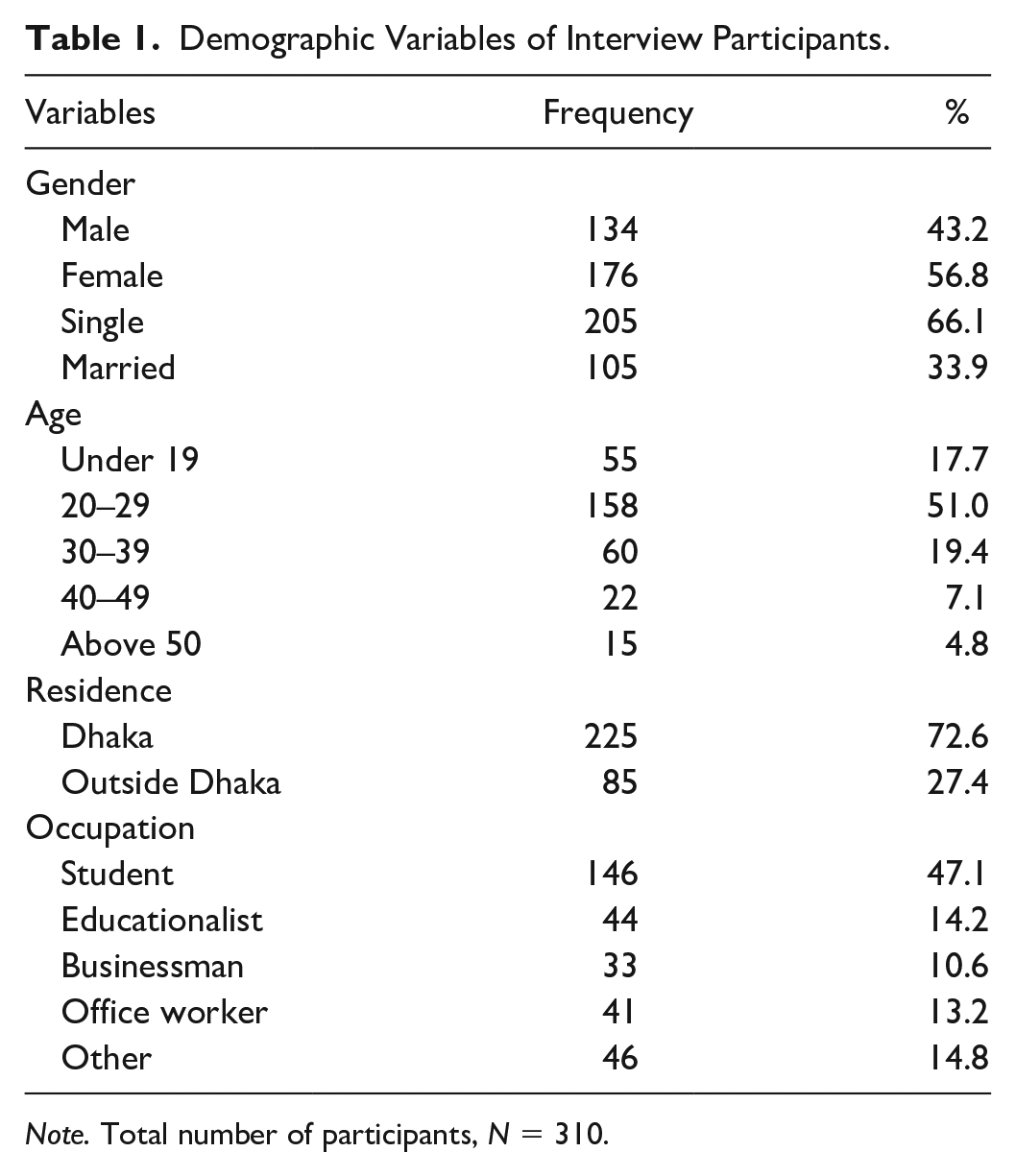
Note. Total number of participants, N = 310.
Experience of Participating in Festivals (Pohela Boishakh).
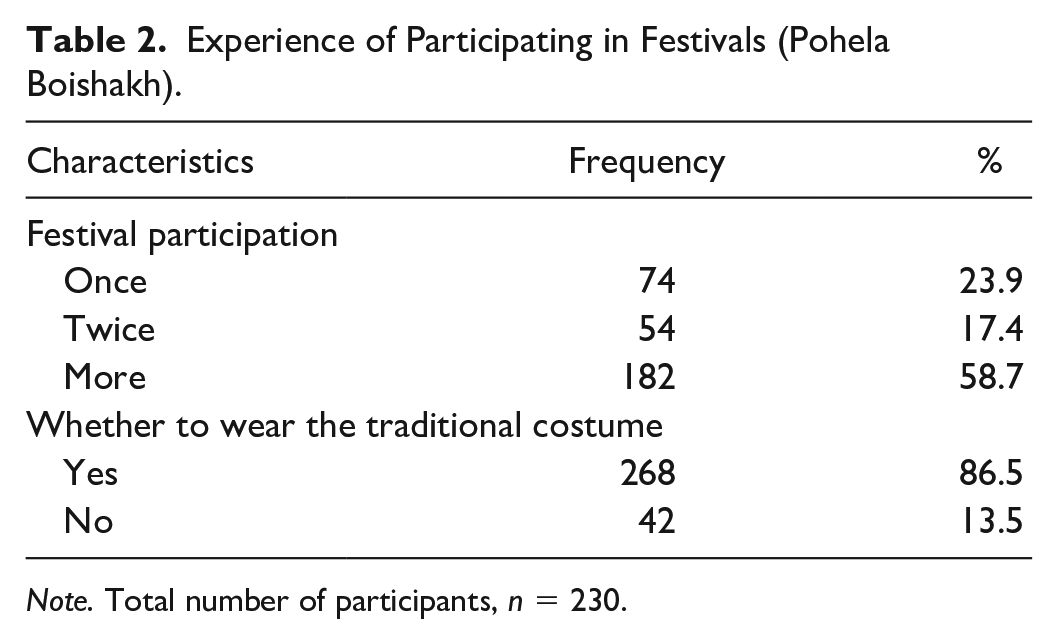
Note. Total number of participants, n = 230.
EFA
To explain the data variables in terms of logical reasoning ability test and verbal skills test, EFA was performed. For this research, the factors that express heritage festivals and traditional costumes, EFA was performed with principal components analysis selecting correlation matrix and varimax rotation. The factor loading less than 0.4 were removed to ensure good relationships between the variables (Yong & Pearce, 2013). In this analysis, we got Kaiser–Meyer–Olkin measure (KMO) = 0.879, Bartlett’s test of sphericity: χ2 = 8,488.492 (p < .001), which measures the collected values acceptable for EFA, as the sample size (participants) was more than 300 (Field, 2013). The Bartlett’s test of sphericity measures to what extent we deviate from the given situation |R| = 1 (R means correlation matrix) with the following Equation 1:

where n is the total number of participants (310), p is the number of variables taken (20), and under given hypothesis, χ2 distributed with a
In Table 3, a total of 20 variables loading based on five factors are shown. The factors were togetherness, tolerance, simplicity, aestheticism, and cultural revival; total variance explained 76.026% in factor analysis.
Exploratory Factor Analysis Results.

Note. Extraction method = principal components analysis; λ = factor loadings; VE = variance explained. Kaiser–Meyer–Olkin measure = 0.879, Bartlett’s test of sphericity: χ2 = 8,488.492 (p < .001), Total variance explained = 76.026%, total Cronbach’s α = .929.
In Figure 1, the scree plot graph shows the Eigenvalue against each variable (p = 20). From the graph, we can see that after four variables, the graph shows a sharp change in the scree plot in curvature, and the total variance counted for a smaller and smaller quantity.

Scree plot graph of Eigenvalue.
The Cronbach’s coefficient alphas were analyzed to demonstrate that the data and the test used for this research are reliable. From Table 3, we get Cronbach’s coefficient α for togetherness .918, for tolerance .904, for simplicity .921, for aestheticism .902, for cultural revival .917, and total Cronbach’s α = .929 for all five factors, which were more than .7 and that was acceptable (Cortina, 1993) for the reliability and the internal consistency of all five factors.
Multiple Regression Analysis
After factor analysis, based on its result, multiple regression analysis was performed to find out the impact of heritage festival’s factors on festival significance. The results are shown in Table 4. Overall multiple regression of the five factors is significant (F = 7.102, p < .001 [from ANOVA plot]) that is satisfactory for all the factors of heritage festival but, individually tolerance is not significant for heritage festival. The standardized coefficients in decreasing order are aestheticism (.168), togetherness (.163), cultural revival (.155), simplicity (0.132), and tolerance (.082), and it supports Hypothesis 1.
Multiple Regression Analysis (N = 310).

Note. Dependent variable: Festival significance. R2 = .105, Adj. R2 = .090, F = 7.102, p = .000** (constant).
Hierarchical regression analysis
If there are three common approaches related to multiple linear regression then the moderating effect can be analyzed (Preacher et al., 2006). So, the relationship between the dependent and independent variables can be analyzed by multiple linear regression as a moderator. For testing Hypothesis 2, hierarchical regression was analyzed using “wearing traditional costume” as a moderator. For these two steps, hierarchical regression was performed, their festival participation was a dependent variable. First, the dependent variable interacted with the independent variable, after that dummy variable was added to make interaction with the dependent and independent variable by variance partitioning process and the model specified here:



where Y is the festival significance, X1 is togetherness, X2 tolerance, X3 simplicity, X4 aestheticism, and X5 cultural revival, D is dummy variable (wearing a traditional costume), β represents regression coefficients, and ε is an error.
In Table 5, from Equation 2, when togetherness is an independent variable in Model 1, togetherness had a positive impact on heritage festival significance as (F = 4.424, p < .5). In Model 2, after adding moderator, the value was significant (F = 5.185, p < .01); so, wearing a traditional costume in heritage festival had a significant moderating impression.
Results for Moderating the Significance of Wearing Traditional Costumes.

p < .05. **p < .01.
From Equation 3, when tolerance is the independent variable in Model 1, tolerance had no positive impact on heritage festival significance as (F = 1.080, p = .299). In Model 2, after adding moderator, the value was significant (F = 4.064, p < .05); so, wearing a traditional costume in heritage festival had a significant moderating impression for tolerance.
From Equation 4, when simplicity is the independent variable in Model 1, simplicity had no positive impact on heritage festival significance as (F = 1.198, p = 1.198). In Model 2, after adding moderator, the value was significant (F = 3.999, p < .05); so, wearing a traditional costume in heritage festival had a significant moderating impression for simplicity.
From Equation 5, when aestheticism is an independent variable in Model 1, aestheticism had a positive impact on heritage festival significance as (F = 4.497, p < .5). In Model 2, after adding moderator, the value was significant (F = 5.017, p < .01); therefore, wearing a traditional costume in heritage festival had a significant moderating impression for aestheticism.
From Equation 6, when cultural revival is an independent variable in Model 1, the cultural revival had no positive impact on heritage festival significance as (F = 2.040, p =.154). In Model 2, after adding moderator, the value was significant (F = 4.245, p < .05); therefore, wearing a traditional costume in heritage festival had a significant moderating impression for a cultural revival. From the multiple regression of all factors together, there was a significant impact on heritage festivals and Hypothesis 2 was supported (Table 5).
Discussion
The dissemination of different cultures is an important driving force for social change. The active or passive cultural interaction between Bangladesh and the West in modern times has shaken the inherent political, economic, and cultural environment, thus affecting the evolution of its heritage, folk costumes. The media role of traditional clothing in interpersonal activities encourages the development of spreading scope and influence of the new ideological trend. This research explains the impact of heritage festivals for cultural revival by considering the factors. The main purpose is to examine the influence of wearing traditional costumes for heritage festival significance among Bangladeshi citizens who had the experience to attend this festival. To get the result of this study, first, we determined the relationship between the festival significance and the factors that were selected for the heritage festival. Then we analyzed the moderating effect of wearing traditional costumes, between festival participation experience and the festival factors.
First, togetherness, tolerance, simplicity, aestheticism, and cultural revival, all had reliability for this study. After analyzing in terms of festival significance, togetherness, simplicity, aestheticism, and cultural revival had significant values except for tolerance and the decreasing order as follows: aestheticism, togetherness, cultural revival, simplicity, and tolerance. Aestheticism had more significant value than other factors, also this factor mostly represents traditional costumes and outfits.
Second, after analyzing the moderating effect of wearing traditional costumes, the impact of the heritage festivals for cultural revival had satisfactory results. All the festival factors are statistically significant for the tendency of wearing traditional costumes in the heritage festival. The findings resulted that togetherness and aestheticism had more significant values compared with other factors. Figure 2 shows the explanation of the overall discussion. The use of the dominant moderator during the analytical test that emphasized the final result to make this study more significant was a unique concept.

Overall analytical results.
Conclusion
The appearance of clothing is a sign that human beings enter the civilized society, it records the development and progress of human culture, and it is also an important symbol of information transmission and cultural transmission. The result provided the knowledge using absolute variables of wearing traditional costume within the study context of Bangladeshi intangible cultural heritage festivals. The discussed hypotheses cover the logical part of this study that indicated the strong relationship between study context and analytical purpose. All factors had an individual impact on Bangladeshi citizens to understand the significance of celebrating heritage festivals.
Through the above research combined with field investigation, it is found that although in recent years, the protection of traditional culture has attracted the attention from the national level and local cultural institutions, different countries have also increased the corresponding investment and made certain achievements. However, due to the relatively backward social development level and cultural transmission mode in Bangladesh since modern times, the theoretical foundation of traditional heritage research in the region is weak, and the establishment of representative costume cultural heritage is lacking. So, the findings are not only supported by Bangladeshi citizens but also applicable to all cultures. Based on the result, the tendency of wearing traditional costumes at heritage festivals plays an important role to retain their heritage existence in the modern era, and it is applicable for all other country’s traditions. Besides, this research can be utilized as cultural studies and will establish to the readers the significance of cultural revival.
Footnotes
Declaration of Conflicting Interests
The author(s) declared no potential conflicts of interest with respect to the research, authorship, and/or publication of this article.
Funding
The author(s) disclosed receipt of the following financial support for the research and/or authorship of this article: This research was funded by “The Major Projects of Philosophy and Social Sciences Foundation of the Jiangsu Higher Education Institutions of China, Grant No. (2019SJZDA021).”
