




Abstract
We examine the relationship between the social practice of migrant remitting and the transnational field connecting Moldova with Italy and Czechia. Using data from a harmonized migrant survey, we estimate ordinal regression models and distinguish two remitting practices. Family remitting is organized around a set of routinized activities and communications that support the survival needs of families, while civil remitting contributes to the long-term development of civil society. These practices are associated with ongoing engagements with the transnational field and differentiated by duration overseas and legal status. Our findings confirm the importance of studying the transnational context of remitting and suggest that migration-development policy should recognize remittances as long-term social practices rather than transactions.
Introduction
Migrant remittances matter. They matter for individual and family livelihood support, for macro-economic development, and for longer term social transformation (de Haas, 2012). Despite global recession and populist hostilities to migrants in many countries, the level and scope of remittances expanded over the first decades of the century (World Bank, 2019). However, once seen as a win–win proposition for countries looking to develop from below, and for migrants needing to secure livelihoods, there is growing acknowledgment that remitting is complex and can bring negative outcomes (Logue, 2009; Piper, 2009). Indeed, the question of how best to manage individual migrant remittances for some greater public good continues as a lively topic of policy discussion (Brown, 2006; International Organization for Migration, 2006).
This article contributes to our understanding of migrant remitting by advancing research that theorizes remitting as a social practice (Page & Mercer, 2012). Practice theory is a long-standing approach to understanding transformation in society that attends to the inter-relationships between agency and structure (Bourdieu, 1977). Based on the work of Ted Schatzki (2002), we conceptualize migrant remitting as an embedded social practice that transforms—while being transformed by—broader structural contexts. This shifts focus away from remittances as isolated transactions or events and contributes understandings of the broader relationship between remitting and linked social, economic, and political transformations (Levitt, 1998).
However, applications of practice theory to remitting in the transnational context of migration are relatively scant (Nowicka, 2015), despite the diasporic and transnational nature of much contemporary migration being well-established (Ban, 2012; Faist, 2008; Hannerz, 1996; Schiller & Faist, 2009). It is important to study transnational fields because they are tri-focal, that is, migrant daily life references origin countries, destination countries, and transnational spaces simultaneously. Failing to consider how remitting practices are shaped by the dynamic relations between origins, destinations, and transnational space undermines “migration-development” policies that privilege remitting as an individual-level process (Bailey, 2010; Castles, 2004). To address this gap in knowledge, the specific objective of our article is to explore the relationship between the transnational context of migration and migrant remitting practices.
Our article makes two specific contributions. To develop remitting theory, we derive a concept of migrant remitting as a relational social practice that is organized by the activities and communications of daily transnational daily life. This concept provides a more balanced view of the constraints upon, and possibilities for migrant agency (Levitt & Lamba-Nieves, 2011). We also provide a richer view of the relationship between remitting as practice and social transformation more generally, and contribute to understanding the “puzzle” of the persistence of remittances (Stark, 2009).
Second, our test of this conceptual proposition contributes to migration-development policy by reporting on the remitting practices of overseas Moldovan migrants. Moldova is a particularly important and under-researched case study of wider patterns of post-Soviet migrant remitting. It is apposite to our research objective because of the great significance of remitting to Moldovan society, and the development of a Moldovan transnational field spanning Europe, including our case study sites in Italy and Czechia. For example, in 1995, migrant remittances made up just 0.06% gross domestic product (GDP) and Moldova was ranked 120th among countries on this metric. By 2019, remittances made up 15.96% of GDP and Moldova was ranked 12th globally (The Global Economy, 2021). Studying Moldovan remitting from Italy and Czechia enables us to compare destinations that differ in terms of the establishment of the Moldovan community and political culture, and draw insights about the relative importance of transnational context for policy.
Theoretical Framework
A growing body of empirical research attests to the complexity of remitting. Social care, social norms, cultural and political values, knowledge, social capital, property, and cash are among the material and symbolic flows of remittances (Batista et al., 2019; Grabowska et al., 2017; Levitt & Lamba-Nieves, 2011). These flows touch origin communities and families as well as persons in third countries (Isaakyan & Traindafyllidou, 2016). Moreover, reverse remittances flow from source countries and communities to support overseas migrants. Indeed, as Boccagni and Decimo (2013) argue, assuming that remitting is a transaction controlled by individual migrants conflates processes of diffusion with linked processes of social reproduction by non-movers. Taken together, such evidence cautions against over-simplifying remitting as transactional and migrant-led.
Practice theory accounts of remitting have emerged in response to this critique. Synthesizing the joint significance of societal structures and contexts alongside intentionality, routine, and reflection, practice theory studies broad transformation by focusing on the conduct of daily life. When applied to migrant remitting, practice accounts draw attention to how daily life is embedded in contexts of origins, destinations, and, we argue, transnational fields, networks, and spaces. We define transnational social spaces as relatively stable, lasting and dense sets of ties reaching beyond and across the borders of sovereign states . . . combinations of ties and their contents, positions in networks and organisations, and networks of organisations that cut across the borders of at least two nation-states. (Faist & Özveren, 2004, p. 3)
What is distinctive about daily life across such transnational social spaces is its relational and tri-focal nature (Orozco, 2002), with “the embeddedness of ties in one location . . . supplemented or transformed by transnational exchanges” (Faist & Özveren, 2004, p. 4). We argue that remitting practices are shaped by how daily life unfolds simultaneously in relation to a migrant’s origin, destination, and transnational field (including third countries with remaining or anticipated ties).
To consider how such tri-focality affects the organization and differentiation of remitting practices, we turn to the corpus of Ted Schatzki, and particularly his 2002 work The Site of the Social. Here, Schatzki re-considers the relationship between agency and structural context by emphasizing the significance of social practices. Daily life is constituted by myriad overlapping practices with each distinguished on the basis of bundles of doings (actions) and sayings (discourses). Individuals orient to some practices and not others by referencing meanings that are derived from reflections and understandings made in relation to their social context (including ways of understanding, values, and norms) and spatial context (including the geographic and temporal structure of the encounters of daily life). Daily life—the site of the social—is how, where, and when context enables and shapes agency through myriad social practices, and vice versa (Everts et al., 2011; Schatzki, 2002, pp. 73–78; Simonsen, 2010). As the framework assumes practices and contexts are mutually constitutive, it is suited to analyzing the relational transnational context of remitting where an assumption of a cause–effect relationship between context and remitting is inappropriate. Moreover, it provides generalized insights into how practices are organized and how to empirically distinguish practices, as well as emphasizing the roles of a range of material, symbolic, and affective relations.
One application of Schatzki’s framework to migrant remitting concerns Zimbabwean migrants working in the United Kingdom (Bailey et al., 2017). Migrants understood their remitting practice in terms of “sending” (sending “out” cash to Zimbabwe and sending “for” family members to come to the United Kingdom) and organized this through routinized activities, communications, and discourses. The remitting practice was deeply embedded across the transnational Zimbabwean field, including through the time-specific use of language, and non-permanent forms of attachment and belonging. For example, while the use of local Zimbabwean languages in remitting practice remained strong among all remitters, it was adjusted and supplemented by English for those who were long-term migrants. The remitting practice was further distinguished by values, including hunhuism (a Zimbabwean value emphasizing virtuosity and common humanity), and norms, notably extended familyhood.
To address our research objective of linking transnationalism and remitting practice, we assess these insights for the specific context of Moldovan migration and remitting. Moldova is ranked 112th among 189 countries on the Human Development Index and is one of the least developed countries in Europe (Hristev et al., 2009). The gross national income per capita (i.e., purchasing power parity) is only US$5,554 (United Nations, 2018). The country experiences a lack of investment, an unproductive agricultural sector, and weak or nonexistent social support policies. Its state is seen as relatively dysfunctional with ongoing charges of corruption (Dostál & Jelen, 2015; Mošňjaga & Lupták, 2008). Political instabilities are associated with the secessionist “Dniester Moldovan Republic” in the eastern part of the country. Against this context, migration and remitting have become embedded as a feature of Moldovan economic and social development, and in common with other post-Soviet societies, a culture of migration has emerged.
Our first research question explores how Moldovan remitting practices are organized as sets of routinized doings and sayings. Existing research suggests that overseas Moldovans contribute economic remittances to family members to enable them to meet survival and basic livelihood needs (Dugoglo & Onofrej, 2016; Piracha & Saraogi, 2011). Cash from family members living and working abroad are vitally important for many Moldovans to overcome the hardships of day-to-day life (Blouchoutzi & Nikas, 2010; Piracha & Saraogi, 2011; Sandu, 2016; Sârbu & Cimpoieş, 2018). Research also suggests Moldovans send social and political remittances to advance the development of Moldovan society (Garapich, 2016; Sandu, 2016). We therefore expect to differentiate a family remitting practice, organized around material and discursive interactions with family, and a civic remitting practice, organized around the application of concepts and ideologies acquired overseas and discursive interactions with community and civic groups (Kubal, 2015; Marcu, 2014).
The second research question explores the association between remitting practice and a Moldovan transnational field. Extant research describes Moldovan transnationalism in terms of participation, residence intentions, and sense of belonging (see Kubal, 2015; Sandu, 2016). This research also underscores the significance of socio-legality in influencing the practicalities and possibilities of transnational daily life for remitting. We therefore argue that while family remitting practice seeks to build belonging to family rather than nation as a long-term aspiration, it requires, in the Moldovan context, short notice, impelled outward, and/or return migration strategies that can urgently address livelihood and survival needs. This implies family remitting will be associated with short duration spells, a fluid sense of belonging with no intention to return at a fixed time, and a lack of permanent residence in a destination. It may also involve closer, more accessible, and less expensive, destinations. By contrast, civic remitting has been associated with those who have longer durations of residence (Poirine, 2006), and, we posit, those who obtain permanent residence yet maintain a geographically fluid concept of home. The presence of an expatriate community in the destination may also promote civic remitting practices (Drbohlav, Bailey, Čermák, et al., 2017).
The third research question explores how values and norms affect remitting practice. Research suggests there are a wide variety of values that underpin so-called political remitting, including modernization, secularization, post-materialism, Europeanisation, and the diffusion of faith-based ideologies (Batista et al., 2019; Inglehart & Welzel, 2005). Concerning Moldovan remitting, we expect that values associated with democracy, post-materialism, and having some future involvement in origin country politics will be associated with higher levels of civic remitting (Aparicio-Fenoll, 2011). In common with other post-Soviet migration systems, we expect that Moldovan migration will reference a gendered expectation that women migrate (and re-migrate) to remit to families (Solari, 2010; Vanore & Siegel, 2015).
Research Design
Data
To represent transnational context, we collected data in two important European destinations for Moldovans, Italy and Czechia. While both offer relatively similar living standards, they differ in ways that enable us to assess our research questions. For example, the political values migrants are exposed to living in what was a former centralized economy are distinct from those of a liberal democracy in Italy, and help us assess if civic remitting is tied to destination political culture. As Italy and Czechia are in a different stage of transition from net emigration to net immigration, migrant inflow, integration, and overall policy (Okólski, 2012), we observe differences in the size, integration, and norms of the Moldovan community. Moldovans have been migrating to Italy for longer and are a more integrated immigrant group, with some 142,000 migrants registered in the country (IDOS, 2016). There were an estimated 5,000 Moldovan migrants in Czechia (not including Moldovans with Romanian passports) who were employed in 2016 (Drbohlav, Bailey, Čermák, et al., 2017).
Within each country, we interviewed migrants where they were most likely to be employed, that is, in major urban cores. In Czechia, we chose Prague, and in Italy, we selected Turin. Most Moldovans in Czechia are drawn to the capital Prague, and the nearby region of Central Bohemia. A count of “Moldovans” based on legal registration shows that in late 2018 some 2,900 Moldovans were legally registered in Prague and the Central Bohemia region. In Italy, we selected Turin as the study location. It is an urban center of approximately 1 million persons, with a mix of industrial and service sector employment opportunities. An estimated 4,500 Moldovans were registered as living in Turin in 2015. Our respective teams knew both sites well, and have community connections spanning a number of years. We used these connections to help locate respondents. Given our interest in differentiating remitting practices, we attempted to be as inclusive of migrants with different backgrounds as possible. The Czech team used prior contacts, snowballing, the Orthodox Church, business community contacts, and hostel managers to locate respondents. In Italy, the team reached out to cultural associations and student groups.
We selected respondents who were above 18 years old, who held Moldovan citizenship (including the Pridnestrovian Moldavian Republic), and who had first moved to Italy/Czechia a year or more ago. Of the 300 potential respondents we contacted who met these criteria in Prague, we were able to complete 203 surveys, and of the 300 potential respondents who met the criteria in Turin, we completed 206 surveys. Our fieldwork ran in parallel from autumn 2017 to spring 2018. We met the respondents in a variety of settings. In Czechia, this included university campuses, Orthodox churches, coffee bars, and dorms. In Italy, the research team pitched up to the headquarters of ethnic associations, Orthodox churches, university campuses, kindergartens, restaurants, grocery stores, and private houses.
Based on our previous research on Central and Eastern European migrant populations, including those lacking formal documentation, we designed and pilot tested a single and harmonized survey instrument. This gathered original data on the remitting activities, communications, values, norms, and socio-demographic backgrounds of migrants. It also included information from migrant respondents about how their family members used monies they had been sent, reverse remitting, their activities upon returning to and visiting Moldova, and the adoption of ideas for public use in Moldova. We offered a small financial incentive for completing the interview, and a further inducement for a referral. We used the PAPI—Pencil and Paper Interview—method and conducted surveys in Moldovan and Czech language in Prague, and in Moldovan and Italian language in Turin. Each field transcript was typed into a spreadsheet immediately after the interview.
Variable Specifications
The harmonized survey tool generated detailed and comparable responses to a wide range of relevant indicators. To address our research questions, we performed a series of transformations on these data. To assess the organization of remitting practices and distinguish different levels of remitting (Research Question 1), we created two composite variables following the logic of Sandu (2016, p. 86). The composite variable for family remitting (hereafter, FAMR) combines an estimate of the absolute amount of money remitted in the past 12 months to family (CASH) with a measure of discursive interactions with family members in Moldova specifically about livelihood issues (see Table 1 for further details on variable derivations). CASH divides the 14 possible answers to how much money was remitted into three categories: 1 (sent no money), 2 (sent a non-zero amount of less than 400 EU) and 3 (sent more than 401 EU). We also considered the regularity with which migrants discussed seven topics most related to sustaining familyhood: family relationships, work, life standard, health, leisure, food, and finances with family members in Moldova (each topic had five answer options from never to very often). A new variable FAMTOPIC aggregates these responses and divides the resulting distribution (ranging from seven to 35) into three equal categories, where (1) indicates irregular discussion of the seven topics and (3) regular discussion of the seven topics. We then created the composite variable FAMR with three ordinal levels of family remitting, where low (1) represents low levels of CASH and FAMTOPIC, high (3) represents high levels of CASH and FAMTOPIC, and medium (2) represents other combinations of CASH and FAMTOPIC.
Independent Variable Derivation and Descriptive Statistics.

Note. N = 228 for all variables.
The compound variable CIVR represents the level of civic remitting and is calculated following the same logic. We combined a measure of applying for public use any concepts and ideologies learned outside Moldova (CIVREM) with a measure of the regularity of conversations with friends/acquaintances in Moldova specifically about civil society issues (including the political sphere and public institutions, legal order, transport and environmental issues, and volunteering Moldova). CIVTOPIC aggregates these five categories into three equal categories (i.e., low/average/high regularity). We then created the composite variable CIVR with three ordinal levels of civic remitting, where low (1) represents low levels of CIVREM and CIVTOPIC, high (3) represents high levels of CIVREM and CIVTOPIC, and medium (2) represents other combinations of CIVREM and CIVTOPIC.
To investigate transnational context (Research Question 2), we derived variables that could represent participation, residence intentions, belonging, and socio-legal conditions. We assessed participation by examining the number of years living in the destination (DURAT) and the degree of general communications between migrants and all their associates in Moldova, including family, friends, and other acquaintances (COMM). We further proxied participation by examining the inter-relationship, if any, between the doings and sayings of family remitting and the level of civic remitting, and vice versa. Our expectation was that while civic remitting would not preclude family remitting, it was less likely that family remitting would be associated with civic remitting. Return intentions were directly measured by MOLRET, recorded as a binary response variable. Belonging was proxied by a measure of local language skills (LANG) and by including a simple dummy variable for the destination country (COUNTRY). To investigate the role of socio-legality, we asked if the migrant has a residence permit (PERMINT).
We derived four variables to assess the association between values and norms and family and civic remitting (Research Question 3). While the range of potential norms and values to explore is great, the sample size restricts our focus. We specify MOLPOL as a measure of planned participation in political life in Moldova. While a coarse proxy, declaring oneself as politically active will reference adherence to underlying values, for example, post-materialist versus materialist. We included more direct measures of democratic values (DEMOC) and materialist values (MATER), and examined the relevance of gendered norms (GENDER). Control variables measured human capital (EDUC), age (AGE), income (INC), marital status (MARST), and living with a child (KIDWITH).
Descriptive statistics are provided for the independent variables in Table 1. We found no significant correlation among the independent variables. For example, while the variables COMM, FAMTOPIC, and CIVTOPIC capture aspects of general and specific communications by migrants, they refer to communications with different groups. Furthermore, these variables showed no inter-correlation. Concerning the dependent variables, we observe that the distribution of levels of family remitting is more uniform than the distribution of levels of civic remitting (Table 2, bottom panel). In all, 38% of Moldovan migrants were categorized with low levels of family remitting, 32% medium level, and 30% high level. A total of 48% of Moldovan migrants were categorized with low levels of civic remitting, 31% medium level, and 21% high level.
Remitting Practice by Country of Destination: Cross-Tabulations.
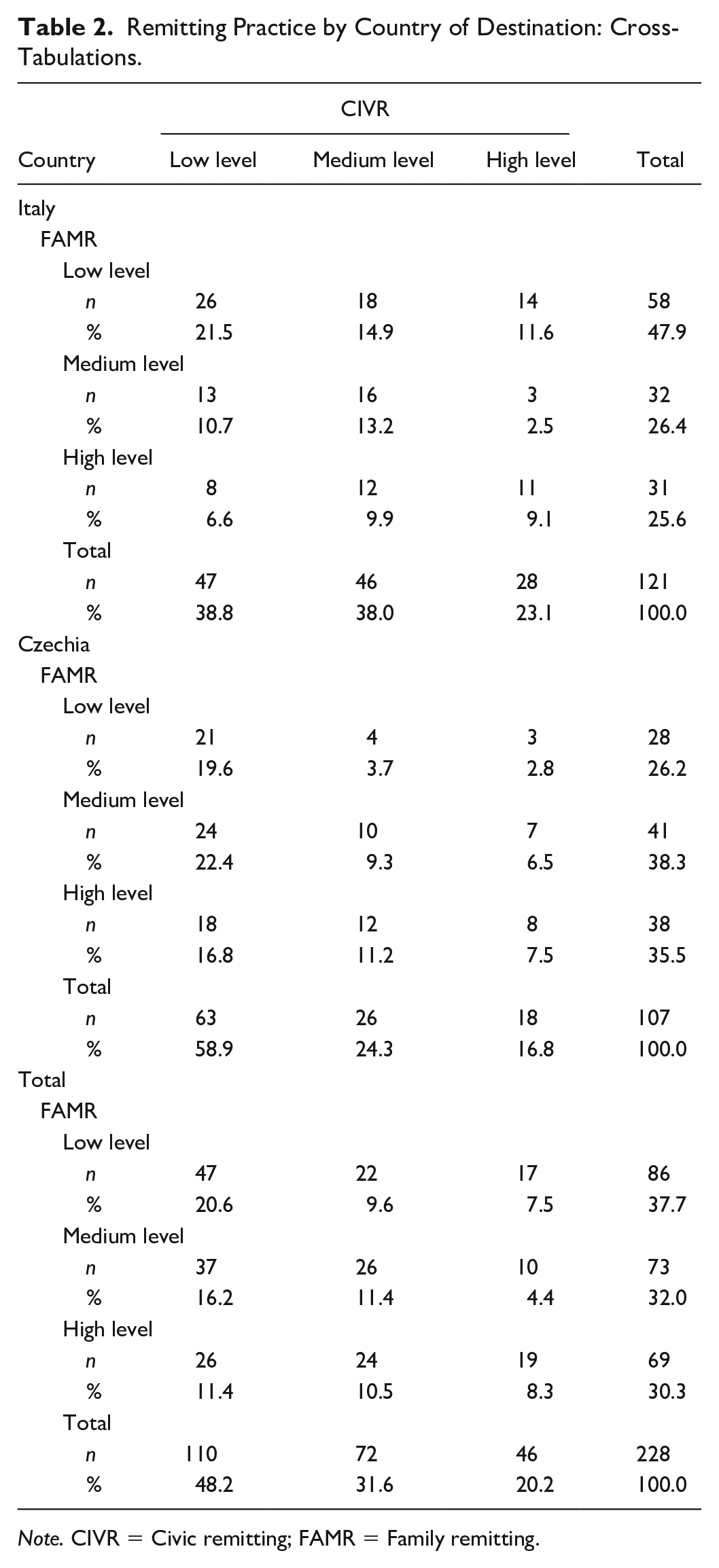
Note. CIVR = Civic remitting; FAMR = Family remitting.
Analysis
To explore the distinctiveness of Moldovan remitting practices, we calculated the statistical association between family remitting and civic remitting using a Pearson’s chi-square and Somers’s d (Tables 3 and 4). To further understand the organization of FAMR and CIVR, we explored if there were differences in how Moldovan family members used remittances according to the level of remitting (high, medium, and low level, Table 5). We also compared which aspects of civic remitting were identified as significant by those exhibiting high, medium, and low levels of civic remitting (Table 6). Separate ordinal logistic regression models were estimated for FAMR and CIVR to ascertain the relative significance of measures of transnational context, norms, and values given control variables (Table 7). These equations made use of only those cases where data were available for all variables. This meant that of the original sample of 409 completed interviews, we used 228 data records in our modeling. Nonetheless, this sample adequately represents the general population of Moldovans in each country. For example, concerning income, Moldovans we interviewed in Italy had higher levels of overall income (including that acquired informally) than in Czechia. In Italy, 18% of the Moldovan sample earned more than 1,500 euros a month and 12 less than 500 euros a month, compared with figures of 4% and 22%, respectively, among the Moldovan sample in Czechia (see also Okólski, 2012).
Remitting Practice by Country of Destination: Chi-Square Tests.
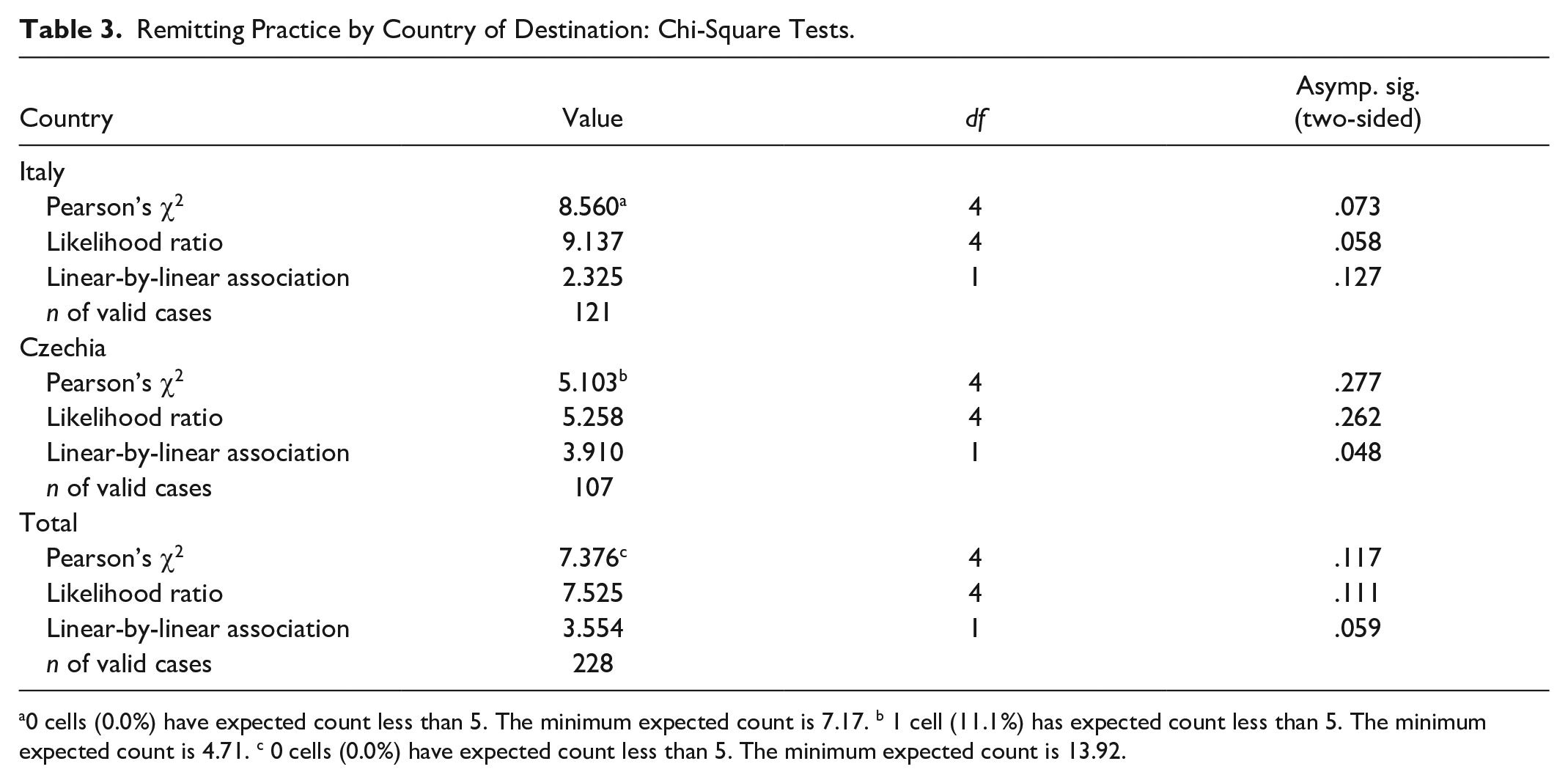
0 cells (0.0%) have expected count less than 5. The minimum expected count is 7.17. b 1 cell (11.1%) has expected count less than 5. The minimum expected count is 4.71. c 0 cells (0.0%) have expected count less than 5. The minimum expected count is 13.92.
Remitting Practice by Country of Destination: Directional Measures.

Note. FAMR = Family remitting; CIVR = Civic remitting.
Not assuming the null hypothesis. b Using the asymptotic standard error assuming the null hypothesis.
Use of Money by Level of Family Remitting.

Transfer of Ideas by Level of Civic Remitting.

Ordinal Regression Models for Family Remitting and Civic Remitting Practice.
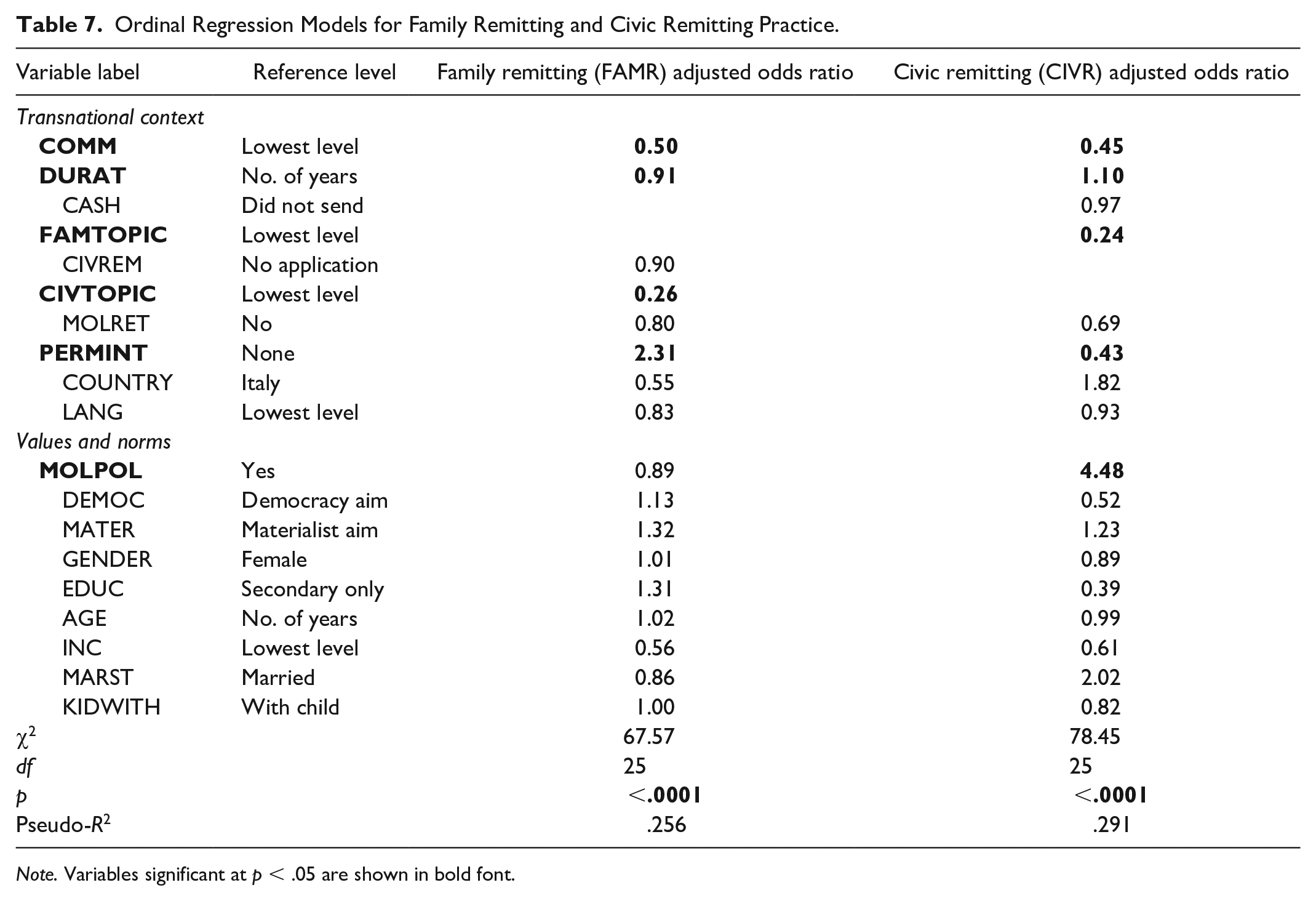
Note. Variables significant at p < .05 are shown in bold font.
Results
Chi-square and Somers’s d tests among the pooled sample of 228 respondents from Italy and Czechia found no significant association between the composite variables FAMR and CIVR (Tables 3 and 4). This supports our view that family and civic remitting can be statistically differentiated on the basis of the measures of the routinized doings and sayings we deployed. When we disaggregated the pooled sample by origin country, the directional result for Czechia was significant although the significance of country of destination was not confirmed by our multivariate analysis, as we further discuss below.
To further interpret the composite variable FAMR and the organization of family remitting, we cross-tabulated the reported usage patterns of remittances by family members in Moldova against the level of family remitting (Table 5). Among those family members being sent money by those we classified as engaged in high levels of family remitting, the most important use of money is for health (mean significance of 4.0 out of 5.0). This was followed by using remittances for electric power, gas, wood for fuel (mean of 3.33), food (3.11), and reconstructing an old house (mean 2.73). This strongly supports prior literature and confirms that family remitting is organized around survival needs. These usage patterns varied by levels of family remitting. Low-level family remitting was significantly associated with using remittances for electric power, gas, wood for fuel (mean of 3.96 on a 5-point scale), and for health care (mean of 3.5). Other uses were less significant (means were less than 2, that is, of low significance in qualitative terms). Among the middle level, three activities were most significant, using remittances for electric power, gas, wood for fuel (mean of 3.13 on a 5-point scale), using money for health care (mean of 3.17), and using money for reconstructing an old house (mean of 3.10). In addition, using remitting for food was of moderate significance (mean of 2.53). Overall, the preponderance of uses for basic needs (health, food, shelter) rather than other options (buying a new car, buying land, starting a business, buying a new home, etc.) suggests that family remitting supports basic livelihood needs.
To further understand the organization and distinctiveness of civic remitting, we similarly examined the choices migrants made about the new ideas, new relations, and new state orders that they had encountered in their destinations and told us they wanted to transfer to Moldova (Table 6). Among those with high levels of civic remitting, the key idea/concern they wished to promote back in Moldova was level of incomes, that is, a surrogate for an effectively functioning Moldovan labor market. This is a helpful insight because it suggests that economic factors are important in both the short-term (family remitting) and long-term (civic remitting) horizons of Moldovan migrants, albeit in differentiated ways (see Sârbu & Cimpoieş, 2018). High-level civic remitting was also organized around ideas about the operation of health care systems and social security systems. While there are further variations by migrant destination, the broad pattern of findings is consistent with our expectation that migrants with high levels of civil remitting aim to build the economic, social, and political infrastructure for the long-term development of Moldovan civil society.
The ordinal regression models predicting FAMR and CIVR on the basis of the selected independent variables were both significant. The summary chi-square test showed that both models provide an improved fit compared with a model with no independent variables (p < .001, see Table 7). Pseudo-R2 values (Nagelkerke statistic of .256 and .291 for FAMR and CIVR, respectively) suggest overall very good fit, affirming that the theoretical framework has generated robust predictors of remitting practices.
The pattern and direction of significance of our independent variables accorded with our expectations. We found an overall positive and significant association between our measures of remitting practice and the Moldovan transnational field. The general measure (COMM) was significant in the expected direction for both family remitting and civic remitting. Having limited or no general social contacts with Moldova reduced by around one half the odds of high levels of family remitting (Adj. OR = 0.50, p < .05) and civil remitting (Adj. OR = 0.45, p < .05). Moreover, the odds ratio of high levels of family remitting are significantly reduced (Adj. OR = 0.26, p < .001) for those who discuss civic topics only infrequently and, similarly, the odds ratio of high levels of civic remitting are significantly reduced (Adj. OR = 0.24, p < .001) by infrequent discussions of topics related to familyhood.
While participation in the transnational field is positively associated with both remitting practices, our results also shed light on how remitting practices are differentiated through transnational context. For migrants with the highest level of family remitting, time spent in the destination country is significant and negative (DURAT, Adj. OR = 0.91, p < .05). That is, each year spent outside Moldova reduced the odds ratio of family remitting by 9%. For those migrants with the highest level of civic remitting, the findings are, as we expected, reverse: Time in the destination country is positively related to civic remitting (DURAT, Adj. OR = 1.10, p < .05). Similarly, our measure of socio-legality is a significant differentiator. For FAMR, those migrants lacking a permanent resident permit had an adjusted odds ratio of 2.31, p < .05 (PERMINT), meaning they were over twice as likely to be remitting at the highest level when compared with those with a permanent residence permit. For civic remitting, not holding a residence permit significantly reduces the odds ratio (0.43). Taken together, measures of duration and legal status support our view that family remitting practices are short term and impelled. Civic remitting unfolds over the longer term. The positive and significant association between intention to enter politics (MOLPOL, Adj. OR = 4.48, p < .001) and civic remitting further suggests this practice may be embedded in career trajectories.
Remaining measures, which focused on national and individual characteristics, were insignificant. That the measure of intention to return (MOLRET) is not significant for either practice suggests a more fluid sense of belonging in this transnational context. Moreover, the insignificance of the measure of country of destination or local language acquisition in either equation is consistent with the proposition that both civic and family remitting practices are embedded in transnational, rather than local or national, contexts. Likewise, our data did not support the hypothesis of direct diffusion of political remittances from Europe to Moldova (Drbohlav, Bailey, Čermák, et al., 2017; Drbohlav, Bailey, Lupták, & Čermáková, 2017). Contrary to orthodox views (Inglehart & Welzel, 2005), holding democratic or post-materialist values per se had no significant effect on civic or family remitting. The insignificance of gender among Moldovan migrants stands in some contrast to what has been reported for other post-Soviet societies (Bailey et al., 2018; Vanore & Siegel, 2015) and is important to further explore in light of rising levels of female migration and the persistence of traditional gendered norms within Moldova. We report no difference in remitting level by age, education, income, or family status.
Discussion and Conclusion
This research has explored the relationship between the transnational context of Moldovan migration and the remitting practices among Moldovan migrants living in Italy and Czechia. Based on original research using a harmonized survey instrument, we report three main empirical findings. First, we distinguish between remitting organized around family livelihood support (family remitting) and remitting organized around the longer-term development of Moldovan society (civic remitting). We discuss each as a social practice that is distinguished by routinized exchange of cash, materials, and ideas, and by the scope of communications that accompanies these exchanges. Second, these remitting practices are positively associated with the overall transnational connections that migrants maintain with Moldova. However, third, the practices are differentially embedded in this Moldovan transnational field. While Moldovans practicing high levels of family remitting stay for shorter periods and are less likely to hold permanent residence, those with high levels of civic remitting have lived for longer periods overseas and are more likely to hold permanent residence. In other words, each remitting practice appears to be associated with a distinctive engagement with the transnational field.
The particularities of our research design and analysis frame the implications of these findings. A multi-seeded snowball sampling method does not guarantee a representative sample. Using our long-standing contacts in Turin and Prague, we were able to reach out to a diverse group of Moldovans and, on the basis of income and occupation at least, produced a sample in line with the broader Moldovan population at large in Italy and Czechia (see further discussion in Drbohlav, Bailey, Čermák, et al., 2017). As a cross-sectional and destination-based study, we did not consider those who had lived in Italy or Czechia, and were currently living back in Moldova. It is unclear, theoretically, if such returnees would be positively or negatively selected with respect to remitting. However, we cannot draw conclusions about the success or persistence of the practices that we describe, and cannot assess if remittance practices are related to cumulative changes in origin conditions. Our restricted sample size reduced the number of independent variables selected for analysis. For example, a larger sample size would facilitate closer examination of the insignificance of income/education and how this may be related to time overseas. These observations do not undermine our basic argument that practice theory can generate parsimonious measures of the distinction and organization of migrant practices of remitting, and that Schatzki’s site ontology generates insights on the complex and differentiated relationship between remitting practices and transnationalism.
In theoretical terms, the research supports existing literature that distinguishes between family-oriented remitting and broader, civic-oriented investments in economic, social, and political infrastructure (Ban, 2012; Cliggett, 2005; Garapich, 2016; Levitt & Lamba-Nieves, 2011; Marcu, 2014; Poirine, 2006). The family remitting practice of Moldovans is distinguished by activities that support the development of familyhood over the long run by meeting short-term basic needs for cash, health, energy, and food among family members in Moldova. The practice is undertaken on a needs basis over the short term and often without residence permit status, and appeared independent of education background, income, or destination country. A civic remitting practice is distinguished from family remitting by its longer term, routinized activities which focus on developing the economic and political infrastructure of Moldovan society. Civic remitting is responsive to personal political aspirations and more likely with residence status and longer residence.
Our findings advance remitting theory by flagging the different ways in which remitting practices appear to be embedded in transnational social spaces. By specifying variables that begin to unpack the variegations of transnational context, we address at least one aspect of Stark’s (2009) “puzzle,” the question of the persistence of remittances. That is, we read persistence as an aspect of the mutual constitution of remitting practice, daily life, and transnational field. Persistence is not something independently linked to the individual characteristics of remitters or their destinations or origins, but a social norm emerging from the waxing and waning of differentiated and constituting social practices. Furthermore, reading remitting as practice that is associated with, and constitutive of, transnational relations undermines measures of home and return migration intention based on binary categorization (Sandu, 2016). For example, civic remitting may be associated with “permanent temporary” forms of belonging rather than any fixed intention to return to an imagined homeland. By contrast, impelled family remitting is attuned to the often forced and materially driven needs of family, which, once met, permits a return that in turn re-exposes migrants to conditions of deprivation and further emigration. The repetition of such impelled remitting may be associated with a sense of “temporary permanence” which does not require any fixed intention to return home at any given moment.
Applying practice theory to remitting also has implications for migration-development policy. In distinguishing remitting practices, we note they are interwoven as part of the fabric of daily transnational life and therefore why, in policy terms, it is helpful to take the long-view, not least as a post-pandemic landscape of remitting unfolds. Seeing remitting as practice rather than transaction emphasizes its ongoing contribution to social, economic, and political transformation. For example, the interpretation of the differential significance of socio-legality should recognize that while migrant agency is often severely constrained, and while migration is often forced by events beyond the control of migrants or communities, it is limiting to stereotype those working without a legal residence permit as somehow lacking purposeful or embedded strategies which already have consequence for broader social fields. Moreover, migration-development policy that is broad not narrow, and organic rather than targeted, can build the capacity and resilience of institutions and sustain policies across dynamic and fluid transnational social fields.
In practical terms, and referencing Moldova, the distinction of civic remitting implies that non-state actors—dissident political groups and faith groups to name two—must be drawn into policy discussion. Furthermore, as the membership of such groups will change, both in response to transnationalization and global and regional events, policy targets may need to be more organic. For example, establishing a “community of practice” where members share a commitment to improve practice and who enter the group on the basis of this motive rather than a priori credentials (see Everts et al., 2011) may generate policy that harmonizes remitting and long-term social transformation. Issues arising would include the time horizon for expectations about policy deliverables, the basis on which such a chaotic group of interests and institutions necessary to sustain a migration-development agenda can cohere (Logue, 2009), how to manage the unequal power of different stakeholders, and what to debate (Phillips et al., 2014). In Moldova, debate may touch on the role of family in civic society and explore if familyhood can be a resilient and culturally viable imaginary and sociality that can facilitate social development and, if so, then what kinds of familyhood—patriarchal, secular, post-Soviet, Orthodox, and so on—could be supported by what kinds of remitting practices and institutions?
We close by calling for further research connecting remitting as a social practice with processes of transnationalization. We need better empirical understandings of the intensity (dimensions and burdens of exchange), extent (which individuals and institutions are involved), diversity and ambiguity (Kubal, 2015, p. 83), and persistence of transnationalization as migration and society relations emerge in the post-Covid-19 world. Such evidence must elevate the terms and quality of public debate on migrants, and their remitting practices, in ways that escape the gutter, avoid fanning moral panics, recognize interdependencies, articulate win–wins, and transcend zero sum games. We also suggest that ethnographic or grounded theory research can further identify the variety of ways that remitting is embedded through attention to the tri-focality of transnationalism and the dynamics of social practices.
Footnotes
Acknowledgements
The authors thank Pietro Cingolani and Francesco Vietti and their collaborators from FIERI (Forum Internazionale ed Europeo di Ricerche Sull’Immigrazione) for carrying out the survey in Turin. Moreover, thanks go to other members of GEOMIGRACE (Geographic Migration Center), namely, Zdeněk Čermák, Eva Janská, Dita Čermáková, Lenka Pavelková, Milan Lupták, and Markéta Seidlová for assisting in collecting the data in Prague.
Declaration of Conflicting Interests
The author(s) declared no potential conflicts of interest with respect to the research, authorship, and/or publication of this article.
Funding
The author(s) disclosed receipt of the following financial support for the research and/or authorship of this article: This work was supported by the Czech Science Foundation project: “Moldovans in Prague (Czechia) and Torino (Italy)—Migratory and Integration Patterns, Financial and Social Remittances Under Scrutiny” (Number P404/16-22194S).
