




Abstract
This research aims to examine the relationship between voluntary carbon disclosures and national cultures of Global 500 companies that direct the world economy. The research is essential in terms of showing the results of the Paris agreement, which is considered to have an impact on climate change, one of the most outstanding variables affecting sustainability, in the national context. Our study is one of the few on the sustainability theories (stakeholder, legitimacy, signaling, and system) and the relationship between carbon disclosures and the context of national culture both. As a consequence of this research, the relationships between Carbon Disclosure Project (CDP) data and the national culture to which Global 500 companies belong were determined. In this context, CDP climate scores also differ in five dimensions (uncertainty avoidance, individualism, power distance, long-term orientation, indulgence) other than Hofstede’s masculinity dimension. CDP’s water security values differ only in the social aspect to avoid uncertainty. Also, we find that the Paris agreement makes a difference in carbon disclosures.
Introduction
Mitigating the catastrophic impact of climate change caused by global warming has become an international concern that urgently needs an international response (Intergovernmental Panel on Climate Change, 2013; Stern, 2006). Owing to the problems of climate change and global warming, the performance expectations of the stakeholders from the organizations are evolving to be more sensitive towards environmental sustainability activities. Climate change, which has a direct effect on societies’ lifestyles, states’ development policies, poses a significant threat to modern societies. Climate change, which is thought to have unpredictable effects, causes excessive rainfall and drought in some parts of the world. Also, food security issues and rising seawater levels will affect the lives of all people in the world (Halkos & Skouloudis, 2016). In this context, global warming is a critical problem that needs to be solved in the long run, as international damage is probably irreversible (Lash & Wellington, 2007; Luo & Tang, 2016). To achieve this, organizations should attach more importance to sustainability activities day by day. Compared to previous years, more organizations now are aware of responsibility and accountability and provide stakeholders with information about their environmental performance (Jose & Lee, 2007).
While changing climatic conditions and increasing population affect biological diversity, they also bring about food and water security issues. International collaborations and agreements are needed to improve global climate conditions and sustainable development goals to cope with these difficulties. In this context, the most well-known events on climate change are; The Paris Agreement, that can be listed as Convention on Biological Diversity (CDB) Aichi, and the United Nations Sustainable Development Goals (Clark et al., 2018). The Paris Agreement, which is also at the center of the study, is an agreement that provides more transparency and accountability in developing the adaptation capabilities of the parties to improve the climate conditions and achieving national goals (Lesnikowski et al., 2017). It indicates other actors’ roles (investors, companies, institutions, etc.) in fighting against climate change (Savaresi, 2016).
The Paris Climate Agreement’s primary goals are to continue efforts to keep the average global warming below 2 ° C and limit the temperature increase to 1.5 ° C worldwide. While efforts towards this goal are formulated worldwide, the achievement of the agreement largely depends on the implementation of climate policies, strategies and procedures at national level (Roelfsema et al., 2020). The Paris Agreement needs to be implemented and strengthened, and supported. (Höhne et al., 2017). Maintaining climate conditions is possible with national-level policymakers’ efforts and many companies’ practical actions. Most of those efforts reduce or even zero carbon emissions by 2050. Business Ambition for 1.5 ° C (320 companies) Climate Ambition Alliance’s Zero to Zero campaign (1100 companies) signed the We Are In (2200 companies USA) statement (Huang & Erb, 2020).
The climate agreement, signed in Paris, is closely related to globalization. The globalization process here is shaped in line with countries’ targets to reduce and zero carbon emissions. The accession of countries to the Paris Agreement envisages global support to achieve zeroing carbon emission. Depending on the worldwide support and expectations, setting the standards between governments and international actors and making agreements for the realization of technology transfers can be considered the leading examples of globalization (Anbumozhi & Kalirajan, 2017). In this way, it will be possible to compare whether companies meet the desired standards by supporting social welfare with green energy and zero-emission scenarios that can be sustainable in the future (Breyer, 2020).
Globalization has led organizations to a competitive environment. All stakeholders of the organizations were able to follow the activities of the organizations as a result of globalization and developments of internet technologies. In this context, companies had to consider the ethical and unethical behavior perception of their stakeholders to a provide sustainable competitive advantage. Thereby, the concept of sustainability has become increasingly important for institutions in recent years (Elkeiy, 2005).
Many theories have been put forward regarding the concept of organizational sustainability associated with the growing role of organizations in society. Social stakeholders are the most critical factors in creating value for organizations (Steiner & Steiner, 1997). Therefore, communication of organizations with social stakeholders is vital to the sustainability of organizations. Within the framework of their social responsibilities, organizations should fulfill their legal and economic objectives as well as their obligations to society in the long term. Thus, organizations will increase the social welfare of the community while carrying out their activities (McWilliams & Siegel, 2001; Robbins, 1994). Within the framework of social stakeholder theory, organizations should not focus solely on their shareholders; they should also consider the interests of employees, customers, partners, investors, and the entire community (Anderson & Bieniaszewska, 2005). Within this framework, companies will be able to protect the interests of both themselves and their stakeholders through voluntary carbon disclosures.
A second theory that describes the relationship between sustainability and companies’ carbon disclosures is the signal theory. Signal theory is useful in defining the behavior that occurs when individuals and organizations have different information. In this theory, the sender (individual and organization) chooses how this information is flagged or transmitted, and the receiver (individual and organization) chooses how to interpret the signal. Hence, signal theory; has a vital position in different disciplines, including sustainability, strategic management, HRM, and entrepreneurship (Connelly et al., 2011). This theory reveals the need for an organization with high carbon disclosures to distinguish itself from bad companies that are not sensitive to climate change. Because companies that make reliable carbon disclosures can implement an advanced carbon management system to minimize carbon-related risks, improve the process, and demonstrate a range of innovative applications to invest in technology that provides low levels of carbon emissions. Organizations cannot then be easily imitated by others that do not implement emission reduction measures. Thus, those organizations try to educate and inform society by making objective explanations about the improvements in carbon profiles (Clarkson et al., 2008). In the context of this theory, it is found that there is a relationship between voluntary carbon disclosures, used as signaling instruments, and carbon emission reduction performance (Al-Tuwaijri et al., 2004; Clarkson et al., 2008; Dawkins & Fraas, 2011).
Another theory is system theory. According to this theory, it has emerged that there are living organisms that both affect and affect the environment of organizations (Daft, 2006). Stakeholders such as governments, non-governmental organizations, customers, investors, suppliers, the media, financial institutions, and the public are putting pressure on organizations in this environment. Those pressures require organizations to reduce and report carbon emissions. All those mentioned leads organizations to climate and environmental protection activities (Amran et al., 2014; Guenther et al., 2016). To cope with those external pressures, organizations share their knowledge of climate issues such as carbon footprint and greenhouse gas emissions (GHG) with the public through various channels (Depoers et al., 2016). It is also stated in this theory that if organizations act outside the specified values, they will not be able to maintain their continuity.
On the other hand, legitimacy theory helps companies react to environmental factors (political, economic, social, and technological) through institutional explanations and to show their legitimate activities accepted by society (Hogner, 1982; Preston & Post, 1975). This theory suggests that voluntary environmental disclosures, especially by low-performing companies, legitimize public opinion regarding their sustainability achievements (Hummel & Schlick, 2016). According to this theory; organizations are anticipated to operate within the limits of social values. This theory also states that if organizations act outside the specified values, they will not be able to maintain their continuity (Deegan & Rankin, 1997). Therefore, it is considered that there is an implicit social agreement between organizations and the society (Cormier et al., 2005; Solomon & Lewis, 2002). Therefore, the organizations should provide sufficient information to assess whether the community is an excellent corporate citizen. Organizations can legitimize their activities through explanations and ultimately offer justified reasons for their existence (Guthrie & Parker, 1990). Organizations choose appropriate strategies to ensure this legitimacy. For instance, when carbon emissions are unusually high, organizational legitimacy is threatened.
For this reason, organizations carry out appropriate activities to cover the gaps that may occur in legitimacy (Ashforth & Gibbs, 1990; R. Gray et al., 1995; Sethi, 1979). Organizations are very likely to be influenced by national culture during these activities. Identifying cultural similarities and differences between countries are vital in terms of their reflections. One of the methods used to achieve this is to identify social clusters. Thus, the information obtained about a country can be concluded by which states can have a common ground (Ronen & Shenkar, 1985). Hofstede calls those cultural clusters as cultural types. Cultural types are models that take the similarities into account between countries based on the cultural dimensions of different countries (Hofstede, 1980). In this study, the CDP scores of the countries in which Global 500 companies belong were evaluated within the framework of Hofstede’s cultural dimension model. In this sense, the primary objective of the study is to specify the CDP scores of the countries of the Global 500 companies (including climate change, water security, forest security) according to Hofstede’s cultural dimension model (uncertainty avoidance, power distance, individualism/collectivism, masculinity/femininity, indulgence/restraint, long/short term orientation).
It is essential to understand the differences in how organizations in different cultures think, act, and feel. Because global climate change is a worldwide problem that requires cooperation with different cultures from all nations. Therefore, stakeholders’ perceptions of climate problems depend on the cultural context. Hence, culture factor is expected to be a key determinant of critical importance that underlies systematic alterations in climate change policies between countries and organizations (Liao et al., 2015; Luo et al., 2012). It uses a very theoretical perspective (system approach, legitimacy theory, social-stakeholder theory) within the framework of CDP. The reason for examining these theories is that the decision to contribute in the CDP is voluntary and strategic. Our results have been extended to an international environment for utilizing multiple theories and at the same time subtracting carbon disclosure from the organizational level and taking into account variables at the country level. In today’s conditions where environmental problems are increasing, the research aims to fill a gap where the relationship between national culture and carbon emissions is not addressed much.
Literature Review
National Culture
The definitions of culture are based on social anthropology, which consists of people, society, and culture (Doğan, 2012). Culture is known as the mental program design of the individual. In other words, culture is the sum of values,beliefs, norms, attitudes, and behaviors that differentiate a group of people from others (Hofstede, 2001; Hofstede et al., 2010). Depending on this definition, it can be seen that there are many aspects of national culture. Each cultural system is separated by its internal and external dynamics, while at the same time; some elements may be related to more than one society. This study focuses on the common aspects of more than one culture (Köse et al., 2001; Smith et al., 1996). The most critical work highlighting these commonalities emerged through the international employee attitude surveys at IBM Corporation in the early 1970s with the opportunity to measure comparable culture worldwide. In this study, attitude surveys were conducted on more than 116,000 employees from 72 countries. All employees participating in the survey have almost similar conditions because they work in the same organization. At this point, the results of the national culture in which employees live instead of organizational culture must emerge (Hofstede & Bond, 1988). Organizational culture can be seen as the continuation of the national culture in which organizations take place. In this context, it can be said that organizational culture is a part of national culture, and it shows similarity. Hofstede’s cross-cultural comparative study is considered to be one of the essential studies in terms of reflecting both national and organizational culture in the literature.
In Hofstede’s model, each country is scored according to the dimensions determined in the study and this score is compared with other countries (Hofstede, 2011). Hofstede defines the first dimension of culture as power distance. This dimension refers to the belief that members of the community or organization are not equal in the distribution of power and influence. Individuals must follow the rules and orders without objection. The second dimension of the national culture is uncertainty avoidance. Uncertainty avoidance dimension indicates the extent to which rules, procedures, and social norms benefit from reducing the unpredictability of future events in a community, organization, or group (House et al., 2004). It can also be expressed as the level of risk and threat of individuals of a culture to feel uncertain or unidentified (Hofstede et al., 2010). Societies often uncertainty avoidance; they do not like risk; they are more anxious, distant, and prefer certainty (Gray, 1988; Hofstede, 1980).
On the other hand, individuals in society who want to avoid high uncertainty want to control the future (Offermann & Hellmann, 1997). In societies with high levels of uncertainty avoidance, individuals tend to more anxious (Hofstede, 2001; House et al., 2004). One of the dimensions of the concept of national culture is collectivism against individuality. In collectivist societies, group performance, group loyalty, and group success come to the fore. In individual communities where individualism comes to the fore, personal interests dominate. The fourth dimension of national culture is femininity against masculinity. In cultures with feminine values, human relations, quality of life, and thinking about others are in the forefront, whereas in masculine society power, success and wealth are at the forefront (Erkmen, 2010; Hofstede, 1980, 1984, 1998; Hofstede et al., 2010; S. Park & Lemaire, 2011). In the long-term orientation dimension, individuals are encouraged for future rewards. In short-term orientation, which is opposite to long-term orientation, the virtues of the past and present are encouraged (Hofstede, 2001). Hofstede et al. (2010) in line with the World Values Survey conducted by Minkov (2007) in 93 countries, it has added tolerance to national cultural dimensions (Hofstede, 2006). Individuals in societies with high levels of endurance can freely express their wishes and needs. Social norms are not very rigid and sharp (S. Kim, 2017). The opposite of tolerance is a restriction; social standards are strict, and societies based on continuous control are evaluated in this group (Hofstede, 2006).
Carbon Disclosure Project
Organizations with the emergence of social stakeholder theory; they are now more comfortable to respond to customers, the media, and all other stakeholders in the society (Bravo et al., 2012). This theory aims to create a better environment for everyone by separating the fields of economics and ethics. In this context, organizations can achieve long-term sustainable competitive advantage and meet the expectations of society. Organizations, according to this theory, attach importance to the protection of the interests of all stakeholders in the environment rather than the profit they will obtain in the short term (Freeman et al., 2004; Schermerhorn, 2001). Within this framework, the CDP also requires organizations to share their management strategies on climate change (Stanny, 2018).
Many studies have been conducted on climate change discourses. CDP is one of the most commonly used data sources in these studies (Hahn et al., 2015). CDP measures the environmental disclosures of organizations for their critical stakeholders, and the organizations’ top management’s commitment to practices against climate change. CDP measure has been used in more than 150 articles about sustainability and the environment in the past five years, and its prevalence is seen as an increasing measurement tool (Ben-Amar et al., 2014; Calza et al., 2014; Delmas et al., 2011; E. Kim & Lyon, 2011; Weinhofer & Hoffmann, 2010). Also, CDP, recognized by the Harvard Business Review as the world’s most potent green non-governmental organization, climate change strategies, voluntarily discloses data on GHG emissions, and sustainable water use to nearly 6,000 organizations to the public and investors. The CDP shares information collected by companies, governments, and investors to ensure that the community takes action against the threat of climate change. In this way, companies can benefit from the sustainability approach in the long term and respond to policies such as the Paris Agreement (www.cdp.net).
There are three benefits of using CDP measurements. Firstly, the content, procedures, and requirements of the CDP guidelines are standard for the participating companies to provide relevant information. Second, reporting resulting from information gathering and rating procedures is consistent for all companies. This makes it possible to make meaningful comparisons between organizations. Finally, CDP reporting includes more detailed carbon performance information than is available (Liao et al., 2015; Luo, 2017; Luo et al., 2013; Luo & Tang, 2014; Datt et al., 2018; Matsumura et al., 2014; Zhou et al., 2016).
Scholarship benefits from climate change disclosures as to why organizations disclose environmental activities (Reid & Toffel, 2009), how much they communicate (Liao et al., 2015) and whether they disclose specific data (Kolk et al., 2008). CDP was developed for this purpose, and the CDP data are used as explanatory variables on issues such as the market value of carbon emissions and environmental performance (Luo & Tang, 2014).
CDP assessments have multiple sub-dimensions: climate change, water security, and forest security. The organization aims to provide organizational awareness of climate change assessments, climate change, and carbon risks. In this context, organizations are required to report climate risks and low carbon opportunities. One of the areas assessed under the CDP is water security. With the CDP water security activities, it became mandatory for organizations to report on water security activities. Forest security data include forest destruction and deforestation. The collection of these data aims to prevent the risk of deforestation (https://cdpturkey.sabanciuniv.edu/tr).
The scores of the responses of CDP organizations are from 0 to 100. A low carbon disclosure score (<50) indicates that the ability to measure and explain problems related to carbon emissions is limited. Low value does not imply insufficient performance but emphasizes that organizations do not provide sufficient knowledge to appraise environmental performance and that it is only a company that complies with environmental norms. In contrast, a high carbon disclosure scores (CDS) (> 70) indicates the organization’s more active involvement in environmental issues. At this point, organizations can see climate change management and organizational efforts towards it to gain strategic advantage. The management of the organization realizes the problems that climate change may cause in the business environment. In this way, it tries to carry out activities that try to turn climate related risks into opportunities. Organizational activities are evaluated on a scale consisting of four levels. Those stages include an explanation, awareness, management, and leadership from the lowest to the highest standard. Each question in the questionnaire was initially created to obtain an explanation score. Awareness score is about how organizations combine environmental problems with their activities. At this stage, how organizations affect individuals, society, and the ecosystem is measured. The compliance of the organizations with the operations determined by the CDP and the partner organizations on environmental issues is evaluated in the management points. In other words, although there is no action plan for the ecological problems of the organizations at the awareness stage, this issue is dealt with at the management level. The leadership score in the final stage of the CDP scoring refers to best practices in environmental issues. Dimensions and scoring of CDP scores are shown in Table 1 (cdp.net/en/companies).
Points Allocation of CDP.

Note. CDP = Carbon Disclosure Project.
Hypothesis Development
In recent years, a significant increase in environmental awareness has been observed worldwide. So, it is essential to examine the environmental awareness of the countries of origin of the companies with the highest turnover in the world. This study purposes to examine the relationship between Global 500 companies’ environmental practices (CDP scores, 2019) and the cultural dimensions of the countries which they belong to.
The Paris Agreement, which came to the agenda in 2015, is the climate agreement signed by 195 countries and affecting the lives of seven billion people. This agreement, based on both voluntary and binding principles, aims to reduce the carbon emissions of countries (bbc.co.uk). Prevention of climate change, through the Paris Agreement, it has gained international legitimacy with concrete targets such as carbon emissions and fossil fuel use. With this agreement, it can be said that states take action against climate change (Pınarcıoğlu, 2018). Countries that sign the convention are obliged to comply with the obligations of the conference. At this point, the signatory states, within the framework of the agreements they signed, also regulate their domestic law (Gündüz, 2003).
For this reason, it can be said that consequently of the Paris Agreement, states make regulations in their domestic laws on issues such as GHG, carbon emission, and climate change. The pressure of stakeholders to act on climate change is based on social norms shaped by the public organizations’ attitudes and by cultures (Dawkins & Fraas, 2011; Luo & Tang, 2016). Accordingly, the culture of the Global 500 companies is controlled by the Paris agreement, and the following hypothesis is developed:
CDP scores are an objective measure of environmental proactivity and can provide information about the organization’s emphasis on environmental issues. As a result of the CDP scoring, organizations also obtain a roadmap to enhance and improve their environmental behavior. Whether or not voluntary carbon disclosures expressed through CDP are related to national culture has been addressed in a few studies.Those small number of studies address that culture has an impact beyond economic and regulatory sanctions (Luo & Tang, 2016). The relationship between culture and CDP has different results in different studies. Hofstede and Minkov’s (2010) study is the most common one that is referred for culture. In our study, the relationship between CDP scores of Global 500 companies was examined based on Hofstede’s classification.
Power Distance and CDP
Power distance mentions to the degree to which a society admits authority, status privileges, and power differences among its organizations, in other words, the area to which unequal distribution of power is approved (Hofstede, 1980; Hofstede et al., 2010; House et al., 2004). There is economic, social, and political stratification in societies with high power distances; individuals in authority positions expect obedience (Waldman et al., 2006). In cultures with high-power distances, the hierarchical distance between subordinates and managers is quite wide. Traditionally in such cultures, powerful group or advantaged people usually possess the power. Global climate changes affect strong groups less than weak ones. Therefore, power-holders or groups may be less likely to consider the environment and reduce carbon emissions. Carbon policies in similar cultures are likely to be inadequate and it can be problematic to identify the carbon footprint of organizations in such cultures. In such cultures, shareholders and managers, that prefer to keep the status quo, achieve financial objectives quickly (Luo et al., 2018). This will result in less dialogue between stakeholders or a low level of discussion capacity on environmental issues. Governments in a society with low power distances are more pluralistic and more sensitive to be sympathetic to their members’ demands. Therefore, it is more comfortable to adopt legislative practices to protect the environment. Hofstede et al. (2010) stated that individuals, in an organization or society where the power distance is low, easily cooperate with public authorities to recycle waste. On the other hand, they stated that individuals expect them to be organized with regulations and regulations to protect the environment in a society or organization where the power distance is high.
In a study is showing that organizations reduce carbon transparency in societies with higher power distances (Luo et al., 2018). Ringov and Zollo (2007) also indicate that the higher the hierarchical power distances of culture, the weaker the performance of the organizations regarding the environmental and social statements (Husted, 2005; Park et al., 2007). Also, Cox et al. (2011) state that there is a significant negative association among power distance and environmental sustainability.
Uncertainty Avoidance and CDP
Societies with high level of uncertainty tend to avoid more risks because future events are not precise and demonstrate unpredictability (Riddle, 1992). Communities take measures through technology and law to reduce uncertainties about the future. Norms and rules also help protect individuals and communities from uncertainty (Hofstede & Bond, 1988). Therefore, it is more likely to mitigate impacts due to climate changes in such societies. There is a relationship between the uncertainty caused by climate change and national culture. Uncontrolled climate change can cause temperature fluctuations. To reduce this impact, emission control mechanisms need to be established, and using it, future weather conditions can be more stable. The carbon strategies and disclosures of organizations will be in line with national culture behaviors to the extent that they provide additional assurance against uncertainty (Ben-Amar & Chelli, 2018). Ben-Amar et al. stated that firms, in high uncertainty avoidance societies, are more inclined to reduce risk due to global warming. Organizations in countries with a high tendency to avoid uncertainty have high CDP values to minimize the potential effects of global warming (Ben-Amar et al., 2014).
Empirical studies are examining the relationship between sustainability and uncertainty avoidance yield different results. Regarding this dimension, Ringov and Zollo (2007) state that societies avoiding uncertainty adhere to rules and routine activities to reduce risk. Simultaneously, researchers point out that adapting to social demands and environmental practices is often more difficult in such societies. However, the high level of uncertainty can help minimize environmental risks. Because in societies with high level of uncertainty, a relationship between the need to have stricter rules and regulations and environmental risk is more likely to emerge. According to Parboteeah et al. (2012), organizations in societies with high levels of uncertainty avoidance can reduce or eliminate uncertainties that may adversely affect the environment by implementing systems and procedures to ensure environmental sustainability. Organizations in those societies are likely to dismiss concerns that may be related to uncertain environmental condition (Calza et al., 2016).
Masculinity/Femininity and CDP
While a society with masculine values tends to achievement, countries that belong to a feminine culture often associate the quality of life and environment. So much so that high carbon emissions will cause global warming and climate change, and the quality of life will decrease. Therefore, the higher the femininity of culture, the more environmentally sensitive it will be. In other words, making high quality of life, a priority reduces individuals’ possibility of tolerating carbon emissions to the environment. In societies where feminine values are dominant, organizations are more likely to have higher sensitivity and awareness to the environment and climate (van der Laan Smith et al., 2005). On the other hand Luo and Tang (2016) stated that companies operating in societies with high masculine values do not voluntarily disclose their carbon emissions.
Individualism/Collectivism and CDP
The concept of individualism reflects to what extent it acts independently of other individuals (Hofstede et al., 2010). Jaggi and Low (2000) state that social mechanism is more competitive, innovative, and open in individualist societies. To raise public awareness in such a community, it must have wider dispersed environmental interest groups that force the authority to act and to force companies to fulfill their environmental accountability by disclosing carbon information (Husted, 2005). Vachon (2010) and Cox et al. (2011) found a positive correlation between environmental sustainability and the level of individualism. Contrary to this view, Buhr and Freedman (2001) have argued that organizations in a collectivist society tend to use a collaborative perspective to deal with environmental matters, including different stakeholder groups. Therefore, in a collectivist culture, carbon statements may become more pronounced.
Long-term/short-term orientation and CDP
The characteristics of long-term oriented societies emphasize on saving tendency and working for long-term success (Chui & Kwok, 2009; Javidan & House, 2001). Cultures with short-term orientation tend to focus on current outcomes. Instead, it emphasizes the development of relationships and increased reputation for sustainable performance in societies with long-term orientation (Hofstede et al., 2010). Despite the importance of the cultural structure in shaping companies’ practices, there is a little evidence of how long-term orientation among countries affects firms’ sustainability disclosures (Orij, 2010). Although an organization in a long-term oriented society must develop a disclosure strategy on the persistent impacts of climate change, most studies have ignored this dimension of sustainability. In this context, reducing carbon emission is usually a long-term investment involving multiple stages. This kind of long-term investment behavior can happen in a society that values its long-term orientation. A study on this topic shows a positive correlation between water conservation and long-term trends in countries (Ben-Amar & Chelli, 2018). In societies with a long-term orientation, managers of institutions and stakeholders will emphasize balancing the climate. This importance can manifest itself in policies towards reducing carbon emissions and encourage companies to invest more in clean energy investments and green product projects.
In summary, since all organizations will suffer some degree of carbon pollution, organizations that take the long-term focus into account will try to reduce the degree of this problem, even if they cannot at least eliminate the pollution caused by carbon. In this context, organizations taking permanent measures to preserve water and their accounting can increase company returns. Such activities are only acceptable in countries based on long-term thinking. Participation in the CDP water survey can be expected to be positively correlated with the long-term focus of institutions and communities (Ben-Amar & Chelli, 2018). Luo and Tang (2016) stated that organizations in long-term perspective countries are more expected to make voluntary statements.
Indulgence/Restraint and CDP
The cultural dimension of “tolerance” refers to the relative level of control individuals try to have over the emergence of their desires and motivations. Societies that have more freedom over their will are considered to be tolerant. Individuals in these countries freely satisfy their primary human motives to have fun and enjoy life from life (Pinkse & Kolk, 2012). On the other hand, societies considered constrained believe that strict norms and rules should regulate such satisfaction (Halkos & Skouloudis, 2016).
Due to the adverse effects of climate change, expectations for the release of carbon have increased for today’s organizations. The non-financial stakeholders of governments, employees, customers, and the public want to learn about the practices of organizations in preventing climate change. Employees, customers, and people make decisions about organizations by examining their carbon performance through environmental awareness. Also, governments provide information on future legislation through carbon disclosure (Guenther et al., 2016). This means that national culture affects the way in which individuals use resources, behaviors, and attitudes in that country (Luo & Tang, 2016). So, considering the importance of the activities of the organizations in terms of carbon transparency, the following hypotheses are formed:
Method
Sample
We use data from the 2019 reports of the CDP annual survey to examine the determinants of carbon disclosures of the Global 500 companies. Although there are different reports, institutions, or initiatives on environmental exposures, it is possible to say that CDP is the leading institution on carbon disclosures worldwide.We took 2019 –only 2019- data of the CDP annual survey; not many years data, since) the companies included in the data set do not consist of the same companies each year. The areas where companies are subject to evaluation are different every year, and 2019 data was the most up-to-date one.
There are several reasons for choosing the Global 500 companies, which are in this study’s empirical focus. The first is to transform climate change into a “specific and concrete business risk” that requires institutional interventions and investments from multinational companies (Pinkse & Kolk, 2012). Climate change also brings about an effort to transform global organizations into “green” organizations. It helps to restructure the key sources of growth, profitability, and survival in their organizations (Kolk et al., 2008). Another reason is the global size of the Global 500 companies, their economic contribution, and their leadership in voluntary carbon disclosures, which motivate researchers to study these organizations. Moreover, methodologically, Global 500 companies provide a consistent sample that contributes to carbon disclosures through CDP and avoids the need for restrictive assumptions about non-participating organizations (Hsueh, 2019).
The fact remains that, the two countries in the universe received CDP scores with different from the origin of country and are not included in the sample of the study. As a result, 496 companies and their countries of origin constitute the sample of the study. In addition, although we state that 496 companies are taken as a sample, this number differs according to whether companies make explanations to CDP titles like climate change, forest security, and water security.
Accordingly, sectoral distribution of the Global 500 companies involved in this study is as follows: Finance 117 (23.6%), Energy 83 (16.7%), Technology 46 (9.3%), Motor Vehicles & Parts 33 (6.7%), Wholesalers 30 (6.0%), Health Care 26 (5.2), Food & Drug Stores 20 (4.0%), Transportation 19 (3.8%), Materials 19 (3.8%), Food, Beverages & Tobacco 18 (3.6%), Telecommunications 17 (3.4%), Aerospace & Defense 14 (2.8%), Industrials 14 (2.8%), Retailing 12 (2.4%), Engineering & Construction 11 (2.2%), Chemicals 6 (1.2%), Apparel 3 (.6%), Business Services 3 (.6%), Media 3 (.6%), and Household Products 2 (.4%).
Measurement of Variables
One of the critical steps taken regarding climate change is the Paris Agreement. The sample of the study consists of Global 500 companies. Examining the origin of the companies in the Global 500 is vital in combatting climate change. In this framework, the companies’ origin in the Global 500 will be examined, and their perspective on the Paris Agreement and their views on climate change will be discussed. Firstly, in the study, dummy variable was defined according to whether the Paris Agreement was signed or not.We coded the agreement to be signed as 1; non-signing status of the agreement as 0. Besides the data related to the Paris Agreement, CDP data taken from the institution’s website was used in the study. In this framework, the carbon approach has been adopted and implemented as 1. The non-implementation of the carbon approach was coded as 0. We use CDP data to assess the carbon disclosures of Global 500 companies (cdp.net). This indicator is equal to 1 when the company responds to the survey; otherwise it is equal to 0. For the evaluation of national culture, we use Hofstede’s national culture scores (hofstede-insights.com).
Results
According to the t-test analysis, H1 was supported. As a result of the t test, the signing of the Paris agreement differs in all dimensions determined by Hofstede. In other words, with the signing of the Paris agreement, the cultural dimensions of the country where the companies are located differ. The differences in the dimensions of masculinity (t = 3.374; p < .01), power distance (t = 17.95; p < .01), uncertainty avoidance (t = .6.585; p < .01), and long-term orientation (t = 23,791; p < .01) of cultural dimensions determined by Hofstede can be seen in the direction of the signatories. However, this analysis has some interesting results. Firstly is that the companies that operate in countries with high individualism (t = −18.891, p<.01) dimension do not sign the Paris agreement of the country to which it belongs, as a source of difference. Second, the indulgence (t = −25.016, p < .01) dimension differs from those who do not sign the agreement (Table 2).
Group Statistics.

p < .01.
According to the t-test analysis, H2 was partially supported. While the CDP score of the Global 500 Company does not exist, there are differences due to companies in cultures with high-power distance (t = 5.416; p < .01) and long-term orientation (t = 4.278; p < .01); the presence of the company’s CDP score in companies with cultures with high individualism (t = −5.233; p < .01), uncertainty avoidance (t = 5.74; p < .01), and indulgence (t = −5.693; p < .01) scores. There is no difference in the dimension of masculinity (Table 3).
t-Test.
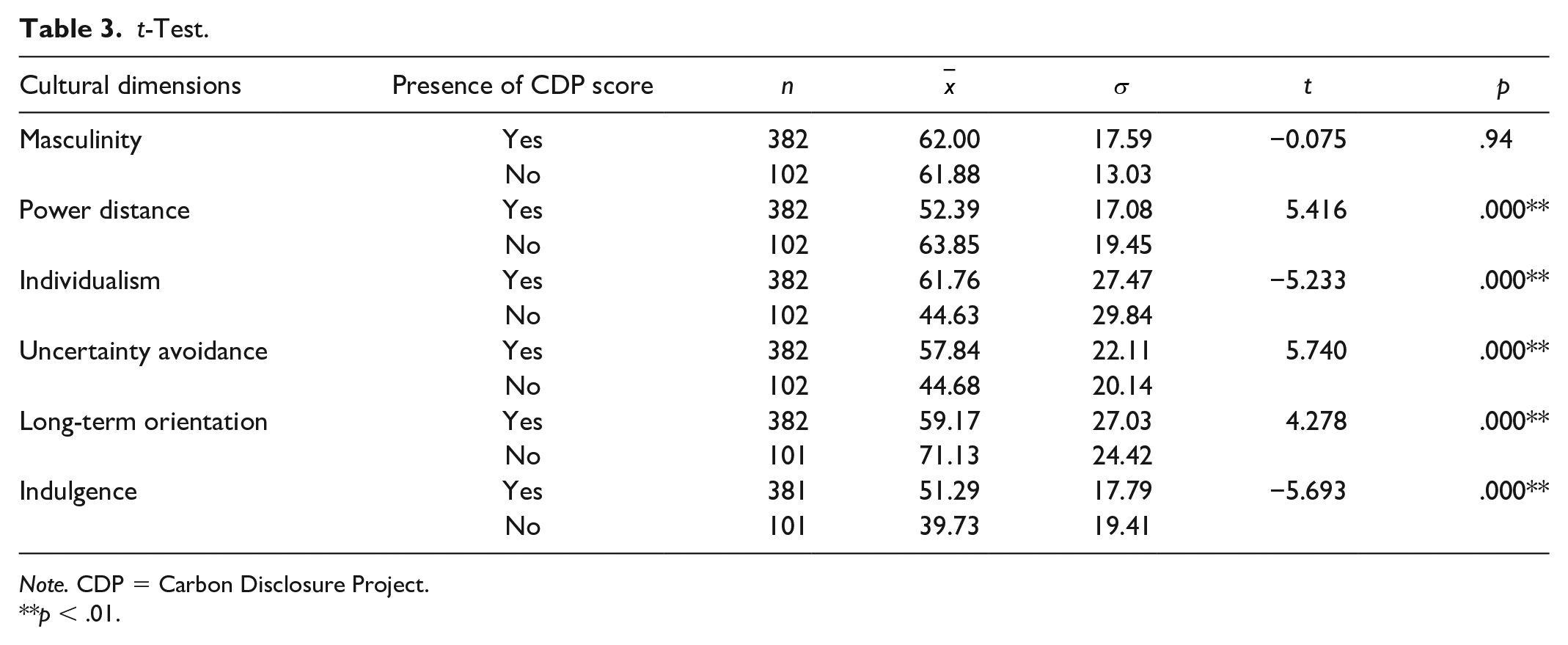
Note. CDP = Carbon Disclosure Project.
p < .01.
According to the one-way analysis, H2a was partially supported. As a result of the one-way analysis of variance, the CDP climate change scores of the Global 500 companies differ according to the cultural dimensions to which they belong—except for the dimension of masculinity. The relationship between cultural dimensions and CDP scores is as follows: power distance (F = 16.803; p < .01), individualism (F = 9.924; p < .01), uncertainty avoidance (F = 12.595; p < .01); long-term orientation (F = 2.261; p < .05), indulgence (F = 2.261; p < .05). There is no difference in the dimension of masculinity (Table 4).
One-Way Analysis of Variance.
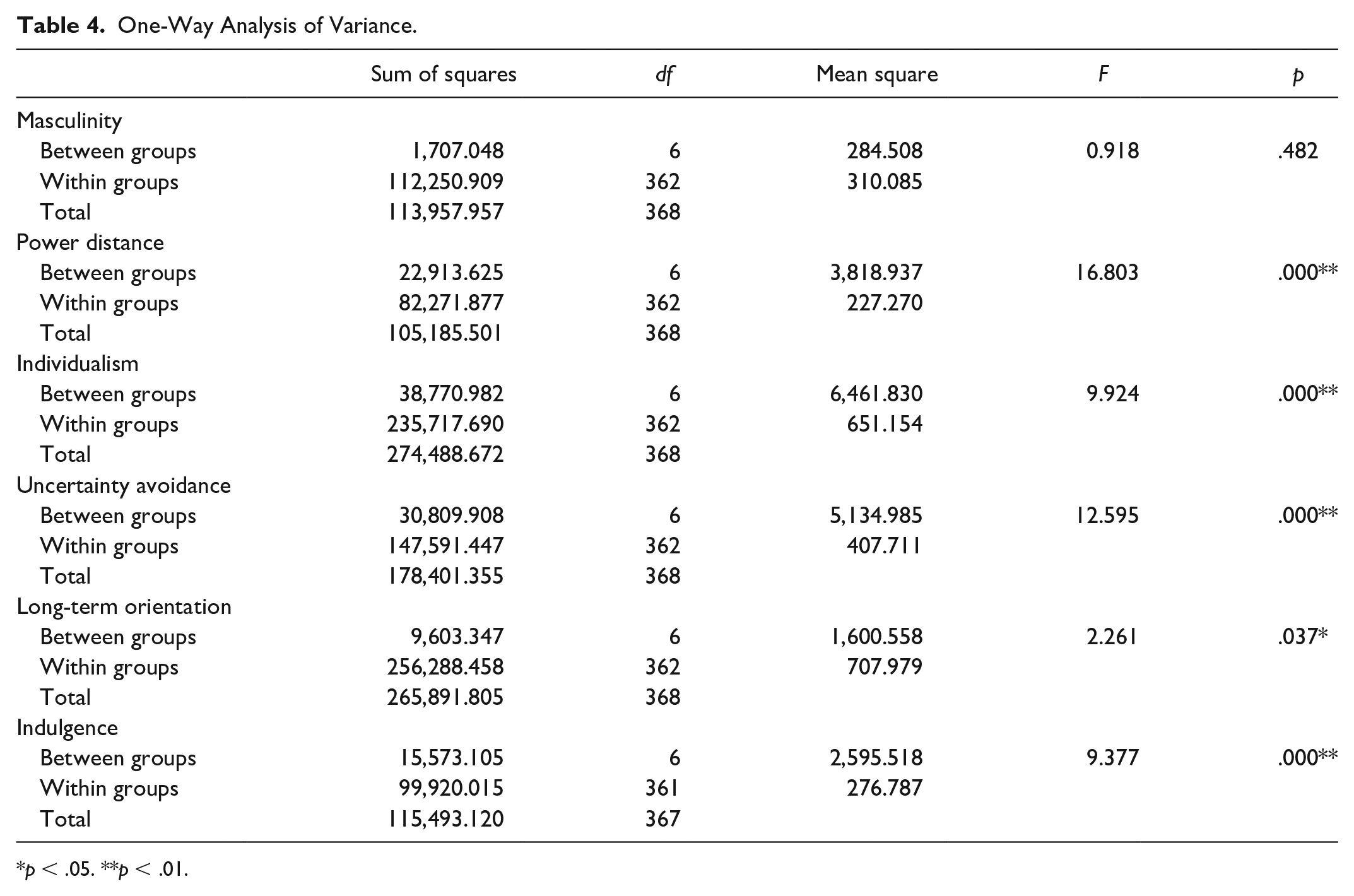
p < .05. **p < .01.
Tukey Test.

p < .05.
Tukey test was performed for different dimensions. As a result of this test, power distance scores (A-, B, C, D of CDP scores differ. In other words, as the power distance increases, the climate score decreases. Individualism scores (A, A-, B, C> F) of companies with higher CDP scores in the individualism dimension appear to be higher. In other words, CDP scores were higher as the individualism score increased. Again, the uncertainty avoidance and indulgence (A, A-, B, C> F) scores of companies with high CDP scores differ. Companies with a CDP score of C have a lower long-term orientation than those with an F (C <F).
According to the t-test analysis, H3 was partially supported. As a result of the t test, the existence of water security application according to the cultural dimensions that Global 500 companies belong to—apart from the dimension of masculinity—differs. Global 500 companies’ water security applications do not exist in the power distance (t = 6.443; p < .01) and long-term orientation (t = 4.246; p < .01) is high in cultures where differences occur; the existence of the company’s water security practices; individualism (t = −5.732; p < .01), uncertainty avoidance (t = −6.337, p < .01), and indulgence (t = −5.783, p < .01) scores are high in the Global 500 companies belonging to cultures (Table 6).
t-Test.

Note. CDP = Carbon Disclosure Project.
p < .01.
According to the one-way analysis, H3a was partially supported. As a result of the one-way analysis of variance, the CDP water security scores of the Global 500 companies differ according to the cultural dimensions to which the only difference is in the uncertainty avoidance dimension (p < .05) as can be seen from the Table 7.
One-Way Analysis of Variance.

p < .05.
As can be seen from Table 8, the only difference is in the uncertainty avoidance dimension (p <.05). Tukey test was used to determine the direction of this difference. According to the test results, the uncertainty avoidance scores of the companies with B water security application scores are higher than those with the F score (Table 8).
Tukey Test.

p < .05.
According to the t-test analysis, H4 was partially supported. As a result of the t test, the existence of the forest application according to the cultural dimensions that Global 500 companies belong to—apart from the dimension of masculinity—differs. While there is a difference in the cultures where Global 500 companies’ forestry practices do not exist and the distance and long-term orientation are high, the existence of the company’s forest practices; individualism, uncertainty avoidance, and indulgence scores are high in the Global 500 companies belonging to cultures (Table 9).
t-Test.

Note. CDP = Carbon Disclosure Project.
p < .01.
In forest applications, timber, palm, cattle products, and soy scores appear as F. The number of firms receiving other scores is very small and it is not possible to compare cultural scores (Table 10).
Frequency.

Conclusion and Discussion
Climate change and environmental problems are one of the most critical challenges for a sustainable world. National culture also plays a vital role in understanding the company management’s responses to climate change. This role concept is fundamental because climate change is managed by people and is mainly influenced by national cultural preferences. Thus, we assume that the regulations on climate change depend on cultural prescriptions. Therefore, national culture can be a critical determining factor underlying fundamental differences in climate change practices and policy between countries. However, previous studies have not investigated this relationship (Liao et al., 2015; Luo et al., 2012). Our research purpose to fill this gap. It is essential to learn about the differences in how companies in different cultures think, act, and feel. Because global climate change is a global problem which requires cooperation with different cultures from all nations. One of the critical organizations of this cooperation process is CDP. CDP is a voluntary platform where organizations are informed about their activities and policies related to climate change, water security, and forest security.
Our study is based on CDP data, which is one of the largest data sources on climate change information in the world. Also, CDP data provides information on greenhouse gas emissions, carbon accounting, public and governance communications, and carbon risks and opportunities (Luo & Tang, 2016). The results of the international context of our study make it suitable for the masculine, high-power distance, collectivist, uncertainty avoidance, longterm oriented, constrained countries that are identified by Hofstede in the Global 500 companies in the states that signed the Paris agreement. These Global 500 companies employ 69.3 million people and operate in 34 countries (Global.com/global500/2019). In the study, it is seen that low power distance, individualistic, uncertainty avoidance, short-term oriented, and indulgence cultures come to the fore in water and forest applications. Our study is consistent with the research of Ringov & Zollo (2007), Coulmont & Berthelot (2015), Park et al. (2007) and Cox et al. (2011), Calza et al. (2016), Luo et al. (2018), Ben Amar & Chelli (2018). The results show that cultural characteristics are essential in explaining climate change.
On the other hand, the findings show that culture has an increasing impact beyond its financial incentives for a globally acceptable climate deal. Thus, the importance of taking into account the cultural backgrounds of the countries to create the necessary negotiation environment in combating global warming is emphasized once again. Also policy reform has become a requirement to create a compelling investment climate and go beyond voluntary commitments. Policymakers may make administrative, financial, informative and innovative regulations in favor of climate policies. In this context, economic policies, reforms aimed at increasing the value given to natural resources can be specified as financial subsidies for renewable energy initiatives. Informative regulations are; the development of reporting practices for climate regulatory activities is developing an international information network to connect investors in climate change projects (Clark et al., 2018; Gallagher et al., 2019). Administrative regulations, setting upper limits for carbon dioxide emissions, rules for reducing coal use, removing fossil fuel subsidies, differentiated electricity tariffs, air pollution standards, energy efficiency standards for buildings and equipment, phasing out old and inefficient power plants, and the national emissions trading system can be listed as zero-energy and electricity-generating, zero-emission aviation practices (Höhne et al., 2017; Gallagher et al., 2019).
Limitations
This study has some limitations. First, the primary data on carbon disclosures were based on the CDP questionnaire, and cross-sectional data were used. The main reason for choosing one-year CDP data here is that the companies included in the data set do not consist of the same companies each year. The areas where companies are subject to evaluation are different every year. No doubt a year-based comparison, balanced or unbalanced panel data analysis or regression might have provide a deeper understanding. However the nature of this data is not proper for such a long-term analysis. On the other hand, it is not possible to make comparisons for companies having more than one country of origin at the same time. Future studies may find it useful to analyze the companies in each country and to reveal the country specific differences. As mentioned in other sections of the study, data on CDP scores were.
