




Abstract
South Korea imports a large amount of agricultural and aquatic food products from China, which meets its food security. However, the import from China raises food safety questions, leading to food safety apprehension. We explored the source of the Korean consumer’s apprehension. Based on the apprehension reduction theory (ART) developed from interviews with Korean consumers in the first stage of the study, we conducted a survey to assess the social media as an indirect source of information and direct experience of the consumer in the second stage of the study. We received 504 responses, of which 1/3 of the respondents had visited China in the last year. Using FSS (Food Safety Satisfaction) as the dependent variable (1—low to 5—high), we link information from the social media vis-à-vis direct experience and made three discoveries. (a) The information quantity of social media increases the consumer’s apprehension, partially refuting the ART. (ii) FSS increased in response to information flow from the direct experience of the consumer with Chinese imported food. (c) The direct information from experience mediates the effects of indirect information (social media) on apprehension about agricultural and aquatic product imports. We made three inferences. First, information quantity and quality have separated roles in the ART. Second, social media increases the free-market style information flow, turning legitimate products to illegitimate and vice versa. Third, the collective irrationality from the information quantity needs institutional bricolage to legitimize the chaotic nature of the untamed information.
Keywords
Introduction
South Korea imports a large proportion of its agricultural food such as Kimchi and aquatic products from China. A reliable estimate shows South Korea (henceforth, Korea) imports 98% of its national needs for the unprocessed and processed Kimchi products (Canadian Government, 2011). The import of aquatic products like fisheries is another necessary import from China. For instance, the imported aquatic products created a trade deficit of $1.4 billion of the Korean economy in 2009, and 31% of it goes to China. Both products fall into the perishable categories, which increases the distribution cost, making an economic argument. At the same time, both products make a normative argument: fisheries have become normative products on the food hierarchy of affluent Korean society; Kimchi has a symbolic cultural relevance to Koreans.
In particular, Kimchi meets normative and economic conditions in the minds of Korean consumers. First, Korean consumers use Kimchi as a stable food item, which carries nutritional and symbolic values. Multiple authors trace its cultural and historical roots, explaining its technical and social aspects (Hong et al., 2014; Jung et al., 2014; E. K. Kim et al., 2011; E. Y. Kim, 2013). Second, Koreans consumers use unprocessed material and processed products at multiple festive occasions. Third, the supply, price, and Korean proximity with China make the economic and normative logic for the import (Lee, 2014). Fourth, with the rise of the Belt and Road Initiative (BRI) and free trade agreement initiatives, China has announced to double agricultural trade with Japan and Korea (Xinhua, 2018). The increased demand in Korea and competitive supply in China makes economic and normative sense for the trade between the two countries.
Between the economic and normative demand and supply of Kimchi and Fisheries imported from China, the consumer’s apprehension about the food safety hampers the exploitation of the full capacity of a possible trade between China and Korea in the agricultural and aquatic sectors. A survey on general food safety concerns in Korea (Choi, 2004) reveals that 41.5% of people had concerns with the food safety, 20.6% had concerns with the taste and appearance of the food, 12.7% had concerns with the price, and 12.3% had concerns with the nutrients (12.3%). A second study on the imported food from China (ConsumerKorea, 2012) reveals that Korean consumers rate food safety of Chinese products 1.5 (out of 5) on the Food Safety Satisfaction (FSS) scale. In comparison, the same consumers rated Australia (3.31), European Union (3.02), the United States (2.92), Chile (2.85), and ASEAN (2.19) higher than that of China. The lowest FSS rating and the highest economic and normative demands place the Sino-Korean business in agricultural and aquatic food products in a dilemma—high-trade and low-safety perception. Why does the Korean consumer find Chinese food comparatively lower on the FSS scale, and what causes this apprehension?
We address this question about the consumer’s apprehension about food safety by exploring the sources of information flow to the Korean consumer and separate perceptual and factual causes of apprehension. We conducted this study in two stages: qualitative and quantitative. In the qualitative part, which we used in the background context and questionnaire development, reveals two sources of information flow to the Korean consumer—indirect and direct. The indirect information flows from social media, especially the internet such as YouTube channels; the direct information flows from the purchasing experience of the consumer. In the quantitative part, which enables us to test the two sources of information flow to the consumer, we report on our findings on the isolated and interactive effects on the FSS. To frame this research design and analysis, we developed ART (apprehension reduction theory), which posits that the quantity of information flow reduces uncertainty.
Does the information quantity from social media (free flow of information) influence the Korean consumer’s food safety apprehension? Does the direct experience (quality of information flow) mediate the indirect information flow on the food safety apprehension of the Korean consumer regarding the imported food from China?
The next section develops the framework for this study. The third section reports methods of data gathering and analysis. The fourth section reports findings. The last section deals with discussions, implications, and limitations.
Framework
The framework follows the earlier introduced research questions in several steps. The first part shows the problem as the phenomenon of interest in the research (food safety apprehension (FSS). In the conventional model, the apprehension (Y) and its implications (Z) are given, and we explore causes (X) through the qualitative study and then tested it through survey data. The chronological order of steps in the research design captures the essence of our aims and objectives of the study as a process and product. The final product in this research map shows whether personal experience reduces apprehension associated with social media–based apprehension in Figure 2. Thus, Figure 1 shows our focus, contribution, and process of achieving that purpose.

Research scope, problem, and question.
ART
The ART explains the role information quantity, quality and a combination of them reduce the consumer’s apprehension about food safety. These information components in the apprehension reduction outcome build on the information processing theory that posits that information about objects, events, or person reduces the actor’s uncertainty about those entities (Berger, 1986; Bradac, 2001; Kramer, 1993, 1999). It follows that the information quantity negatively correlates with the uncertainty of people about things because uncertainty means lack of information about the issue. As the information of the person increases (about people, objects, or events), the level of uncertainty goes down. Several authors have provided an in-depth discussion on this inverse correlation between information flow and uncertainty reduction in the established literature in multiple fields of studies (Kramer, 1999; Malik, 2011; Sunnafrank, 1986; Wilson, 2004). For simplicity and precision, we use Figure 2 to build the ART framework based on the uncertainty reduction theory (URT) cited in this literature. Before proceeding to the ART framework, we highlight the focal concept of food safety apprehension.

Uncertainty reduction theory (URT).
Food Safety Apprehension
The notion of apprehension refers to anxiety, ambiguities, and uncertainties about a person, object, or thing (Lazarus & Smith, 1988; Lerner & Keltner, 2000). The notion of apprehension means uncertainty and fear of the unknown, and it produces a valence such as a response. The response may be intended, such as a deliberated decision to do something, or it may be an unintended such as sweating or goose bumps. In other words, the emotion related to an event, object, or person elicits a response, depending on the situation. In other words, the emotional response depends on a context-specific phenomenon (Forgas & Laham, 2009). Likewise, the apprehension about food safety reflects on the information stimuli that elicit a response from the consumers. A consumer watching a YouTube video interprets information for decisions, which means that information inflow shapes the consumer’s apprehension. Ideally, ART suggests that apprehension should decrease with the increase in the free flow of the information to the consumer. Figure 2 demonstrates a simplified version of the quantity of information linked to the food safety apprehension.
Indeed food safety apprehension has increased because of the population pressure in the world (Xiang et al., 2020), making food security a critical challenge for the world population (Anderson et al., 2014; Haan, 2001; Lin, 2014; McCalla & Revoredo, 2001; Nepusz et al., 2009; Oyeyinka & Sampath, 2009; Verger & Boobis, 2013). International organizations, integrated markets, and nations have direct and indirect concerns about the sustainable supply of food on the planet earth. Food safety and security dilemma often appear together in the literature. Food security apprehension increases because of the excessive population pressure and limited supply, making way for potential crisis (Verger & Boobis, 2013; Williams, 2012). On the supply side, the environmental factors further exacerbate the situation in the world (Xiang et al., 2020). Then cultures, skills, and social support vary across communities in the world (Lê et al., 2015). Therefore, food safety and security affect and reflect each other.
Unsafe food contributes to the shortage of food supply because hazardous contents such as toxins, lack of sanitation, harmful industrial additives, substandard processes in the food, and misleading labeling of ingredient raise safety concerns (Crandall et al., 2012; Lin, 2014; Smith DeWaal & Guerrero Brito, 2005). Food safety apprehension has further increased with the changing nature of international trade because of the complexities of logistics and diversity of sources. In this sense, the food safety and security complement each other toward a general security issue within and between nations (Silva et al., 2011; Silver & Bassett, 2008; Simopoulos, 1998; Slorach, 2006, 2013). On top of these conditions, the information about the new technologies for the food safety differs across regions (Galati et al., 2019; McFadden & Huffman, 2017; Wongprawmas & Canavari, 2017). Thus, the food safety apprehension has an international relevance more than national relevance in the globalized world, and some countries rely more on imports than others.
South Korea imports had followed some critical incidents that influenced the Korean consumer’s perceptions. In 2005, the Korean safety agency found some amount of parasite eggs in imported Kimchi from China to the media (The Economist, 2005). The KFDA (Korea Food and Drug Administration) further revealed that the parasite eggs had made their way into the cabbage (ingredients for Kimchi) from the human excrement. The Korean consumer felt a sense of resentment because Kimchi resembles a national icon for the Korean people in the cultural context. In another incident, the imported Chinese Kimchi brought malachite green, a suspected carcinogen, in fishery products (The Economist, 2005). These safety incidents highlighted the agricultural and aquatic concerns within products and between imported products at different times from China. These limited cases created a high impact in the media. The widespread apprehension about the food safety persists because of the lack of information or the abundance of it. The abundance of information implies the quantity of information through social media, and incidents of small scale reach the consumer at a large scale (Cohn, 2001; C. L. Liu, 2010). The lack of information implies the quality of information. The combination raises the attention to the perception before the apprehension.
Perception Theory
Perception about a thing, event, or object builds on the interaction between stimuli and mental scripts. The stimuli refer to information representing a situation or context, and mental scripts that refer to the frame of reference developed through historical events. Actors interpret stimuli and decide on it based on their mental models. Mental models lack sufficient capacity to process information quantity (Simon, 1986; Simon, 1991). Because of the limited capacity of mental capacity for information processing, actors rely on the primer of decisions (March, 1994). For instance, as a primer of attention and influence, the media alter meanings and responses. Likewise, actors interpret information based on existing models from their previous interaction with the information. In the psychological terminology, “halo effect” explains the processes involved in the consumer’s perception (information and its interpretation). The “halo effect” posits that qualities of one aspect of an entity overshadow its other qualities (Thorndike, 1920). Likewise, the “halo effect” influences one entity because of its association with another entity. For instance, the negative aspect of an entity overshadows the positive aspect and vice versa (Goldman et al., 1983). This rule of “halo effect” applies to food safety perception and apprehension because of the internalized models of the consumers.
In the Korean context, the “halo effect” emerged in 2001 when Korean consumers reduced meat consumption because the BSE (bovine spongiform encephalopathy) disease broke out in Japan (Jin, 2008). Koreans never imported beef from Japan at that time, but they stopped consuming meat products imported even from third countries. Based on the media reports, the consumer reacted to food safety issues elsewhere. Prior research links this phenomenon of same product between countries to perception through processes of “halo effect” (L. Wu & Zhu, 2015). Likewise, different products in the same country carry a halo effect on consumer’s perception. In China, a milk production company engaged in illegal practices produced had a negative “halo effect” on the entire dairy sector (Jia et al., 2012; Lam et al., 2013; The Lancet, 2014). Such adverse “halo effects” also influence food products in other sectors because they originate in China.
Studies show that the “halo effect” of food safety stems from two sources: the perception of the new technologies and the channels of information flow (Galati et al., 2019; McFadden & Huffman, 2017; Wongprawmas & Canavari, 2017). The technological aspect contains elements of intentions and capabilities. For instance, the consumer may believe that the supplier has intentionally affected food safety through additives for profiteering. Alternatively, the consumer may believe that the producer, regulatory agencies, and distributors lack technical skills. Korean as a member of the OECD (Organization of Economic Cooperation & Development) demands a level of training and skills, and the lack of such skills and training raises food safety apprehension (Soon & Baines, 2012). For instance, the lack of skills hampers the transformation of scientific knowledge to the industry, and the barrier to the conversion of science into technology reduces the safety or security of the food production chain (Jongwanich, 2009; Shukla, 2012).
Even if technical skills in food safety exist, it is insufficient without regulatory agencies’ involvement because technical skills produce desired effects when effectively implemented. The exclusion of the institutions misplaces the risk away from its sources because science and technology play one part and regulatory aspect play another role in this situation (Shan et al., 2013). As a result, consumers form their perception based on their understanding of multiple factors for the food safety (Soon, 2012; Zorba & Kaptan, 2011), that the perceived food safety concerns increase or decrease apprehension. The evidence links both the ability and willingness effects on the food safety scandals in China (Shan et al., 2013; The Lancet, 2009; Y. N. Wu & Chen, 2013).
Regarding the information channel, information about the new food technologies flows to the consumer indirectly and directly. Indirectly, the role of social media has become a critical factor. For instance, the so-called gutter oil phenomenon on YouTube informed many consumers around the world about food safety issues in China (Li et al., 2017). References were made to it several times during interaction with respondents. A Korean participant alluded to the gutter oil story that has captivated the audience. The other source of information reflects the direct experience of the consumer with food safety. A survey in China shows that emotional perception creates a higher level of safety apprehension than the experience of the consumer (Mou & Lin, 2014). Therefore, adverse incidents about food safety, coupled with the indirect information flow through social media, create trickling-effects within and between products.
As we noted earlier, the “halo effect” travels through multiple information conduits, but two conduits of information flow stand out in the context of Kimchi and Fisheries in Korean. First, the free flow of information from the social media (e.g., YouTube television) links the consumer with the product, its suppliers or the country of origin. The social media affects the audience’s perception more than does the factual experience (Mou & Lin, 2014). Notably, social media plays a vital role in Korea for its rich information technology culture, highly developed infrastructure, and highly organized broadband penetration (The World Bank, 2018). In contrast, many Koreans have direct experience with Chinese food through tourism, cross-country cultural exchanges, integrated business relationships, and cultural proximities.
Methods
We used a two-stage methodology to develop the argument in this article. The first stage includes a qualitative research method. From 2014 and 2015, we conducted interviews with experts from China and Korea. We also visited state agencies of China in the Northeast region of Korea in Seoul. Part of the qualitative research included observation of the supply chain, and we explored information obtained from several public research institutes. This stage contributed to developing questions related to innovative technologies, consumers’ understanding, agencies’ functions, and national policies. We contextualized those qualitative questions and answers from the exploratory stage, and it revealed two aspects: (a) the benevolence versus malevolent dimensions of the technology and (b) the role of the social media. The benevolent–malevolent duality refers to the interpreted dimensions of technology as good or bad. We borrowed this term used by the first author in a paper on nuclear technology presented at the Academy of International Business (AIB) in Milan, 2008. Like any technology or tool, the new technologies used in the agricultural and aquatic food products have positive (benevolent) or negative (malevolent) value in the mind of the user. This duality of the technology trickled to the consumers through indirect information about the social media and direct experience of the consumer.
The second stage of the research conducted a survey data to assess the effects of indirect information processing from social media and direct information processing personal experience. We used a series of questions in the survey method at this stage. Table 1 shows a preview of those questions distributed through convenience sampling method (Lavrakas, 2008). Ideally, a random sampling increases internal validity and external reliability. Practically, it limits a researcher like ours for several reasons. First, random segmentation makes it challenging to find those who visited China versus others among the Korean population. Likewise, it is difficult to differentiate between different types of respondents directly or indirectly involved in the imported food as distributor, retailers, or consumers. Second, the random sampling method increases the cost and time to complete the project, and it alters the scope of the research project. The current article has a limited scope that a convenience sampling serves it effectively. Third, some projects benefit from nonrandom sampling more than others. For instance, the snowball sampling served our project effectively, which means that one respondent introduced us to the second one and that respondent referred us to the third one.
Survey Questions and Responses.

Note. Scale = 1 (low) to 5 (high).
The authors visited several Korean cities (Seoul, Sejong, Dejon, and Gyeongju) and several Chinese cities in interview Korean citizens staying in China. We received responses in three ways. The author filled, the respondent filled it in front of the researcher, or the respondent filled the questionnaire in days or weeks. The fourth method included electronic media for the questionnaire. As some participants requested more to understand the questionnaire, we collected their responses after a gap of a few days by sending reminders to them. Thus, the sampling method is similar for all the participants, but the data collection method varies between authors-filled and respondent-filled questionnaires.
Social Media Versus Experience
Social media creates a quantity of information to the consumer from indirect sources; the direct experience of the consumer generates qualitative information. The quantitative research from the social media, such as the YouTube channels, has played a role in the information flow from on the food safety issues to consumers in Korea. Among other sources, YouTube became the hallmark of the open information flow, which has unlimited boundaries in scope, scales, and skills, and it alluded to the quantity of information flow to consumers. In contrast, the personal experience of the consumer reduced the quantity of information flow, but it increased the quality in the ART framework. The consumer’s personal experience refers to direct information as it builds on learning-by-using against learning-before-buying. Thus, based on the indirect (quantity) of information from the social media and direct (quality) of information through personal experience, we tested whether social media versus experience positively or negatively influences the Korean consumers FSS in the survey.
We used two food items associated with the usage of new technologies: agricultural products and aquatic products. Then we divided the information flow between the social media (direct flow) and personal experience (indirect flow). About 2/3 of the respondents lived in Korea, and 1/3 of them have lived in China for over 6 months. Snowball sampling had enabled this distribution of the sample for the interest group and default group. According to the ART framework, we propose that the direct experience of purchasing differs from indirect information from the media, altering the notion of apprehension about food safety. In other words, experience mitigates the apprehension effects from the direct information flow from social media. First, the evidence from various streams of research shows that the product adoption occurs through the direct experience of the consumer. Second, direct experience improves information quality more than quantity through indirect sources. Third, the direct experience alters the attitude developed from cognitive information processing. Thus, we predicted that social media reduce FSS of the Korean consumer, and the direct experience with the purchasing and using the product improves the FSS.
Table 1 shows a list of questions and their rated responses. The FSS (2.64) rating shows a little higher than the neutral position between less or more satisfied respondents. The next set of variables shows the summary of indirect information flow (social media) and direct information flow (the respondent’s experience). We received 50% (501) responses out of 1,000 expected responses. This response rate is comparable to other studies. One study on food insecurity has used a similar method (a combination of qualitative and survey) in Australia and received 364 responses, with the response rate of 63% (Lê et al., 2015). Another study in the United States explored the consumer’s trust in the information from the media sources and regulatory authorities, and it received 369 participations in the analysis (Galati et al., 2019; McFadden & Huffman, 2017). A third study closely relates to our research project in Thailand. It received 200 responses (Wongprawmas & Canavari, 2017). Compared to this literature, our sample (501) is above average compared to previous surveys.
Dependent variable
FSS measures the Korean consumer’s attitude to Chinese imported food on the Rickert scale (1—disagree; 5—agree). We took the log of the dependent variable to transform it from the ordinal to a normal distribution.
Independent variables
Two types of variables represent independent variables.
Social media (binary)
Personal experience (binary)
Agricultural products (factorized)
Aquatic products (factorized)
Before factorizing the two scales for the analysis, we tested the internal validity of four items for the construct of agricultural products, which produced the Cronbach’s Alpha 0.88. Then we tested the internal validity of three items for the construct of aquatic products, which produced the Cronbach’s Alpha 0.856.
Model and Analysis
Table 1 shows the description of the variables and measurements. We used linear regressions to model the statistical technique after transformation of the ordinal dependent variable into a continuous variable. The straightforward statistical analysis of the continuous dependent variable followed the straightforward specification, which is followed by the variables in Table 1 below.

Y = dependent variable.
Xs = independent variables.
βs = coefficients,
β0 = constant term
e = error term.
To estimate the coefficient, we used maximum likelihood estimation (MLE). We report results from these estimates in the following.
Results
Table 2 shows intervariable correlations. The table shows a large set of variables in response to measures used in the survey. Two focal variables show positive correlations with the outcome variable—FSS. The agricultural products and purchasing experience show positive correlations with FSS. Based on these variables, we perform a regression analysis in the next table.
Summary and Intervariable Correlations.

Note. N = 505.
p < .05. **p < .01.
Table 3 shows three models and presents regression results in steps. Based on the last model, we find that agricultural product shows a negative correlation with the FSS, and purchasing experience shows a positive coefficient with FSS. Thus, agricultural products decrease the consumer’s safety satisfaction while purchasing experience increases safety satisfaction (Wongprawmas & Canavari, 2017). Based on these results, we introduce interactions in the next regression result.
Regression on Food Safety Satisfaction.

Note. Dependent variable = Food Safety Satisfaction. Linear Model (OLS). N = 505.
DOF = degree of freedom; VIF = variance inflation factor; FSS = food safety satisfaction.
p < .05. **p < .01.
Table 4 shows multiple models to capture various predictors and their effects on FSS. Model 7 shows the result of the conclusion, and four variables take prominence: agricultural product, media, agriculture–media interaction, and purchasing experience. First, the agricultural product becomes marginally significant after introducing media, interaction, and purchasing experience. Second, the information flow from social media shows a positive coefficient with the FSS, change the minds of information consumers. Third, the interaction between agriculture and media changes the direct sign or reduces the effect size, which implies that agricultural products and media-based information lead to negative FSS. Last, the purchasing experience positively predicts FSS. In other words, the respondent who purchased products from China had a positive reflection on Chinese food imports. Based on the last column in Table 3, we discuss results in the following section and doing so; we use figures as analytical tools to explain these findings.
Media Versus Purchasing Experience Effects on Food Safety Perception in Korea.

Note. Dependent Variable: Food Safety Satisfaction (FSS). N = 505. DOF = degree of freedom.
p < .10. *p < .05. **p < .01.
Discussion
South Korean consumer faces food security-safety dilemma in the imported agricultural and aquatic products. On one hand, the import resolves the food security dilemma of the consumer market, filling the gap between excessive demand and limited domestic supply. On the other hand, food safety concerns increase the consumer’s apprehension, hampering imports and supporting the food security question. To resolve the food safety apprehension and the food security dilemma, we deem it necessary to explore the source of the consumer’s apprehension about food safety. This study uses a two-stage resource to understand the underlying mechanisms in information access and meaning. In the first stage, we conducted multiple interviews with the Korean consumer. In those interviews with consumers, we identified the three dimensions: (a) the awareness and preference for food safety issues, (b) the concerns of the consumer about the safety, and (c) the source of consumer’s information flow. Based on these dimensions, we developed the ART framework which we borrowed from the idea of URT from the communication literature (Berger, 1986; Bradac, 2001; Kramer, 1999).
In the second stage of the research, we defined new technologies such as digital and social media in the information flow between producers of information and consumer of information on the food safety issues. Previous research on the role of technologies on the effect on the consumers’ perception of food safety explains the role of social media in multiple markets (Galati et al., 2019; McFadden & Huffman, 2017). This study uses social media (e.g., YouTube) to assess the effects of these technologies on the consumer’s perception of food safety in Korea. Based on a survey developed from the interview-based analysis, we received 501 useful responses (50% response rate) from the Korean consumers. In the interviews and later in the questionnaire development, we made a specific reference to the imported agricultural and aquatic products from China, rather than including the national food supply or general imports from other countries. Figure 4, as the output of the interview stage of the research and input on the survey, guided the questionnaire.
The analysis reveals that two sources of information stood in perceived FSS. The first source of information suggested that information quantity reduces apprehension and improves satisfaction. We introduced this quantity variable in the model based on the assumption that information flow reduces uncertainty (Berger, 1986; Bradac, 2001; Kramer, 1993, 1999). In the same way, the information quantity accessed in the social media would reduce the consumer’s food safety apprehension. Surprisingly, the results reveal the opposite correlation. Instead of decreasing uncertainty and apprehension, the free flow of information quantity of social media decreases the Korean consumer’s apprehension about food safety. For instance, social media (e.g., YouTube channels and similar other unsolicited online sources) increased the quantity of indirect information to the consumer at the cost of the quality of the direct information.
Then we introduced the direct information source to assess its impact on the consumer’s apprehension. Results show a decrease in the apprehension and an increase in the FSS. The respondents who had purchased food during the last year reveals decreased uncertainty and improved satisfaction. To explain these counter-intuitive results in the social media, free flow of contents and quantity of news, we used analytical models and theoretical context to explain. Analytically, Figure 3 shows the opposite directions of the correlations between the information sources and the FSS. First, the quantity and quality of information type and sources reveal a different set of implications on food safety perceptions of Korean consumers. Second, social media’s agenda-setting principles have influenced the consumer’s perception, which may counter to information about the new technologies. The social media aims to increase its hit-rate to attain the celebrity status, which makes it vulnerable to present emotionally charged news related to accidents and scandals to generate fear for better attention of the consumer. The free flow of information and untamed social media has the potential to transform illegitimate issues into legitimate ones and vice versa. Third, collective irrationality sets in when the number of users increases.
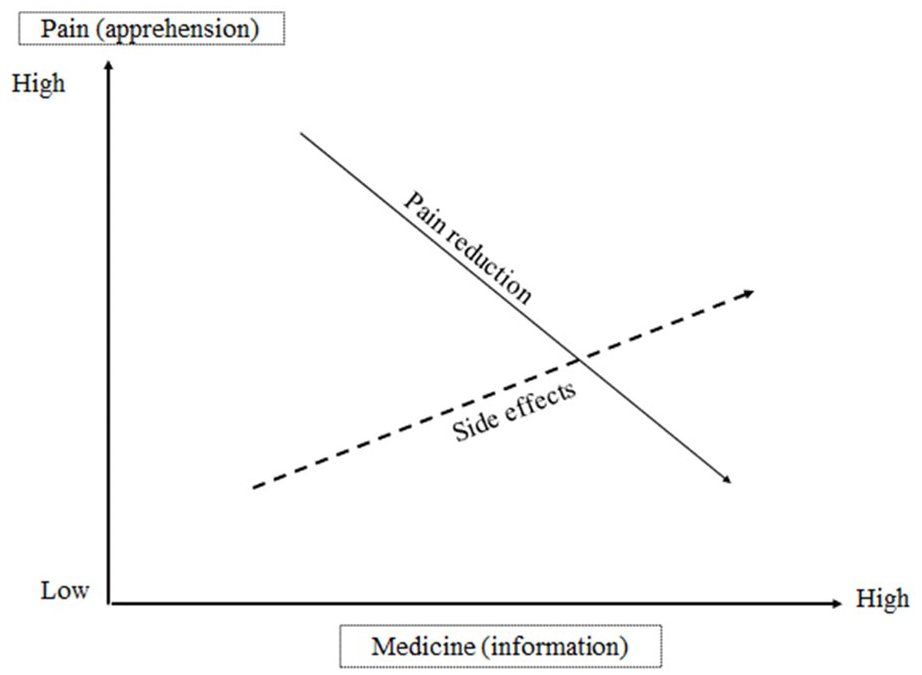
Analogy medicine effects: Pain reduction and side-effects.
Generally, the critical perspective improves the overall quality of the information provided the supply has the ability and willingness to justify. However, the free flow of information from untamed media information closes the door for justification. The free social media, such as YouTube, rarely answer questions to the audience. The critical theory requires a dialectic between the information producer and consumer. Social media reduce these dialectics to unidirectional information flow—from the producer to the consumer, and not the other way around. The consumer’s questions and information barely flow to the consumer, and it fails to elicit justification from the producer of the food product or the new sources (social media). The legitimacy of the information flow maintains the contents, but it lacks legitimacy in social media. The audience ends up relying on the media in unsolicited and unwarranted information. As a result, the suboptimal solutions to food safety and security problems may occur.
Theoretically, we link the information contents and its legitimacy to the change in the outcome, contributing to the ART. In this development, the information content and its legitimacy complement each other. Whereas the information may satisfy the technical part of the consumer demand and conceptual development, it lacks justification and legitimacy. Alternatively, legitimacy of the information sources, contents, and producers may reduce apprehension, the lack of information contents reduces FSS. In other words, the increase of quantity and decrease of quality or decrease of quantity and increase of quality partially answer the question. Together, the increase of quality and quantity improved the food safety issues, reduces apprehension and creates consumer’s satisfaction. In short, the contradiction between quantity and quality fail to reduce apprehension, and complementary between the two types of information succeeds in reducing the consumer apprehension.
Metaphorically, the notion of “side-effects of information quantity” explains this dilemma. Like drug therapies that target the disease and reduce pain but also induces some unintended side-effects, the information quantity has side-effects along with the treatment of apprehension. Why does the quantity of information flow from social media cause apprehension rather than hampers it? Several points come to fore to explain this dilemma. First, the lack of institutional development causes such side-effects of the free flow of unwarranted information. China lacks institutional development to manage food safety issues (Sun et al., 2014; The Lancet, 2009). In particular, inadequate development of the regulatory system in the food safety assessment and the weak enforcement of relevant policies and programs explain the persistence of problems with food safety production and distribution (Ni & Zeng, 2009). Second, the side-effects of information flow through social media influences the perception of the Korean consumer because of the negative consequences of the reported cases in China (Xue & Zhang, 2013). Third, the side-effects trickle from the trust deficient in China. Chinese consumer shows deficient trust in food safety, let alone foreign consumers of Chinese food (Chen, 2013; Lam et al., 2013). Fourth, social media bypasses the institutional mechanisms and serve the direct and indirect audiences at large. The Korean viewer’s perception is no different from other side-effects of the declining quality of information flow from unregulated sources on the internet.
Fifth, in addition to the social media effects, the salient position of China on the global scene has attracted increased attention in research and practice as well as in medical, social, political, and economic issues of various kinds. Unsurprisingly, some research alludes to Chinese institutional and structural problems in the food safety fields (The Lancet, 2014). In the same year, several other studies appeared on the incidents of Chinese food safety issues (X. M. Liu, 2014; Lu & Wu, 2014). Recently, the China–United States trade tension has increased information in social media from multiple angles, partially without legitimacy. More recently, COVID-19 has triggered new questions and opinions on social media, and its impact lasts into the future about food safety apprehension. However, the Chinese and Korean government intend to expand trade in the tripartite market (China, Korea and Japan) in billions of dollars in the next 10 years (Xinhua, 2018), which can reduce the food security issue due to the world population pressure (Xiang et al., 2020), does not reduce the food safety issues without institutional development.
We infer two policy solutions. First, the direct information flow (the quality of information) through experiential learning has played a positive role in the perception building. It appears that the direct experience of the consumers alters their frames of references and changes their attention to factual and experiential information. Figure 4 shows how direct experience (quality of information) has the potential to change the side-effects of the quantity of information. The direct link follows from the side-effects in Figure 3, represented. H2 suggests a positive correlation between most imported products (agricultural and aquatic) and media stories such as YouTube and the internet. H3 shows that the free flow of information coming from YouTube leads to a negative perception of safety. However, this negative correlation changes to a positive correlation with the interaction of personal experience (quality of information) associated with H4. This model draws support on the processes used in Figures 1–3. In short, the first solution directs the attention of relevant parties to increase the direct experience of consumers through various mechanisms.

Model contribution.
Second, the institutional development in social media can improve FSS and reduce apprehension in developing an attention structure that links the information flow to both directions. The current attention structure delivers an information quantity to the consumer; it excludes the consumer seek justification through questions, feedback, and accountability. In other words, the problem is not with the information flow; it is with the wrong information that has a high cost to society. The perceptual-actual gap of the information flow increases with the social media, providing one-sided information, its inaccurate interpretation and unwarranted actions (Kiousis & McCombes, 2004; McCombs & Shaw, 1972; Palmgreen & Clarke, 1977). Elsewhere, the organizational literature explains the role of attention structure in meaning and action (March, 1994). It suggests that a trade-off exists between perceptions and facts due to cognitive limitations of the actors and attention to incomplete information in a linear fashion. Therefore, in the increasing nature of the social media, information contents and artificial intelligence along the value chain of food production and distribution, it is necessary for the collaborative institutional development to address the attention structural deficiencies. Instead of controlling information that creates more resistance, we suggest favorable policies to complement the social media for the quality of the information in the policy formation.
Conclusion
The article contributes to the literature in three ways. First, it offers an extension on the ART. It shows that the information flow of social media increases the quantity, and in line with the notion of free information, it produces unlimited, uncontrolled, and unsubstantiated material. Instead of decreased apprehension, it increases it. We referred it to the side-effects metaphor and demonstrated in the dotted curve in Figure 3. Second, the argument that the institutional role becomes imperative to sift relevant and vital information from the illegitimate and unsubstantiated information to legitimate sources on critical issues such as food safety. In other words, we support the institutional perspective in contrast to the free market of information produced based on the desire for gaining increased hits, attract followers, and develop the celebrity status of the content producers. Third, the methodology developed through a multistage study (qualitative and quantitative data) offers cues into the process for future research across contexts. We also produced a model in Figure 4 for future research to test, refine, and improve the model in the context of cross-countries research at a general level (Malik, 2019) and Sino-Korean analysis at a specific level.
The study draws the attention of the policymakers on both sides of the borders through an interinstitutional bricolage. Interinstitutional bricolage refers to the combination of multidimensional ideas, structures, or practices. First, since the policymakers expect to increase agricultural trade worth billions of dollars, joint institutional development is critical. Both countries have made progress in science and technology; now, it is time to develop the institutional context. Second, we propose countermeasures against the two extremes: excessive control over information flow reduces the scope of the information, and excessive freedom of information unleashes information havoc. Third, physical and infrastructural development can reduce the apprehension of the consumer. For instance, joint systems linking the two countries, the supply chain, and the producer-consumer can rectify some safety perceptual and factual issues. Fourth, the two trading partners need to increase the exposure of the citizens through exhibitions, shows, seminars, and festivals to encourage the environment of interaction at the macro level, industry level, and community levels. Tourism offers a sample of such interaction.
This research also presents several limitations. First, although the sample includes 501 responses, it is still not enough to capture a large population in the country rather than in the world (Xiang et al., 2020). Second, the nonrandom sampling method in the survey limits the general relevance of this study. Third, a level of endogeneity may persist because of the limited data. Fourth, the data lack demographic attributes and other interaction variables. Fifth, panel data needed to answer causal questions. The research question has a limited scope as it deals with food imports from China without reference to other countries. This snapshot offers a partial explanation of the food safety apprehension. Further research can reduce some of these ambiguities.
In future research, we hope that researchers in the field tackle the issue of anxiety and apprehension. One possible research direction links apprehension to its antecedents and the other direction links it to consequence or implications. Indeed, apprehension influences decisions that may lead to undesired outcomes at the individual, organizational, or national levels. Second, the distribution system is less known to consumers, and if the consumer has reliable information, relevant authorities can manage the anxiety level. Researchers have a good chance to contribute to those areas in this fast-changing world in which food security and safety are affecting each other. Therefore, another opportunity for research arises from the interaction between food safety and security dilemma.
Footnotes
Declaration of Conflicting Interests
The author(s) declared no potential conflicts of interest with respect to the research, authorship, and/or publication of this article.
Funding
The author(s) received no financial support for the research, authorship, and/or publication of this article.
