




Abstract
Civil society organizations have played a pivotal role in democratization process in Nigeria since the advent of the Fourth Republic. They have greatly helped in the success of the 2015 and 2019 General Elections through pre-election, during election, and in post-election monitoring and advocacy. This article, therefore, examined the role of the Nigerian Civil Society Situation Room (NCSSR) in improving the election in Nigeria during the 2015 and 2019 General Elections. While many civil societies flourished recently in Nigeria, their role toward democratization and facilitating credible election remain insignificant until in the 2015 and 2019 General Elections where their activities helped immensely the process of a credible election. A Civil Society as the Third Tier of Government framework was adopted as a theoretical explanation of the context of the work. The research used a qualitative case study method of data collection where informants consisting of members of NCSSR, Independent National Electoral Commission (INEC), and academicians were selected for the interview and Focus Group Discussion. The total number selected was 16 from the three identified categories. The research discovered that the NCSSR aided the process and fairness of the 2015 and 2019 General Elections through proper monitoring, civic voter education, active collaboration with electoral body (INEC), and collaboration with international donor agencies through what they called “Civil Society Situation Room” which consist of more than 60 registered civil societies. The research recommends that civil societies should be empowered with constitutional backing and independent funding to enable them carry out their responsibilities adequately. Also, the article recommends that the electoral body (INEC) should liaise more and cooperate with civil societies to enable them conduct good and credible elections in future.
Introduction
Civil society is referred to as nongovernmental and personal self-help organizations, institutions, and agencies which emerged in modern times and has been identified as part of the tools for the promotion of democracy, good governance, civil rights, and democratization in contemporary times. Civil society organizations are perceived today as distinct from the state but closer to it as a cooperating partner that operate within the state in the advancement of civil liberties and voluntary services to the community (Chambers & Kopstein, 2008, p. 2). Civil societies prioritize critical national and international issues in their objectives such as the economic situation, human rights, civil rights, politics, disaster management and humanitarian aid, corruption, governments’ abuses and failures and other issues that affect the well-being of the global citizenry (Aiyede, 2001, p. 1). Civil society is an important institution that influences the settings of social life of individuals and their activities through the identification of the societal needs anchored under a common platform in facing the key challenges that affect people in the society (Canadian Foundation for the Americans, 2006, p. 1). Civil society is sometimes referred to as nongovernmental organizations, nonprofit organizations, and volunteering agencies that bridge the gap between the public and private domain in a state (Edwards, 2011, p. 1).
Civil societies operate within the boundaries of nation-states and in international environment. Domestic state–civil society relations indicate antagonism sometimes because they promote popular resistance and resentment of unpopular policies that are perceived as anti-masses (Edwards, 2011, p. 3). Since open political opposition in some states is impossible, civil society is recognized as an alternative source of struggles and resistance (Rosenblum & Lesch, 2011, p. 285). In contemporary world, the changing pattern of romance between governments and nongovernmental organizations emerged. Civil societies became intermediaries between the state and the citizens. The nature of hostility of some civil societies toward some dictatorial states in South America, East Europe, and Africa invited a negative responses and an attempt at suppression from the states. In Africa, several civil liberty movements met with many frustrating efforts from the governments (Sidel, 2011, p. 298).
The African context of state-citizens’ relations is that of authoritarian approach which necessitates for the role of civil societies in demanding democratic rule and good governance as in the case of Nigeria where civil societies are found to be more active toward democratization process (Dakyyen & Dang, 2014, p. 9). Civil society organizations are operating in Nigerian state for many years particularly during the military regimes and transition to democratic rule. Civil society played a strategic role in Nigerian democratization especially in pressurizing the military to surrender power to the civilian government. It is argued that the return to civilian rule in 1999 was actualized courtesy of the intensified activities of civil societies (Igue 2005, p. 2; Ikelegbe 2013, p. 6; Mgba 2015, p. 2). According to United States Agency for International Development (2006), civil liberty activities increased in Nigeria which have positive output on accountability, transparency, and good governance in recent times. Civil society organizations in Nigeria are proactive in aiding the process of democratization and responsive leadership (Songonuga, 2015, p. 11) because it emphasizes on maintenance of rule of law (Sall, 2009, p. 1). State–civil relationship in Nigeria is characterized with acrimony and harmony depending on the role and environment. Advocacy is often tolerated and supported while demand for accountability in governance and electoral process is received by the state with hostilities (Utsaha, 2014).
Although, civil societies are believed to have periscope, the process of civil liberty in Nigeria, they have faced many challenges in achieving their aim because of many factors which impede their success including corruption, government policies, nature of the economy, literacy level, political culture, and other related factors. An important area in which the civil society is proactive and successful to some extent is election monitoring in Nigeria. Civil societies are found to have portrayed a vital position in the electoral conduct since the inception to the conclusive aspect. This is evident in the 2011, 2015, and 2019 General Elections. This work is an examination of the role of the Nigerian Civil Society Situation Room (NCSSR) in making the process of the 2015 and 2019 General Elections better. The 2015 and 2019 General Elections are comparatively relative in terms of the performance of parties and the general conduct of the election. However, the NCSSR consolidated and expanded its role in election monitoring in 2019 more than in 2015. There was a collaboration with local monitoring agencies such as Centre for Democracy and Development (CDD), YIAGA Africa, and international monitoring groups including African Union (AU), European Union (EU), National Democratic Institute (NDI), International Republican Institute (IRI), International Federation for Electoral Systems (IFES), and several others. NCSSR jointly released statement on their observations, successes, challenges, and overall conduct of the 2019 General Election. This collaboration was not obtainable in the 2015 General Election. It simply signifies consolidation and expansion for the NCSSR. This study discovered that even with the huge presence of civil societies in the electoral process, most of the existing works in the field neglected this vital aspect and it is this knowledge gap that is identified as contribution to knowledge by this work.
Literature Review
In this section, attempt is made to review literature critically to have a bright and relevant understanding of the term civil society from diverse views. In doing so, it is pertinent to discuss subthemes such as the emergence of civil societies across the globe, the nature and types of civil societies, civil societies in Nigeria, their origin and role in democratic process particularly election monitoring and a succinct highlight of the 2015 General Election.
The State of Electioneering Process in Nigeria
The transition from military rule to democracy is a major obstacle in the electioneering process in Nigeria. This is because the process was full of malpractices and undemocratic practices owing to military close supervision and imposition. This was the situation during the establishment of the Fourth Republic (Yagboyaju, 2011, p. 11). The Independent National Electoral Commission (INEC), which is the electoral management body in Nigeria, constitutes sometimes, a stumbling block in the process of conducting election in Nigeria. In many instances, intervention and bribery from politicians made the electoral officials to succumb in a body that is anticipated to be neutral and totally independent (Yagboyaju, 2011, p. 12). Political behavior and voting pattern in Nigeria presents another hiccups in electoral conduct in Nigeria. Ethnic politics, religious manipulation, regional affiliation more than national interest, and other primordial sentiments sway supreme in determining voting pattern and electoral behavior in the country (Adeyemi, 2012, p. 1). Electoral violence is a serious threat in the conduct of elections in Nigeria’s Fourth Republic as severally established in the attitudes of politicians who sponsored ethnic militarism, intimidation of perceived threats and opposition (Abdullahi, 2015, p. 168). Failure to institutionalize political parties with sound ideology and principles diminished the flavor of the electoral process in the Fourth Republic. Politicians simply used parties as a conduit pipe for securing power without any recourse to party politics or internal democracy. The process made elections violent and tumultuous (Auwal, 2015, p. 211). Party financing and corruption affects electoral conduct in Nigeria via excessive spending, violation of regulations, and bribery and corruption leading to a scenario of those with the highest bid winning at all cost instead of quality and integrity (Adetula, 2008, p. xxvii).
What Is Civil Society?
Civil society is made up of voluntary assemblies and organizations that form part of the modern democratic system as a pressure group that promotes justice and social order (Ikelegbe, 2013, p. 16). Civil society is a combination of civil groups that represent voluntary articulation of interest and yearnings of the populace who share similar goals, purpose, and moral attitudes or social norms (Almond & Verba, 1963, p. 6). Civil society is a trend of societal interaction between individuals and the government which is displayed in the values of the societal cooperation, self-help organizations, and networks of public activities (Adibe, 2015, p. 1). Chambers and Kopstein (2008, p. 8) identified that civil society is an association and an activity that is apart from the state, against the state, in support of the state, in dialogue with the state, in partnership with the state, and beyond the state. This definition simply denotes that civil society is an association that is in coordination with the state, in contradiction and in-between depending on the interests and the issues at hand.
Civil society is a nongovernmental organization which promotes democracy and good governance across the globe through some legal activities that are entrenched in the constitution (Bratton, 1994, p. 1). Civil societies consist of wide range of organizations which are not under the government control and which are not profit oriented. This consists of civil society organizations (CSOs), nongovernmental organizations (NGOs), community-based organizations (CBOs), faith-based organizations (FBOs), trade unions, farmers association, academics, professional organizations, students movements and other activities which are not related to political organizations (Edwards, 2011, p. 13). The term civil society is becoming a wider term beyond NGOs only. It is identified today owing to its role at the global level as a wider and more active variety of organized and unorganized groups; they are more of service providers, economic partners, and political associates today than ever before (Nigerian Civil Society Situation Room, 2015).
The term civil society refers to an agency or tool of enhancing democratic good governance and it is associated with the operation of democracy. They work closely with governments of the nation-states most especially those that are practicing democracy. It is a positive enabling democratic association. It is an intermediary between the people and nongovernmental organizations and the policymakers by correlating and linking a societal needs and operations (Election Fact book, 2019). It can be inferred also from the above submissions that civil societies are mainly associated with democratic governance and flourished more in democratic organizations and nation-states than in authoritarian societies.
Emergence of Civil Societies
The term civil society was first mentioned by Plato in his imagination of the dichotomy between the public and private life. His desire for framing a community moral life led to the search for the civil rights and activities which differed from the public life. A better expression of civil society was later formed by Aristotle (Almond & Verba, 1963, p. 12). Aristotle perceived civil society as a community just like Plato with attributes of common values and ethics, where free citizens lived under the rule of law with a common purpose for flourishing of mankind in the society (Ishkanian, 2007, p. 4). This discourse by Aristotle emerged as the major interpretation of civil society in the Western world later when his works were translated into Latin as mentioned by Cicero.
In the Western perspective, the term civil society emerged from the works of scholars like Saint Thomas Aquinas, Durkheim, Leonardo De Bruni, Hobbes, Rousseau, Alexis De Tocqueville, Hegel, and Marx. However, the views were later developed by Almond and Verba (1963, p. 13). Their views are on the concern that participatory democracy does not hinder or usurp liberty of the people in the state and they have the moral and ethical justification for civil activities and private associations different from the state (Kew & Oshikoya, 2014, p. 4). In another view, it has been argued that the modern usage in the Western world is traced to Adam Ferguson who identified the development of a liberal state as a means of changing the corrupt feudal Europe and strengthening the liberty of an individual (Klaus et al., 2009, p. 7).
Civil society is a global idea. The resurgence of global democratization made civil society concept and ideas vital. Civil society has its root from both the Liberal and Marxist traditions in the Western political thought. Emergence of authoritarian democracies in the Eastern Europe in 1960s and 1970s compelled for a renewed position of civil societies in the globe. The common ground for the advocate of civil societies is the critique of the state dominance in politics (Omodia & Erunke, 2007, p. 2). In America, the adoption of Inter-American Democratic Charter after the Second World War propelled the activities of civil societies. The Charter provides for both the theoretical and practical means of democracy protection in America. Thus, over the last 15 years, many groups of citizens such as black movements and gender feminist groups took advantage of the Charter and came together to form associations for an increased personal and political freedom to voice their concern and aspirations on inclusion in the decision making at both national and international level (Salamon et al., 1997, p. 1). Most civil societies in America are NGOs and since 1990s, programs on the promotion of civil societies excluded political parties and political associations to make them look nonpartisan and civil in nature (Sriskandarajah, 2016, p. 1).
In contemporary times, the role of civil societies across the globe is changing most especially in tackling societal challenges. Civil society is now an evolving phenomenon, being increasingly proactive in its response toward remedying community issues, and intervention for domestic, regional, and international governance (Udogu, 1995, p. 11). According to CIVICUS, a platform for global civil society, civil society in the 21st century is set to promote inclusion, to tackle challenges within itself and beyond, to accommodate divergent views, and to fulfill the promise of civil global governance and liberty for all in the 21st-century globalization era. Civil society in the modern times play the role of responding to conflict and disaster, citizen mobilization, protest, activism and participation, fighting for human rights, and working at the global level.
In Africa, civil societies exist or emerge actively for many decades, did not functioned well owing to the dictatorial activities and character of African leaders. The main cause of the weakness of civil societies in Africa is because the state subverts the growth of civil societies as in the case of arrest and torture of many leaders in Nigeria and several other African countries under military regimes (Okome, 2013, p. 1). In sub-Saharan Africa, states are weak and there is a high tendency for political instability where politicians manipulate ethno-religious divisions to win elections. Many civil associations and movements were stifled being perceived as an indirect opposition by leaders. Since the states in Africa failed to institutionalize democratic principles and good governance, the role of civil society is much important toward achieving freedom and civil liberty for their citizens (United States Agency for International Development, 2006:1). In essence, the 1990s was the year when society movements were born in Africa as a response to the citizenry from the suppression and authoritarian nature of the African rulers. In Nigeria, for example, the civil society movements in the 1990s campaign vigorously against the military demanding the return of the nation to democratic rule, thereby making them active in national issues.
Civil Societies in Nigeria
The history and emergence of civil societies in Nigeria can be categorized into four basic stages: pre-colonial period, colonial period, military era, and post-military period (Udogu, 1995). Civil societies existed in pre-colonial period in forms of influence, communication, participation, and persuasion between the citizens and the state. There are various nonpolitical associations in the pre-colonial kingdoms, chiefdoms, and societies that formed the present-day Nigeria separate from government or rulers whose main activities were centered on civil activities such as community self-help and demand for civil right particularly in the decentralized states of Igbos and Niger-Delta societies (World Economic Forum, 2013, p. 3).
During the colonial era, the Nigerian elite organized themselves and formed movements and associations which were different from political parties or government agencies and institutions to press home for their civil rights. These associations include West African Students Union (WASU) in 1920 and the National Congress for British West Africa (NCBWA) in 1925 (Wikipedia, 2018). The civil societies in Nigeria during colonial era were movements established to fight against colonial rule in the country. Some of these groups included political parties like Nigerian National Democratic Party (NNDP) established in 1922, Nigerian Youth Movement (NYM), National Council for Nigeria and Cameroons (NCNC) 1941, Action Group (AG) 1948, Northern Peoples’ Congress (NPC) 1951, Northern Elements Progressive Union (NEPU) 1952, United Middle Belt Congress (UMBC) 1954, and several other parties established during colonialism (Utsaha, 2014).
The rise of active and modern civil society has been associated with the era of military regime. They received a considerable support from international civil societies and agencies as well as financial support to challenge military authoritarianism and to pursue democratic governance. There emerged many groups of civil societies such as human rights, women’s associations, and other NGOs (Nigerian Civil Society Situation Room, 2019). As discussed in the previous section of this work, the civil societies are active organizations that succeeded in pressurizing the military to surrender power in the 1990s after prolonged decades of military rule.
Nigeria has for long enjoyed a vibrant civil society which are inform of activists, associations, and other professional unions. Civil societies play an important role in sustaining development politically, economically, socially, and in other aspects. Table 1 adopted from Ikelegbe (2013, p. 65) displays the function of civil societies or the role they played in Nigeria.
Selected Role of Civil Societies in Nigeria.

Source. Adopted from Ikelegbe (2013). The design in tabular form was made by the researchers.
Other classes of civil society in Nigeria are professional associations, students’ unions, nongovernmental organizations, political watchdogs, health care associations, international NGOs, and many others. Thus, Table 2 illustrates the categories of civil societies in Nigeria.
Categories of Civil Societies in Nigeria.

Source. Design by the researchers (Field Survey 2019).
The civil societies in Nigeria are observed to have sometimes faced many problems which made their operations and activities difficult to undertake. One of these problems is corruption. Many members of the civil societies are corrupt and are sometimes running their associations to attract grant from abroad to enrich themselves personally (Mohammed, 2013, p. 7). Others are accused of trying to harbor influence and benefits such as contracts from the government through their pseudo activities. They are accused of being bribed to hide the truth or remain inactive during a serious call for concern. In addition, civil societies in Nigeria suffered state repression in which their leaders are threatened, coerced, and arbitrarily arrested and molested for saying or telling the truth (Mohammed, 2013). Many civil societies reported that. Furthermore, some civil societies are ethnic in approach and sentimental religiously where they can only voice out their grievances if a certain group is affected but, if the other group that is not on their favored agenda is affected, they will look at the other way. It is also observed that most of the civil societies in Nigeria limit their activities in urban centers neglecting the rural areas where almost more than 60% of the Nigerian population lives (Reported from interviews with various informants).
Nigerian Civil Society Situation Room
After a careful scrutiny of the above works on civil societies in Nigeria, one can clearly identify that the phrase “Nigerian Civil Society Situation Room” is missing and this is one of the targeted contribution of this work in filling research gap and contribution to knowledge. The existing literature neglected this aspect which is critical in contemporary Nigerian civil society especially in terms of election monitoring and political watchdog. This study contributes to knowledge and fill the research gap by studying the role of the Nigerian Civil Society Situation Room (NCSSR) which was not reported by academic research of this nature previously. The Nigerian Civil Society Situation Room (NCSSR) was established in 2010 prior to the 2011 General Election as a response to boost civil society cooperation and a proactive engagement in the process of electoral conduct. Since that time, the Situation Room continues to help in improving the conduct of elections in Nigeria through providing a useful and credible information. The Policy and Legal Advocacy Centre (PLAC) serves as convener and host of the Situation Room comprising more than 60 civil society organizations in Nigeria. The Situation Room is supported financially and technically by United Kingdom Department for International Development (DFID) and Open Society for West Africa (OSIWA) in their activities (NCSSR, 2015, 2019). Situation Room is governed by a steering committee including members as follows (NCSSR, 2019):
Action Aid Nigeria, Abuja;
Centre for Democracy Development, Abuja;
CITAD, Kano;
CLEEN Foundation, Abuja;
Election Monitor, Akure;
Human Rights Monitor, Kaduna;
Institute for Human Rights and Humanitarian Law, Port-Harcourt;
Partners for Electoral Reform, Abuja;
Policy and Legal Advocacy Centre, Abuja;
ReclaimNaija/Community Life Project, Lagos and
Responsible Citizenship and Human Development Initiative, Gombe.
The Nigerian 2015 General Election
The Nigerian 2015 General Election is a milestone in the democratization process in the country. The defeat of an incumbent by an opposition party is seen as a milestone in Nigerian democracy as reported by numerous academic works because it was a dream that was never conceived in Nigerian politics since 1960, a journey of 55 years. It will set the threshold for future political changes from one party to another (Sule, 2018). General Elections have been taken place in the country since 1959 before the political independence and after 1960 when political independence was secured. From the inception of the Fourth Republic (1999–2018), there is constant periodic election after every 4 years. But the elections were accompanied with violence, protest, and allegations of rigging and malpractices. However, the 2015 General Election differed from the previous ones and it is considered a watershed in electoral history of Nigeria resulting from combination of many factors. The 2015 General Election faced challenges like other elections but it also presented a victory and success for democratization unprecedented since 1999 for the first time rigging was radically and drastically minimized and results were accepted unanimously as credible by national and foreign observers including the NCSSR (Sule, 2018). It was the first of its kind where the opposition party All Progress Congress (APC) wrestled power from the ruling party, the People’s Democratic Party (PDP) which ruled for 60 years (Sule et al., 2018). In addition, many factors took place such as massive defection from ruling PDP to opposition APC before the election, the use of electronic card reader for voting, a strong national opposition party that challenged the ruling party squarely, issue-based campaign instead of the usual ethno-religious manipulation, and a strong vibrant civil society that was watchful (Adibe, 2015; The Centre for Public Policy Alternatives, 2015; Mgba, 2015; Paden, 2015; INEC, 2017; IRI, 2015; Sule, 2018; Sule et al., 2019).
In the 2015 Presidential Election, 14 political parties struggled for the Presidential post. The incumbent PDP was defeated by the contending APC by 45% to 54%; the opposition APC secured 21 out of 36 States and majority of seats in the National Assembly. For example, in the Senate 60 (55.05 %) and 225 (62.5 %) in the House of Representatives (INEC, 2017). The above analysis showed that the 2015 General Election differentiated itself entirely from the past elections in the country where the incumbent always assumed victorious in elections with contestable results. Alternatively, the campaign processes were influenced by various issues while the voting pattern took the pattern of rational choice instead of the usual ethnic, religious, and regional trend. Sule et al. (2018) reported that the APC won most parts of the Southwest, secured important votes in some section of the Southsouth and won some Northern States dominated by Christians such as Benue with a considerable percentage of votes from Plateau. The election presented varieties of changes that are projected to influence future general elections in the country. A study by Sule (2018) identified the major reason for the success of the 2015 General Election to have consist of 16 factors including civil societies, strong opposition, card readers, electoral umpire, international observers, social media, fair play, socioeconomic conditions, campaign issues, money politics, electoral reforms, electoral management, voters’ determination, desire for change, decamping, and minimized rigging.
The 2019 General Election
In preparation for the 2019 General Election, the total number of registered voters across the country increased with 15.3 million making a final number of valid voters to stand at 84,004,084 million. The male constitutes 53% of the total voters while female is 47%. Statistics indicated that the younger ones dominated the larger percentage of voters with those from the age of 18 to 35 constitutes 51%, 36 to 50 years 30%, 51 to 70 years 15% and 70 and above years 4% and this by implication indicated that 81% of the total registered voters are younger than 50 years of age. By occupation, the voters’ registration showed that students are the highest with a total number of 22.3 million, farming/fishing 13.6 million, housewives 11.8 million, business 10.8 million, trading 7.6 million, civil servants 5.0 million, artisans 4.5 million, others 6.0 million while nobody indicated that he is a politician or public servant. The voters’ registration by geopolitical zones indicated that the Northwest has the highest number of voters of 20.2 million, Northeast 11.3 million, Northcentral 13.4 million, Southwest 16.3 million, Southeast 10.1 million, and Southsouth 12.8 million with a total polling units of 119, 973 across the country (Election Fact Book, 2019, retrieved from http://yourbudgit.com/wp-content/uploads/2019/02/factbook-1.pdf).
The 2019 General Election deepened democratic practice in Nigeria and kept the hope of continuous civilian rule in the country. Like other elections in the past, it was accompanied with imbroglios and political confusion in addition to tension and perceived violence and threats. The INEC registered 93 political parties and 73 of them contested for the Presidency but the contest was a clear battle between the ruling APC of Muhammadu Buhari and the major opposition PDP of Atiku Abubakar. The results indicated that the APC candidate secured 55.54% of the total votes, the PDP scored 41.18%, while other parties scored 3.28% (Sule, 2019). In the Governorship election, election was held in 29 states out of the 36 and the ruling APC won 15 while the main opposition PDP won 14. In the National Assembly, at the Senate chamber, the APC won a total seat of 65, PDP 43, YPP 1 making a total of so far as declared by the INEC during the time of writing this research. One seat is not yet declared. In the House of Representatives, APC has 190 seats, PDP 151, APGA 9, ADC 3, PRP 2, AA 2, SDP 1, ADP 1, LP 1, and APM 1. The results in general indicated a landslide victory for the ruling APC (CLEEN Foundation, 2019; IRI, 2019; NDI, 2019; NCSSR, 2019).
Theoretical Framework: Theory of Civil Society as a Third Sector
The work adopted the theory of a civil society as the “Third Sector.” This theory has its origin, basic assumptions, strengths, and weaknesses and it is suitable in this work practically.
Origin of the Theory of Civil Society as a Third Sector
The theory has its root from the support by Kettering Foundation in 1987 in the United States. The Kettering Foundation financed programs to study civil societies and their role in the society. Such sponsored and financed programs examined various aspects of civil societies in the modern-day democracies. To this end, universities were sponsored by the program to study civil societies. For instance, the University of Pennsylvania announced in 1996 that it opened a program for research and study on civil societies (http://www.iri.org/sites/default/files/fields/field_files_attached/resource/2015-03-30_). The University of Chicago too formed its own council on civil societies for investigation into the role of civil societies in the state. In 1997, Salamon and Anheier together with their team of researchers postulated the Third Sector view which became an important theory in explaining the emergence, role, and activities of civil societies in the state. Thus, it can be deduced from the above disposition that the theory of Third Sector was originated from the United States specifically from the financial sponsorship of Kettering Foundation and scholastic researches of the Universities of Pennsylvania and Chicago (Sriskandarajah, 2016, p. 6).
Major Assumptions of the Theory of Third Sector
One of the major assumptions of the Third Sector theory is that civil society is a third sector in governance or an independent sector different from the government and private/business sectors. The assumption believed that civil society is a voluntary and nongovernmental organization which played a critical role in democratic process around the world. Thus, the state is perceived as the first sector, the second sector comprises businesses, families, schools, universities, mosques and churches, and all forms of voluntary organizations and professionals. Civil society is thus seen as the third sector which plays an important role different from the above two sectors (Salamon et al. 1997, p. 14).
The second assumption is society is not composed only of political order, but it also consists of social order of voluntary groups and their own orders. These social orders of the civil societies include diverse networks of organizations from alliances, unions, federations, and confederations of interest groups. Through this mode, a civil order is established (Sriskandarajah, 2016). Thus, succinctly, it can be understood from the two major assumptions of the Third Sector Theory that civil society is distinct from the government and a private enterprise sectors making it another independent body for social order and that, it is not only the government or the political aspect of the society that can provide regulations, order, needs, and social norms for individuals in the society since civil societies too can do the same.
The Strengths of the Theory of Third Sector
The major strength of the theory used in this work is it is an unambiguous stand on the position of civil society as an independent, nonprofit, and nongovernmental organization which is not in any way conflictual with the government but coordinated and subordinated toward achieving political and social order. The independence of civil societies means that they can pursue the common goods of the public without any influence or political interest from the ruling class. Second, the theory is powerful in the sense that unlike many theoretical postulations in the social sciences, it emanated from a rigorous research by a foundation and a conglomeration of scholars from different institutions of learning. Third, the strength of the theory is in its usage of generalization where it identified civil societies as an independent body or association with a unique role in any society which made the theory easy for application and study in any context.
The Weaknesses of the Theory
One of the main weaknesses of the theory is it failed to emphasize the role of civil societies toward political development around the globe and in particular Africa. The theory emphasize on the independence and social role of civil societies without recourse to political implications which makes the theory difficult to apply in areas like Africa and other authoritarian as well as developing democracies except if the meaning and context of the theory is expanded extensively as did by the researchers in this work.
Applicability of the Theory Within the Context of Study
The Theory of Third Sector is practically applicable within the context of the area of study which is Nigeria. This is because in Nigeria, prior to the emergence of civil societies and their activities in the 1990s, there were two sectors in the country. They are the government which controls the political order and the second sector is the private enterprise which consists of families, businesses, schools, universities, and professional groups. The civil societies which emanated in the 1990s to challenge the status quo of military dominance in Nigerian politics formed the third sector perfectly and it influenced the democratization process of Nigeria. Obviously, one of the tenets of democratization is election and electoral conduct. Thus, the Nigerian civil societies are active in that aspect. Presumably, it is right to say that the Theory of Third Sector of civil society is applicable and practicable within the context of this study.
It is imperative that the above discussions are presented in a model for easy grasp and a clear understanding (see Figure 1).

Model showing the origin, assumptions, strengths, weaknesses and applicability of the third sector theory.
Materials and Methods
The work used a case study qualitative technique of assembling data and analysis. Qualitative method is the use of a technique to gather a large data from selected informants/participants using different methods such as interviews either structured, semi-structured, or unstructured, observation, and Focus Group Discussion (FDG) (Braun & Clarke, 2007, p. 7). It is a strategy of data gathering which is not only limited to one specific area or issue but different sources and a large information which can be assembled and interpreted using specific codes such as themes, models, tables, and charts (Lune & Berg, 2017, p. 2). The research design for this work is a qualitative case study involving an area of Nigeria with specific attention to an institution (Nigerian Civil Society Situation Room) using inductive analogical method of data gathering and interpretation.
Data were collected from both primary and secondary sources. The primary source is the use of interview where semi-structured questions were designed by the researcher and the selected informants/participants were interviewed to generate their views and information on certain themes identified in the study. Open and direct questions that will enable the informants to flow toward the level of saturation points were asked. Three criteria were used for selecting the informants: accessibility, possession of quality of information on the subject matter, and the relevance of the stakeholders on the chosen subject of study. A total of 14 informants/participants were selected from three groups. The first group is the civil societies where a total of eight members of Nigerian Civil Society Situation Room were accessed and interviewed in a place called Unity Fountain in Abuja with each of the informants representing one of the six geo-political zones in Nigeria and the remaining two from the Federal Capital Territory Abuja (FCTA) for a Focus Group Discussion. The second category is the senior officials from the Independent National Electoral Commission (INEC) where three of them were selected and the last group is the academicians where three experienced Professors of Political Science were selected from three famous Universities in Northern Nigeria due to accessibility factors. This made a total of 14 informants/participants which is justified by Sharan (2009, p. 71) and Creswell (2014, p. 30) as an enough number for qualitative interview from an average perspective.
The secondary data include books, journals, internet sources, and reports from civil societies and other international agencies that deal with civil societies directly. The data obtained was coded and analyzed using thematic analytical interpretations including tables and models for clarity of interpretation and perception. The data were backed up with theoretical postulations and the existing literature in the field for a better analysis and discussions.
Discussions and Findings
In this section, information from the field is presented and analyzed in the thematic discussion of the interviewers’ information. In this study, it is discovered that the Situation Room engaged actively and monitored the election in three major sequences as follows: pre-election period, after the election, and post-election assessment. This has been discussed extensively below.
How the Nigerian Civil Society Situation Room Improved the 2015 and 2019 General Elections Pre-Election Preparation
In the preparation for the 2015 and 2019 General Elections, the members of the Situation Room that were interviewed by the researchers revealed that they displayed a vital action in the preparation toward the conduct of the election. They narrated that the intervention of the Situation Room in the success of the 2015 and 2019 General Elections is critical right from the preparation. For instance, the Situation Room welcomed former UN Secretary General Kofi Anan to a discussion programme where he presented a speech on the critical position of Nigeria’s election to the Africa’s continent in 2015 and other notable world leaders were invited again in 2019.
The Situation Room also according to some of the interviewers Persuaded Kofi Anan to meet with the two major Presidential contenders; former President Goodluck Ebele Jonathan and current President Muhammadu Buhari and other opposition parties too during the campaign period where he pleaded for peace and harmony. Also, African and European leaders were invited in 2019 to advocate for a peaceful process among the contenders.
This position from the informants was also supported by a report from the Nigerian Civil Society Situation Room (2015), Adibe (2015), Paden (2015), INEC (2017), and NCSSR (2019).
Another significant activity executed by the Civil Society Situation Room during pre-election period is the unwavering support it provided to the electoral body, the INEC. “The situation in the country prior to the elections; consist of tension and impending violence which became a major concern for the Situation Room” according to one of the interviewers: the Situation Room succeeded in averting disaster by supporting INEC in which it led other civil societies to resist an attempt to force the INEC Chairman to go into compulsory leave or retirement three months before the conduct of the 2015 General Election. The country would have been thrown into confusion and chaos but for the timely intervention and support. The association also protested the postponement of the Election which was not welcomed by most Nigerians who suspected the move as a ploy to subvert the democratic process and the election. In the 2019 General Election, the Situation Room became curious of the level of preparations and the perennial postponement saga which it paid a closer scrutiny to ensure that the process is maintained as a fair play ground for all the contending parties and their candidates. The NCSSR also in 2019 General Election mounted pressure on National Assembly and the Presidency to avoid playing politics with funding of the election which nearly came late due to executive-legislative feud.
The Situation Room also according to one of the interviewers “managed to assess the situation of INEC’s preparation and the level of responsiveness of the parties and candidates as well as monitoring the parties’ expenditure to ensure transparency.” In another version, The Situation Room worked closely with local communities through organising workshops, seminars and public lectures in addition to door to door campaign for enlightenment of the voters on the nature and pattern of the electronic card reader and franchise as well as shunning of violence of whatever nature.
The same was also observed by Adibe (2015), Paden (2015), INEC (2017), CLEEN Foundation (2019), IRI (2019), NDI (2019), NCSSR (2019), and Sahara Reporters (2019).
The above analysis can be supported by the theoretical framework used and applied by the work (Ehrenberg, 2011, p. 28). The Third Sector Theory of civil society implied that civil societies are separate and distinct from government and other private organizations and operate toward fulfilling the civic interest and desires of the members and individuals in the society. In the case of Nigeria, the Situation Room identified election monitoring as one of the most important civic duties that can serve the community, and it did that successfully since the role above played contributed in the success of the Election.
Monitoring and Field Work During the Conduct of the Election
According to diverse views of the informants, during the conduct of the 2015 and 2019 General Elections, the Situation Room coordinated the human resources of various civil society groups that are not members in the Room. The process discussed above provided a convenient environment to collate and examine critical information, planned for expected challenges during elections and rapid response toward the challenges. A central command center was established which coordinated the plans and activities of the Situation Room during the conduct of the Election. The Situation Room engaged INEC workers to guarantee public confidence in the Commission to deliver credible elections. The group was engaged in advocacy with local and international leaders to identify quickly the potential flashpoint for conflict and how to curb it. The Situation Room monitored the Election in the field by sending its members across the nation to watch, observe, and report. The Situation Room in its headquarters received reports on the way the Election was going.
The Situation Room was categorized into three main groups on the Election day: the expert/analysts, the technical team, and the field officers. The technical team received reports from the field and verified its authenticity, then intimated the INEC on the situation, and used social media to reveal the information. One of the members of the Situation Room, Reclaim Naija constantly gave hotlines for reports of challenges from the public. Once, an electorate made a claim, they quickly sent their representatives to observe the situation and report back. They will then alert the INEC, security, ad hoc workers or voters depending on whose immediate action is required there. This role succeeded in averting many conflicts, subversion of the electoral process, and other irregularities that used to take place previously in the past elections. It has been observed by Sule (2018) that civil society is another factor that propelled the credibility of the 2015 General Election, and the same can be said of the 2019 General Election. In addition, the theory of Third Sector of civil society is also confirmed and applied here because the civil society which distinguished itself from the government and private business organizations succeeded in watching the Election as reported by CLEEN Foundation (2019), IRI (2019), NDI (2019), NCSSR (2019), and Sahara Reporters (2019).
Post-Election Period
The Situation Room having successfully seen the conduct of the 2015 and 2019 General Elections played another role in the post-election period through providing a comprehensive report according to many of the selected informants. The report was made on the areas of success, improvement, challenges, and future anticipation of the conduct of elections in Nigeria and handed over the report to the INEC, government, other civil societies, and international observers as well as agencies that are operating in Nigeria. The report includes some recommendations especially on the campaign expenditure, the adoption of electronic card reader permanently for voting, the use of e-collation of results from polling units and wards, the administration of local council elections by the INEC at the national level and not by the state government and other notable observations as reported by CLEEN Foundation (2019), IRI (2019), NDI (2019), NCSSR (2019), and Sahara Reporters (2019).
Thus, the theory of Third Sector is applicable here because it can be understood that the Situation Room maintained neutrality from the two other sectors; the government and private profit organizations through a carefully assembled ideas and recommendations for an improvement in the future elections to ensure transparency and good governance for the sake of the well-being of the public. The findings of the discussion are presented summarily in Table 3 for easy perception.
The Role of Nigerian Civil Society Situation Room (NCSSR) in Improving the 2015 and 2019 General Election.

Note. INEC = Independent National Electoral Commission.
Source. Field Work 2019.
Apart from the Nigerian context, civil societies are instrumental in determining and gingering the interest of groups and individuals for election monitoring and political participation. For instance, some studies (Ida et al., 2020; Saud, 2020; Saud et al., 2020) suggested that youth are now involved more in electoral process through the platform of civil societies with reference to Pakistan and Indonesia. The youth relied on social media and civil societies to push forward their role in the electoral process and political participation. Comparatively, Nigerian youth too adopted the same approach as expressed above in the findings since many of the members of NCSSR are youth active in their age of exuberance (Sule et al., 2018). In addition, the FGD with some of the members of the NCSSR revealed the following results as indicated in chart below. A total of eight of them participated in the discussions.
Figure 2 reveals that as previously discussed in the literature and discussions sections, members of Nigerian Civil Society Situation Room (NCSSR) played different roles and tasks in monitoring the 2015 and 2019 General Elections. Some of them are foot soldiers in the field during the election, some of them are pre-election strategists, others are compilers of post-election observation, statements, and recommendations while others maintain constantly post-election advocacy throughout the electoral cycle from 2015 to 2019 and they will maintain the same role till 2023 and beyond.
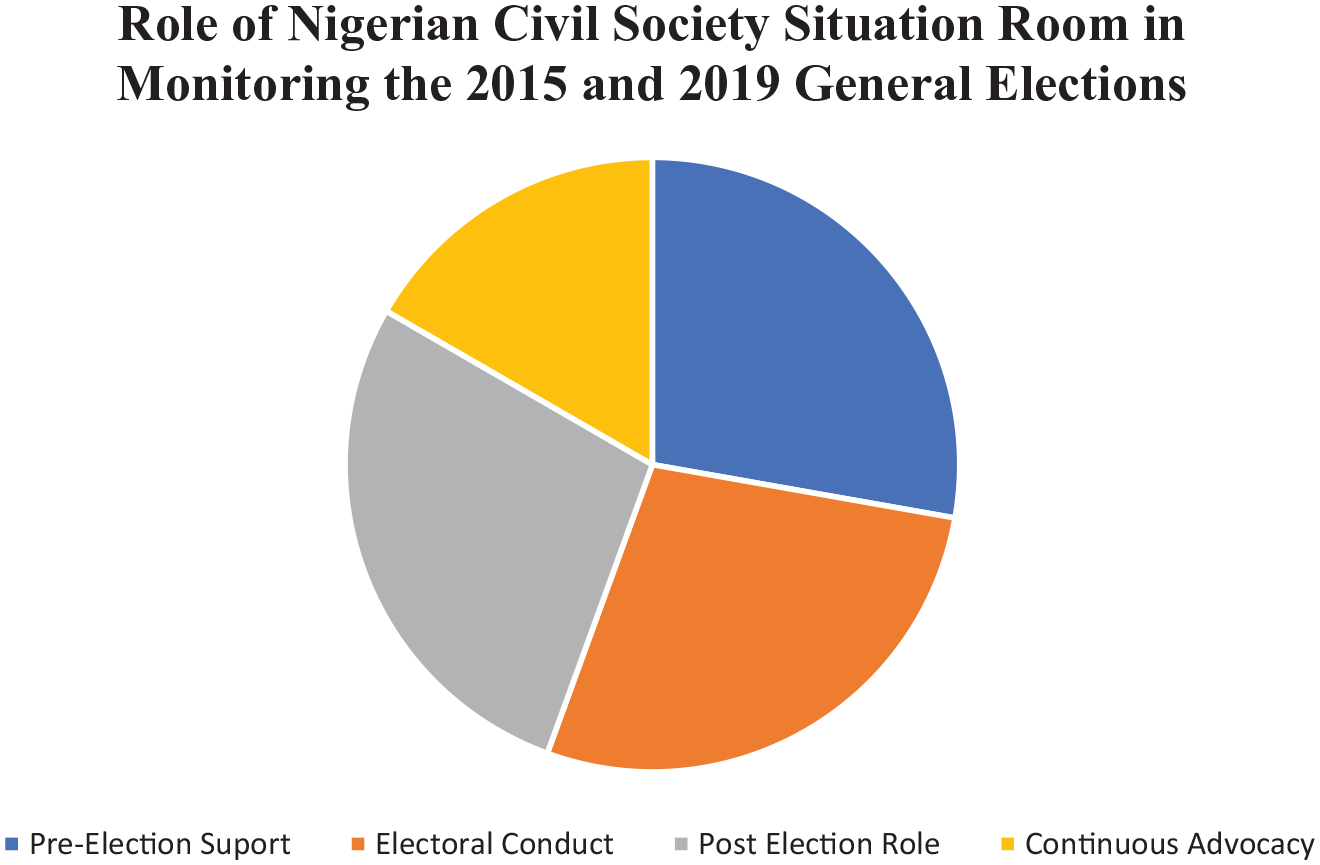
Showing the role of Nigerian Civil Society Situation Room (NCSSR) in monitoring the 2015 and 2019 general election.
Theoretical and Practical Implication of the Research
The work has both theoretical and practical implications for knowledge building and for policy making. Theoretically, the work presented and suggested logically that civil society is assuming the responsibility of a third tier of government in modern democracies. The public sector operates within the public sphere, the private sector aspires for personal gain while civil societies equalize the equation of serving both public and private interest. It has succeeded in further extending the theory building which hitherto was applied in the context of studying civil societies in America to Nigerian context in similar characteristics. Thus, the NCSSR theoretically is a third tier of government which monitors electoral conduct in Nigeria from the perspective of both public and private approach. Practically, the research has benefits and implications. It has succeeded in identifying and studying an area that has not been examined previously by researchers in the field which provides an opportunity for contribution to knowledge and filling of research gaps. The research also identified the successful roles and challenges that the NCSSR faced in their role of monitoring elections in Nigeria, with some practical suggestions on how to overcome them. Furthermore, the electoral body, INEC, Nigerian Government, electorates, and other stakeholders in the electoral process are also guided in the role of NCSSR and how to support them in providing a neutral ground for observing and fostering of a credible election that will consolidate democracy in Nigeria. This will help in enhancing an election that will be more transparent, credible, and fair in 2023 and beyond if the recommendations are adopted.
Conclusion and Recommendation
The article concludes that civil societies played a greater role in many social services and activities in Nigeria for many decades since pre-colonial, colonial, military, and post-military periods. However, the most vibrant and active role of civil society is that of democratic sustenance and electoral support through monitoring the process. This has been the great role of Nigerian Civil Society Situation Room which has become more pronounced in the 2015 General Election. Thus, this study is very important and of great interest to researchers, policymakers, civil societies, and other champions of democratic governance and credible election conduct in Nigeria and indeed Africa. This is true because it has identified a new era and area of knowledge and action that will be more beneficial in the future. The study, therefore, recommends the following for an improved role of the civil societies in election monitoring in future:
The civil societies should join the coalition in the Situation Room for those who are nonmembers to make the group formidable and leverage for negotiation and their activities;
The civil society situation room should try to improve in terms of their activities by expanding into other parts of the country especially the remote areas and rural places;
The civil society situation room should strive hard to detach themselves from any corrupt practices and romance with public agencies except in a legal manner to be as neutral as possible;
The civil society situation room should sponsor a bill in the National Assembly as part of their recommendations that they observed during their monitoring of the election in 2015;
The civil society situation room should involve other sectors in the state for coordinated activities that will lead to harmony and achievement of their goals; and
The civil society situation room should continue to play the role of economic, social, political, environmental, and other services to the communities as part of their responsibilities.
Footnotes
Appendix
Declaration of Conflicting Interests
The author(s) declared no potential conflicts of interest with respect to the research, authorship, and/or publication of this article.
Funding
The author(s) received no financial support for the research, authorship, and/or publication of this article.
