




Abstract
Pastoral livestock production as a primary source of livelihood is increasingly becoming unsustainable due to the rapidly changing social context, perennial cattle rustling, unpredictable climatic conditions, and rapid population growth. Migration in response to these changes in social context has often increased competition for land and natural resources between the farmers and pastoralists. Using survey data from 1,750 agro-pastoral households, this study examines the impact of cattle rustling and relative deprivation on shaping the patterns of migration in Nigeria. The results of linear regression show that the loss of livestock, cattle rustling, income diversity, literacy, and herd size are significant determinants of migration patterns. These factors were instrumental in the households’ decision to migrate transitorily or permanently. While the findings indicate that relative deprivation is a significant push factor, migration in response to deprivation and cattle rustling may not necessarily decrease inequality due to weak social capital among the agro-pastoralists. In this sense, increasing pastoral social and economic capital is critical to the reduction of inequality and competition for natural capital. As such, rural livelihood enhancement intervention embedded within the context of a conflict mitigation mechanism is required to decrease the perceived relative deprivation.
Introduction
Pastoralism as a livestock-based livelihood is regarded as a major component of agribusiness, which particularly supports the income streams of households in Sub-Saharan Africa (SSA), and thus serves as an important strategy for reducing poverty (A. Ibrahim et al., 2018). Fulani, who account for 4% of Nigeria’s population (Ducrotoy et al., 2016), are still key to cattle production in the country. There are three broad classifications of Fulani in Nigeria: the first are nomadic pastoralists who constitute the minority among the Fulani and are characterized by subsisting entirely from the proceeds of their herding stock. The second class is the settled Fulani who stand in sharp contrast to the nomadic Fulani. This class of Fulani arguably comprises the descendants of the aristocratic elite who were previously referred to as the Hausaland (Ducrotoy et al., 2018; Majekodunmi et al., 2017). The last category of Fulani (as the main focus of this study) is the agro-pastoralists (also called semi-sedentary Fulani), who combine crops with livestock production as their main sources of livelihood.
Pastoral livestock production as a primary source of livelihood is increasingly becoming unsustainable due to the rapidly changing social context, perennial cattle rustling, unpredictable climatic condition, and rapid population growth (S. S. Ibrahim et al., 2020). This has impacted negatively on pastoral-based livelihoods (Olaniyan & Yahaya, 2016). As a coping strategy, pastoralists increasingly migrate from the northern to the southern part of Nigeria in search of grazing lands and security for their herding stocks (S. S. Ibrahim et al., 2016).
Several forms of pastoral migration have been observed prior to the recent rapidly changing social context (such as intensification of cattle raiding and unpredictable climatic conditions). Seasonal and economic migration of pastoralists, which have predominantly been the most widely practiced aspects of migration in search of greener pastures in the south, have since assumed a different dimension and intensity (Ducrotoy et al., 2018). Migration in this period can thus be broadly classified as permanent and transitory. The former is primarily influenced by the intensity of cattle rustling, unpredictable climatic conditions, and rapid population growth, while the latter resembles the decades-old traditional movement from one place to another, which exemplifies the internal migration hypothesized by the traditional theories of migration (see S. S. Ibrahim & Bakori, 2011). Transitory migration, in this case, is distinct to other forms of temporary migration. It is shorter and is not primarily induced by pull factors, such as the attraction of southern regions characterized by abundant pastures (Akukwe & Ogbodo, 2015; Ducrotoy et al., 2018). In Nigeria, it often occurs as a response to violent conflicts, such as cattle rustling and post-election violence (S. S. Ibrahim et al., 2016). Migrants within this spectrum sojourn in the internal displacement camps (IDCs) and some neighboring communities. For instance, in a report by the International Organization for Migration (IOM) covering 13 states of northern Nigeria, it was revealed that there were almost 2,152,000 internally displaced people (IDPs) between November and December 2015 (internal displacement monitoring center, henceforth Internal Displacement Monitoring Centre, 2016).
The traditional push–pull model of Ravenstein (1889) posits that individuals and households depart from places typified by undesirable factors to places where desired conditions or factors are available. The model deals with social conditions in one place that induce movement to another destination with favorable conditions. This pull–push paradigm has provided the theoretical foundation of neoclassical migration models. Lewis (1954) strongly asserted that income inequality between the traditional and modern sectors can be reduced via rural–urban migration. On the contrary, Todaro (1969) observed that wage differential is not always a primary driver of rural–urban migration, as the prospect for better welfare and other social factors largely influence the decision to migrate. The Integrated Threat Theory (ITT) of Stephan and Stephan (2000) holds that social relations between groups are impacted by either real or perceived threats. This threat (or peaceful coexistence) can push (or pull) individuals and households to migrate. However, a perceived threat can lead to prejudice between social groups and intensify relative deprivation (RD) given the pre-existence of social inequality.
Migration within a country is more likely to generate alienation and increase RD through a smooth reference group substitution (Stark & Taylor, 1991). Migration could perhaps be associated with a rise in a household’s RD if the host community becomes the relevant reference group for the potential migrant. Internal migration is more likely to generate alienation and increased RD through a smooth reference group substitution (Arcimaviciene & Baglama, 2018; S. S. Ibrahim & Bakori, 2011). In Nigeria, transhumance pastoralism has led to the overutilization of natural capital and increased competition for land and water among the pastoralists as well as between them and farmers (S. S. Ibrahim et al., 2019). Competition among different social groups on the access and control of commonly owned resources often serves as a breeding ground for violent conflict. This has frequently led to the destruction of crops in the cultivated land as well as encroachment of grazing routes and livestock theft (Majekodunmi et al., 2017), which has increased the hostility and mutual distrust between crop farmers and pastoralists (A. Ibrahim et al., 2018). For instance, the government’s proposals to establish a cattle colony and mapping of grazing areas as solutions to challenges associated with cattle migration were vehemently opposed by crop farmers, whereas the idea of cattle ranches was opposed by the pastoralists (Ducrotoy et al., 2018). This reinforced the collapse of the symbiotic tradition whereby livestock benefited from crop residues in the harvested farm in return for manure from dung (S. S. Ibrahim et al., 2020). A condensed body of ethnographic studies has argued that the fragmentation of land and the resulting changes in property rights in terms of ownership have underpinned the strained relationship between pastoralists and farmers (Ducrotoy et al., 2018; S. S. Ibrahim et al., 2019; Majekodunmi et al., 2017) resulting in perennial migratory conflicts (S. S. Ibrahim & Bakori, 2011).
RD generally refers to the perception of unfairness and disadvantage compared to a reference point that is salient to the individual (Stark & Taylor, 1991). It entails comparing oneself to others in society, or more generally, comparing the socioeconomic status of one place with another at a certain point in time (Smith et al., 2012). The link between deprivation and the rise of violent conflict was partially explored in the context of pastoralism (see Ducrotoy et al., 2016; S. S. Ibrahim et al., 2019; Olaniyan & Yahaya, 2016). According to S. S. Ibrahim and Shagali (2019), poverty (among the pastoralists) and alienation (between them and other tribes) are the key drivers of violent conflicts (for instance, banditry and cattle rustling). The degradation of environmental resources driven by the overgrazing of pasture and mounting pressure on land due to increased competition (Majekodunmi et al., 2017) has resulted in rising levels of poverty (Olaniyan & Yahaya, 2016), as well as deteriorating social services and infrastructure facilities (A. Ibrahim et al., 2018).
Cattle rustling (or raiding) has recently become a key internal security concern in Nigeria (Olaniyan & Yahaya, 2016), and Northern Nigeria is the epicenter of this menace. It connotes unconventional means of restocking and replenishing herding stock (Kaimba et al., 2011). There is a growing body of literature that attributes cattle raiding to poverty (Behnke, 2008; Olaniyan & Yahaya, 2016), primitive accumulation of wealth (Simelane, 2005), tribal-based conflicts (Kaimba et al., 2011), environmental degradation (S. S. Ibrahim et al., 2019), and proliferation of small arms (Olaniyan & Yahaya, 2016). Moreover, a number of studies have convincingly highlighted how pastoral migration from northern to southern Nigeria is pushed by factors such as agricultural extensification, rapidly changing climatic and environmental conditions, among others (Ducrotoy et al., 2018; A. Ibrahim et al., 2018). However, there is no consensus of opinion that this is the main driver of pastoral migration because there is a dearth of rigorous evidence supporting the theory that transhumance pastoralists have better herd sizes than semi-sedentary pastoralists (S. S. Ibrahim et al., 2019; Kaimba et al., 2011).
Proponents of the “pull paradigm” argue that the propensity to migrate is not necessarily induced by environmental differences between the northern and southern parts of Nigeria. A mounting body of studies has empirically examined certain social and economic pull factors (such as dairy development, herding contract, social network, and cattle cross-breeding programs) as drivers of pastoral migration from north to south (see, Ducrotoy et al., 2018; Olaniyan & Yahaya, 2016). In this way, the migration of pastoralists may be driven by both push factors related to the origin of the migrants (for instance, social inequality and poverty) and pull factors associated with the attractions of the destination (greater security and better opportunities). However, the literature dealing with drivers of migration overlooks the impacts of violent conflicts (cattle rustling) and social inequality (RD) on migration in the context of pastoralism.
This study examines the impact of cattle rustling and RD as drivers of agro-pastoral migration in Nigeria. The paper departs from and builds upon extant literature in three ways. First, the integrative approach used in this study extends the theoretical work of Olaniyan and Yahaya, (2016) as well as the qualitative findings of Ducrotoy et al. (2018) and thus offers new insights into the drivers and outcomes of pastoral migration based on quantitative and qualitative methodologies, which is expected to guide the policy dialogue from farmer’s resistance to cattle colonies to the pastoralist rejection of modern cattle ranches. Second, the study provides further ground to revisit and test the decades-old RD theory of migration using pastoral household-level data from northern Nigeria. To the best of our knowledge, this is a pioneering attempt to empirically test the RD-migration relation in the context of pastoralism in SSA. Finally, the study fills an important literature gap by exploring the complex effects that cattle rustling and social inequality (RD) have on shaping the patterns of pastoral migration.
The rest of the paper is structured as follows. Section “Method” describes the methodology, Section “Empirical Results” presents the results, Section “Discussion” discusses the results, while the last section concludes the paper.
Method
The Study Area
The study was primarily conducted in the agro-pastoral communities in north-western Nigeria. The region consists of seven states, notably Jigawa, Kaduna, Kano, Katsina, Kebbi, Sokoto, and Zamfara. The incidence of cattle rustling is more intense in the outer regions of the border communities linking the Katsina, Zamfara, and Kaduna states axis (Olaniyan & Yahaya, 2016). Two state-owned grazing reserves in the region (the Rugu and Falgore forests) established to support the sedentarization of pastoralists deepen access to social amenities (Majekodunmi et al., 2017), improve the production of livestock, and enhance living standards, instead offer perfect concealment opportunities for cattle rustlers (S. S. Ibrahim et al., 2016). The Rugu forest, which spans over 220 km2, borders the four states of Katsina, Zamfara, and Kaduna, and extends to the state of Niger in the northcentral and neighboring border communities of the Republic of Niger. On the contrary, the Falgore forest covers approximately 1,000 km2 and its boundary stretches between Kano and Kaduna and extends to the Bauchi states in the northeast.
Nigeria has diverse and rich vegetation capable of supporting a large population of livestock (S. S. Ibrahim et al., 2019). The northwest region in particular has a hot semi-arid climate around the Katsina, Kano, Kebbi, Sokoto, and Zamfara states, while Kaduna state seems to have more favorable climatic conditions (Ducrotoy et al., 2016). The average annual temperature ranges between a minimum of 22°C and a maximum of 36°C. Generally, an agro-pastoral mix is the main source of livelihood in the region (A. Ibrahim et al., 2018). While livestock, particularly cattle, has been the main farm input that supports subsistent farmers due to the low adoption rate of mechanized farm equipment, farm output is used in return as livestock feed (Ducrotoy et al., 2018).
Research Design
In compliance with the triangulation approach aimed at enhancing the reliability of the research outcome, a wide range of relevant stakeholders were consulted, which enabled key information to be obtained that guided the selection of the cattle rustling corridors. In this sense, certain criteria were established by the researchers that guided the selection and recruitment of the respondents. Key research stakeholders needed to have: (a) a satisfactory level of knowledge about the ongoing cattle raiding in the study area; (b) a sense of objectivity demonstrated by how the rural inhabitants entrusted them with dispute settlements in the community; and (c) a reasonable literacy level, which is a fundamental attribute required in the event that they decided to document their input by themselves. The relative ambiguity portrayed in the above criterion necessitated the selection of informants in batches. This process was in full compliance with the principles of nominated sampling. As fieldwork continued, informants were selected to fill in any gaps in the profile that arose.
To parsimoniously ensure that an adequate number of cattle raiding affected agro-pastoral households were included in the sample, the enumeration areas were restricted to rural communities with reported cases of cattle rustling. Three Ardo (community leaders) from each surveyed area were selected for the focus group discussions (FGDs) and a total of 489 Ardo participated. Their selection was informed by the level of expertise they demonstrated regarding the ongoing cattle raiding during the pilot survey. This study benefited immensely from their wealth of experience about the menace in that valuable insights were deduced from the snowballing effects of the discussions. For convenience, FGD sessions in each of the selected clusters of local government areas (LGAs) were conducted in the central municipality with representatives of the security agents (police and vigilante groups) in attendance. The lead researcher moderated the discussion, while the rest of the team members were assigned different tasks, principal of which were taking minutes of the proceedings and documenting spontaneous responses during the focus group sessions. The moderator played a vital role in steering the discussions in a manner that facilitated the extraction of desired information and also kept the members on track.
The data collection for the study was conducted in phases between October 2014 and September 2015. The first phase was merely a participatory rural appraisal (PRA) geared toward determining the cattle rustling affected areas, gathering preliminary information, and identifying the potential informants. Participants for the interviews and FGDs were selected via a maximum variation purposive sampling method. The information gathered at this stage was instrumental in the design of the structured household survey questionnaire and the interview guide, which were pilot-tested. The second phase consisted of sampling the respondents based on a multistage sampling procedure. Purposive sampling was used to select the raiding-prone communities within each of the identified LGAs. The selected communities were used as the enumeration strata. The random sampling process was then applied in selecting the ward from each stratum. Respondents were selected randomly and the sample size of 1,750 was distributed proportionately to the total number of inhabitants in each stratum. Random selection is superior in allowing legitimate generalization of information from few people to many (Aliero et al., 2010).
Measure of RD
The tendency of households to participate in migration was directly related to the households’ initial RD level (Stark & Taylor, 1991). Migration due to cattle raiding is immune to ex ante and ex post scrutiny. It is the result of RD and the anticipation of welfare improvement by the potential migrants. Stark and Yitzhaki (1988) argued that the concepts of deprivation and utility are actually two sides of the same coin; while utility is defined as “having,” deprivation is defined as “not having.” It is important to note, however, that envy or altruism are not postulated; the relevant factors are how individuals evaluate what they have (satisfaction) and what they do not have (deprivation) (Aliero & Ibrahim, 2013; Stark & Taylor, 1991).
Drawing from Stark and Yitzhaki’s (1988) RD model, one can assume a continuous welfare distribution as a function of drivers of social inequality at a place of origin. Consequently, each welfare gain can, for the sake of exposition, be represented by an income range sufficient to maximize welfare relative to the reference group

where RD is a construct variable based on multidimensional indicators of social inequality (income, asset, household characteristics, landholding, herd size, access to water, access to grazing areas) and cattle rustling that induce migration (see Table A1 in appendix for details). RD as an index was constructed via principal component analysis (PCA). Note that
Let RMR be rural migration due to some exogenous factors, such as social inequality or cattle raiding. For clarity, RMR must be decomposed into permanent rural migration (PRM) and transitory rural migration (TRM). The latter is migration for a short stay spanning from 3 weeks to approximately a year (Aliero & Ibrahim, 2011) where the migrants are expected to return whenever the security situation of the village improves (or when their perceived feelings of social inequality are reduced). To avoid overlapping, migrants are classified as permanent migrants if they have disposed of all their belongings and pledged that they would never return to live in the village affected by strife. The residual (p), rural residents (R) − PRM + TRM, is the total population left-over in the ith village. The size of p depends on the propensities of PRM and TRM, subject to exogenous factors such as livelihood resources, infrastructure, and social inequality, among others, and by assumption, these factors do not change over the period of study. In general, the higher the PRM, the smaller the p. In this sense, if
Estimation Model
Migrants are axiomatically rational in the sense that they are assumed to express their preference for higher welfare by migrating out from hostile communities to relatively safer communities. To a large extent, this determines the level of their utility (or RD) tenable at a given point in time (Aliero & Ibrahim, 2011). The decision to migrate or not is fundamentally related to a household’s status (feeling satisfied or deprived). Rural migration in cattle raiding plagued communities is presented in Equation 1 as a function of certain socioeconomic factors of the ith migrant:

The variables are defined in Table 1. The RD is introduced and, for the ease of estimation, Equation 2 is compressed and parameters are assigned in Equation 3:

where RMRi is the number of agro-pastoral households engaged in rural migration, RD is a latent variable constructed via Equation 1, Zi is the vector of exogenous variables,
Definition of Variables.

Generally, migration decisions are made due to risks and uncertainties, such as the fear of loss of life and properties. The migrants should be able to contend with chances and should have a sense of optimism about the potential utility that could be enjoyed in the migrated area (S. S. Ibrahim & Bakori, 2011). To this end, two systems of equations estimating the transitory and permanent migration dynamics by decomposing Equation 3 into Equations 4 and 5 are specified as


While the codes used in Equations 4 and 5 are defined in Table 1, the Classical ordinary least squares (OLS) method is applied in the estimation of the parameters for the equations. It is expected that the regressors in the equations will exhibit different magnitudes driven by the degree of RD. Thus, it can be hypothesized that the higher the magnitude of RD, the greater the permanent migration and the lesser the transitory migration. If households have built varied risk coping strategies, such as income diversity, savings or access to insurance, and access to finance, then they may embark on transitory migration, even during intensive cattle raiding periods.
Empirical Results
Household Characteristics
The initial source of livelihood of the agro-pastoralists is a rain-fed cropping and livestock production mix. The Fulani have increasingly adopted diversified economic engagements (such as on-farm and off-farm activities) as a response to contemporary challenges affecting pastoralism. The off-farm income spectrum is confined within un-skilled and semi-skilled related occupations, including farm laborers, carpenters, housemaids, and other forms of menial jobs.
The basic descriptive statistics, as highlighted in Table 2, indicate that the average years of formal education is 3.02. This low literacy rate corroborates with the underwhelming minority (8%) who indicated that they are working as civil servants. The level of literacy can further be illustrated in terms of the respondents that successfully completed their post-secondary school education. It was found that only 15% had completed their high school studies and only 3% were graduates of higher education. The mean age of the households is 43 years, out of whom 74% are male (26% are female). The average herd size is 14 and a significant difference was found between households with minimum and maximum herding stock (p < .01). When comparing between the minimum (2) and maximum (12) sizes of households who migrated, a significant difference was found between them (p < .01).
Household Characteristics.
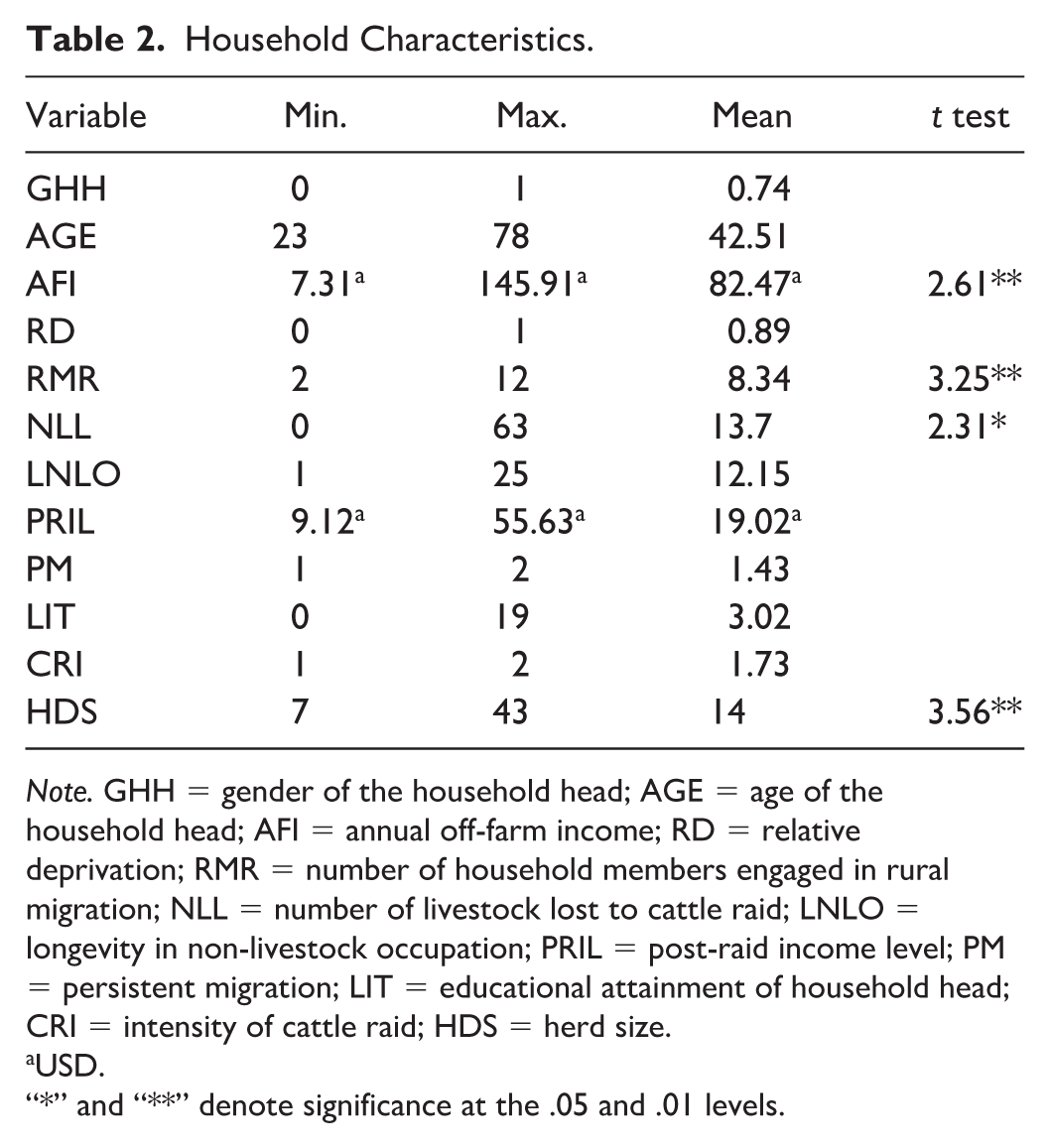
Note. GHH = gender of the household head; AGE = age of the household head; AFI = annual off-farm income; RD = relative deprivation; RMR = number of household members engaged in rural migration; NLL = number of livestock lost to cattle raid; LNLO = longevity in non-livestock occupation; PRIL = post-raid income level; PM = persistent migration; LIT = educational attainment of household head; CRI = intensity of cattle raid; HDS = herd size.
USD.
“*” and “**” denote significance at the .05 and .01 levels.
Socioeconomic Well-Being: Sources of Further Deprivation
Social changes in a given society are considered as one of the principal drivers of RD. In this sense, abrupt social changes can trigger subjective deprivation, which can create subjective injustice and emotional distress (Stark & Taylor, 1991). The perennial cattle rustling poses a considerable challenge to the socioeconomic well-being of agro-pastoralists in the northwest region of Nigeria. The FGDs revealed that the menace has caused them to feel sentiments of fear and despair. Their aspirations are destroyed and development is hindered as they live in an environment devoid of hope. The participants further lamented that cattle raiding represents the worst crisis they have ever experienced. They claimed that no one is spared from the devastating and savage attacks launched by the cattle marauders. Reacting to the incessant attacks, the vast majority of the agro-pastoralists demonstrated willingness to leave their traditional occupations if tangible actions were not implemented to combat the problem. Such an eventuality would likely deepen the unemployment crisis and eradicate traditional pastoralism in the region. The survey results, as highlighted in Figure 1, reveal that the level of unemployment increased to 88% in the raiding period. This would worsen the vicious cycle of poverty and threaten food security in the region. There is a paucity of data about the actual value of assets and the numbers of livestock lost, as information provided by the respondents may have been exaggerated in anticipation of compensation or relief from the government.

Socioeconomic well-being.
Among all the remote agro-pastoral areas surveyed, the items commonly raided were stated as:
Cash: Due to challenges of workable systems of banking that fit the peculiarities of agro-pastoralists, their savings are often kept in cash. Hence, whenever they are raided, they often lose all of their hard-earned savings. Furthermore, cash is more attractive to cattle rustlers than any other form of wealth. The economic motive of cattle rustling in Nigeria stands in sharp contrast to practices in the East African scenario, where raiding is culturally motivated as a test of bravery (Kaimba et al., 2011).
Automobiles: Cattle raiders need automobiles for rapid conveyance of the items rustled. The FGDs revealed that vehicles worth more than $100,000 were stolen and usually sold in the neighboring countries.
Women: In some instances, women and girls were most impacted by the raiders. In many cases, women were raped and their wealth was stolen. The victims of such atrocities are often stigmatized and they have no option other than to migrate out.
Youth: The motives for raiding pastoral communities are not unconnected with the need for cattle rustlers to forcefully recruit more fighters. Youths have been kidnapped, radicalized, and forcibly trained to engage in commercialized cattle rustling. It was further revealed in the FGDs that the abducted youths were being deceitfully assured that, if they participated in successful cattle rustling, they would not only regain their freedom but also their livestock and other assets would henceforth be protected from further raids.
Livestock is therefore a fundamental form of pastoral capital, which is the means through which wealth is stored (Ducrotoy et al., 2016). Livestock can also be viewed as a vehicle through which assets and wealth are accumulated, as societal recognition in pastoral communities is a function of herd size. Consequently, losing livestock is directly associated with the loss of societal recognition (Behnke, 2008). Indeed, losing a significant amount of assets to raiders increases the intensity of migration. The household interviews and FGD sessions revealed that most of the permanent migrants are those who have lost all of their assets. The loss of assets in the region is more severe in border villages and in communities close to the Rugu forest. The porosity of the border, which makes the proliferation of small arms possible, has been indicated as a possible reason behind the poor security in the border villages. The efforts of the security forces to expose the suspected cattle rustlers in the Rugu forest have recorded little success. This situation has led to calls for the constituted task force to re-energize, re-strategize, and be more proactive in the war against cattle raiding (A. Ibrahim et al., 2018).
Raiding can directly lead to the loss of lives and properties and indirectly contributes to the spread of diseases. An overwhelming majority of the respondents (92%), as highlighted in Figure 1, indicated that the populations in their villages had significantly reduced in the last decade in line with the intensification of cattle raiding. Apart from the rising death toll driven by the menace, migration and displacement were the major factors responsible for slowing population growth. This has also had a retarding effect on the pastoral workforce, as checks have revealed that six out 10 migrants are skilled or semi-skilled workers who are optimistic of a problem-free adaptation to the new environment. This further confirms the findings of Kaimba et al. (2011), who revealed that out-migration has a lost labor effect.
In addition to the loss of life, diseases have spread throughout the raided villages. Different degrees of injuries have been sustained by men, women, and children. In some extreme cases, patients have had to travel for an average of 60 km to metropolitan areas to receive better medical attention. Similarly, respondents in the FGD sessions lamented the disruption to community health services during intensive cattle raiding periods, which has further aggravated child and maternal death rates. Given such circumstances, the attainment of sustainable development goals in such communities can at best be described as a “myth.”
The provision of qualitative child education is one of the most important indicators of prosperity and well-being in pastoral societies (A. Ibrahim et al., 2018). There is growing concern regarding the dilapidated state of nomadic schools in terms of infrastructure, superstructure, and the nonchalant attitude of students in rural areas within the region (Olaniyan & Yahaya, 2016). The average schooling hours has decreased from 7 to 0 hr during the extreme raiding periods. Thus, in the same manner as the rural health sector, it also requires comprehensive restructuring, repositioning, and re-strategizing for effective service delivery.
Furthermore, the weekly market seems to be the bedrock of commercial activities in most pastoral economies. The market is not only the medium through which agro-pastoral produce is traded in large quantities, but it also facilitates the paths through which backward and forward linkages are maintained between the traditional and modern sectors of the economy (S. S. Ibrahim & Bakori, 2011). Rural markets play an important role in the remoteness–well-being relationship (Simelane, 2005). It is equally the vehicle that ensures the necessary diversity in sustainable rural livelihoods (Majekodunmi et al., 2017). Any activities that disrupt the operations of rural markets would be highly detrimental to rural well-being. The normal operations on market days in the cattle rustling affected areas in Nigeria have been hampered, thereby depriving agro-pastoralists access to various essential commodities, which induces out-migration. The lack of secure markets could threaten economic security in the pastoralist communities and deepen RD (Behnke, 2008).
Patterns of Migration Driven by Cattle Rustling and RD
Table 3 presents the results for the regression estimating the diverse patterns of cattle rustling and RD-driven migration. The estimated models met the OLS regression assumptions and fit the data well (f-statistics, which measures overall adequacy, is significant with good X2 Breusch-Pagan and X2 normal values). The estimated coefficient of RD for all the models is positive and significant, implying that migration increases as agro-pastoralists feel relatively deprived. This finding supports the RD hypothesis that households migrate to minimize deprivation in their place of origin (Stark & Taylor, 1991). Moreover, deprivation has a stronger effect on permanent migration as the propensity of RD in the permanent migration equation is higher than for transitory migration (0.43 > 0.35). This implies that the more households feel relatively deprived, the greater the likelihood that they will embark on permanent migration.
Patterns of Migration.

Note. RMR = number of household members engaged in rural migration; PRM = permanent rural migration; TRM = transitory rural migration; RD = relative deprivation; NLL = number of livestock lost to cattle raid; LNLO = longevity in non-livestock occupation; PRIL = post-raid income level; PM = persistent migration; LIT = educational attainment of household head; CRI = intensity of cattle raid; HDS = herd size.
“*” and “**” denote significance at the .05 and .01 levels, t values in parenthesis.
The coefficient of the number of livestock lost is positive and significant, which implies that the more the livestock lost, the greater the tendency for pastoral out-migration. The disaggregate coefficients of the variable show varying magnitudes. Holding other variables constant, the number of livestock lost influences the tendency for transitory migration by 0.73 (p < .01). This is significantly higher compared to permanent migration, which has a magnitude of 0.33 (p < .05). This finding implies that households who have lost substantial numbers of livestock have less incentive to embark on permanent migration. Moreover, respondents who have relatively diversified sources of income (occupational diversity) were found to migrate temporarily. The estimated coefficient measuring the longevity in non-livestock occupation is positive (0.81) and significant (p < .05) in the transitory migration model. This can possibly be explained in part by their engagement in off-farm sources of livelihood and their minimal reliance on income driven from agro-pastoral activities.
Moreover, cattle raid intensity is positive and statistically significant in the overall migration and permanent migration models, indicating that migration increases as the raiding of pastoral livelihood assets intensifies. On the contrary, herd size reduces transitory migration by 0.75 (p < .05). However, pastoralists with large herd sizes were found to migrate more than those with less, as the study found a positive (0.43) and significant (p < .05) coefficient of herd size in the overall migration model. In this sense, rural out-migration can be perceived as insurance against the vicious cycle of cattle rustling.
Interestingly, the results highlighted in Table 3 show the possibility of a rural brain drain, as a significant number of permanent out-migrants are literate. Holding other factors constant, literacy influences permanent migration by 0.74 (p < .01) as it will be easier for higher educated agro-pastoralists to find salaried jobs in towns or cities. However, this revelation should be approached with caution, as it does not confine permanent migration to the literate rural dwellers. The findings indicate the tendency for illiterate agro-pastoralists to embark on transitory migration. This could be because less literate out-migrants may not only find it more difficult to adapt to new surroundings, but are also less likely to secure permanent jobs.
Discussion
The economic contribution of the agro-pastoral mix of production cannot be overemphasized, as this symbiotic agricultural system makes the production of crops, milk, meat, and other livestock produce possible, which contribute immensely to facilitating production and consumption linkages. This study revealed some critical challenges affecting the sustainable development of agro-pastoral communities vulnerable to cattle rustling in Nigeria. With the threat of food insecurity and poverty increasingly affecting vulnerable households in SSA, policy-makers may explore the option of using agro-pastoralism as a buffering institution. Evidence has shown that livestock production is playing an important role in buffering households from food and income shortages in South Africa (Behnke, 2008). Through the colonial legacy, the South African government has succeeded in investing hugely in pastoralism, making the system mechanized with secure land tenure arrangements (A. Ibrahim et al., 2018; Ndi, 2017). This has reduced the pressure on rangeland resources and minimized conflict associated with the competition for natural capital among the pastoralists on one hand, and between them and crop farmers on the other hand. Consequently, transhumanism has been drastically minimized.
The controversial anti-open grazing law implemented in some parts of Nigeria needs to be suspended. The findings of a plethora of studies reveal that pastoralists are using open grazing systems to feed their herds (Ducrotoy et al., 2016; S. S. Ibrahim et al., 2020; Kaimba et al., 2011). Without an alternative arrangement in place, pastoralists may not easily abandon their accustomed heritage of open grazing (S. S. Ibrahim et al., 2020). In this regard, the provision of cattle colonies may be an option. It may require a long-term plan for modern ranching to be embraced by the pastoralists (S. S. Ibrahim et al., 2016). The sustainability of customary agro-pastoralism is threatened by climate change, cattle rustling, chronic poverty, as well as food and economic insecurities (Kaimba et al., 2011). It has become necessary for the government to intervene to conserve traditional agro-pastoralism. The Nigerian government and indeed the rest of SSA need to integrate pastoralism into its quest for stimulating agriculture as a driver of growth. Undoubtedly, it would help the country to reduce its overreliance on the highly volatile crude oil market. This suggests a win-win policy intervention that can substantially connect the economy to rely more on renewable resources that are relatively sustainable.
This study found a significant positive effect of RD for all patterns of migration. This is consistent with numerous other studies, which have found a positive relationship between RD and the migration of smallholding farmers (Stark & Yitzhak, 1988; Agbonlahor & Phillip, 2015; S. S. Ibrahim & Ahmad, 2013; S. S. Ibrahim & Ibrahim, 2014). The study further found that cattle rustling increases the propensity of agro-pastoralists to migrate and this supports the finding of Kaimba et al. (2011), who revealed a significant positive relationship between the raiding of pastoral livelihood assets and the decision to migrate in Kenya. The complex effects of cattle rustling and RD have the potential to deepen the pre-existing social inequality. The schematic framework (Figure 2) shows that rising cattle rustling could lead to the temporary closure of markets, schools, and clinics, which in turn could not only affect income diversification, well-being, and human capital development but also serve as a source of further RD. As a coping strategy, migration from the northern to the southern part of the country in search of grazing lands, infrastructure, and security of herding stocks may increase the competition for rapidly degraded natural capital in the south (S. S. Ibrahim et al., 2016).
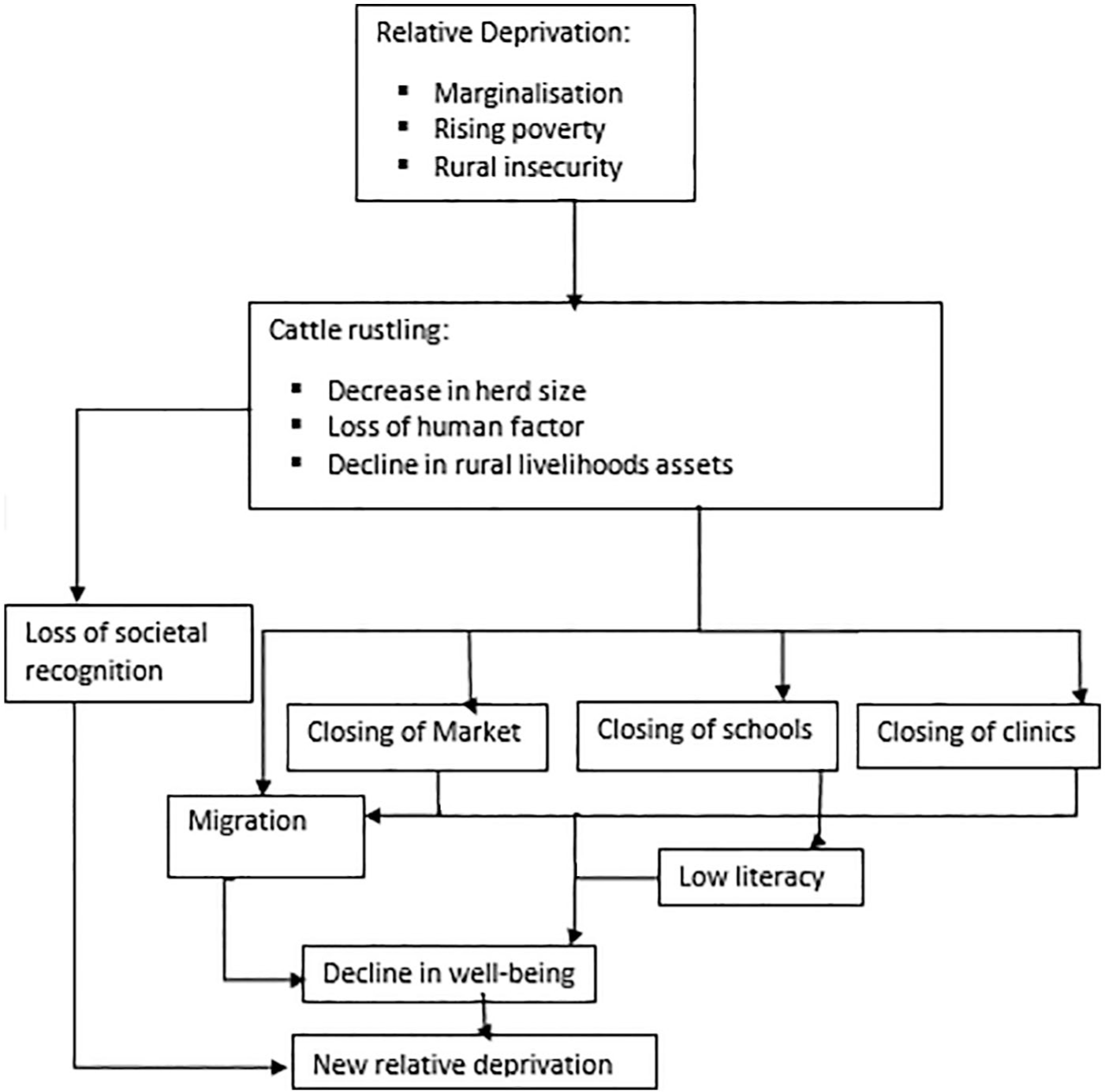
Relative deprivation and cattle raid: motives and effects.
Conclusion
This study analyses the roles of cattle raiding migration within the RD framework. Rural migration was decomposed into permanent and transitory migrations and OLS was used to estimate their drivers from the data sourced in the cattle rustling plagued communities in Nigeria. The findings reveal that the number of livestock lost, the literacy, and the intensity of cattle raiding are all significant determinants of permanent migration. However, income diversity and herd size are important factors accounting for transitory migration. In general, RD was found to be the push factor shaping the patterns of migration. The status of infrastructure in agro-pastoral communities could further increase social inequality and deepen RD. Migration in response to deprivation and cattle rustling may not necessarily decrease inequality due to weak social capital among the agro-pastoralists, particularly in southern Nigeria. Thus, rural livelihood enhancement intervention embedded within the context of conflict mitigation mechanism is required to decrease the perceived RD.
In many SSA countries, pastoralists are often held responsible for overgrazing the range (S. S. Ibrahim et al., 2020), stemming from their inability to protect land despite their awareness about the importance of grazing management. In other words, pastoral societies are characterized by poor institutional frameworks to guarantee the sustainable management of resources and peaceful conflict management (Simelane, 2005). This has contributed to the degradation of the environment and has driven climate change. In this sense, increasing pastoral social and economic capital is critical to the reduction of inequality and competition for natural capital. Although an integrative approach of quantitative and qualitative methodology has been applied to examine the impacts of cattle rustling and deprivation in shaping the patterns of migration, given that these drivers of migration are more qualitative than quantitative, it is left for future research to re-explore their impact on migration patterns ethnographically.
Footnotes
Appendix
Variables Used for Constructing Multidimensional RD Index.

| Component | Indicators | Measurement |
|---|---|---|
| Human assets | Years of formal schooling | Count |
| Access to information | 3-point Likert-type scale | |
| Participated in human empowerment and capacity building program | 1 = participated; 0 = otherwise | |
| Livelihoods strategies | Livelihoods diversification activities | Index |
| Security | Local security outpost | 1 = available; 0 = otherwise |
| Walking distance to the nearest police outpost | Minutes | |
| Awareness about the process of reporting cases of cattle theft | 5-point Likert-type scale | |
| Responsiveness of security force | 1 = yes; 0 = otherwise | |
| Informal security network | Lack of local vigilante group | 1 = yes; 0 = otherwise |
| Proximity to border | Minutes | |
| Proliferation of small and light arms | 1 = yes; 0 = otherwise | |
| Legal system | No severe punishment for perpetrators | 1 = yes; 0 = otherwise |
| Household’s assets | Household size | Count |
| Sanitation | Safe drinking water (public water system, borehole) | 1 = yes; 0 = otherwise |
| Access to indoor kitchen | 1 = yes; 0 = otherwise | |
| Access to latrine | 1 = yes; 0 = otherwise | |
| Has first aid box | 1 = yes; 0 = otherwise | |
| Income composition | Share of livestock income to total income | Ratio |
| Grazing areas | Access to grazing areas | 1 = yes; 0 = otherwise |
Note. RD = relative deprivation.
Acknowledgements
We would like to thank the editor and the anonymous reviewers for their review, thoughtful comments, and constructive suggestions on our manuscript.
Authors’ Note
Data, codes, and DO-files used in this article are available from the author upon request.
Declaration of Conflicting Interests
The author(s) declared no potential conflicts of interest with respect to the research, authorship, and/or publication of this article.
Funding
The author(s) disclosed receipt of the following financial support for the research, authorship, and/or publication of this article: This research was funded by the Tertiary Education Trust Fund.
