




Abstract
Festive sport events provide an opportunity for people to engage in leisure in an atmosphere of celebration. It has become increasingly popular in China. Although motivations have been explored thoroughly in the context of participant and recreational sport, events, and festivals, no research has yet focused on the overlap among these domains. To address the gap, this study is an investigation of what motivates people to participate in festive sport events as an emerging subcategory of more traditional events and festivals. After the development of a new motives scale, a questionnaire was administered to 894 participants in a festive sport event for hikers in China. The sample was split in three to validate the scale using factor analysis. Six participant motives in the context of a festive sport event emerged including Physical Health, Achievement, Socialization, Mental Health, Novelty/Excitement, and Culture/Event. Important implications of this study are also discussed.
Introduction
There have been recent calls for sport and recreation management literature to pay more attention to physical activity and organizational issues related to participation in sport and recreation (Rowe et al., 2013), especially in the face of growing inactivity level and decrease in traditional sport participation. There is an increasing interest from the public for recreational sport practices, which might be less structured and constraining than the traditional practice within clubs yet still provide opportunities for socialization. One such trend is the emergence of mass participation sporting events, often with a festive atmosphere (Sato et al., 2016). While there is a body of research on understanding both sport motivation and festival motivation, understanding the motivations of participants to such sporting festival is—to our knowledge—an underresearched area. This article aimed at filling that gap by analyzing the motivation of participants to Shenzhen 100-Kilometer Hiking Festival, a festive sport event in China.
Festive sport events, which feature recreational, mass participant, and festive elements in a single event, are increasingly popular in large Chinese cities, for example, Shenzhen 100-Kilometer Hiking Festival (Yang et al., 2018). These events are more than participation of sporting events alone, because they also incorporated an entertaining and celebratory atmosphere linked to local culture (Hernández-Mogollón et al., 2018). Events of this type may be tailored specifically to maximize opportunities for socialization which we know is an important motive in this domain (Sato et al., 2016). Competition is deemphasized and participants can engage more flexibly, which create a youthful and inclusive culture. This ultimately attracts more people to participate.
Participants’ involvement in festive sport events can best be understood through self-determination theory (SDT). According to SDT, human’s self-motivation and well-being are based on the satisfaction of three basic psychological needs: autonomy, competence, and relatedness (Ryan & Deci, 2000). Festive sport events have the potential to satisfy need of autonomy and competence by facilitating an experience one is in control of and that is goal oriented. Relatedness needs are met through celebration of local culture with other community members. Considering the popularity and value of festive sport events, it is important to know why people partake in these events, so organizers can more effectively encourage participation and structure them such that they better meet people’s needs (Scott, 1996).
Hiking has recently become more popular in China (Wang et al., 2012) and is often the focal activity within festive sport events; therefore, it provided an ideal context for this research. In contrast to the West, where hiking typically involves walking in the forest, mountain areas, countryside, or other cultural landscapes, usually individually or in small groups (Svarstad, 2010), Chinese hikers often participate in the sport with larger groups in broader scope, community events that are celebratory in nature and resemble an organized sport quality rather than unstructured leisure activity. Despite a proliferation of vibrant festivals and events in the Asia-Pacific region, there is a scarcity of research that helps us understand them (Couto & Whitfield, 2016). Furthermore, the question of whether instrumentation developed to explore festival motives in the West is appropriate for use in Eastern contexts needs to be explored further (Ko et al., 2010).
Literature Review
Understanding motivations to engage in sport is important given the recognized benefits for participants and communities (Chalip, 2006). It has been noted that motivational theories in sport contexts are exhaustive (Hungenberg et al., 2016), but it is nonetheless important to continue to build our understanding both because the change of needs and the ways in which people participate in sport are also shifting. Motives of those participating in festive sport events are likely to emerge from multiple sources (Funk et al., 2007). Since festive sport events feature recreational, mass participant and festive dimensions, motives research from these bodies of literature are considered to shape the current study.
Recreational Sport Motives
Recreational sport is a subset of physical activity that usually involves less competition and perhaps less training, less organization, and less cost as well. Organizing a sport this way can result in higher participation rates and therefore more people enjoying the benefits of sport (Park & Kim, 2000). Despite the popularity of recreational sport, it has been noted that measuring motivation in this context has taken a back seat to competitive contexts (Alexandris & Carroll, 1997) and this is still true. It is also the case that the conceptualization and measurement of motivation in the context of recreational sport is still not settled (Alexandris et al., 2009).
A number of participant motives in the context of recreational sport and hiking are likely to carry over to a festive sport event. The notion that recreational sport participants engage in experiencing a social environment is well established (Alexandris & Carroll, 1997; Beard & Ragheb, 1983). Festivals are inherently social occasions, so it is very likely that recreational sport participants driven by socialization will be attracted to the social environment of a festive sport event. Likewise, motives linked to physical health are also well established in the recreational sport motives literature (Frederick & Ryan, 1993; Markland & Hardy, 1993). Given many who participate in recreational sports do so at least in part to improve their physical health, this is likely true for those engaging in festive sport event as well.
There are several psychologically oriented recreational sport motives that are likely to be relevant in the context of a festive sport event. Motives related to mental health have emerged from previous studies of recreational participant sport (Ko et al., 2010; McDonald et al., 2002). It has been found in previous research that achievement is an important motive for recreational sport participants (Alexandris & Carroll, 1997; Ko et al., 2010). It is likely that festive sport event participants are seeking opportunities to achieve as well. The potential to experience excitement has also been linked to recreational sport and been identified as an important motive for participants (Koivula, 1999).
Hiking is a recreational sport for which our understanding of the drivers of participation is still developing. Social interaction is important, but not yet well understood in hiking contexts (Svarstad, 2010). Svarstad (2010) found that hiking positively affects mental health which contributes to why people participate in the sport and why they enjoy it. Most research on hiking has focused on how individuals experience an unusual environment (nature, countryside, or regions with unique culture). However, hiking in familiar environments that are close to urban areas as it often takes place as part of festive sport events is becoming more popular and not much is known about the motivational profile of participants. So, from the recreational sport literature five motives emerge based on relevance to the festive sport context: Socialization, Physical Health, Mental Health, Achievement, and Excitement.
Mass Participant Sport Event Motives
Mass participant sporting events are increasingly popular around the world (N. Murphy et al., 2015; Sato et al., 2016) and are valued for the myriad of benefits they facilitate for communities (R. Zhou & Kaplanidou, 2017). Events of this nature have been categorized as elite sporting events, nonelite events facilitating community-wide participation, and major population-level health promotion events (N. M. Murphy & Bauman, 2007). The latter two types of events have particularly grown recently as community members embrace less competitive environments organized around a central theme (Buning & Walker, 2016). Several other emerging characteristics of mass participant sport events are present in the context of a festive sport event—namely that participants seek a fun experience but also one in which they can derive a sense of achievement. Within the related literature, inquiry on motivation to participate in these less competitive, more fun, community-focused mass participant sport events is quite limited. Many studies of event-based sport focus on motives associated with participation in the sport considered more broadly rather than within an event format specifically (e.g., Ogles & Masters, 2003).
Five motives from the mass participant sport event literature are well supported empirically and are relevant in the context of a festive sport event. These are Socialization, Physical Health, Mental Health, Achievement, and Culture/Event. Socialized event environments can attract participants, particularly those who are less focused on the sport activity itself (N. Murphy et al., 2015) and those seeking a less competitive environment. Socialization is a well-established motive throughout the mass participant sport literature (e.g., Funk et al., 2007). In their work on motives associated with recreational spot events, Filo et al. (2014) found that socialization and physical health emerged. Motives related to maintaining or improving one’s physical health have been highlighted in other studies of sport event participants as well (Rundio et al., 2014).
Numerous motives associated with mental health have emerged in event participation studies. A desire to escape everyday life has been noted (Filo et al., 2014; Funk et al., 2007), and events are also linked to increased self-esteem (I. S. Lee et al., 2016). Deriving a sense of achievement is important in the context of participant sport events. This often occurs when a participant pushes their limits—a state that we know drives involvement (Ogles & Masters, 2003). Finally, there are various aspects of an event location and other characteristics that attract participation (Zach et al., 2017) including the culture (N. Chen & Funk, 2010; Funk et al., 2007). While we can extrapolate these very important participant sport event motives to the current context, the role of festivity in mass sport events has not yet been empirically assessed (N. Murphy et al., 2015).
Festival Motives
Over the past couple of decades, the occurrence and scope of festivals have grown rapidly around the world (Bachman et al., 2016). Festivals are special events within communities that are unique opportunities to combine social and cultural experiences (Hall et al., 2016) and increasingly sport participation as well. There are a range of reasons why people attend festivals (O’Regan et al., 2017) and the empirical body of work in this area is fast developing (e.g., Maeng et al., 2016). Numerous motives for festival attendance have emerged in related research (Y. Li & Wood, 2016). Despite increasing interest in festivals and all the various forms they take, no universal scale of festival motivation exists.
Four motives that are well established in the festival literature are relevant to the current context of a festive sport event. The socialization motive, already linked to recreational sport and mass participant events, is also prominent among studies of festivals (e.g., Blešić et al., 2013; McMorland & Mactaggart, 2007; Pegg & Patterson, 2010). It is also clear that people attend festivals to improve their mental health (e.g., Blešić et al., 2013). It has been found that festival goers are motivated based on excitement, thrills (e.g., McMorland & Mactaggart, 2007), and the novelty of the festival atmosphere (e.g., Bowen & Daniels, 2005). Finally, we also know that event features or attractions are important drivers of festival attendance (e.g., Blešić et al., 2013; Pegg & Patterson, 2010), and we believe these will be important in the context of festive sport event as well. It is noteworthy that many festivals are increasingly embracing local culture as well as environmental sustainability and awareness. The festival motives literature has music, arts, and other types of festivals well covered (X. R. Li & Petrick, 2006; Y. Li & Wood, 2016), but there is currently a gap in terms of festivals that are organized around a sporting activity. We cannot assume that motives to attend a music or arts festival are equivalent to the motives associated with participating in a festive sport event.
Festive Sport Event Motives
Festive sport events are an emerging context in which people participate in sport in a festival atomosphere. What differentiates a festive sport event from mass participant sport events is the unique blend of a novel and exciting atmosphere and the celebration of local identity. However, we do not know much about what drives people to participate. Having identified important motives that have emerged in related contexts, it is possible to conceive of a model of motives that drive participation in a festive sport event (Figure 1). Six motives were identified: (a) Physical Health; (b) Achievement; (c) Socialization; (d) Mental Health; (e) Novelty/Excitement; (f) Culture/Event. The Physical Health motive captures one’s desire to improve or maintain body health and the Achievement motive reflects the desire to complete or compete in the sport (Funk et al., 2007; Masters et al., 1993; Svarstad, 2010). The desire to be with families and friends or interact with others is captured in the Socialization motive (Bowen & Daniels, 2005; Svarstad, 2010). Mental Health motives include escaping from life pressure, seeking relaxation, and enhancing psychological well-being (Blešić et al., 2013; Masters et al., 1993). Novelty/Excitement motives explain how participants want to try new things, experience enjoyment, and the thrill of an event (Bowen & Daniels, 2005; Funk et al., 2007; McMorland & Mactaggart, 2007; Pegg & Patterson, 2010; Svarstad, 2010). Finally, the Culture/Event motive captures participants’ motivation linked to experiencing culture and aspects of the event itself.

Conceptual framework of festive sport event motivations.
The motives identified from related literature are linked to the three innate psychological needs that underpin SDT. As a macrotheory of human motivation, SDT has been widely adopted to understand human motivation, affect, behavior, and well-being (Deci & Ryan, 2008b). It has proven effective in explaining sport motivation, mass participant event motivation, and adventure recreation event motivation (Lynch & Dibben, 2016; Zach et al., 2017). The self-determination continuum ranges from amotivation (no intention to act), to extrinsic motivation (driven by external regulation), and intrinsic motivation (driven by self-motivation) and forms a useful frame for conceptualizing festive sport event motives. Individuals with higher levels of self-determined motivation predict better performance and well-being outcomes (Ryan & Deci, 2000) and drive participation in a variety of event formats. Satisfaction of competence, relatedness, and autonomy needs enhances self-motivation and well-being (Deci & Ryan, 2008a, 2008b; Ryan & Deci, 2000). In the current model of festive sport event motives, physical and mental health motives relate to autonomy; achievement to competence; and motivations for socialization, excitement, and culture/event to relatedness. It is posited here that SDT is a useful theoretical frame to understand this phenomenon and that motives for attending a festive sport event are aligned not only to the focal sport but also a desire to immerse oneself in culture and enjoy a unique event.
In this article, we intended to investigate the motives of participating festive sport event. The proposed six-dimensional framework would be further refined and validated by a festive sport event in China.
Method
Research Context
The Shenzhen 100-Kilometer Hiking Festival is China’s largest annual festive sport event. The event first took place in 2001 and features a hiking route in and around the wider city of Shenzen including business centers, city parks, and mountainous regions on the city’s outskirts. The event is unique because it is a mass participation sport event in which awards are given for route completion, but it also has prominent festive elements which are heavily promoted and central to the participant experience. The event fits N. M. Murphy and Bauman’s (2007) second category of mass participation events in that it is not elite and fosters community-wide participation. Participants often bring family members, wear flamboyant costumes, and bring their pets into an environment with exhibition booths, music, and other entertainment. Furthermore, eco-friendliness, youthfulness, innovation, and the “freedom” of the city are all prominent themes contributing to the festive atmosphere (Liu, 2017; Yan, 2016). Many participants immerse themselves within these themes in creative and personal ways. There is a celebratory feel all around the event (J. Wu, 2014; Zhang, 2017) which is the central dimension of a festival experience (Getz et al., 2010; Jepson et al., 2014).
Instrumentation
New instrumentation was developed through a rigorous scale development procedure proposed by Churchill (1979). This procedure was then adopted and refined by numerous scale development studies (e.g., G. Chen et al., 2014; Kim et al., 2012). We initially relied on the literature in consideration of context appropriate motives. The six aforementioned motives were identified from sport, festival, and event literature: (a) Physical Health; (b) Achievement; (c) Socialization; (d) Mental Health; (e) Novelty/Excitement; (f) Culture/Event. Interviews were conducted with six former event participants to confirm that the six motives fit the research context. To further validate the instrument (Golafshani, 2003), online forum posts related to motives were also analyzed (G. Chen et al., 2014). An instrument comprising 30 items was the result of this scale development procedure. A mandarin Chinese language version of the questionnaire was produced through a translation and subsequent back translation procedure.
As recommended by Churchill (1979) and widely adopted in previous studies (e.g., Kim et al., 2012; C.-K. Lee et al., 2004), three experts with related experience were invited to review the proposed instrument. In a face-to-face meeting, the wording of each item was discussed in regard to its appropriateness to measure the construct and whether it overlapped with the meaning of other items. The quality of the translation was also assessed by the three bilingual experts. Their comments were analyzed and incorporated into the final wording of a reduced 22-item questionnaire designed to measure motives to participate in a festive sport event. Each item was measured on a 5-point Likert-type scale (Table 1) and respondents were asked to indicate their agreement with the extent that each item was related to their motivation to participate. Demographic and other variables were also included in the questionnaire.
Initial Constructs and Items of Hiking Festival Participation Motivations.
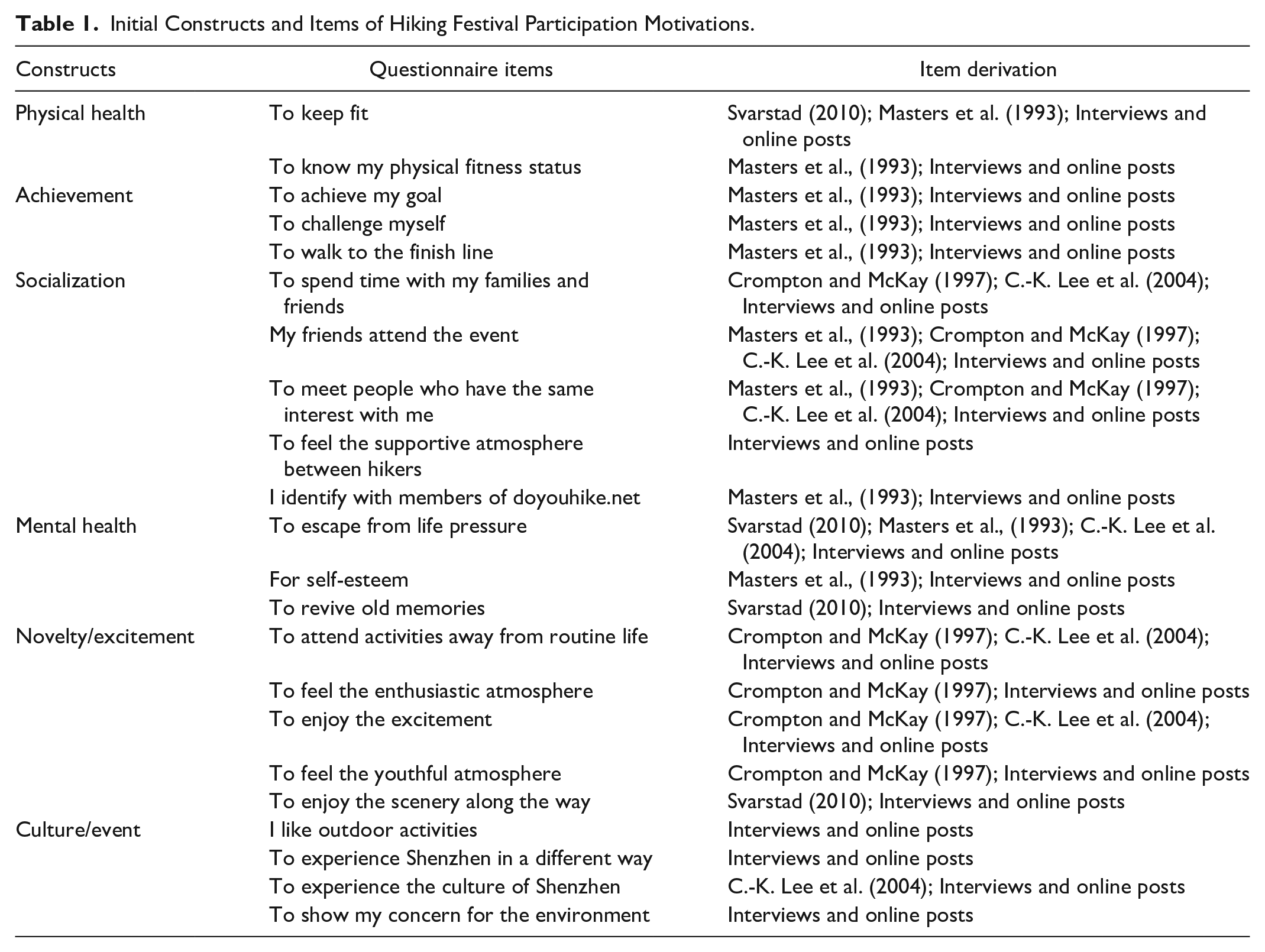
A pretest of people who had previously participated in the hiking festival (n = 48) was conducted to further refine the items and ensure they were understandable (Boley & McGehee, 2014). Participants completed online questionnaires and provided feedback related to understandability via the online discussion platform Wechat. This led to minor wording adjustments for a number of the items.
Data Collection
At the 2016 event, participants were intercepted at two rest stops along the route using convenience sampling and asked to complete hard copy questionnaires without rewards. The initial number of items was 30; according to 10 participants per item rule-of-thumb of factor analysis, the proper sample size should be 300 per group. Three groups of sample was needed for (a) refinement of measures, (b) scale calibration, and (c) scale validation (Kim et al., 2012); thus, the sample size should be 900. Considering the possible refuse rate and uncompleted questionnaires, a total of 1,000 questionnaires were distributed, of which 927 questionnaires were returned. Thirty-three questionnaires were discarded due to significant incompleteness leaving a usable sample of 894. Demographic characteristics of the full sample are provided in Table 2.
Demographic Profile of Respondents.

Data Analysis
Consistent with previous scale development research (e.g., G. Chen et al., 2014; Kim et al., 2012; So et al., 2014), the full, usable sample (N = 894) was randomly divided into subsamples. Sample 1 (n = 300) was used for exploratory factor analysis (EFA), Sample 2 (n = 300) was used for calibration, and Sample 3 (n = 294) was used for validation. Before assessing the reliability and validity of the scale, descriptive statistics for individual items were generated through SPSS 19.0. Mean scores, skewness, kurtosis and item-to-total correlations were calculated for each item. EFA using the principal component method was conducted on the Sample 1 data to identify the dimensionality of the broad motives construct. Confirmatory factor analysis (CFA) was performed using the Sample 2 data to verify the latent structure that emerged from EFA. Another CFA using the Sample 3 data was performed to further test dimensionality and validate the scale. The three sample approach to scale development used here includes aspects that have been implemented previously in similar studies. This includes splitting the sample (G. Chen et al., 2014; Kim et al., 2012) and the practice of conducting an EFA prior to a confirmatory procedure (C.-K. Lee et al., 2004; So et al., 2014).
Results
Refinement of Measures (Sample 1)
Among the 22 items, 21 had a mean value over the midpoint (3.0), indicating that the participants deemed the motives relevant in this context (Table 3). Following Kim et al. (2012), item-to-total correlations (r) were calculated for each item. However, all items had high item-to-total correlations (r > 0.4); thus, no items were deleted.
Descriptive Statistics of Motives Items.

EFA using the principal component method and varimax rotation was conducted on the Sample 1 data (n = 300). To select a model that substantially explains the data, a number of decision rules including “eigenvalues greater than 1,” “scree test,” and “total variance explained” were used to extract factors (Fabrigar et al., 1999; Floyd & Widaman, 1995). Items with a factor loading above 0.4 were retained, while items with loadings lower than 0.4, or that cross-loaded on two factors with loadings greater than 0.4 were removed (Tabachnick & Fidell, 2007). Items substantively loading with theoretically unexplainable factors were also discarded (Kim et al., 2012; M. L. Wu, 2010). Then, a reliability coefficient (Cronbach’s alpha) was computed for each factor to estimate the reliability of each scale. All factors with a reliability coefficient above 0.6 were considered acceptable (Cortina, 1993; C.-K. Lee et al., 2004). Eighteen items were included in the final model, in which the Kaiser–Meyer–Olkin (KMO) Measure of Sampling Adequacy was 0.824, the Bartlett’s Test of Sphericity was significant (p < .01). The items loaded onto six factors that aligned with the motives extracted from the literature. The final model of 18 items explained 66.57% of the total variance (Table 4). The variance explained for each motive was as follows: Physical Health (9.07%), Achievement (11.37%), Socialization (11.43%), Mental Health (10.18%), Novelty/Excitement (12.59%), and Culture/Event (11.93%).
Exploratory Factor Analysis Results (Sample 1).

Scale Calibration (Sample 2)
To further verify the latent structure identified from EFA, CFA was conducted using Mplus 7 on the six-factor, 18-item structure using the Sample 2 data (n = 300). Results are reported in Tables 5 and 6. The chi-square to the degrees of freedom ratio (χ2/df) was 1.69, comparative fit index (CFI) was 0.954, Tucker–Lewis index (TLI) was 0.941, root mean square error of approximation (RMSEA) was 0.048, standardized root mean square residual (SRMR) was 0.049. These were all in line with or very close to the criteria (χ2/df < 2, CFI ≥ 0.95, TLI ≥ 0.95, RMSEA < 0.06, SRMR < 0.08), indicating the model fit the data adequately (Hu & Bentler, 1999; Schreiber et al., 2006). Although the standardized factor loading (SFL) of one item (“To escape from life pressure”) was lower than 0.4, it was retained for further analysis because of its importance in hiking (Svarstad, 2010), mass participant sport event (Masters et al., 1993), and festival literatures (C.-K. Lee et al., 2004). Convergent validity was evaluated by checking standardized factor loadings and average variance extracted (AVE). All but the aforementioned escape item factor loadings varied from 0.584 to 0.868 and were therefore greater than the 0.4 critical value. AVE of all items (except mental health) exceeded 0.5 (critical value). Although the AVE for mental health was less than 0.5, it was not warranted to remove the motive on that basis alone (e.g., G. Chen et al., 2014; Jin & Weber, 2013; Q. B. Zhou et al., 2015). AVE is considered a conservative tool to assess scale psychometrics (Fornell & Larcker, 1981) and the structure of the scale was otherwise reasonable (Tabachnick & Fidell, 2007). Except for Mental health, other factors showed satisfactory discriminant validity (Table 6) insofar as AVE values exceeded corresponding squared intercorrelations (Fornell & Larcker, 1981).
Confirmatory Factor Analysis Results (Sample 2).

Note. SFL = standardized factor loading; CR = composite reliability; AVE = average variance extracted.
Construct Intercorrelations (Sample 2).

Scale Validation (Sample 3)
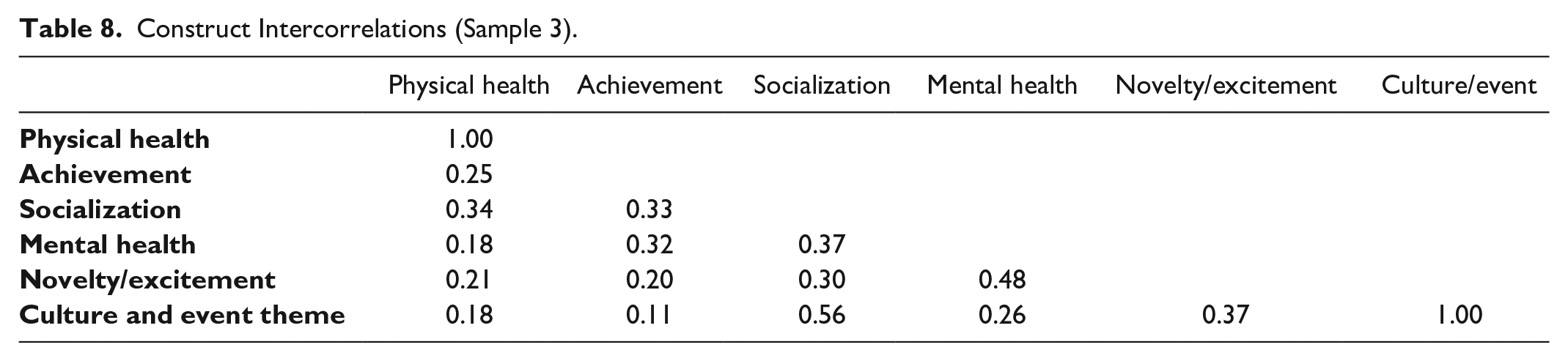
As in Kim et al. (2012) and G. Chen et al. (2014), a further factor analytic procedure was conducted using the Sample 3 data (n = 294) to assess psychometrics and comprehensively validate the instrumentation. The same process and statistical approach as with the Sample 2 data were used at this stage. Results are reported in Tables 7 and 8. This model had satisfactory fit with a χ2/df of 1.62, CFI of 0.951, TLI of 0.937, RMSEA of 0.046, and SRMR of 0.048. The convergent validity and discriminant validity of the scale were assessed through factor loadings, AVE, composite reliability (CR), and correlations, and the results were promising (Tables 7 and 8). It is noteworthy that the factor loading of the item “To escape from life pressure” was higher in the scale validation (0.467) than it was in the scale calibration (0.355), which justifies its inclusion in the scale.
Confirmatory Factor Analysis Results (Sample 3).
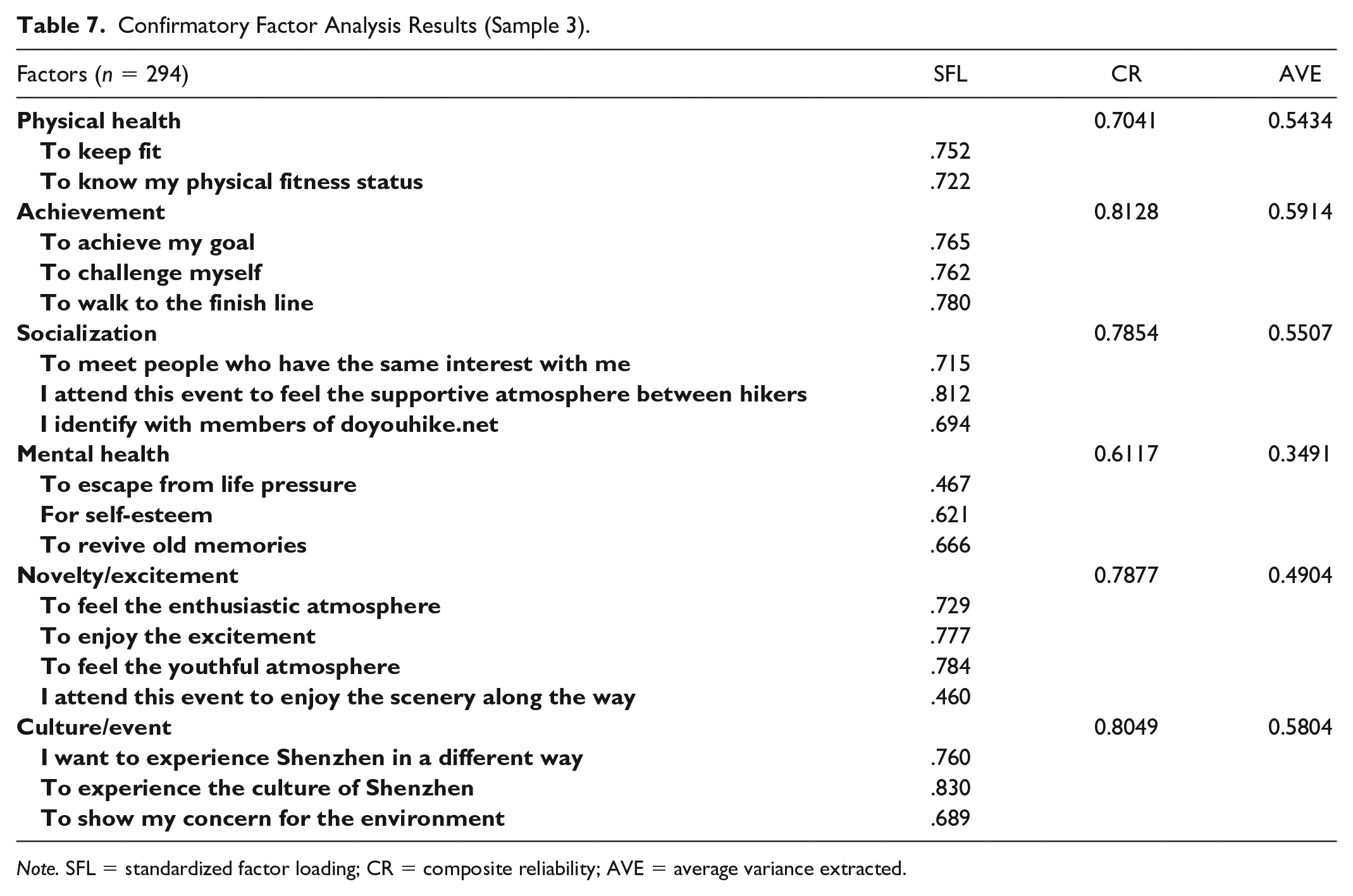
Note. SFL = standardized factor loading; CR = composite reliability; AVE = average variance extracted.
Construct Intercorrelations (Sample 3).
Repeat Participation
A comparison of the motives of first-time and repeat participants was carried out using the full sample (N = 894) (Table 9). First-time and repeat participants varied on Mental Health; t(892) = −3.05, p < .01) and Culture and Event Theme; t(892) = −2.11, p < .05) motives. Compared with repeat participants, first-time participants were less motivated by Mental Health and Culture and Event Theme. Although statistically significant differences across the motives emerged across various subgroups from these analyses, none of the differences were large. This is, however, inconsistent with previous research on participation motivation of sport events which found that first-time participants were more motivated by the event attractions, whereas repeat participants were more motivated by elements related to the physiological aspects of their participation (Snelgrove & Wood, 2010). Reasons behind such differences might be the festive elements, that is, to celebrate and represent the city’s culture and identity. Thus, repeat participants, who are more familiar with the host city and the event itself, will have higher culture and event theme motivation. It is worth noting that the festive elements of this emerging event format may have better potential to enhance participant’s overall experience and therefore motivate participants to re-participate.
Motives Based on Repeat Participation.

Note. Asterisks indicate group differences.
p < .05. **p < .01.
Conclusion and Discussion
Conclusion
In this study, motives for participation in an emerging event format were explored. The six motives put forth here that drive participation in a festive sport event are grounded in SDT as they are aligned to competence, relatedness, and autonomy. Participating in festive sport event fosters connectedness to oneself, to the city, and to others. What differentiates festive sport event motives from those common in general mass participant sport events is the desire to experience a novel and exciting atmosphere within a unique cultural context. Unlike more traditional sport events where physical health and achievement are prominent motives (Masters et al., 1993; Svarstad, 2010), excitement and culture are of vital importance here. In a festive sport event, participants are free to be competitive or recreational, to have fun in their own way, and to creatively represent and celebrate the city’s identity, while participating in an organized sport activity.
The factor analysis carried out in this study indicated that the six motives which were generated as part of the scale development process and featured on the questionnaires were mostly psychometrically sound. The Physical Health and Achievement motives are perhaps most strongly linked to mass participant sport events (e.g., N. Murphy et al., 2015; Sato et al., 2015); while Novelty/Excitement and Culture/Event are strongly aligned with festival attendance motives (e.g., Blešić et al., 2013; Bowen & Daniels, 2005). Socialization and Mental Health are in line with both literatures (Blešić et al., 2013; Masters et al., 1993). All of the motives aside from Culture/Event are consistent with what has been found in the recreational sport and hiking motives literature. Therefore, findings suggest that the motivational makeup of participants in this emerging leisure context are unique and more complex. Participants are not simply seeking the benefits from playing sport, participating in an event or attending a festival in isolation, but rather they seem to be attracted by a combination of benefits from the various dimensions of the event.
Physical Health and Achievement motives have not emerged in the extant festival literature (Y. Li & Wood, 2016) but were relevant here. Most festival contexts in this literature have a leisure and entertainment focus which is different from the current sport-based context in which there is an element of competition and opportunity for achievement. The results of this study suggest that in the context of a festive sport event, these motives are important. The study therefore bridges these two areas of literature, which constitutes a key contribution and opportunity to advance theory as it relates to an emerging event format. The results of this research also cast doubt on our existing knowledge of event motives more generally. From this study, it seems that the unique features of events may be strongly linked to motivation to participate, which is a departure from our current understanding. With disparate event features including culture, locations, and ancillary offerings emerging nowadays, motives may change accordingly and be specifically linked to those unique features.
Managerial Implications
The breadth of motives that drive participation and the potential for varied benefits suggest that festive sport events are an effective means for a city to engage with community members and also attract tourists. Participating in a festive sport event may satisfy autonomy, competence, and relatedness needs, which is great for personal well-being but cities may also use festive sport events as a chance to build city identity and promote social inclusion for collective well-being.
The establishment of the six distinct motives aligned to this event context and subsequent evidence supporting their validity is important. Festive sport event organizers now have a practical framework for understanding the underlying psychology of participants in this leisure. This framework allows for the creation of viable market segments that can be uniquely engaged. It is very important for managers to acknowledge that participants may be driven by a myriad of motives linked to sport, event, and festive dimensions. Promotional material can tap into these underlying motives to drive engagement from community members.
Motivational differences were noted here between first-time and repeat participants. Although the distinction was modest, organizers should establish strategies to recruit new participants and reengage those who have participated before nonetheless. For targeting those who have participated before, the festive elements of the event should be emphasized. The music, stalls, and wider eventscape should be updated and improved on a year-to-year basis to keep repeat participants interested.
Limitations and Future Research
It is advisable to further explore motives related to participant’s Mental Health. This motive was the least statistically robust in the current study and suggests that it is not quite being measured accurately or that these motives may be more complex than how we have conceptualized it. This is a limitation of the study and should be kept in mind when interpreting the findings. The motive is predominant in both sport and festival literatures (Blešić et al., 2013; Funk et al., 2007; Masters et al., 1993), so it would be useful to explore in future research exactly how this motive manifests in the context of a festive sport event. In addition, this article is based on a festive sport event attended by mostly local residents or those from nearby cities. Motives of long-distance participants could be different from local participants, and this could be explored in future research. Besides, participants of this event are predominantly young, male, and highly educated. Results of this study should be tested and validated with events in more diverse context. Moreover, cluster analysis by motives may be employed to understand participants of this type of event to greater depth. Cluster analysis has been applied previously in festival motivation studies (e.g., McMorland & Mactaggart, 2007) and would provide a comprehensive understanding of segments of festive sport event participants.
Footnotes
Declaration of Conflicting Interests
The author(s) declared no potential conflicts of interest with respect to the research, authorship, and/or publication of this article.
Funding
The author(s) disclosed receipt of the following financial support for the research, authorship, and/or publication of this article: This work was supported by the National Science Foundation of China (grant number 41771145).
