




Abstract
As the literature on the economic abuse of women in Arabic contexts is quite limited, we aimed to detect the correlation between this economic abuse and a variety of demographic variables. Specifically, we considered women’s age, education, income, number of children, and length of marriage, as well as the husband’s education and employment status. We distributed questionnaires that included the economic, psychological, and community composite abuse scales to 500 married working women in the capital of Amman, Jordan. The results revealed that the economic abuse of women decreased as their education levels and length of marriage increased, as long as the husband worked full-time. In addition, a husband’s high education level would also increase the likelihood of economic abuse. Most importantly, the findings showed that economic abuse definitively heightened the probability of intimate partner violence (psychological, emotional, and physical abuse, as well as harassment).
Keywords
Article 1 of the UN General Assembly’s (2006) study defined violence against women or based on gender as any act of gender-based violence that results in, or is likely to result in, physical, sexual, or psychological harm, or women’s suffering. This includes threatening acts, such as coercion or arbitrary deprivations of liberty, occurring in public or private. This definition emphasizes the idea that violence is inevitably inherent in the societal inequalities between men and women (Krantz & Garcia-Moreno, 2005). The National Council for Family Affairs (2008) also agreed that violence against women takes on many forms (sexual, psychological, physical, economic, and social), due to the different definitions of violence and ways of measuring it. Nonetheless, all forms have negative and grievous health, mental, and physical consequences on women, including increased absenteeism from work and mobility/movement restrictions, both of which reduce productivity and income. Specifically, this council indicated that economic violence against women deprives them from being active as economic resources or taking part in financial decisions that influence their lives, affecting their future and rendering them entirely dependent on others. For example, these women are deprived from having the freedom to choose how they wish to manage their property and spend their money on essentials. Therefore, eliminating violence against women requires an applicable strategy at the local, regional, and international levels, and represents an important step in developing women’s human capital and economic empowerment (Tavares & Wodon, 2018).
Similarly, the National Center for Human Rights (2017) defined economic violence against women as any reaction depriving women of their financial rights, including working income, inheritance, or essential maintenance funds. In other words, economic violence against women occurs when the abuser has total dominance over the victim’s properties, resources, economic activity, and family financial affairs, and makes decisions irrespective of their combined financial situation. Consequently, this would restrict women’s capacities, as they are fully dependent on the aggressor for their personal needs, which leaves them with a degrading alternative of being forced to beg for money (Fawole, 2008).
Within the labor market, economic abuse involves discrimination in terms of wage disparity, career development, and promotions. It includes behaviors that control a woman’s ability to acquire, use, and maintain economic resources, which threatens her economic security and her ability to be self-sufficient (Adams et al., 2008). However, although economic abuse is used in correlation with financial abuse, the two concepts are different. Financial abuse is the perpetrator’s use or misuse of property which would restrict his current or future partner’s control over the property’s management, and her freedom to make decisions and choices. This may include using credit cards without her permission, forcibly committing her to contractual obligations, and gambling with the family property (Sharp, 2008). Thus, financial abuse involves the illegal or unauthorized use of another person’s property, money, pension, or precious objects. It also applies to cases where the abuser/aggressor becomes the inheritor, either forcibly or through legal circumvents, deprives the other of their money or other property, and makes them evacuate from the house. Financial abuse can also involve the ill-treatment of the elderly and household violence (Carnot, 2004). However, economic abuse rarely occurs separately from other forms of abuse, as the offenders, especially husbands, use other abusive conducts to increase the economic abuse (Sharp, 2008). For example, women may get exposed to sexual, physical, psychological, or emotional violence, resulting in their deteriorating health, self-esteem, and ability to work and provide, while their social and economic participation also dwindles (Eriksson & Ulmestig, 2017; Fawole, 2008; Postmus et al., 2018; Women’s Aid, 2019). As a result of the partner’s pressures and exploitation, their debts may accrue, they may be deprived of meeting their essential needs, such as food and clothing, and/or they may lose their job and become unhealthy. It is important to note that this economic abuse can continue with the marriage or because of child support if the couple is no longer together (Eriksson & Ulmestig, 2017; Fawole, 2008; Sharp, 2008; Women’s Aid, 2019).
Unfortunately, financial independence also influences the probability of intimate partner violence (IPV; physical, sexual, or psychological), as a result of a person’s status and earnings in the labor force. However, this influence is generally limited, and appears in various manners and different intensity levels in terms of the type of violence. One of the strongest influences is a woman’s financial independence. As the woman gains this independence through work, her earnings will significantly reduce the household’s poverty level, but this may also cause increases in violence, which is consistently associated with households in critical economic conditions. Furthermore, exposure to sexual harassment also increases the chances of a woman belonging to this type of household (Bettio & Ticci, 2017).
The FEMM Committee’s Policy Department for Citizen’s Rights and Constitutional Affairs (2016) studied the issue of violence against women in the European Union (EU), and found that 31% of women in the EU had experienced physical violence by a partner or nonpartner. The most common experience of violence was being manhandled, followed by other incidents of physical abuse (i.e., slapping, grabbing, and pulling the hair). The study further revealed that poverty and unemployment are widely perceived as contributing factors to domestic violence. For example, when the women are unemployed, potentially due to threats and fears of violence that create a vicious circle in which she purposely does not look for work, the lack of economic resources creates a dependency and often deters the women from leaving. The man may also become violent when he is unemployed, especially in cases where the woman is the breadwinner, as her economic independence and social life may be seen as a threat. In some settings, women’s financial independence is protected, but there are additional risks when the woman is the only working partner. Moreover, the psychological impact of an abusive relationship must also be taken into account. The resulting poor self-esteem can create feelings of culpability, and women can begin to think that they are responsible for the situation or they could suffer from a form of Stockholm syndrome.
Furthermore, the 2018 Global Gender Gap Report Index ranked Jordan 138th among 149 countries around the world, due to women’s poor economic participation (World Economic Forum, 2018). Specifically, Jordan came in 144th in economic participation, revealing a 14.9% and 67.1% labor market participation rate for women and men, respectively, a 22% gender gap in the labor market, and a 63% pay gap. The Sisterhood division of the Global Institute in Jordan commented on Jordanian women’s economic participation, and argued that the root cause and structural grounds for discrimination against women and gender inequality are among the most important constraints to their economic empowerment (SIGI-Jordan, 2019). For example, a husband can prevent his wife from working, unless she included this factor in the marriage contract; many women are deprived of their inheritance, and shared money is not divided in the event of a divorce or separation. Women also carry out household chores and nonpaid work on their own, leading to the feminization of poverty phenomenon.
The Sisterhood is Global Institute (SIGI)-Jordan statement highlighted that the protection of women against economic abuse does not only involve their economic participation in different activities. It extends to cover their ability to freely control their possessions, acquire real estates and property, and have access to different resources. Conversely, the statement emphasized that economic violence has significant and enormously negative consequences on their economic participation, food security, and possibility to escape from poverty and hunger. Finally, the declaration also stressed that women should be treated as partners in the process of sustainable development, not victims, which could contribute to eliminating poverty and hunger.
It is evident that the abuse of women is still a significant issue in numerous contexts, and that economic abuse has substantial repercussions for women’s personal and social lives, as well as their general well-being. As such, this study examines a population of working women in the capital of Amman, and aims to determine the relationship between economic abuse and a series of demographic variables. To our knowledge, this is the first study to address the correlation between economic abuse in the target population (working women residing in Jordan) and a variety of demographic variables: the woman’s age, education, income, number of children, and length of marriage, as well as the husband’s education and employment. Previous studies have not examined these variables in the Jordanian context. Furthermore, the chosen variables have caused controversies among researchers in terms of their impact on economic abuse levels and methods, as a cause or consequence. Finally, we also make a positive contribution to the scant Arabic literature on the economic abuse of women in Jordan, by attempting to understand the relevant demographic variables in light of the Arab environment’s particularities.
Economic Abuse Under the Sociology Microscope
Economic abuse is part of a broader spectrum of family violence, including domestic violence, IPV, and abuses within marriage and families, that could also be recognized as emotional, psychological, and physical violence. When defining a family, one needs to understand the different relationships within the family and that the occurring violence could be attributed to various problems and reasons. One must further take into consideration the differences between couples who are dating, and those who are living together and are engaging in sexually activities without being married. Therefore, it is important to clearly define what is implied in a couple to avoid unclear results (Loseke, 2003).
Sociology’s tendency to label families as social institutions, without considering specific variations and complexities, could lead to other risk factors, as this label is not applicable to all families. Taking this into account, it is important to divide the family institution according to general and specific definitions, and have a clear definition. To clarify this, we consider three groups under which family institutions must be identified: (a) despite significant social changes, the family’s life and values should have a strong foundation, (b) the ways in which the family members approach each other and react toward one another in given situations, and (c) the specific arrangements and requirements, based on society, that are beyond the individual’s control. One must further be aware of the legal requirements with regard to marriage, divorce, the protection of children, care for the elderly, and employment status (Loseke, 2005).
Furthermore, although not one sociological theory can, with certainty, be singled out as adequate for all forms of violence, when dealing with IPV, the field of study tends to place the blame on social structures, rather than the pathology of the offender (Lawson, 2012; Michalski, 2005; Montesanti, 2015; Pacheco et al., 2017). Sociologists are in total disagreement regarding the idea that family violence seldom occurs and that when it does, it is the result of a mentally disturbed individual. However, family violence theorists do not accept the psychological approach to violence and focus on the various social forces that, from their perspective, are responsible for family violence. Sociologists have developed a number of approaches to explain family violence, including resource and systems theory, exchange and social control theory, ecological theory, patriarchy explanations, economic models, sociobiological perspectives, and sociocultural explanations, all of which can be classified as social psychological and sociocultural theories, as well as the subculture-of-violence theory. Therefore, IPV is an expression of conflict within the family that can best be understood through examinations of social structures that contribute to violence (Ellialti, 2016; Lawson, 2012; Steinmetz & Straus, 1974).
Resource Theory (Theory of Intrafamily Violence)
Goode’s (1971) theory was the first theoretical approach explicitly applied to family violence. Based on the foundation that force or recognition of force is present in all social systems, it argues that the more power an individual has in the control of resources, social situations, and economics within the social system, the more force that individual can apply. This largely supports a direct relationship between income and violence (Aizer, 2011; Houston, 2014). In accordance with this theory, violent force could be used to obtain an aim and resolve conflicts. In today’s societies, violence is used as a last resort, when no other approaches are successful in obtaining the required outcome (Loseke, 2005; Hyde-Nolan & Juliao, 2012; Sommer, 1994).
The visible common denominator in domestic violence is the imbalance of power and control (Bernett, 2009). According to this theory, traditionally, men who earn a higher income and have a higher social standing have a choice of resources that enable them to exert more control over their wives, marriages, and family relationships. Unfortunately, this results in women and children finding themselves in a subordinate and vulnerable situation. However, when men are not in this position and are unable to sufficiently support their family, they will most likely resort to violence to compensate for this inadequacy and as a means to establish their dominance (Abramsky et al., 2019; Cools & Kotsadam, 2017; Hampton, 1999; Loseke, 2005; Rusbult & Van Lange, 2003; Vyas & Watts, 2008). As the family is a power unit, wherein the members rely on a certain degree of force to ensure that other members comply with their requirements, force can be used as a resource for obtaining one’s needs. Therefore, women within families with a lower social structure are often subject to abuse, as they have limited resources to counteract. Due to this minimal number of alternative resources at their disposal, the consequences of this situation could result in the women resorting to violence in an attempt to address this imbalance in their lives and social structure, and protect their children as well as themselves. These situations are all a result of the prevailing societal norms and trains of thought on women’s placement within the structures of a society (Sommer, 1994). Therefore, control and resource theories can pertinently explain the risk factors for various crimes, including family violence (Cools & Kotsadam, 2017; Hampton, 1999; Loseke, 2005).
Method
Participants and Data Collection
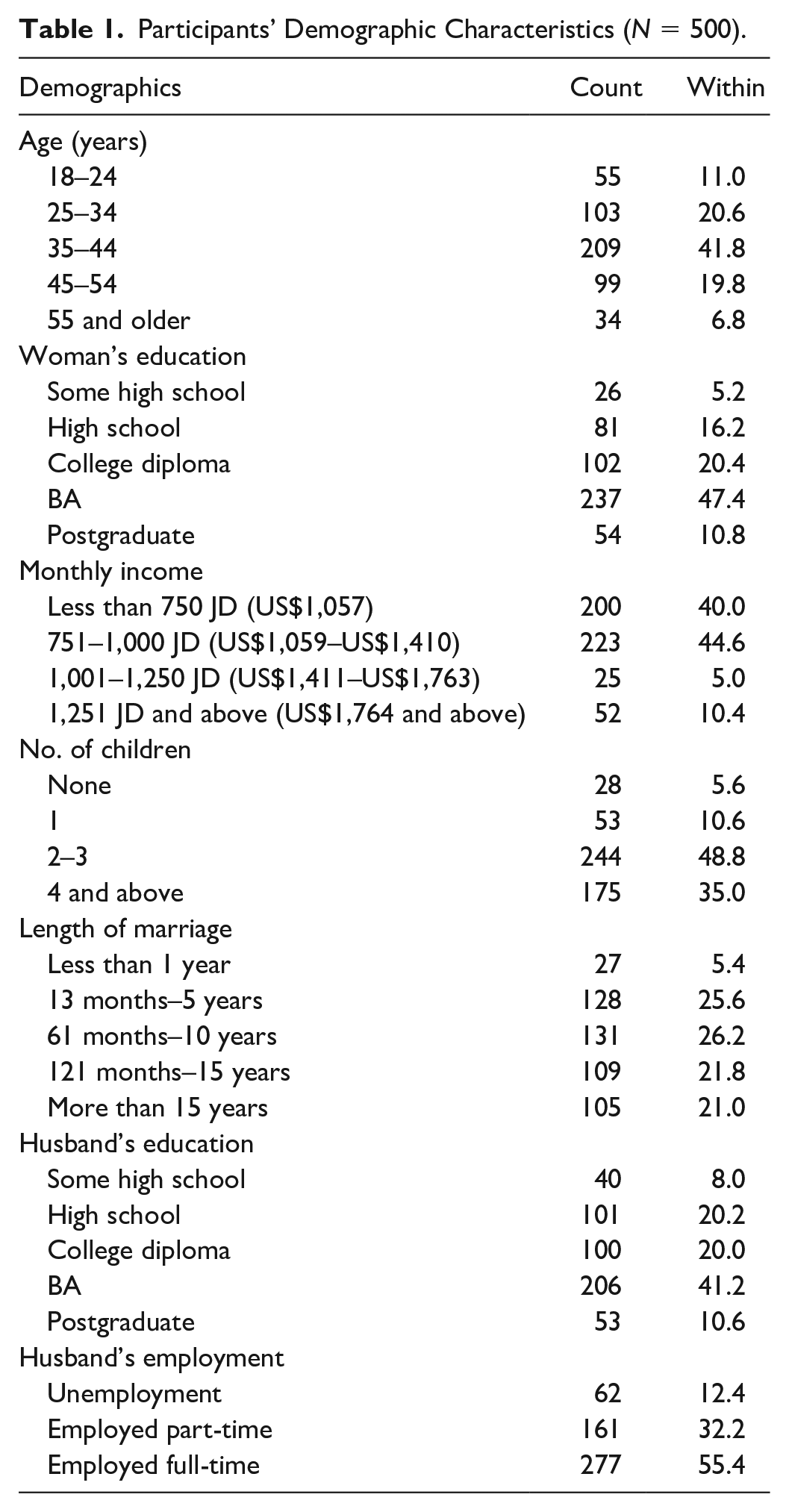
We opted for a random sampling technique to choose our participants, conducted in four stages: (a) randomly choosing four districts of nine, (b) drawing out five villages from the nine districts (5 × 4= 20 villages), (c) selecting five blocks of each village (5 × 50 = 100 blocks), and (d) selecting five families of each block through the systematic random method. We employed the Jordanian General Statistics Department’s data to reach out to 500 families that became the study sample. We discarded the homes with unemployed wives, as our focus was on working women from Amman city, the capital of Hashemite Kingdom of Jordan. We collected data from 500 working married women through interviews and a questionnaire that was self-administered or administered by a professional. The questionnaire included demographic questions (the women’s educational level, age, monthly income, years of marriage, and number of children, as well as the husband’s educational level and employment; Table 1), in addition to the research measures, and was distributed by a research team from the Department of Sociology at the University of Jordan. Ethical approval for this study was obtained from the Scientific Research Committee in the Department of Sociology from the University of Jordan. All participants provided informed consent during the interview, and respondents were promised anonymity.
Participants’ Demographic Characteristics (N = 500).
Measures, Scales, and Variation Frequencies
We used several measures to examine the levels of economic abuse and its effects on women. The chosen scales were adapted from local definitions and perceptions of economic abuse that could be considered distinct to the Jordanian or Arab context.
Scale of Economic Abuse (SEA): consisting of 28 items (Adams et al., 2008).
Profile of Psychological Abuse of Women: a 21-item scale that measures a wide variety of psychological aspects (Sackett & Saunders, 1999).
The Community Composite Abuse Scale: a 28-item scale that measures physical abuse (10 items), emotional abuse (14 items), and harassment (4 items; Loxton et al., 2013).
We developed a yardstick for the responses’ general rating levels according to the Likert-type scale (five answer options). As such, each item of the aforementioned scales was scored on a five-point Likert-type scale ranging from 0 (never) to 4 (always), as shown in Tables 2 and 3. A five-point scale is ideal for large samples and tends to produce better data distributions.
Quintuple Likert-Type Scale.

Triple Gradation Scale per Level.

The length of each period of the five dimensions equals to 0.80 of the unit, based on the periods rule: (distances between periods − 1) / number of periods
As shown in Table 3, the values of the arithmetic means will be treated as follows with regard to the quintuple gradation: 2.67 and above is high, 1.34–2.66 is medium, and 1.33 and below is low, in accordance with the following equation,
Reliability, Goodness of Fit, and Normality Test
We verified the reliability of the study’s instrument through Cronbach’s alpha coefficient. A scale is considered reliable if the value of the latter coefficient is greater than 0.060 (Sekaran & Bougie, 2016). The closer the latter value is to 100%, the higher the instrument’s reliability. This scale’s Cronbach’s alpha coefficient value was .99, indicating high reliability.
Before quantitatively and statistically analyzing the collected data, we calculated the skewness coefficient values for all the study’s variables to verify the normal distribution of the data. The values were less than 1, indicating no problems in the normal distribution of the study data. To further test this distribution, we also conducted kurtosis tests. As all values of skewness and kurtosis ranged between ±2, all the survey variables were normally distributed (Hair et al., 2013). Furthermore, the Kolmogorov–Smirnov test’s results showed the lack of statistically significant differences for all themes (independent and dependent) at the α ≤ .05 significant level. As such, the naught hypotheses cannot be rejected, that all means are normally distributed vis-à-vis the alternative hypothesis which suggests unequal normality. Based on all the above, we concluded that all the themes were normally distributed.
Results
After conducting the statistical analysis, we concluded that the level of overall economic abuse of women was moderate (38%), based on the results presented in Table 4. The overall mean of the sample’s attitudes toward all the examined dimensions is also moderate (1.5054).
Mean and Standard Deviation of the Economic Abuse Levels Among Married Working Women.

To determine the correlation between economic abuse and other patterns of abuse, in addition to the correlation between economic abuse and demographic variables, we employed a Kendall correlation coefficient analysis for the ordinal samples (Kendall’stau_b), as it is the appropriate method for such ordinal data and produces results that realize the study’s objectives. As illustrated in Table 5, the results show a high and direct significant correlation (p ≤ .05) between the economic abuse of women and other abuse patterns, such as psychological, emotional, and physical abuse as well as harassment.
Correlations Between Economic Abuse and Other Abuse Patterns/Economic Abuse and Demographic Variables.

Correlation is significant at the .05 level (two-tailed). **Correlation is significant at the .01 level (two-tailed).
Table 6 shows these other patterns of abuse faced by women who have experienced economic abuse. We also found no statistically significant correlation (p ≤ .05) between the economic abuse of women and each of the following demographic variables: wife’s age, monthly family income, and number of children. An insignificant correlation would indicate that the level of economic abuse is moderately equal to the difference in ages, family size, and monthly income. The results also indicated a converse statistically significant correlation between the level of economic abuse and the following variables: women’s educational level, marriage years, and husband’s employment status. In other words, when the woman’s educational level and years of marriage increased, and her husband worked full-time, the economic abuse levels would decrease. However, the results revealed a direct and significant correlation (p ≤ .01) between the economic abuse of women and the husband’s educational level: The economic abuse level would increase with the husband’s educational level.
Mean and Standard Deviation for Abuse Types (N = 500).

Bold values highlight core values.
Discussion
Significant Correlations
The results showed that economic abuse and other patterns of abuse (psychological, emotional, physical, and harassment) had a highly significant correlation, as these behavioral patterns may support economic abuse and be a result of it. Indeed, women with economically abusive partners may endure the stress associated with chronic economic deprivation and exploitation, and may face further physical and psychological health issues as a result. This also applies to women who have left their abusive partners and are struggling to make ends meet (Adams et al., 2008). In fact, women’s marital resources and constraints accounted for most of their risk of experiencing physical domestic violence (Young & Li, 2010).
The most prominent impacting demographic variables for lowering the economic abuse of working married women were women’s education level, marriage years, and the husband’s employment situation. Regarding the first demographic factor, this result may be attributed to the fact that higher education would contribute to increasing women’s awareness and knowledge in all aspects of life. Therefore, they would be more educated about their rights, allowing them to defend and protect themselves, and they would be more capable to manage their lives, property, and resources, compared with noneducated women. Their education would also contribute to improving their health and that of their children, and would boost their self-confidence, allowing them to engage more in their social lives (United Nation Development Program, 2013). Similarly, Ackerson et al. (2008) found that a woman’s education affected her likelihood of reporting IPV, while her husband’s education still captured about 40% of her own educational effects. They also found that women whose educational attainment was higher than their husbands’ were more likely to report IPV, similar to Young and Li’s (2010) findings on married women in Egypt with unusually less or unusually more schooling than their spouses. In addition, the former study revealed that a neighborhood’s male and female literacy was inversely associated with IPV, independent of individual-level factors, and modified the relation between a woman’s education and IPV. As such, the protective effects of neighborhood literacy were stronger for women with a middle to high level of education.
Okenwa and Lawoko (2010) also considered illiteracy and low education an independent risk factor for women experiencing intimate partner physical abuse (IPPA). Furthermore, as a woman’s ability to resist violence depends on her access to economic and social resources, her education could provide her with more opportunities for financial independence, allowing her to leave an abusive husband and providing her husband with an incentive to refrain from abusing her (Krishnan, 2005). Moreover, a woman’s level of education might protect her against IPV, as women with more education may be more assertive in their relationships, negating the power and control that husbands of this type may try to exert over their wives (Bonnes, 2016). Accordingly, the Central Agency for Public Mobilization and Statistics (2016) asserted that, in Egypt, the violence levels that wives experience would be reduced if they increased their level of education. This would enable them to rationalize and determine the type of interactions they require in a marriage for it to be successful (Määttä & Uusiautti, 2012), and would enhance the level of respect and commitment between the partners (Booth, 2009). In the Kenyan context, Sang and Sang (2014) demonstrated that the women predominantly have a low education, and that those who do not own property or their own businesses are deprived of decision-making, resulting in being exposed to economic abuse. This result is also consistent with the FEMM Committee’s Policy Department for Citizen’s Rights and Constitutional Affairs’ (2016) findings, confirming that women who, as a result of their education, are more empowered, economically self-sufficient, and socially accepted are most protected.
Regarding the second demographic factor mentioned above, our results showed that the longer the marriage, the lower the chances of abuse, as both spouses have a better understanding of each other and their respective characters, which strengthens their mutual recognition of each other’s needs. Thus, they can overcome their differences by utilizing the diverse experiences and challenges they already encountered in their lives. To the best of our knowledge, previous literature has not assessed these factors. However, Lerman (2002a) has provided much empirical evidence that marriage might enhance the economic well-being of families with children. In addition, Lerman (2001, 2002b) suggests that marriage serves as a protective device against hunger and the inability to meet basic expenses. This may contribute to a longer marriage and reduce abuse.
Regarding the third factor, we found that a husband’s full-time employment reduced the chances of economic abuse, potentially due to his financially stability, job security, and his constant occupation, which would alleviate confrontations and the persistence of household problems. However, a husband who works part-time may worry about losing his job, and his monthly salary may be insufficient to repay his debts and provide for household essentials. As such, he may feel incapable, and might repeatedly blame his wife and children. The unemployed husband, however, would definitely feel incapable of providing for his household’s future and the family’s essentials, due to the lack of economic resources. In addition to his low self-esteem, if the wife is working, she would have economic resources that would allow her to support the family and provide for their needs, which may further drive the husband to mistreat his wife economically. Accordingly, Althaqafi (2016) showed that the family’s economic situation is one of the most important factors affecting household violence. When the husband is suffering from economic difficulties, he may claim that his wife’s salary is his right, and in cases where she refuses to give him her money, he may resort to violence. Comparably, our results further demonstrated that among the most important economic risk factors affecting household violence in the Arab community is the husband’s unemployment, as he would experience a lower status and position, all of which would increase the likelihood of him being violent toward his wife. However, Rainer et al. (2016), who found opposing results, revealed that male and female unemployment had opposite side effects on domestic violence: While female unemployment increased the risk of abuse, male unemployment had the opposite effect. This study was robust and included a wide set of controls. The differences in these results may be due to differences in cultural factors.
Furthermore, it is important to understand the interrelationship between the wife’s and the husband’s education to grasp the potential for IPV in a marital relationship because the protective effect of a woman’s level of education is contingent on her husband’s education (Okenwa & Lawoko, 2010). Our results did support the dependence hypothesis between these two variables, through a direct and statistically significant correlation between the economic abuse of women and the husband’s education level: The level of economic abuse rose with the husband’s education. On one hand, this result can be ascribed to the husband’s employment, as he may be unemployed or a part-time worker, which would increase his financial burdens or debts. Thus, he becomes unable to provide for his household essentials and subjects his wife to economic abuse. On the other hand, the result may also be due to his wife’s low education. In this situation, the husband may look down on his wife and give himself the right to be in charge of the economic resources and financial decisions, as he believes himself to be more aware and familiar with these matters. In other words, based on the domination and authority allocated to men from the patriarchal social makeup, husbands having a higher education than their wives may imply that they dominate the decision-making process, a behavior that has been associated with increased abuse (Choi & Ting, 2008). However, Bonnes (2016), who studied Malawian married couples, found that a husband being more educated than his wife does not predict any variation in the likelihood of IPV. This opposing result may be related to the different social and cultural context, as a husband having more education and greater decision-making power than his wife fits the traditional marriage relations and gender norms, perhaps making it less of a predictor for the likelihood of IPV in this context.
These findings demonstrate that economic abuse is a significant tactic used by abusive partners to gain power and maintain control over their partners. This confirms the assertions of the theory of resource control.
Insignificant Correlations
Our results showed no statistically significant correlation (p ≤ .05) between the economic abuse of women and the wife’s monthly income, age, and number of children. Regarding income, although previous studies have shown that economic abuse may increase as a result of low income (Abramsky et al., 2019; Lynch et al., 1997; McCallum et al., 2002), our results confirmed the need to better understand the relationship between these factors. Although Okenwa and Lawoko (2010) revealed that low income increased the likelihood of IPPA for women, Abramsky et al.’s (2019) results, specifically with regard to economic abuse, confirmed our own, as they also found no clear associations between income and economic abuse. While women’s income protected them against IPV, women who contributed more financially than their partners had a greater IPV risk. Abramsky et al. (2019) further suggested that the relationship between a woman’s income and the risk of abuse may be explained, confounded, or modified by contextual factors, including household and economic hardship, the woman’s major economic contribution, length of marriage, the woman’s individual factors (e.g., age, education, gender attitudes, and childhood experiences of abuse), and the man’s individual factors (e.g., age, education, and gender attitudes). We also believe that a woman’s participation in social empowerment interventions may also modify the association between her income and IPV risk.
Our results confirmed the findings of Adams et al. (2008) regarding age—namely, that 99% of women aged 18 years or older had suffered astounding economic abuse at some point during their relationships. In other words, almost every woman had been involved with a partner who controlled her use of or access to economic resources (Adams et al., 2008, p. 581). Moreover, Kutin et al. (2017) found that women in all age groups were more likely to experience economic abuse (15.7%). In contrast, Jury et al. (2016) conducted a survey of 445 women that had been victims or potential victims of economic abuse by partners, and found that the highest rates of responses were from women aged 35 to 45 years. In a narrative review of 48 studies exploring IPV in women aged ≥45 years, Pathak et al. (2019) found that the data suggest that IPV is commonly experienced by older women (lifetime prevalence 16.5%–54.5%), but that their age and life transitions mean that they may experience abuse differently than younger women. They also face unique barriers to accessing help, such as disabilities and dependence on their partners.
Although our findings show no statistically significant correlation (p ≤ .05) between the economic abuse of women and number of children, Jiwatram-Negrón et al. (2018) found a relationship between partner economic abuse and parental status; specifically, women who did not have children were less likely to report partner economic abuse. In addition, some research on domestic violence and IPV suggests that women prefer not to contact previous partners about child maintenance because they do not want it to be an issue in custody disputes and fear violence or a recurrence of abuse that was experienced previously (Correia, 2000; Jaffe, 2002; Wilcox, 2006). Sanders (2015) has also explained that women often feel unable to leave abusive partners due to economic dependence, especially when they have children. However, women who did not have children were also likely to be exposed to partner economic abuse. All this suggests that women with children who experience partner economic abuse have more difficulty ending the relationship because children affect their economic self-sufficiency and they sometimes rely on their partners to pay their children’s expenses (Fawole, 2008; Sanders, 2015). Our results differ from those of other researchers with regard to the number of children due to different culture factors which control the Arab environment, in this instance, the Jordanian culture. The children are forced to stay with the fathers who are responsible for the total financial expenditures for the children with no financial requirements expected from the mother. Should a father give up this responsibility, he will face social abasement and blame.
Conclusion
Economic abuse is a part of family violence, embodying a form of discrimination-based violence, and includes behaviors that control a woman’s ability to acquire, use, and maintain economic resources, limiting her freedom of choice. It rarely occurs separately from other abuses, as the offenders, in most cases husbands, use other abusive conducts to amplify the economic abuse, such as harassment, and psychological, emotional, and physical abuse. This study is the first to assess the impact of the chosen demographic variables on the economic abuse of women in Jordan. In addition, it also contributes to the limited literature on the economic abuse of wives in the context of an Arab environment. Overall, our results support the dependence hypothesis between a wife’s and husband’s education, as it regulates the potential for IPV in a marital relationship. Also, longer marriages and a husband’s full-time employment were both associated with lower odds of economic abuse.
Our findings illustrate the complex nature of economic abuse in Arab culture, especially in Jordan. Furthermore, this study highlights the need to better understand the relationship between income and economic abuse, as we found no clear association between them. Economic abuse needs to be given greater attention and consideration as a dynamic of domestic violence. Awareness of the concept of economic abuse in Jordanian women needs to be raised, which would enable these women to recognize abusive behaviors to confront, reduce, or stop them.
In terms of practical implications, our results suggest that interventions to empower women should not only broaden their access to economic resources and opportunities but also work with women and men to address men’s livelihoods, male gender roles, and masculinity norms.
Footnotes
Acknowledgements

Declaration of Conflicting Interests
The author(s) declared no potential conflicts of interest with respect to the research, authorship, and/or publication of this article.
Funding
The author(s) received no financial support for the research and/or authorship of this article.