




Abstract
The market for food delivery mobile applications (FDMAs) in South Korea has massively expanded due to the increase in both smartphone penetration rate and single-person households, thus marking a phase of severe competition. A deeper understanding among FDMA practitioners of users’ acceptance of FDMAs is required to become more competitive. The technology acceptance model (TAM) is a dominant theory to help illuminate users’ acceptance of new technology. However, users’ familiarity (FAM) and satisfaction (SAT) with new technology has been less studied in the context of FDMA. Based on this background, this study aims to examine the relationships between users’ FAM, perceived ease of use (PEU), perceived usefulness (PU), SAT, and intention to reuse (IR) in the context of FDMAs. With the use of an online-based questionnaire, data were obtained from consumers who have experienced with one of the top-three mobile apps for food delivery in South Korea. Partial least squares structural equation modeling is employed to examine the extended TAM in the Korean FDMA setting. The findings demonstrate that (a) FAM has a positive influence on both PEU and PU; (b) PEU is positively associated with PU; (c) both FAM and PU positively affect SAT, but PEU does not; and (d) FAM, PU, and SAT are the significant antecedents of IR. This study then discusses the findings in terms of academic contributions and suggests practical implications, focusing on marketing strategies that can be usefully adopted by FDMA developers.
Keywords
Introduction
During the last decade, the smartphone has become an essential tool of communication in modern society (S. W. Lee et al., 2019). As of 2019, more than 5 billion people around the world use mobile devices, and it is estimated that approximately half of them use smartphones (Silver, 2019). The rapid increase in smartphone penetration and high-speed network services have enabled business enterprises to deliver their information to consumers more quickly and efficiently than before, allowing consumers to use various information services beyond time and space constraints (Cho et al., 2019; Dinh et al., 2013; S. W. Lee et al., 2019; Liu et al., 2017).
Increasing smartphone use has also led to many changes in people’s dining cultures, and food delivery mobile applications (FDMAs) are among the most innovative changes in the contemporary restaurant market (Cho et al., 2019). The global FDMA market is projected to grow drastically and to reach approximately US$ 16.6 billion by 2023 (Sahoo & Sonawane, 2017). This innovative consumption paradigm has also changed the advertising channels of delivery-focused restaurants into sustainable ones. In the past, particularly in South Korea, delivery-focused restaurants had mostly distributed paper-based flyers with phone numbers and a menu to facilitate mobile ordering. Interestingly, the waste of food delivery flyers has been dramatically decreased as the market volume of FDMA has grown to approximately US$2 billion in the country (S. W. Lee et al., 2019; Statista, 2019). This change is due to the fact that FDMA offers many benefits to both consumers and restaurants. For instance, FDMA provides various features, such as searching by food categories, ordering and tracking, posting a review, and accessing discounts with coupons and points, which enables consumers to order meals in more convenient ways than paper-based flyers provide (AsiaOne, 2014). Restaurant operators can, through apps, advertise their restaurant information to more targeted customers and engage their customers in two-way communication by replying to customers’ reviews for delivery services. Reviews on the apps can mention issues like food quality and the kindness of the delivery person (S. W. Lee et al., 2019). On the contrary, printed flyers, which are mailed or distributed to unspecified receivers, focus on one-way communication from sellers to consumers.
The income of FDMA developers consists of fees for membership, advertising, and the cost incurred when customers pay for their orders to the restaurants through the apps, and those fees are all charged to the restaurants (Tarun, 2019). Therefore, the survival of FDMAs lies in securing and retaining app users. Moreover, the FDMA market is currently very competitive in South Korea. Therefore, to achieve successful market entry, new FDMAs must understand users’ psychological attributions, such as satisfaction (SAT) with the apps and intention to reuse (IR). Uber Eats’ failure to enter the FDMA market in South Korea provides an example. Uber Eats, an FDMA based on crowdsourcing, terminated its service in South Korea 2 years after its debut in the country in 2017. The company does not officially provide any apparent reasons for its withdrawal from the market, but it has remained under single-digit market shares in the FDMA market in South Korea. It also failed to surpass the barriers of the top-three apps, Baedal Minjok, Yogiyo, and Baedal Tong, which account for 95% of the Korean FDMA market (Albrecht, 2019). It is presumed that the defeat of Uber Eats against the FDMA competition in South Korea might have been resulted from the app’s unfamiliarity with Korean users, even though the company adopted aggressive marketing strategies such as substantial discounts, promotions, and events.
Familiarity (FAM) is crucial to understand app users’ online shopping behavior and IR the app, because users who feel more familiar with an app, website, and other technological shopping systems are likely to search information more efficiently and save time exploring and ordering the items they want, resulting in less risk for their online shopping (Chang et al., 2016; Van Slyke et al., 2006). FAM with an app is also a crucial factor in understanding users’ IR an FDMA. Notably, this factor is critical in the FDMA market of South Korea, because many Koreans tend not to switch impulsively from native apps that they have used to other apps.
At a time when the penetration of smartphones has increased, the necessity of academic discussions associated with FDMA is highlighted. However, the literature on exploring the factors that can affect users’ IR FDMA has been minimal. Specifically, the existing studies on FDMAs have not adopted FAM to elaborate on the FDMA users’ IR, even though FAM and SAT can play an important role in explaining FDMA users’ IR. To fill the gaps between the FDMA market and the literature, the current study applied the technology acceptance model (TAM) to FDMA in South Korea and expanded the model by adding the two concepts of FAM and SAT. In sum, the research objective is to identify the relationships between FAM, perceived ease of use (PEU), perceived usefulness (PU), SAT, and IR, focusing on the context of FDMAs in South Korea.
Literature Review
Technology acceptance model
In the management information system (MIS), various approaches have been applied to understand user behaviors following the introduction of new information systems. Among them, the technology acceptance model (TAM), as proposed by Davis et al. (1989), describes users’ acceptance, attitude, and intentions to use toward the newly adopted systems in the organization and has been widely cited by numerous scholars in the MIS field. The TAM is rooted initially in Fishbein and Ajzen’s (1977) theory of reasoned action (TRA), whose main idea states that an individual is motivated by subjective norms and his or her attitude toward the particular action, and the individual’s degree of intention to act determines actions. TAM focuses on users’ acceptance of an innovative information system based on the causal relationships between individuals’ beliefs, attitudes, intention to use, and actual behavior of use. From this point of view, individuals’ actual behaviors to use a new information system are considered as their acceptance of the system, because of the actions resulting from the self-motivation, which is formulated by users’ beliefs and evaluations of the system. On the contrary, Davis et al. (1989) argue that users’ behavior results from social norms that connote external motivations and should not be understood as the concept of acceptance, because an individual’s acceptance is one of the concepts that inherently indicate an individual’s willingness to do something. According to TAM, PEU influences PU, and those two factors play crucial roles in an individual’s belief structure. Also, TAM describes PU as the variable that directly affects an individual’s intention to use an information system. In addition, intention to use formed by attitudes toward the use of information systems eventually results in actual use, which is the outcome variable in the model.
Although the TAM has contributed to the body of knowledge in the MIS literature by demystifying the acceptance process of the innovative system of organizational members, many scholars have argued that various antecedents need to be added into the TAM to better understand users’ acceptance behavior toward a new system (Legris et al., 2003). In response to the research call, Venkatesh and Davis (2000) modified their initial TAM and suggested the extended technology acceptance model (ETAM), which includes subjective norms, job relevance, output quality, and result demonstrability as antecedents of PU as well as experience and voluntariness as moderators. Furthermore, a TAM3 was proposed in Venkatesh and Bala’s (2008) follow-up study, which includes four personal constructs (computer anxiety, computer self-efficacy, computer playfulness, and perception of external control) and two moderators (perceived enjoyment and objective usability).
Meanwhile, researchers must adopt specific criteria to make a decision for a variable selection in the process of research model specification. The comprehensiveness and the parsimony can be fundamental criteria for which variables should be included in or excluded from a research model. The parsimony is the criterion that focuses on eliminating a variable that rarely contributes to explaining a phenomenon, whereas the collectiveness includes as many influential variables as possible (Whetten, 1989). While both ETAM and TAM3 demonstrate strength of collectiveness, TAM has the advantage in terms of model parsimony (Venkatesh & Bala, 2008). As the additional constructs included in ETAM and TAM3 are mostly organizational variables, prior studies related to the utilization of the MIS in organizations have adopted comprehensive models such as ETAM and TAM3.
On the contrary, the TAM has been widely adopted by studies on marketing related to information technologies due to its advantages in flexibility and model extensibility (Agag & El-Masry, 2016; Gefen et al., 2003; Salloum & Al-Emran, 2018). In particular, the TAM has been applied to consumers’ acceptance of online shopping and an electronic payment system (Agag & El-Masry, 2016; Gefen et al., 2003; Salloum & Al-Emran, 2018). In sum, the TAM has been applied to studies on consumer behavior in the information technology field, and various antecedents and mediators have been added as a context of such research. Thus, to understand users’ acceptance of FDMA, the current research proposes an extended model from the TAM by adding FAM and SAT with FDMA, which have been omitted from ETAM and TAM3.
Definitions of Constructs
The current study seeks to explore the relationships between five constructs, such as FAM, PEU, PU, SAT, and IR. Prior to presenting the hypotheses and research models between the constructs, this study provides the conceptual definitions of research variables. FAM in an MIS refers to users’ understanding of when, where, what, and how the information system can be utilized through processes such as interaction, experience, and learning (Gefen, 2000). PEU is defined as “the degree to which the prospective user expects the target system to be free of effort” (Davis et al., 1989, p. 985). That is, PEU reflects how easy it is for users to obtain what they want by using certain apps. In addition, Davis et al. (1989) also defined PU as “the prospective user’s subjective probability that using a specific application system will increase his or her job performance within an organizational context” (p. 985). The definition of PU by Davis et al. (1989) indicates that it is the extent to which users believe that using an FDMA would provide them with benefits. In other words, PEU indicates whether or not users perceive FDMA to be useful for what they want to do. SAT refers to users’ contentment with respect to their prior use experience with a particular FDMA (Alalwan, 2020; R. E. Anderson & Srinivasan, 2003). Finally, IR refers to the extent to which a user would be likely to use a particular app again in the future (Choi & Sun, 2016).
Hypotheses Development
FAM has been treated as a critical component in explaining consumers’ intention to use in online shopping settings (Chang et al., 2016; Siau & Shen, 2003; Van Slyke et al., 2006), because it can reduce the complexity users experience in using information technology. Previous studies on information technology have argued that FAM can be a crucial antecedent of PEU and PU (Chang et al., 2016; Chuah et al., 2016; Gefen et al., 2003; Van Slyke et al., 2006). Specifically, Gefen et al. (2003) applied the TAM model to Amazon, the largest online shopping medium in the United States, and found that the users’ FAM with Amazon has significant impacts on both PEU and PU. Moreover, many studies on online shopping have argued that online shoppers who feel more familiar with the company’s websites are likely to draw useful information more easily from the website because they have more knowledge about the company, such as its products and online payment systems (Chang et al., 2016; Van Slyke et al., 2006). In the same vein, Chuah et al. (2016) applied the TAM to the wearable device market and found that users’ FAM with the device category enhances PU. In sum, it can be inferred that users’ higher degree of FAM generated by their prior interaction with mobile apps leads to users’ higher PEU and PU. Accordingly, the current study posits two hypotheses as follows:
Regarding the relationship between PEU and PU, many studies on online purchasing have argued that PEU positively affects PU (Agag & El-Masry, 2016; Davis et al., 1989; Gefen et al., 2003; King & He, 2006). For instance, Gefen et al. (2003) applied the TAM to the e-commerce settings and found that greater ease of use on a website enables users to gain more useful information. Agag and El-Masry (2016) also applied the TAM to online travel communities and illustrated that PEU has a substantial impact on PU. Moreover, a study on a meta-analysis of the TAM (King & He, 2006) showed that the most robust causal relationship had been found in the association between PEU and PU among the variables in the TAM. This relationship is possible in FDMA as well, because a user can easily elicit the restaurant and menu information they want when a user can use the app more efficiently, which makes the user perceive the app as useful. Thus, based on the TAM (Davis et al., 1989) and the expanded research mentioned above, this study formulates the following hypothesis:
With the accumulation of literature based on the TAM, meta-analysis studies related to the TAM have also been actively conducted in response to the research call for a comprehensive review of existing prior studies (King & He, 2006; Yousafzai et al., 2007). Both ETAM and TAM3 do not contain users’ attitudinal variable for information systems, which mediates the impacts of PEU and PU on intention to use in the TAM. Also, those two comprehensive models have been criticized for omitting an attitudinal variable, which is an essential factor to account for intention to use and actual behavior, despite the many variables added into the models (J.-S. Lee et al., 2003). However, several studies have argued that users’ SAT with information technology plays a crucial role in their acceptance of the technology. For example, J.-S. Lee et al. (2003) examined the TAM in the distance learning system settings and treated learners’ SAT as an essential variable. Siau and Shen (2003) also stated that consumers’ initial transactions depend on the attractiveness of compensation obtained by using mobile commerce, thereby users’ FAM with mobile business in users’ activity to collect information could determine their intention to use. User SAT is also included in the research by Park and Kim (2014) on the ETAM for mobile cloud services, and they illustrate that user SAT has positive impacts on both PEU and PU. According to the literature, the FDMA is a service that includes online purchasing, so user SAT can play a vital role in users’ re-using the app. SAT with information technology may not be essential in the organizational setting, because the right option for information systems sometimes lies in the organization rather than actual users. This implies that users in an organization should use the information system regardless of their dissatisfaction with it. Unlike the organizational setting, the level of SAT resulting from FAM may be a crucial factor in consumers’ intention to use from the consumers’ point of view. Thus, the current study proposes hypotheses as follows:
Regarding the antecedents of intention to use, the literature has shown that higher FAM, usefulness, and SAT may result in greater likelihood to reuse the FDMA (Alalwan, 2020; Chang et al., 2016; Chuah et al., 2016; Davis et al., 1989; Gefen, 2000; E. Park & Kim, 2014). For instance, Gefen (2000) argued that FAM with e-commerce has a strong effect on consumers’ actual purchasing products through e-commerce. In addition, Chang et al. (2016) explored the relationship between customers’ FAM with a shopping website and their purchase intention to use the website for shopping. They found that customers’ FAM with a website reduces their perceptions of risk and thereby leads them to shop via the website. With respect to the linkage between SAT and use (or reuse) intention, Park and Kim (2014) found that users’ SAT with mobile cloud services is a key driver of their intention to use. Alalwan (2020) also revealed that restaurant customers’ SAT with an online ordering system positively affects their IR the system. In the TAM, PU is treated as an antecedent that directly influences users’ intention to use, while PEU is not (Davis et al., 1989). Moreover, E.-Y. Lee et al. (2017) adopted the TAM to explore the antecedents of users’ attitudes toward FDMA and identified that users who perceive an app as more useful are likely to have better attitudes toward the app. Chuah et al. (2016) also disclosed that the users of smartwatches tend to adopt a smartwatch more readily if they think the smartwatch is useful in their life.
In sum, the literature not only on FDMA but also on online shopping, wearable technologies, and other mobile technologies supports that FAM, PU, and SAT may be key factors for users’ high IR the FDMA. Therefore, this study established the following hypotheses:
The current study, as illustrated in Figure 1, proposes the extended TAM that can be applied to the FDMA, which consists of the five constructs and nine hypotheses discussed above.

A theoretical framework for user acceptance of an FDMA.
Research Methods
Research Instrument and Measures
To obtain data, the researcher produced an online-based questionnaire using Surveymonkey.com, one of the most popular online survey platforms. The questionnaire was also designed using the smartphone-friendly interface, consisting of five parts: introduction, screeners, a body of measures, demographic information, and quality checks. In the introduction section of the questionnaire, the participants in the survey were instructed on the research purpose, procedures, and estimated time to complete the questionnaire as well as provided a consent form indicating that they voluntarily participated in the survey. In the screener section, three screening questions were asked to the participants to filter out improper respondents from this research, such as frequency of monthly FDMA usage, recency of FDMA usage, and the name of FDMA they use most. In the body of measures, 21 items, anchored with a Likert-type 5-point scale (1 = strongly disagree; 5 = strongly agree), were separately parceled into each construct and presented to the participants in random order within each construct. In the demographic information section, the participants were asked questions about their gender, age, education levels, jobs, and monthly incomes. Finally, two bipolar questions about the quality of the responses were presented to the participants at the end of the questionnaire.
To assess the five constructs, the researcher derived the scales from those that have been used in previous studies. Precisely, FAM with FDMA was measured with a two-item scale adapted from Gefen et al. (2003). To assess the PEU and PU of FDMA, the researcher used the six-item scale adapted from Davis et al. (1989). Moreover, both a four-item scale for user SAT and a three-item scale for IR were obtained from Park and Kim (2014). Some of the wording was altered to reflect the perspective of FDMA. As all measures were initially developed in English, a professional translator was employed to translate the descriptions of scales in English into Korean. Then, a bilingual graduate student performed back-translation from Korean to English to determine translation accuracy.
Sampling and Profiles
The population of this study is defined as FDMA users in South Korea. The researcher collected data from customers 19 years or older who have used at least one of the top-three Korean FDMAs within the last 6 months by applying a simple random sampling technique, one of the probability sampling methods. Cell phone numbers with three fixed digits (010) and eight random digits (ABCD-EFGH) were generated, and an e-mail or text message embedded with the URL for the online-based questionnaire was sent to the respondents who accepted the survey invitation through five investigators’ random phone calls. A coffee coupon worth US$3.00 was awarded to all participants in the survey. The survey invitations have been continued until 500 participants were acquired. Out of the 500 participants, 296 valid samples were finally retained for further analysis, and 138 uncompleted responses and 66 inappropriate completions were discarded by the screeners and during the quality check.
Out of the 296 participants, 52.7% were female, 70.9% had post-secondary degrees, 34.1% were employed, 6.1% were self-employed, and 36.8% were those who earn 4 million KRW (US$3,333.00) in average monthly household income. The participants were 26.3 years old on average. Furthermore, all valid respondents have demonstrated FDMA usage within the last 6 months, and the majority of them used FDMAs within the last 3 months (73.0%). The average frequency of FDMA usage was 2.8 times per month, and the respondents on average spend 21,508 KRW (US$17.92) per order through an FDMA.
Data Analysis
To test the research model and the hypotheses, the researcher used SmartPLS ver. 3.0 for the partial least squares structural equation modeling (PLS-SEM), an advanced statistical tool with the advantage of freedom from normality assumption. As all latent variables are measured with reflective indicators, a complete PLS algorithm was applied to estimate the parameters. Moreover, 5,000 bootstrap samples were generated to examine the statistical significance of the parameters. Following the two-step approach recommended by Anderson and Gerbing (1988), the researcher examined the measurement model specified with five latent and 21 observed variables before testing the structural model. As a first step, the researcher identified a common method bias (CMB), scale reliability, and convergent and discriminant validities. As a second step, the posited hypotheses were examined by the confirmation of the path coefficients and their significance among the constructs.
Results
Measurement Model
Method variance
Parameters are likely to be contaminated by a CMB when self-administration assesses all scales in a cross-sectional research design (Podsakoff et al., 2003). To mitigate potential CMB, the researcher carried out several procedural remedies as suggested by Podsakoff et al. (2003). As mentioned in the “Method” section, different cover stories for each construct were shown to the respondents, and a random order in item presentation was applied to each scale. In addition, the researcher clarified the item descriptions by embedding the name of the FDMA that a respondent selected into all item descriptions. The researcher diagnosed the CMB contaminant from the variances by adopting a full-collinearity examination. The results showed that the CMB did not seriously contaminate the parameters of the research, because all of the variance inflation factors (1.59 ≤ VIF ≤ 2.88) met the criterion of 3.3 or lower (Kock, 2015).
Scale reliability and validity
The researcher identified the reliability and the construct validity of measures with various approaches. As shown in Table 1, the high values of Cronbach’s alpha coefficients (.81 ≤ α ≤ .95), Dijkstra–Henseler’s Rho-A coefficients (.84 ≤ RhoA ≤ .96), and composite reliability (.82 ≤ CR ≤ .95) indicate that all of the measures used for this research are quite reliable. Moreover, the outer loadings of indicators that ranged from 0.58 to 0.93 are significant (p < .05), and the measures’ average variance extracted (0.53 ≤ AVE ≤ 0.77) are higher than the cutoff value of 0.5 (Fornell & Larcker, 1981), which clearly implies that the convergent validities of the measures are at acceptable levels. With regard to discriminant validity, the researcher compared the square root of AVE with the shared variance with other constructs (phi-coefficient) based on the Fornell–Larcker criterion. In addition, the researcher confirmed the Heterotrait–Mototrait ratios. As reported in Table 2, not only is the smallest value of the square root of AVEs (0.73) higher than the largest phi-coefficient (0.72), but also the Heterotrait–Mototrait ratios (0.47 ≤ HTMT ≤ 0.72) are all lesser than the cutoff value of 0.85, as Henseler et al. (2015) recommend. Accordingly, those two assessments indicate that the discriminant validity of the measures has been established.
Reliability and Convergent Validity of Measures.

Note. AVE = average variance extracted; α = Cronbach’s alpha coefficient; Rho-A = Dijkstra–Henseler’s Rho-A coefficient; CR = composite reliability.
p = .05.
Discriminant Validity.
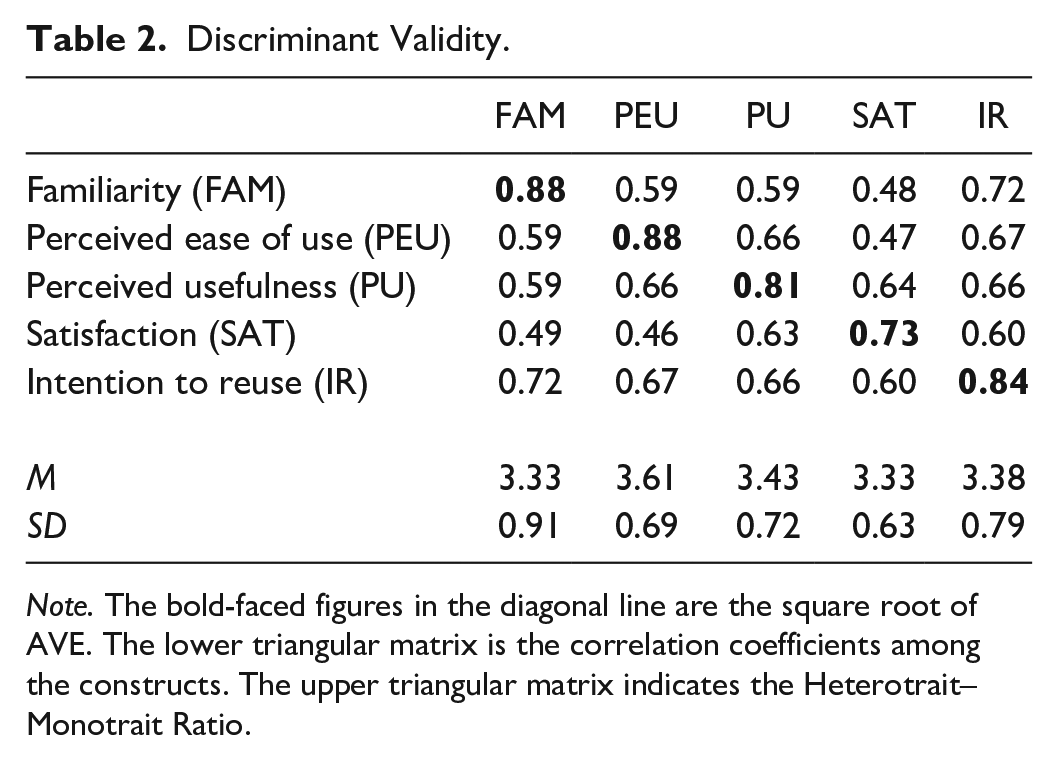
Note. The bold-faced figures in the diagonal line are the square root of AVE. The lower triangular matrix is the correlation coefficients among the constructs. The upper triangular matrix indicates the Heterotrait–Monotrait Ratio.
Structural Model and Hypothesis Testing
To examine the research model and hypotheses, the structural model, identical with the measurement model, was tested by employing a consistent PLS algorithm with 5,000 bootstrap samples, and the bias was corrected within 95% confidence intervals. The results are illustrated in Figure 2. First of all, the model fit indices (standardized root mean residual [SRMR] = 0.04; normed fix index [NFI] = 0.89) show that the theoretical model fits the covariance data at an acceptable level (L. Hu & Bentler, 1999). Second, the inner variance inflation factors (1.00 ≤ VIF ≤ 2.01), which are less than the cutoff value of 5.0 (Hair et al., 2011), indicate that no multicollinearity issue has been found in this model. Finally, the R2 values (.35 ≤ R2 ≤ .63) disclose that the model has moderate predictive power (Chin, 1998), and all Stone–Geisser Q2 amounts (0.20 ≤ Q2 ≤ 0.39), with are much higher than the zero thresholds, signify that the model has substantial predictive relevance (Henseler et al., 2009). In sum, the research model suggested in this study meets all of the required quality criteria before testing the hypotheses through PLS-SEM.

Results of PLS-SEM and Hypothesis Testing.
As displayed in Figure 2, the results of the PLS-SEM indicate that FAM with FDMA has a positive and significant impact on PEU of FDMA (β = .59; t = 14.84; p < .05). Thus, Hypothesis 1 is supported. Regarding the antecedents of PU, the results show that both FAM (β = .30; t = 4.81; p < .05) and PEU (β = .48; t = 7.54; p < .05) have positive and significant effects on PU of FDMA. Therefore, both Hypotheses 2 and 3 are strongly supported. For the relationships among FAM, PEU, PU, and SAT in the FDMA settings, the results demonstrate that the positive effects of both FAM (β = .17; t = 2.00; p < .05) and PU (β = .52; t = 5.94; p < .05) on SAT with FDMA are significant, while that of PEU (β = .02; t = 0.26; p > .05) on SAT is not. Accordingly, Hypotheses 5 and 6 are supported, but Hypothesis 4 is not. With respect to the antecedents of the outcome, the results reveal that FAM (β = .47; t = 9.44; p < .05), PU (β = .26; t = 3.06; p < .05), and SAT (β = .21; t = 2.74; p < .05) positively and significantly influence users’ IR the FDMA. Consequently, Hypotheses 7, 8, and 9 are all supported.
Discussions and Implications
Building on the extended TAM research with FAM and SAT, the findings demonstrate that FAM leads to both PEU and PU in the context of FDMA. These findings are in line with those from the previous research (Chang et al., 2016; Chuah et al., 2016; Gefen, 2000; Van Slyke et al., 2006). Furthermore, the current study found that PEU is an important antecedent that drives PU even in the context of FDMA. This is consistent not only with the TAM from Davis et al. (1989) but also with the previous studies that applied the TAM for users’ acceptance of various technologies (e.g., Agag & El-Masry, 2016; Chuah et al., 2016; King & He, 2006). In addition, this study found that PU predicts users’ SAT with the FDMA, while PEU does not. Such results are in line with those in the context of wearable devices (Chuah et al., 2016) as well as those in the context of online payment technology (Choi & Sun, 2016). Consistent with the findings of the previous studies (P. J.-H. Hu et al., 2017; J.-Y. Park et al., 2019), this research also identified that FAM is one of the key factors of SAT in Korea’s FDMA setting. The findings of this study also confirmed that FAM, PU, and SAT drive users’ IR FDMAs, which echoes the results of the literature on users’ technology acceptance (Alalwan, 2020; Chang et al., 2016; Chuah et al., 2016; E.-Y. Lee et al., 2017; E. Park & Kim, 2014). Based on these findings, the current study discussed the aspects of both theoretical contributions and practical suggestions as follows.
This study theoretically contributes to the sustainable hospitality literature in the context of FDMA by extending the TAM into the FDMA market in South Korea. The TAM has received great attention from scholars focusing on information technology studies. However, limited studies on the TAM have applied the model to the FDMA market. Although some studies have investigated users’ acceptance of FDMA (E.-Y. Lee et al., 2017; S. W. Lee et al., 2019; Okumus & Bilgihan, 2014), the critical factors for users’ reuse intention, such as FAM and SAT with FDMAs, have been ignored. Unlike the existing literature on the TAM and FDMA, this article found that FAM with the FDMA is a crucial driver for both ease of use and usefulness of FDMA. In addition, the current study found that users’ SAT with FDMA serves as an essential mediator between the predictors and the outcomes of the TAM. These combined findings deliver the vital implications that users who feel more familiar with FDMA are less likely to switch to other apps, because the users who are more familiar with the app tend to use the app more readily and thereby gain more useful information. This enhances their level of SAT, resulting in continued use of the app. These implications are the significant contributions of this article, complementing the body of knowledge about information technology.
The findings of this study also suggest practical implications for FDMA developers and marketers to manage their apps. First of all, FDMA developers must understand that users will readily use and draw useful information from the app when they feel familiar with it. FDMA providers should also understand that more user experiences lead to less switch intention. Therefore, developers and providers are advised to boost the frequency of user experiences to enhance the FAM of their apps through aggressive promotions such as large discount when a user orders a meal on their app. Baedal Minjok, the leading FDMA in South Korea, has persistently applied a 0% commission from restaurants and has created revenue through advertising based on the heavy user traffic. The no-commission strategy can enrich the number of restaurants that enroll in the app, which in turn enables them to retain and acquire more users based on users’ high levels of SAT. This strategy is feasible, because users tend to secure as many FDMA restaurants as possible to provide diversity of choice. Yogiyo and Baedal Tong, the second and the third largest FDMAs in the Korean FDMA market, still depend on commissions from restaurants. Consequently, to gain market advantage, the latecomers in the FDMA market need to enhance the frequency of user experience by suggesting more aggressive promotions for consumers than the leading FDMA company.
Conclusion
As smart mobile devices become more common in modern society, consumption culture is also changing through mobile apps. In particular, the advent of FDMA has entirely changed the advertising channel of restaurants from the anti-environmental printed flyers to mobile apps, which are relatively more eco-friendly. This change also allows consumers to order food delivery more easily and efficiently. FDMA providers seek to secure many users as one of the most crucial tasks to survive in the highly competitive FDMA market. Moreover, despite the tremendous growth of the FDMA market in South Korea, there has been limited research that investigates users’ acceptance of FDMAs. In the current study, the researcher extended the TAM by adding two variables—FAM and SAT—and applied the model to explain restaurant consumers’ acceptance of FDMAs in South Korea. The results imply that FAM is a key driver of users’ acceptance of FDMAs through PEU, PU, and SAT. The findings of this study attested that both FAM and SAT play crucial roles in the models to account for users’ use (or reuse) intention of new technologies and systems.
Despite its meaningful contributions and implications, the current study has several limitations as follows. First, as this study focuses on the extension of the TAM, other possible antecedents have been omitted from the proposed model. For example, hedonic and economic values may also be crucial antecedents of SAT and reuse intention for FDMA. Thus, for a better understanding of users’ acceptance of FDMA, a follow-up study is required to extend the TAM by adding value dimensions into the model of this study. Second, the current research focuses on food delivery consumers only. However, the FDMA market has three different parties of users—customers, food providers, and food delivery clerks. Accordingly, future scholars in the academia of information technology and hospitality management should expand the suggested model to include these three different parties and compare the model from those positions. Finally, this study has a limitation of generalization, because the research has been conducted in a specific country, South Korea. To establish generalization of the extension of the TAM for FDMAs, an effort to empirically apply the proposed model into the FDMA markets in various countries is also necessary.
Footnotes
Declaration of Conflicting Interests
The author(s) declared no potential conflicts of interest with respect to the research, authorship, and/or publication of this article.
Funding
The author(s) received no financial support for the research, authorship, and/or publication of this article.
