




Abstract
The 2003 Iraq War was a landmark for real-time news dissemination, with news broadcast by journalists embedded with U.S. troops. The literature indicates that mainstream media reflected the viewpoints of those in power, giving little coverage to anti-war sentiment. This study focuses on press coverage relating to a specific aspect of dissent—protest songs against the 2003 Iraq War. After analyzing the content of articles sourced from mainstream newspapers from both sides of the Atlantic, namely, The New York Times, The Wall Street Journal, The Guardian, and the Telegraph, the results indicate that from the beginning of this war, anti-war songs were perceived by journalists to be in decline for reasons that were reported to have been linked to the period’s sociopolitical and economic context. The conclusions of the study underscore the value of analyzing news type articles and opinion pieces from newspapers of record.
Keywords
The 9/11 terrorist attacks on the United States launched the Bush Administration’s War on Terror narrative (Zalman & Clarke, 2009) and the 2003 Iraq War was positioned as the main front in the War on Terror (The White House, 2003). Concurrently, a significant number of protest songs were released from a range of musical genres that expressed dissent against the 2003 Iraq War. Protest songs are a form of affective communication and can inspire social or political commitment as they “are expressions of discontent or dissent which imply or assert a need for a change . . . and may serve to stimulate thought, reinforce, or modify attitudes” (Kizer, 1983, p. 4). Indeed, in extreme cases, this has even resulted in regime change. Such an example is Street’s (2003) discussion of a case study provided by Wicke (1993), who argued that musicians in East Germany became an important catalyst for the collapse of the East German regime because they triggered a series of events after leaking a document to Western media about the exodus of young people from East Germany. The state had refused to recognize the crisis or publish the document. Musicians also read the document out loud at concerts, which led to the imprisonment of many performers. Wicke (1993) argues that this repression incited hostility, which fueled the New Forum grassroots civic movement and led to the fall of the Berlin Wall and the unification of Germany.
The significance of protest music as an expression of dissent and standard bearer of a cause has been dealt with extensively in the literature (Denisoff, 1970; Garofalo, 2013; Kizer, 1983; Mondak, 1988; Peddie, 2006; Rodnitzky, 1971). This study provides a novel perspective on the study of protest music because it analyses the journalistic perception of the protest song phenomenon in relation to the Iraq War 2003. The issue is worth exploring because several studies, as detailed in the literature review section, found that voices opposed to the war were marginalized in mainstream media. Hence, the present work investigates how mainstream newspapers covered the protest song—a traditional sociocultural resource for dissent—during the Iraq War period, when mainstream newspapers still exerted a considerable influence on public opinion, at least in the early pre–social media stages of the war.
Theoretical Context and Literature Review
The media landscape during the 2003 Iraq War was evolving and becoming radically different to that of any previous war; more than 500 journalists were with military forces as “embeds,” and it was the first ever internet war (Hiebert, 2003), with dissenting voices and cyber-activism emerging through online alternative media (Carty & Onyett, 2006). Pickerill and Webster (2006) and Vasi (2006) have documented the merits of these new digital platforms in mobilizing dissent. Moreover, in the lead up to the 2003 Iraq War, large personal-level digital communication networks may have accounted for the scale and speed of mobilization of the transnational anti-war protests (Bennett et al., 2008).
Several studies have investigated mainstream media’s coverage of the 2003 Iraq War and the extent to which dissenting voices were represented in the news media. A content and framing analysis carried out by Goddard et al. confirms the predominance of news stories that focused on daily battle events, whereas coverage of “Domestic protest (4.7%) and the rationale for war (4.4%), issues that opponents of the war would wish to see covered, are almost invisible by comparison” (Goddard et al., 2008, p. 17). Television news coverage in the United States and the United Kingdom (Aday et al., 2005; Robinson & Goddard, 2006) indicated a similar tendency. Dardis (2006a) and Cushion (2007) conducted content analyses of mainstream press relating to anti–Iraq War protestors and found evidence of a protest paradigm, a term coined by Chan and Chin-Chuan (1984) to describe a pattern whereby the press delegitimizes and marginalizes protest and dissent. Kumar (2006) argued that pro–Iraq War arguments dominated the public arena. Hayes and Guardino (2010) found that sources from the Bush administration were the most frequently quoted, whereas Democrats or anti-war groups received negligible airtime. A study conducted by Glazier and Boydstun (2012) explains that we see the press aligning with the president’s frames during periods of national unity following a crisis but then diverging as that solidarity fades. While our findings strongly support the conclusion that the press did not perform as a “watchdog” in the time leading up the Iraq war …, the media’s framing behavior was directly in line with its institutional incentives, which simply do not dictate scrutiny at all times. (p. 441)
Indeed, overreliance on official sources, and other possible ideological factors related to patriotism and fear of weakening support for the war effort, as well as fear of disrespecting troops have been cited as possible reasons for journalists’ reluctance to highlight voices of dissent during war times (Harp et al., 2010).
The consequence of this overreliance on official sources is explained by Bennett’s (1990) indexing theory that mainstream journalists generally reflect the variety of viewpoints of those in power because their sources are consistently public statements of officials. This results in a narrow perspective on events because dissenting voices tend to be excluded from the mainstream media discourse (Harp et al., 2010). But not all scholars concur with indexing theory (Althaus, 2003; Althaus et al., 1996; Entman, 2004; Livingston & Eachus, 1996). Indeed, a content analysis of articles published in Time magazine during the 2003 Iraq War found that journalists and their editors allowed voices of dissent into stories from the start. Official voices typically dominated the discourse, but voices from civilians, particularly Iraqis during the first year of the conflict, were also shaping the story. These results call for a more nuanced and qualified approach to indexing theory. (Harp et al., 2010, p. 477)
The existence of substantive research that deals with the lack of dissenting voices in mainstream media during the Iraq War 2003 can be seen from the previously cited work. However, scholarly research that focuses on the journalistic perspective of the protest song phenomenon during this period is virtually nonexistent, to the authors’ knowledge. This leaves a knowledge gap, which the study addresses by investigating how mainstream newspapers reported on and perceived this traditional sociocultural manifestation of protest.
The hypothesis of this study is that press coverage in mainstream newspapers provided an insight on what was happening to anti-war protest songs during the 2003 Iraq War. Thus, the overall aim of this study is to investigate coverage by British–U.S. newspapers of news related to anti-war songs during the 2003 Iraq War period. Although the production of media texts is a political activity (Garner & Mendez, 2016), it is expected that analyzing them will facilitate the “capture of feeling” and provide an understanding of the protest song narrative from the journalistic perspective during the period in question.
The objectives of the study are threefold: (a) to investigate the content and produce a thematic framework for what constituted the news on protest songs over the 11-year time span covered by the study (2003–2014), (b) to identify patterns of press coverage, and (c) to describe the nature of the press coverage.
Method
Design and information sources
The method adopted to address the objectives is empirical, qualitative-descriptive, and transversal. First, an ad hoc questionnaire was used to select the articles in line with the subject under study (Cohen & Manion, 1990; Guzmán Arredondo, 2015; McMillan & Schumacher, 1993) from the following opinion-forming U.K. and U.S. newspapers: The Guardian, The Telegraph, The Wall Street Journal, and The New York Times.
This nonexperimental approach of incidental sampling does not present manipulation of the variables and is theoretically based on the criterion of quantifying an investigation through an ex post facto design (Mateo Andrés, 1997, 2004), which permits a description of reality, analyzing relationships, categorizing, simplifying, and organizing the variables that comprise the object of study in line with the characteristics of exploratory-descriptive studies. This procedure enables textual data to be treated and analyzed numerically so that thematic categories can be quantified based on frequency percentages.
The research involved four consecutive stages: (a) search and compilation of newspaper articles, (b) selection of the compiled material in accordance with the ad hoc questionnaire, (c) classification by thematic category, and (d) interpretation of these categories.
Newspaper articles that tackled anti-war protest songs and were published between 2003 and 2014 were analyzed and the common topics that emerged were thematically categorized. Clearly, the newspapers selected are not intended to represent the entire U.K. and U.S. press landscape. However, they were selected because of their “circulation numbers and ‘of record’ hegemony” (Dardis, 2006b, p. 404). Furthermore, the Guardian was one of the newspapers whose coverage of voices of dissent during the Iraq War “suggests a position that at least negotiated the meaning of the war and at times took an oppositional stance” (Goddard et al., 2008, p. 27). Moreover, both U.S. and British opinion-forming newspapers were included to ensure that possible differences in cross-national press coverage would have the chance to emerge (Dardis, 2006b). The exact combination of the following words was searched in the online archives of the aforementioned newspapers and a date filter of January 1, 2003–August 14, 2014, was applied: anti-war/antiwar/anti war and protest songs/music. The search was carried out beyond the cessation of the Iraq War at the end of 2011 because there was considerable post-conflict media coverage related to the war, and therefore it was considered necessary to investigate whether this included a journalistic perspective on anti–Iraq War protest music.
Fieldwork development
Three researchers were involved in the fieldwork and the research technique adopted was qualitative content analysis through investigator triangulation. The total number of newspaper articles collected was n = 2,619 and they were scanned in accordance with the criteria set out below in an agreed ad hoc questionnaire to determine article inclusion or exclusion. The ad hoc questionnaire ensured that opinion pieces and shorter news type articles that presented the journalist’s opinions or those of his or her sources would be included if they were related to the objectives of the study:
Questions considered to determine article exclusion if answered affirmatively:
Did the article exclusively focus on a specific concert with no mention of protest in relation to the Iraq War, anti-war sentiment, or anti-war protest music? Was the article an obituary? Did the article include an irrelevant book review? Did the article report exclusively on a non-war-related protest/demonstration that took place? Did the article focus on non–English language anti-war protest songs?
Questions considered to determine article inclusion if answered affirmatively:
Did the article make any reference to the absence of, decline in, or resurgence of, anti-war songs during the 2003 Iraq War era? Did the article explain what had happened to protest music/or anti-war protest music/songs? Did the article make any mention of anti-war or pro-war sentiment during the 2003 Iraq War era? Did the article suggest that the status of anti-war protest music/songs may be attributable to a particular factor or trend?
Analysis strategies
The standard interpretation procedure consisted of data reduction, keyword selection, dimensional grouping of phrases, coding, and thorough editing and classification of categories. Once the article selection protocol was applied, 677 newspaper articles were selected with the following breakdown by newspaper: The Guardian: 225, The Telegraph: 102, The New York Times: 187, and The Wall Street Journal: 163.
The AQUAD6 open-source software tool for qualitative text analysis was used for the coding process.
The categories were not defined from the outset. Instead, an inductive approach was adopted and, therefore, they emerged after reviewing all the newspaper articles and deciding the coding categories. This provided a more accurate idea of the different emergent categories that would comprise the final thematic framework.
Each researcher proposed a way of coding the significant themes. This formed the basis of the research group’s discussion and a 97% consensus was reached on the coding and thematic framework after six meetings that took place over approximately 5 months.
Results
The ad hoc questionnaire resulted in the selection of 677 newspaper articles for analysis and coding. A descriptive, comparative, qualitative study was conducted, resulting in the categories, and emergent subcategories, which are presented in Table 1. After conducting the analysis, the researchers observed that despite the structure of news type articles and opinion pieces being different and opinion pieces having a greater depth of commentary, given the ad hoc questionnaire’s selection criteria, the treatment of the topic under study by both types of newspaper articles was similar. For this reason, Table 1 does not make a distinction between news type articles and opinion pieces.
The Thematic Framework: Four Emergent Categories.

Anti-war protest songs: includes articles that report on the state of anti-war protest songs, anthems, or music. bPerceptions. Contemporary anti-war protest songs: includes articles where the journalist gives an opinion on anti-war protest songs. cProtest: includes articles that refer to news on or the nature of anti-war protest as well as any aspect of the protest song phenomena. dReported impact factors: groups articles that tackled the complex mix of economic, social, political, and other constraints that were reported by journalists to have impacted protest songs.
Thematic framework of the press coverage
The four categories that comprise the thematic framework represent the intrinsic value of the news reported in the 677 articles analyzed and are reproduced in Table 1. Each article was coded for the presence of the emergent categories and subcategories; therefore, it is possible for an article to reflect more than one category.
From the thematic framework, it was possible to identify two key modalities—pressure and utility—which provide a means by which to discuss the nature and depth of the press coverage in the news type articles selected, as explained next in “Discussion” section.
Patterns of the press coverage
The press coverage surrounding the protest song phenomena included news type articles that reported on events or observations in line with accepted news-values criteria and articles from the opinion pages of the newspaper. Examples of news stories included articles that reported on the singing of anti-war protest songs from the Vietnam War era during anti–Iraq War demonstrations. Examples of opinion articles include articles whose content was grouped under the fourth category—reported impact factors—and these articles suggested that the anti-war protest song was affected by economic, political, and sociopolitical factors, and the constraints on anti-war songs that are indicated in Table 1.
Nature of the press coverage
The nature of the press coverage pointed to the identification of two modalities: pressure and utility. The pressure modality described an article typology—that is, covering protest songs, demonstrations, or concerts organized with the intention of protesting against the war—in which the journalist reported that artists were frightened to express anti-war sentiment, fearing a backlash for appearing unpatriotic. The utility modality described two article typologies: (a) the journalist covered both the dissemination of information as well as a denouncement, criticism, and/or analysis, or (b) the journalist exclusively reported on events and observations without reflection.
The study uncovered several reported examples of the pressure modality, as indicated in Figure 1.
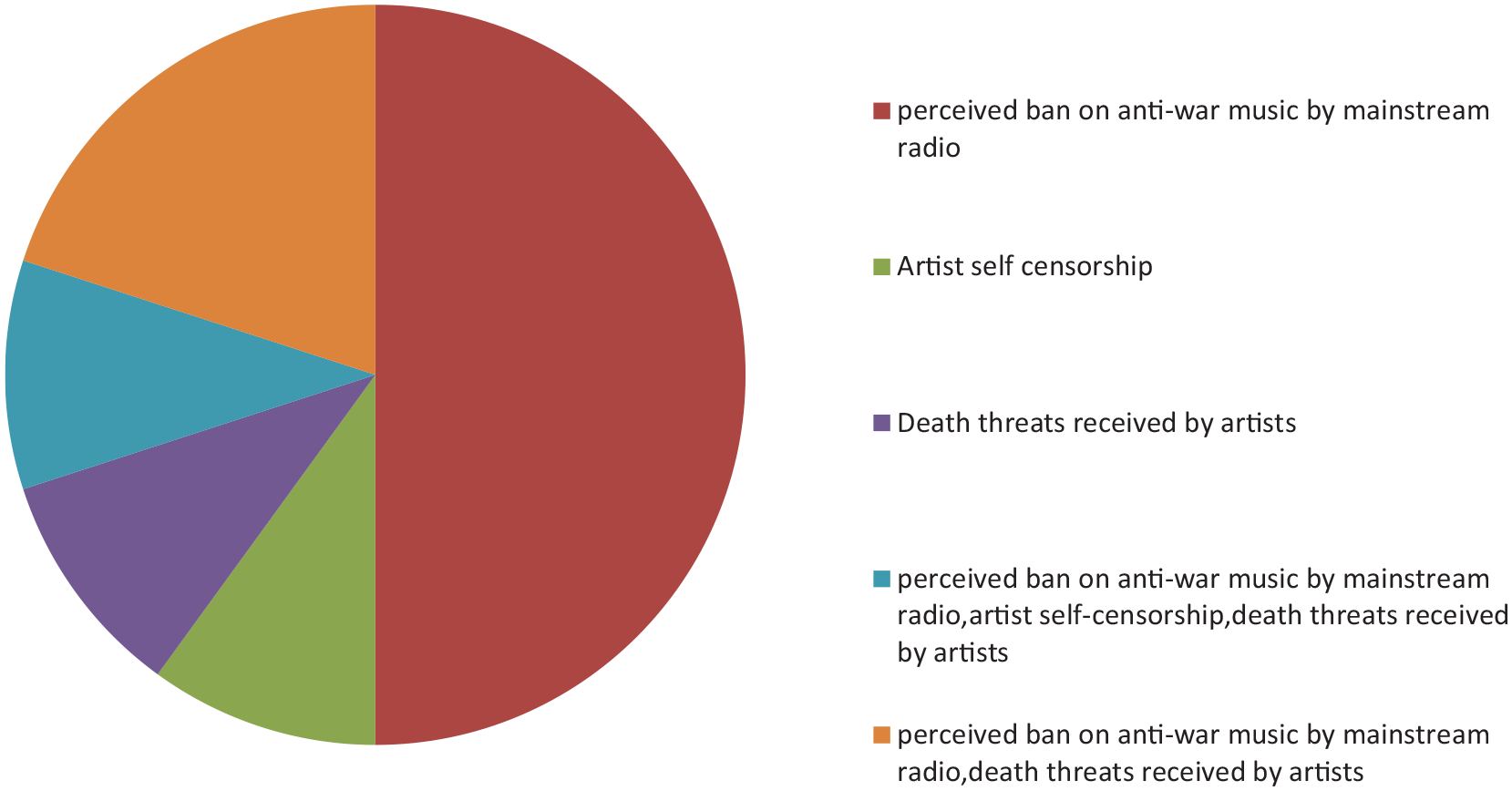
Breakdown of reported indicators that constrained anti-war protest music.
Turning to the utility modality, several articles performed the function of denouncing government policies, which included a critical discussion of radio deregulation, consolidation, and the constraints this placed on musical expressions of anti-war sentiment—see Table 1. Reported impact factors category—Others were critical of a perceived youth apathy or an unwillingness to stand up to the Bush Administration and oppose the war in Iraq—see Table 1, Reported impact factors category, Sociopolitical.
The news type articles, in contrast to the opinion pages, as would be expected given their limited space allocation and time constraints, tended to transmit information without reflection. For example, in Janofsky’s (2005) The New York Times (NYT) article on the anti–Iraq War demonstrations in Washington, the journalist remarks, with no interspersion of opinion, that “War, the Vietnam-era protest song by Edwin Starr, suddenly filled the air.” There is no further comment as to why an anti-war song from the Vietnam era was being sung at an anti–Iraq War protest. However, in the case of Pareles’ (2003) article in The New York Times (NYT), “Music; New Songs, Old Message: No War,” there is a brief mention that rock musicians expect little radio exposure, given the consolidation of most radio stations into two national networks. Pareles (2003) concludes that the new anti-war songs received no commercial airplay to avoid dividing or alienating listeners. In both newspaper articles analyzed, there is no further critical reflection on what this means for the expression of anti-war sentiment through the protest song.
The main purpose of some articles was to inform the reader as to how artists reacted to the obstacles faced in terms of getting airplay for their anti-war songs, without delving into the underlying causes or implications of these constraints on their artistic expression. Thus, from the subcategory, Constraints—see Table 1 emergent category, Reported impact factors—artists’ reactions were reported and these were coded and are reproduced in Figure 2.
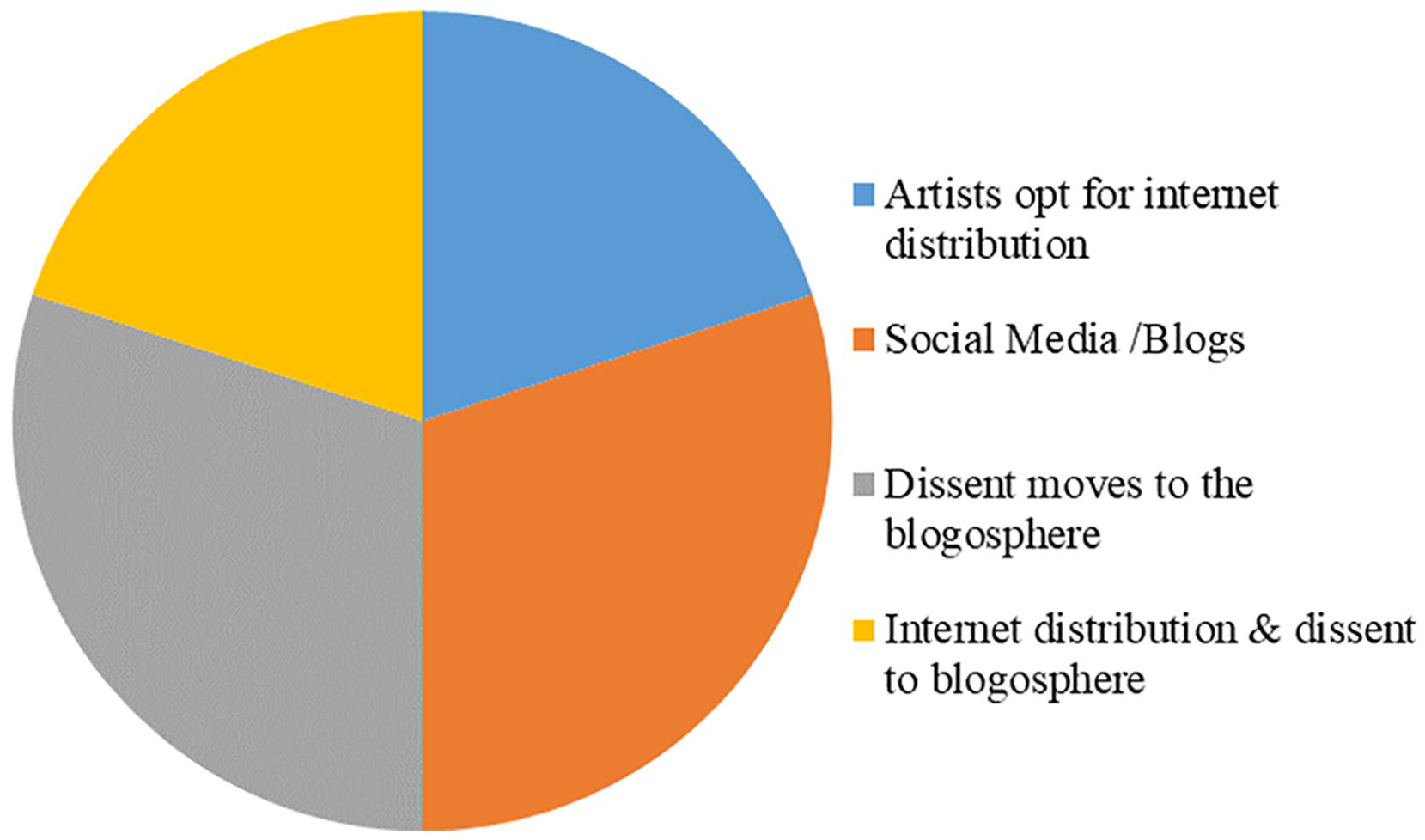
Artist reactions to reported constraints on anti-war protest songs.
The newspaper articles analyzed predominantly reported on anti-war protest songs, but some articles also reported on the American country singer and songwriter, Toby Keith, and mentioned his bellicose song “Courtesy of the Red, White and Blue” as a reaction to 9/11: Pareles, writing for The New York Times, described “The craving for vengeance after Sept. 11, vented in songs like Toby Keith’s ‘Courtesy of the Red White and Blue (The Angry American),’ is still seeking a target” (Pareles, 2003).
Several articles also mentioned Toby Keith in relation to Dixie Chicks’ Natalie Maines anti-war comment at the opening of a concert in London at the outset of the war. For instance, when the Dixie Chicks won best record at the Grammys in 2007 for “Not ready to make nice,” the Guardian reported in depth on the background surrounding the winning song: That song was the product of the estrangement and furore caused by comments the group made during a London concert in 2003. In remarks first reported in the Guardian, Maines told the audience at the Shepherd’s Bush Empire: “Just so you know, we’re ashamed the president of the United States is from Texas.” Those remarks were picked up by the US media and a firestorm ensued, with calls for boycotts of the band’s albums and concerts amid allegations that they were unpatriotic and disrespectful to the office of the president. All three members of the group received death threats and their attempts to clarify their position seemed to make matters worse. The controversy deepened as other musicians took sides: Bruce Springsteen supported them, while some country singers such as Toby Keith came into conflict with them. (Glaister, 2007)
Discussion
The results of this study confirm the hypothesis that the press coverage of anti-war protest songs during the 2003 Iraq War highlighted some important factors that contribute to understanding the fate of this type of music during the period studied. The information that emerged has been structured around the following conceptual and thematic categories to facilitate an understanding of the journalistic discourse on protest songs during the Iraq War era.
The Perceived Decline of Protest Music
The “decline” subcategory embraced several themes perceived by journalists that include the following: a decrease in airplay of anti-war protest songs, a reported decrease in the aesthetic quality of the protest music being produced, a suggested decrease in the willingness of listeners to engage with anti-war protest music, and the reported artist self-censorship (see Table 1).
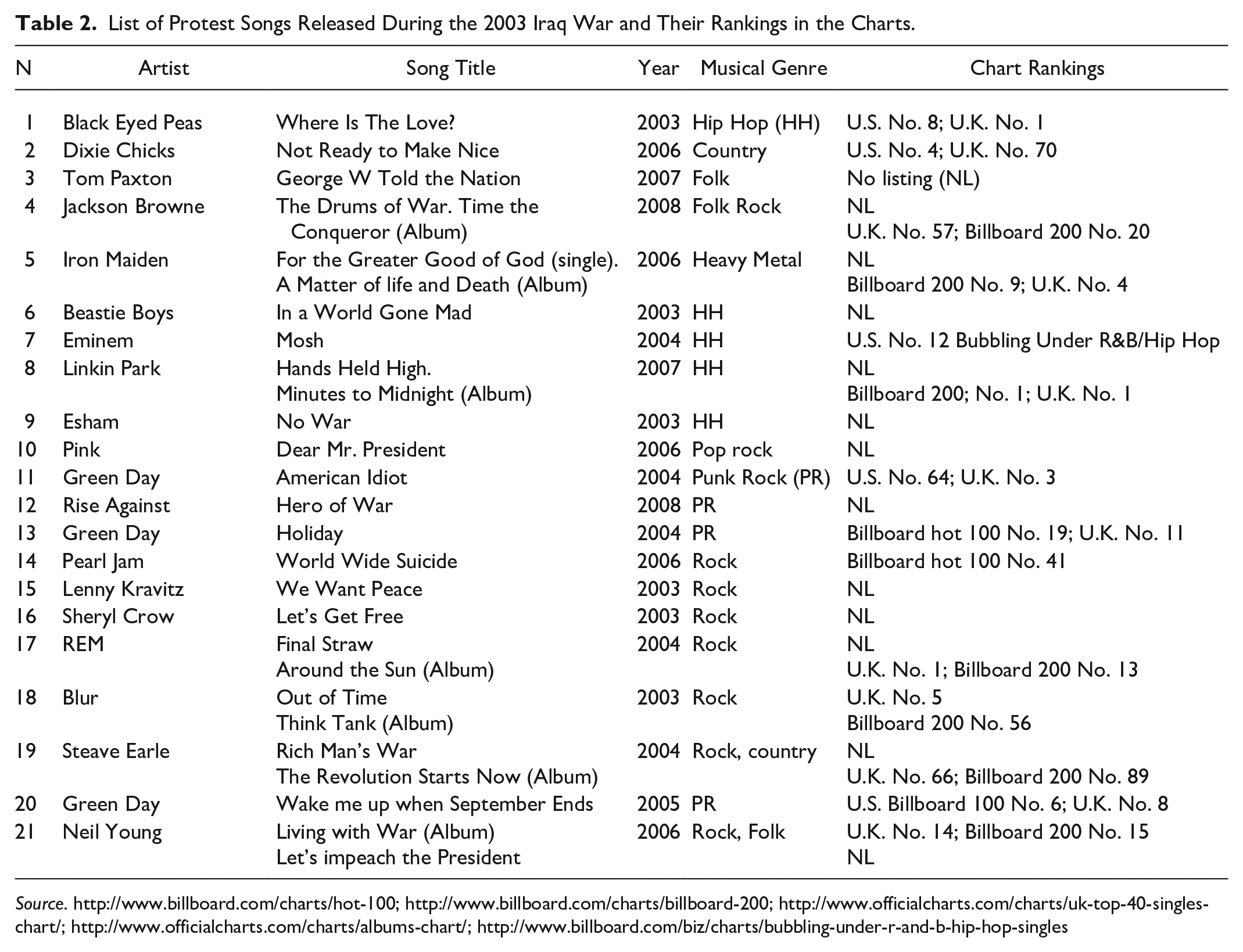
According to the results, 44% of the newspaper articles analyzed made a specific reference to a perceived decline in contemporary anti-war protest songs. This journalistic perception would need to be validated by a separate comparative study with the journalistic perception of anti-war songs during Vietnam era, which is beyond the scope of this study. However, the later scholarly writings of Garofalo (2013) and Lynskey (2010) reflect a similar argument in relation to the decline of this type of music during the Iraq War era, suggesting that, despite the large quantity of songs released, most of them failed to make a significant impact commercially (see Table 2). In fact, this claim may be substantiated by the fact that not one of the songs reached the No. 1 slot in the U.S. “Billboard Hot 100,” Billboard Music (2015), with the exception of the Black Eyed Peas’ hit “Where is the Love?” which reached the No. 1 slot in the U.K. Top 40 Singles, U.K. Top 40 (2015). During the early years of the war, without airplay, it would have been impossible for a song to succeed in the charts as this period predates YouTube (launched in 2005) and Spotify (launched in 2008) as serious alternative music listening options.
List of Protest Songs Released During the 2003 Iraq War and Their Rankings in the Charts.
By way of contrast, in terms of success in the charts, the Vietnam War era produced several No. 1 anti-war hits, including “War,” “Eve of Destruction,” and “Turn, Turn, Turn.” The United Kingdom’s Top 40 charts painted a similar picture, although the United Kingdom did not officially send troops to Vietnam, with both “Eve of Destruction” and “War” reaching the No. 3 slot.
A further point suggesting this perceived decline of the protest song from the journalistic perspective, and notable for its news value, was the reported negative opinion of the aesthetic quality of contemporary anti-war protest songs. These anti-war songs were said to be lacking an anthem-like rallying quality. However, there was no further journalistic probe as to the possible reasons for the protest song’s perceived demise as a galvanizing force. Andrew Murray of the Stop the War Coalition was quoted in an article published in The Guardian that he had not yet come across a new song that had the “anthemic, rallying resonance of Fixin’-to-Die or War” and that the anti-war movement did not have the support that he would have hoped from the music fraternity (Campbell, 2007). This aesthetic criticism may be explained in the literature by Mondak’s (1988) work, which argued that one of the “shortcomings of protest music as political persuasion . . .” becomes apparent when the listener is not able “to ‘cognitively process the songs’ messages” (p. 27). This can occur when the lyrics are unintelligible, making them difficult to sing on marches and therefore, such songs are unlikely to become anthems. However, to ascertain whether this was the case with the anti–Iraq War songs would require a further qualitative study on the intelligibility and appeal of a sample of these songs, which is beyond the remit of this study. Qualitative research was carried out by Esteve-Faubel et al. (2018) to explore this issue. Their findings indicate that viewing the music videos of two well-known songs released during the Iraq War—Green Day’s “Wake Me up When September Ends” and the Black Eyed Peas’ “Where is the love?”—triggered critical reflection in a group setting, demonstrating the value of these types of topical or protest songs in a global citizenship educational context. Discussion-debate and the evolution of thought took place as the cohort reconciled their strong convictions about the contested rationale for the Iraq War with an equally strong sense of natural compassion toward the troops and civilians caught up in the armed conflict.
The other reported “decline” related statements are subsequently dealt with in the relevant literature. Garofalo (2013), and Scherzinger and Smith (2007) argue that artist self-censorship and lack of airplay, resulting from the deregulation and consolidation of the radio industry, were primarily responsible for demise of anti-war songs during this period. In fact, Garofalo (2013) argues that given the changes in political climate and the corporate landscape of the culture industries, however, country anthems supporting military action as the appropriate response to the 9/11 attacks have overwhelmed more critical voices in rock and rap that challenged this course of action. (p. 24)
Thus, the sociopolitical context of the Patriot Act (U.S. Congress, 2001) had an arguably restrictive impact on the entertainment industry according to Garofalo (2013).
Examining the relevant bibliography from the Vietnam and post–Vietnam War era would seem to indicate that the decline of protest music may well have been a process that started several decades before the 2003 Iraq War. Rodnitzky (1971) argues that “protest music has been fragmented by its commercial success, cultural acceptance, and failure to establish relationships with specific reform movements” (p. 49). According to Kizer (1983), “. . . the dramatic lack is in specialized lyrics created for social movements,” a statement that coincides with the results of the present study that curiously revealed the singing of anti-war songs from the Vietnam War era by anti–Iraq War protestors (p. 10). There are various possible reasons to explain this. Perhaps it was due to the demonstrators being mainly from older rather than younger generations and, therefore, they felt more akin to anti-Vietnam War songs. Indeed, according to Leland’s New York Times (NYT) article (March 23, 2003), the anti–Iraq War protests do not represent a new counterculture as did the socially seismic youth movement of the 1960s: “Pacifists march with fiscal conservatives, traditional liberals with centrists who favor war but only with support . . . the signs at demonstrations have told a story not of philosophical uniformity but of sprawl . . .” The phenomenon that Leland observed about the diverse profile of anti-war protestors was subsequently analyzed in the scholarly literature several years later and, similarly, the conclusions were that “the organizational coalitions were so loosely knit that they stretched the capacity to imagine them as a social movement at all” (Bennett et al., 2008, p. 273).
Anti-War Sentiment Is Reported to Be on the Wane
The proximity news angle, relating to the observation that U.S. anti-immigration laws attracted far more protestors than the anti–Iraq War protests suggests that the war in Iraq was not perceived to be as relevant as immigration issues. The elimination of the military draft, mentioned by 50% of articles coded under political factors, may have played a key role in diminishing anti-war sentiment. In addition, recruitment to the voluntary army in the United States and the United Kingdom remains an attractive option for young people from underprivileged backgrounds (Gee, 2007; Kleykamp, 2006; Sackett & Mavor, 2003). Another factor that may have contributed to the decline in anti-war sentiment is that the Iraq War was framed by the Bush Administration as a key strategy in the War on Terror. In this political context, there was no elite voice of dissent for journalists to report on, especially at the initial stages of the war and, therefore, the media coverage became “a one-sided information flow” according to the research findings of Hayes and Guardino (2010, p. 60). Other research found that, during the early stages of the 2003 Iraq War, voices resistant to the dominant political ideologies were suppressed and marginalized (Goddard et al., 2008; Kumar, 2006). These issues that emerged from the analysis of the newspaper articles represent some of the sociopolitical factors that may have diminished the strength of the anti-war sentiment, which in turn may have contributed to the decline in the popularity of this type of protest music.
Patterns of Press Coverage. News and Opinion
The results can be understood from the perspective of the two existing patterns of press coverage: news type articles and opinion. The following themes overwhelmingly made the news type articles items, as discussed in the previous sections: anti–Iraq War protestors sang anti-war songs from the Vietnam era, protest songs against the Iraq War were not rallying anthems and were perceived to be on the wane, and immigration attracted more protestors than the anti–Iraq War protests.
Most of the news grouped under the categories, Protest and Perceptions. Contemporary anti-war protest songs, met the news-values criteria of negativity and proximity (Harcup & O’Neill, 2001) identified originally by Galtung and Ruge (1965). For example, the negativity element with respect to contemporary anti-war protest songs is observable in the following emergent subcategories: contemporary protest music lacked rallying resonance; anti–Iraq War songs are not anthems, not easy to sing; and protest songs have become marginalized (see Table 1).
The proximity angle, which is also apparent in the results (Galtung & Ruge, 1965), describes the phenomenon that citizens relate more easily to an event when it has a local or national focus or involves people from their country. This may explain why the U.S. anti-immigration laws attracted far more protestors than the anti–Iraq War protest, as was reported by several journalists in the sample of articles analyzed.
Articles that discussed the factors that affected the anti-war song were coded according to whether the content had an economic, sociopolitical, or political slant (see Table 1, “Reported impact factors”). These were typically more opinion-type articles. Economic factors, namely, the “marketization and commercialization of music to maximize profits” emerged in this study. A drive for standardization to increase profits, reduce costs, and the concentration of the recording industry into four major labels (Sony BMG, Universal Music Group, EMI, and Warner Music) contributed to a decline in music variety. These specific findings lend further corroboration to the conclusions of other studies in this field and are aligned with the scholarly literature. For instance, Smith-Said (2006) argues that anti-war artists are active but are being silenced by “. . . an industry that has for years derived its profits from kiddy porn and dream boys” (p. 32). Côté (2011) agrees to some extent with Longhurst (1995) and Negus (1997) who contend that although popular musicians may attempt to express dissent in their songs, they are restricted by the demands of big business, which eventually suppresses their artistic freedom. Madonna’s withdrawal of her graphic anti-war music video, “American Life,” a few days after the American invasion of Iraq, was arguably due to the perceived risk associated with expressing dissent against the 2003 Iraq War: “Dissenting musical expressions within the established monopoly structures are increasingly compromised or maimed outright . . . it is in this context that Madonna’s withdrawal of the video of ‘American Life’ should be understood as well” (Scherzinger & Smith, 2007, p. 219). Similarly, Côté (2011), citing Rosselson (1979, p. 40), argues that songs can be “the most powerful emotional force of all” but they have become co-opted by commercial interests and end up promoting empty catchphrases (Côté, 2011, p. 734; Rosselson, 1979, pp. 45–46).
Sociopolitical factors included the following themes: death of idealism or loss of faith in ideology, apathy and/or cynicism, a reluctance to talk about politics, and fragmented communities lacking social cohesion (see Table 1). These subcategories suggest that journalists were describing what they perceived as a corresponding decrease in appetite for, or interest in protest music. In this respect, scholars such as S. Hall (2011) and P. A. Hall and Lamont (2013) have written extensively on the notion of the “disenchantment of people from politics itself and the idea of collective resistance” (S. Hall, 2011, p. 273), as well as the concept of disaffected consent, which explains why people may not agree with the status quo but accept it, feeling powerless and incapable of affecting change.
Exploring the Nature of Press Coverage
Two modalities of press coverage—pressure and utility—provided a means by which to group the thematic categories to provide an insight on the nature and depth of the coverage provided by journalists.
The pressure modality applied to articles that divulged the constraints on musical expression during the period under study—see Figure 1. For example, The New York Times reported on a concert that protested media deregulation and consolidation and revealed that artists felt under pressure not to speak out against the Iraq invasion for fear of having their songs banned: “Mr. Riley, a rapper, said he could not get other musicians to speak out against the Iraqi invasion. They were, like, ‘The radio will ban my songs,’ and the truth is, we couldn’t say, ‘You are wrong’” Lee (2003). Similarly, Strauss’ (2003) article published in The New York Times covers the release of the anti–Iraq War song, “In a World Gone Mad,” which was not released commercially but was made available free at the Beastie Boys website, and the song’s message was reported to be aimed at telling the U.S. public that it was not un-American to protest.
These news type articles exposed the realities facing artists at the time. They also indicated that there was a shift in the protest paradigm—a pattern whereby the press delegitimizes protest and dissent (Chan & Chin-Chuan, 1984)—that had been identified by several previous studies. For instance, Dardis’ (2006a) content analysis identified the marginalization devices used in the press coverage of Iraq War protests that involved a generally perceived negative story tone toward protestors. Furthermore, Dardis (2006b) concludes in a subsequent study that the U.S. press was more likely to use such marginalization strategies in its coverage of anti–Iraq War protestors than the U.K. press. However, the protest paradigm that was applicable to the coverage of anti–Iraq War protestors in the previously cited works was not identified in this study’s analysis of newspaper articles about protest music. By contrast, this study indicates that protesting musicians and protestors were not marginalized; instead, journalists gave them a voice and exposed their fears about speaking out against the Iraq War through their music. Notably, this press coverage occurred in mainstream newspapers, and this coverage took place at the very outset of the Iraq War in 2003.
The utility modality was applicable to articles that performed the function of a denouncement of government policies, such as those that discussed the issue of radio deregulation, consolidation, the silencing or marginalization of anti-war sentiment, and those that reported on artists’ reactions to these constraints. The most prominent example appeared in an opinion page article published in The New York Times entitled, “The Trouble with Corporate radio: The Day the Protest Music Died” (Staples, 2003), where a controversial and reflective statement was made about the status of the anti-war protest song at the start of the Iraq War. Staples argued that, whereas “Pop music played a crucial role in the debate over the Vietnam war . . . a comparable song about George W Bush’s rush to war in Iraq would have no chance at all today,” because of what he described as “the conservative corporate structure that controls thousands of stations,” and he concluded that “this flight to sameness and superficiality is narrowing the range of what Americans hear today and killing popular music.” He referred specifically to the negative impact of the 1996 Telecommunications Act, which, in his view “. . . limited expression over the airwaves as playlists ‘continually repeat songs that challenge nothing and no one . . .’” (Staples, 2003). These types of opinion articles played an important role in terms of addressing the issues that were perceived to have impacted protest songs during the Iraq 2003 War era. Indeed, Staples’ discourse has been subsequently corroborated by other scholars (Côté, 2011; Garofalo, 2013; Smith-Said, 2006).
Dissent and freedom of expression are held to be vital elements of any democratic society; however, several scholars have demonstrated that media strategies also silenced or marginalized voices that opposed the Iraq War. For example, Kumar (2006) documents what he describes as “. . . the dominance of pro–Iraq War arguments in the public sphere” (p. 48). See Sahlane (2012, 2013a, 2013b, 2015, 2019) and Wilson et al. (2012) for similar findings. These studies use critical discourse analysis and the pragma-dialectical approach to argumentation as a method of analysis. Hayes and Guardino (2010) provided an analysis of television evening news stories in the 8 months leading up to the Iraq invasion, which found that sources from the Bush administration were the most frequently quoted, whereas “the voices of anti-war groups and opposition Democrats were barely audible” (p. 59). In such an apparently restrictive media climate, which existed especially at the outset of the Iraq War, it is not surprising that the expression of musical dissent from the war would also be compromised. For example, Rage Against the Machine had their message board closed by secret services and Madonna issued a statement withdrawing her controversial anti-war video for “American Life” (Scherzinger & Smith, 2007, p. 218).
Having considered the bibliography indicating a pro-war media bias at the initial stages of the war, it is important to note that the journalists who wrote the articles analyzed in this study did not follow the same pattern. This study highlights that at the very outset of the Iraq War, journalists explicitly reported on the constraints experienced by artists wishing to express anti-war sentiment.
The utility modality was also applicable to some journalists who were critical of a perceived youth apathy. In an article published in The New York Times, journalist Graham-Felsen (2006) wrote in an opinion piece as follows: “the greatest disappointment of my generation has been its failure to stand up to the Bush administration and particularly its refusal to actively oppose the war in Iraq.” It is important to signal that this journalistic perception of youth apathy may be misleading because support for the anti-war movement may have been weakened by the devices deployed by the media to delegitimize the anti–Iraq War protests through negative coverage of protestors (Dardis, 2006b). Cushion’s (2007) content analysis of U.K. press coverage of young anti–Iraq War protestors indicated that young protestors were portrayed as violent. A later survey carried out by Cushion (2009) among politically motivated young people in the United Kingdom indicated a reluctance among many to attend anti–Iraq War protests because they were portrayed by the media as violent and conflictive.
Finally, the utility modality could also be applied to several newspaper articles that reported on how artists reacted to constraints on their expression of anti–Iraq War sentiment by making MP3 downloads of their songs available on their websites. They also used alternative digital media and social media as well as the “blogosphere” to express dissent—see Figure 2. However, there was no reflection on, or analysis of, the effectiveness of these new music distribution methods in the sample of articles analyzed.
Clearly, the MP3 download provided artists with a means by which to reach their audiences online with anti-war messages. According to Smith-Said (2006), the modern protest song “that actually has political effect because of its timely ability to affect public opinion is the free MP3 download” (p. 33), and he concluded that protest music during the Iraq era had moved online, offering artists the chance to express anti-war sentiment as quickly as they could write and record their anti-war songs, without the time constraints imposed by the large record companies. However, despite Smith-Said’s (2006) argument, Garofalo (2013) concludes that in practice, “the internet offered limited possibilities for promoting such protest music” and that there had been a suppression and marginalization of dissent in popular music during the Iraq War era (p. 19).
The results of the study also indicated that alternative digital media, social media, and the “blogosphere” were becoming the vehicles to express dissent. This trend has been the subject of considerable scholarly study. Alternative digital media and cyber-activism played an important role in terms of giving an enhanced voice to anti-war sentiment and mobilizing dissent, as indicated by scholars such as Carty and Onyett (2006), Pickerill and Webster (2006), and Vasi (2006). However, Bennett et al. (2008) critically analyzed the dynamics of the communication process in the case of U.S. protests against the 2003 Iraq War, and question whether such flexible political identifications operating through such personalized political communication channels can produce the kinds of focused collective action that often seem necessary to define common goals, develop power relationships with targets of protest, and ultimately achieve political and social change. (p. 286)
Conclusion
The newspaper articles analyzed chronicled the events and phenomena surrounding the anti-war protest song as observed and perceived by journalists, providing an insight on the status of anti-war protest music during the 2003 Iraq War. Many articles reported on newsworthy observations, others offered more in-depth analysis, disclosing the practice of artist self-censorship due to fear of a backlash against expressing dissent through song. The deregulation and consolidation of the U.S. radio industry was also raised by journalists as a factor that limited the dissemination of protest songs.
Significantly, the results of this study indicate that the newspapers analyzed did report on and delve into what had happened to anti-war protest music, revealing the constraints experienced by artists. The study highlights a journalistic perception that the dissent deficit associated with this war extended to the protest song, a traditional symbol of dissidence. The study’s novelty lies in the finding that from the outset of the 2003 Iraq War, journalists were reporting on the suppression of anti-war sentiment by professional musicians. Journalists from mainstream newspapers gave these musicians a platform to expose their fears about speaking out against the Iraq War. Overall, the results of this work point to the importance of professional news reporting, investigative journalism, and the value of analyzing the output from mainstream newspapers.
Finally, the study suggests a journalistic perception that the anti-war protest song, as it was conceived historically, may have become a relic of the previous century. What this may mean for the peace movement, which has historically united around anti-war anthems, is a question that remains unanswered.
The strengths of the study include the use of investigator triangulation, which enabled inferences to be drawn from the coding categories proposed. The thematic framework that emerged from the content analysis made headway in terms of investigating the journalistic treatment of the anti-war protest song during the 2003 Iraq War. The limitations of this study are that the results of the newspaper content analysis may partly explain the motive for the waning influence of anti-war songs during the Iraq War era, but it should not be considered as the entire or sole explanation of this phenomenon; there may be other ways to judge the motive although they did not emerge in this study. Furthermore, other limitations include the following: There is no analysis of the tone of the articles or the rhetorical devices that may have been used to sway readers, online links to the articles were used so it was not possible to note the article’s position in the newspaper’s print edition (such as right-hand page/left-hand page/newspaper section/front half or back half of the newspaper), and all articles sampled named the author but there was no investigation as to whether the author was freelance or an exclusive correspondent of the newspaper. In addition, as previously mentioned, criticisms related to the aesthetic quality of the contemporary protest songs may be considered somewhat subjective and therefore could benefit from further qualitative research.
Footnotes
Declaration of Conflicting Interests
The author(s) declared no potential conflicts of interest with respect to the research, authorship, and/or publication of this article.
Funding
The author(s) received no financial support for the research and/or authorship of this article.
