




Abstract
This article outlines the state of the art in picture analysis as it has been developed in the trajectory of reconstructive methodology. Analyzing pictures in their own right—that is, by adhering to the particular affordances of the medium “picture”—has strong implications for qualitative research some of which are discussed in this article. With regard to content, this discussion revolves around questions pertaining to bodily self-presentation in mass and social media. On this basis, the article concludes with a praxeological model of communication that offers a guideline for social research which is clued-up as to its own media and, thus, takes into account that meaning in pictures is constructed differently than meaning in language.
Keywords
It is difficult to imagine our everyday communication taking place without an array of media-technical devices. The “intervention” of media technology into our life-world is first and foremost an intervention of pictures. Technological progress has made it increasingly easy to generate, modify, and circulate pictures on an almost permanent basis. Although digitalization may not have changed the basis of our perception—“If the ones and zeros did not add up in an image that massages the familiar and traditional habits of the human sensorium, it is unlikely that the digital revolution would have gained any attraction at all” (Mitchell, 2010, p. 45)—, it has drawn scientific attention to the question of iconicity (e.g., Müller et al., 2016). In qualitative research, access to the iconic dimensions of perception and comprehension was long overshadowed by a hermeneutics that for centuries had been developed in an almost exclusive conjunction with textual material (Przyborski & Slunecko, 2012). Communication science in particular, though it is in a way predestined to examine the visual, still does not sufficiently encompass the specificity of pictures (Bohnsack, 2020; Philipps, 2012). Most communication models are still—more or less implicitly—based on the underlying idea of a “message,” for which it does not matter whether it is conveyed through language or pictures. This is particularly true for empirical research. By contrast, the following considerations pivot on the self-referential meaning or inherent logic of pictures and its impact on methods for empirical research. To put it more generally, we fundamentally differentiate between communication through pictures and communication through language or, as we prefer to say, between communication in the medium picture and communication in the medium language. Contrary to spoken language, pictures can only be examined as material surfaces and are thus subject to a technical dispositive. Thus, when investigating iconic (i.e., picture) communication, one is always faced with technical dispositives which can only analytically be separated from the context of mass media and social media. To put it in a nutshell, as soon as you deal with pictures in social research, you are bound to deal with their technical dispositive, and you get immersed in questions of media, of mass media, and of media theory.
In the following, we will first examine the inherent self-referential meaning of the picture and, thus, the special nature of iconic understanding (section “Iconic Understanding: Dimensions of Meaning of the Picture”). We then focus on the research design of the empirical study that has contributed significantly to the development of the communication model that we are heading for (section “Research Design: Pictures as the Empirical Basis”), and we discuss two empirical cases as examples (section “Body Imagination and Practice”). On this basis, we present a praxeological model of communication which accounts for the implications that a genuinely iconic understanding has for qualitative research (section “A Praxeological Approach to Media Communication”).
Iconic Understanding: Dimensions of Meaning of the Picture
In our everyday life, we are usually capable of perceiving, of seeing, whether a picture is “good” and whether it rightly captures, represents, or encapsulates a certain situation that we are familiar with. On the other hand, we find it rather difficult to explain exactly why the picture is good. This judgment—or, to be more exact: this way of seeing—is partly due to the fact that we do not only recognize concrete persons or objects in pictures but that we also perceive, albeit unconsciously most of the time, their compositional elements.
In photography, practical knowledge controls the choice of image section, perspective, focus, and so on, and this applies not only to the act of taking the photo itself but also to its technical processing and, thus, to the entire pictorial action. This does not mean that photography as well as painting cannot be learned by explicitly referring to certain forms of composition, that is, by an explicit reference to the How of its making; in the end, however, this theoretical knowledge has to turn into a practical. It must be applied in practice. (Note that the reverse conclusion is not valid: practical knowledge does not need theoretical representation to function.) The life-wordly understanding and dealing with pictures is thus basically structured by a mostly implicit type of knowledge anchored in practical action at its core.
Essential elements of image-specific practical knowledge were pointed out in particular by Panofsky (1955, 1964) and Imdahl (1996a, 1996b). The latter has differentiated between what is represented in a picture—which is grasped in a “recognizing view,” and how the picture is composed—which is only given to a “seeing view” (Imdahl, 1996b, p. 432). This differentiation has proved central to picture analysis in cultural sciences, as only by analyzing the how, that is, the formal principles of composition, can we reconstruct image-specific practical knowledge (Bohnsack, 2020; Przyborski, 2014; Przyborski & Wohlrab-Sahr, 2014, p. 315 ff.). It is important to understand that this differentiation between a what and a how, crucial as it is, does not set the image apart from text in a methodological sense, as advanced methods of text interpretation also employ this differentiation. To gain access to the how, one has to understand the specific architecture and affordances of each medium, for example, its formal principles. Like texts do, images also follow formal principles which are implicitly known to us. In the realm of spoken language, this knowledge has been made explicit especially in conversation analysis (Sacks et al., 1978) and sociolinguistics (Goffman, 1981; Gumperz, 1982; Labov, 1970). However, the formal principles guiding the composition of pictures are different ones. So far, the following four dimensions, or formal structures, of pictures have been reconstructed:
The planimetric composition as the cohesion (or disintegration) of the pictorial elements in their entirety, as this is crucial for any understanding of the two-dimensional (2D) logic.
The perspectival projection as a means for creating or a three-dimensional world within a 2D system.
The scenic choreography as the positioning of persons and objects in relation to each other.
The ratio of sharpness and fuzziness in the picture (Boehm, 2007, p. 199 ff.; Przyborski & Slunecko, 2012).
The first three dimensions were developed by Imdahl (1996a) and have successfully been integrated in the Documentary Method, a particular methodological trajectory of social research that has been highly successful in Europe for the past 20 years (Bohnsack, 2001). Taking Boehm’s (2007, p. 199ff) approach further in the course of empirical work, we added the fourth dimension—sharpness/fuzziness—into the documentary interpretation of pictures (Przyborski, 2018; Przyborski & Slunecko, 2012). With the help of these four dimensions, the particular pictorial logic of the plane is systematically accounted for in the Documentary Method (Bohnsack, 2010, 2020; Przyborski & Slunecko, 2020) and in other reconstructive methods of picture interpretation (as summarized in Przyborski & Wohlrab-Sahr, 2014, and Przyborski, 2018). It is important to note that the Documentary Method deals with language and pictures by way of a common meta-theory, which permits an investigation of the specificity of the picture as opposed to language from the same methodological vantage point. It is not the least for this reason that the Documentary Method (Bohnsack, 2018; Przyborski & Slunecko, 2020) serves as the basis of our analysis in this article.
Seen from the analytical perspective of the Documentary Method, understanding occurs, respectively communication happens—in the medium of the language as well as in the medium of the picture—on different and clearly distinguishable levels. Such differentiation between levels of communication or rather—and more generally—of levels of meaning allows for, among other things, a method(olog)ically controlled access to implicit or tacit practical knowledge which, in everyday life, usually defies explication.
One of these levels is that of conjunctive knowledge (Bohnsack, 2017; Mannheim, 1922–1925/1980), that is, knowledge that is embedded in conjunctive spaces of experience. Such conjunctive spaces of experience are characterized by a structural identity of existential conditions and practices of action. The concept of “the conjunctive,” thus, holds many parallels to Bourdieu’s (1977, 1984) concept of habitus. Both relate to a type of primordial collectivity anchored in existential commonalities, which leads to a shared “atheoretical” (Mannheim, 1922–1925/1980) understanding, as it is phrased in the Documentary Method, to something “which exists in a practical state in an agent’s practice and not in their consciousness or rather in their discourse,” as Bourdieu (1977, p. 27) puts it. The terms “conjunctive” and “habitual” as well as the terms “habitus” and “frame of orientation,” all of which relate to conjunctive knowledge that guides or governs action, will therefore—despite some differences—be used synonymously in the following.
Along the lines of the Documentary Method, conjunctive knowledge and conjunctive understanding is distinguished from communicative-generalized knowledge and its respective type of understanding. The latter comprises common-sense theories, norms, and roles. Some norms and roles are explicit and institutionalized, for example, the role of a judge or a secretary of state; others are, although being are quite universal indeed, spawned by implicit conceptions. Gender roles, for example, are commonly performed and pervasive, but this seldom in a conscious and intentional way. From a practical point of view, the explicit and implicit aspects of norms and roles are intertwined and superpose each other. As an instance, it makes a difference whether a secretary of state is male or female.
For the empirical analysis of the habitus along the lines of the Documentary Method, such rules and norms have a systematic significance. Indeed, habitus develops from its existential premises and thus in the context, or rather in confrontation with, institutionalized roles and social identities, like being a father or mother and being identified by others in such identity (Goffman, 1979). That is, the Documentary Method provides a meta-theory, in which the concept of habitus resp. frame of orientation systematically refers to the concepts of norm, identity, and to common-sense theories (Bohnsack, 2017). This multidimensionality of categorization is central to any handling of the empirical material (compare section “Research Design: Pictures as the Empirical Basis”).
To tap the full potential of pictures, we introduce one more argument which has derived out of our empirical research: pictures offer privileged access to incorporated knowledge. This includes the knowledge of the use of things (of the Zeuggebrauch, to borrow a term from Heidegger, 1962 along with Bohnsack, 2020) and of gesture, referring to a generalized knowledge which structures the action of, for example, tying a knot, riding a bicycle or a skateboard, or of waving or smiling at someone. This type of knowledge can only be separated analytically from conjunctive knowledge because any knowledge of the use of things or of gesture is acquired and developed in a particular cultural context, that is, in a specific conjunctive space. It is therefore—as universal as it is—always embedded in conjunctive knowledge. Thus, we always face particular, conjunctive forms of, for example, cycling, waving, and smiling: riding a bicycle as a practice of youth culture differs from that serving as an alternative urban mobility. The incorporated interplay of both forms of knowledge—that is, the knowledge of the use of things and gesture on one hand and conjunctive knowledge on the other hand—is to a large extent elusive and cannot be represented through the medium of language (Bohnsack, 2017; Przyborski, 2018). In everyday practice, these forms of knowledge are mostly conveyed, communicated, and formed through the medium of the picture. This would include, for example, guidelines for putting on makeup or tying one’s tie. Separating the level of knowledge of the use of things and gesture on one hand, and conjunctive knowledge on the other hand, corresponds to Panofsky’s model of picture interpretation with its differentiation between preiconography and iconology (Panofsky, 1955). While preiconography focuses on the level of knowledge of the use of things and gesture, iconology deals with the level of conjunctive knowledge. The meta-theoretical conception addressed here only in rudiments is developed in greater detail by Bohnsack (2017, 2020) and Przyborski (2018). In the material analysis (section “Research Design: Pictures as the Empirical Basis”), it is further explicated through concrete research examples.
Pictures offered by the mass media comprise all types of knowledge that we have just referred to. Moreover, pictures give access to this knowledge, which can be intersubjectively verified and is therefore suitable for empirical research. In doing so, they allow us to investigate on those layers of normative and role-specific knowledge which mostly remain tacit, as they are usually part of our imagination, or mental images. To identify the constitutive power of implicit normative knowledge was one of the most intriguing aspects of our empirical work based on public and commercial pictures (Przyborski & Slunecko, 2011, 2012). As a matter of fact, the following analysis will first focus on the relation between norm and habitus. We then develop a model of communication, which can serve as the basis for research on such issues. Both is described in great detail by Przyborski (2018).
Research Design: Pictures as the Empirical Basis
The model originates from empirical research based on pictures, group discussions, and participant observation, carried out in the course of a Program of Excellence of the Austrian Science Fund (FWF, Project Number V156). The leading interest of this research project (also: Przyborski, 2018) was directed at the reconstruction of communication and understanding within the medium of the picture, a kind of understanding, which Bohnsack has distinguished from that about the picture. About pictures, we can speak. But if we communicate within the medium of the picture, we do not need any other medium. In most cases, we are not capable of making all aspects of this kind of meaning explicit. We neither need to bring it into words nor can we. From the researcher’s point of view that means, it must be reconstructed in a systematically controlled methodical approach—which exactly was the explicatory focus of the project “Iconic Communication.”
The key point of this project’s empirical design lies in the combination of two pictures: a commercial and a private one. These pairs of pictures, all of them photographs, were selected by real groups who were asked for these types of pictures. To be able to compare the photographs chosen, we introduced three conditions: the pictures were supposed to show people; participants should like the photos; and the photos should resemble each other, that is, the photographs should be similarly “cool,” “great,” “awesome,” “gorgeous” and the like. To work out the special characteristics of understanding in the medium of the picture compared to that through the medium of language, we conducted group discussions, with the two pictures serving as the starting point.
Both the pictures and the group discussions were evaluated on the basis of the Documentary Method; for the evaluation of the group discussions, see Bohnsack et al. (2001) and Bohnsack (2010); for the evaluations of pictures, see Bohnsack (2008, 2020) and Przyborski (2018). On one hand, this was done for the reason already mentioned, that is, the benefit of a methodological perspective that encompassed both pictures and discussions. On the other hand, the Documentary Method offers a theoretical access to understanding that makes do without any concept of coding and decoding. Rather, it conceptualizes understanding as basically linked to practice. It is thus a methodology that conceives understanding as an element of collective practical action.
As both the commercial and the private pictures were selected by the groups as pictures relevant to them and were thus authorized by each group, they can be seen as an expression of the respective group’s frame of orientation. At the same time, the commercial pictures also express the frame of orientation of the milieu(s) in which they were produced, that is, certain units of the advertising and communication industries. A search strategy for investigating the direct understanding in the medium of the picture, as an aspect of communication beyond that of language, was to work out differences between and similarities of the pictures on the levels defined by Panofsky (1955):
The level of preiconography, that is, recognition based on “practical experience” (comprising the knowledge of the use of things and of gesture).
The level of iconography as cultural-narrative knowledge (comprising the generalized knowledge of norms and roles as well as common-sense theories).
The level of iconology as the “documentary meaning” (Panofsky, 1964, p. 115ff), comprising the conjunctive knowledge
and by Imdahl (level of iconicity, see above).
In the following, the empirical work is exemplified on the basis of two specific cases. The focus lies on two axes of comparison: that within the cases, that is, the comparison of the commercial and the private pictures, and that between the cases, which serve as the basis for typological considerations. This typology is described in greater detail by Przyborski (2017, 2018).
Body Imagination and Practice
The case “Foam,” which will be dealt with first, consists of two young men who work as game developers. As commercial picture, they present the poster of the movie “Pulp Fiction” (Figure 1). The group discussion reveals that they had first put up the poster in their apartment for hiding a damaged spot on the wall. One morning, however, it occurred to them that they stunningly resemble the two men represented in this poster and, out of this feeling, decided to reenact the picture. What in their conscious perception was, at first, nothing but a piece of wallpaper—seemingly chosen by chance and put up for pragmatic reasons—all of a sudden turned into something so close, appealing, and emotive to them that they felt a visual resemblance and recognized (parts of) themselves in it. The group discussion shows that the relevance of this media offer for the young men had developed below the level of verbal expression. Their habitus had unfolded beside their consciousness, so to say. As regards the resemblance, the group discussion did not touch upon it; neither did the young men mention the issue of why exactly their attention suddenly focused on this picture. The answers to these questions are provided by the iconic interpretation of the two pictures.

“Pulp Fiction”: Commercial picture.
In the reenactment of the picture, the young men have the functions of both “representing” and “represented” picture producers (Bohnsack, 2020), that is, they stand in front of and behind the camera (Figure 2). The picture is based on several photographs at different times of the day. Their props are one suit and one handgun.

“Pulp Fiction”: Private picture.
As is shown in the group discussion and by the picture itself, the two men cooperated exceptionally well when producing the picture. This can be regarded as an expression of their habitual accord with regard to their use of media. In the picture production, there are signs of a frame of orientation that structures the professional practice of the two young men as game developers: they are approaching a media offer both playfully, by reenacting or recreating it, and technically, by analyzing its structure and developing it further.
The reenactment of the picture had no real purpose; it made, as the group discussed, no sense other than that it was fun to do. Thus, it can be regarded as an action typical of young people, especially during the “negation phase” (Przyborski & Slunecko, 2009), which coincides with an episodic negation of everyday existence and a more or less strongly developed loss of habitual security. The actionisms in this phase serve to support the search for habitual concordance and security.
The identification of both frames of orientation—that of the acquisition of the structures of a media offer through reenactment and that of negation—was worked out not on the basis of the pictures, but on that of the group discussions. Thus, all insights have been gained from a conversation about the picture, and not through the picture itself. What made the initial offer by the mass media so enticing to the two young men was not more specifically revealed in the course of the group discussion. It seems that only the private picture opened a way to access the specific meaning that the commercial picture had to them. It is by analyzing the relation of the two pictures that we gain access to their specific meaning and relevance for the two young men. Thus, we will now analyze both pictures in depth according to the dimensions mentioned in section “Iconic Understanding: Dimensions of Meaning of the Picture.” First, we have a closer look at the formal composition of the commercial picture. The picture analysis is illustrated in more detail by Przyborski (2018).
The lines in Figure 3 serve to direct the viewer’s glance toward the planimetric composition, that is, to the cohesion of the composition in the plane: the vertical lines emphasize that the door and the edge of the right man’s suit divide the picture into three sections of almost the same size. In the middle one, the man on the left, wearing a black suit, stands out clearly from the light-colored, almost white background. The silhouette of the man in the right section may be almost identical, but here, the contrast to the environment is significantly less distinctive. Only those body parts or parts of the suit are emphasized which are sharply and clearly lit from above.

“Pulp Fiction”: Commercial picture, planimetric composition.
The relationship of the two pistols is similar. That of the left marksman stands out, almost white, from the monochromatically black surface on the lower left part of the picture, while that of the right marksman is equally black and white as its background, and therefore not as clearly demarcated from it. The outlines of body posture, clothing, and the pistols repeat themselves. However, this is not a simple duplication but rather a watered-down repetition, a reflection of the left man by the one on the right. Also the right pistol can be characterized as a reflection of the one on the left.
Just like the right section reflects the one in the middle, two further lines slightly dropping from the upper right to the left reflect each other. The upper one is borne by the pistol barrel, the left man’s shoulder and mouth, and the right man’s line of vision. The lower line leads along the left man’s lower arm through the barrel of the pistol held by the one on the right. Thus, the upper line is supported by four pictorial elements, while the lower one is merely supported by two. Moreover, especially the upper line illustrates the performative harmony of the two shooters. They more or less act like a single, duplicated warrior.
Homologously, the principle of reflection is also revealed on the preiconographic level, that is, in the combination of bodily posture and look of the two men: their postures are almost identical, they are standing upright, each with the right arm stretched out and pointing slightly downward, a pistol in the right hand, the left arm loosely hanging down, the head turned in the direction of the barrel, looking in the same direction. Still, the left man’s facial expression and look, especially around the mouth, are somehow grimly determined, while the right man’s expression is completely different: although he looks similarly determined, his mouth seems not completely to corroborate his determination. His upper lip is hidden by a mustache, while his lower lip is significantly more relaxed than the left man’s, and the corner of his mouth shows the vestiges of a smile, if not even those of a suppressed grin. A comparison of facial expressions supports the argument that it is not a mere duplication but rather, again, a reflection, or refraction. Thus, the relation of the left shooter to the right can be characterized as an imitation not quite “successful,” which ultimately serves to break the seriousness of the entire scene.
Hence, the private picture is a reflection of the reflection, or an incomplete imitation of a picture that already sports an incomplete imitation. Thus, it amounts to a self-referential loop. On the iconographic level, the picture shows a scene in which two men in dark suits are about to start shooting and, thus, a brutal side to hegemonic masculinity. In its manifold refraction, however, it has an absurdly comical dimension, especially due to its little inconsistencies, which can already be found in the original poster.
Analysis, thus, shows that the reenactment of the poster cannot merely be seen as a simple imitation. Rather, it reflects an expression of something already contained in the original poster: a principle of refraction or reflection that can be reconstructed homologously on several levels of analysis, both in the commercial picture and—in a less distinctive and slightly clumsy form—also in the private photograph.
Furthermore, the original picture is distinguished by several compositional elements as an imaginary, fictional one, for example, by its design in black and white. This also applies to its reenactment. Ultimately, we find the two young men in a situation which is anything but usual; rather, we see them as showmen, or actors, which systematically distorts our view of their habitus, and of their bodily practice. They would probably never show themselves in public the same way they represent themselves in the picture. This was confirmed in the course of the group discussion. In the view of the young men, their remake is “surreal,” as they refer to it in the group discussion.
Both pictures can be seen as documents for a gender identity norm which cannot be redeemed in real life; this is so, because identity norms are always spanned by contradictions (Goffman, 1979). The norm here being that of an extremely hard, superior man who is impossible to impress and who is at the same time able to reflect himself to the utmost, and funny. What makes this identity norm so attractive and so absurd at the same time? The total disappearance of the young men’s own habitual bodily practice behind the staging of a fictional character—the funny killer—points toward some kind of insecurity as regards normative gender-typical self-presentation. The pictures per se do not help to understand this insecurity.
However, the issue was addressed during the group discussion. Here, the young men describe their encounter with a young woman in a way that clearly shows what they expect when they find a woman attractive: they immediately start expecting her to regard them as superficial and oriented on traditional masculinity. This expectation prohibits that they actively approach young woman that they find attractive and thus prohibits the realization of potential relationships. The habitual insecurity is fed by the assumed danger of a certain kind of identification by others. Thus, core areas of male habitus become insecure. The solution that the fiction—as represented by the pictures—offers for this dilemma lies in the maximum security of a completely unimpressionable, supremely male position combined with maximum reflection and self-ironizing.
Both pictures illustrate the tension or pressure that norms—here in the form von expected external identifications—exert on the habitus, insofar as the pictures both lend form to these expectations of expectations as well as to the desire to transcend them. For the two young men, it (still) seems impossible to deal playfully with these norms beyond the realm of fiction, which sets them apart from the next case. In the case “foam,” habitus and norm, bodily practice and body imagination are irreconcilable when it comes to issues of masculinity. The pictures do not express a genuine integration of external norms, but rather a fictional transcendence of a practical dilemma and a self-reflectiveness based on habitual insecurity.
Let us now move on to the case that was called “Ink” by the research team. The group consists of a young couple, both graphic designers. Olivia comes from Brazil and Paul from a German city, where they met each other working at an agency. At the time of the study, both were living in Austria and working freelance. Paul chose the pictures (Figures 4 and 6), as can be gleaned from the group discussions, quickly and at random, without giving much thought to his choices; he certainly did not make his selection consciously or intentionally. Still, Paul seemed to be happy with his choices and showed himself increasingly convinced of them during the group discussion (in this discussion it also turns out that Paul uses the private picture as his profile in certain social media). His choice of picture was obviously based on taste which—thinking with Bourdieu (1984)—is a function of habitus. What appears as intuition, is thus based on a clear structure. This structure is molded in conjunctive spaces of experience, is operating behind consciousness, and is hence only accessible by interpretative methods.

“DC Shoes—Dompierre”: Commercial picture.
When we look at the iconographic level, we can see that the commercial picture shows a skater doing a trick in a rather ordinary, at least not very distinctive residential complex (Figure 4).
A reconstruction of the planimetric composition (Figure 5) exposes as focus of the picture a point where the skater more or less breaks the law of gravity and transcends the tedium of the ordinary, of the everyday routine. This “superhero” has no need of any fancy dress; indeed, he does not differ from ordinary people, not even when he flies. When performing his audacious trick, he presents himself in inconspicuous and standardized clothing. What seems to be a distance to anything exalted and fashionable, is in fact an expression of a fashionable lifestyle because the gesture of distancing counts among the strongest motives of fashion (Esposito, 2017).

“DC Shoes—Dompierre”: Commercial picture, planimetric composition.
The photograph of the daredevil maneuver by which the skater seems to catapult himself out of the normalcy of a common housing complex, can be characterized as a both risky and relaxed venture, executed with an impressive and at the same time laid-back expertise. This extreme juxtaposition is very suitable for representing a male identity norm which we like to call the “super-normal hero.”
The “Ink” group provides the following private picture (Figure 6) which—as to them—corresponds to the commercial one of the skater (Figure 4).

“Mountain”: Private picture.
At first glance, the two photographs seem to have very little in common: here’s a housing complex with a skater in motion, there’s a massive mountain with a static-looking hiker. However, the homologies lie first and foremost on the level of iconic-iconological meaning, that is, the level of meaning that we have elaborated only on the commercial picture so far.
It is the same casual and standardized clothing that Paul is seen wearing in his private photograph. Also in this instance, the clothing creates a contrast; but this time not to a rather risky type of exercise, but to the impressive surroundings and scenery. Paul finds himself in hardly warming clothes, in an exposed position at the foot of a glacier. In this picture, it is not the man who brings a certain thrill to an otherwise rather boring environment. Rather, it is the other way round, as is also shown by the reconstruction of the planimetric composition (Figure 7).

“Mountain”: Private picture, planimetric composition.
Still, the picture carries a “complexity of meaning which is characterized by transcontrariness” (Imdahl, 1996a, p. 107), which has a similar structure as the one in the commercial picture. In this picture, the tension is created by the juxtaposition of Paul’s very laid-back closing and posture in an exposed environment. Thus, the self-presentation in Paul’s profile picture strongly corresponds to the body imagination in the commercial picture.
At this point, we turn from the comparison within cases to that between the cases. As the subsequent analysis shows, both cases are characterized by extreme oppositeness: in the “Foam” case, it is the oppositeness of hegemonic masculinity and reflection, in “Ink” it is that of risk and equanimity. According to Goffman (1963, p. 122), this immanent contradiction can be understood as characteristic of identity norms, as “phantom normalcy” (Goffman, 1963) which we can, in principle, never consistently do justice to. It is such norms that are priorly expressed in the media offers.
The comparison within the cases yields a number of homologies between the media offers (commercial pictures) and the documents of the study participants’ everyday practice. These homologies express direct understanding on various levels of performative knowledge, which is a constituent of both the media offers and everyday practice. In the pictures, this especially refers to the level of knowledge pertaining to the practice of the gesture and the use of things, central to incorporated knowledge. This level of implicit knowledge and thus of implicit understanding can only be reconstructed on the basis of pictures. Group discussions do not grant any access to this type of communication or understanding. A look at the homologies of the private and commercial pictures serves to reconstruct the relation between body practice and body imagination, or in other words, of habitus and identity norm.
The tertium comparationis of the case studies is the relationship of norm and habitus which can be thought of in both directions: as the reference to communicative generalized knowledge (identity norms) in the context of conjunctive, incorporated knowledge (body practices) and—vice versa—as what the iconic representation of communicative-generalized knowledge (i.e., norms in form of body imaginations) borrows from habitualized knowledge (i.e., body practices).
Moreover, we reconstructed whether the pictures can be regarded as imaginative or as fictional, that is, whether they show a practice that potentially can be realized or enacted by the groups, or whether they show something that rather belongs to the realm of phantasy and fiction. If one assumes that enactment is basically possible, one can strive for it, even though at first it may only have the character of a virtual social identity. Yet, it still has a different value or significance for the respective frame of orientation than a representation that is perceived as purely fictional. The latter usually refers to an unbridgeable contradiction, an absurdity, something that surpasses reality, something surreal, or dream-like—and thus carries the potential to visually express everyday dilemma.
With the help of the group discussions (i.e., a document taken from the context of the picture’s use, see below), we reconstructed the way the implicit knowledge underlying body practices and imagination is embedded into other dimensions of everyday practice: The “Ink” case reveals comprehensive integration of a particular identity norm into habitus. The group chooses two imaginative pictures. The private one shows a holiday scene, while the commercial picture shows a scene familiar from youth culture. In his youth-cultural practice of skating, Paul has integrated certain gender-typical normative demands into his own habitus. This integration structures both his self-presentation and other central aspects of life such as his stylistic and spare-time preferences (he still skates and dresses like a skater). He integrates the specific contradiction represented by a skater’s lifestyle into his daily practices and self-presentation. This way he is identified by others as such a type of man, fulfilling this stereotype, this identity norm. This contributes to the group’s being habitually secure.
By contrast, the “Foam” group does not expose itself to a confrontation with a possible identification by others in this respect. Rather, they try to solve their orientation dilemma—of not exposing themselves to hegemonic normative attributions on one hand, but seeking the company of women on the other hand—playfully, or more precisely, by a variety of reflective actionisms of which the pictures we dealt with are only one example. Thus, for the “Foam” group norm and habitus (at least temporarily) cannot be reconciled.
Their material illustrates their habitual insecurity, especially on the level of gender-typical self-presentation. Both pictures are framed by the group as fictional, showing scenes with gun-carrying men that do not occur in their own everyday lives. Such fictionality systematically clouds the group’s view of their own gender-typical male self-presentation, this way avoiding the risk of negative identification by others. The performative, actionist, reflective loops made by the young men in regard to representations of male identity norms allow them to make fun of themselves and to distance themselves from their own dilemma. Moreover, they are able to express their yearning to transcend the irreconcilability of habitus and normative societal expectations.
Both cases, thus, deal with normative claims or demands with regard to a hegemonic type of masculine self-presentation, although they refer to it in very different ways: “Foam” in the mode of reflection and irreconcilability, and “Ink” in the mode of integration (for a differentiation of this typology, also with regard to female cases, see Przyborski, 2017, 2018).
A Praxeological Approach to Media Communication
The communication model that we are now heading for based on the empirical work that we have just presented differs from most other such models. So far, models of communication, even if they emphasize the importance of practice like Hall’s (2004), still embody the idea of a message: In such models, a message that comes out of a practice has to be coded to enter a medium, is thereby modified—and only by means of decoding returns to practical action. The idea of “message” inherently goes along with the idea of its existence independently of praxis. Moreover, it goes along with the traditional concept of sending and receiving.
One of the aims of the empirical investigation was to show what can be achieved if media communication is scrutinized without the concept of an underlying message. One of the central aspects of this endeavor was the reconstruction of the mutual constitution of mass media practice and everyday practice (Larsen & Sandbye, 2014). The advertising industry, for example, utilizes elements taken from the everyday practice of skating, while the picture from the “Ink” group comprises the advertising industries’ way of depicting a virtual identity norm.
As we have unfolded so far, media offers (pictures, pop songs, movies, profile images etc.) are always the product of a certain kind of practical action and can be regarded as their manifest trace. The Documentary Method regards any cultural objectivations—texts, buildings, and also media offers—as documents and manifestations of praxis. The social context of this praxis can be conceived of as the context of creation. The “DC Shoes”-ad, for instance, is a product of the advertising industry, while the picture “Mountain” comes out of the practice of a concrete group traveling and taking photographs together. Usually, media offers do not only occur in a certain context of creation but also in various contexts of use.
If one wishes to investigate the relation between the contexts of creation and use empirically one will have to analyze material from both contexts. This means that, if one wishes to look more closely at media communication, it is essential to reconstruct the relationship of at least two different documents that refer to each other—in the above examples: documents from everyday practice and documents from the advertising industry. Looking at media communication, these documents can be defined as media offers—a notion Przyborski (2018), thereby following Schmidt (2000), has developed as a central component of her communication model (Figure 8).
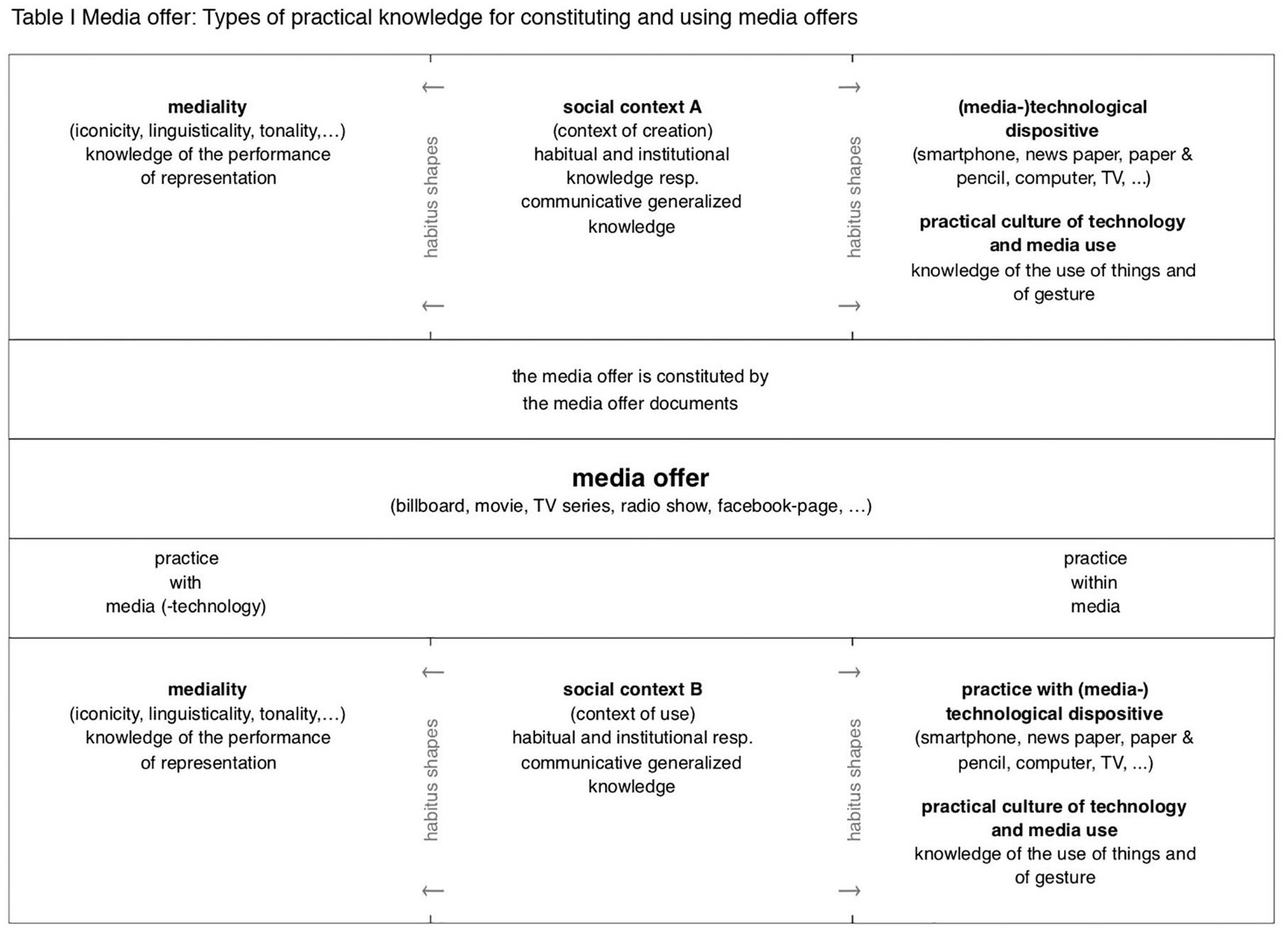
Media offer: Types of practical knowledge for creating and using media offers.
A media offer can be characterized by three different levels or components:
Its mediality, that is, iconicity, linguisticality, musicality, or tonality (performative quality of representations).
The social context of its creation, with its specific relation or ratio of implicit and explicit, conjunctive and generalized knowledge (frame of orientation).
The technical dispositive, that is, its technical-concrete and electronical-digital aspects, the hardware and software of technologies used for representation (level of the use of things).
Ads 1 and 2
An analysis of the medium on the basis of its entelechy (mediality) opens the way to an analysis of implicit knowledge, or rather, it enables us to comprehend the different levels of implicit and explicit knowledge, as was shown using the two examples above. Instead of trying to discover the “message,” its modification by the medium, and its right or wrong understanding, complete or incomplete arrival at the recipient’s address, which is still an important theoretical frame in the context of the mass media (Hall, 2004), the method proposed here enables us to examine what comes about/is documented how in this context, and what finds connection—and how it does find connection—in practical action.
A reconstruction of the formal structures that are specific for each mediality, via the aesthetic preconditions of the respective medium, opens access to conjunctive knowledge, to the habitus of the producers, that is, the context of creation, but also to specific norms, rules, role expectations, and common-sense structures that have sedimented in the media offer—something which, especially with regard to pictures, often occurs implicitly.
Thus, it is essential for the empirical investigation of communication to identify the exact medium one is dealing with. In the model, discussed in this article, both iconicity and linguisticality are understood as media in the sense of Luhmann: on one hand, in the difference to their concrete forms (i.e., as a sentence or a photograph, respectively); and on the other hand in difference to the common-sense understanding of media (which comprises, among others, both mass media and social media). For Luhmann (2012, p. 113ff), concrete forms are manifestations within media. Whereas any such manifestation might be destroyed or forgotten, media—like linguisticality or iconicity—endure. An image may fade; iconicity, however, remains and is charged by any iconic manifestation (Schmidt, 2000; Slunecko & Przyborski, 2009). Such media differences have been discussed in pertinent fields such as communication science, sociology, and psychology only lately and marginally (Pauwels, 2011; Przyborski, 2008; Przyborski & Slunecko, 2011). As long as the focus lies on “messages” which are examined independently of the medium, the difference between picture and language is not relevant, for instance. The issue of the medium used is also significant in that different media are able to document different forms of implicit knowledge. For instance, pictures can enable the reconstruction of incorporated knowledge, which cannot be represented by language (alone).
Ad 3
Media offers are usually linked to certain techniques or technologies and concretenesses. These technical dispositives document a certain practice of the use of things, or even a practical culture of technology and media use. Techniques come into being within certain cultural contexts and also express the latter. The same applies to the technical dispositive as well as to the entirety of media offers, as stated at the beginning: the product expresses the producer’s habitus.
Common sense does not differentiate between mediality and technical dispositive, for example, for most users, a profile photo on Facebook is not perceived as a picture embedded in a certain technology, but is just a profile photo. In fact, mediality and technical dispositive always come together as one and can only be analytically distinguished. It is only by this analytical distinction that one can gain access to the practical culture of technology and media use sedimented in the media offer. A picture, for instance, demands from us one single mediality: iconicity. However, it can manifest itself—be stored or disseminated—in very different dispositives and modified by the latter: The “Pulp Fiction” ad picture discussed in the “Foam” case was found on both traditional and electronical posters. A reproduction of it was attached to the wall of the young men’s room as a traditional poster, while finally it was made accessible for the purpose of the group discussion via the Internet. Other pictures are only published in a magazine and are not digitally available to the public, while others still, as I have discussed using the example of the picture from the Situation Room (Figure 9), can only be accessed via social-media platforms such as Flickr, Instagram or Facebook, for contexts other than that of their creation (Przyborski, 2014).

“Situation Room”; https://www.flickr.com/photos/obamawhitehouse/5680724572 (February 26, 2019).
The level of the technical dispositive represents a separate and independent level of analysis for a media offer. This level is not central to every research question. However, it may prove interesting to investigate how closely or loosely a picture is coupled to its technical dispositive, and how the various levels of knowledge that are manifest in the technical dispositive connect to those levels of knowledge expressed in specific medialities. The reconstruction of the posting of the picture from the Situation Room on Flickr highlights what was already reconstructed on the iconological-iconic level: the picture has the character of a snapshot, referring less to a professional context than to a private one. Flickr is a platform that was created for the private exchange of photographs: through the method of publication, that is, the use of the specific dispositive, the White House grants every single person the opportunity to catch a glimpse of what goes on beyond the closed doors of power. Such a glance is difficult for press agencies to provide in the traditional way.
The “Pulp Fiction” picture can be almost completely detached from certain technical dispositives; it is around independent from them. It inhabits no clearly definable space. In the end, it is ubiquitous, it is present everywhere. These considerations bear differences and similarities with the concept of “iconotopia,” in the way Dörner (2013) has developed it. In his understanding, places are the precondition of pictures with regard to their creation, use, and contemplation as places make pictures visible in the first place (Dörner, 2013, p. 219). But the concrete location of a picture does not fully answer the question how a picture or a film is made visible dispositivewise. As to the model presented here, this has to be systematically integrated into the analysis. The crucial point, which Dörner does not grasp, is what exactly makes a picture appear on a (material) surface, or—to change the register—what instrument lets us hear a melody, or what assembly of techniques has us read a sentence. Indeed, even before a (concrete) place becomes relevant in the analysis, we need to deal with the dispositive, which is far more directly and closely connected to the picture than is the place.
Technical dispositives comprise, among other things, that level which has been described as the practice of Zeuggebrauch, that is, the use of things, and gesture. In other words, dispositives express certain optionalities for their handling that arise from particular spaces of conjunctive experience, where they originate. A camera such as those installed in smartphones, for instance, helps to manifest the central perspective, a perspective strongly connected to the subject as it is, thus expressing and stipulating a certain weltanschauung. Similarly, the technical intricacies of the internet, the underlying connection of all computers, express a certain frame of orientation, originally that of an equal, democratic accessibility. By expanding and using it in a variety of ways, in different cultures, the internet may be subject to modification and forming. (Currently, there is discussion whether certain institutions should have faster access to the internet, which would allow them to access and pass information on more easily.) A learning platform, with all its possibilities and limitations, with the forms of evaluation and cooperation it provides, expresses a certain pedagogical habitus even before the electronic scaffold has been linked to concrete tasks.
Again in the context of use, the three levels mentioned above, and the way they interact, respectively, are essential:
The mediality (performance of representation).
The social context or connection with its specific relation of communicative and conjunctive knowledge (frame of orientation), in which the media offer becomes relevant.
The technical (technological) dispositive (the culture of media practice and the performance in contrast to the propositional level of the use of things and gesture).
As a first step, when analyzing the context of use, it is important to focus on which documents are relevant for the research interest one aims for. Are they iconic, linguistic, or film documents, for instance? What does this imply with regard to the levels that can be reconstructed concerning the use of the media offers? If we aim to learn something about incorporated knowledge like we do in the study presented here, we will have to look for iconic documents (compare also Breckner, 2007).
In the realm of iconicity, the so-called new media, the new dispositives of media technology, have made a form of communication visible that it did not cause to come into being in the first place, that is, communication in pictures for which these media merely provide an appropriate platform. For instance, there are now apps for smartphones that have made communication in pictures their point, such as Snapchat, Slingshot, or EyeEm. Also Facebook and, even more so, Instagram and Flickr are platforms that provide a suitable basis for the circulation of and communication in pictures. Communication of this kind is playing an increasingly central role, as can also be seen in the material corpus of this study. Some of the pictures chosen by the groups we examined are also used as profile images on social-media platforms, such as the private photograph in the “Ink” case. Direct communication in pictures or through pictures as a special form of communication, however, has hardly been a focus of empirical social research to date, especially when compared to communication about pictures in the form of language (see, among other, Harper, 2012; Richard & Lahman, 2015).
In a reconstruction of iconic communication via an analysis of pictures stemming from both the context of creation and of use, the reconstruction of the technical dispositive plays a certain role. Media technology as expression and means of certain cultures of media practice interplay with other cultures of media practice whenever they are used. For instance, we know that we cannot zoom into a photograph of a paper family album, but a kid socialized with smartphones and the like might try. Cultures of media practice may have overlaps of varying extent. The reconstruction of a social context via the analysis of a picture usually also requires a reconstruction of the interplay between the respective cultures of media practice, all of which act under particular technical preconditions (Figure 8): If one wishes to reconstruct the picture from the Situation Room which, due to its worldwide dissemination and intensive public discussion has found its way into political iconography representing Osama Bin Laden’s termination, as merely a document from the White House, then the issue of media technology is somewhat less significant.
As soon as, however, we are focusing on communicative processes taking mediality and media practices into account (in other words, as soon as we go beyond the context of creation), it is, for instance, important that the picture was posted on the social-media platform Flickr and did not follow the traditional path through the news agencies. Such news agencies would have been the first context of use. The platform Flickr, by contrast, can be understood as a component of the media offer as the picture can still be found there today. The actual posting of the picture on Flickr is thus expression of its context of creation and not, as we would intuitively guess, of its context of use (Przyborski, 2018).
In a comparative analysis of both media offer and documents from the context of their use, one can then reconstruct whether one is dealing with forms of direct, that is, conjunctive, understanding, or whether there are merely forms of communicative-generalized understanding. Our examples illustrate how essential the exact reconstruction of the formal structures of the respective mediality is. This is true in case of staying within one mediality but also holds true for the reconstruction of meaning in cases where the document from the context of creation and the document from the context of use differ in regard to their mediality: Michel (2006), in his analysis of the receiving of semantically more and semantically less-open pictures in different social milieus, clearly shows that especially the How of group discussion—the way language is used, small references to each other, repetition of words, little sounds, pauses, emphases and the like—allows for the reconstruction of those facets of meaning that specifically refer to the picture at hand.
What Michel mentions, but what he does not follow through, is the reconstruction of the media offer and thus the context of creation. Without a closer scientific look at the media offer, however, it is impossible to reconstruct whether and how frames of orientation of the contexts of creation and of the context of use overlap. Thus, Michel cannot reconstruct processes of media communication.
A research subject in the realm of mass media communication that is pursued in the above examples and which makes do without the idea of the “message,” lies in the reconstruction of the ratio of habitus and identity norm. The former (habitus) lies on the level of conjunctive knowledge and predicts the way and the extent to which virtual social identities often transported via mass media, for example, in the form of propagandized lifestyles, may become relevant. Overall, such analysis is geared toward the circulation of different forms and subjects of knowledge, of the way they connect to each other and develop practical relevance.
It is possible to refer to photos using other photos, as it was implemented in the empirical design of this study. The reason was that photographs can be used as documents from which especially the respective iconic-iconological understanding can be gleaned. Participant observation and group discussions, family or table talks (Keppler, 1994; Przyborski, 2004) may as well serve as documents of particular social units in which pictures or other media offers are relevant. However, when analyzing media communication using visual material from the context of creation and linguistic material from that of use, one has to keep this change of medium in mind.
The model illustrates that during an analysis of mass media communication, one can hardly examine all the aspects of a particular media offer equally. Moreover, it helps to clarify the research matter and also which research questions can be pursued with what design.
Footnotes
Declaration of Conflicting Interests
The author(s) declared no potential conflicts of interest with respect to the research, authorship, and/or publication of this article.
Funding
The author(s) disclosed receipt of the following financial support for the research, authorship, and/or publication of this article: This work was supported by the Austrian Science Fund (grant no. V156) and by the University of Vienna (three month guest professorship for Aglaja Przyborski).
