




Abstract
Preferred walking speed (PWS) is considered a robust measure for assessing mobility and overall health. Healthy reference data are unavailable for Qatar. The aim of this study was to investigate PWS and underlying gait parameters around PWS among healthy young adults living in Qatar. PWS was assessed for 18 Qataris (9 females) and 16 non-Qatari Arabs residing in Qatar (9 females). Within- and between-gender group comparisons were carried out using Mann–Whitney U-tests. Metabolic cost of transport, heart rate, rating of perceived exertion, and spatiotemporal parameters were compared between Qatari and non-Qatari groups of similar gender at seven speed levels relative to PWS using two-way analyses of variance (ANOVAs). Similar comparisons were done at two absolute speeds using Mann–Whitney U-tests. While PWS did not differ significantly between the female groups, it was on average 19% slower for the Qatari males as compared to non-Qatari males. At similar relative speeds, differences appeared solely in physiological parameters between female groups. Only spatiotemporal differences were revealed between the male groups where longer stride and support phase durations and slower stride frequencies characterized the Qatari male group. It is suggested that differences in PWS could be due to potential cultural factors (e.g., cultural clothing) differentiating the Qatari and non-Qatari groups. PWS values reported in this study also appear systematically lower when compared to Western references found in the literature. Findings suggest that the assessment of normative gait values needs to take both cultural habits and geographic disparity into account.
Keywords
Introduction
Walking is the most natural activity of daily living and is a popular form of physical activity. Analyses of gait patterns typically examine the speed and manner in which individuals prefer to walk. Even though healthy humans can walk at speeds up to 9 km∙h−1, they typically only use a very limited range of speeds around 4.5 km∙h−1 in their daily life activities (Bohannon & Andrews, 2011), coinciding with the least energy requirement (Margaria, 1976). The most comfortable speed at which humans freely choose to walk, known as the preferred walking speed (PWS), is considered an important and reliable indicator of mobility and health (Cesari et al., 2005; Studenski et al., 2011). Increasing attention has been given to this “vital” measure in a large range of clinical populations (e.g., frail older adults, individuals with Parkinson’s disease, or chronic stroke). Indeed, walking speed was found to predict functional dependence (Shimada et al., 2013), mobility disability (Rosano et al., 2008), quality of life (Ekstrom et al., 2011) as well as all-cause mortality (Studenski et al., 2011). Obtaining gait normative values allows more objective judgments about a person’s deviation from normal gait by comparison to healthy individuals (Bohannon & Andrews, 2011). In a recent review on walking speed as a reference tool for clinicians, Middleton et al. (2015) defined important cut-off values that could be used as indicators of specific health outcomes (e.g., dependency levels, frailty, risk of death, hospitalization and falls, and safety in crossing street).
In explaining differences in pedestrians’ walking speed across 31 cities in the world, Levine and Norenzayan (1999) highlighted that factors such as climate, cultural, socio-economic variables, or size of population and cities play a key role. For instance, these authors showed that cities with faster walking speeds (e.g., Switzerland, Ireland, and Germany) were more likely to have cold climates and emphasize individualistic culture. Other studies pointed out that ethnic and/or cultural backgrounds also have a significant impact on walking speeds and gait characteristics (Al-Obaidi et al., 2003; Ando & Kamide, 2015; Quiben & Hazuda, 2015). Ando and Kamide (2015) showed a faster walking pace in Japanese compared to non-Japanese older adults. The existence of specificity in gait was also highlighted by the observation of lower stride frequency characterizing young Tunisian male adults compared to available references on Western populations (Dhahbi et al., 2014).
To date however, there is scarce information regarding walking speeds and locomotion patterns in the Arab and Gulf regions. To our knowledge, the only available study from the Gulf region showed several differences in basic gait parameters (e.g., walking speed, stride frequency, and length) between young Kuwaiti and Swedish adults (Al-Obaidi et al., 2003). Compared to Swedish participants of the same gender, Kuwaiti men presented significantly higher speeds in the “fast walking” condition, while Kuwaiti women adopted significantly slower speeds in the “medium speed” condition. While these authors discussed results in relation to a potential impact of Arabian sandals (“rigid and wide to facilitate walking on rough desert and sandy terrain”), they did not consider this as a potential explanation for differences in walking speeds. While the study of Al-Obaidi and collaborators (2003) has the merit to be first to set gait reference data for one of the Gulf region’s population, this work presents several limitations. For instance, both studied groups were tested in different laboratory settings using different materials and presented significant discrepancies in their physical characteristics (e.g., Kuwaiti men being shorter compared to Swedish men). Such limitations reduce the possibility to generalize conclusions. Therefore, there is a need to further examine gait characteristics at various speeds and extend the analysis to include physiological and perceptual parameters.
Qatar is a relatively small country (i.e., 11.850 km2) with a dry desert climate and a population of about 2.6 million (Permanent Population Committee, Ministry of Development Planning and Statistics, 2017) that shares a cultural heritage with many of the Arab Peninsula Gulf countries. In Qatar, as in many other parts of the Arabian Gulf region, local men traditionally wear Arabian sandals and white long robes with a straight cut (i.e., thawb), while women wear black loose robes (i.e., abaya). This specific cultural feature is not present in most of other non-Gulf Arab countries in which individuals usually wear western clothing in their daily life. The country’s demographics indicate that Qatari nationals represent a small portion of the resident population (Permanent Population Committee, Ministry of Development Planning and Statistics, 2017), given the large proportion of expatriates working in the country.
This study aims to investigate PWS along with physiological, perceptual, and spatiotemporal gait characteristics in male and female Qataris and non-Qataris. The analysis was performed at various speeds relative to the PWS to get better insights into the preferred behavior and at two absolute speeds to better understand potential gait specificities that would arise independently of any effect of speed. Based on previous observations, we hypothesized that specificities in gait patterns of Qatari participants would exist as compared to non-Qataris. Potential differences would mainly concern spatiotemporal parameters (i.e., stride length and/or stride frequency). However, when compared at similar absolute speeds, we expect no differences in gait characteristics between groups.
Materials and Methods
Participants
Thirty-four students from different majors were recruited from the university campus to participate in the study, which was approved by the Institutional Review Board. The population was composed of 18 Qatari nationals (nine women) and 16 non-Qatari (nine women) residing in Qatar. The non-Qatari group included participants who were not nationals of or born in any Gulf countries but were all from neighboring Arab countries. All Qatari participants wore the usual cultural clothing in their daily life, while the non-Qatari participants wore regular western clothing and never tried the abaya or thawb. No significant differences in physical characteristics were found between groups of same gender (Table 1). Participants were healthy and presented no evidence of past or present metabolic, cardiovascular, neuromuscular, or musculoskeletal dysfunctions or any health problem that might have interfered with exercise, or an inability to walk continuously on the treadmill. This information was revealed by a medical and exercise screening questionnaire that was completed before the first experimental session. Informed written consent was obtained in accordance with the Declaration of Helsinki.
Participants’ Physical Characteristics.

Note. Values are presented as mean ± standard deviation.
Protocol
Participants performed two separate testing sessions on the same experimental day while wearing comfortable sports outfit and footwear (no sandals or heels were allowed). The duration of a laboratory visit was on average 2 hours and ambient temperature was 24°C.
The first testing session started with a 10-minute treadmill accommodation to determine whether each participant was willing and able to walk on a treadmill (Van de Putte et al., 2006). This was also conducted to ensure that their gait was representative of treadmill walking. After a 5-minute seated rest and water if needed, a standardized test was performed to determine the PWS of each participant (Dal et al., 2010; Jordan et al., 2007). For the purpose of PWS determination, participants started walking at a relatively slow treadmill speed (i.e., 2 km∙h−1). This was then followed by 0.1 km∙h−1 increments every 10 seconds until the participant reported walking at his or her preferred speed (i.e., most comfortable speed). From there, the treadmill speed was incremented by 1.5 km∙h−1 and followed by 0.1 km∙h−1 decrements until the participant indicated that he or she once again reached PWS. This procedure took between 2 and 4 minutes to complete and was repeated three times with at least three minutes of rest between trials. The individual PWS was determined as the average of the six reported PWS. Participants were blinded to the displayed digital speeds throughout testing.
After a 10-minute resting period, the second testing session aimed to collect physiological, perceptual, and spatiotemporal parameters when walking at a range of speeds around the PWS. This test was performed to get better insights on the underlying factors favoring the adoption of individual PWS that is understood in terms of comfort and minimal cost. Characterizing gait at different speeds provides a means to examine the dynamics of the locomotor system. To do so, participants were first equipped with a gas analyzer mask and a heart rate monitor. They were then introduced to the Borg scale (Borg, 1973) and instructed on how to report their perceived exertion when requested by the experimenter. Subsequently, each participant performed seven 3-minute walking trials at relative speeds in the following order: PWS-1.5 km∙h−1, PWS-1 km∙h−1, PWS-0.5 km∙h−1, PWS, PWS+0.5 km∙h−1, PWS+1 km∙h−1 and PWS+1.5 km∙h−1. Between each trial, a resting period of at least 3 minutes was given to participants to avoid any premature fatigue, and heart rate was monitored to ensure that recovery was sufficient (HR < 100 bpm).
Apparatus
The experiment was performed on a motorized medical treadmill set at 0% gradient with side handrails, a walking surface of 60 × 170 cm and a speed range of 1 to 25 km∙h−1 (Valiant 2 CPET, Lode, the Netherlands).
Respiratory and pulmonary gas exchange parameters were measured using a breath-to-breath gas analyzer (Metalyzer 3B, Cortex Medical, Germany) with a dedicated software (MetaSoft Studio, Cortex Medical, Germany). The system was calibrated prior to each session according to the manufacturer’s instruction, with room air and reference gases of known concentrations, and airflow volume was calibrated with a 3-liter syringe (Medbo et al., 2002). Heart rate was measured continuously using a Polar belt wrapped around the chest (Polar, Kempele, Finland) and fully synchronized with the gas analysis system. Ratings of perceived exertion (RPEs) were determined using the Borg 6 to 20 scale (i.e., 6 = no exertion at all, 20 = maximal exertion) (Borg, 1973).
Spatiotemporal data were digitalized using a video-based analysis and modeling software (Tracker 4.91, Open Source Physics, Brown, 2015) from 1-minute video samples recorded at the middle of each speed trial with a high-definition camcorder (sampling rate of 25 Hz, CCD-TRV66, Sony, Japan) fixed at a constant position perpendicular to the plane of movement and facing directly participants on the treadmill (i.e., 2 meters away from the midpoint of the treadmill’s left length).
Data Analysis
Oxygen uptake

RPE values were collected exactly 20 seconds before the end of each 3-minute walking trial (i.e., after walking for 2 minute and 40 seconds), by asking the participants to raise the index to indicate a “yes” as the experimenter read up the scale.
Four spatiotemporal gait parameters were computed from the average of 30 strides recorded in the middle of each trial (i.e., between the first and second minutes) (Hansen et al., 2017): (1) stride duration (SD, seconds) was considered as the time elapsed between two consecutive left heel strikes, (2) support phase duration (SPD, seconds) represented the time elapsed between the left heel-strike and the consecutive left toe-off event in a single stride, (3) stride length (SL, minutes) was computed as the product of the SD and the corresponding treadmill’s speed (in m∙s−1), and (4) stride frequency (SF, strides∙s−1) was calculated as the ratio between the corresponding treadmill’s speed (in m∙s−1) and SL. To facilitate comparison, the speed unit is presented in km∙h−1 rather than m∙s−1 throughout the rest of the text.
Statistical Analysis
The normality of all data sets was verified using Shapiro–Wilks’ tests. Mann–Whitney U-tests were then performed to assess differences in PWS between Qatari and non-Qatari groups of the same gender and between male and female participants within each group. This procedure was also used to control for possible “within-gender” differences between the groups’ physical characteristics. Two-way analyses of variance (ANOVAs) with repeated measures were performed, for each gender separately, to determine the effect of “Speed” (7 measures in km∙h−1: PWS-1.5, PWS-1, PWS-0.5, PWS, PWS+0.5, PWS+1 and PWS+1.5], “Group” (two measures: Qatari and non-Qatari) and their interaction on all physiological (i.e., MCT and HR), perceptual (i.e., RPE) and spatiotemporal (i.e., SD, SPD, SF, and SL) variables. The significance of p-values was adjusted according to the so-called Huynh–Feldt procedure to control for possible violations of the assumption of compound symmetry (Huynh & Feldt, 1970). Tukey’s honestly significant difference (HSD) post hoc analyses for pairwise comparisons were performed where necessary. Finally, Mann–Whitney U-tests were used to investigate within-gender differences in dependent variables (i.e., physiological, perceptual, and spatiotemporal) at two common absolute speeds (i.e., slow and moderate) between the Qatari and non-Qatari groups. Indeed, this analysis was meant to bring further insights into whether differences in gait characteristics were solely the consequence of differences in speed or rather indicative of a specificity in gait patterns. The slow and moderate speeds chosen for analysis (i.e., 3.1 km∙h−1 and 5 km∙h−1, respectively) corresponded to the lowest and highest common speed found between all participants’ trials of same gender. All analyzed trials at the set absolute speeds were within a range of less than 0.1 km∙h−1 from the absolute speeds (i.e., 3.0–3.2 km∙h−1 and 4.9–5.1 km∙h−1). All data are presented as mean (±standard deviation). Statistical analyses were performed using Statistica 7.1 package with a level of significance set at p < .05.
Results
PWS
While PWS did not differ significantly between the Qatari and non-Qatari female groups (p = .790), it was on average 19% slower for Qatari compared to non-Qatari males (U = 8.5, |Z| = 2.43, p = .015; Figure 1). The between-gender comparisons revealed a significantly higher PWS for the non-Qatari males as compared to the non-Qatari females (U = 6.0, ǀZǀ = 2.70, p = .005), while no difference in PWS was found between the Qatari female and male groups (p = .80).

Mean preferred walking speed (PWS) in km∙h−1 for the non-Qatari and Qatari female and male groups. Error bars represent the within-group standard deviation.
Walking Around the PWS
ANOVAs’ results are presented in Table 2 for the main effect of Group and Speed and their interaction on all dependent variables. Post hoc comparisons are detailed in Figure 2 for physiological and perceptual variables and in Figure 3 for spatiotemporal variables. Main results indicated a significant effect of speed on all variables (p values < .001). Significant spatiotemporal differences between the two groups were revealed in males at the tested relative speeds (p values ≤ .013), while no physiological or perceptual differences occurred. However, there was no difference in spatiotemporal gait characteristics in females, Qatari females had higher heart rate values in reference to non-Qataris as revealed by the post hoc comparisons on the significant interaction effect (p < .001). The significant interactions found on MCT (p = .032) in females is explained by a significant increase in values between PWS-0.5 km h−1 and PWS only for the Qatari group compared to the non-Qatari group. The interaction revealed on SD (p = .033) in males shows a significant decrease in values between PWS-1.5 km h−1 and PWS-1 km h−1 and between PWS and PWS+1 km h−1 only for the Qatari group as compared to the non-Qatari group. Overall, interactions indicate a higher sensitivity to changes in speed for Qatari females and males as compared to non-Qataris.
ANOVAs’ Results Performed for Male and Female Groups Separately With 2 (Groups: Qatari and Non-Qatari) × 7 (Relative Speeds) Repeated Measures on Perceptual, Physiological, and Spatiotemporal Variables.
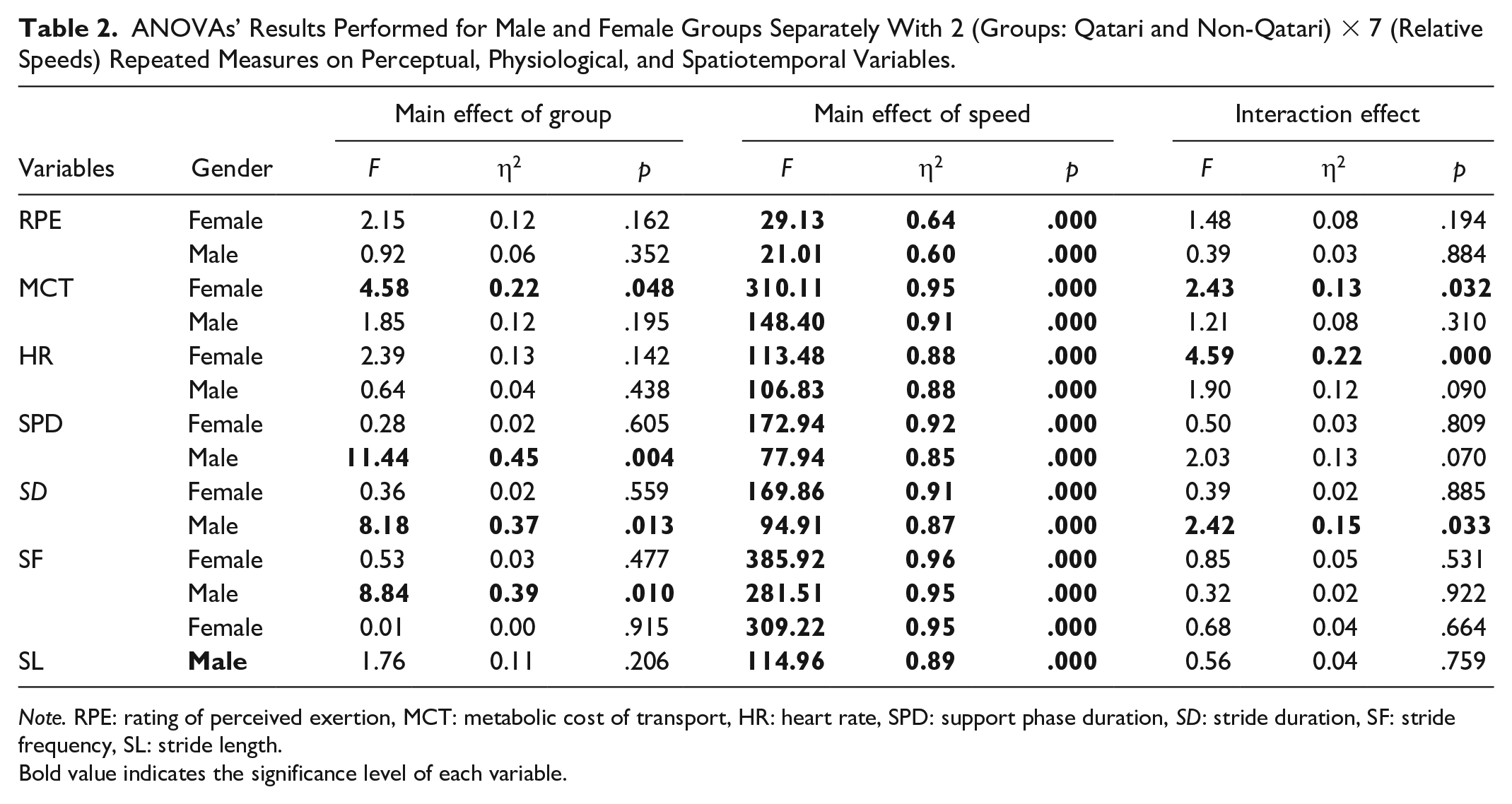
Note. RPE: rating of perceived exertion, MCT: metabolic cost of transport, HR: heart rate, SPD: support phase duration, SD: stride duration, SF: stride frequency, SL: stride length.
Bold value indicates the significance level of each variable.

Mean perceptual and physiological values around the preferred walking speed (PWS) for the female and male groups (i.e., Qatari and non-Qatari).

Mean spatiotemporal values for walking around the preferred walking speed (PWS) for female and male groups (i.e., non-Qatari and Qatari).
Walking at Common Absolute Speeds (Slow and Moderate)
Given that female groups did not present statistical differences in their PWS and therefore in all relative speeds tested, Mann–Whitney tests on variables’ differences at absolute speeds were undertaken only for male groups. Figures 4 and 5 summarize the results of the aforementioned analyses. Results revealed no significant differences in any of the perceptual, physiological, and spatiotemporal variables when walking at a slow pace of 3.1 km∙h−1 (p > .05). At the moderate speed of 5.1 km∙h−1, only spatiotemporal differences were found within the male groups. Compared to non-Qatari group, Qatari males had shorter stride length values (U = 14.0, ǀZǀ = 2.34, p = .019) at the common moderate absolute speed.

Mean rating of perceived exertion (RPE; A), metabolic cost of transport (MCT; B) and heart rate (HR; C) values of the non-Qatari and Qatari male groups at absolute slow (i.e., 3.1 km∙h−1) and moderate (i.e., 5 km h−1) walking speeds. Error bars represent the within-group standard deviation.

Mean spatiotemporal values of the non-Qatari and Qatari male groups at absolute slow (i.e., 3.1 km∙h−1) and moderate (i.e., 5 km∙h−1) walking speeds. A: support phase duration (SPD), B: stride duration (SD), C: stride frequency (SF), D: stride length (SL). Error bars represent the within-group standard deviation.
Discussion
This study is the first to investigate walking patterns in Qatar’s population (Qatari and non-Qatari Arab residents) with additional examination of associated physiological, perceptual, and spatiotemporal features across a range of seven speeds relative to the PWS and at two absolute speeds. A main finding revealed significantly slower PWS and shorter stride length for Qatari male participants as compared to the non-Qatari male group, while female groups presented similar PWS and spatiotemporal parameters. Male groups’ differences in stride parameters were not only evidenced at the relative speeds but also at the tested absolute moderate speed. In female participants, only physiological differences appeared between groups, as evidenced by higher heart rate values for Qatari females at all tested speeds. Those findings do not fully support our hypothesis as differences in gait appeared solely between male Qataris and non-Qataris.
PWS
A first result revealed a PWS of 4.10 km∙h−1 for the Qatari female group which was not statistically different compared to the one found for the non-Qatari female group (i.e., 3.99 km∙h−1). It is worth mentioning that the PWS of our female groups was lower compared to the average value of 4.89 km∙h−1 reported in a meta-analysis (Bohannon & Andrews, 2011) examining a total of 21 studies and different populations (e.g., Kuwait, Australia, United States, United Kingdom, France, Italy, and Sweden) including healthy women of 20 to 29 years old. The walking speed of our female groups was only consistent with that reported in young Kuwaiti women (i.e., 3.90 km∙h−1) that was in turn, significantly lower than the PWS found in Swedish women (i.e., 4.47 km h−1) (Al-Obaidi et al., 2003). Moreover, excluding both Kuwaiti and Swedish female samples from the meta-analysis (Bohannon & Andrews, 2011), reference speed values ranged from 4.56 km∙h−1 to 5.40 km∙h−1 for women from Italy and the United Kingdom, respectively. Even though any comparison with the literature must be made with caution, it could be argued that both Kuwaiti and Qatari women living in the same Arabian Gulf region present a slower gait as compared to other Western women. Indeed, this interpretation supports previous findings (Levine & Norenzayan, 1999) showing that cities with slowest walking speeds were more likely to have warm climates and emphasize collectivistic culture. The latter study therefore ranked two Arab countries (i.e., Jordan and Syria) from the Middle East with the slowest walking countries on the list. This observation, also true in regards to our non-Qatari female group and seemingly pointing toward a geographic, environmental and/or cultural explanation of walking speeds (Levine & Norenzayan, 1999) would merit further investigations.
A second result concerns the significantly slower PWS found in the Qatari male group (i.e., 3.79 km∙h−1) as compared to the non-Qatari group (i.e., 4.63 km∙h−1). Expected gender differences (e.g., due to anthropometric differences) were also not seen between the male and female Qatari groups, while this appeared for the non-Qatari groups. On one hand, the Qatari group seems to adopt walking speeds that were lower to those reported for Arab and Gulf populations of similar age, namely Tunisian (i.e., 4.39 km∙h−1; Dhahbi et al., 2014) and Kuwaiti (i.e., 4.38 km∙h−1; Al-Obaidi et al., 2003). Indeed, the Qatari males’ PWS appears to be even lower when compared to the average walking speed of 4.89 km∙h−1 found in a meta-analysis (Bohannon & Andrews, 2011). Excluding the Kuwaiti study, these authors found minimal and maximal PWS values of 4.43 and 5.31 km∙h−1 for Swedish and British men, respectively. On the other hand, and contrary to what was suggested for the female groups, non-Qatari male participants had PWS values that were in a closer agreement to the ones reported in the literature (Bohannon & Andrews, 2011). One potential explanation for differences in male gait speed may be related to specific cultural features as suggested in other studies (Ebersbach et al., 2000; Levine & Norenzayan, 1999). Indeed, important determinants of walking pace were related to factors such as the city’s degree of industrialization, size of both population and city, or climate (Levine & Norenzayan, 1999) which are virtually the same for both groups involved in this study. To which extent the male cultural clothing, that is less wide than that of females, influences gait is unknown. Although all groups were wearing comfortable sports outfits during the experiment, the influence of lifelong adaptations to walking with a long robe and/or specific footwear on our results cannot be ruled out. Our current findings, have been obtained from a small group of randomly selected healthy participants, and must remain specific to this cohort.
Physiological and Perceptual Responses
A step further in our analyses aimed at providing possible specific features in preferred gait. On one hand, knowing that both female groups presented similar PWS and stride characteristics at all tested speeds, one would argue as to why walking at the preferred pace was physiologically more demanding for the Qatari group as compared to the non-Qatari one. In fact, results indicated higher heart rate values (MCT marginally higher) for Qatari women at almost all tested speeds among which the PWS. From a motor control perspective, it is generally accepted that preferred behaviors are self-selected on the basis of an energy-saving principle (Sparrow & Newell, 1998). Although both groups perceived similarly their activity, it is unlikely that Qatari female participants have chosen a PWS that does not correspond to the one requiring the least energy and therefore walked faster than what was expected. However, it is important to acknowledge that the fitness level of both groups was not assessed or controlled at the beginning of this study. The higher physiological demand found at similar intensities might be indicative of a lower aerobic fitness level for the Qatari female group. It is unclear if a lower aerobic fitness level could impact the PWS in young adults as evidenced in older adults (Malatesta et al., 2010). Nonetheless, participants tested here were not only asked to walk at PWS, but rather continuously at seven incremental speeds (i.e., 3 km∙h−1 range) around the PWS. Even though tested speed values were relatively slow, it is also true that all variables were very sensitive to increases in speed as shown by the significant main effect of speed on all tested variables (p < .001). On the other hand, the slower PWS and differences in associated spatiotemporal parameters in Qatari males did not elicit significant differences on the physiological or perceptual levels when compared to the non-Qatari male group. Pending confirmatory findings, from a motor control view, it can be argued that both groups organized their gait patterns in a way to produce minimal physiological requirements.
Spatiotemporal Parameters
The slower walking speeds adopted by Qatari males were mainly achieved by a lower stride frequency and a higher stride and support phase durations, with no significant differences in stride length. Stride frequency and stride length are spatiotemporal variables that describe gait and scale to walking speed. Both are not necessarily dependent factors, and a higher stride frequency while maintaining the same walking speed results in a decreased stride length (Schubert et al., 2014). While this affects impact peak, kinematics, and kinetics (Schubert et al., 2014), comparisons between self-chosen and fixed walking speed on a treadmill showed small differences (1%) between stride length and stance percentage (Sloot et al., 2014). However, findings from a recent study showed significant decreases in stride length and increases in stride duration when walking as close as 80% or even 90% of the PWS (Thomas et al., 2017). According to Thomas and collaborators (2017), for healthy young adults, walking at slower than preferred speeds increases stride width and reduces its active control, which might offer an interpretation for the slower pace revealed for the Qatari males. This could be explained by the medio-lateral margin of stability, which is influenced rather by stride frequency than stride length and walking speed (Hak et al., 2013). The male Qatari group might have adopted a slower than preferred speed and increased the stride and support phase duration to control the medio-lateral center of mass movement to remain in the margin of stability. The latter interpretation would merit further confirmation.
Walking at Common Absolute Speeds
With relative intensity comparisons, it remains difficult to speculate whether differences in stride characteristics are specificities in the male Qatari group’s walking pattern or a simple consequences of the lower speeds adopted by the Qatari group. One important methodological aspect of our study was the addition of a between-group comparison at common absolute speeds. This analysis did not reveal any physiological, perceptual, or even spatiotemporal difference between groups when walking at the slow pace (i.e., 3.1 km∙h−1; Figures 4 and 5). Therefore, the group differences revealed in stride characteristics at the preferred pace might be due to differences in the freely selected speed. However, when constrained to walk at a faster pace (i.e., 5 km∙h−1), a significantly shorter stride length was seen in the Qatari male group as compared to the non-Qatari group. This finding not only suggests a higher sensitivity of faster speeds in discriminating gait differences but also could be indicative of a gait specificity in male Qatari participants. This is coherent with findings of a previous study (Dhahbi et al., 2014) that was able to highlight kinematic and spatiotemporal specificities in gait at the preferred pace (i.e., greater hip extension and lower cadence) in Tunisian adults. The spatiotemporal differences found at the higher common walking speed between the Qatari and non-Qatari groups could reveal a characteristic of the Qatari male participants’ gait. It can only be speculated that the limited stride length in Qatari males (at the higher than preferred speed) might be indicative of long-term gait adaptations to overcome constraints to the antero-posterior leg movement, potentially due to walking with a tight cultural thawb. However, this hypothesis needs to be confirmed in a further study to be valid.
Limitations and Additional Considerations
Walking on a treadmill differs from overground walking, and a comparison with other studies using overground timed distance on a walkway (e.g., Al-Obaidi et al., 2003) is difficult to perform. It is uncertain how overground and treadmill walking can be compared, given the contradictory findings with regards to stride frequency, length, and duration or stance duration (Alton et al., 1998; Boda et al., 1994; Sloot et al., 2014; Strathy et al., 1983). However, treadmill gait analysis allows to reliably measure and assess a large number of steps while controlling walking speed. Moreover, replacing the two-dimensional (2D)-video analysis with a three-dimensional (3D) motion analysis system coud help clarifying the differences between the experimental groups (e.g., additional kinematic and spatiotemporal parameters). It can also offer an examination of the medio-lateral component of movement, where stride width seems to play an important role with respect to PWSs (Thomas et al., 2017).
Finally, it is important to mention that participants of this study were all living in a single geographic area. To control for this limitation, participants were not only selected based on the nationality criterion but also on whether or not they adopted cultural clothing customs which is indicative of an adherence to cultural norms. Furthermore, our significant findings obtained from a limited sample size would merit further support from future studies to be generalizable to the Qatari population, however constitute a first step into better understanding gait characteristics of a local random sample. Finally, results from healthy individuals may have a limited clinical significance for patients and only aimed at characterizing potential similarities or differences in gait characteristics of the tested population cohort.
Conclusions
A preference toward a slower gait pattern was revealed for Qatari males in comparison to the non-Qatari males, which was paralleled with a specific organization of the spatiotemporal gait pattern, and potentially indicating a search for an increased stability. In general, slower gait values were identified in this study’s cohort when compared to international norms (mostly Western). The latter emphasizes the importance of considering not only geographic disparity but also environmental and/or cultural factors when examining gait references. The study’s methodology presented advantages, allowing to recommend an examination of gait, not only at the preferred pace where it is the most acquired and stable but also at slower or faster than preferred speeds. This examination allows to better understand the control of gait in an effort to reveal specificities of the studied population. The speed constraint imposes gait adaptations that are not necessarily seen at the self-selected pace.
Footnotes
Acknowledgements
The authors are grateful to the Sport Science Program’s students for their help in running a big part of the experiments. Specifically, the authors thank Wajiha Ghazi, Rania Bouhesine, Mohamed Elhams, and Mohamed Aziz Riahi for their great efforts in performing the experiments and Abderrahman Ouattas for his involvement in preparing the spatiotemporal datasheets for analysis.
Declaration of Conflicting Interests
The author(s) declared no potential conflicts of interest with respect to the research, authorship, and/or publication of this article.
Funding
The author(s) disclosed receipt of the following financial support for the research, authorship, and/or publication of this article: The study was funded by a Qatar University grant (QUST-CAS-FALL-14\15-22). The findings achieved herein are solely the responsibility of the authors.
