




Abstract
The purpose of this study is to examine how sociodemographic factors and everyday events are related to adolescent’s happiness in Malaysia. A total of 1,766 adolescents from 20 secondary schools in peninsular Malaysia completed a questionnaire on demographic background information and Malay version of Oxford Happiness Questionnaire. Participants were also requested to identify everyday events that made them happy in the last 6 months. Univariate analysis of variance (ANOVA) was run to determine effects of gender, ethnicity, religion, and location on happiness. None of the main effects and interactions were significant. Correlation analysis revealed that household income, income of father, education of father, education of mother, and academic performance were significantly associated with adolescent’s happiness. Analysis of the everyday events that were reported to induce happiness suggested these events as related to domains considered salient in an adolescent’s life, including family, friends, and school. Everyday events are also related to intentional activities. Findings provide better understanding of the key demographic factors and everyday events that contribute to happiness of adolescents in Malaysia. Findings particularly suggest the importance of intentional activities in increasing happiness among adolescents.
Keywords
Introduction
In general, happiness comprises three major components, global life satisfaction, presence of positive affect, and absence of negative affect (Diener, 1994; Lyubomirsky et al., 2005). Happiness has been found to be associated with positive outcomes across different life domains, including health relationship, performance at work, and income (Lyubomirsky et al., 2005). Lyubomirsky et al. (2005) also suggested that happiness is not merely the product of being successful but being happy is what leading to successful outcomes. According to the broaden-and-build theory of positive emotions, people who experience positive emotions are more likely to move upward in which their attention and thinking become broaden (Fredrickson, 2004). Over time, positive emotions lead to psychological growth and optimal functioning (Fredrickson, 2004). Happiness therefore can be viewed as an important resource that can lead to more positive outcomes in the future.
As such, it is important to investigate what are the associated determinants of happiness (van de Wetering et al., 2010). However, published studies on happiness mainly focused on developed nations (Addai et al., 2013). While these studies are essential in the development of the knowledge and theoretical understanding related to the topic, limited information is available with regard to happiness in middle-income countries like Malaysia. More studies on happiness also tend to focus on children or adults and less on adolescents (van de Wetering et al., 2010). As an attempt to fill this gap, this study focuses on understanding happiness among adolescents in Malaysia.
Studies on happiness have identified several factors associated with happiness, including age (Greene, 1990), gender (Fujita et al., 1991), and country of origin (Diener, 2006). This study is an extension of this body of research by examining how sociodemographic variables such as age and gender are associated with happiness. In addition, a large proportion of research in happiness tends to focus on understanding only certain aspects of happiness in one single study. This study attempts to understand happiness of adolescents in Malaysia from a bigger picture by examining not only sociodemographic factors associated with happiness but also their sources of happiness. Taking the phenomenological approach, we also investigated how everyday events are associated with the experience of happiness.
Sociodemographic Factors and Happiness
Sociodemographic backgrounds have been found to be associated with whether or not people are happy with their lives. For example, several studies have indicated that the level and predictors of well-being change with age. Greene (1990) found that elementary school children experienced more positive affect than older children. Other studies focused specifically on adolescents. van de Wetering et al. (2010) studied a group of young Dutch adolescents and found that most of their participants reported high level of overall happiness. Trung et al. (2013) examined data from fifth wave of World Value Survey across 10 Asian countries, including Malaysia. They found that the relationship between age and happiness was in the U shape when happiness hits lowest level between the age of 25 and 37 years. Based on this finding, it is probable to predict an overall high level of happiness among adolescent sample, especially in comparison with older groups of 25 to 37 years old. This study focuses on adolescents in Malaysia. In general, it can be expected that happiness of this group is generally high. However, it can also be predicted that happiness level will also vary according to other sociodemographic backgrounds of the adolescents.
There are mixed findings related to gender differences. While women may report more negative affect, women also report more positive emotions and these two offset the other, leading to men and women to be equally likely happy (Fujita et al., 1991). Similarly, Trung et al. (2013) found mixed findings related to gender differences in happiness. In Hong Kong, women seemed to be happier than men, whereas in Indonesia, women reported higher level of life satisfaction. In this study, gender of the adolescents is considered as one of the sociodemographic predictors of happiness of adolescents in Malaysia. Although previous studies were not able to conclude gender differences, we predict that girls are more likely to report higher level of happiness. This is based on findings from Hong Kong and Indonesia.
A review of research on Malaysians’ happiness suggests that happiness is slightly lower compared with that of Western countries (Howell et al., 2012). Looking at predictors of happiness, health is associated with increased happiness, whereas financial satisfaction contributes to life satisfaction for Malaysian sample (Howell et al., 2012). Malaysia is a multiethnic and multireligion country. As such, it provides an ideal opportunity to examine how people of different ethnicities and religions experience happiness. In this study, we examined the level of happiness among adolescents of different ethnicities and religions in Malaysia. We argue that ethnicity and religion influence cultural practices, and these practices influence happiness and happiness experience. Limited studies have taken this approach. To understand how cultural background and practices may play in a role, we reviewed comparative studies looking at differences in happiness across different countries. This may in fact reflect cultural-specific patterns. A comparative study on children’s well-being in rich countries by United Nations Children’s Fund (UNICEF) reported in 2013 showed that while the bottom four places consisted of three poorest participating countries, the United States as one of the richest economies in the world placed fourth from bottom. This appears to indicate that country’s per capita gross domestic product (GDP) has no strong relationship with overall child well-being. Investment on children’s well-being on the contrary may be more important. Relating this issue to culture, it is important to understand how culture plays a role in determining the investment on children and in return determine their well-being and happiness. In a culture where investment on children, both material and psychological, is not regarded as important, then happiness of children can be expected to be relatively low. This is as opposed to a culture where a large amount of resources are invested on children, where the children’s quality of life and happiness in that culture are more likely to be high.
The above idea is consistent with the contemporary discourse on how culture contributes to the construction of happiness. Although there is a general consensus that happiness is desirable regardless of the culture (Diener et al., 1995; Michalos, 1991; Veenhoven, 1991), there are differences in the way people conceptualized happiness (Diener & Suh, 2000; Kitayama & Markus, 2000). There are also cultural difference in motivations (Heine et al., 1999) and predictors of happiness (Kwan et al., 1997). In general, European and American cultures define happiness in terms of personal achievement and personal experience, whereas East Asian cultures defined happiness as part of the social harmony (Uchida et al., 2004). They attributed these cultural differences to the way people view independence and autonomy of self. In European and North American cultures, social relations are viewed as independence of self, whereas in East Asian cultures, the boundary separating self and others is blurred through social interactions. They argued that individuals from East Asian cultures are more likely to see happiness as “inter-subjective state that is grounded in mutual sympathy, compassion and support” (Uchida et al., 2004, p. 226). In other words, happiness for East Asians is heavily influenced by positive relationships.
Focusing more specifically on income or wealth, people living in the wealthier countries tend to report higher level of happiness (Diener, 2006). People in wealthier countries are somewhat happier than those living in destitute countries, but increased incomes are not always accompanied by increased happiness (Myers & Diener, 1996). Once a person has just enough money to feel barely comfortable, more money will not necessarily lead to more happiness. This indicates that while being poor does make people unhappy, but once basic needs are being met, money does not have much impact. In our study, the impact of parent’s income on their children’s happiness was explored. Powdthavee and Vernoit (2013) suggested that the relationship between parental income and children’s well-being is a lot more complex. In their study, they found that parental job loss which is related to parental income can in fact have positive influence, especially among young children. Job loss may be associated with more time spent with children, and although the impact of job loss can also mean financial loss and this can be damaging, it can be moderated by the time spent with children. According to Trung et al. (2013), the association between income and happiness in Asian countries is complex. For Asian countries with the highest income level like South Korea, India, China, and Taiwan, income level is not associated with happiness.
In this study, previous academic achievement was considered as part of sociodemographic characteristic of the adolescents. Previous studies found that school success has a relationship with subjective well-being (Quinn & Duckworth, 2007). In a 2006 cross-sectional study, Gilman and Huebner found that students with mean of age of 14.45 years and who reported high life satisfaction were more likely to report higher grade point averages (GPAs) than students with lower life satisfaction. This finding highlights the significant relationship between academic performance and happiness. In Malaysia, all students have to sit for their major national exam in Form 3 (ninth grade). Participants in this study were secondary school Form Four (equivalent to 10th grade) students. Their academic performance was based on the major national exam results which they took the previous year (equivalent to ninth grade) prior to data collection. The score provides a robust measure of standardized academic performance, which can be used for comparison purposes in this study. In this study, we also examined how parent’s educational background can be associated with happiness. In general, studies in Asia have demonstrated that people with higher educational background reported higher level of happiness and life satisfaction (Trung et al., 2013). The pattern is especially evident in India.
In addition, location can play a role in contributing to happiness. In this study, we compared urban and rural locations. Trung et al. (2013) also investigated whether urban and rural communities have different level of happiness across the 10 Asian nations. They found that people who lived in towns with population of at least 10,000 were happier and more satisfied with their lives compared with those who lived in the areas with population size of 2,000 to 10,000. In this study, the categorization of the urban and rural schools was not based on the local population size. Instead, it was decided based on the classification determined by the State Education Department.
Sources of Happiness
Some researchers take the more phenomenological approach to understanding happiness by examining sources of happiness in an individual’s life. Lu and Shih (1997) conducted a qualitative study to identify people’s sources of happiness in Taiwan. They found that sources of happiness can be categorized into the following: (a) gratification of need for respect, (b) harmony of interpersonal relationships, (c) satisfaction of material needs, (d) achievement at work, (e) being at ease with life, (f) taking pleasure at others’ expense, (g) sense of self-control and self-actualization, (h) pleasure and positive affect, and (i) health.
Focusing on children, Chaplin (2009) conducted a series of studies in an attempt to understand what contributes to their happiness. The sample in his studies was 300 children between the ages of 8 and 18 years. In the first part of the study, participants responded to an open-ended question of “What makes me happy” and the content analysis led to five emergent themes that included people and pets, achievement, material things, hobbies, and sports. From the first study, Chaplin employed collage-methodology that allowed for examination of age differences in terms of sources of happiness. Although people and pets was always a source of happiness across children of different ages, there were age differences. Younger children such as third graders also identified hobbies, seventh and eighth graders identified material things while older children (11th/12th graders) reported achievement (Chaplin, 2009) as their other sources of happiness. The findings highlight age differences with regard to people’s subjective sources of happiness. In addition, Chaplin also found gender differences in which boys were more likely to identify sports as something that makes them happy as opposed to girls who reported people and pets more frequently.
Relationship with teachers can also be a source of happiness and can contribute to the students’ well-being. In a study on positive relationships between teachers and students, children from upper secondary schools reported how respect, bonding, care, trust, and kindness from teachers are important in promoting positive teacher–student relationships and consequently positive experiences at school (Krane et al., 2017).
Lu and Shih (1997) argued that while the nature of happiness and its state of experience can be universal, people’s sources of happiness can be different depending on the culture (Lu & Shih, 1997). This is again consistent with Uchida et al.’s (2004) review on meaning, motivation, and predictors of happiness mentioned earlier. Specifically related to sources of happiness, they observed substantial differences in the sources of happiness among East Asian and North American cultures. More specifically, happiness for people from East Asian cultures is associated more with interpersonal connectedness as opposed to personal achievement in North American context. In a study on happiness among adolescents between the ages of 15 and 18 years in Thailand, family factors contributed more to happiness compared with nonfamily factors. Participants who reported adequate time spent with family and higher level of love and connectedness also reported higher level of happiness (Gray et al., 2011).
Layous et al. (2013) investigated how positive activities can boost happiness across different cultures. In this regard, positive activities can be viewed as sources of happiness. Comparing people from the United States and South Korea, they found that participants from South Korea were more likely to experience mixed emotions due to their dialectical philosophical traditions. They argued that people who come from East Asian traditions are more likely to experience complex emotions, thus benefiting less from activities such as expressing gratitude compared with their Americans counterparts.
Studies on sources of happiness in Malaysia are still limited (Jaafar et al., 2012). In a study on sources of happiness among Malaysians and Indonesians, family is reported to be the biggest sources of happiness (Jaafar et al., 2012). This is consistent with collectivistic values often associated with Asian cultures which put family and group welfare before individual’s needs (Jaafar et al., 2012). In another study that investigated happiness among Malaysian households, findings suggest good health as the most important aspect that contributes to happiness (Ismail et al., 2014).
Haque and Hasking (2010) who examined emotionally charged autobiographical memories among Malaysians found that events associated with happiness were those related to close relationships (e.g., getting married) and religion (e.g., Eid celebration and pilgrimage to Mecca). While close relationships have been well cited to be associated with happiness across a number of studies in different cultures, spiritual or religious-related events appear to be more of Asian or Malaysian phenomenon. In this study, it can be predicted that events leading to happiness are those related to close relationships and spiritual.
In this study, we looked at how everyday events can be sources of happiness for Malaysian adolescents. In this study, events reported can be conceptualized into two components: domain and focus. We argue that adolescents’ lives can be divided into different domains, and these domains include family, friends, schools, romantic, spiritual, and others. Very often, events can occur across domains and this leads to a mixed domain. We also argue that what happened in that particular domain can vary across different focuses. For example, getting a good grade is an event associated with the domain of school and the focus of this event is achievement, whereas celebrating birthday with friends involves the domain of friends where the focus is on social activity. Similar to domains, focus can also be of mixed and other category.
Theoretical Framework
According to the model of architecture of sustainable happiness, there are three main factors contributing to a person’s chronic happiness (Lyubomirsky et al., 2005). These factors are genetic set-point of happiness, circumstantial factors and intentional activities and practices. Genetic set point has greatest contribution, accounting for 50% of the population variation (Braungart et al., 1992). Circumstances such as sociodemographic factors (e.g., age, gender, and ethnicity) and life status variables (e.g., marital and occupational status) contribute the least, accounting for only 10% of the variance (Diener et al, 1999). Intentional activities can be defined as “discrete actions or practices in which people can choose to engage” (Lyubomirsky et al., 2005, p. 118) and may include a wide variety of things that people do in their daily lives. They can be behavioral such as jogging, cognitive such as counting one’s blessing, or volitional such as striving for an important goal (Lyubomirsky et al., 2005).
In this study, we explored how happiness of adolescents can be associated with sociodemographic factors. In this study, sociodemographic factors include gender; ethnicity and religious background; father’s, mother’s, and household income; father’s and mother’s education; previous academic performance; and location (urban vs. rural). This can be part of the circumstances factors. Although it can be predicted that the relationship between these variables and happiness is relatively weak, it is still important to understand their contributions in Malaysian context. Malaysian multicultural, multiethnic society offers a great opportunity to explore how happiness may be influenced by circumstantial background, thus providing useful information about groups that may be at risk of experiencing a relatively lower happiness compared with other groups. This information can have important practical implications in terms of intervention programs to help Malaysian adolescents to become happier.
In addition, respondents were also asked to respond to an open-ended question on events that induced happiness in the last 6 months. The study aimed at gaining understanding of the sources of happiness for the adolescents. Sources of the events can be of intentional activities, especially when the events described as inducing happiness are part of the behavior or actions. Conceptualizing intentional activities as part of actions or practices that people choose to engage in, we explored the sources of events that are reported as inducing or eliciting happiness for this sample. Earlier studies suggested that sources of happiness for adolescents are likely to be related to achievement (Chaplin, 2009) and in various domains of relationships, including family (Gray et al., 2011) and school-based (Krane et al., 2017). We used this conceptualization to categorize and analyze the sources of happiness by dividing them into different domains of friendships (family, friend, etc.) and different focuses (achievement, social gain). Some of these categories were determined based on the sources reported by the participants. Details of the data analysis process are provided in the analysis section.
This Study
This study looked at how happiness of adolescents can be associated with sociodemographic factors. In this study, sociodemographic factors include gender; ethnicity and religious background; father’s, mother’s, and household income; father’s and mother’s education; previous academic performance; and location (urban vs. rural). In addition, respondents were also asked to respond to an open-ended question on events that induced happiness in the last 6 months. The study aimed at gaining understanding of how sociodemographic factors can be associated with happiness and what the sources of happiness are for the adolescents in this study.
Method
Participants
Participants were 1,766 tenth graders (45.9% male, 80.8% Malay, 81.4% Muslim, and 57.1% urban) from 20 secondary (high) schools in Malaysia. Mean age was 15.97 (SD = 0.614).
Procedure
Data collection began with identifying schools to represent urban and rural areas from all 14 states in Malaysia. Urban schools were first randomly selected from a list of schools located in the capital city of every state in Malaysia. Fourteen schools were selected in the beginning. Rural schools were selected from a list of rural schools but the ones relatively near to the urban school selected in the first list. This was employed to minimize the traveling cost. Altogether, 28 schools were selected, but only 20 agreed to participate in the study. Data were collected in one session where researchers distributed questionnaires to 80 to 100 Form Four (10th grade) students from each school. In schools where the number of students were more than 100, schools determined the selection process. Questionnaire administration was conducted in the hall designated by the school. Students were requested to gather in the hall, and two to three researchers were present during the administration. Only students who had parental consent and gave informed consent participated in the study.
Measures
Background information
This section tapped into the sociodemographic backgrounds of the respondents. These include gender, age, ethnicity, religion, academic achievement, and parental education and income.
Happiness
The Malay version of Oxford Happiness Questionnaire (Hills & Argyle, 2002) was used to measure happiness. It consists of 29 items with six choices for each one. The scale has been widely used with adequate psychometric properties (Medvedev et al., 2017). In the present study, reliability coefficient for the measure was α = .76.
Happiness-inducing events/situations
In this section, participants were requested to identify “things” that made them happy in the last 6 months in an open-ended question. These responses were then coded on the basis of domains and activities.
Results
Sociodemographic Factors and Happiness
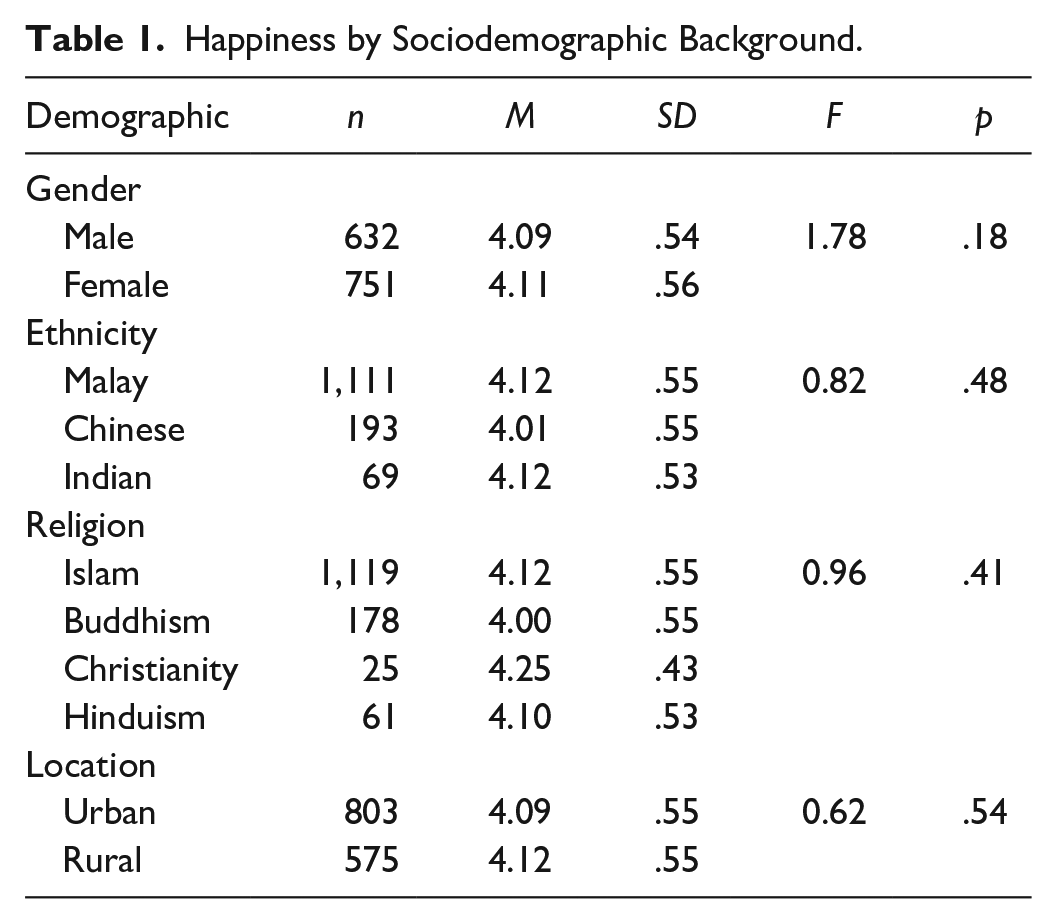
Univariate analysis of variance (ANOVA) was run to determine whether happiness differed by sociodemographic factors such as gender, ethnicity, religion, and location. None of the main effects and interactions were significant (see Table 1). However, Tukey post hoc test indicated that Muslim adolescents (M = 4.12, SD = 0.55) reported significantly higher happiness than Buddhist adolescents (M = 4.00, SD = 0.55; p < .05).
Happiness by Sociodemographic Background.
Pearson correlation analysis was conducted to determine the relationships between happiness and parental income, parental education, and academic performance. There were significant associations between household income (r = .087, p < .001) and income of father (r = .064, p < .05) and happiness (see Table 2). However, there was no significant association between income of mother and happiness of adolescents. Pearson correlation analysis also revealed significant associations between education of father (r = .082, p < .001) and education of mother (r = .076, p < .001) and their children’s happiness. Academic performance also significantly associated with happiness (r = .128, p < .001). The significant associations were strongest for female and Hindu adolescents (see Table 2).
Pearson Correlations Between Happiness, Parental Income, Parental Education, and Academic Performance.

p < .05. **p < .001.
Events as Sources of Happiness
For the open-ended question, participants were requested to identify events or situations that made them happy in the last 6 months. From the responses, more than 30% of participants listed out more than one events/situations. It is important to know how many events/situations occurred in the last 6 months. The first analysis is with regard to the number of events or situations reported by each participant. Some reported 0 events, whereas others reported up to 10 events. This analysis was recorded manually. A rater was trained to rate the number or events/situations reported.
Table 3 presents the number of events participants reported. A large proportion of the respondents reported between one and four events. A smaller proportion reported between five and seven events, and even smaller number of people reported eight or more events. A closer examination showed that these events did not necessarily represent one event but rather one category of events. Examples of an event are “getting together with family members” or “outing with friends.” In this regard, it does not mean that a particular event only occurs once but rather it is a distinct event in comparison with others. It can be concluded that people who reported more events did not necessarily experience more happy events but they just experienced more variety of events that made them happy.
Frequency of Happiness Events.

From the responses, it appeared that every reported event could be categorized into two: domains and foci. Domains represented areas in life (e.g., family vs. school) in which the events took place while foci described the major component of the events (e.g., engagement in a particular activity or a material or a social gain). Some events involved a combination of domains (e.g., outing with family and friends) or a combination of foci (e.g., will be successful in the future). Some events involved domains and foci other than categories identified above. The analysis is again conducted manually by trained raters.
A trained rater manually analyzed responses reported by participants and categorized them into domains. The events could be categorized into seven domains: family, friends, romantic, school, spirituality, mixed, and others (see Table 4). The most reported domains were school, others, family, and friends. For school domain, the events/situations described were mainly focusing on achievement. The focus is further illustrated in Table 5. The finding suggests school as an important source of happiness for adolescents. Friends and family or the combination of the two domains of relationships is the other two sources of happiness for this sample. There are other events/situations that cannot fit into any of the categories but are still important, and some of them are part of the daily uplifts (e.g., laptop getting fixed). Romantic relationship is also important but it is less important in comparison with school, family, and friends. The least reported domain was spirituality.
Domains of the Event/Situations and Their Frequencies.

Foci of the Events and Their Frequencies.

The events could also be categorized into seven foci: activities, recognition, material gain, social gain, achievement, mixed, and others (see Table 5). While the above analysis categorized reported events or situation into domains of relationship, this part of analysis focuses more on the elements central to the events/situations. The category “activities” is the most closely related to intentional activities, and from Table 5, this represents the highest number of focus (2,706). Recognition, material gains, social gains, and achievements are somewhat related in that all of them represent some kind of gain or achievement. The category achievement is mainly related to achievement in school, whereas the other categories represent achievement or gain in other areas. Material gain remains an important category of happiness-inducing events or situation for adolescents (747).
The “mixed” category was more often reported in domains than foci, suggesting that while the major component of the event could be specific, many events involved more than one domain. “Others” category was often reported in both domains and foci, suggesting the need for a more refined analysis, so was the “activities” category.
Discussion
This study looked at how happiness can be associated with sociodemographic and what are the events and situations that can induce happiness among a group of Malaysian adolescents. Looking at the association between age and happiness, this study did not look at this interaction specifically. All of our participants turned 16 during the year the data were collected, and the average age of the participants was 15.97 (SD = 0.614) years. This was a homogeneous group in terms of age and therefore did not allow for any comparison to be made between people of different ages. However, they do represent adolescents. Earlier findings suggested that adolescents’ happiness to be high (van de Wetering et al., 2010) and the relationship between happiness and age is in the U shape. Trung et al. (2013) found happiness hits bottom between the ages of 25 and 37 years. Consistently, we observed a relatively high level of happiness among Malaysian adolescents in this study. This finding can be a baseline data for future studies on Malaysian adolescents.
In this study, we did not find any gender differences in terms of happiness. Previous studies have shown mixed findings with regard to gender differences (Fujita et al., 1991; Trung et al., 2013). It is likely that life circumstances and challenges are somewhat comparable for boys and girls at this age that the reported happiness between them was not statistically significant.
This study examined cultural-significant findings at two different levels. The first one is the comparison between Malaysian sample and adolescents from other different countries. The second is the comparison between different ethnic groups in Malaysia which we argue as representing the deeper cultural differences. With regard to the first one, consistent with the study by van de Wetering et al. (2010) which focused on a group of young Dutch adolescents, Malaysian sample also reported high level of happiness. Howell et al. (2012) reviewed Malaysian happiness in general and concluded that happiness for Malaysian sample is slightly lower compared with that of Western countries. The differences observed by Howell et al. (2012) may reflect adult sample as opposed to adolescent sample, as demonstrated by our findings. When comparing adolescents of different ethnicity and religions, we found no differences between the groups. It is possible that cultural differences between the different ethnic groups in Malaysia are minimal and not significant enough to contribute to happiness.
In this study, household and father’s income have significant relationships with happiness. Adolescents who reported higher level of household and father’s income were more likely to report higher level of happiness. This is consistent with previous findings that indicated people who live in wealthier countries in the world tend to report higher level of happiness (Diener, 2006). Because household income in Malaysia is generally relatively low, the levering impact of income on happiness among those with exceptionally high income may be less obvious. What is interesting is that mother’s income has no relationship with adolescent’s happiness. This may indicate gender gap in Malaysia where women’s income represents a smaller proportion of household total income and thus not affecting family’s well-being. Many of the respondents reported their mothers as staying-at-home and thus reflected in the results.
In this study, we found that father’s education, mother’s education, and academic performance of the participants can be associated with their happiness. Adolescents with more highly educated fathers and mothers reported higher level of happiness. This is consistent with the findings from previous studies that found similar effects of education on happiness (Gilman & Huebner, 2006; Jaafari, 2002; Trung et al., 2013). Consistently, we found people who performed well in the last national examination, also reported higher level of happiness. Education of parents may have some bearing on their parenting style, whereas academic performance may indicate more positive experience associated with school, thus explaining the relationships between father’s education, mother’s education, and academic performance and adolescents’ happiness as observed in this study.
In this study, we examined the differences between people from different locations: urban and rural. We found the two groups to be similar and this is inconsistent with findings by Trung et al. (2013) who found people living in larger communities to be happier. We argue that our rural sample may be closer to urban or near urban population rather than representing rural sample due to the way we selected the sample.
A majority of the adolescents reported one to four (types of) events suggesting happiness for adolescents may be induced by a few categories of events that occur frequently. Family, schools, and friends are three important domains of life for adolescents in Malaysia. This is consistent with findings by Chaplin (2009) and Haque and Hasking (2010). Chaplin found that people and pets are the most dominant sources of happiness for children between the ages of 8 and 18 years. In this study, Malaysian adolescents did not specifically reported on pets, but family, schools, and friends emerged as important. This may reflect cultural differences in how people view pets in Eastern and Western cultures. Chaplin (2009) sample were children attending summer camps in the Midwestern United States and may viewed pets differently compared with Malaysian adolescents. Indeed, this finding is consistent with suggestions by Lu and Shih (1997) and Uchida et al. (2004) who proposed cultural differences in sources of happiness. Uchida et al. (2004) found that happiness for people from East Asian cultures is associated more with interpersonal connectedness as opposed to personal achievement in North American context. Indeed, we found sources of happiness events for this sample to be associated highly with family and friends. Our study provides further evidence of how sources of happiness can be different for people from different cultures, relating back to the comparisons made between adolescents from different ethnic and religious groups in Malaysia in which we did not find any significant difference across these groups. Cultural differences between Asian and North Americans may be significant enough that they can be reflected in the sources of happiness reported, but the differences between different ethnic groups in Malaysia may be less in magnitude that we did not see any significant differences between them. It is important to further explore not only the influence of culture on how people experience life and happiness but also to identify specific mechanism in which culture plays a role.
On the contrary, spiritual related events were substantially less frequently reported. It is likely that spiritual is not a salient aspect for this age group. What is more obvious is that event reported related to happiness focuses around activities rather than achievements. This is again consistent with cultural differences between Western and East Asian cultures in which achievements for East Asians are less likely to be associated with happiness (Lu & Shih, 1997; Uchida et al., 2004). Although achievement can still be an important domain in people from eastern cultures, they may not contribute or seen as sources of happiness.
The above discussion provides useful information with regard to how demographics and everyday events and situations can be related to happiness, particularly among Malaysian adolescent samples. In conclusion, we found some but limited evidence on the importance of sociodemographic variables and happiness. Some variables such as parental education and academic achievement are important, but other variables like gender and ethnicity and religion have only minimal effects on happiness. This is consistent with the model of architecture of sustainable happiness which suggests that sociodemographic factors and life status variables contribute the least to happiness accounting for only 10% of the variance (Lyubomirsky et al., 2005). Instead, the model proposes the importance of intentional activities that include a wide variety of things that people do in their daily lives as sources of happiness. Indeed, we found that these activities are very important. Based on responses to open-ended questions on the events/situations that induced happiness, a large proportion of them are in the form of these intentional activities, including celebrating birthdays, going on holiday, trying out new things, and meeting new people. This is very encouraging indeed as intentional activities are doable and controllable and it is possible to provide more opportunities for adolescent to participate in these activities.
The findings have also some practical implications. In this study, we found family, friends, and schools are three important domains in determining happiness for young people. These groups, particularly schools and parents, must continue to provide positive experiences and positive emotions for adolescents not necessarily through achievement or material gain but more from activities, including time spent. Activities involving these two domains were reported to be strongly contributing to Malaysian adolescents’ happiness.
This study has a few limitations. First, while we aimed to have samples representing both locations, our method of selecting rural samples as the nearest school in rural category may in fact suggest suburban sample. They may be closer to urban or near urban population rather than representing rural sample. Future studies need to be more careful in the selection of respondents. The sample also use 16-year-old to represent young people. Future studies should have more variations. Second, in analyzing open-ended question, we have general categories like “mixed,” “others,” and “activities” as often reported by the participants. These categories are still general at this point. Clearly, more refined examination of the events needs to be employed in the future to get a more accurate picture of sources of happiness.
This study indicates the importance of looking at happiness among Malaysian adolescents. It gives clearer understandings of how happiness is experienced especially across different cultures such as in Malaysia.
Footnotes
Declaration of Conflicting Interests
The author(s) declared no potential conflicts of interest with respect to the research, authorship, and/or publication of this article.
Funding
The author(s) disclosed receipt of the following financial support for the research, authorship, and/or publication of this article: This research was funded by Research University Grant RU USM 1001/PSOSIAL/816156 from Universiti Sains Malaysia, Malaysia.
