




Abstract
The proactive role of university students demands that teaching staff engage in attempts at motivating students to make greater efforts at building knowledge by providing them with resources that facilitate learning. This paper provides details of a study that has involved designing and building Learning Objects (LOs) for Architectural Graphic Expression and inserting them into a university degree as a teaching aid to study their influence on student motivation. Findings show that the use of LOs in Architectural Graphic Expression produces significant improvement in students’ intrinsic goal orientation, which is fundamental to the development of deeper learning.
Introduction
The changes that have taken place in university education as a result of the implementation of the educational model proposed by the European Higher Education Area (EHEA) have centered on, among other topics, students’ learning processes. Greater weight is being placed on student autonomy and deep learning, as it is argued they facilitate a student’s ability to correctly acquire competencies. These learning processes require special attention be paid to aspects such as motivation, a psychological component used to explain voluntary behavior (Pintrich, 1994).
Motivation should be understood as an element linked to the quality of the teaching and learning processes that originate in, and are subsequently developed upon, in the university context (Paoloni, 2009); this is needed now more than ever as a means to ensure students make greater efforts in their learning processes (Crespo & Martínez, 2008; Romero & Pérez, 2009).
In the classroom, it is the teacher who both sparks a student’s interest and maintains their levels of motivation (Scogin, 2016). Likewise, it is also the teacher who should place value on the importance of motivating students toward achieving their goals, which in essence is simply a case of educating their students as well as possible and establishing greater and better possibilities for knowledge acquisition (Bono, 2010). In the transformation from being a mere transmitter of knowledge to being a tutor and guide through the learning process, the teacher must play a key role in designing proposals for interventions that enrich the level and type of motivation for the purpose of improving the quality of learning (Lechuga, 2014).
This model for innovative learning has led teachers to develop alternative teaching strategies that allow for the implementation of learning process that provide students with the information they need in a more appealing manner (Zambrano, 2007), and to deploy new methodologies in university degree programs. Fundamentally, the task is to design and deliver resources that students can use to learn that are predominantly based on the use of new Information and Communication Technologies (ICTs).
In following this course of action, it should be noted that we have seen the emergence of “Learning Objects,” and that these are now at the forefront when it comes to designing, building, and delivering content to students that can be adapted to their needs and facilitate learning, and that can also be reused in different learning contexts (J. A. Hernández et al., 2006).
In this study, the authors contribute to innovate in teaching university by developing digital Learning Objects specifically for the subject Architectural Graphic Expression to analyze their influence on student motivation. There is no evidence of studies that evaluate the teaching-learning method of this subject relating it to the motivation of the student.
In the following sections of this paper, the authors provide descriptions of the concepts for Learning Objects and Motivation, followed by a description of the study itself which uses specifically designed LOs in a university degree subject. The characteristics of the LOs in question are provided in detail along with details of the sample groups and the questionnaire used to gather data. In the final sections, the authors present the results obtained and their conclusions.
Learning Objects
According to Melian-Melian and Martin-Gutierrez (2018), Reusable Learning Objects (RLOs), are digital modular learning resources that are broken down into bite-sized sections using the scope of capabilities offered by modern ICTs. Importantly, LOs are indivisible stand-alone structures containing interactive pedagogic materials. Given the nature of their design, they can be used by students as many times as needed, thus allowing learning to be performed flexibly and independently. Consequently, LOs make the learning process more dynamic and provide students with significant autonomy as learners (Downes, 2012; M. Martínez, 2002; Wiley, 2002).
Wiley (2000) defines Learning Objects as “any digital resource that can be used to support learning.” Melian-Melian and Martin-Gutierrez (2018) indicates “their raison d’être is to: reduce production and distribution timings and costs; make it possible to exchange and reuse educational resources used in the teaching-learning process; and facilitate support via the use of new technologies.” Polsani (2003) as cited in Melian-Melian and Martin-Gutierrez (2018), mentions that the quality of LOs is assured through a strict set of characteristics that by definition must be met. These criteria indicate that LOs must have a digital format; be designed for pedagogic purposes; contain interactive content; be stand-alone and, most importantly, indivisible (in other words, independent of other LOs); and, finally, reusable in different educational contexts not just for its originally intended purpose (p. 63). A. Hernández and Sosa (2014) mention that a set of standards has been developed to provide LO construction specifications. These standards have been implemented to support the creation of high-quality LOs, as all LOs must have well-structured educational content and clear standards for creating metadata. As mentioned by Rosanigo et al. (2012), the reason onus is placed on LO structure is because a clear structure facilitates the following processes: sharing, reusing, importing, and exporting. On the other hand, A. Hernández and Sosa (2014) as cited in Melian-Melian and Martin-Gutierrez (2018), mention that when it comes to LO creation, the most widely used model is the Sharable Content Object Reference Model (SCORM) developed by Advanced Distributed Learning (ADL), and the most used standard for metadata creation is Dublin Core. It is widely accepted as a direct result of its widespread use (p. 63).
The freely available Open Source tool eXe-Learning is the most useful app for creating educational content (Nieves-Guerrero et al., 2014). The software helps users to create websites, and then insert interactive content, activities or questions for assessment purposes. The SCORM model is used as standard within the app to create LOs containing clearly structured educational content. Once an LO has been created in the eXe-Learning app using SCORM, users can then export the LO into E-learning platforms, for example, Moodle.
Exe-Learning helps teachers to easily create and publish LOs by allowing them to structure content, insert resources, and export tasks. All of this helps them to create a well-structured final product and set of activities. In terms of reaching set objects, what is clear is that several factors come into play and success will depend on the correct planning, sequencing, and content of the activities being designed, questions that are more closely related to the teacher’s pedagogical training (Tárraga & Colomer, 2013).
Boyle (2003) referring to the EHEA, our approach to learning must be radically reformed, and we should no longer view it as being a one-off activity, but instead a lifelong activity that is continuously pursued during our professional career. In reality, such changes will require new instruments be in place to assist this task. Arguably, the most suitable tools for this task are LOs. In fact, given that the reusability of LOs is guaranteed, they are particularly suited to fields of study that have extended lifecycles, that is, Architectural Graphic Expression, given that they can reduce long-term maintenance and update requirements.
In this paper, the authors have created a set of LOs using Exe-Learning Software which will be used in the subject “Graphic Expression” by architecture students. This software was selected for its outstanding capabilities, its specific features and its interoperability with SCORM and Dublin Core.
Motivation
Motivation is a psychological construct tied to teaching and learning, and most experts agree in defining it as a set of processes. These processes activate and direct behavior, and are also involved in the continued pursuance of said behavior (Albrecht & Karabenick, 2018; Maquilón & Hernández, 2011); it embodies that which will drive a person into action (activation), enable them to set an objective (direction) and continue to work toward it (persistence) (Naranjo, 2009).
Naranjo (2009) as cited in Melian-Melian and Martin-Gutierrez (2018) declare that motivation is the process in which individuals set themselves an objective, use appropriate resources, and continue with a particular behavior in order to achieve said objective. So, within the field of education this will be seen as the individual’s willingness to learn, and as their willingness to continue doing so independently. The same way, Melian-Melian and Martin-Gutierrez (2018) paraphrasing Lechuga (2014) points out that motivation is a proven cornerstone in learning, as students who are motivated will engage more and also have greater powers of concentration in academic tasks. In their hunt to resolve a problem, greater efforts will be made to find potential solutions, and students will readily attempt to present alternative solutions (p. 61).
Motivation requires decisive action and sustained activity (Boza & Toscano, 2012). In broader terms, it proves key in the academic performance of university students and is vital in determining the success of higher education in general (J. Martínez & Galán, 2000; Rinaudo et al., 2003, 2006).
Consequently, López and Yagüe (2011) would argue that in the process of training students and preparing them for their future professions, teaching staff must address motivation and work actively on increasing it among their students. In doing so, we build the foundation that guarantees them the biggest possibilities of success.
Pintrich and De Groot (1990) highlight three important components in motivation within an educational setting:
Expectation (this has been conceptualized in a variety of elements such as the perception of competencies, self-efficiency, beliefs about control, etc.), which include a student’s beliefs about their ability to perform a task;
Value (conceptualized as extrinsic goals, intrinsic goals, task value, etc.), which includes the goals and beliefs or perceptions that a student holds regarding the importance of a task and their interest in it, or the reasons that motivate them to perform a task;
Emotion (conceptualized as feelings of anxiety before a task or exam), this includes the affective and emotional consequences derived from performing the task and the chances of academic success or failure.
Paraphrasing Melian-Melian and Martin-Gutierrez (2018) these authors state that available research reveals a positive link between motivation and the individual’s engagement in the learning process in the following cases: when s/he trusts his or her own abilities, when the student takes ownership of the learning objectives, when the student possesses high expectations for their self-efficacy, and when the student values the learning activities (p. 61).
As cited Melian-Melian and Martin-Gutierrez (2018) when attempting to measure motivation, the instrument Motivated Strategies for Learning Questionnaire (MSLQ) by Pintrich et al. (1991) is of notable mention. This is because this instrument has demonstrated good internal consistency and efficiency across many pieces of research that have studied motivation. The Motivation Section of this instrument consists of 31 items divided into 6 areas that cover the following motivational aspects or factors:
Intrinsic Motivation (IM): Motivation driven by the activity itself. Greater efforts are made based purely on the student’s enjoyment and interest in the activity itself. The student is better able to focus his or her attention, and, in addition, the student takes pleasure in the task until the learning objective is completed. Learning is a reward in itself, and no other external reward is necessary. As motivation stems from internal reasons, the task is an end all to itself.
Extrinsic Motivation (EM): Motivation is driven by external incentives. Said incentives are not connected to the act of completing a task, but instead to the reward obtained following completion; in other words, the incentive is the qualification obtained. The task is only completed as a means to an end, and it is the reward itself that becomes the final goal.
Tasks Value (TV): Students are asked to reflect on a task, focusing on how interesting, useful, or important they consider activities to be. This self-reflection encourages students to reflect on their own attitudes toward learning and is designed to produce a change in attitude.
Control of Learning Beliefs (CLB): Students are asked to identify to what extent they feel in control of their own learning process. This insightful activity helps them to realize that outcomes, successful, or otherwise, are dependent on their own efforts rather than on external factors.
Self-efficacy Beliefs for Learning and Performance (SEB): These are the beliefs held by students regarding how capable they are in terms of organizing and completing the actions that form part of the learning objectives. In other words, to what extent do they trust their own ability to successfully perform tasks.
Test Anxiety (TAX): This is the anxiety experienced by students just prior to performing a task or sitting an exam that may negatively affect performance. Naranjo (2009) and Siong Hoe and Woods (2010) as cited in Melian-Melian and Martin-Gutierrez (2018) mention that the overarching goal of the field of education is to: first, ensure students are motivated to learn; and second, to instill motivation that is strong enough so that an individual who is willing to learn continues to do so, independently, for their own enjoyment or growth. In other words, instill in them a passion for lifelong learning, whether it be for academic reasons or personal ones. As such, the university lecturer, who essentially serves as the main driving force behind motivation, should play an active role in providing students with various resources and strategies that increase IM. Such efforts on the part of the lecturer should serve to establish a suitable atmosphere in the classroom, which reveals itself as greater student participation and sizable interest in the subject (p. 62).
The objective of this work is to provide students with learning objects tailor made for a specific subject and identify whether the use of these LOs in the teaching-learning process affects students motivation to learn.
Study: Sample, Instruments and Methodology
This work has been created as an educational innovation project run at the Universidad de La Laguna (Spain), in the subject Architectural Graphic Expression Applied to Building Design, which forms part of 2nd semester of 2nd year of the Degree in Building Engineering. Participants, who volunteered willingly, were students recruited from the academic courses 2014 to 2015 and 2015 to 2016. The pilot study was carried out punctually in the indicated subject during two consecutive academic years, in order to get an optimum sample size that would allow this study to be carried out.
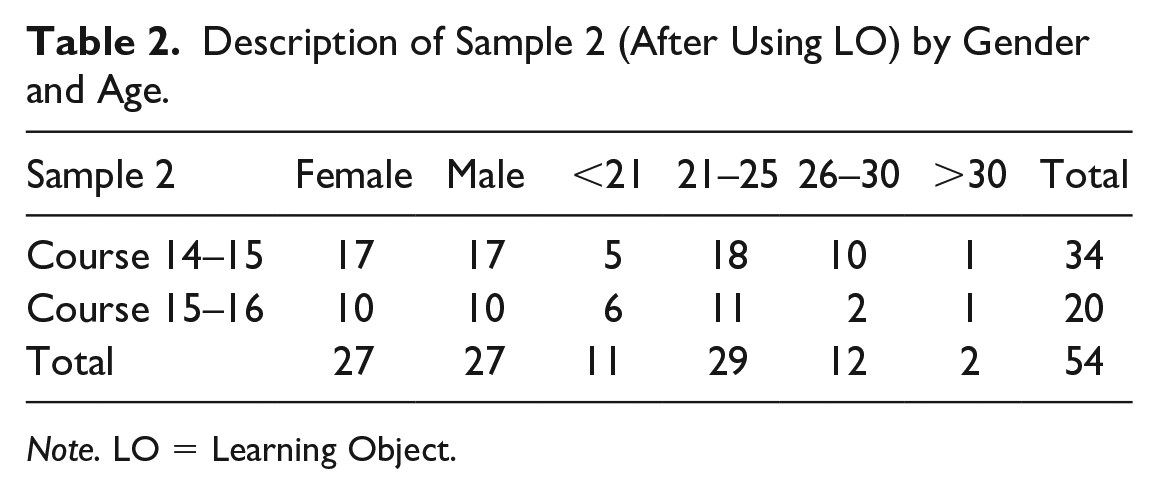
The study contained two sample groups: the first group contained 83 students and was established to test motivation prior to using LOs as teaching aids; the second group contained 54 students and was established to test motivation following the implementation of LOs as teaching aids. Tables 1 and 2 contain details of participant demographics for each sample group, respectively.
Description of Sample 1 (Before Using LO) by Gender and Age.

Note. LO = Learning Object.
Description of Sample 2 (After Using LO) by Gender and Age.
Note. LO = Learning Object.
Before starting the study, the sample sizes were checked to ensure adequate statistical analysis. Following considerations of García-García et al. (2013), calculations were performed to identify the number of participants required in order to estimate parameters with an accurate degree of certainty, and detect differences between the sample groups. To perform the study, the research team developed 10 LOs for subjects taught in Architectural Graphic Expression. A screenshot is provided for reference purposes in Figure 1, which shows an LO once inserted into the Virtual Classroom.

LO inserted into the Moodle platform as SCORM.
As Melian-Melian and Martin-Gutierrez (2018) describe, each LO has been designed based on a set of objectives that would be achieved through their use. Said objectives were clearly defined in order to arouse students’ curiosity and encourage motivation from the get go. When objectives are well defined from the outset, students can better appreciate the importance and utility of the content, as well as the abilities and skills they are supposed to acquire while using the LOs to study.
In the case of this study, step one of the design process involved carefully planning the LO structure, which can be broken down into the following phases: (a) producing an initial outline of the content that will be dealt with, (b) organizing content into sections and subsections to establish content hierarchy based on the importance of content, (c) placing these sections into chronological order, and (d) designing and scheduling appropriate activities—within the limitations of possibility for this type of resource. It is important to rememeber that said activities must be designed so that students fulfill the established objectives. Step 2 involved carefully selecting the content for each of the LOs. When covering a specific piece of knowledge, the teacher must ensure that all the necessary information is covered while also ensuring that there is no overlap with another LO. Simultaneously, the teacher must also analyze how best to include digital content (made possible thanks to the digital format) without losing sight of the instructional and pedagogical purpose behind the LO. And, finally, it is very important to check that the content can be easily reused, thereby ensuring the LO meets the defining characteristics described by Peñalosa and Landa (2008). Step 3 involved selecting images to illustrate content. In LOs created for other subjects, we would typically see photographs being used; however, as we are dealing with the subject Graphic Expression, architectural drawings are typically being used instead. Step 4 involved overall layout and LO structure. To help users become familiar with LOs and how to use them, attention needs to be paid to their layout and ensuring that they follow a similar design. As such, all LOs should have a home page that informs users about the course content. This will need to include a welcome message, a general overview of the course, a description of the objectives that will be covered during its use, and an outline of the content. Regarding content, it is important to remember that the LO should be designed in such a manner that students are initially presented with more general content and then progressively more specific content. Abundant illustrations must also be provided at all stages to assist in content assimilation.
Finally, each LO is designed so that it present users with activities that evaluate knowledge acquisition. Upon completing these evaluation activities they thereby complete the LO. These activities include: gap fill exercises, multiple-choice tests, True or False dichotomy tests, and SCORM questionnaires. Students can proceed at their own pace, or use the LO in the manner that best fits their own individual style of learning. In other words, users can repeat content as many times as they want or need. Real-time feedback allows students to establish when their answers are correct or incorrect for any given attempt. Given that the system provides them with instant feedback, they can identify whether they have assimilated content or not and, consequently, whether they are ready to continue on to the next LO. Thus, self-directed learning is being encouraged.
Once all these steps were completed, the LO were then built. In the case of this study, the research team used the eXe-learning app as an authoring tool to facilitate the process. Paraphrasing Melian-Melian and Martin-Gutierrez (2018), the next step involved administering the Motivation Section of the MSLQ questionnaire by Pintrich et al. (1991), that was previously selected to measure student motivation in the subject Graphic Expression. The questionnaire was administered to students in the academic courses 2014 to 2015 and 2015 to 2016 prior to using any of the Learning Objects designed for this study. This tool was used to identify their initial motivation prior to undertaking subjects taught as part of Graphic Expression. Once the questionnaire had been administered, participants could then start using the LOs. However, first the research team had to export the LOs from the design application eXe-Learning and import them into a Learning Management System, in this case Moodle. The LOs were exported in SCORM format, as it relies on a set of standards that are designed to assist with issues relating to accessibility, adaptability, durability, interoperability, and reusability. This greatly facilitated the task of importing the LOs into the virtual classroom of the subject “Architectural Graphic Expression Applied to Building Design” that is hosted on the University’s private LMS called “Campus Virtual ULL.” All students participating in this study have access to this LMS.
Once the aforementioned steps have been completed, each LO is then made visible to students in parallel with the theoretical class that covers the same content. The LO are revealed gradually, not all at once to prevent students from feeling overwhelmed by too much content and to create anticipation. This strategy serves to encourage more student participation in theoretical classes, which in turn leads to a deeper assimilation of the subject matter in question and a better understanding of content. These classes are supported by teaching methods (collaborative work in small groups) that allow academic staff to accurately assess the progress being made by each student and the quality of their learning. In addition, the teacher can feel confident in the knowledge that students feel reassured by the process. Students will be more relaxed as a result of knowing that materials are readily available for self-directed learning, that they can follow content at their own pace; that they can view content as and when necessary, in any order, and for as long as necessary; and finally, that the activities can be repeated as many times as necessary until the content is fully mastered. Given that the LOs provide instant feedback upon completing activities, students are well-placed to judge whether they are in fact ready to move on to new content, or not.
Upon completing the subject Graphic Expression, the students were once again asked to complete the Motivation Section of the Motivated Strategies for Learning Questionnaire by Pintrich et al. (1991) in order to identify how the LOs influenced student motivation when used as a teaching aid in this subject (p. 65)
Results
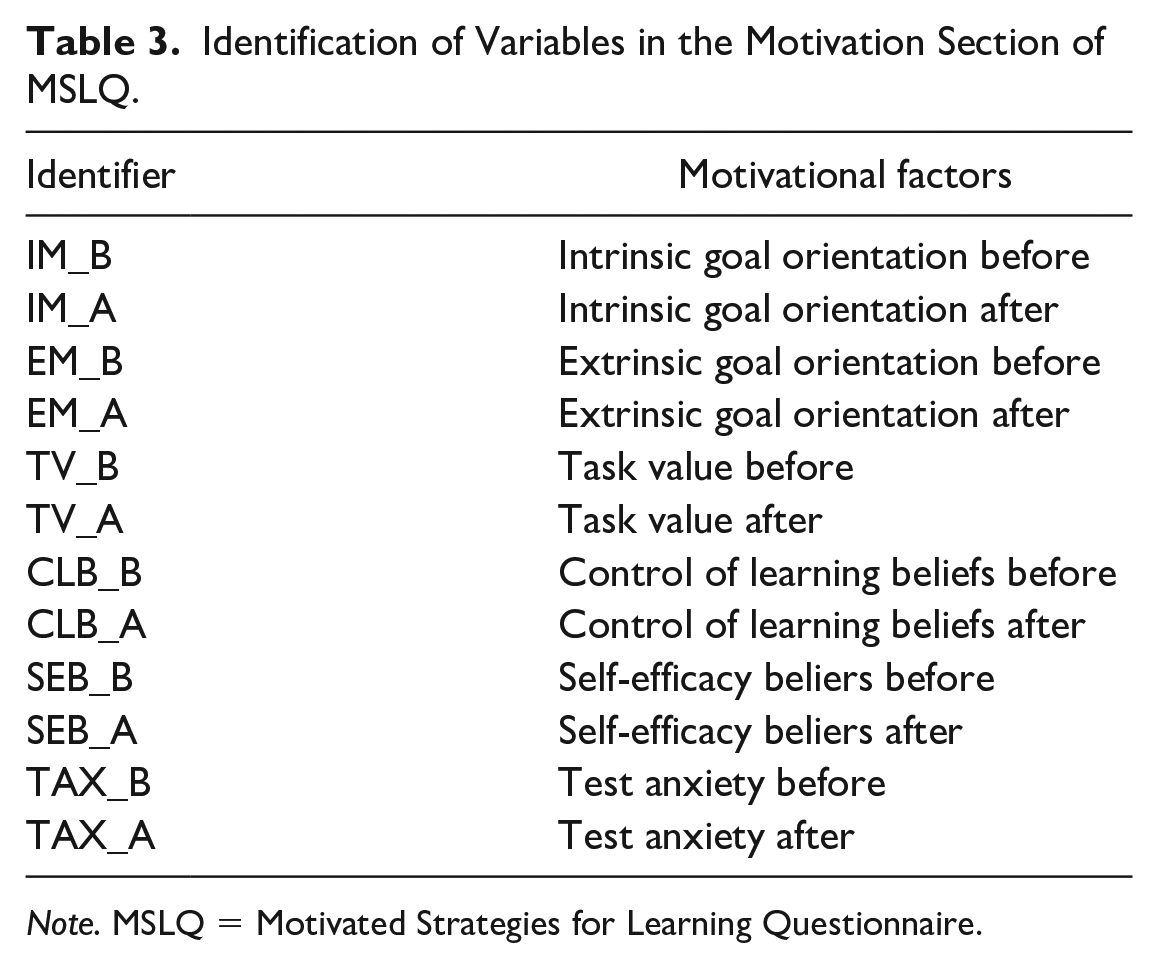
The research team assigned each variable an identifier, which was simply an abbreviation of the full name (see Table 3). The abbreviation before (B) and after (A) that are placed at the end each variable refer to the moment when data were gathered from participants: the former identifies data gathered prior to using LOs developed for this study, and the later refers to data gathered after testing the LOs.
Identification of Variables in the Motivation Section of MSLQ.
Note. MSLQ = Motivated Strategies for Learning Questionnaire.
In order to check if the sample size are representative of the population, a student T-test for independent samples was performed using the grades from a practical exercise carried out by all students (total population) prior to use the Learning Objects. The sample results were compared against the total population. The resulting p-value (>.05) indicates that the size of the sample is representative of the wider population.
Table 4 contains the average values (AVs)and standard deviations obtained from the 83 participants that correspond to each of the factors in the MSLQ that was used.
MSLQ Results. Motivation Section (Before Using LO).

Note. MSLQ = Motivated Strategies for Learning Questionnaire; LO = Learning Object.
The results seen in these descriptive statistics obtained from responses provided by participants in the MSLQs suggest that students were favorably disposed toward learning at the start of Term 1. The instrument use a Likert-type scale from 1 to 7 points.
In Figure 2, the motivation variables showing the highest averages are as follows: TV and CLB, followed by Self-Efficacy Beliefs then Intrinsic Goal Orientation. The variables with the lowest averages are as follows: Test Anxiety Before and Extrinsic Goal Orientation.

Graph of results from motivation section of MSLQ(before).
As shown in Melian-Melian and Martin-Gutierrez (2018), the descriptive statistics presented provide an analysis of student responses to the MSQL questionnaire. This tool was specifically designed to gauge how individuals perceive themselves by eliciting self-reporting. As this was a pilot study, these statistics only reflect the opinions of a restricted number of students. However, despite this, they do serve to draw our attention to elements that invite further reflection, specifically: student characteristics, which motivates them to carry out the tasks, as well as to analyze and rethink how to conduct the teaching activity. The aim of this study is to check if the use of the Learning Objects created affect participant motivation.
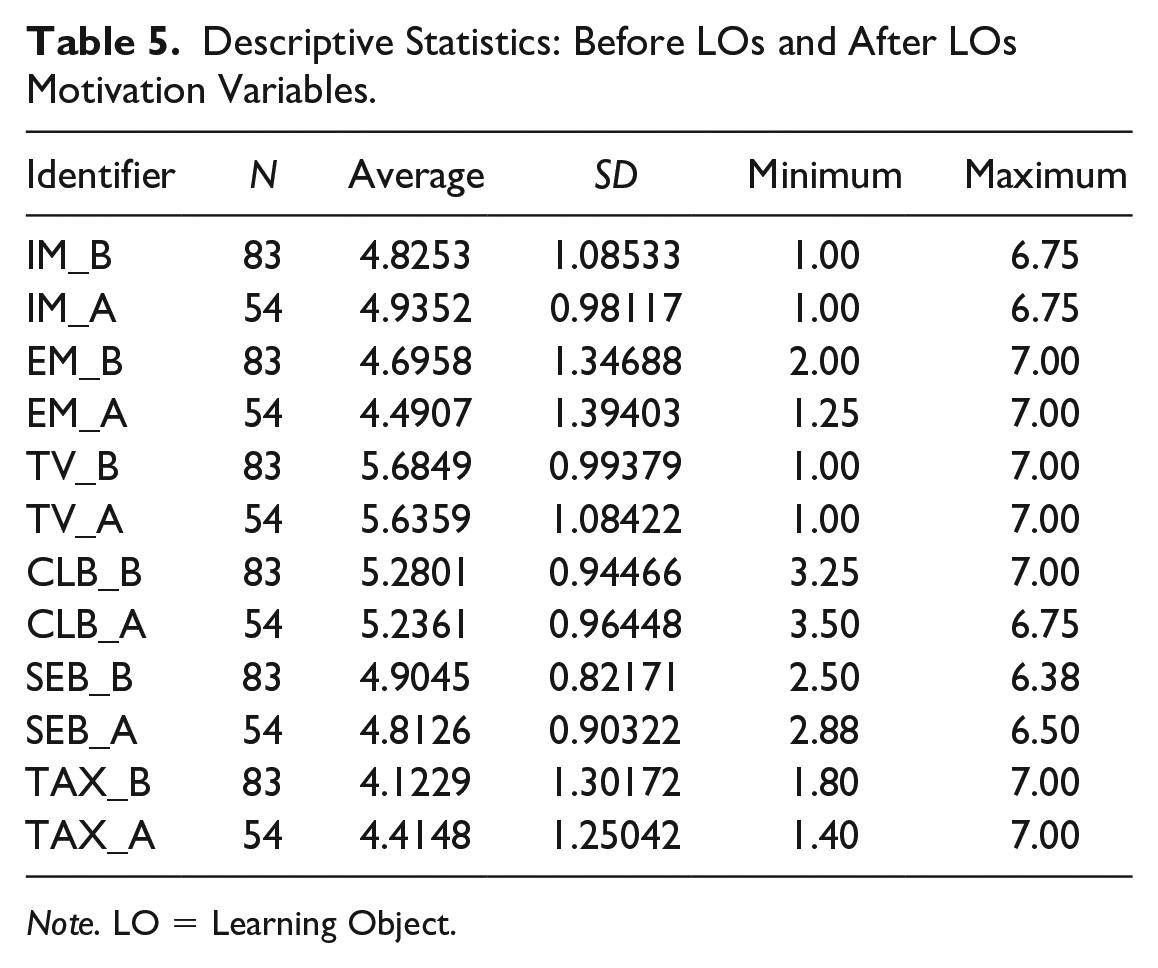
Table 5 shows the data gathered before and after using LOs for each variable. A Kolmogorov-Smirnov Test was applied in order to check that these values follow a normal distribution.
Descriptive Statistics: Before LOs and After LOs Motivation Variables.
Note. LO = Learning Object.
The values for both the before and after motivation variables are above p-value 0.05. As such, they all follow a normal distribution, and it is therefore possible to use the results of the study to perform calculations and statistical analysis (Tables 6 and 7).
Kolmogorov-Smirnov Test (One Sample) for Motivation Variables Before Starting the Subject.
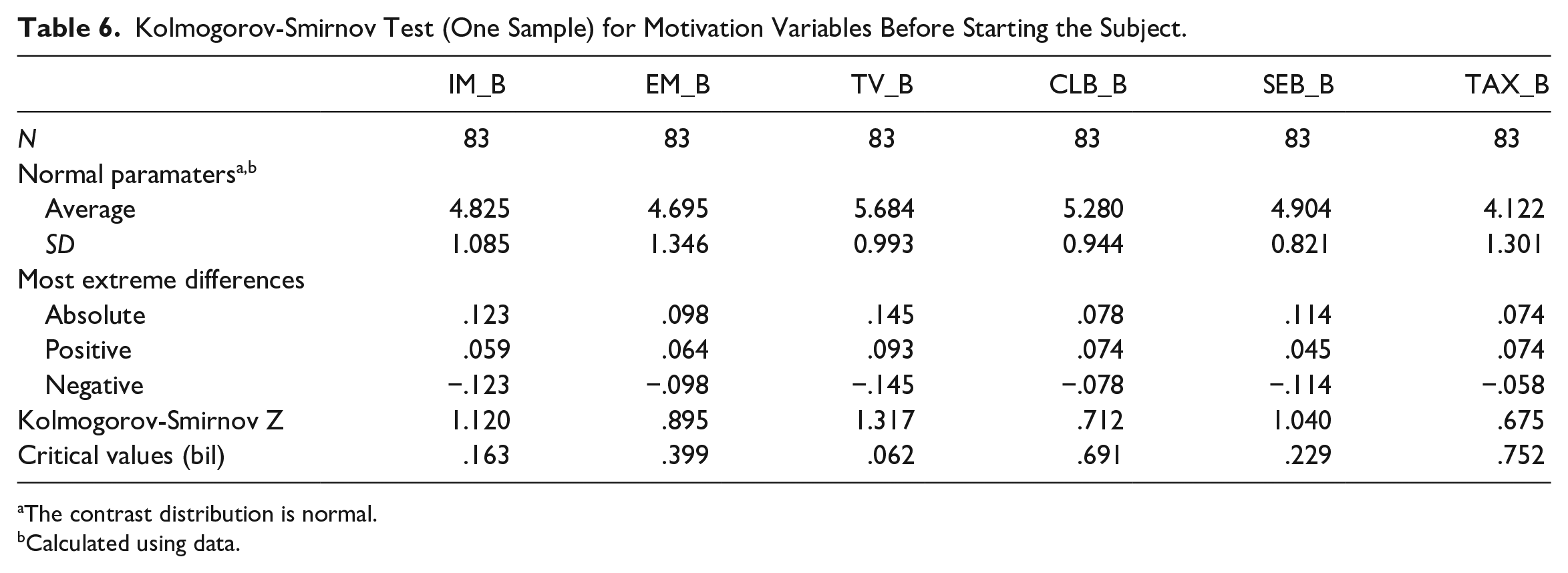
The contrast distribution is normal.
Calculated using data.
Kolmogorov-Smirnov Test (One Sample) for Motivation Variables After Completing the Subject.

The contrast distribution is normal.
Calculated using data.
With the aim of identifying whether there are differences in the group’s motivation upon completing a subject using an LO, a comparison is made between each of the before and after motivational variables (Figure 3).
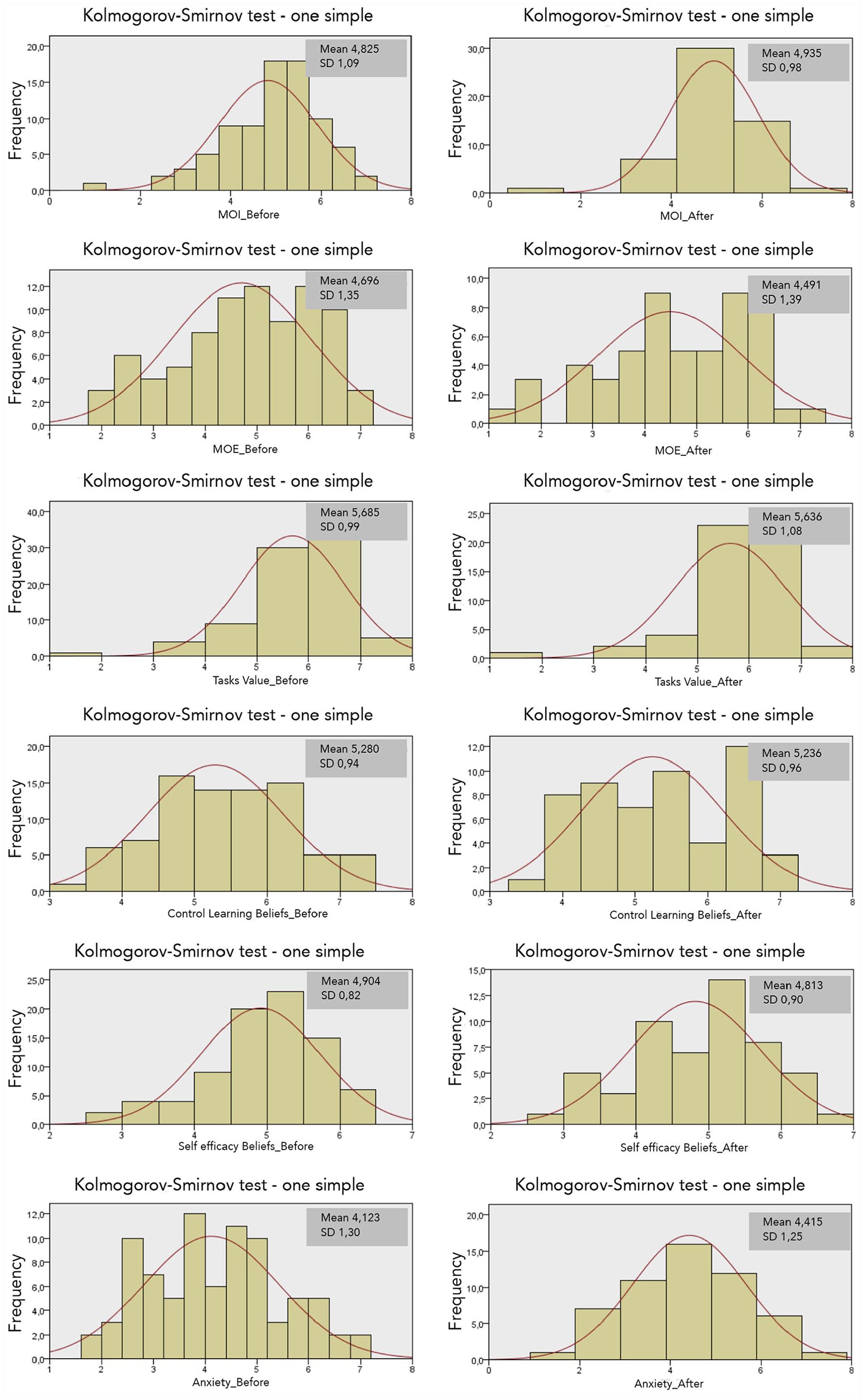
Frequency histograms with normal curves for motivation.
From the descriptive statistics data of Table 8, a statistical analysis was performed using T-Student test (from the available 52 paired data sets for students) as shown in Table 9. A Null Hypothesis (H0) is reached should the results of AVs for Motivation be the same both before and after the subject is completed. The student T-test compares the AVs calculated for the test in the before and after samples. The hypotheses serve to contrast the AVs and determine whether they are significantly different:
Statistics for Related Samples Before and After Using LOs Motivation Variables.
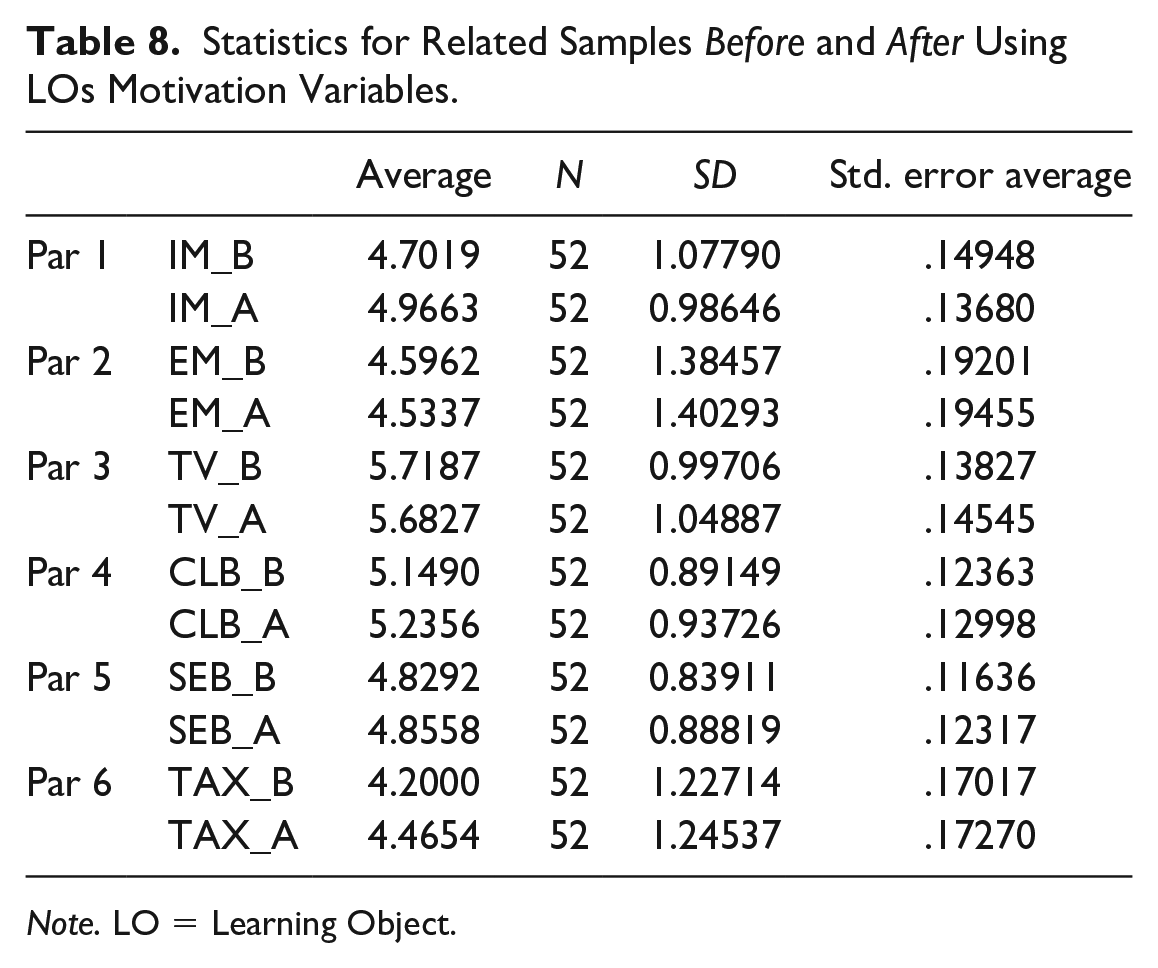
Note. LO = Learning Object.
Student T-Test on Related Samples. Before and After Motivation Variables.

An Alternative Hypothesis (H1) is accepted for Intrinsic Goal Orientation. From the results, significant difference is only found in IM-Intrinsic Motivation (Table 9). In assessing the use of these Learning Objects, the authors also analyze the relationship between the variable Gender and the before and after motivation variables. In doing so, it is possible to identify whether significant difference exists between men and women in motivation variables before and after the use of LO in the area of Graphic Expression. A review of the paired data mentioned previously is performed and students for which there is both before and after data are selected (52 individuals, see Table 10). Then the same calculations are run for before and after(Table 11).
Inter-Subjective Factors. Gender. Samples Before and After Using LO (Paired Data).

Note. LO = Learning Object.
ANOVA Inter-Subjectivity Effects Test Gender and Motivation Before and After Using LO (Paired Data).

Note. ANOVA = analysis of variance; LO = Learning Object.
The results reveal (Table 12) that there is in fact significant difference between the genders in the variables that correspond to extrinsic goal orientation and task value before using LOs, and that there is significant difference in the variables that correspond to intrinsic goal orientation and task value after using LO.
Inter-Subjectivity Effects Test. Gender and Motivation Before and After Using LO (Paired Data).

Note. LO = Learning Object.
Discussion
The following subsections have been drawn as a result of it being possible to identify motivation both prior to using learning objects and following the use of learning objects, based on feedback from students taking subjects in Architectural Graphic Expression:
Motivation Before Using LOs
As cited in Melian-Melian and Martin-Gutierrez (2018), it is possible to determine that prior to using the LOs developed as teaching aids “Architectural Graphic Expression” the study participants:
Demonstrated, for the most part, IM. This is despite the fact that not all their goals were intrinsically motivated. Intrinsic goals coexisted with extrinsic goals; that is to say, students state that they have a positive attitude and approach toward the study of Architectural Graphic Expression given that the material is of importance to them, both academically and professionally speaking. They want to master content and develop abilities in order to improve their level of expertise, and it is this that subsequently marks their perceptions (p. 67). However, students also acknowledge to a somewhat lesser extent that they are motivated by external recognition factors. These factors include obtaining good grades or winning awards.
Students placed significant importance on the tasks set in the learning process. They found the content, activities and materials in their subjects interesting, useful, and important (p. 67).
Highly rated control beliefs. They believe they have a high degree of control over their own learning: there are clear objectives, they use the necessary resources to achieve the objectives, potential difficulties and pitfalls are easily dealt with, and responsibility is assumed both for learning and for continued effort and commitment (pp. 67–68).
Rated self-efficacy highly. They believe themselves capable of understanding advanced concepts as well as performing tasks and exams satisfactorily. Thus, they consider themselves capable of demonstrating increasing expertise, which in turn translates into greater aspirations and dedication to the tasks used to guide them through the learning process.(p. 68).
Demonstrated significant differences based on gender for motivation variables corresponding to extrinsic goal orientation and task value; in other words, for these elements, the difference is statistically significant between males and females. As such, the conclusion drawn by the authors is that male and female students’ perceptions differ with regard to whether their studies are motivated by external recognition factors. These factors include such things as gaining good grades or winning awards. The activity of completing the task is merely a means to an end; the reward itself is the final goal. The activity of completing the task is only performed as a means to an end and the reward itself becomes the final goal. Likewise, the authors also conclude that male and female students’ perceptions differ with regard to how interesting, useful, and important they find the proposed content, activities, and materials for learning purposes.
The Influence of LO Use on Motivation
The study that was performed allowed the research team to determine that significant improvement in the intrinsic goal orientation occurred in students following the use of the Learning Objects developed as teaching aids for the subject “Architectural Graphic Design,” as outlined by Melian-Melian and Martin-Gutierrez (2018):
The conclusion drawn is that LO use in Graphic Expression improves IM, and allows students to successfully perform and master the tasks that lead to deep learning and the use of more complex strategies. In turn, these will also contribute to the development and refinement of the existing skill-sets, thereby encouraging interest in self-study without the need for any form of external incentive or reward. The aforementioned is fundamental in order to achieve deep learning, which implies the correct understanding, retention and transfer of knowledge (p. 68).
Following the use of LO in Architectural Graphic Expression significant differences based on gender for motivation variables corresponding to intrinsic goal orientation and task value; in other words, for these elements the difference is statistically significant between males and females. What this implies is that both males and females hold different opinions regarding the goals that cause them to engage in learning activities that are based on how interesting an activity or learning is perceived to be, and how satisfying it is to develop an understanding of the content or to improve their expertise. On the other hand, the feedback provided reveals that males and females rate differently the value placed on how interesting, useful, and important the proposed tasks or activities are for learning purposes.
All that which has been discussed throughout this section has proven positive and can be directly attributed to the introduction and use of the LOs proposed in this study, which were designed and build as teaching aids within Architectural Graphic Expression; this is a fact that can be appreciated by comparing the results obtained following LO use against data obtained from students prior any pedagogic intervention.
Conclusion
This work presents a study exploring the influence of learning objects designed as learning aids for Architectural Graphic Expression on the components of motivation as described by Pintrich et al. (1991) and evaluated using the MSLQ questionnaire. The motivation study was performed both before and after learning objects were used. The pilot study has revealed that LOs can be used in an educational project to increase the motivation to learn. As technology evolves toward a total integration of educational processes, it opens up the possibility of offering novel approaches to motivating learners in their learning environments. In accordance with the six components of motivation as described by Pintrich et al. (1991), students demonstrate an increase in IM when using learning objects without the need for external incentive or rewards. They also show greater interest in self-guided study. This is important given that under the EHEA framework autonomous learning and self-guided study need to be fostered. On a cautionary note, although the study has produced good results, it is important to note that the authors’ initial aim was to merely build a pilot study that would reveal a suitable approach for a larger scale experiment. Thus, one of the great limitations of this study relates to scarcity of numbers, given the scarce number of students undertaking Architectural Graphic Expression courses offered as part of university degrees.
Results and conclusions have to be taken with caution. As authors’ indicate, this is a pilot study that would reveal a suitable approach for a larger scale experiment. In particular, one great limitation relates to the scarce number of students undertaking Architectural Graphic Expression courses offered as part of university degrees. Nevertheless, the results of this study have delivered positive findings. This should serve as an invitation to further exploit the use of these types of pedagogical methodologies and initiatives, as they could serve as an effective tool for comfortably handling the new teaching styles that are currently being imposed across Europe (Melian-Melian & Martin-Gutierrez, 2018). On a final note, this study has proven to be an incredibly positive experience and would be highly recommended for the setting of higher education.
The contribution toward innovation made by this study lays in the analysis of how LOs impact student motivation in the area of Graphic Expression, and thereby ensure deep learning. The authors detail the design and implementation of LOs as teaching aids in this subject area and demonstrate how this type of tool provides students with a more appropriate way to familiarize themselves with content and obtain and develop competencies within this subject area. It is hoped that the results herein will serve as inspiration to the academic community and encourage it to continue building on the findings, thereby strengthening the bridge between teaching and research. In terms of future research, it is possible to take this study and extend the experience to include all Engineering students. In doing so, it would be possible to analyze the variances arising from larger sample sizes and more heterogeneous groups.
Footnotes
Acknowledgements
We would like to thank the University of La Laguna’s Vice-Rectorate of Teaching for its teacher-training program and its innovative projects development initiative.
Declaration of Conflicting Interests
The author(s) declared no potential conflicts of interest with respect to the research, authorship, and/or publication of this article.
Funding
The author(s) received no financial support for the research, authorship, and/or publication of this article.
