




Abstract
This study explores the extent to which public and elite sources are used in economic news. A content analysis of the economic coverage of three major South Korean national newspapers published between 1994 and 2014 found that elite sources were more prominent in South Korean economic news. More important, although public sources increased slightly in the economic news over three time periods (1994, 2004, and 2014) within a period of 20 years, they were still less common than elite sources in daily life–oriented economic news. This study suggests that the lack of coverage that cites public sources may not reflect the interests and perspectives of the general public (the nonelites).
The voices that are presented in the news media are crucial channels of information for the public. Depending on the range of voices to whom the media attribute news coverage, the public may or may not have access to a wide range of balanced viewpoints or be limited to perspectives voiced by institutional spokespeople or members of the dominant elite (Lewis et al., 2008; Tiffen et al., 2014). Therefore, especially in a democratic society, providing a variety of perspectives or voices in political news stories has been regarded as a crucial role of the news media.
A wide range of balanced viewpoints is important not only in political news but also in economic news, given that information about economic circumstances and business or financial circles is represented by selected elite sources who usually have expertise in economics (Kim & Kim, 2014). That is, economic news provides the public with information about current economic conditions in addition to future trends (Goidel et al., 2010; Haller & Norpoth, 1997; Hester & Gibson, 2003; van Dalen et al., 2017), and this news plays a critical role in driving individuals’ economic decisions with respect to matters of consumption and savings (Lee et al., 2007; Merrill, 2016; Raaij, 1989; Starr, 2010). In other words, how broadly or narrowly the news incorporate different perspectives can determine how well informed individuals are in their roles as consumers, workers, and investors.
Research on source selection has found that news coverage of economic business and finance overwhelmingly favors elite or institutional sources in general to the exclusion of public sources, including, for example, ordinary citizens and leaders of civic organizations (Davis, 2000, 2005; Doyle, 2006; Knowles et al., 2017; Strauß, 2019; Thompson, 2013). In fact, this practice of source usage in economic journalism may result in a “self-referential” information system that relies heavily on small and privileged elite sources (Strauß, 2019). If that type of unbalanced use of sources occurs, journalists cannot play the role of a watchdog and provide balanced perspectives (Usher, 2013).
Therefore, source selection in economic news is worthy of examination. However, so far, much research on source selection has been devoted to political coverage (e.g., Hopmann & Shehata, 2011; Son & Weaver, 2006; Turcotte, 2017; Wallsten, 2015) with less attention to the types of sources used in economic news (e.g., Davis, 2000, 2005; Doyle, 2006; Knowles et al., 2017; Strauß, 2019; Thompson, 2013). Most of the research on source selection in economic news has thus far mainly discussed Western cases. As a result, there is little knowledge on the way in which source selection represented in economic news operates in Eastern countries that have experienced dynamic economic changes, such as South Korea.
Advancing that line of research and supplementing an empirical evidence concerning source selection in economic news, this study explores the use of public and elite sources in economic news articles published between 1994 and 2014 in the three leading South Korean newspapers: Chosun Ilbo, JoongAng Ilbo, and Dong-A Ilbo. The South Korean case provides a unique research context in response to the national news environment in which South Korea is ranked in the bottom 11 countries with respect to both the mean number of sources per story and the frequency of the story with conflict between sources (Tiffen et al., 2014). In addition, a few empirical studies have found that South Korean newspapers increasingly cover more business news that highlights the interests of individual corporations that are under pressure from financial crises of the past 20 years (Lee & Baek, 2016). The three periods during the 20-year period were chosen because they represent dynamic economic changes that took place in South Korea, including the Asian foreign exchange crisis of 1997 and the recession in domestic demand in 2004. Within this time frame, the use of sources presented in the three newspapers before and after the national financial crisis was examined, along with how the use of sources differed in 2014 when compared with a decade earlier.
In short, the purpose of this study is to examine whether and to what extent sources used in economic news published in South Korean newspapers represent a various spectrum of voices when informing the public about real-world economic conditions.
Literature Review
Public Sources Versus Elite Sources
The role and implications of news sources have long been documented (Sundar, 1998; Tuchman, 1978) in terms of examining to what extent the press present various perspectives toward issues of interest. Source selection is considered an indicator of how effectively the news media serve the democratic function of engaging various viewpoints in public debates (Tiffen et al., 2014). Earlier, Sigal (1986) emphasized that information or opinions attributed to dominant sources in news coverage amplifies the dominant voices of society while muting others.
The foremost criterion for evaluating the quality of source selection is the extent to which the press presents a cross section of the social spectrum, ranging from political and social elites, such as government and business spokespeople, to nonelites, such as ordinary citizens (Brown et al., 1987; Hopmann & Shehata, 2011; Reich, 2015; Schudson, 2011). In a sense, a broad spectrum of sources not only enhances public trust toward the media but also leads to formation of public opinion by introducing diverse ideas about different issues (Son & Weaver, 2006).
Previous empirical studies have reported that journalists prefer elite or institutional sources because they are more reliable and authoritative than voices of ordinary citizens and other public sources (Gans, 1979; Hopmann & Shehata, 2011). Furthermore, interviews with South Korean journalists found that they are more likely to use elite sources, particularly government and corporates, to interpret certain issues and to provide background knowledge (Lee & Pae, 2016). This finding occurred because South Korean news media has covered economic issues by merely reflecting information from news beat and press releases by the government and corporates. This type of coverage has significant problems in terms of journalistic routines in South Korea (Hahn & Lee, 2003; Lee & Pae, 2016; Park & Park, 2015). Similar results were found among Danish (Albaek, 2011), American (Gil de Zúñiga & Hinsley, 2013), and Israel journalists (Reich, 2015). The voices of ordinary people are often excluded from news coverage because journalists disparage the contribution of ordinary people as a public source (Reich, 2015). Even today, the voices of ordinary citizens rarely serve as primary sources in news coverage even though the climate of public opinion as assessed by journalists may be more accurate when alternative bottom-up viewpoints from public sources are added to the opinion spectra (Lewis et al., 2008).
In contrast to common journalism practices, scholars emphasize that public sources should be more frequently employed in news articles, and indicate that ordinary citizens as public sources play a strong role not only in influencing public opinion but also in recalling information. Daschmann (2000) found that the public tends to pay more attention to information provided by individuals rather than institutions.
Regarding journalists’ practices with respect to public sources, another problem that has arisen is that representation by news articles’ public sources represents passive actors rather than active players who are closely embedded in issues of interest (Hermans et al., 2014; Lewis et al., 2004). For example, based on a content analysis of television news in the United States and the United Kingdom, Lewis and his colleagues (2004) demonstrated that the public was generally represented as passive in the media of both countries. Specifically, individuals’ voices were limited to responses to questions posed by the media about their personal experiences or impressions concerning specific issues, rather than on engagement with citizens that would have allowed them to suggest what should be done with regard to the government or corporate world. In both the United States and United Kingdom, public voices were less likely to be actively represented in national broadcasts about economic news with regard to consumption and shopping (Hermans et al., 2014). Together, these results suggest that the public has been consistently and globally constructed as passive in public debates.
As journalists fail to view citizens’ voices as informative or authoritative, the voices of nonelites are still muted and not appreciated in current news media. Journalists are less likely than the public to think that giving voice to ordinary people is a criterion for good journalism (Gil de Zúñiga & Hinsley, 2013). News media fail to include various sources to force news discourse to have a balanced view of real-world economic conditions and various interpretations to promote democratic discussion; thus, the news is dominated by elite voices (Knowles et al., 2017). In particular, use of the voice of civic society, including such as ordinary citizens, civic organizations, and as informative sources, is low in economic news (Lee & Pae, 2016; Park & Park, 2015) even when compared with other coverage, such as education and culture (Hopmann & Shehata, 2011).
Considering how closely economic news is related to the public’s financial expectations and behaviors, it is important to investigate whether and to what extent elite and nonelite, public, sources are actually used in economic news. South Korea has experienced dynamic economic situations since the economic crisis of 1997. Newspaper readership has dramatically declined, resulting in financial pressure on newspaper organizations that has forced the organizations to rely exclusively on corporate advertisements (Korea Press Foundation, 2014). The reliance of revenue on corporate advertisements to overcome financial difficulties has influenced news content as the number of economic news articles addressing corporates includes the management of corporations and their products and services (Choi et al., 2011; Lee & Baek, 2016; Pae, 2010, 2012; Tumber, 1993). Furthermore, between 1994 and 2014, economic news increasingly used corporate-affiliated or corporate-related sources (Lee & Baek, 2016).
Based on the previous economic conditions and findings from previous research, this study examined sources used in South Korea’s economic news during three time periods (1994, 2004, and 2014) within a period of 20 years to determine the extent to which South Korean economic news has relied on elite and public sources in response to real-world economic conditions. In line with the findings of previous studies (e.g., Davis, 2000, 2005; Doyle, 2006; Knowles et al., 2017; Strauß, 2019; Thompson, 2013) and purpose of this study, the following hypothesis is suggested:
Economic News and Use of Public Versus Elite Sources
Previous studies on source selection that focuses on economic news coverage have suggested that economic news is generally dominated by elite or institutional sources and that other nonelite or public voices are relatively muted (Davis, 2000, 2005; Doyle, 2006; Knowles et al., 2017; Strauß, 2019; Thompson, 2013). These results strongly suggest that by relying on a narrow range of sources, news media may inadvertently present as reality that is framed by elites.
Economic news is the generated knowledge provided by news sources (Knorr Cetina & Bruegger, 2002). Economic news is closely tied to the public’s daily lives given that it informs individuals about their day-to-day attitudes and microeconomic behaviors (Adoni & Cohen, 1978). Especially because economic news is significantly related to the public’s everyday economic behavior, such as consumption and savings, individuals actively seek information about changes in economic conditions by reading about or watching economic news that influences their expectations about current or future economic conditions (e.g., inflation and employment) that in turn, determine their economic behavior (Raaij, 1989; Starr, 2010). Thus, it is worth examining the implications of economic news as a separate category of media coverage by looking at the types of selected sources.
How individuals feel about current and future economic conditions is determined to a large measure by the public’s exposure to economic news about inflation and unemployment (Behr & Iyengar, 1985; Goidel et al., 2010; Haller & Norpoth, 1997; Hester & Gibson, 2003).
Compared with other news topics, economic news, in particular, often exerts a greater impact on the public because most individuals have little knowledge and understanding of economic concepts; thus, elite sources often play a decisive role by informing the public about real-world conditions in addition to forecasts for the future (Adoni & Cohen, 1978; Nadeau et al., 2000). As found in the case of Denmark, public sources, specifically, ordinary citizens, in public service broadcasts between 1994 and 2007 appeared less often in economic than in coverage of education and cultural issues (Hopmann & Shehata, 2011).
Journalists are less likely than the public to think that giving voice to ordinary people is a criterion of good journalism (Gil de Zúñiga & Hinsley, 2013). Financial journalists tend to depend on elite financial sources that provide expert knowledge about the economic and financial sectors (Davis, 2000; Doyle, 2006; Knowles et al., 2017). Based on interviews of financial experts and a survey of financial journalists in the United States, Strauß (2019) found that financial journalism strengthens the “self-referential” financial information system because it relies heavily on small and privileged Wall Street business elites, such as financial analysts and institutional investors. This leaves little room for independent sources, such as noninstitutional academics or research. Therefore, financial journalism often fails to play the role of a watchdog that provides a variety of informed sources to uncover fraud, misbehavior, and irregularities (Usher, 2013) when the market is uncertain and volatile. Instead, it reinforces the market consensus suggested by elite financial sources (Thompson, 2013). As an example, Knowles and his colleagues (2017) did a content analysis of economic news published in the U.S., U.K, and Australian newspapers and found that elite sources, such as public relations spokespeople and analysts, dominated the three nations’ coverage over nonelite sources, such as ordinary citizens and nongovernment organizations. Moreover, elite sources took a role in shaping the news agenda in being mentioned at the beginning of a story, whereas ordinary citizens played a passive role as merely reacting to an issue by being mentioned later in the story. As economic news has relied more on corporate elites, it has become dominated by corporate agendas and has ignored noncorporate interests and other concerns (Davis, 2000).
According to previous studies, the choice of source often differs depending on whether issues are tied to people’s livelihood (Hansen, 1991; Hopmann & Shehata, 2011). It has been found that the general public pays more attention to economic news that is oriented toward daily life rather than non–daily life economic news, which consists of macroeconomic issues, such as exports/imports and the federal budget. This selection of news related to daily life provides the public with information that is closely related to their microeconomic behaviors in their livelihood, such as price indices and interest rates (Lee & Pae, 2016; Yang, 2004). In an analysis of news coverage of South Korea’s quantitative easing policy in 2013, Park and Park (2015) found that news coverage relied heavily on analysts of stock firms, corporate-affiliated research institutes, government officials, and mainstream economists. In contrast, public sources, such as ordinary citizens and civic organizations, were not found in economic news coverage. The quantitative easing policy is closely related to the general public’s daily lives because the policy influences interest rates, which can place a considerable burden on household debt (Park & Park, 2015). Although the general public is not only a consumer of economic news but also a market participant (Lee & Pae, 2016), the voices of the public have been excluded in economic news, particularly, topics closely related to public’s economic life (Lee & Baek, 2016; Park & Park, 2015).
News about the unemployment rate and inflation level tends to rely mostly on elite sources because economic statistics are usually provided by governmental bodies and economic research institutes (Harrington, 1989). Furthermore, the range of sources differs according to the topics (Knowles et al., 2017; Strauß, 2019). Building on those findings, the current study examines the South Korean case to determine whether and to what extent public and elite sources were used in specific types of economic news. The focus of this inquiry is to assess the extent to which economic news coverage was more or less closely related to individuals’ everyday lives. Therefore, this study raises the following research questions:
Method
Based on a quantitative content analysis, the current study examined economic news in South Korea from 1994 to 2014 by examining public and elite sources used in economic news as published by three leading newspapers with high circulation figures—Chosun Ilbo (1,458,614), Dong-A Ilbo (959,260), and JoongAng Ilbo (970,968; Korea Audit Bureau of Certification, 2018). Newspaper coverage was chosen based on findings from previous research in which print news compared with other media platforms is a more important information channel of the public (Goidel et al., 2010). The three specific years examined (1994, 2004, and 2014) include the periods before and after South Korea’s economic crisis when financial pressure on newspaper companies became more severe after the 1997 foreign exchange crisis (Korea Press Foundation, 2014; J. Lee, 2013). Ten-year intervals were selected based on previous studies that examined economic news coverage and focused on the sequential changes of the time intervals (Baden & Springer, 2014; Choi et al., 2011; Kjaer & Langer, 2005; Wallsten, 2015). For sampling, 4 months (February, May, August, and November) for each year were chosen with one randomly selected week (from Monday through Friday) for each month. National economic news in South Korean newspapers is typically published on the first three pages; therefore, only news on those pages was examined. Economic news published from these three newspapers was collected from each newspaper’s website based on a methodological rationale applied in prior research in which a content analysis of South Korean newspaper’s coverage of economic issues was done (Ban et al., 2010; Hahn & Lee, 2003; Lee & Park, 2016; Lee & Shim, 2017). Articles that did not include a journalist’s byline, columns, and editorials were excluded from analysis. From the sampling process, a total of 2,331 articles on economic issues were included in the analysis (see Table 1). As shown in Table 1, a greater amount of economic news coverage in 2004 than in 1994 (before and after the 1997 financial crisis) was observed, whereas there was less economic news coverage in 2014 than in 2004, which reflects the aftermaths of the 2004 recession in domestic demand.
Data Analyzed in the Study.

Measurements
Types of news sources
The unit of analysis was an entire article on economic issues. Each article was examined to determine whether public or elite sources were included. Elite sources were operationalized as mainstream or institutional sources with public sources as ordinary sources that represent the public interests or alternative viewpoints in the economic news domain. Elite sources included government, corporate, economic organizations, economic research institutes, and institutional intellectuals (e.g., professors; M = 1.12, SD = 0.65). Public sources included ordinary citizens, civic organizations, and labor unions (M = 0.06, SD = 0.25). Multiple coding was allowed if more than one source was presented. If the source was mentioned throughout an article, it was coded as “1” or if the source was not present, it was coded as “0.” On average, all types of public sources were found to be less frequently presented than elite sources (see Table 2).
Mean Score of Sources Per Article Dealing With Economic Issues.

Note. Other sources such as foreign reports (M = 0.04, SD = 0.20) and real estate agents (M = 0.04, SD = 0.19) that do not belong to either public or elite sources were not included in the analysis.
Types of economic news
Articles were divided into two categories: daily life–oriented and non–daily life–oriented economic news. Drawing upon the type of economic news identified in Yang’s (2004) study, daily life–oriented economic news was operationalized as news that provides the public with information closely related to people’s microeconomic behavior in their livelihood, such as price indices and interest rates. The extent to which South Korean newspapers covered daily life–oriented economic news was then analyzed in terms of the number of public and elite sources that were represented. Each article was identified by topic and then divided into daily life–oriented or non–daily life–oriented economic news. The dominant topic of each article was coded based on a total of 12 topics identified as daily life–oriented economic news (n = 1,023, 43.8%) followed by a categorization of three subtopics. As a result, five topics of daily life–oriented economic news (consumption trend, inflation, employment, taxes, and construction/transportation policy) were categorized into “daily life-related policy” news (n = 437, 18.7%) with five more topics (stock exchange trading, property prices, interest rates, investment information/gold price, and real prices) combined into daily life–oriented “savings and investment” news (n = 283, 12.1%). Finally, two other topics (products of individual corporations or industry and consumption of the products) were combined into daily life–oriented “consumption and products” news (n = 303, 13.0%).
Similarly, a total of 12 topics were categorized into non–daily life–oriented economic news (n = 1,308, 56.2%) and then recategorized into the two subtopics of non–daily life–oriented economic news articles: Six topics (exports/imports, financial currency, government policy affecting national growth, federal budget, interviews with economic officials, and the financial supervisory system) were categorized into “non-daily life-related policy” news (n = 591, 25.4%). Six other topics (industry trends, strike, general management, human resources/labor and management, group-wide activity, and interviews with chairmen or members of the group owners) of non–daily life–oriented economic news were combined under the “industry or corporate” news (n = 717, 30.8%). The categorization of types of economic news are presented in Table 3.
The Categorization of the Types of Economic News.

Multiple coding was allowed if more than one topic was presented. If the topic was mentioned throughout an article, it was coded as “1” or if the topic was not present, it was coded as “0.”
News articles were then coded and analyzed by two trained coders including the authors, with an intercoder reliability test of a subsample of 240 articles (10%). The intercoder reliability test used Krippendorf’s alpha, which generated satisfactory scores across all the study variables: .81 for the types of economic news and .90 for the types of sources.
Results
This study examined the extent to which public and elite sources were used in economic news published by three South Korean newspapers in three time periods (1994, 2004, and 2014) within a period of 20 years. An analysis of variance (ANOVA) was conducted to estimate whether there were significant differences in the use of public and elite sources in overall economic news between the years of 1994, 2004, and 2014. As shown in Table 4, the use of both public (F(2, 2,328) = 20.75, p < .001) and elite (F(2, 2,328) = 30.31, p < .001) sources increased from 1994 to 2014. Post hoc comparisons using the Scheffe’s test proved that, on average, the number of public sources cited per article in 2014 (M = 0.10, SD = 0.31) was slightly higher than in 2004 (M = 0.06, SD = 0.25) and 1994 (M = 0.01, SD = 0.11). That same pattern was found in the use of elite sources, the differences between the years of 2014 (M = 1.26, SD = 0.75) and 1994 (M = 1.00, SD = 0.45) were even greater than the differences in the use of public sources between the same years. Although it is important to note that the number of public sources used per article included in the samples was smaller (n = 3) than the number of elite sources (n = 5), the higher overall mean scores and rates of increase in the use of elite sources across the 3 years indicate that elite sources became more likely than public sources to be present in South Korean economic news articles. Therefore, H1 was confirmed.
Changes of Mean Score of Public and Elite Sources Per Article Dealing With Economic Issues Between 1994 and 2014 (N = 2,331).

Note. Overall economic news is entire sample. Using Scheffe’s posttest, we found the significant mean difference between a, b, and c at the .05 level.
p < .001.
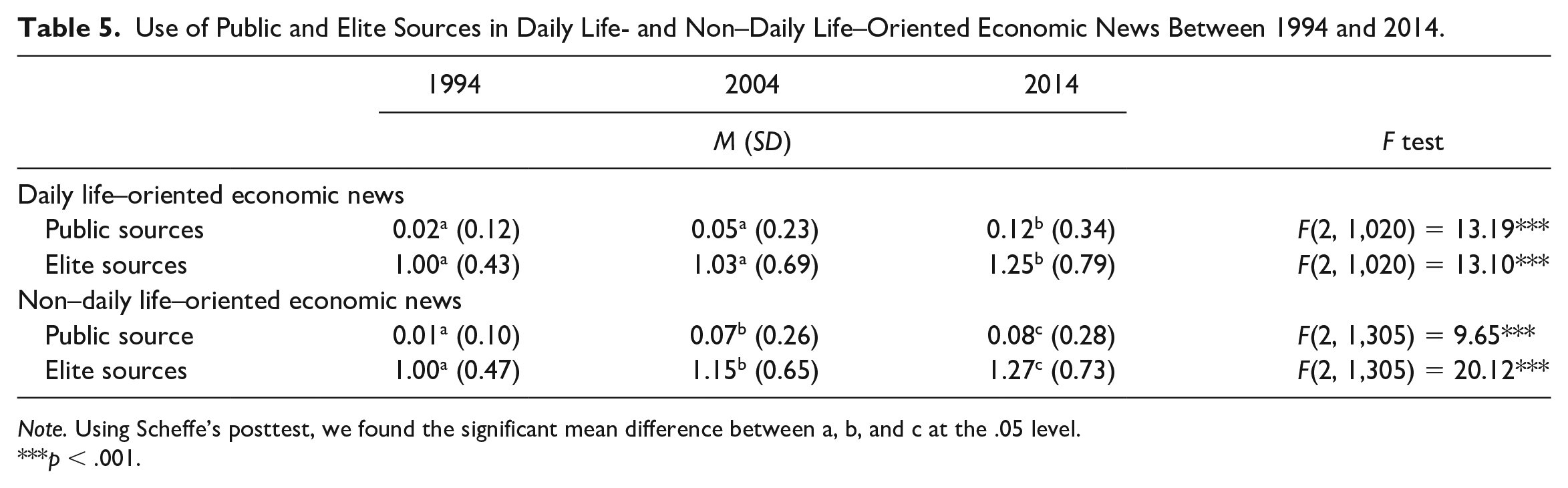
Other critical elements in the use of news sources in economic news include what information is presented and whose point of view is over- or underrepresented in daily life–oriented economic news, the issue raised in RQ1. As shown in Table 5, although the use of public sources increased slightly from 1994 (M = 0.02, SD = 0.12) to 2014 (M = 0.12, SD = 0.34), the differences in higher mean scores of the use of elite sources selected between 1994 (M = 1.00, SD = 0.43) and 2014 (M = 1.25, SD = 0.79) were greater. Overall mean scores of elite sources used in daily life–oriented economic news were higher than public sources across the 3 years studied. That is, only a small number of ordinary citizens’ voices, compared with elite voices, were present in daily life–oriented economic news. These results imply that institutions, such as government agencies and corporations, expressed their elite opinions on economic issues that were closely related to public life. Furthermore, it can be assumed that information presented in those articles may have elevated elite viewpoints in the economic domain in ways that hindered the public from engaging in public debate.
Use of Public and Elite Sources in Daily Life- and Non–Daily Life–Oriented Economic News Between 1994 and 2014.
Note. Using Scheffe’s posttest, we found the significant mean difference between a, b, and c at the .05 level.
p < .001.
Similarly, although the findings from RQ1a indicate that although public sources in non–daily life–oriented economic news slightly increased from 1994 (M = 0.01, SD = 0.10) to 2014 (M = 0.08, SD = 0.28), the rates of increase in usage of the elite sources were greater than that of public sources between 1994 (M = 1.00, SD = 0.47) and 2014 (M = 1.27, SD = 0.73).
The tendency of greater discrepancy between the use of public and elite sources becomes particularly noticeable when examining particular subtopics of daily life–oriented economic news (RQ2). To better understand results related to RQ2, a further analysis was conducted to determine whether there were significant differences in the use of public and elite sources depending on the subtopics of daily life–oriented economic news. An ANOVA was run for each subtopic of daily life–oriented economic news revealing significant differences as shown in Table 6. Public sources were slightly more frequently used in daily life–oriented economic news covering daily life–related policy issues (F(2, 434) = 4.88, p < .01), savings and investments (F(2, 280) = 4.51, p < .05), and consumption and products (F(2, 300) = 3.09, p < .05). Likewise, the use of elite sources in issues related to daily life–oriented economic news of policy issues (F(2, 434) = 10.75, p < .001) and consumption and products (F(2, 300) = 3.85, p < .05) was significantly different for the 3 years studied. However, that was not the case regarding issues on savings and investments (F(2, 280) = 2.82, p > .05). Specifically, in 2014, public sources were more often present in daily life–oriented economic news covering policy issues (M = 0.11, SD = 0.36) than a decade earlier in 1994 (M = 0.01, SD = 0.09). However, the difference in the use of elite sources was even greater between the same years (M = 1.39, SD = 0.84, in 2014; M = 1.03, SD = 0.43, in 1994). Taken together, these results indicate the possibility that public voices provided by the media to readers—especially in the daily life–oriented economic issues on policy, such as employment and taxes, more or less increased within a period of 20 years, but those voices remained muted in South Korean economic news compared with the more frequent presence of elite sources.
Uses of Public and Elite Sources in Subtopics of Daily Life–Oriented Economic News Between 1994 and 2014.

Note. N = 1,023 (daily life–related policy: 437, savings/investments: 283, consumption/products: 303). Using Scheffe’s posttest, we found the significant mean difference between a and b at the .05 level.
p < .05. **p < .01. ***p < .001.
The same tendency of rate increase in the use of elite sources was higher than that of public sources across the 3 years studied and became especially evident when a post hoc test was run to determine the use of public and elite sources in non–daily life–oriented economic news (RQ2a). As shown in Table 7, the use of elite sources per article of non–daily life–related policy increased more sharply from 1994 (M = 0.99, SD = 0.43) to 2014 (M = 1.36, SD = 0.77), whereas the mean differences in the use of public sources were smaller: 1994 (M = 0.01, SD = 0.09) and 2014 (M = 0.09, SD = 0.34). The same results were found in the non–daily life–oriented economic news covering industry and corporate issues. These results suggest that the use of public and elite sources increased slightly but significantly for two topics of economic news covering non–daily life–oriented issues; however, overall, elite sources were still more visible in South Korean economic news during the three time periods within a period of 20 years.
Uses of Public and Elite Sources in Subtopics of Non–Daily Life–Oriented Economic News Between 1994 and 2014.

Note. N = 1,308 (non–daily life–related policy: 591, industry or corporate: 717). Using Scheffe’s posttest, we found the significant mean difference between a and b at the .05 level.
p < .05. **p < .01. ***p < .001.
Discussion
The press faces more requests from the public to express their opinions in ways that promote greater engagement in policy debates. Because economic news is closely connected to individuals’ everyday lives, ordinary people can contribute their experiences and ideas to the production of that news (Lee & Pae, 2016; Park & Park, 2015). Furthermore, news articles about the economy help individuals learn about current and future economic conditions (Merrill, 2016; Raaij, 1989; Starr, 2010). Hence, news about business and finance is one of the topics that members of the public actively seek from the media (Tewksbury, 2003). Despite the public’s attention to the economic sector, journalists have not satisfied the public’s need to know due to an overwhelming reliance on elite sources (Harrington, 1989; Hopmann & Shehata, 2011). Based on that perspective, the current study examined the extent to which the public and elite sources were presented in economic news published in three South Korean newspapers—Chosun Ilbo, JoongAng Ilbo, and Dong-A Ilbo—from 1994 to 2014. Findings identified different types of sources that were used more frequently during dynamic changes in the national economy, including the 1997 financial crisis and the 2004 recession in domestic demand, and how the use of sources differed in 2014 compared with the previous decade.
Overall, this study found that South Korean newspaper coverage of economic issues did not make use of a wide range of sources during the 1994 to 2014 time frame due to an overreliance on elite sources versus public sources (H1). Although the use of both public and elite sources in economic news rose slightly, the amount and rates of increase were prominent mostly in the use of elite sources. These findings parallel those of previous studies, suggesting that news stories today use more sources than in the past (Pedersen & Holst, 2000; cited in Albaek, 2011). Furthermore, the results of the current study are in line with the thesis (Hopmann & Shehata, 2011; Reich, 2015) in which the average number of elite sources in South Korean economic news increased between 1994 and 2014, although the rate of public source use also grew but at a much slower rate. Therefore, the voices of the public continue to lag in today’s news, and elite sources still supply most of the economic issues published by South Korean newspapers. The heavy reliance on elite sources by the South Korean economic news may occur because the news media are more likely to turn to elite voices, especially during financial crises (Baden & Springer, 2014). In those situations, South Korean newspapers may contact government officials to obtain information about government policies or use information provided by economic research institutions for interpretation of privileged knowledge or turn to corporations to understand the business climate for production of consumer goods.
In addition, the current study examined whether and the extent to which the use of public and elite sources changed between 1994 and 2014 in terms of specific types of economic news, such as daily life–oriented economic news, that is more closely tied to the public’s everyday lives (RQ1). In response to RQ1, the current study found that public sources were less likely to be used in overall daily life–oriented economic news about policy issues (e.g., inflation rates, taxes), savings, and investments (e.g., stock exchange trading, real prices), and consumption and products. Meanwhile, overall reliance on elite versus public sources increased more rapidly between 1994 and 2014. Although the overall frequency and rates of increase in the use of elite sources were more prominent in both daily life–oriented and non–daily life–oriented economic news, public sources were limited to daily life–oriented economic news. By comparison, elite sources were more frequently cited in non–daily life–oriented economic news (RQ1a). These findings suggest that economic news that was more closely tied to the public’s daily lives attempted to satisfy the public’s interests and needs by relying on use of public sources that were not sufficient to destabilize the dominant elite discourse.
Another area examined by the current study was whether and to what extent public and elite sources were used in subtopics of daily life–oriented economic news (RQ2). This study found that in coverage of savings and investments, public sources were more frequently and increasingly cited compared with daily life–related policy issues and corporate products and the public’s consumption of those products. This finding may have occurred because news coverage of savings and investments, which was related to issues such as property prices, interest rates, and real price, may have been of greater interest to individuals based on their personal experience or economic circumstances. Meanwhile, elite sources were not only more prominent but sharply increased in coverage of daily life–related policy. This result suggests that elites are considered more reliable or authoritative informational sources when covering daily life–related policy news, such as consumption trends and construction and transportation policies. These findings are consistent with previous studies, in that, the degree of source that was selected differed depending on particular issues (Dimitrova & Strömbäck, 2009). More specifically, elite sources were more prominent than public sources in economic news, such as news addressing the unemployment and inflation rates (Harrington, 1989).
Finally, this study demonstrated there were no clear differences in the use of public and elite sources between the subtopics of daily life–oriented and non–daily life–oriented economic news (RQ2a), suggesting that the amount and the rate of increase in the use of the public sources were lower in non–daily life–oriented economic news than for elite sources. Inconsistent with previous studies (Hopmann & Shehata, 2011), the current study suggests that public sources in South Korean news tended to be invisible in financial news, especially in policy news articles that are not concerned with daily life–related issues. Although the use of public sources rose slightly but significantly in non–daily life–oriented policy issues, including financial issues, the mean differences were smaller compared with those in the use of public sources between 1994 and 2014 in daily life–oriented economic news, including policy issues other than financial issues. In other words, it is clear that public sources were rarely used between 1994 and 2014 not only in the overall economic news but more important, regarding issues that were more closely related to the public’s everyday lives.
This study contributes to the relevant literature by focusing on South Korea. Empirical evidence confirms that the dominance of elite sources in South Korean economic news aggravated the consensus of financial elites (Davis, 2000, 2005) in not only Western societies but also in Asian contexts. However, several limitations should be addressed. First, it is not clear that higher reliance on elite sources meant a narrower range of information because this study did not examine how public and elite sources were used in economic news. For example, the question of whether and to what extent public sources presented alternative viewpoints to elite information was not addressed by this study. As Brown and his colleagues (1987) noted, it is possible that even though different types of sources, including a variety of public and elite sources, are used in news coverage, their opinions may not differ significantly. Similarly, even though the frequency of public sources was found to be lower in the current study, limited source use may nevertheless represent diverse opinions. Thus, future research should examine whether the range of opinions that present conflicting or at least alternative opinions differs according to not only the types of sources but also with respect to the topics of economic news. Second, both public and elite sources used per article were coded only once (present or not present) even if the different types of public or elite sources were cited in an article. Although the overall mean scores of the public and elite sources per article indicated an unbalanced use of sources, an analysis of the total number of sources used may better demonstrate the magnitude of lack of diversity in South Korean economic news. Finally, this study focused on only three leading newspapers and did not include other types or business newspapers or television broadcasting. The three leading newspapers were selected for this study because of their roles as important informants and agenda setters in South Korea (Lee & Baek, 2016, 2018; Lee et al., 2007; Pae, 2012). However, such a limited focus cannot present the overall picture of South Korean economic news; thus, future studies may include other types of news media.
While acknowledging these limitations, this study adds to the still sparse amount of literature by showing that economic news demonstrates a greater reliance on elite sources compared with public sources. Although most previous studies on source selection have focused on political coverage, the findings of the present study also contribute to a better understanding of the implications of news sources in the economic news domain. In practice, the findings of this study may also contribute to the broader task of improvement of news media practice in illuminating the interaction between sources and journalists for the benefit of well-informed citizens.
Footnotes
Declaration of Conflicting Interests
The author(s) declared no potential conflicts of interest with respect to the research, authorship, and/or publication of this article.
Funding
The author(s) received no financial support for the research, authorship, and/or publication of this article.
