




Abstract
This study was carried out to determine the relationships between supervision and teachers’ performance and attitude in secondary schools in Kuala Lumpur, Malaysia. This is a quantitative study where the 5-point Likert-type-scale questionnaire was used to analyze data using descriptive and inferential statistics. Simple random sampling was used to select the respondents. This study entailed respondents from various schools in one of the districts in Kuala Lumpur which comprises 200 teachers and 50 supervisors. Descriptive statistics were used to describe the status of supervision practices, teachers’ attitude toward supervision, and teachers’ level of performance after supervision. Multiple regression analysis was used to test the relationships between supervision (supervisory practices–directive, collaborative, and nondirective approach) and teachers’ performance and attitude. The current status of supervisory practices, teachers’ attitude toward supervision, and teachers’ performance after supervision is found at moderate level in secondary schools in Malaysia. As a whole, supervisory practices are not correlated with teachers’ performance and attitude. But worthy to mention, directive supervision is positively and significantly related to teachers’ performance and attitude. This study result will benefit the policy makers, school supervisors and headmasters to choose the right kind of supervisory practices which can contribute to better teaching performance.
Keywords
Introduction
Education today is defined as the most important asset to an individual which is known as a device to assist human beings on how to think, how to work, and how to make decisions. Looking into the importance of education today, the government is taking education system in Malaysia into a very crucial matter. This could be seen with the implementation of the Malaysian National Education Blueprint (2013–2025) to prepare every student to be globally competitive. One of the efforts taken to achieve this is to transform teaching into profession of choice as quality teaching is the most significant school-based process (Goldhaber, 2006). The government is in the effort of providing the best teacher training from the day they begin their teacher training programs till retirement (Malaysian National Education Blueprint, 2013–2025). Thus, it is crucial for teachers to develop themselves professionally to face the reforms and fulfill the students’ needs.
In the effort of improving teaching, supervision can be one of the strategies to enable teachers to achieve the goal. According to Glanz et al. (2007), teachers are one of the key inputs to education delivery; thus, the quality of education partially depends on the way they are trained and supervised. This is because supervision is genuinely concerned with the growth and development of students. Besides, many researchers claim that supervision has the capability to improve classroom practices and lead to student success by improving teachers’ professional growth and their work performance (Baffour-Awuah, 2011; Kholid & Rohmatika, 2019). In these days, supervision does not aim to inspect or evaluate the teachers’ performance but it moves its direction into a technical process which is aiming for the continual teachers’ development (Ahmad et al., 2013). Glickman (1990) also found that the view of supervision has changed from inspection to school-based collaborative process that aims in improving instruction. It is a form of guidance for teachers to enhance their teaching skills through various methods such as classroom visits, educational workshops, seminars, and training courses which help to meet teachers’ needs. Supervision provides equal importance to students, and teachers by having constant interaction between the supervisor and the teacher to improve teaching and learning processes (Al-Saud, 2007).
Teachers’ continuous learning assists them to be more efficient and effective. This can be achieved through supervision which is considered as a part of professional development (Hoque, Alam, & Abdullah, 2010). Although few studies mentioned above indicated that supervision improves teaching performance, other studies reported teachers’ mixed reaction toward supervision (James & Massiah, 2019; Khun-inkeeree et al., 2019). Though studies indicate that supervision helps teachers to develop their teaching skills, it is still arguable whether teachers can improve their teaching performance in classroom. Thus, this study attempts to address the impact of supervision on teachers’ performance and attitude.
Background
There are various models of educational supervision such as clinical, peer coaching, and developmental supervision. Clinical supervision is a therapeutic process which aims to improve professional competency among clients. The pioneer of this model Goldhammer (1969), and Cogan (1973) defined supervision as an ongoing process where the most experienced therapist will guide his or her less experienced supervisee. A study on effectiveness of clinical supervision in Turkey reported that it enhances learning and teaching processes in schooling but takes long time to evaluate a teacher (Kayıkçı1 et al., 2017). James and Massiah (2019) also found clinical supervision as time-consuming, teachers’ lack of training and competence, and distrust. Peer coaching supervision involves two or more professional colleagues who collaborate together to reflect their classroom practices and solve the problem that occurs by guiding each another and sharing ideas that facilitate in developing new skills (Robbins, 1991). A study in Kuwait context reported that though peer coaching fosters changes in professional growth and influences classroom teaching practices, team cooperation, self-confidence, supervisors are concerned related to correspondence between peer coaching strategy and ministry formal evaluation regulations (Alsaleh et al., 2017). Scheduling of class observation has been found as the main challenge of peer coaching in Malaysia (Yee, 2016).
Developmental supervision aims to support teachers to become autonomous in their educational practice. However, this is not applicable for all teachers as their developmental level; personal and professional skills may vary. The approach should be adapted based on the teacher’s needs (Brunelle et al., 1988). In another study, Brunelle et al. (1988) categorize teachers into four types: First, teachers who are dependent on their supervisor and want to be directed what they should do to solve the problem; second, teachers who prefer to collaborate with their supervisor in overcoming the problem; third, teachers who take their supervisors as theoretical resources to solve the problem; finally, teachers who prefer to enhance their teaching on their own through their experiences. This shows that individual teacher’s needs are different. These differences occur as teachers’ experiences vary which entails different levels of professional development needed in directing them (Glickman et al., 2001). In developmental supervision, the supervisor uses directive assistance when the teachers have low developmental level, expertise, and commitment. Supervisor is responsible in solving problems faced by the teachers. Teachers who are at moderate level of development, expertise, and commitment are complemented with collaborative assistance. In collaborative approach, teachers and supervisors work as a team in solving problems. Nondirective approach is suitable for teachers who are functioning at high level of developmental level and commitment to teaching. Teachers who can find solutions to the problems that they face in their teaching will experience this type of assistance. Hence, the supervisory goals should increase teachers’ abilities which lead them to develop their thoughts in higher level (Glickman, 1990). Developmental supervision encourages teachers to reflect their teaching for self-improvement (Glickman, 1981, 1990). Similarly, Glickman et al. (2001) claimed that this model known as developmental model utilizes collaborative, nondirective, and directive approaches that depend on individual teacher’s developmental levels. Glickman et al. (2001) also defined developmental model as “the match of initial supervisory approach with the teacher or group’s developmental levels, expertise, and commitment” (p. 190). Strieker et al. (2016) in their studies reported the evidences of equal engagement in directive, the collaborative, and the nondirective approach which were inherently more collegial.
In general, it is true in many contexts where teachers around the world have the perceptions that classroom observations can cause stress, discomfort, and nervousness (Aubusson et al., 2007; Borich, 2008). Besides, even though the main purpose of classroom observation is to develop teachers’ professional growth, in real it is more on evaluating than developing (Shah & Al Harthi, 2014). It is considered incompetent and threatening as it is more to subjective, judgmental, and imprecise (Mercer, 2006). Besides, school supervision is still underdeveloped in Malaysia. Principals as supervisors tend to ignore their role as educational supervisors (Nek et al., 2000). Besides, school management teams do not pay much attention toward supervision (Suseela, 2007). Lack of attention can cause severe impact to the entire practice of supervision as it can influence the teachers, students, and the school as well. The comparative study by Izham et al. (2013) found that teachers were not really satisfied with the supervision practices carried out in secondary schools in Kuala Lumpur. As they are not satisfied, it can affect their work performance too. Sharma et al. (2011) also found that the process of supervision is not carried out efficiently in three Asian countries including Malaysia. It is proven through teachers’ responses where they claimed that supervisors are more intent to find their faults than help them improve their performances. Moreover, they felt they are being insulted as they do not agree with the way supervision is conducted. In his study, Mohd Zaki (2001) found that principals ignore their task to supervise the teachers and if they do so their approach is more on hierarchical, bureaucratic, and autocratic. Even though the role of supervision has moved from evaluating teachers’ ability to providing support and encouragement for improvement, it is still superficial that teacher can improve their performance through supervision.
Teachers in school may have different perceptions on their supervisor’s technique used to improve their instructional supervision. This is due to the teachers’ developmental level, expertise, and commitment. This can influence their attitude toward supervision that they experience which ultimately influences their performance. Supervisors are there to develop the intention of supervision by applying different approaches and strategies on different teachers. This is because teachers as adult learners may vary in terms of their backgrounds, experiences gained, abilities, and level of concern for others (Beach & Reinhartz, 2000; Wiles & Bondi, 1996; Glickman et al., 1998). A recent study in Malaysia shows mixed result in which knowledge and technical skills of teachers are found related to positive attitude to supervision, while interpersonal skills were the barriers (Khun-inkeeree et al., 2019). Thus, it is important to link supervision to evaluation into a seamless process to be more effective (Hvidston et al., 2019).
On the contrary, Nadeem et al. (2011) found that a number of factors affect teachers’ performance and one of them is working relation to staff and head teacher. In another study, Smith (1996) also pointed that support from other staff at all levels can influence teachers’ performance. Besides, teachers’ attitudes and perceptions toward supervision bring great impact on teachers’ learning and job development (Fraser, 1980). Studies show that supervision activities cannot be separated from teaching achievement and profession (Aldaihani, 2017; Ayandoja et al., 2017). As teachers fail to understand that supervision facilitates professional growth and improving students’ learning, the notion of supervision can be detrimental. This reveals that teachers’ attitude toward supervision is an important aspect that needs to be concerned. A proper supervisory approach is fundamental to change their perception which can influence their attitudes.
Therefore, this study is carried out to reveal if developmental supervision can enhance teachers’ classroom performance. Therefore, the study conceptualized assuming the relationships between the independent variables of development supervision (directive, collaborative, and nondirective) and dependent variables teachers’ awareness, attitude, and performance (Figure 1).
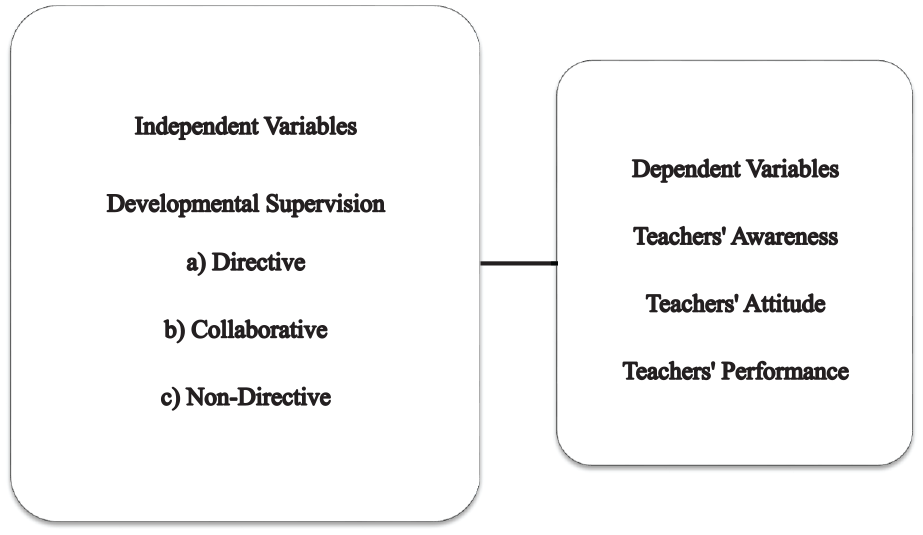
Conceptual framework of the study.
Thus, this study addresses the following research questions:
Research Design
This was a survey conducted to understand the current status of the supervisory practices in secondary schools in Malaysia. The purpose of using survey was to collect data from a large sample of teachers and supervisors so that the findings could be generalized to similar other conditions.
Population and Sample
There are 97 secondary schools in the city of Kuala Lumpur located under three districts, namely, Pudu Bangsar, Keramat, and Sentul. The target population for this study was supervisors and teachers from secondary schools from Pudu district. This district was chosen for this study as it consists of the most number of secondary schools (51 schools). As this district had the highest number of schools, the sample selection for this study was simple random sampling. Simple random sampling is used when the entire data set is not compulsory and it is known to be expensive in terms of time response or resource usage (Frank & Doron, 1986). To avoid the difficulties or issues that occur if specific schools are selected, the respondents were selected by simple random sampling based on teachers’ list from district office. Accordingly, school address of selected teachers was collected and then the researchers reached there to collect face-to-face data. As the total population was unknown, the following formula was used to determine the right sample size: n = Z2 × pq/e2 where n = sample size, Z is the value on Z table at 95% confidence level 1.96, e = sample error at 5% (0.05), p = maximum variability at the population at 50%, that is, (0.5):

In this study, the sample size was 400, which was more than 384. Thus, it can be said that the selected sample represents the entire population. The sample referred to 300 teachers and 100 supervisors including male and female.
Instruments
Two set of questionnaires were used as instruments to collect data. Each set of questionnaire was divided into subsections. The first set of questionnaire was aimed at gathering data to comprehend how supervisors carry out developmental approach to supervise teachers. It was divided into four sections as the first section focused on the demography information of the school where the study was conducted, the second section consisted of respondent’s profile information, the third section focused on supervisors’ awareness of supervisory tasks, and items in the fourth section focused on developmental approach consisting subtopics with directive approach, collaborative approach, and nondirective approach. Section 1 consisted of four items to collect information regarding school background, Section 2 consisted of eight items to gather information regarding the respondents, Section 3 consisted of 13 items, while Section 4 was divided into three subtopics containing five items each.
The second set of questionnaire was designed for teachers to gather information on how supervision influences teachers’ performance in schools. It was divided into five sections. In the first section, three items were developed on school background information; second section contained eight items about respondents’ profile information; the third section on teachers’ awareness on supervision included 14 items; fourth section was about teachers’ attitude toward supervision with 17 items; and the last section of the questionnaire was on teachers’ performance with 12 items. The respondents were asked to read each statement carefully in the questionnaire and indicate one response that best described their feelings. 5-point Likert-type scales: strongly disagree (SD), disagree (D), not sure (N), agree (A), and strongly agree (SA) were used against each statement of the questionnaire.
Validity and Reliability of the Instruments
It is crucial to consider the reliability and validity of a study. Reliability is defined as the degree to which an assessment tool provides stable and consistent results (Phelan & Wren, 2005), whereas validity refers to tool measures what it sets out to measure (Twycross & Shields, 2005). The validity and reliability of the instruments were tested in due process. To measure the validity and reliability of the developed questionnaire, a pilot test was carried out which involved 30 respondents. They were selected randomly from the secondary schools in Kuala Lumpur to answer. These 30 respondents were excluded from the main study. The pilot study was conducted by distributing the questionnaire for supervisors to randomly selected vice principals and senior teachers who had experience in supervising teachers. Random sampling was used to ensure every element in the population having an equal chance of being selected as a subject (Cavana et al., 2001).
They were asked to answer the questions and give some comments by looking at their understanding of the needs of the questions. Cronbach’s alpha measurement was tested to check the reliability of the questionnaire in the pilot study. Cronbach’s alpha value for the instrument designed for teachers was .854 with the number of items tested being 42. A few changes were made to the questionnaire for giving more understandable meaning of the questions to the respondents such as the instruction in the questionnaire was restructured to ensure the respondents’ understandability. Next, some teachers found difficulties to understand the term “supervision”; thus, the meaning was added in the questionnaire so that they could have a better understanding. Five supervisors were selected who had sufficient experience in supervising teachers to answer the questions which consists of 28 items. All the supervisors were able to answer the questionnaire without facing any difficulties.
Data Collection Procedure
A few procedures were followed to collect the data from respondents for this study. In total, 300 sets of questionnaire were distributed to teachers and 100 sets of questionnaire were distributed to supervisors. As the first step, permission was granted from supervisor together with the permission letter from faculty. The approved sets of questionnaire were given to the Ministry of Education to get approval to conduct this study in schools. Then, approval was obtained from school administrators to distribute the survey questionnaire to the teachers and supervisors. Once the approval was granted, teachers and supervisors were selected based on simple random sampling method. Respondents were personally handed in the questionnaire and given sufficient time to answer the questions. They were given a week to answer and the answered questionnaires were collected immediately. Challenges still occurred in collecting questionnaires as supervisors were occupied with their administrative tasks and teachers were busy in preparing their teaching materials, marking students’ books, exam papers, and other co-curricular activities in schools. Both the supervisors and teachers had difficulties in completing the questionnaire. Due to this, the estimated amount of questionnaires could not be obtained from the respondents. For teachers, instead of getting 300 respondents, only 200 respondents returned the questionnaire. This was the same for supervisors as this study designed for 100 supervisors and at the end only 50 questionnaires were returned.
Data Analysis
In the effort of answering the developed research questions, the collected data were analyzed using SPSS (Version 20) for Windows software program and descriptive and inferential statistics were used to reveal the result. The central tendency and the dispersion of the data were checked; the reliability of the measures were tested using Cronbach’s alpha. To analyze the collected data, descriptive analysis was used to find the current practices and multiple regression analysis was used to establish the relationships between dependent and independent variables. The multiple regression analysis was used in the study as one of the methods to describe the relationship between one dependent variable and multiple independent variables (Jomnonkwao et al., 2020; Tahtali, 2019). For descriptive analysis, mean value in between 1 and 2.99 is considered low, 3 and 3.99 is moderate, and 4 and 5 is high.
Findings
Respondents’ Experience
Experience is one of the important items included to support this study. Most of the teachers who are involved in this study were having sufficient experience in teaching. Table 1 shows that, 60 (30.0%) teachers were having more than 10 years’ experience, whereas 39 (19.5%) teachers were considered as novice teachers with the lowest percentage of 19.5%. Meanwhile, 59 (29.5%) of the respondents were having 4 to 6 years’ experience and 42 (21.0%) were having 7 to 9 years’ experience in teaching.
Teachers’ Experience.

Supervisors were also asked regarding their experience and 19 (38%) out of 50 were having experience from the range of 7 to 9 years as this range is the highest frequency shown in the table. Besides, 13 respondents were having more than 10 years experience which carries 24% from the total number of respondents, whereas six of them were still new to this post as they were having the least experience as a supervisor as shown in the table.
Supervisory Practices
According to Table 2, for Item 1, the mean value is 4.02 and this shows that most of the supervisors in schools have the high level of awareness of their task. For Item 2, the mean is 2.90 and this shows that they have much less supervisory training, and thus, it could be said that supervisors need to be sent for courses so they can acquire the skills to observe teachers. The mean value 3.78 for Item 3 shows that they are busy at their administrative work at moderate level. It can be described that most of the supervisors are occupied with their admin work more than supervisory in schools. The mean value for Item 4 is 3.22 and this indicates that a moderate level of discussion is held by supervisors with their teachers. The mean range of Items 5, 6, 8, 9, 10, 11, and 13 is between 3.22 and 3.88 which refers to moderate level of supervisory practices in terms of checking teachers’ scheme of work, lesson plan, helping teachers in times of need, informing teachers on the purpose of supervision, having discussion on the mistake, and giving post supervision feedback. The mean value for Item 7 shows the low level of informal supervision. It means most supervisors inform the teachers before they are supervised. The standard deviation range (0.02–0.58) indicates very less variation of respondents’ reply. Overall, most of the supervisory practices are at moderate level which should be improved. Another vital issue is that supervisors’ themselves have very low tendency of attending training before supervision.
Mean Value of Supervisory Practices.

Directive Supervision Practices
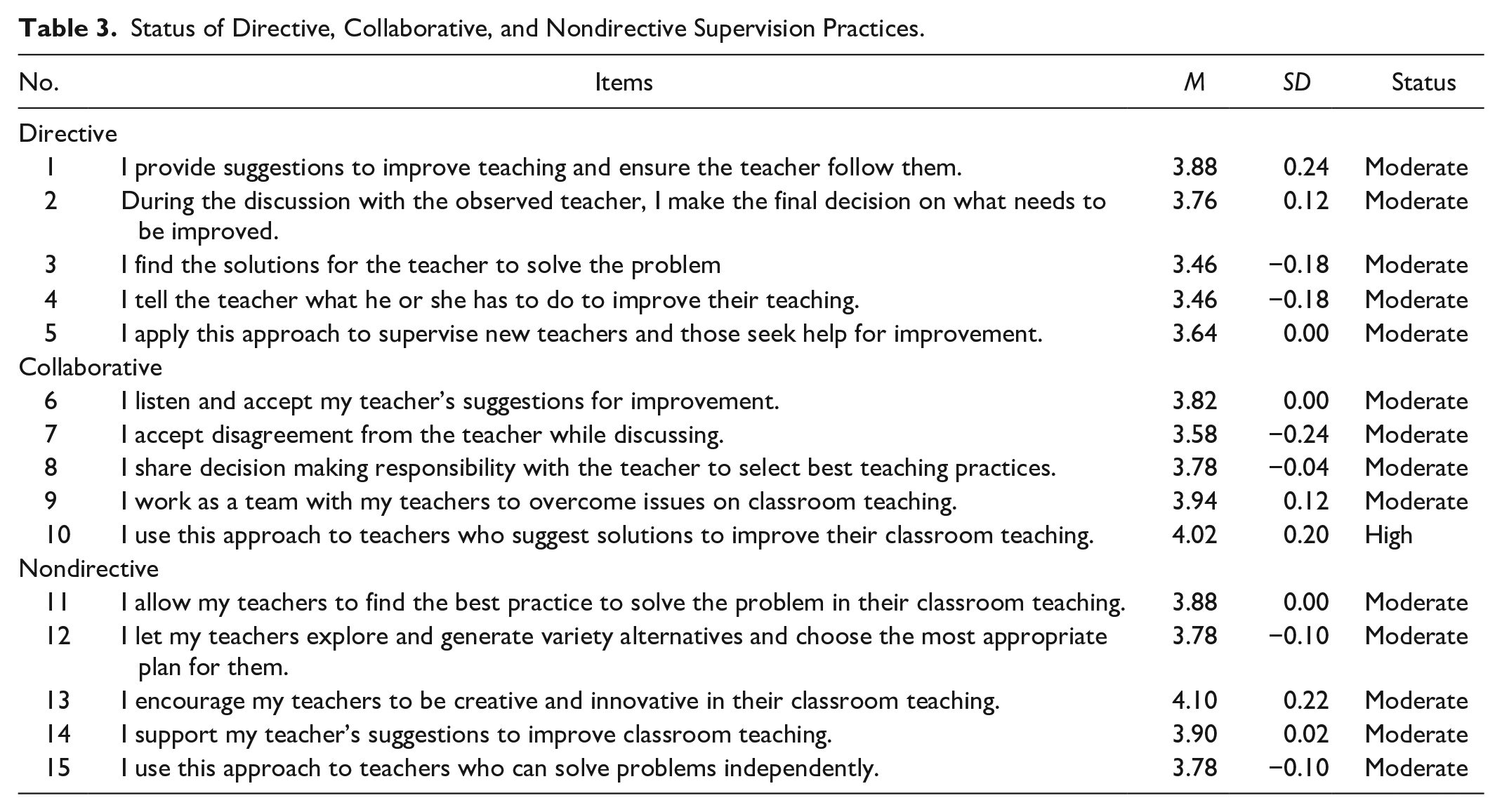
Table 3 exposes the moderate level (M = 3.46–3.88) of directive supervision practices in the areas of providing alternatives for teachers to improve their teaching, assisting teachers finding solution to solve the problem, guiding teachers to overcome encountered problems, and guiding new teachers who seek help. The status of collaborative supervision practices is also found at moderate level (M = 3.54–3.98) in which supervisors listen and accept teachers’ suggestion and disagreement, share decision-making responsibility to choose best teaching practices, work as a team, and practice collaborative approach. The status of nondirective supervision practices is also found at moderate level (M = 3.78–390) in which supervisors allow their teachers to find the best practice for their classroom, let teachers explore and generate variety alternatives and choose the most appropriate plan for them, support teacher’s suggestions, and use this approach to teachers who can solve problems independently. But the practices of encouraging teachers to be creative and innovative are found at a slightly high level (4.01). In all cases, the SD value is in an acceptable range which shows very less differences of the responses.
Status of Directive, Collaborative, and Nondirective Supervision Practices.
Teachers’ Attitude
Table 4 shows teachers attitude toward supervision. The mean value of most of the items shows moderate level of attitude of teachers toward supervision in the areas of “supervision as inspection than a collaborative process,” “teachers’ preference to be observed,” “consultation with their supervisor to get feedback to improve their teaching,” “fearing while being observed,” “preference level to be observed,” “spending quality time with supervisor to improve,” “feeling different being supervised and not supervised,” and so on. It indicates that teachers’ attitude is not highly positive toward supervision. But teachers are positive toward supervision as the mean value of Items 16 and 17 is 2.95 and 2.44 indicates that most of the teachers do not think that the intention of supervision is to find mistakes and thus teachers feel relaxed. The mean of Item 15 shows that teachers do not think regular supervision reduces their anxiety of being supervised. However, overall result shows that supervision help teachers in good classroom management and having effective teaching. Even though teachers opinionate that they can learn teaching strategies from their supervisor, they still prefer to use their own.
Teachers’ Attitude Toward Supervision.

Teachers’ Performance
Table 5 shows teachers opinion of their performance when they are supervised. According to the data above, mean values shows moderate level of satisfaction in majority of areas including “improved classroom instructions,” “more creative teaching,” “improved classroom management,” “improved teaching without guidance,” “improved teaching after supervisor guidance,” “better teaching practices following suggestions,” “improved teaching style,” “better classroom control,” “more attentive students,” and “improved exam results.” These data show mixed feelings of teachers toward their performance because of changes caused by supervision. The majority of data show that teacher thinks mostly positively toward their performance changes caused by supervision. Another positive data vouching for supervision would be Question 11 which had a low mean to the opinion: “I can’t teach well if I am being supervised.” Overall, the data show most teachers believe that supervision in most conditions helps improve their performance but at the same time too much guidance is an irritant (Question 5).
Teachers’ Performance.

Supervision and Teachers’ Attitude
The multiple regression analysis has been performed to find out the impact of supervision (directive, collaborative, and nondirective) on teachers’ attitude. The results of the analysis are presented in Table 6.
Impact of Supervisory Practices on Teachers’ Attitude.

Note. SE = standard error.
ΔR2= .086 (8%, F= .242), p ≥ .05.
The results show that supervisory practices did not significantly impact teachers’ attitude. As a whole, supervisory practices have no impact on teachers’ attitude (ΔR2 = .86, F = .242, p ≥ .05). The coefficient table shows the impact of every independent variable on the teachers’ attitude. The β value of directive supervision (β = 0.304, p ≤ .05) shows that there is a significant impact of it on teachers’ attitude. But collaborative (β = −0.004, p ≥ .05) and nondirective (β = −0.227, p ≥ .05) supervisions have been found to have no significant impact on teachers’ attitude.
The Impact of Supervision on Teachers’ Performance
The multiple regression analysis has been performed to find out the impact of supervision (directive, collaborative, and nondirective) on teachers’ attitude. The results of the analysis are presented in Table 7.
Impact of Supervisory Practices on Teachers’ Performance.

Note. SE = standard error.
ΔR2= .050 (8%, F = .499), p ≥ .05.
The results show that supervisory practices did not significantly impact teachers’ performance. As shown in the table, supervisory practices have no impact on teachers’ performance (ΔR2 = .50, F= .499, p ≥ .05). The coefficient table shows the impact of every independent variable on the teachers’ performance. The β value of directive supervision (β = 0.172, p ≥ .05) shows that there is no significant impact of it on teachers’ performance. The results for other two independent variables also show that there is no significant impact on teachers’ performance as their results, respectively, collaborative (β = −0.235, p ≥ .05) and nondirective (β = −0.101, p ≥ .05), have been found to have no significant impact on teachers’ attitude.
Discussion
This study focused on the three supervisory practices which are under developmental supervision. Descriptive finding shows that the supervisors use directive approach to new teachers, collaborative approach to teachers who can be able to suggest solutions to solve problems, and nondirective approach to teachers who could solve problems independently. This finding is in line with the developmental approach which needs to identify the teachers’ current developmental level and provide feedback and support appropriately and facilitate them to develop themselves to the next level (James & Massiah, 2019; Littrell et al., 1979; Loganbill et al., 1982; Stoltenberg & Delworth, 1987).
In terms of teachers’ attitude, the results of this study contrast to the previous findings as supervision does affect teachers’ attitude either positively or negatively. A study done by Rahmany et al. (2014) showed that teachers who had experience less than 5 years had positive attitude toward supervision that they experienced. In contrast, studies done by Kayaoglu (2012) in Turkey and Acheson and Gall (1980) in Zimbabwe found that teachers have negative attitude toward supervision. Rahmany et al. (2014) found that teachers who had experience between 5 and 10 years had negative attitude toward supervision. Some recent studies also reported both positive and negative attitudes of teachers toward supervision (Khun-inkeeree et al., 2019; Hvidston et al., 2019). Although collaborative and nondirective supervisory practices were not associated with teachers’ attitude, directive approach was influential. This finding is similar to Gordon (1997) and Khun-inkeeree et al. (2019) who claimed that even though American teachers have positive perceptions toward all three supervisory approaches, directive, collaborative, and nondirective, they were less positive with nondirective. This indicated that directive approach is still being the choice of teachers in schools.
The Impact of Supervisory Practices on Teachers’ Performance
Several literatures have discussed the role of supervision to enhance teachers’ performance which contrasts to the current study. Previous studies found supervision enabling the teachers to develop their professionalism and teaching performance (Mohd Zaki, 2001; Veloo et al., 2013; Ayandoja et al., 2017). Sullivan and Glanz (2000) also claimed that teachers need to have proper guidance to improve their teaching method to ensure improvement in their performance. This provides a clear view that supervision has impact on teachers’ performance and plays important role in teaching. But the current study indicated no impact of supervision on teaching performance. In this study, most of the respondents (refer to Table 5: Item 11) claimed that teachers could not teach well when they were being observed by their supervisors. They felt nervous as they were being watched by someone on their teaching performance. This is similar to Harris (1985) and Aldaihani (2017) who claimed that teachers likely related supervision as fault-finding process. They also mentioned that teachers usually become anxious and have bitter feelings toward the process of supervision. Even though this study found that teachers’ were aware of the role of supervision in their professional development, their view on observation as the platform for supervisors to find mistakes on them causes the teachers to be negative toward supervision (Beach & Reinhartz, 1989; Tshabalala, 2013). Besides, most of the teachers (refer Table 4.16: Item 31) claimed that they preferred to use their own method of teaching. From this finding, it could be inferred that teachers were comfortable of following their own teaching techniques as they were not restricted to the suggested method of teaching by their supervisors. This enables them to explore to new way of teaching independently without receiving guidance from their supervisor which ultimately improves their performance on teaching. Thus, teachers feel that supervision does not bring impact on their performance.
Limitations
The sample size of the study is limited to teachers and supervisors from one of the districts in Kuala Lumpur. The sample of the study can be extended by including teachers from other districts and other states. Moreover, the schools selected in this study were from urban area. They may have the opportunity to have experienced supervisors. It will not be the same for the schools in rural area. The future study might focus on rural schools as it is necessary to find out if teachers in rural area are exposed to supervision and if they are given proper assistance from their supervisors. Besides, this study only focused on one of the states in Malaysia. Studies on supervision need to be carried out in other schools as well. As this is a quantitative study, to get a precise response from the supervisor, qualitative study would be more appropriate to find out how supervisors practice developmental approaches on their teachers.
Concluding Remarks
This research reveals that developmental supervisory practices do not bring impact on teachers’ attitude except directive approach. This illustrates that if teachers are not motivated enough by supervision, the result will be more negative, and if teachers do not accept supervision from their heart, they will be resentful toward the process of supervision. Moreover, they do not perceive supervision as the process of improvement. Thus, teachers’ attitude might change before supervision is being practiced. Directive supervision has impact on teachers’ attitude because teachers in schools prefer to be guided by someone as the nature of directive is to assist teachers on their teaching. Some teachers are used to being directed especially novice teachers who seek help from other teachers or senior teachers. Therefore, they prefer to be guided by their supervisors to improve their teaching.
Footnotes
Declaration of Conflicting Interests
The author(s) declared no potential conflicts of interest with respect to the research, authorship, and/or publication of this article.
Funding
The author(s) received no financial support for the research, authorship, and/or publication of this article.
