



Abstract
This study examines socioeconomic factors that influence child marriage and gender relations in the post-independence South Sudan. Grounded Theory (GT) methodology is utilized to discuss how sociocultural construction of gender relationships and socialization can influence gender relations and equitable female and male contribution to the society. The sample consisted of 55 females and 36 males chosen at random (n = 91), who took part either in a focus group discussion or one-on-one interview. The study covered the period from August 2015 to October 2017. The participants were drawn from four counties—Mapel, Kabu, Besselia, and Jury River—of the Wau State, in Bahr el Ghazal. Findings yielded by the GT analysis revealed that child marriage is influenced by social and economic factors and is perceived as an acceptable social norm. This practice is further complicated by the effects of everlasting conflict, poverty, and high illiteracy rate in the society.
Introduction
Traditionally, the practices of child marriage and interactions between males and females have been governed by social norms and group traditions (Japan International Cooperation Agency [JICA], 2017). In this context, the preferred time for a girl to get married is not measured by her age, but rather by her physical and sexual reproductive development, as indicated by the onset of her “period.” In the case of men, the emphasis is placed on their capacity to meet the basic needs of and provide support to their own families and relatives in an extended family setting (Human Rights Watch, 2013b). These practices and social norms continue to influence social interactions and gender relations among social groups in South Sudan and shape their ways of life (Madut, 2015). However, the ongoing conflict and displacement has normalized gender inequality and has intensified violence against women and girls in the country and within refugee camps. The early marriage practices were used to fit traditional socioeconomic livelihood of suburban communities, as people depended on traditional farming, hunting, and cattle keeping. The impacts of child marriage have become obvious because of the conflict and transformation toward urban lifestyle after independence, whereby new set of skills is required to thrive socially and economically (Human Rights Watch, 2013b). Hence, traditional practices involving inequitable gender roles and relations have led to unbearable conditions of poverty and neglect, and have hindered women’s effective contribution to the socioeconomic development (Iyaa & Smith, 2018). These conditions have been further complicated by the high level of illiteracy created by lack of access to education due to early marriage and social expectations favoring boys’ education (United Nations Children’s Fund [UNICEF], 2010).
According to the UNICEF, only 33% of South Sudanese girls are in schools, even though women comprise 48% of the population (Iyaa & Smith, 2018). The overall literacy rate among children is 27%, and 70% of children aged 6 to 17 years have never been in a classroom and less than 10% have completed primary school, which is among the lowest rates in the world (UNICEF, 2010).
Furthermore, 52% of South Sudanese girls are married before their 18th birthday and 9% are married before the age of 15 (Human Rights Watch, 2013a). According to the UNICEF findings, South Sudan has the seventh highest prevalence rate of child marriage in the world. The Unity State of South Sudan has the highest rate of child marriage, as 67% of women aged 20 to 49 were married before the age of 18. The Western Equatoria accounts for 50%, and Upper Nile and Western Bahr el Ghazal (WBG) for 48% of the overall rate of child marriage in the country (UNICEF, 2010).
In 2018, the United Nations Office for the Coordination of Humanitarian Affairs estimated that 100,000 children were affected by human rights violations and exploitation. These include effects of instability, economic decline, lack of services, and poverty, which prompt many families to marry off their daughters to support themselves (Human Rights Watch, 2013b).
The high illiteracy rate is another important element in encouraging early marriage as an alternative means of alleviating poverty in South Sudan and many African societies (Beswick, 2001). In South Sudan, the overall life expectancy for a woman is 42 years due to subjugation of girls to early marriage, as well as and lack of participation in the decision-making process regarding pregnancy and access to health care (Ministry of Health, National Bureau of Statistics [MHNBS], 2010). Thus far, extensive research has been carried out on gender inequality, mostly focusing on abuse and violence against women. However, limited attention is given to sociological factors that influence early marriage practices among the communities and how these practices in turn affect girls’ education and socioeconomic progress in society. In this context, understanding the core practices of communities and construction of social interactions is crucial in the enactment of effective equitable and inclusive socioeconomic policies (Iyaa & Smith, 2018).
Hence, there is a need to explore social constructions of child marriage practices in each social group from the social, religious, ethnic, and regional perspectives, because South Sudan is a highly diversified country. It has been documented that South Sudan hosts about 64 different ethnic groups, distributed over three regions (Bahr el Ghazal, Equatoria, and the Upper Nile; Gurtong, 2015). Each of these ethnic groups is characterized by unique cultural and social norms and lifestyle, thereby influencing their own attitudes toward gender relations and child marriage.
Demography and Ecology
Wau State, WBG, has the population of about 358,692, comprising of the Luo, Aja, Balanda-Boor (Luo), Balanda-Bviri, Banda, Bongo, Feroghe, Gollo, Ndogo, Ngulngule, Sere, Shatt, Yulu, Kara, Binga, Indri, and Mangayat ethnic groups. The region hosts 21 ethnic groups, which is equivalent to about 32% of the ethnic groups residing in the country (Gurtong, 2017; Madut, 2015).
The Bahr el Ghazal, located in northwest South Sudan, is divided into several states because of administrative, socioeconomic, environmental, and sociocultural characteristics of the regions and its people. The Wau State, where the present study was conducted, is the least populated and the most diverse in the region (Gurtong, 2017).
Factors Influencing Early Marriage
Even though the constitution of South Sudan sets the legal age of marriage at 18, there has no clear mechanism for enforcing this law is in place, as communities depend on traditions and social norms that determine girls’ readiness to get married (Savicki, 2010). In this context, girls’ readiness is determined by their sexual reproductive development, whereby the first period is seen as an indication that they are ready to get married regardless of their age (Mkandawire et al., 2019).
The overdependence on ethnic knowledge and traditional ways of life in these communities stems from the high rate of illiteracy among parents and community at large, as well as lack of access to health services that can issue birth certificates or records and promote healthy lifestyle (Mkandawire et al., 2019). Nonetheless, it is a common practice in ethno-cultural African societies that female children from large families do not attend school to allow their male counterparts to gain education (Amadi, 2013). Parents think of their daughters as caretakers responsible for performing domestic duties, who should be married to members of other clans or families to strengthen social bonds or provide for their own family, while males (and thus sons) are regarded as the keepers of family, kinships, and ethnic lines (Amadi, 2013).
As far as socioeconomic influence is concerned, the quantitative and qualitative studies conducted by OXFAM in 2016 in Wau State suggested that girls, their parents, and other family members typically cite poverty as the driving factor in their decisions to marry young (OXFAM, 2016). In this context, “poor families with little money even for food and necessities, marrying off their daughter early to a wealthy old man with political or military powers is an economic coping strategy” (OXFAM, 2016, Para 7). The same phenomenon was reported by Stark (2018) following her fieldwork in Tanzania, where girls were forced by family members to marry a man chosen by them as early as age 15. These practices will never change if socioeconomic perceptions of women do not improve and gender biases are not removed.
In this context, the present investigation focuses on the traditional socioeconomic practices influencing the construction of gender relations and shaping the social interactions among members of ethno-cultural society in Wau State, South Sudan. The research aim is the conceptualization and analysis of social norms governing female and male social and economic interactions. These phenomena are explored methodologically to identify an effective approach to the development of policies on gender equality and inclusion that meet the needs of vulnerable groups within ethnic communities with strong ethno-cultural values and practices. The work concludes with recommendations and suggestions for improvements in health and sexual reproductive policies.
Theoretical Framework
South Sudan is a region that has been under one of the longest civil wars in Africa. Even though the country finally earned its independence in 2011, the counties under study have not witnessed any economic development and depend on traditional modes of economy for their survival. Therefore, there was a need to utilize qualitative research methods and theoretical framework that would facilitate empirical examination of collected data (Braun & Clarke, 2006). The most relevant theoretical framework was that based on the sociocultural and the ecological human development theory, supported by Grounded Theory (GT) methods of analysis.
Therefore, this qualitative research study arises from the need to explore and understand how cultural norms socially construct child marriage and gender relations. Its aim is to examine sociocultural factors that influence our behaviors regardless of cognitive or emotional processes immersed in learning activities. Authors of extant studies have discussed the consequences of child marriage in South Sudan in terms of abuse, neglect, weak institutions, and lack of participation in decision-making processes (Human Rights Watch, 2013a). Limited contribution has, however, been made to the understanding of the social or economic factors that promote and normalize child marriage and inequitable gender relations within the South Sudanese society.
This study is an attempt to elucidate the socioeconomic factors that influence child marriage from a critical social science perspective. Its further aim is examination of child marriage practices from the perspective of theoretical framework of cultural studies, and deconstructing meanings that render women and girls disadvantageous (Grossberg, 1996). The findings yielded are expected to deepen our knowledge of the social factors underlying these phenomena, as they are explored in the context of social justice, equity, social responsibility, and social inclusion.
The theoretical framework employed for achieving these aims is based on the sociocultural and the ecological human development theory. The sociocultural theory suggests that there is a relationship between the development of higher individual mental functioning and the cultural, institutional, and historical contexts in which an individual is immersed (S. Scott & Palincsar, 2013). This interaction is influenced by social construction, whereby individuals assume roles that guide their development throughout their life course (S. Scott & Palincsar, 2013). These learned behaviors shape the construction of social expectations and social interaction norms, and become a social contract that is adopted over the course of social development (Wertsch, 1993). These assertions are also confirmed by the ecological human development theory, postulating that human development takes place through interactions between people and all the elements that construct the different interactions in which individuals are involved within their groups, regions, or personal spaces (Bronfenbrenner, 1994). In adopting this framework, the aim of the present study is to establish how socioeconomic factors construct gender relations and child marriage by identifying, describing, and analyzing these factors and practices from research participants’ experiences and narratives.
Method
GT and its qualitative method of analysis is adopted in this study. This approach was chosen for data analysis and interpretation because it allows further interpretations and identification of themes that may not have been explored in extant research on a similar subject matter (Braun & Clarke, 2006). The GT inductive data analysis approach allows for generation of main themes grounded in the whole dataset, with evidence for the meaning and depth of each theme presented in the analysis (Charmaz, 2006). In this inductive approach, the data collected and the themes that emerge from analysis shape the body of research and storylines (Clarke & Friese, 2007). The inductive analysis is also useful in filling gaps in extant knowledge on the phenomenon under investigation. In this specific case, this pertains to the influence of social practices in the construction of gender inequality and exclusion of women in an ethnic-based community. Thus, it provides an opportunity to ensure that the themes that are identified are equally analyzed, thereby avoiding the trap of forcing themes to fit into a preexisting storyline (Denzin, 2007). As such, it is important that themes are identified based on their context and importance to answering research questions (Braun & Clarke, 2006). In the present study, themes were established in relation to the research aims, which guided the entire process, from transcribing the interview data, to uncovering the underlying cultural meanings, subcultures, and ethnic metaphors, to presenting the final analyses. Even though, in GT, it is assumed that there is a shared, informal definition of most words used among people, generally accepted semantic meanings of words were adopted in the present investigation to generate themes (Braun & Clarke, 2006).
Participants
The study participants were recruited from four counties in Wau State, namely, Mapel, Kabu, Besselia, and Jury River. Mapel and Jury River counties are inhabited by the Luo, and Kabu and Besselia by Fertit ethnic groups. Prior to commencing the study, ethics clearance was received from both South Sudan Ministry of Health (SSMH) and Wau State Ministry of Health (WSMH).
Due to the voluntary nature of participation in this study, participants could opt for either a focus group or a one-on-one interview depending on their comfort level. Thus, 70 participants took part in four separate focus groups, while one-on-one interviews were conducted with 21 individuals. Before the focus groups or interviews began, participants were fully informed of the purpose of the study and what would be asked of them, and were told that they would be audio recorded. At that time, participants were asked to give a recorded variable consent and were advised that their actual names would not be reported anywhere in the study for confidentiality. Participants were also advised that they reserve the right to opt out of the study at any time if they wanted to do so. Both the focus groups and the one-on-one interviews followed a semi-structured interview format, with the same questions being asked in both situations. In addition to answering the predetermined questions, participants were encouraged to provide more information when needed. Participants’ responses were audio recorded, translated, and later transcribed verbatim by the researcher. During the consent process, participants were advised that pseudonyms instead of their actual names would be used in the transcription and data analysis processes.
Data Analysis
All recorded interviews and focus group discussions were transcribed and directly translated from local languages into English. During the translation and transcription process, the researcher re-read and repeatedly listened to the audio recordings to ensure that meanings are accurately captured and initial memos are developed. According to Braun and Clarke (2006), listening and memo writing are important aspects of the transcription process and need to be grounded in the data. Thereafter, the transcribed data were analyzed using NVivo 10 to identify patterns in the meanings pertinent to participants’ stories. The analyzed data were examined, combined, and given equal consideration to form initial themes. The resulting themes were then assessed for quality, whereby those that were not grounded in the data and did not relate to the study aims were eliminated (Braun & Clarke, 2006). The subthemes that emerged from this process and the main themes were identified, labeled, and defined.
Results
The study sample comprised of 24 participants from the Mapel site (FG1), 14 of whom were female and 10 male; 17 participants from Kabu (FG2), nine of whom were female and eight male; 21 (13 female and eight male) participants from Besselia (FG3); and 29 (19 female and 10 male) participants from Jury River (FG4). All study participants were recruited through the support of local community’s youth and elders within the four counties. Total number of participants from four study sites (n = 91) included 55 (40%) females and 36 (60%) males, who were considered well informed and understood the context of the local cultural norms and social interactions. FG1 Mapel was represented by 11% males and 15% females, FG2 Kabu by 9% males and 10% females, FG3 Besselia by 9% males and 14% females, and FG4 Jury River by 21% females and 11% males.
The participants were grouped into five age range clusters, that is, 20−30, 30−40, 40−50, 50−60, and 60−70 years old. The aged representation was chosen at random to represent views of the youngsters, middle-aged, and the elders in these communities.
Themes and Categories
The following themes emerged from the thematic analysis of data transcripts using NVivo 10: traditional marriage (Theme 1), gender roles (Theme 2), and early marriage (Theme 3). These themes are analyzed below in detail. Figure 1 shows factors influencing the concepts of marriage, gender roles, early marriage, and social interactions.
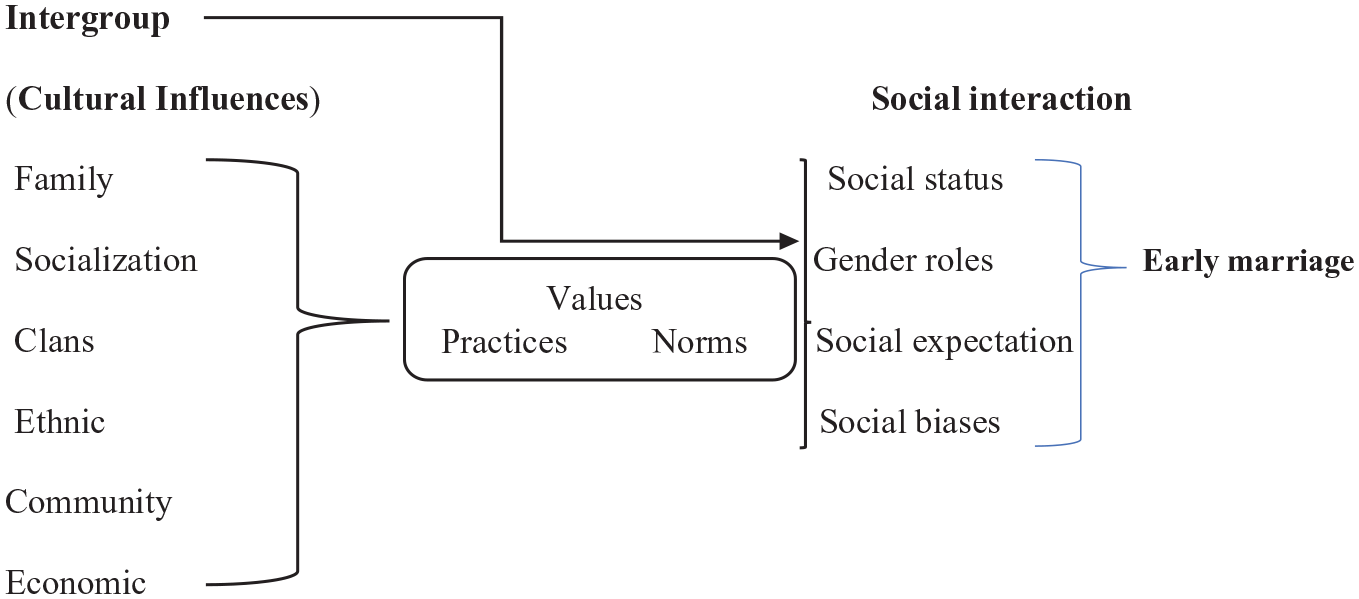
How culture influences traditional marriage, gender roles, early marriage, and social interactions.
Theme 1: Traditional Marriage
For centuries, marriage rituals and family formation have been considered as the first step in the formation of social organization units, allowing social and cultural norms to be preserved and passed from one generation to another (Gracia, 2005). Participants from all study sites agreed that marriage and formation of the family unit is not only based on couple’s preferences but also requires approvals of the family, relatives, and clans. Moreover, the gender roles and decision-making processes that govern spousal relationships and family members’ behaviors are defined by cultural norms, values, and social expectations (Duffy, 2005). These social practices consequently influence all aspects of gender relations and interactions socially and economically. In this context, family decides whose turn is to get married in the family. On the approval of parents and relatives, one male participant shared, I think if the girl is approved to get married by her parents and my parents, it means that she is ready to get married. We don’t measure woman’s readiness for marriage by her age, but by her ability to have children and manage her family. I wouldn’t marry a lady of whom my parents and relatives do not approve. I can’t divorce my spouse without their consent regardless of the type or nature of the problem. (Male, FG1)
According to the participants, marrying a relative from both parental and maternal bloodlines is prohibited. As such, the initial screening of whom son or daughter should marry, and the family, clan, and village the potential candidate comes from, is regarded as an important vetting process in preventing marriage between relatives. An elder participant stated, We are not trying to control the process or decide on whom our son or daughter should marry, but we know the history and the identities of relatives within the community and outside the community. We also know if the girl is ready to get married or not. Nothing would prevent marriage if all these are cleared. (Male, FG3)
In some cases, children are forced to abandon education by parents to marry a rich older adult in the community (Human Rights Watch, 2013b). Traditionally, early marriages were not permitted unless a girl reaches the age of maturity, mostly signified by the first cycle of period. Nonetheless, the girl decides whom she wants to marry and is not forced to marry a man unless she is pregnant (Female, FG1). An elderly participant explained, Traditionally, the ideal age for men to have a wife is when they are 20 years old. However, the family has to make sure that the person (man) is a hardworking individual and that there is enough food/resources in the family to support the new family member (wife). (Male, FG2)
The notion of marriage is constructed around having children and sustainability of the family, clan, and the tribe at large. Families who have children, especially boys, have special place and are valued more than those who do not have children. A newly wedded participant in the FG1 Mapel shared, When I got married to a younger girl, I knew that I was going to have children. I value women who would have children, raise them and are hardworking. . . . It is considered a curse if you or your wife cannot produce children. (Male, FG1)
In this context, polygamy (which also involves early/child marriage) is considered culturally and socially accepted practice among many communities of the Wau State. Polygamy is also seen as a sign of pride, manhood, and prestige.
Theme 2: Gender Roles
The gender roles and decision-making processes are socially constructed by groups’ norms, values, and social expectations. The patriarchal norms and values influence all aspects of gender inequality and relationships socially and economically (Bobo, 1990). In this context, the dominant culture dedicates all decision-making processes to males and father figures in the family, group, and society. These include decisions pertaining to marriage and accepted norms that govern gender relations and social interactions. However, marriages no longer take place according to cultural traditions and family expectations, as one participant explained: Wars have brought urban culture and lifestyle into our villages and towns. As people become poor, they do not care about our traditional marriage and cultural norms. They can give their daughter to a rich man, whether she is ready for marriage or not. (Male, FG4)
In South Sudan, social, economic, and livelihood matters are still based on a traditional “mechanical society,” where all aspects of social interactions are defined by the size of a community and its ability to protect and provide. In this context, male figures are looked upon as the driving engine of economic, livelihood, and security progress, and female roles are limited to domestic work and giving birth to ensure continuation of family line (Duffy, 2005). As a result, polygamy and polyamory are accepted practices in many communities. Consequently, girls’ education and contribution in the society are not considered a priority, as far as families and society are concerned. As one participant noted, We give orientation and train boys right from their birth, so that they are responsible to provide for the entire family and its livelihood. They are prepared to farm and build houses, and are encouraged to get married for the continuation of the family lines, clans, and the tribe in general. (Male, FG4)
It is therefore thought that more than one wife means more than one child and consequently a stronger workforce, as well as stronger sense of social security within the family, clan, and the community in general. This is evident from one participant’s account: Most of our families are big because most of the men have lot of wives at home and each of the women gives birth. Our villages are big and we do not have enough people to work or protect our lands. (Female, FG3)
Traditionally, most homes were built around farms; as such, most women lived together in the same home as the man they married. In the cities, however, some women tend to have separate places named after the man. These women cooperate and help each other, and do not object if the man decides to add another wife into the already large family (Hindan, 2000). Such practices and women’s inability to negotiate sexual and other rights have implicated practices of gender inequality, abuse, and psychosocial well-being.
Theme 3: Early Marriage
Socioeconomic reality of conflict and poverty forces parents to marry their young daughters to older men with a better social status for whom they would be a second or a third wife (Human Rights Watch, 2013b). As one participant explained, “if a man has a big house, well paid job or business and has a car, young girls would prefer him regardless of his age” (Female, FG2). When families and communities are under financial pressure, it becomes more common and socially accepted that women find themselves in multi-wife families with limited emotional and social support.
Female participant in the Mapel county focus group described the effect of conflict and poverty on parenting and child marriage as epidemic. She shared, Conflict and poverty have affected families’ ability to provide parenting and childcare as they used to do. It is difficult to plan for the future of children as anything can happen at any time. Parents have to be strong to provide for and help children stay in school, because many young girls and boys drop out of school and consider working or getting married in order to support themselves and their families. (Female, FG3)
Some children have lost their fathers because of the conflict. The absence of a father figure at home has in many cases led to social deviance, such as neglect, child labor, early marriages, and unwanted pregnancies, especially among displaced children who left rural areas to live and seek work in the cities. An elder participant in the Jury River county focus group said, Wars have changed our communities. I am afraid that these changes will destroy our families because mothers are left with parenting responsibilities to deal with children and family when the spouse dies. As such, young boys and girls try to find work or leave home at a very young age, as young as nine years old. They will start to make money and engage in sexual activities at early an age. (Female, FG2)
Many of these communities have started to witness high early pregnancy and school drop-out rates among young boys and girls. On that, a participant in Mapel’s focus group observed, Some kids have abandoned school and work full-time. They (young boys) get engaged with young girls who don’t have parental or institutional support to care for them. These girls get pregnant very young not because they want to do so, but mainly because they do not know any better, or just because they are poor. (Female, FG1)
For policy implications, such factors do not only implicate child marriage but delayed female progress in the society and subject them to violence, abuse, and everlasting poverty. It is therefore in the interest of policymakers to enact laws and policies that will protect young girls’ rights and provide them with the health and social support needed to become effective contributing members of the society.
While women have never had the power to negotiate any aspects of social and economic matters which directly affect her life, it was traditionally agreed upon that parents and male siblings are responsible for making decisions on their behalf, including getting them married without their approval.
Nonetheless, some younger women in urban settings have the option of attending schools and joining workforce and do become productive members of their societies. Other women cannot pursue education due to the lack of family support, forced marriage, or unplanned pregnancy before completing their studies (Kircher, 2013). Participants in the four focus groups shared similar views on the importance of women’s education. They justified their stance by explaining that it is in the interest of the society to send boys to school, because girls leave homes and get married anyway. As one elder put it, We would like people to get married and have children; we will not encourage the Western society concept of marriage we hear about here. Boys are created to lead and support their families, while girls need to become women capable of raising them to be good people. . . . We want to have more boys in this empty land and educate them to make our country the greatest country in Africa. We have empty lands, with just few people. (Male, FG1)
For policy implications, the above discourse highlights strong social and economic factors that influence early marriage, which requires urgent improvement of policies that encourage girls’ access to social and economic participation.
Discussion
Family practices and social norms are central elements that shape social interactions and cultural expectations that define gender roles. For centuries, the rituals of marriage have been considered the first step in the formation of solid social organizational units, where social and cultural norms are preserved and passed from one generation to the next (Kircher, 2013). In the context of South Sudan, participants from all study sites agreed that marriage and formation of the family is not based on couple’s decisions but requires approval from family, relatives, and clans (J. Scott et al., 2014). In addition, the gender roles and decision-making processes that govern spousal relationships and family members’ behaviors are defined by group’s norms, values, and social expectations, thereby rendering girls vulnerable to biased perceptions and limited access to education, training, and economic opportunities in their society (Kircher, 2013). These social exclusions influence all aspects of gender inequality and limit the future contribution of women and girls socially and economically.
The gender inequality, as discussed, goes beyond child or early marriage to include negotiation of sexual space and participation in socioeconomic activities, which depends heavily on the prevalent cultural norms that give parents an upper hand in the decision-making process about all aspects of girls’ lives socially and economically (Berenger & Verdier-Chouchane, 2016). Families are also responsible for the vetting process, the aim of which is to ensure that prospective groom is economically well off and is able to support their daughter. Marriage to an older rich man has therefore become a new phenomenon, allowing powerful rich men to marry more than 20 girls (Lacey, 2013).
According to Human Rights Watch (2013b), parents maintain their right to force girls out of school and marry these rich older men with social and economic status in the community to improve family well-being. Traditionally, early marriages were not permitted unless a girl reaches the age of maturity, mostly signified by the first cycle of period. They were also permitted to decide on whom they want to marry (Lacey, 2013). Girls who had children before marriage are also not permitted to attend school or engage in any training activities, as young girls are not considered women. These practices have led to high illiteracy rate among girls (90% of the national average; Calder, 2013). The female value is socially constructed around home and sustainability of family, clan, and the tribe at large. Women who have children, especially boys, have special place and are valued more than those who did not manage to conceive after marriage or produce mostly girls.
In this context, polygamy (which in many cases involves child marriage) is a culturally normalized and socially accepted practice among many social groups. Polygamy is also seen as a sign of pride, manhood, and social status. It is therefore thought that having more than one wife would not only ensure a greater number of offspring and thus a stronger workforce but would also engender a stronger sense of social security within the family, clan, and the community in general (Pinaud, 2014).
Furthermore, the social, economic, and livelihood norms in South Sudan are still based on a traditional “mechanical society” where all aspects of social interactions are defined by the size of communities and their ability to protect and provide (Komey, 2008). In this context, male figures are looked upon as the engine of economic, livelihood, and security matters, and female roles are limited to domestic labor.
Nonetheless, gender roles and decision-making processes are defined by cultural norms, values, and social expectations. These norms consequently influence all aspects of social and economic interactions in the society. The dominant culture still designates the decision-making power to the parents, who decide on behalf of their daughters when and whom they should marry regardless of their age, as well as impose the norms and rules of social engagement (Hatoss & Huijser, 2010). After the independence of South Sudan in 2011, researchers and sociologists, as well as women’s rights activists, started to recognize and discuss factors that hinder girls’ and women’s participation in socioeconomic development (Mai & James, 2015). Women also started to think that they should have a decision over their own lives. Moreover, they would like to be involved in making decisions over whom they should marry, and how and when they should get married. They also believe that education is important before marriage and having children, to improve their future life prospects by gaining access to a meaningful employment, which would allow them to make equal social and economic contribution to their community. However, due to the ongoing conflict, poverty, and lack of equitable policies that grant children rights, young girls will continue to face barriers to education and effective participation in social and economic development in the country.
In the urban settings, young girls’ condition is further complicated by acute poverty, which subjects them to child labor, early marriages, and unwanted pregnancies, especially among orphan girls who have no choice but to work to offset family’s expenses. As such, communities have started to witness high early marriage and unplanned pregnancy rates, as well as school attrition (Muller et al., 2017).
Conclusion and Recommendations
The early marriage phenomenon and socioeconomic factors that encourage child marriage practices continue to hinder girls’ social and economic progress. It is a high time for South Sudan to review its social policies to ensure that the rights of girls are protected. Indeed, some social practices directly affecting girls have started to change in villages and towns. However, polygamy (which is still considered as a signifier of wealth and economic well-being) has continued to implicate child marriage and girls’ rights in the society. At present, an acceptable discourse on girls’ education is not fully recognized as human development investment and their given constitutional right. Rather, it is agreed upon that it is in the interest of the society to send both boys and girls to schools with no formal policies and legislation that will enforce girls’ right to complete school before marriage.
There is also a need to enact laws that will set an appropriate age for an individual to be considered adult and eligible for marriage. Such laws should be able to support women who can establish themselves socially, economically, and live independently and become self-sufficient. Policymakers need to acknowledge that gender relations and interaction practices are culturally normalized to become an acceptable norm among both genders, thereby limiting girls’ and women’s contribution to the society.
Policymakers need to focus on eliminating strong social barriers that promote child marriage and gender inequality. They also need to improve institutions and policies that encourage women’s access to social services and economic opportunities.
It is in the interest of government and the society at large to enact laws and policies that will protect women’s rights and facilitate their effective contribution in all aspects of social and economic affairs in their society.
Gender issues should be institutionalized by supporting implementation of nationwide gender policy in conjunction with other key national policies. These include strengthening the gender policies already enacted within the South Sudan interim constitution.
Longer term strategic gender policies need to be developed, focusing on women’s socioeconomic participation, as well as immediate access to the currently male-dominated public institutions, such as schools, vocational training initiatives, and politics.
Focus should be given to long-term livelihood, labor market laws, and equitable system to improve resilience and reduce women’s dependence on family and spouse as the only socially accepted providers of basic sustenance and livelihood.
In short, these socioeconomic factors not only implicate gender inequality but also delay female progress in the society and subject women to violence, abuse, and marginalization.
Footnotes
Declaration of Conflicting Interests
The author(s) declared no potential conflicts of interest with respect to the research, authorship, and/or publication of this article.
Funding
The author(s) received no financial support for the research, authorship, and/or publication of this article.
