




Abstract
Using the existing knowledge about the social and cultural characteristics of the Roma in Serbia, possible connection between Roma population and preserving of natural resources was established. This analysis acquired in social and other related studies, as well as the data obtained through the GIS (geographical information system) methodology, was used for determining the spatial distribution of Roma settlements and activities of the Roma community in the space. The Toplica District has one of the high percentages of Roma population and their daily migrations. This article investigates the possibility to raise the level of their economic activity and social integration, while simultaneously preserving natural resources and improving environmental safety. With the specific GIS, and numerical and sociology analysis, we try to address main problems in the District, hoping to find a connection between inner migration of Roma and better preservation of nature.
Introduction
The Republic of Serbia has a large number of Roma settlements. A field study conducted in the first decade of the current century “recorded that in Serbia there are 593 Roma settlements with more than 15 families, with more than 100 Roma people” (Briza, 2000). The presence of the Roma population is also significant in the territory of the Toplica District that has an area of 2,231 km2. The Toplica District is located in the south-eastern part of Serbia, bordering with the Nišava, Jablanica, and Rasina Districts, and partly with Kosovo. The total population in this district according to the census of 2011 (Statistical Office of the Republic of Serbia; Volume X) amounted to 91,754 with an average density of 41.1 per km2.
The depression of Toplica is located between mountains Jastrebac, on the north, and Pasjača, Vidojevica, Sokolovica and partly Radan, on the south, with an average height of 400 to 500 m (Maćejka & Tanasković, 2008; Valjarević, Srećković-Batoćanin, et al., 2018). The river after which the district was named flows through the central part of the valley dividing it into two parts the Upper and Lower Toplica. The Toplica river, 130-km long, flows into the South Morava and connects to the South Morava river basin.
The Toplica District was settled in antiquity. Some ethnic groups that inhabited this area were the Avars, the Celts, the Dardanelles, the Turks, the Slavs, while the Roma as a community are mentioned in Turkish records from the 15th century. After the Battle of Kosovo in 1389, the Turks conquered Toplica District, and the ethnic structure was changed. The first written accounts of Roma settlements were given by a Turkish travel chronicler Evliya Çelebi in the 17th century, although it cannot be determined with certainty whether he separated the Roma population from the Serbs (Kanitz, 1868). According to the last census from 2011, the number of Roma people has increased, both in Serbia as a whole and in the district.
In the first census after the Second World War in 1948, 0.8% of the total population of Serbia declared themselves as members of the Roma ethnic group, and that level was maintained up to the census in 1961, when it declined to only 0.1%. A decade later, during a wave of ethnic emancipation which affected Serbia, the Roma declared ethnicity more freely (0.7%), and this practice has been particularly intense since the nineties of 20th century.
Thus, the proportion of the Roma in the population of Serbia in 1991 was 1.4%, reaching 2.1% in 2011, so the Roma became the fifth largest ethnic group in Serbia (after the Serbs, Albanians, Bosnian, and Hungarians). Sociodemographic analyses suggest that this increase cannot be attributed solely to the processes related to natural and mechanical demographic factors, such as an increase in the birth rate, the reduction of mortality or the migrations (Raduški, 2003).
A series of political, legal, and sociocultural factors contributed to a freer expression of ethnicity and the repression of expressed ethnic mimicry. They need to be identified not only in the fact that, with the disintegration of Yugoslavia, a supranational framework for identification disappeared but also in factors such as intense efforts of Roma activists to preserve the ethnic identity of the Roma in Serbia and, in the wider international level, to raise awareness about the importance of accepting their own national identity, together with a number of social policy measures that promote the full social inclusion of the Roma population in Serbia.
However, ever present explicit and latent discriminatory practices, although formally and legally impermissible, contribute that a part of the Roma in Serbia conceals their ethnic identity. This applies in particular to the population that does not live in spatially segregated settlements and that has achieved a certain degree of social integration. According to scientific estimates, there were at least twice as many Roma in Serbia at the beginning of the 21st century than the census results showed (Jakšić & Bašić, 2005). The Toplica District, particularly the municipality of Kuršumlija, has very large forest areas, except Žitoradja (Kuršumlija 63%, Prokuplje 39%, Žitoradja 12%, Blace 37%). Due to a negative birthrate, in the municipality of Prokuplje forests have been returning to their former habitats (Valjarević, Djekić, et al., 2018). At first glance, this scenario has positive effects on the environment and natural potentials of the District. However, the biggest problem faced by Serbia in joining the European Union (EU) is precisely the deficiency in the area of environmental protection.
The Roma parts of the settlements are largely situated on the fringes of forests, or even inside the forest belts, so with the rise of environmental awareness, the Roma population could become an active factor in the preservation of the forest belts in the future. This is especially true if one takes into account that, when it comes to joining the EU, Serbia is particularly lagging behind in opening the chapters dealing with ecology and environmental protection (Stopić et al., 2009) (Figure 1). In this research, we also established two kinds of data estimation. First belong to qualitative and second to quantitative. These methods are useful in connection between social and environmental science (Kohsaka & Matsuoka, 2015; Schlesinger & Lawston, 2011).
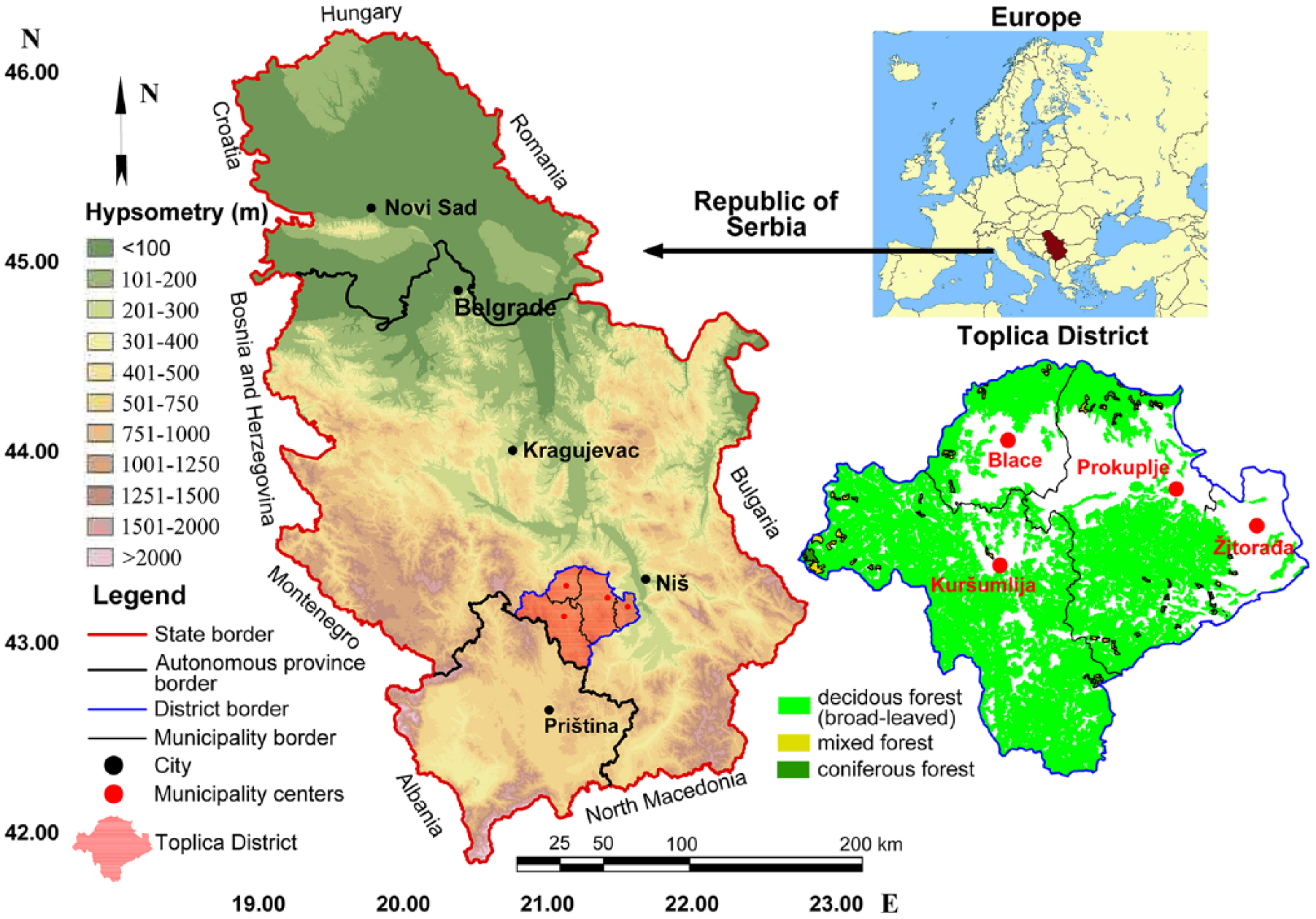
The position of Serbia and the Toplica District (source of hypsometry: CGIAR Consortium for Spatial Information; source of land cover: Copernicus, 2018).
Cultural and Social Practices of the Roma Community in Serbia
As part of the cultural tradition of the largest Pan-European minority, Roma cultures in Serbia have some universal elements resulting from the intermingling of a series of broader historical, economic, and political factors including the influence that originated from the intercultural exchange. The attitude that the Roma outlook on the world is “based on archaic images that they brought from their homeland” is not without foundation (Djurović, 1996). However, cultural identity and cultural practices of the Roma in Serbia cannot be understood apart from the micro and macro sociocultural milieu in which the Roma communities survive.
The Roma, as a social group, are characterized by the cultural, social, religious, and residential diversity (Djordjević, 2010; Djordjević & Todorović, 1999; Škorić et al., 2014; Sokolovska, 2014), as well as social mimicry and a relative group closure that is not only reactive in type—a response to social isolation—but also a form of “protection of group identification and a way of preserving the group order and structure” (Sokolovska & Jarić, 2014). For several decades, the key characteristics of their social status have been (a) spatial segregation—a common practice of living in separate (ethnically cleansed) settlements that in appearance reflect the state of permanent misery of the majority of Roma population that is dramatically manifested in the organization and way of life; (b) an extremely unfavorable education structure and a high proportion of illiterate population in comparison to the same parameters of other ethnic groups in Serbia (Ministry for Human and Minority Rights of Serbia and Montenegro [MHMRSM], 2004); (c) frequent unemployment or engagement in least paid and stigmatizing positions; (d) a low level of inclusion in health and social care; (e) the lack of political participation, public action, and international organization (Mitrović, 1996; Todorović, 2011); and (f) low social capital—social relations of the Roma population in Serbia are primarily based on contacts, and the exchange of information and support within the immediate and extended kinship community, all of which makes social inclusion difficult.
In addition, the population in Serbia, and in the region, displays social distance and stereotypes toward the Roma, which apparently arise from their unfavorable “subclass,” “subproletarian” position (Lazar & Koković, 2005; Miladinović, 2008; Mitrović, 1990; Mitrović & Zajić, 1988; Petrović, 2014; Petrović & Šuvaković, 2016). The totality of outlined characteristics and the existential and social practices in which the majority of the members of the Roma ethnic group live are the reasons that the Roma in Serbia lack the resources important for the preservation of ethnic and cultural identity, as well as the resources for true social integration that does not mean assimilation and suppression of their cultural and ethnic identity. Observed from the standpoint of the theme of this article, the professional practices of the Roma in Serbia are of great importance, namely the ways in which this ethnic group earns an existence.
In this regard, it is important to present the results of a research carried out in 2014 as part of the project Social and cultural potential of the Roma community in Serbia, implemented with financial support from the Open Society Foundation Serbia in Belgrade. Based on these data, the distribution of the sample by region and the number of settlements in which to conduct research were determined. The sample of 1,212 respondents accounted for 0.82% of the total Roma population in Serbia.
The survey was conducted in 34 municipalities which, according to the results of the 2011 census, recorded a high share of Roma people in the total population. To encompass the diversity of the Roma population in the research, in the formation of the sample a special attention was placed on the residential aspect that is directly linked to the degree of integration of the Roma into mainstream society, that is, the autochthony of Roma communities and cultural practices. For these reasons, a more detailed classification of the areas where Roma people live was created.
The city and village areas where the research was conducted were divided into urban/rural micro-regions where there is no territorial concentration of the Roma, but they are integrated into the rest of the population. Roma settlements (mahalas) in cities/villages, slums in cities/villages, mahalas and slums outside of the cities/villages, and the suburban settlements. The gender structure follows the structure of the population recorded in the census. Data from our study largely remain within the estimate presented in the report on the situation of minorities in Central Serbia, compiled in 2000, according to which in Central Serbia only 5% of the Roma work in publicly owned enterprises, and there are practically no Roma in the executive government (Briza, 2000).
Although there is improvement compared to the period of a decade and a half ago, it is not large. Thus, less than a third of respondents in the sample classified themselves into one of the offered activity sectors. Only 5.4% said that by profession they belonged to the sector of economic production; 3.1% to agriculture; 5% to trade, catering, and tourism; and the same number to the service sector. The Public Services (administration) employ only 4% of the respondents, health care and education 5.4%, and the culture and information sector 1.4%. The results that we got show that the structure of specific occupations among the Roma in Serbia is dominated by the unpaid work of housewives with 29.4%, mainly carried out by women. Then, there is wage labor, mainly doing simple and hard labor without a regulated employment status with 20%, the collection of recyclable materials 13%, and resale of goods, either through legal or illegal forms of trade, 10.8%. Only 6.6% of the questioned Roma stated they were employed in an economic unit as a worker. Craft products and services employ 5.1% of the Roma, playing music 3.8%, street cleaning 3.1%, while only 2.4% perform agricultural activities.
Among the Roma, there are few who hold jobs for highly qualified persons: 0.2% are lawyers, 0.9% are pedagogues, 0.3% are teachers, and 0.3% are engineers. There are very few among administration officers, 1.2%, and 0.9% among the taxi drivers, or medical and paramedical personnel, 0.9%. Sporadically, they engage in begging, 0.4%, and divination and healing, 0.3%. Traditional past occupations of Roma people on the territory of Serbia are present in 63.9% of respondents’ families. Playing music is dominant with 24.1%, peonage with 21%, blacksmithing 8.3%, and reselling horses and carpentry each with 1.7%. Other traditional jobs (such as goldsmiths, weaving, processing of feathers and the like) are present in the families of respondents with less than 1%. A consideration of the intergenerational transfer of interest provides an interesting picture.
When we compare the occupations of the respondents and the occupations of their fathers, it can be seen that the occupations of fathers and offspring do not overlap entirely, because many of the fathers’ jobs are not even mentioned as activities that respondents currently perform (seed seller, a rope maker, an umbrella repairman, a blacksmith, a knife sharpener, etc.). However, some occupations appear as traditional family occupations that are performed by fathers and sons/daughters. Thus, 65.9% of those who said they were playing music listed a musician as the father’s profession, and 42.9% of laborers said that their fathers had also performed the same job.
Slightly more than a quarter of respondents, 25.6%, who work in the collection and sale of secondary raw materials stated the identical occupation of their fathers. So, despite the fact that some jobs disappeared, and that today in Serbia much less Roma are employed as workers in the economy, there remains a number of occupations that is transferred through generations among the Roma. Taking into account the low social status of this minority group, the lack of education, the lack of economic inclusion, and consequently, the lack of material resources, access to the media, bank loans, and other social resources, the question about the possibility of their social integration into mainstream society is being raised (Postma, 1996). Thus, the vicious circle of social exclusion is being repeated: The exclusion from education reduces the chances on the labor market (Petrović, 2011; Petrović & Šuvaković, 2013; Sparkes, 1999).
The exclusion from the labor market reduces the availability of social benefits that act as insurance in case of illness, old age, and inability to work, whereby the higher the risk of long-term exclusion or the exclusion in later years of life (Flores, 2009). The chain continues with the material, cultural, and political deprivation, which reduces the chances for the establishment of social relations outside their deprived groups and produce a feeling of powerlessness, personal and social incompetence, and passiveness (Sen, 2000). In the case of the Roma in Serbia, the situation is more than clear, particularly when one takes into account the structure of their economic activity.
Equipped with such information on the Roma population in Serbia as a whole, we asked whether the spatial distribution of the Roma population in the area tested and their registered daily migrations within the geographical space with the aforementioned natural characteristics can become a part of the policy of social inclusion of the Roma population in the wider community. We believe that such potential exists.
Natural Resources of the Geographical Space in the Function of the Social Inclusion of the Roma Community
Ecological geography is not only important for the acquisition and protection of certain resources within nature, but also because the development of environmental awareness can prevent conflicts and strengthen efforts to protect nature (Barnett, 2001; Berdal & Keen, 1997; Keen, 1998; Le Billon, 2000). In other words, it is necessary to ensure environmental security and efforts to preserve local and planetary biosphere as a fundamental system underpinning all human activities. A geographical space itself can sometimes present certain communities that are traditionally close to it. The Roma community is related in part to the migration way of life, although its concept and way of life has changed due to globalization, new technology, and improved social conditions of existence.
To that extent, the migration way of life has been increasingly replaced by a sedentary life; migration and specific life usually occur as a result of discrimination in different historical periods in different geographic areas. Anthropological migrants within the Toplica District are bound to three coordinates within the geographic space Barlovo-Kuršumlija, a suburb of Prokuplje called Staklara, and village Žitini Potok. The Kastrat village in the Municipality of Kuršumlija has large number of Roma families. Today, Roma minority group in the territory of the District lives in the border areas of mountain slopes in the periphery of villages. Another number of Roma citizens live in the suburbs of two large settlements Prokuplje and Kuršumlija.
Materials and Methods
GIS (geographical information system) and data modeling is a very powerful tool for calculating and describing certain population properties in a specific area. In this article, demographic characteristics and the changes of Roma population in the Toplica District were analyzed. For that purpose, GIS software QGIS (Quantum Geographical Information System), Grass-GIS (Geographic Resources Analysis Support System), and SAGA (System for Automated Geoscientific Analysis) were used, with tools for geospatial calculations (Bíl et al., 2012). The satellite recordings of the land and forest areas were downloaded from the official web page of CORINE (Coordination of Information on the Environment), while from the official web page we downloaded vector data with the exceptional view of coniferous, broad-leaved, and mixed forests (Wu & Chen, 2016).
After downloading, the data were exported to the GIS software. In GIS, the data were cropped for the territory of the Toplica District for future manipulation. In QGIS software, raster data were georeferenced and digitized, with all positions of the Roma settlements. The Ordinary Kriging method is a fundamental part of tools implemented in software Quantum GIS and SAGA dealing with spatial analysis. Although there are a few other methods, the priority was given to Ordinary Kriging and the Global Kriging method because of the most realistic autocorrelation and the statistical relationship among the measured points. Thus, with this method, the weights are based not only on the distance between the measured points and the prediction of location, but also on the overall spatial arrangement of the measured points, and it minimizes the variance of the error of estimation. The Ordinary Kriging method was employed through QGIS and SAGA extension of Spatial Analyst. The Roma settlements and Roma daily migrations with gravity law were given in (Figure 2).

Degradation areas and directions of Roma migration.
GIS and geostatistical data were used for all villages with Roma minority. The territory of Toplica District was divided into four municipalities, which included all number of Roma villages. In that way, it is possible to present Roma population properties in the four municipalities and for the whole territory (see Table 1).
Influence of Roma Population on Forest Areas.

Results
Namely, more than half of the Roma community in Serbia have no education or have incomplete elementary education 53.72%, a third have completed the elementary education 33.3%, as well as 11.54% have completed secondary education, while only 0.65% have university education, wherein this structure is even more unfavorable in underdeveloped areas of Serbia such as the Toplica District. Empirical research points to the widespread social exclusion of long-established Roma communities in their home countries, one of which is Serbia (Guy, 2001; Sigona, 2005). The results of the census in 2002 show a very small number of Roma people in the Toplica District.
After the war in Yugoslavia (1991–1999), Roma people declared themselves as being Serbs (Ljujic et al., 2012). The official data of the census in 2002 show that, in the Republic of Serbia in the entire territory of the Toplica District, the number of Roma population was 3,338 or 3.27%. Data from the last census in 2011 show that the number of Roma people significantly increased to 4,278 or 4.72%, while the total population decreased. The data show that the number of Roma people has not increased in demographic terms, but that the process of segregation has been reduced due to the activities of the institutions of the EU and Government of Serbia. In this research, the migration of the Roma population using numerical and statistical methods was calculated. The Roma settlement investigations were used too. Other methods were interviews, oral questions, written questions, statistical books, census materials (Statistical office of the Republic of Serbia, 2011).
With the help of GIS and numerical analysis, the belts of the Roma population and their gravitational influence in relation to forests, and the opposite impact of forests to the areas where the Roma live, were divided (see Table 1).
Therefore, the area covered in forest is not the same because forests do not cover a similar area; for example, in municipalities of Prokuplje and Žitoradja, there is a different dispersion of forest. According to satellite recordings, we measured the forest areas in the municipalities. In 2015, in the municipality of Prokuplje, forests cover the total area of 40.5%, in Žitoradja 12.8%, in Blace 38.2%, and in Kuršumlija 64.5% (Consortium of Spatial Information, 2017).
In comparison to the last census data from 2011, the municipality of Prokuplje has an increment of 1.5%, Žitoradja of 0.8%, Blace of 1.2%, and Kuršumlija of 1.5%. Since we divided forests into three categories (broad-leaved, coniferous, and mixed), the coniferous forests are especially threatened because their territory has been decreasing for many years. Conifers that are strongly influenced by potential cuts spread over an area of 0.32 km2. In the municipality of Prokuplje, this area is 1.9 km2; on the territory of the Municipality of Žitorađa, it is 0.4 km2; and in the municipality of Blace, there are no coniferous forests and a consequent influence.
The pressure on mixed forests would cover the following surfaces: 0.8 km2 in the municipality of Žitorađa and 0.4 km2 in the municipality of Kuršumlija. Other municipalities do not have a potential pressure on mixed forests. The pressure on broad-leaved forests which are most frequent in the territory of the Toplica District has the following values: in the municipality of Kuršumlija this area is 30.2 km2, in the municipality of Prokuplje the area is 183.5 km2, while in the municipality of Žitorađa it is 36.3 km2 (see Figure 2).
Discussion
In Serbia, there are 593 Roma settlements, inhabited with more than 100 Roma people. The number of Roma population is also big in the territory of Toplica District. This District is surrounded by the municipalities which have also a significant number of Roma population. The total population of the District, according to the census from 2011, showed a decrease of citizens, but a slight increase of Roma population. Some earlier research does not include a complete view of this problem. Many authors of before investigations think that the Roma population has also small budget of birth rate (MHMRSM, 2004).
The advanced procedures would be including process of inclusion through the time and process of demarcation, as well process of human rights for Roma in the Republic of Serbia (Petrović, 2014). Monitoring the Toplica District has shown the tendency of increased urbanization related solely to the central parts of the towns, which indicates the constant rural to urban migrations (Figure 2). Namely, due to social changes in the Toplica District during the period from 1984 to 2012, the level of industrialization considerably decreased.
Therefore, a constant migration of the population from this area is noticed, especially to Belgrade, the capital of Serbia, and the depopulation of this territory amounted to 8.1%. The Roma population moved to the central part of the region especially to the city of Prokuplje, because many of them were not included in the reform process and resocialization (Janjesević et al., 2010; Rudic, 1978). Many of them live in inhumane conditions on the suburb zones of the towns of Prokuplje and Kuršumlija.
The Roma population usually lives in the unhygienic parts of the District (Figure 3). The increase in the total amount of forestation can clearly be explained by the fact that forests have been returning to their initial habitats. Based on the obtained results covering a long period, it can be concluded that the forestation increased greatly, which indicates a decreased number of settlements, and numerous villages were abandoned due to social changes in the Toplica District during the period from 1984 to 2012. Ecological geography experiences development by asking the question whether humanity is viable even when separated from nature. The largest development of ecological geography happened in the eighties of the last century when the first conference on the effects of global warming had a panel discussion on how we can save the planet Earth and whether the development in perpetual motion is sustainable or not. Eurocentric dualism failed to separate the influence of politics on society, even if the society was far from modern, or not sufficiently accepted by the major communities (Hobson, 2007).

Roma community in the flow in the subway of Prokuplje, 2014 (photo by Aleksandar Valjarević).
The theory on supernatural effects in geography failed to absolutely come to life. Today, there is insufficient evidence that nature is inherently sustainable. Theoretical ecological geography together with political geography calls for the possibility of post-humanism as a direction that will, due to the great development and therefore the technology, be able to solve some of the most pressing problems of mankind, including certain minority communities in certain territories that have their own characteristics in the ontological sense (Sundberg, 2014). The way of Roma personal living even today including a huge level of inner and external migrations. The bigger volume of migration throughout the history Roma had was after the liberation of Turkish citizens in the Toplica District (Figure 2).
Strengths and Limitations
This issue takes additional significance when we take into account the low economic potential of the area and the deindustrialization of the entire region lasting several decades, which substantially reduces the chances of getting a job, wherein the possibilities of the Roma community are even fewer, in view of its extremely adverse educational structure.
For these reasons, the spatial and social segregation of the Roma in the Toplica District could be turned into its opposite. The knowledge of the terrain, the migratory practices and a spatial proximity to significant natural resources, paired with appropriate education for environmental protection and occupational training to perform certain tasks within the forest areas in the Toplica District could give the Roma a significant opportunity for a way out of the vicious cycle of poverty and social deprivation, not only by providing new sources of existence, but also by strengthening their social ties with the local population.
All this together could become an example of good practice in the social integration of the Roma. In doing so, it is of course necessary to further efforts and implement other measures for social inclusion, such as an intensive commitment to include all Roma children of age in all levels of formal education in Serbia, as well as other activities on strengthening their social and cultural potential. The main strength of this research presents a new view of the one not enough investigated area of science.
The Roma community present in whole European countries is an important part of the population. Even if this territory present small area for Roma research, this methodology may be presented in the whole territory of Serbia. The main limitations would be but not limited to the next difficulties. One of the important limitations is not taken enough Roma population of the whole territory. The second presents a very difficult way to connect GIS with natural and human factors. The third was presented in limited literature, books, text, and data.
Future Research
Future research must be extended for the whole territory of Serbia or for the whole territory of Balkan countries. GIS and geostatistical analysis may give better results in combination with other GIS methods or algorithms. For example, some of them are AHP (analytic hierarchy process) method, buffer-segmental and numerical analysis. Statistical methods used in this research may be extended for the whole territory of the country, and it may produce creating a new project of Roma population.
Conclusion
Identified determinants of the studied geographical territory primarily pronounced forestation and the return of forest resources to previous habitats, and the potential impact of population on forest resources that was found requires the consideration of measures to preserve and protect these natural resources, particularly given the weaknesses of the system of ecological safety in Serbia. On the contrary, a significant concentration of the Roma population in the study area that is recorded, and the characteristics of their social status, including spatial and overall social segregation, offer the possibility to include this population in the protection of ecosystems through certain systematic measures.
By initiating a wide range of activities to preserve local ecosystems, especially forest resources, the Roma ethnic community could become one of the key actors. As a population with a very low rate of economic activity, it could be trained to recognize the potential for self-employment in the business of preserving forest resources, reforestation, forest cleaning, and the collection of recyclable materials improperly deposited on the forest ground, and in many other activities.
Resources, as valuable goods in society, whose maintenance and improvement Roma communities may deal with, can become the basis for strengthening their economic and overall social position, especially if one takes into account the experience of their members in the area of forestry. At the beginning of the current century, among the economically active members of the Roma ethnic community, it was found that as many as 23% of them were engaged in agriculture, hunting, and forestry. Researchers do not perceive such activities as a new form of social exclusion of the Roma, removing them from the main currents of social life in Serbia. On the contrary, we see their role in connecting current major environmental issues which Serbia has to address in the future, which means the standardization of this activity in the process of joining the EU, and the issues of social integration of the Roma ethnic minority.
The Toplica District would be used such as experimental territory for connection between Roma population and nature preservation. This research will be a strong influence, especially for interdisciplinary sciences.
Footnotes
Acknowledgements
The authors are very grateful to the Ministry of Labor and Office for Human and Minority Rights for providing data. The corresponding author is appreciative to his mother Biserka Valjarević who gave motivation for investigation of Roma population activity.
Author Note
Aleksandar Valjarević is now affiliated to the Faculty of Environment and Labour Safety, Ton Duc Thang University, Ho Chi Minh City, Vietnam.
Declaration of Conflicting Interests
The author(s) declared no potential conflicts of interest with respect to the research, authorship, and/or publication of this article.
Funding
The author(s) received no financial support for the research, authorship, and/or publication of this article.
