




Abstract
The purpose of this study is to explore the grounded theory literature surrounding the health care decisions of dementia caregivers and to evaluate the rigor of these studies according to methodological guidelines. This scoping review was guided by Arksey and O’Malley’s scoping review framework. Articles were then evaluated against key principals of grounded theory. Results from five included articles show that while researchers label their study as grounded theory, some aspects of the methodological principles do not get adhered to. We draw lessons from these shortcomings to make recommendations for future research. Exploration of the shortcomings of grounded theory research could offer suggestions for improving the overall methodological rigor in dementia caregiving research, which may enhance the credibility of the findings. Grounded theory methodologies in dementia caregiving research could move findings from qualitative descriptions to explanations of processes, such as substitute decision-making for dementia caregivers.
Introduction
There has been a rise in the prevalence of dementia. By the year 2030, it is expected that dementia will impact 66 million individuals worldwide and subsequently increase the number of family caregivers caring for persons with dementia (Lou et al., 2015). Dementia leads to a progressive decline in cognitive abilities, such as memory, judgment, behavior, motor-movement, and communication (Reisberg et al., 1982). Moreover, Ellison (2008) notes that dementia results in deep life changes that affect self-esteem, autonomy, interpersonal relationships, employment, income, medical care, residential decisions, and plans for the future (pp. 1568–1569). As a result of decreasing cognitive abilities and the ability to care for themselves, persons with dementia often rely on family caregivers 1 to assist with daily living. The process of which caregivers undergo when making health service decisions in relation to service use and the factors that influence use for persons with dementia is unclear. In particular, qualitative literature highlighting the health care decision-making processes of family caregivers is sparse. Understanding the decision-making process related to health service use from the perspectives of caregivers to individuals with dementia can inform improvements to services for caregivers of persons with dementia. Suggestions for improvements to health services can also inform policy and practice recommendations aimed at optimizing the access and availability of services to support caregivers and people with dementia.
Grounded theory methodology is particularly useful in revealing processes and thus, could help shed light on improving complex processes when caregivers are involved as substitute decision makers for someone with dementia (Charmaz, 2008). Given the difficulty and multiple variables that influence decision-making in the context of dementia caregiving, greater attention is needed, both in terms of research and in practice, to help better facilitate and support caregivers through this process. To be able to provide tailored emotional support that fits the experience of informal caregivers, identifying methodologies that can help provide a better understanding of the influential factors of decision-making is needed.
Grounded theory is an inductive methodology used to generate theory that does not impose any preexisting theories on it (Charmaz, 2006) and is likely able to uncover social processes (Charmaz, 2006; Corbin & Strauss, 2008), such as the process of selecting and accessing health care services from the perspective of family caregivers. Weed (2009) describes grounded theory as a “total methodology [. . .] that provides a set of principles for the entire research process” (p. 504). Finally, grounded theory is often used in areas that lack a large amount of research, given its focus on generating a new, novel theory (Stern, 1980). The focus of grounded theory is on uncovering the elements of the phenomena being studied and developing a theory that enables the researcher to gain a better understanding of the participants being studied (Charmaz, 2014).
There are many interpretations of the methodology and the three principal approaches to conducting grounded theory research most widely used in academic research (listed in order of conception) that have been commonly used are Glaserian classic grounded theory (Glaser, 1978) grounded theory (sometimes referred to as Straussian grounded theory), and constructivist grounded theory (Charmaz, 2000). However, all grounded theory studies rely on synchronized data collection and analysis, have emergent analytic categories, employ theoretical sampling, and use iterative methods to analyze data that involve a comparison of the data to generate a theory (Charmaz, 2006, 2014).
Charmaz’s (2000, 2004a, 2004b, 2006, 2008, 2014) grounded theory has an obvious constructivist epistemology, which distinguishes it from other approaches. Charmaz’s (2006, 2014) grounded theory focuses on the interpretation and co-constructed understanding of the study data and phenomena under investigation. The co-construction of understanding experiences and meaning by the participants and the researcher(s) is central to the constructivist stance and this means that knowledge is created, equally, by both participants and researchers (Charmaz, 2006). Charmaz (2006) believes that the interpretations of the experiences are dependent on social contexts and individual perceptions. The researcher’s reflective lens and opinion of the data is a key component of the theory-generating process for Charmaz (2006). This is consistent with some of the other approaches to grounded theory, including Corbin & Strauss (1990), which believes that researchers “must draw upon personal knowledge, professional knowledge, and the technical literature” (p. 84). This contradicts the early teachings of Glaser (1978), who holds an objectivist stance whereby it is believed that an objective truth exists and the researcher discovers theory from data that already exists in the world (Charmaz, 2006, 2014).
Considering the scarce research on decision-making processes for dementia caregivers and lack of grand-theories in the area, grounded theory is a justified methodology that could help advance this area and may be particularly beneficial for studies seeking to enrich knowledge about decision-making processes, rather than just qualitative descriptions (Charmaz, 2006). Moreover, research has found that family caregivers lack information about the knowledge and skills required to care for persons with dementia (Farran et al., 2004; Lethin et al., 2016) and it is unclear how a lack of knowledge and skills affect health service decision-making. Grounded theory can help elicit the process caregivers use to seek information or compensate for a lack, thereof, to make health care decisions (Charmaz, 2006). Moreover, by being grounded in the experience(s) of study participants, this methodology allows a substantive theory to be generated that depicts the actions of individuals in a given social context (Charmaz, 2006). Historically, gerontological research has long been characterized as data rich but lacking in theory (Birren, 1999), suggesting the need of creating theory in this area.
During the dementia illness trajectory, numerous decisions must be made in relation to aspects of the person’s daily life and overall well-being and health (Feinberg & Whitlatch, 2002). Many of the decisions caregivers make on behalf of persons with dementia are related to health care or health care services (such as institutionalized care). The goal in health care decision-making is to choose health care services or care options that increase the chance of positive health outcomes of value to the individual, while minimizing the chances of undesired consequences based on the best available (often, scientific) evidence (O’Connor et al., 2003). Legal frameworks provide structure for decision-making when an individual, with dementia, loses the ability to make a particular decision for themselves. Internationally, areas of legislation and policy highlight the role of proxy decision makers, such as family caregivers, as important to care decision-making for older people with dementia. Moreover, there is widespread legislative provision for assigning decision-making power to a proxy (Lord et al., 2015).
Research has shown that decision-making for a family member or friend with dementia is a difficult process and can cause great deal of stress for caregivers (Samsi & Manthorpe, 2013). However, most of the literature has tended to focus on either decision-making in the context of patient-spouse dyads (Boyle, 2013; Olsson et al., 2012) or the context of long-term care and end-of-life decision-making (Caron et al., 2005a, 2005b). To our knowledge, no review has been conducted on how decisions are made specifically for persons with dementia across various health care decision points despite the increasing need for research in this area.
This article reviews grounded theory studies on how caregivers approach health care decision-making for persons with dementia such as, but not limited to, long-term care decisions. Thus, the focus of this article is on grounded theory studies within the broader dementia decision-making literature. Although a systematic review might synthesize evidence on health service decision-making for dementia caregivers, these complex processes can be quite variable. Rather, we conducted a scoping review to describe the state of the literature concerning the use of grounded theory in this vast area given the potential benefits that grounded theory methodology can have on providing insights for health care practice in areas such as patient care, patient decision-making, and complex processes related to decision-making for dementia caregivers (Peterson et al., 2017). The second aim guiding our scoping review is to provide novice researchers some guidance on one methodological approach that might be useful for gaining a deeper explanation of social processes dementia caregivers experience when making health care decisions. As previous literature has suggested that studies claiming to be grounded theory are commonly mislabeled and do not adhere to key methodological principles (Baker et al., 1992), our objective was to provide a descriptive summary of those studies that were consistent in applying core attributes of grounded theory methodology. The information gathered can be used to establish areas of existing evidence and gaps that should be addressed in future caregiving and decision-making studies to ultimately improve caregiver support programs by better understanding the decision-making process of caregivers.
Method
We used scoping review methodology guided by Arksey and O’Malley (2005) to answer the following two questions: (a) What evidence has been generated from grounded theory studies that helps explain decision-making processes of caregivers of persons with dementia related to health service use?; and (b) How many grounded theory studies (a count) in the area of health service decision-making for dementia caregivers adhere to grounded theory principles? The scoping review framework has six stages: (a) identifying the research question; (b) identifying relevant studies; (c) selecting studies; (d) charting the data; (e) collating, summarizing, and reporting the results; and (f) consulting with key stakeholders, such as caregiving and grounded theory researchers (Arksey & O’Malley, 2005). Although typically applied to systematic reviews, the Preferred Reporting Items for Systematic Reviews and Meta-analysis for Protocols (PRIMSA-P) was used to prepare this scoping review to ensure reliable methods were used (Moher et al., 2016).
We conceptualized the principles of grounded theory in an evaluative tool (see Online Appendix A). This evaluation tool was designed specifically for this review. To create the evaluative tool, the authors independently reviewed seminal methodological books by Charmaz (2006), Glaser (1978, 1998), and Strauss and Corbin (1990) and noted key features of the methodology. The authors then met and discussed the key features of the methodologies and variances among them. Our tool was designed based on the distinctive qualities of grounded theory methodologists including mention of the philosophical underpinning of the grounded theory study, the use of inductive reasoning, having a clear objective and research questions simultaneous and parallel data collection, analysis and coding, clear coding techniques according to the methodological guidelines outlined by the appropriate methodologist, comparative method, theoretical memoing, as well as an appropriate use of literature review, adherence to strict methodological procedures and whether or not any evaluation criteria was used (Becker, 1993; Charmaz, 2006; Dunne, 2011; Elliott & Lazenbatt, 2005).
We considered decision-making to be the selection of a health care service, setting, care plan, or medical therapy/treatment on behalf of a person with dementia. We defined caregivers as non-paid family or friends to persons with dementia who assist with the provision of care and substitute health care decision-making.
Search Strategy
Searches were conducted in Medline (Ovid—includes Epub Ahead of Print, In-Process & Other Non-Indexed Citations, Ovid MEDLINE(R) Daily and Ovid MEDLINE(R)), Embase and Embase Classic (Ovid), PsycINFO (Ovid), CINAHL (EBSCO), Ageline (EBSCO), Sociological Abstracts (Proquest), and Dissertations and These (Proquest). A supplemental search was conducted in PubMed to identify non-Medline records. All searches were conducted from inception of the database to June 2018. Searches were limited to English language articles, and to a human population when possible. Key search terms included dementia, caregivers, decision-making, and grounded theory. The search strategy was determined in consultation with an Information Specialist at the University of Toronto Library, with searches conducted by an Information Specialist. The search strategy was peer reviewed using Peer Review of Electronic Search Strategies (PRESS EBC) guidelines (McGowan et al., 2016). We first ran our search strategy in MEDLINE and had this peer reviewed by a second independent information specialist prior to translation in the other databases, to minimize the risk of errors (McGowan et al., 2016).
Eligibility
We aimed to limit our search to qualitative articles only. Specifically, we only included grounded theory studies. We are conceptualizing grounded theory as an inductive research approach that is used to inductively develop theory based on qualitative data, with all theoretical concepts extracted directly from the data and not imported from other theories or analyses (Walliman, 2005).
For the purpose of this review, articles were included if
Authors indicate that that they are conducting a grounded theory study;
They present findings that are generated using grounded theory methodology with the outcome of the study being focused on decision-making;
The research aims are to better understand the decision-making processes of family caregivers to persons with dementia;
They are peer reviewed and published in English before May 2018.
Articles were excluded if they
Are a protocol or pilot study and did not include results.
Data Collection
The review process consisted of two levels of screening: (a) a title and abstract review and (b) full-text review. All titles and abstracts were screened by one reviewer (K.M.K.) and a subset (50% of the data) was reviewed by another reviewer (R.A.) (i.e., Level 1 screening). The full-text articles (i.e., Level 2 screening) were also reviewed by one reviewer (K.M.K.) and a subset of the data (50%) was screened by the second author (R.A.). Discrepancies were discussed with a third reviewer who had expertise in grounded theory methodologies and discussed until consensus was reached. There was 100% concordance between all reviewers in both steps. Reference lists of the five included articles were reviewed by one of the authors (K.M.K.), but no additional articles were added to the review. One author (K.M.K.) extracted data and discussed this with the other reviewer (R.A.). Abstracted data included participant population, key characteristics of the study, key findings, outcomes collected, elements of study design as it relates to each phase of the research study (refer to Supplementary Table 1), the health care being decided upon, and the inclusion of persons with dementia in the decision-making process.
To ensure quality at the stage of data extraction, the data abstraction form was pilot tested with a subset of the retrieved included articles and was to be modified if poor agreement is observed. Additional changes did not occur. See Supplementary Table 2 for an example of data extraction.
Synthesis
Consistent with scoping review methodology, we aimed to describe the extent and nature of the available evidence (Levac et al., 2010). We present the results as a narrative synthesis to provide greater detail and integrate diverse evidence for an interdisciplinary target audience of researchers.
Consultation and Dissemination
Throughout the process, we shared our emerging findings and results with health service researchers through local conferences (i.e., The Dementia Conference) and seminars at the University of Toronto. We also sought out a partnership with the Critical Qualitative Research Centre at the University of Toronto so that the results are disseminated in a timely and effective manner. We summarized their feedback and included it in our thematic analysis and results.
Results
Out of the 87 articles we reviewed, five articles met all of our inclusion criteria (see Figure 1). Nine articles were unable to be included, as their full text was not available. To try to obtain copies of these nine articles where the full text was not found, we consulted a resource librarian at a University Health Network hospital, who was unable to obtain the articles for our purposes. We also tried to contact the authors of each of the articles, but did not receive a response to our emails. Of the five articles in our sample, all of the articles were published between 2004 and 2010 (Caron, Ducharme, & Griffith, 2006; Caron et al., 2005a, 2005b; Chang & Schneider, 2010; Corcoran, 1994). Two of the studies were conducted by the same three co-investigators (Caron et al., 2005a, 2005b). Three of the articles were published in gerontology journals (Caron, Ducharme, & Griffith, 2006; Caron et al., 2005a, 2005b). One article was published in an occupational therapy journal (Corcoran, 1994) and one article was published in a psychiatric care journal (Chang & Schneider, 2010). All but one article reported on data collected from participants from North America (Chang & Schneider, 2010).
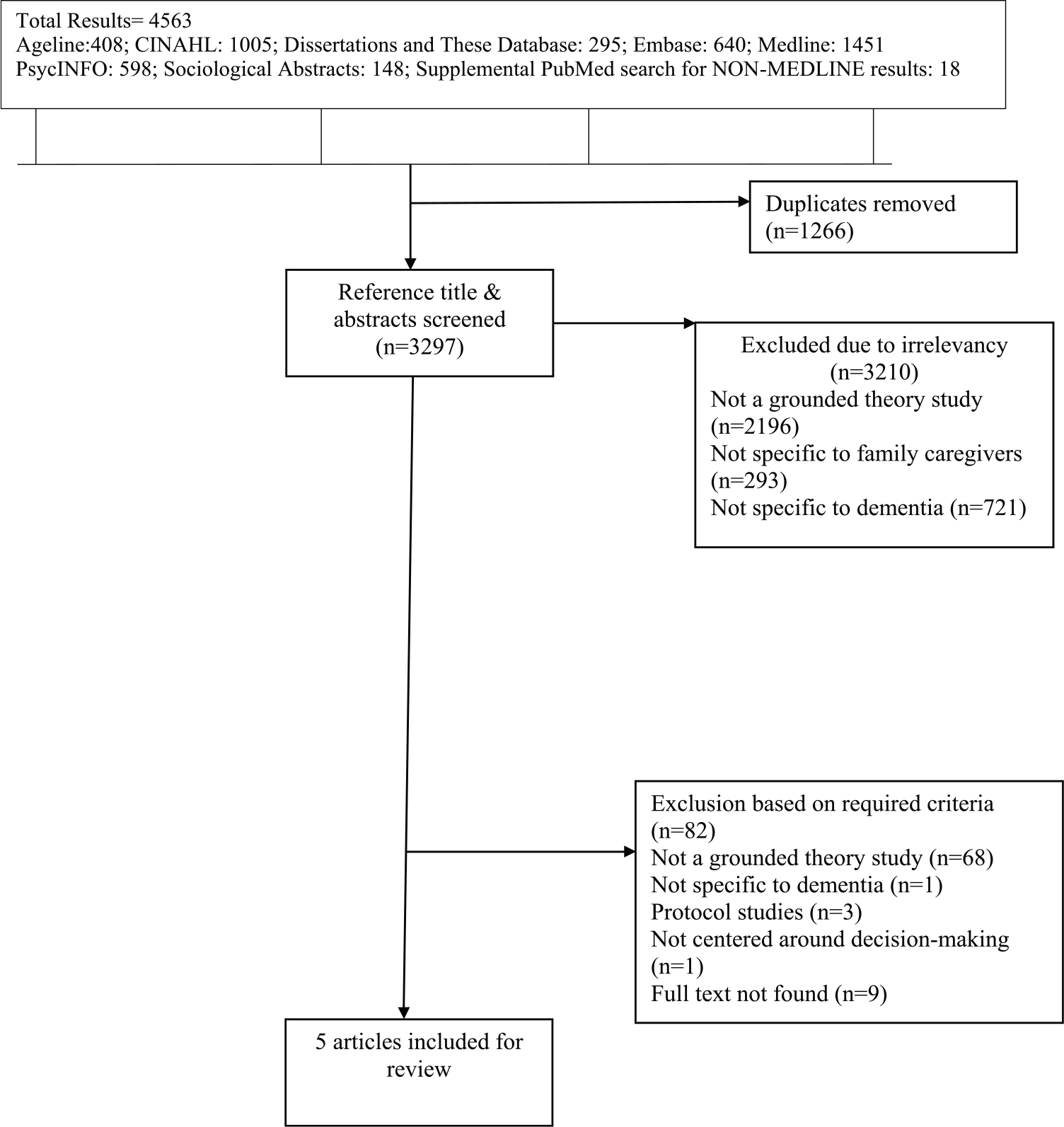
Article selection.
Our evaluation criteria were defined in light of the different procedures of grounded theory methodology. Three of the articles followed Glaser and Strauss’ (1967) grounded theory methodology (Caron, Ducharme, & Griffith, 2006; Caron et al., 2005a, 2005b). One study followed Charmaz’s (2006) constructivist grounded theory guidelines (Chang & Schneider, 2010). Corcoran (1994) did not follow a specific grounded theory methodology, which made evaluating this study difficult as grounded theory methods, like other qualitative methods, can only be systematically evaluated only if their principles and procedures are made explicit.
Caregivers saw the decision-making process as a series of steps by which they had various key responsibilities in the provision of care. The key components of decision-making processes include the different levels of care provided by family caregivers, the relationship and presence of family, and feelings of trust. The majority of decisions most often mentioned were about location of care, such as the decision to institutionalize. Caregivers’ extent of involvement in the decision-making process varied as decisions were often made in the context of the advice of other family members and health care providers.
Health Service Decision-Making Processes: Synthesis of Grounded Theory Studies
Corcoran (1994) posits that there are four levels of care provided by family caregivers of persons with dementia that require health care decision-making: anticipatory care, supervisory care, preventive care, instrumental care, and protective care. Much of the decision-making literature has focused on institutionalization. Caron and colleagues (2005) discovered that there are four major factors that are in play when looking into the best care possible for both the caregiver and dementia patients: quality of relationship, frequency, values and beliefs, and levels of trust. These factors are specific to interactions with the health care provider and caregiver.
Researchers state that it is essential to construct a quality relationship over time (Caron et al., 2005a). When looking into Chinese families specifically, it is observed that most caregivers are worried about the negative impact of dementia behaviors from their parents; it has ongoing effects on family life pattern and relationships (Chang & Schneider, 2010). However, quality of relationships is not influenced by the frequency caregivers spend with the care recipient.
Researchers have also found that the presence of family values helps facilitate decision-making, which avoids negative sentiments such as guilt associated with ceasing treatment (Caron et al., 2005a) and helps family members “guess” what their loved one would like done (Corcoran, 1994). Moreover, having a level of trust may alleviate some of that guilt family caregivers feel when letting health care providers take initiative to make health care decisions. The care team intervenes in the best interest of the caregivers’ relative (Caron et al., 2005a). However, a feeling of failure is shared among many caregivers, and placing a loved one into a nursing home is a painful and stressful experience for caregivers (Chang et al., 2010). The guilt associated with placing a family member into an institution may be one of the consequences of placement.
Evaluation of Adherence to Principles of Grounded Theory Methodology
Authors of five studies in the area of decision-making from the perspectives of family caregivers labeled their methodology as grounded theory. Each study identified to some of the principles of grounded theory, but not all. All of the studies except for one were characterized under one of the three types of grounded theory—Glaserian, Straussian, or Charmaz (Caron, Ducharme & Griffith, 2006; Caron et al., 2005a, 2005b; Chang & Schneider, 2010), with three of them using the Straussian Grounded Theory (Caron, Ducharme, & Griffith, 2006; Caron et al., 2005a, 2005b) and one of them using Charmaz’s Constructivist Grounded Theory (Chang & Schneider, 2010). All of the studies except for one used inductive reasoning to test caregiver decision-making (Caron, Ducharme, & Griffith, 2006; Caron et al., 2005a, 2005b; Chang & Schneider, 2010). Furthermore, three of the studies performed constant comparative analysis (Caron et al., 2005a, 2005b; Corcoran, 1994) allowing for the enrichment of substantive theory (Caron et al., 2005b), emerging of a taxonomy of meaning allowing for each caregiver’s story to be told (Corcoran, 1994), and coding of the interviews (Caron et al., 2005a). Only two studies mentioned about the use of line-by-line/dimensional analysis which was used in addition to constant comparative analysis, to code each interview (Caron, Ducharme, & Griffith, 2006; Caron et al., 2005a). Finally, only two studies stated that they used theoretical memoing throughout each stage of the study (Caron, Ducharme, & Griffith, 2006; Corcoran, 1994).
At the same time, there were some grounded theory principles that were not adhered to by any of the studies that were analyzed. All of the studies did not state a broad research question. None of the studies carried out simultaneous data collection and analysis in accordance to the grounded theory principles. Finally, none of the studies carried out a literature review, although the role of literature reviews vary among grounded theorists (Dunne, 2011).
Discussion
The aim of this study was twofold: first, to identify what evidence has been generated from grounded theory studies that helps explain decision-making processes of caregivers of persons with dementia. The second aim of the study was to apply a tool designed by the researchers, to determine the prevalence that grounded theory methodology has been used to guide research investigating decision-making processes of caregivers of persons with dementia.
Our review highlighted various factors that influence the caregiving process including the key responsibilities caregivers enact in caring for someone with dementia across the illness trajectory and the context of the family dynamic. Caregiver involvement in decision-making indicated various levels of influence from health care providers and other family members. Our data illustrate that the majority of decision-making dementia caregivers face is in relation to choices about institutionalization. A lack of alternative choices for health care delivery precludes the use of any decision-making process by caregivers in terms of health service utilization. Many caregivers report negative feelings throughout the decision-making process, which can be counteracted by feelings of trust.
This scoping review identified five grounded theory studies that met our inclusion criteria (Caron, Ducharme, & Griffith, 2006; Caron et al., 2005a, 2005b; Chang & Schneider, 2010; Corcoran, 1994). The limited number of articles that met our scoping review criteria is an important finding in itself (Peterson et al., 2017). This indicates a limited representation of grounded theory dementia caregiving research in respect to health care decision-making. One of the assets of using grounded theory methods is that it moves beyond mere thematic description into richer explanation of processes; thus, there is future potential that grounded theory methodology may have in helping to expand knowledge and theory on the topic of decision-making processes for caregivers of persons with dementia (Charmaz, 2006, 2014). Given the complexity of health care decision-making for caregivers of persons with dementia, there is a need for methodologies, such as grounded theory, that can help elaborate an explanation about complex processes. Findings from the five included studies moved beyond qualitative description of participant experiences to a better understanding of the processes dementia caregivers construct health care decisions. These studies identified key components of the decision-making process and factors which described their influence (Caron, Ducharme, & Griffith, 2006; Caron et al., 2005a, 2005b; Chang & Schneider, 2010; Corcoran, 1994).
Interestingly, while all of the studies’ authors labeled their methodology as grounded theory, none of them met all of the criteria of a grounded theory study as identified through our evaluation tool. Only four of the studies classified their methodology as one of three types of grounded theory (Caron, Ducharme, & Griffith, 2006; Caron et al., 2005a, 2005b; Chang & Schneider, 2010) and only one of these studies identified using a constructivist approach (Chang & Schneider, 2010). There is a potentially untapped source of understanding caregiver processes that can help explain how caregivers make health care decisions. Understanding the processes caregivers undergo to make health service decisions can help inform service delivery that better supports decision-making for care partners facing the challenges of dementia. The results of effective interventions that meet the needs of family caregivers when making decisions that stem from a better understanding of care processes can be disseminated for use by researchers and practitioners to test their effectiveness.
The focus of our scoping review on processes of decision-making for dementia care explicitly centered on those studies using grounded theory methodology. This is not to suggest that other types of literature review methodologies or qualitative research methodologies do not produce valuable contributions to this field of knowledge. For example, a meta-review conducted by Gilhooly et al. (2016) demonstrated that caregivers to persons with dementia receive health-related benefits from psychosocial and psychoeducational interventions that are aimed to address the psychological stress and physical ill-health they face as a result of caregiving. A literature review by Cheng (2017) also provided an overview of the determinants of caregiver burden. This is helpful because dementia caregivers been repeatedly been acknowledged to have chronic stress, due to the high level of daily stress that caregivers experience, but without much clarity on which of the challenging aspects of dementia care (e.g., dealing with neuropsychiatric symptoms and impairments in activities of daily living), lead to the most caregiver burden. Neither of these recent reviews focused on decision-making processes. The literature review conducted by Xie et al. (2018) centered on end-of-life decision-making by caregivers of persons with dementia and concluded that it is an understudied area. Greater research is needed to produce tools and educational materials to help guide caregivers in the decision-making processes for persons with dementia who are end-of-life (Xie et al., 2018). Finally, a systematic review by Daly et al. (2018) did explore the processes of engaging people with dementia themselves in shared decision-making. Daly et al. (2018) demonstrated the confusion and lack of clarity that continues to exist in decision-making processes for people with dementia. Our scoping review helps add to this body of knowledge by suggesting that there is a greater role for grounded theory methodology to help provide greater depth and clarity on decision-making processes of caregivers for people with dementia.
Qualitative research studies have contributed largely to the field of dementia caregiving research. Although research on dementia and decision-making has increased in its breadth, few studies have examined the processes caregivers go through when making health service decisions. There is an acute paucity that grounded theory methodologies could help advance this area by helping to uncover the processes caregiver undergo when they make health care decisions on behalf of their care recipient with dementia. Future grounded theory studies are encouraged to adhere to the guidelines of the methodology. We also urge future studies to provide explicit details about their methods to help highlight distinguishing methodological features of grounded theory methodology. Many of the included studies did not provide explicit detail of their methods, although we acknowledge that this may be due to word count limits by the publishing journals. In this domain, as there are so few studies it is important that researchers are elaborative in their methods, so that other researchers in this domain can know and distinguish between methods (i.e., those used in grounded theory) used to uncover complex processes, such as caregiver decision-making. In addition, as grounded theory is not homogeneous, authors should cite the specific branch of the methodology, to help discern the appropriate methods used.
Presently, grounded theory studies in this area do not explicitly state their research question, as evidenced by this review. Thus, researchers are encouraged to explicitly state their inductive research question(s) to help orient readers into the aim of the study, even if the research question(s) naturally evolve (Charmaz, 2006). Precisely framed questions can help readers to better understand the specific areas of a potential theory that can help further an interpretation of the phenomena being studied. Moreover, this can help to provide additional reasoning to why methods were deliberately chosen. We also urge that researchers employing a grounded theory methodology include some account of their reflexive role and how they and other involved researchers impacted on the research process.
Health services research is a multidisciplinary field of which includes aiming to better understand processes and personal behaviors. In the specific domain of understanding dementia caregivers’ processes and personal behaviors related to health care decision-making, few qualitative studies employ a grounded theory methodology. This raises the question of what other qualitative methodologies and methods are being used in this complex domain that may provide rich explanations of decision-making processes. Grounded theory can be applied to help advance this area to help bring rigor to the analysis of qualitative data and lends itself well to understanding key processes in health care decision-making from the participant perspective (Charmaz, 2014). In better understanding family caregivers’ preferences for services and experiences of decision-making, those working with family caregivers can develop support strategies to support the decision-making process that does not add to caregivers’ existing levels of burden. Caregivers may also benefit from interventions that support different decision-making process, such as preferences for receiving information, which can influence their provision of particularly services and the overall factors which influence access to particular supports. With this information, the structure support and information provided to caregivers may be tailored to their individual needs.
Limitations
Only English, peer-reviewed literature was searched for and analyzed, thus excluding grounded theory literature that may exist in gray literature or in other languages. Only a small number of studies were included. The evaluation check list used to analyze the articles has not been validated by researchers external to this project. Future research is needed to validate our tool. Finally, although consistent with the aims of this research, by excluding field research that did not employ grounded theory we acknowledge numerous studies have been omitted that may help clarify the process of decision-making of persons with dementia (i.e., Wackerbarth, 1999).
Conclusion
Many community-dwelling individuals with dementia are being cared for by family caregivers (Dupuis et al., 2004). Family caregivers are often required to make health care decisions on behalf of loved ones with dementia, especially as the disease progresses. Considering the scarce research on health service decision-making from the perspective of family caregivers with dementia, and lack of grand-theories in the area, grounded theory is a justified methodology to advance the field of dementia caregiving research. However, despite the potential of grounded theory in this area, we were only able to find five peer-reviewed studies that claimed to use a grounded theory methodology. None of these studies adhered to all the principles of grounded theory. This suggests now that we need to create an awareness of the scientific merit required of grounded theory research and promote the use of quality standards in grounded theory research practices to help advance the area of dementia caregiving research. The existing studies highlight components of caregivers’ decision-making processes, which include the different levels of care provided by family caregivers, the relationship and presence of family, and feelings of trust. Clinicians can use these findings to help caregivers make decisions. Clinicians can also consider the various factors that influence caregiver’s decision-making processes and how they make decisions when making care plans. By understanding the decision-making processes of caregivers to persons with dementia, policy and practice recommendations can optimize access and availability of services to support caregivers and people with dementia. Moreover, advancing qualitative research that aligns with the complex experiences of caring for individuals with dementia is central to optimizing caregiver support in the community.
Supplemental Material
Appendix_ASupplementary_Material-_Sample_Search_Strategy – Supplemental material for How Dementia Caregivers Make Health Service Decisions: A Scoping Review and Implications for Grounded Theory Studies
Supplemental material, Appendix_ASupplementary_Material-_Sample_Search_Strategy for How Dementia Caregivers Make Health Service Decisions: A Scoping Review and Implications for Grounded Theory Studies by Kristina M. Kokorelias and Rachelle Ashcroft in SAGE Open
Supplemental Material
Supplementary_Table_1-_Evaluation_Tool_for_a_Grounded_Theory_Study – Supplemental material for How Dementia Caregivers Make Health Service Decisions: A Scoping Review and Implications for Grounded Theory Studies
Supplemental material, Supplementary_Table_1-_Evaluation_Tool_for_a_Grounded_Theory_Study for How Dementia Caregivers Make Health Service Decisions: A Scoping Review and Implications for Grounded Theory Studies by Kristina M. Kokorelias and Rachelle Ashcroft in SAGE Open
Supplemental Material
Supplementary_Table_2-_Data_Extraction – Supplemental material for How Dementia Caregivers Make Health Service Decisions: A Scoping Review and Implications for Grounded Theory Studies
Supplemental material, Supplementary_Table_2-_Data_Extraction for How Dementia Caregivers Make Health Service Decisions: A Scoping Review and Implications for Grounded Theory Studies by Kristina M. Kokorelias and Rachelle Ashcroft in SAGE Open
Footnotes
Declaration of Conflicting Interests
The author(s) declared no potential conflicts of interest with respect to the research, authorship, and/or publication of this article.
Funding
The author(s) received no financial support for the research, authorship, and/or publication of this article.

Supplemental Material
Supplemental material for this article is available online.
Notes
References
Supplementary Material
Please find the following supplemental material available below.
For Open Access articles published under a Creative Commons License, all supplemental material carries the same license as the article it is associated with.
For non-Open Access articles published, all supplemental material carries a non-exclusive license, and permission requests for re-use of supplemental material or any part of supplemental material shall be sent directly to the copyright owner as specified in the copyright notice associated with the article.
