




Abstract
Within a changing global consciousness for international guardianship of the targets of terrorism, this article explores the broad narratives, strengths, and limitations of adopting community policing for the control of herdsmen terrorism in West Africa. It follows the search by social engineering and criminal justice practitioners for a relational and experiential agent for social change against destructive terrorist tendencies and its eroding influence on the sensibilities of human civilization. The article frames an approach for creating a social policing environment in rural and poor communities along pastoral transhumance routes in West and Central Africa. The mass murder of indigenous communities by the migratory and transborder terror groups in this region is a crime against humanity. The adoption of the concept of “connected communities” is suggested to create a multilayered and all-involving intelligence community policing shield in individual communities under siege of the pastoralists.
Introduction
Our herd is our life because, to every nomad, life is worthless without his cattle. What do you expect from us when our source of existence is threatened? The encroachment of grazing field and routes by farmers is a call to war. (Awogbade et al., 2016, p. 3)
Terrorist activities by ethnic Fula herdsmen in West Africa, called the “Fulani,” result from the need for better pasture land as desertification direct their search inward and down south. Another explanation is that the herdsmen act to protect their herds from cattle thieves and rustlers (Awogbade et al., 2016; Gefu & Kolawole, 2002). However, in many West African nations, cattle herdsmen attack Christian churches and destroy entire villages and farming communities that neither rustle cattle nor pose any hindrance to those nations’ pastoral activities. In a twist to this case, Fulani Muslim herdsmen in Nigeria carry out these attacks alongside Muslim Nigerian soldiers (“The Suffering Church,” 2019). The Global Terrorism Index (GTI) rates the Fulani herdsmen militant groups, which operate mostly in Nigeria–West Africa and the Central African Republic, as the fourth deadliest terrorist organization in the world. In 2014, Nigeria witnessed about 7,512 terrorism-related deaths (Buchanaan, 2015). A significant characteristic of this terrorist group is its use of pastoralist symbolism as an object to enhance and upscale its influence and to camouflage its real dimensions and intentions. The term Pastoralists as used throughout this article accurately presents the original identity of the Fulani herdsmen as cattle farmers. The seeming reluctance to arrest and prosecute the perpetrators of these violent crimes leads many to relate these activities to what David Luban (2004) referred to as crimes against humanity.
West African communities and families increasingly under siege of nomadic terrorists are seeking ways to address threats from these new agitators of social disorder and crime. Currently, they are ill prepared to handle these situations of social disorientation. Durkheim described social order as a set of shared social norms (Hechter & Horne, 2003). Social order depends on the laws and the cohesive powers of the state; it also relies on the internalization of its attributes by the individuals who make up the state (Hechter & Horne, 2003). Placing these laws and norms within the social fabric of communities increases the impact of policing on the citizenry (Alpert et al., 1998; Greene & Pelfrey, 1997; Rosenbaum & Eck, 1994; Skogan, 1998). Professional terrorism security specialists seek ways to work together with diverse populations like Muslims to ensure their public safety and to protect them from being treated as pariahs. These specialists suggest that reducing the threat of terrorism requires increased vigilance and new and unorthodox ways of policing (Innes, 2006; Miller et al., 2014). However, very little has been said about an inclusive program for the cattle herdsmen of Western and Central Africa and the feasibility of configuring such a program. How can African nations include nomadic pastoralists into a culture that appreciates public and community safety? In a sense, global terrorists cannot survive if their ability to recruit converts from small local communities across the world is compromised in any major way. However, in the case of the pastoral Fulani terrorists, terrorism is seen as a sufficient tool to retain grazing land, which, in turn, would ensure the survival of the Fulani culture that is predicated on a tradition of pastoral cattle rearing (Awogbade et al., 2016). This group has a ready army of waiting recruits spread across Western and Central Africa. It comprised members of the pastoralist Fula (Fulbe) tribe, which believes in an ancient right of access to the regional pasture lands. The creation of European-style sovereign states and boundaries in Africa had voided those ancient pastoralist transhumance passages. Proactive intervention against the growing pockets of terrorist ideals around the world leverages community-based security systems by strengthening communities as agents of social control; this should include the reinvention of the pastoralist system from a cultural narrative, which diverges, somewhat, from the modern state system (Awogbade et al., 2016). However, it is essential that the process of community policing of terrorism does not entrench a state of community control (Jiao, 1995).
This article reviews the historical roots and successful practices of community policing in Western and Eastern cultures and addresses its legitimacy to control herdsmen terrorism in a world that has changed, significantly, since the times of the tithings. It commences with the examination of the evolving narratives on pastoralist terrorism and the issues involved in the recreation of social policing. Subsequently, it explores the possible constituents of such social change agenda as well as the limitations to the adoption of community–police partnership to arrest the emergence of these fronts of local terrorism. It concludes by calling on West African nations to adopt multilateralism and a multiagency approach constructed under a new model of problem-solving community policing that involves connected communities and balances the formal requirement of individual rights and liberties with the needs of group survival.
Understanding Narratives on Pastoral Terrorism
Conflicting narratives about the purposes and the causes of the killings by pastoral Fulani herdsmen in West Africa pose the greatest challenge to the development of solutions by national governments (Blench, 2004). Agencies of government and powerful individuals exacerbate this problem when they consider political persuasions and ethnic orientations more paramount than a crisis that is fundamental to their nation’s existence. In the past decade, the most serious of these incidents have occurred within Nigeria and its neighboring peripheries, giving rise to various narratives about the nature of the problem. Nigeria’s population of about 170 million inhabits a land area of 923,773 km2. About 41.9% of the nation’s 81 million hectares of arable land are under agricultural cultivation. Livestock production stretches from the Sudan and Northern Guinea savanna areas into Nigeria’s arid, semiarid, and subhumid central regions. The pastoralist moving through ancient transhumance routes control 90% of the livestock in Nigeria (Gefu & Kolawole, 2002). Uji (2016) estimates that between 1990 and 2015, the conflict between the pastoralists and farmers has cost thousands of lives and an annual loss in income of US$14 billion (Ogundipe & Josiah, 2016). Compared with about 2,500 deaths that occur, annually, in Nigeria due to the Boko Haram insurgency, about 1,229 and 2,000 deaths were recorded in herdsmen-related conflicts in 2014 and 2015, respectively (Amzat et al., 2016). The conflict has created thousands of internally displaced persons (IDPs) living under IDP shelters across the north central region of Nigeria (Uji, 2016). The West Africa region appears to be under siege of the pastoral terrorist. A similar situation reported in the nations of Niger, Mali, Ghana, and the Chad Republic indicates that deadly clashes between the pastoralists and farmers and ordinary villagers and members of their host communities are rampant. These cases include rape, arson, murder, and armed robbery (Awogbade et al., 2016). Figure 1 shows the spatial distribution of terrorist incidents by Fulani herdsmen between 2002 and 2017. It shows 510 attacks by the Fulani extremists from data recorded by the University of Maryland–based GTI. The movement of such incidents toward Nigeria from Mali, Niger, and Burkina Faso, and the Central African Republic and Cameroun, on the west and east of Nigeria, respectively, is an indicator of the transboundary routes of migratory pastoralists who carry out a significant proportion of these attacks. The depiction of international transhumance corridor in Figure 2 (Moutari & Giraut, 2013) shows multiple routes for the transborder movement of herdsmen in West Africa. Access to multiple routes may explain the ease with which transborder migration of pastoralist terrorism occurs. In addition, Figure 3 shows that the Fulani terrorist attacks peaked in 2014 and 2016. Incidentally, 97% of these attacks occurred on Nigeria’s side of the transhumance corridors. The upsurge in these attacks has been linked to the presidential campaigns and eventual election of Muhammed Buhari, a retired army general, and a Fulani tribe’s man as the president of Nigeria in 2015. Since President Buhari’s election, Fulani tribesmen parade the cities and hinterlands across Nigeria with military-grade machine guns and weapons.

Map of West and Central Africa showing location of terrorist incidents by Fulani herdsmen between 2002 and 2017.
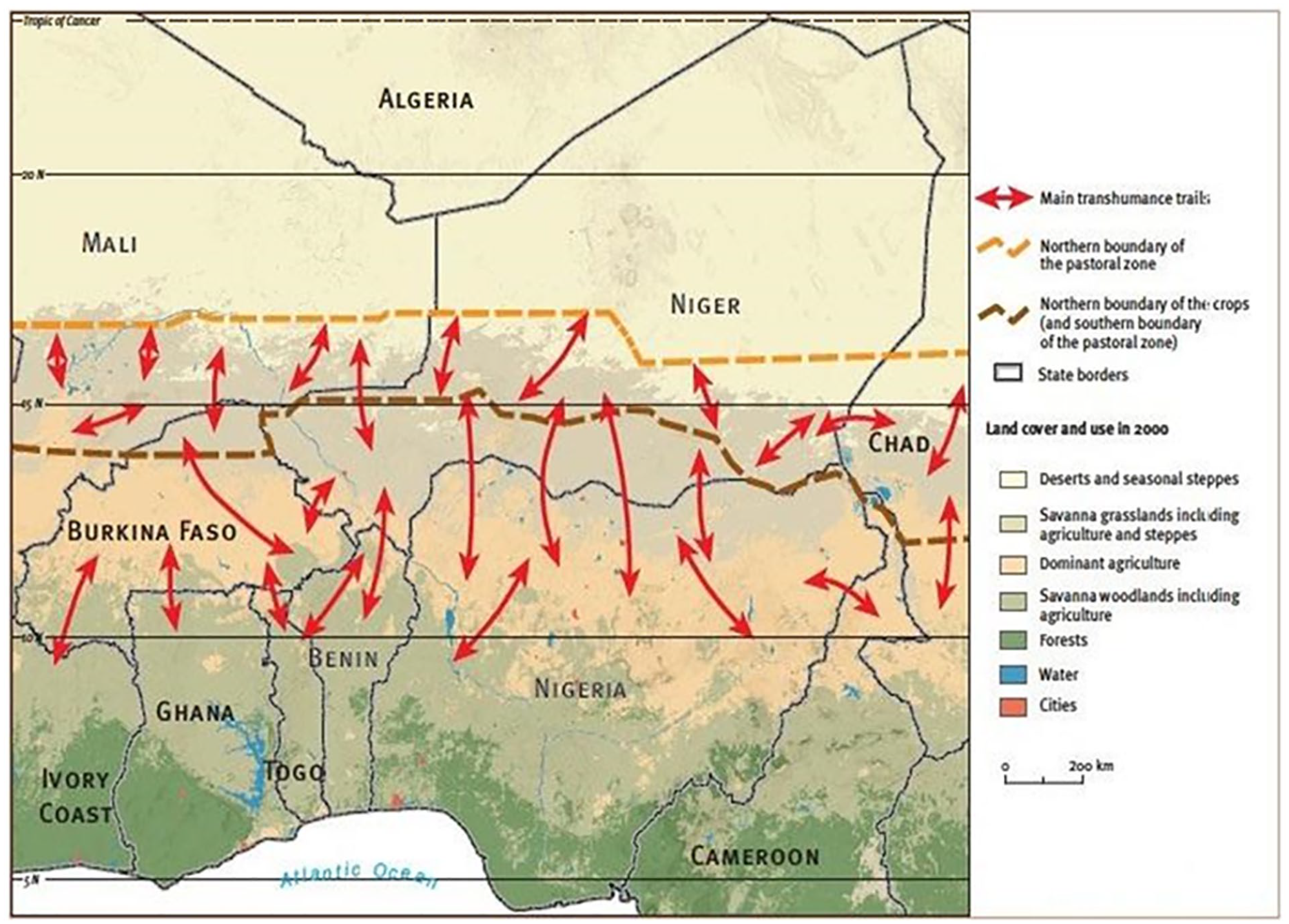
International transhumance corridor in West Africa.

Plot showing the distribution of terrorist incidents and deaths by Fulani herdsmen between 2002 and 2017.
A Nigerian coalition of public policy experts tagged “The Nigerian Working Group on Peace Building and Governance (NWGPBG)” raised some political dust when they recommended what they termed a strategic solution to this phenomenon. The group observed that pastoral terrorism is a direct conflict between pastoral Fulani herdsmen and farmers, noting that both groups are equal victims of the conflict. In a memo published in January 2018, the group explained that pastoralism is a rational but misunderstood livestock management system that is rooted in history, environment, parasitology, economics, and climate in Africa. The growth of population, loss of grazing land to agricultural expansion, blockage of transhumance old pastoral route, and the intensification of desertification in Africa due to climate change resulted in the movement by the pastoralists in the South to search for better grazing land for their livestock (“Pastoralist-Farmers Conflicts and the Search for Peaceful Resolution,” 2018). The central theme of this narrative is that pastoral Fulani-led terrorism is a conflict between cattle herdsmen and farmers and the outcome of years of government neglect and underdevelopment of the rural agrarian and livestock production economy. Among the solutions suggested by the group to stop the conflict are the development of Nigeria’s vast acres of grazing reserves, the enactment of laws that will establish such reserves, and the revisiting of a past 1965 Grazing Reserve Law that prevents state governments from prohibiting open grazing in the middle belt (north central) and southern regions of the country. Although the group noted that pastoralism is not a sustainable livestock management system in Nigeria, it advised against the prohibition of the practice in the short term for cultural and political reasons. The NWGPBG implied that constitutional laws that guaranteed free movement of people and goods by intent also guaranteed open grazing. In sum, they advocated that the Nigerian government should commission a study to understand the etiology of the conflict and the development of livestock ranch management by the military. The group also recommended the control of Boko Haram insurgency (sic), digital tracking of cattle, and control of hate and dangerous speech, including the use of pastoralism to control greenhouse emission (“Pastoralist-Farmers Conflicts and the Search for Peaceful Resolution,” 2018). It is notable that this working group comprised individuals who hold important policy- and decision-making roles in Nigeria and in academia and, thus, represents a major narrative constructor of this phenomenon. However, this group seems to have glossed over the fundamental fact that pastoralism, by any means, cannot explain the senseless killings of thousands of Nigerian citizens by individuals bearing all manner of mass killing weaponry, for example, AK47s. Moreover, the group failed to mention the public’s despair, or the widespread perception that Nigerian security forces are unwilling to arrest the herdsmen.
Recently, the Nigerian government has intensified plans to set up settlements for the nomadic Fulani herdsmen across the nation’s 36 states against the wishes of the indigenous communities. The settlements known as the Rural Grazing Area (RUGA) settlements is believed to be politically motivated to resettle the nomadic Fulani herdsmen in Nigeria without the consent of the land owners as described in the Nigeria Land Use Decree enacted by Federal law in 1978 to standardize the administration of land. This law gave authority to state governments over all urban lands within the states, and vested authority over nonurban land to the local government administrations. However, in a diametrically opposite viewpoint contradicting the assertions of the NWGPBG, a speaker at the National Institute of Policy and Strategic Studies (NIPSS), an important and respected policy research body, has described the herdsmen–farmers crisis in terms of a trespass by the herdsmen rather than a conflict between both parties (Omotosho, 2019). The NIPSS is one of the most prominent centers for policy research and dialogue in Nigeria. According to the NIPSS release, the nomadic herdsmen are in trespass when they encroach on the farmer’s right of privacy on their lands. Because the farmers suffer trespass to land, goods, and possession from the herdsmen, the situation became belligerent. Because trespassing is a legal argument, the situation requires legal, political, and social solutions (Omotosho, 2019).
Seasonal agricultural practices, encouraged by market forces and a growing population, boost the conflicts between pastoralists and farmers. Gefu and Kolawole (2002) observed that with wetland (fadama) agriculture, farmers crop wetland areas during the rainy seasons. In the dry seasons, these wetlands are left fallow, allowing pastoralists to graze livestock. However, with an expanding population, wetland farmers engage in dry season irrigation to satisfy the demand for agricultural products. The loss of grazing land results in hostilities between the pastoralists and farmers. Two types of pastoralist reflect the nature of livestock keeping in Nigeria. These are the agro-pastoralists, who live on permanent settlements and engage in both farming and livestock management, and the migratory pastoralists, who live in tents and migrate through transhumance routes to graze livestock (Gefu & Kolawole, 2002). Clashes between migratory pastoralists and farmers have been ongoing since the colonial period in Nigeria. Just like the Fula, by the 18th century, both the herdsmen of the Shuwa Arabs and the Kanembu, who also inhabited the northern Sahel areas of Nigeria and Chad, were having similar clashes with farmers along the Lake Chad Basin region (Maishanu & Maishanu, 1999). However, these clashes are incomparable with the terrorism of the present day. The first attempt to take control of livestock pastoralism occurred during the colonial era, when the British imposed a cattle tax, called the Jangli, on each head of cattle (Awogbade et al., 2016). However, today, a third arm has been identified as a nomadic migratory pastoralist group, shifting its focus to agro-pastoralism by seizing space from farming communities through illegitimate means, for example, the use of terror. These groups of transborder nomadic Fulani, in alliance with bands of local migratory pastoralists, engage in kidnappings, murders, armed robberies, arsons, rapes, and targeted, carefully planned annihilations of entire communities (Awogbade et al., 2016).
Indeed, resource utilization as a source of conflict in different parts of the world is not new. With regard to the differences between two groups, the herdsmen’s perspective of the conflict must also be understood. As such, and in such a context, the term “conflict” must be adequately defined to avoid inaccurate attempts to adopt the generic expression as a new synonym for terrorism. The crises between the herdsmen and farmers, differ, fundamentally, from the terrorism. The terror from cattle herdsmen in West Africa today should present a critical source of concern for governments and citizens. Innes (2006) defined terrorism as a communicative action by which a group tries to use violence to influence public perception and attitudes by inducing fear and a sense of insecurity. The final objective of this process of communication is to topple the social and political order and seize legislative and executive authority from the majority. In a sense, terrorism is a process of strategic negotiation that leverages violence as a tool of struggle in the conflict for power. The discrepancies in individual and group narratives in defining the term terrorism is often intended to make it user friendly. Conflicts suggest the existence of some form of hostility and antagonism between individuals or groups. Conflict may emanate from, both, objective and subjective reasons.
When examining the term “conflict,” typologically, the resource utilization conflict described by the “The Nigerian Working Group on Peace Building and Governance” appears shortsighted because it reflects an economy-based type of conflict, because conflict, too, could be based on values where belief and ideological preferences exist between individuals and groups. Conflict also arises where hostilities and antagonisms emanate from the struggle for power (Aubert, 1963). It is not too difficult to see that the suggested conflict between the nomadic herdsmen and the landowning farmers may be an amalgam of all the three forms of conflict. Incidentally, the Working Group Report noted that it is difficult to prohibit pastoralists in Nigeria in the short term because of the strong cultural and political economy reasons for its existence. However, this article suggests that pastoralist terrorism can and should be prohibited. Although conflict is a process of social relationship, terrorism is not. Ethnic irredentism complicates the politics of Nigeria. The removal of the politics of pastoralist terrorism anytime soon is highly unlikely where Nigerian politicians choose ethnic and religious persuasions before issues of national security, civil rights, and justice.
By implication, the fear of herdsmen terrorism in West Africa is no less critical than the fears of other terrorist groups, for example, the Taliban, Islamic State of Iraq and Syria (ISIS), Boko-haram, and Alshaabab, which share similar value systems based on Islamic ethnoreligious sentiments. For instance, in north central Nigeria, which is populated by ethnic minority Christian villages, the pastoral terrorists have attacked and decimated one rural community after another, killing the residents and destroying property, and in many instances, they have taken over land and residence (Uji, 2016). Incidentally, the present crisis in Nigeria has both historical and colonial origins. The nomadic herders had no competition in their traditional grazing grounds around the Arid and Sahel regions of West and Central Africa. Climate change affected the environmental conditions of the Sahel and Arid regions deleteriously, including the important grazing areas around the Lake Chad Basin. This led them to the Guinea savanna and Rain Forests in search of pasture (Omotosho, 2019). The Fulani pastoralists are a part of the broader Fula (Fulbe) ethnic group, which originated as Muslim raiders from the Futa Jalon Highlands of Guinea. They migrated from Senegambia to Nigeria in the 13th and 14th centuries and acculturated into the Hausa culture of Northern Nigeria (Omotosho, 2019). These raiders overcame the Hausa States of Northern Nigeria in the 19th century, between 1804 and 1808, to establish the Sokoto Islamic Caliphate (See Ejiogu & Mosley, 2017). Figure 4a shows the spatial spread of the Sokoto Caliphate, comprising the northern, central, and a tip of Western Nigeria. This area also represents the primary center of the herdsmen terrorist activities in present-day Nigeria (Figure 4b).
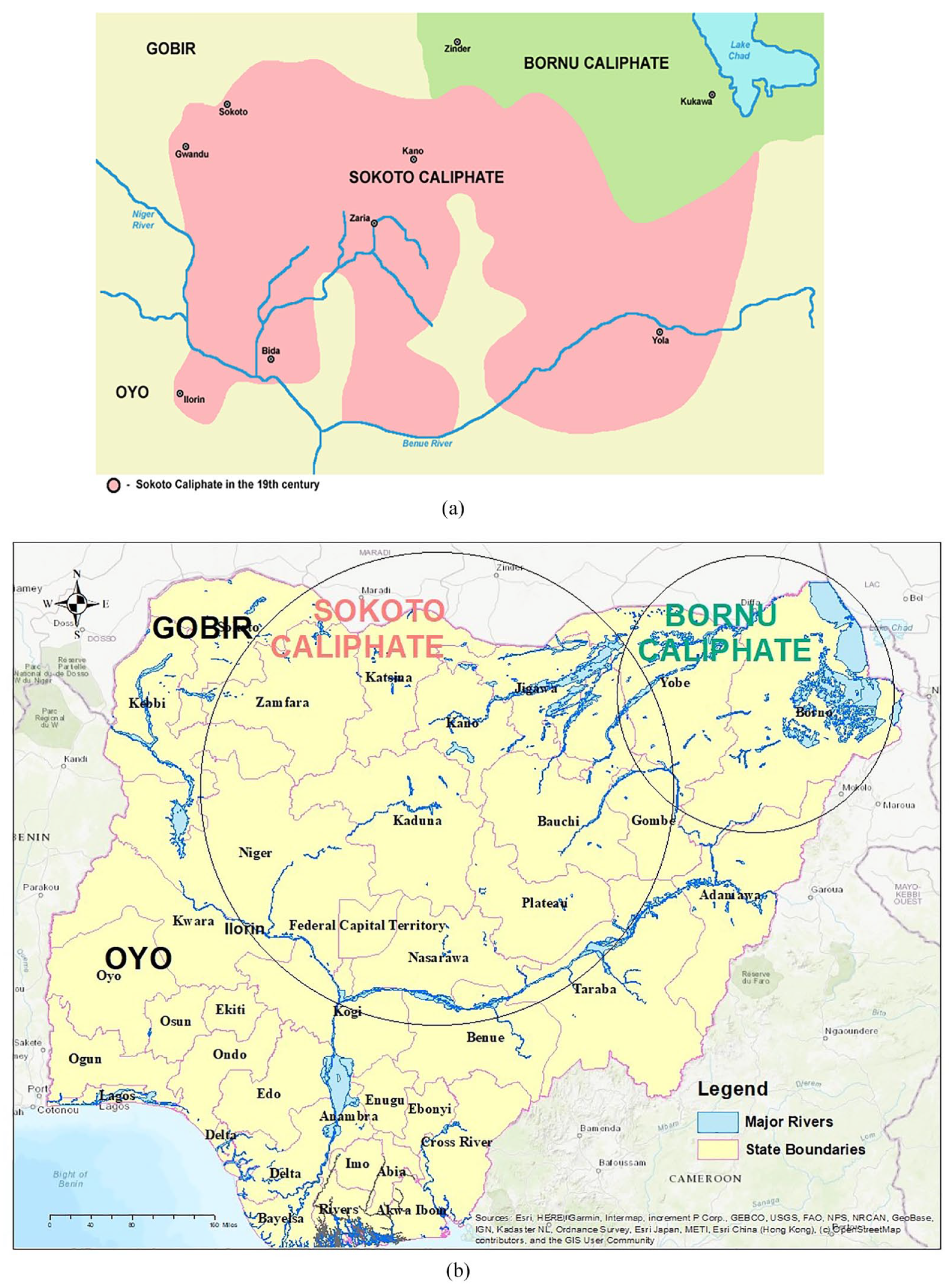
(a) Map showing the spread of the 19th-century Sokoto Caliphate comprising northern and central Nigeria and Ilorin in Western Nigeria. (b) Map of present-day Nigeria showing 36 states and the spatial spread of the Sokoto and Bornu Caliphates.
In the past decade, herdsmen terrorism has had an extended reach and has intensified in the areas below the confluence of the River Niger and River Benue, two rivers that appear to split Nigeria into the North and South. Under British colonial rule, the establishment of the northern protectorate of Nigeria brought hundreds of Christian minority ethnic groups and communities under the authority of the Fulani-led Sokoto Caliphate (Uji, 2016), an agenda of the colonial indirect rule structure. The Fulani tribesmen have since claimed the rights to this lineage of colonial domination of Nigeria’s economic, cultural, and political space. Interestingly, the present Nigerian president, Muhammad Buhari, a Fulani and retired military general, seems to have ignored all international and internal entreaties to arrest and reign in the terrorists. In the words of Uji (2016), The Fulani Islamic class of the North had an imperial interest in the spread of Islam and re-colonization of the central people of Nigeria. This imperial ambition marked the beginning of the process of the spread of conflict between herdsmen and rural farmers in central Nigeria. (p. 56)
It is noteworthy that the clashes between the herdsmen and the farmers intensified during two periods in Nigeria’s recent history. The first encounter occurred during the reign of Ibrahim Babangida, a Muslim military general, after he enrolled Nigeria into the Organization of Islamic Countries (OIC) in 1989 (Uji, 2016), and the second during the administration of the current president, General Muhammad Buhari. The NWGPBG recommends the revisiting of a legislative Act of 1965, which forcefully sought to establish grazing reserves in Nigeria’s Northern Region. Uji (2016), however, explained that the land reserve law was a deliberate political policy aimed at transferring land from farmers to herdsmen and facilitating the expansion of Islam in the north central region. As noted by Awogbade et al. (2016), More than a resource conflict between pastoral and sedentary groups, the pastoral nomadic Fulani onslaught since the 1990s have taken a war-like and criminal dimension—rampaging, killing and destroying communities in the northern and southern Nigeria. The use of this form of terrorism appears to be a tactical move to intimidate their host communities thereby paving the way for subsequent land-acquisition and capital accumulation (p. 10).
The destruction of property and decimation of entire communities by ethnic Fulani nomads across West Africa has reached such a crisis state that nudges one to borrow Luban’s (2004) phraseology of “crimes against humanity.” The phraseology underscores the complicity of Nigeria’s security infrastructure where these terrorists are not arrested or prosecuted. Luban ascribes this to crimes of the magnitude and senselessness that benumbs human legal and moral imaginations. In other words, such offenses aggrieve victims, their communities, and entire human civilization. The processes involved in the invasion and slaughter of men, women, and children from one community to the next in recent years, and especially since 2014 in Nigeria, would, in Luban’s words, cut into our core humanity, including into the principles that set us apart from other natural beings. The values that these pastoral terrorists violate include the quality of being human (Luban, 2004). These types of crimes do necessitate a redress not only from the victims but also from the state as the representative of our shared human heritage of humanness.
This article calls for the reintroduction of community self-regulatory mechanisms as shields against pastoral terrorism. Next, it discusses avenues for incorporating community policing as a security shield against the terrorists through the reactivation of everyday social policing environments.
Recreating the Social Policing Environments
In a way, internet-based social media communities represent a reorientation toward increased community interest in governance, public thought, and safety. As noted by Awogbade et al. (2016), the loss of grazing land affects age-old pastoral practices, and the use of violence, along with illegal transborder movement by nomadic Fulani herdsmen into Nigeria from Niger, Mali, Chad, and Cameroon to displace sedentary farming communities, fundamentally, constitutes terrorism. Controlling herdsmen terrorism in Western and Central African nations, and ensuring collective security in local communities, require, in part, an assessment of the degree of individual liberty that is expendable (Wang & Lumb, 2012). Informal police–public relationships, developed through community policing practices, serve as practical intelligence-gathering tools that protect communities from the threat of terrorist attacks and aids in the development of programs that shift pastoral cattle breeding to modern-style ranching. However, this requires an integration of the structure and function of community policing in different communities, based on their historical roots.
Wisler and Onwudiwe (2008) recognized that informal policing existed in many undocumented cultures in Asia, Africa, and Latin America in centuries past. These entrenched informal systems are still functional in some of these cultures despite the inroads of new state-controlled policing systems. They described these self-controlling societies as “Communities in search of a State.” These ancient modes of social controls include orders of jurisdictions and patrols. It appears that policing has always been a part of the nature and existence of society for protection, discipline, development to avert the atrophy of social norms. Dempsey’s 1994 account of the tithings provides an evolutionary trend of policing from a social control system, which was part and parcel of a community that communicated and interacted and refused to simply wait for a response to the exigencies of social disturbance. Subsequently, the police parted from the community and into a body that was, sometimes, entirely out of touch with its local setting (Sullivan, 1977). Depending on the circumstances, the police culture of dangerousness perceives citizens as both adversaries and abiding criminals (Weitzer et al., 2008). However, depending on demographic makeup, perceptions of the police by the public have continuously varied (Weitzer et al., 2008). Bordering on the historical colonial subjugation of Africans, people in sub-Saharan Africa perceive police units in their communities as stranger organizations. This perception is entirely at variance with the letter and philosophy of the evolution of social control from which the police derived their purpose. Comparing Eastern cultures, sub-Saharan African, and Western culture of policing with that of the United States, it is noteworthy that for Africa, the historical origins of policing, such as that which contends with the public as adversaries, has fundamental implications for the advancement of community-based control of the pastoralist terrorism referenced in this article. A solution to this lingering historical imprint requires an increased element of social policing within community policing.
Social Policing
Social change entails a reengineering and reprioritization of social attitudes and conformities. The social and physical environment of a rural community in Africa influences access by criminals (see Heirrstein & Wilson, 1986). Certain criminal attitudes in communities are due to specific characteristics of the class, culture, demography, socioeconomic status, environment, relationships and community social efficacy, and security consciousness. For instance, the ease with which the terrorist herdsmen have successfully operated in Nigeria, wasting the lives and properties of entire communities, typifies how disconnected new state communities in sub-Saharan Africa are from their direct security. Heirrstein and Wilson (1986) suggested that openness and surveillance within a community may reduce the crime rate. They observed that fewer eyes on the street encourage crime. Community surveillance, therefore, imposes some restrictions on the capabilities of criminals, including terrorists. Individuals could be controlled and better advised when a community changes its social priorities through neighborhood surveillance with organized, physical development around the group’s peculiar interests and persuasions.
Criminologists have opened up new viewpoints on the imprint of the social environment of criminality, and not just for factors of individual tendencies (Lynch et al., 2000). This understanding seems to suggest that reordering the social context will affect the level of social disorder and tendencies toward crime within society. However, this does not fully explain the crimes of terrorists, which aim to decimate the original residents and take over their space with impunity. Heirrstein and Wilson (1986) noted that in communities with insipid animosities from factors such as race, shared territories are highly unlikely to elicit change in crime control. Whyte (1993) also elucidated the territorial factor of crime. Based on the accounts of real participants, he noted that racial, ethnic, and socioeconomic boundaries limit the capacity of individuals to operate effectively outside the confines of their communities. These boundaries also determine people’s belief and appreciation of instruments of social control to which they are more likely to consent to within their boundaries than outside. However, for Chavez (1994), a community transcends ethnicity and physical boundaries and is identified by shared identity and norms. But, migratory Fulani pastoralists, in search of sedentary communities, oppose Chavez’s idea in its entirety. Lacking long-term pragmatism and socializing attributes, they, instead, believe in the annihilation of the existing community to occupy new lands (Awogbade et al., 2016). Studies have shown that fear of punishment from the police has limited effects on these criminal tendencies (Greenberg et al., 1982), and that labor-related social disorder and internalized political and cultural subjugation add its form of community criminality in poor and rural communities and ease terrorist targeting where the neighborhood is also the labor market (Heirrstein & Wilson, 1986). It is likely that terrorism has its firmest footholds in these rural communities.
By many accounts, terrorism is not a new phenomenon. The historian Xenophon described it in the times of the ancient Greeks (Flower, 2016). Although institutional enforcers cannot control all forms of social deviation within a community, Latane and Darley (1970) state that the presence of these enforcers is crucial to the legitimacy of deterrence factors. However, aside from the innovative approach of community policing, which sees the community as a partner in identifying and solving crime-related problems, the institutional orientation of traditional police, the hierarchical and functional structure may not be amenable to the flexible approaches to social engagement required for community order reprioritization (Goldstein, 1979). Such reprioritization is required to control community-based pastoralist terror. However, can community police go a step further to claim an informal role as a principal agent for social change and target hardening in rural communities under siege by pastoral terrorists? It is essential to assess the legitimacy of community in consideration of its application as a social change agency (Hawdon, 2008). One important perspective to consider is the utilization of community policing to increase self-regulatory behaviors and internalization of formal regulations among the citizenry. While accepting the possibility of intrusive elements of unconstitutionality that may arise with full engagement of citizens as agents of antiterrorist surveillance, the task of this article is to expand on the rights of the communities to protect their boundaries in times of such provocations as presently witnessed in several rural communities under siege and plunder of pastoral terrorism in West Africa—when citizens may be required to make some sacrifices, by letting go of some rights, if required, to maintain the integrity of communities and their ways of life.
Constituents of Social Change to Engage Terrorism
Historically, the line between national security and civil liberties has always been thin and fuzzy. The engagement of citizens as natural barriers of surveillance to prevent the advance of terrorism into local communities would invariably elicit conversations about the damage to civil liberties. Contradictions in defining the roles of traditional versus community-oriented policing (COP) units within the community are at the heart of many policing studies (Bayley, 1994a, 1994b; Famega, 2009; Goldstein, 1990; Sherman, 1995).
In many West African nations, such as Nigeria, the laws that regulate the police as a law enforcement agency also limit the concept of community participation in policing. As in other regions of the world, these colonial structures are intricately woven within the international systems. Drawing a full social change agenda for community policing may raise issues of legitimacy. Then, only by standing on the spirit behind the letters of the law, can the full-service implication of community policing be explored (Plousis, 1999). Although Plousis (1999) observed correctly that this is doable in the application of the philosophy of community policing, there still exists minefields in following these routes. It is important to identify certain perspective of the legitimacy, use, and limitations of community-oriented policing relevant to this reinvigoration of social change, order, and control as we explore the practical utility of community policing in the impending fight against Fulani nomadic terrorism.
Naturally, social change emerged from an inner and continuous search from societies to better their lot (Friedman, 1994). For instance, in nations such as postapartheid South Africa, it would not have been surprising to expect a policing style geared toward reengineering the distorted social order of the apartheid era, rather than having expectations that it would be utterly reactive. It is feasible to believe that the uncontrollable level of violence, terrorism, and other social discrepancies in South Africa could have been limited if legitimate agents of social change had employed proactive, soft social control powers to earn popular trust and legitimacy from communities. Policing style is vital for gathering necessary social capital required for effectiveness (Hawdon, 2008). Such community policing agendas may have also helped ameliorate the anger that Black youths feel in American society about the slave era. Blacks, then, viewed the police as club-wielding agents of subjugation.
In this era of terrorism, there is a need for collaboration across different policing cultures to prepare a formidable front within communities. That is because terrorism—as it has been witnessed in recent years—is not limited to any particular region or nation. It appears pertinent to examine Wang and Lumb’s (2012) call for the integration of Eastern program features into Western community policing—this time in sub-Saharan Africa. The idea is to create an effective policy process that would balance the Western ideal of individual freedom and the requirement for collective security for the entire society. The need to effectively marry both ideas of the optimal consensual society remains a significant problem for taking the war to the terrorists across the globe. Nations such as Japan have effectively integrated intelligence-gathering functions with the delivery of services to communities, under the Koban Community Policing System. Such service integration is equally true for Korea and Taiwan—once former colonies of imperial Japan. Police operational beats are the fundamental structure of community policing in Taiwan, traceable to the Koban system established during the Japanese occupation of Taiwan between 1895 and 1945 (Cao et al., 2014). Incidentally, Japan and Taiwan are considered to be among the 10 safest countries to live in the world. The need to collectively share intelligence to control terrorism was a primary motivator for the creation of the U.S. Department of Homeland Security. The department is an American security agency, in the same vein as the Secret Service, the Transportation Security Administration, and the Immigration and Customs Enforcement, and provides a platform for the sharing and integration of each agency’s unique functionalities, information, and talents to secure the U.S. homeland. However, because the administrative structure of U.S. police follows the structure of the U.S. federal system, the collective efficacy of policing in local communities is not practicable. This noncentralization is a significant weakness for the use of standard, cost-effective, and efficient program principles, just as it is a significant source of strength for protecting individual freedoms. However, collectively coordinated policies and programs have been increasingly adopted to target, monitor, and prevent the brand of ISIS-led terrorists from infiltrating and increasing fears in different communities across the West since the 9/11 attacks in the United States.
West African democracies such as Nigeria, with their collectivist federal units, are, arguably, structurally defective in many areas of democratic pragmatism, but appear all set to tap into this style of community policing. The police capabilities to integrate intelligence gathering and community policing in Asia make Eastern community policing more receptive and better prepared to resist the push by terrorists to create destruction cells in local communities. It should not be problematic in sub-Saharan Africa to abandon some freedoms in exchange for a more secure environment, just as Eastern nations have learned to conform to their police service systems in exchange for protection from communist threats (Wang & Lumb, 2012). In other words, as much as the social cultures of different societies have determined the uniqueness of policing, the threat of pastoralist terrorism can assist in adjusting policing in West Africa to control policies that will resist the mushrooming of terrorism for the sake of collective security. Unlike in the Eastern nations, which are used to policies of community control, the West, which controls global thought on the management of terrorism, is still nervous about the implications of community terror resistance on individual freedoms and liberties. However, as terror leaves its former government targets and moves into local communities in sub-Saharan Africa, a firm decision on the cost of a society’s security regarding freedom would be required.
The establishment of citizens’ academy in the United States through community policing strategies (Oliver, 2004) seems to have introduced a window of opportunity for a better relationship between the police and the people. In such academies, citizens are taught police duties, patrol operations, communications, about crime and investigation (Oliver, 2004) to have an appreciation of the job of the police, and equipped to play active roles as partners in the fight against crime. These forms of institutions could be adapted and structured to specifically target and diminish societal factors that ingratiate individuals toward the ideals of pastoralist terrorism through the encouragement of a multilateral and regional approach to control terrorism in West Africa, for example, the West African Police Chief Collaboration (WAPCCO) meeting on Transborder crime. Accordingly, community-oriented policing could be activated top down. That is, a situation where a community initiates moves to establish the program in its community (Friedman, 1994; Oliver, 2004). However, for each enforcement, monitoring and surveillance tactic, the limitations to police-led multiagency partnerships to control terrorism, such as intelligence gathering, must first be articulated in relations to the community-level and individual-level variables within a specific community.
Gathering Community-Based Intelligence
The secretive and subversive inform public perception of police and security intelligence (Innes, 2006). However, intelligence is all about gathering useful information to solve identified problems. Current models of intelligence gathering within communities by security agencies in many West African nations employ the services of the so-called informants. Informants are motivated under duress to telescope information, often leading to recall error. Information overload from many data sources affects persons across a broad section of human activities; however, gathering intelligence by distinguishing and leafing through massive amounts of data is much less appealing, compared with target, identifiable, and goal-oriented data from human agents. According to Innes (2006), in the United Kingdom, intelligence-gathering processes are more likely to be successful for gathering data about the threat from known places and people than for locating threats from unknown places and persons. This practice is particularly noteworthy for a West African terrorism face-off because the similar security attributes are applicable in other regions of the world. The internet and other technology-assisted sources for gathering intelligence provide a summary of threats compared with the use of individual human intelligence, which lead to the culprits or the precursors of the threat situations. Such information provides police intelligence units with the prerogative of maintaining both a high-level community intelligence relationship at sublevel community, group, and local relationships, thus creating a network of intelligence that is well informed about happenings within local communities—retrospectively and prospectively. Neighborhood policing creates a win-win situation for both the local police and communities by granting the communities a voice on police practices. Neighborhood officers generate enough trust to collect local community intelligence (Innes, 2006)
The use of community intelligence can help the police overcome the limitations and gaps in intelligence gathering that characterize their established processes (Innes, 2006). One of the advantages of community intelligence is that it provides the police with an accurate knowledge of the actual demographic makeup and the complex structural framework of communities that would be important for counterterrorism. Innes (2006) observed that, hitherto, police in the United Kingdom thought that communities comprised homogeneous ethnic or religious groupings.
However, he found from a direct interview of community members that even the so-called Muslim community was a complicated make of groups, factions, and rivalries—cultures and subcultures—that is a mix of different subcommunities. In the same approach, though nomadic Fulani herdsmen carryout pastoral terrorism in West and Central Africa, it is essential to underscore the make and structure of the active group. Spalek (2012) raised some pertinent questions about the engagement of communities for counterterrorism intelligence-gathering purposes. For instance, in Nigeria, traditionally, the police have not involved communities in countering terrorism. Among the knowledge withheld from the public by the police is the evidence of existing counterterrorism partnerships between the police and communities: How is it possible to establish partnerships between the police and Muslim communities to avert politico–religious tensions? How does the police intend to build trust in Muslim communities? What factors pose limitations to trust in the relationships? What is the implication of multiagency collaboration in this area? Spalek distinguished between two approaches for engaging communities in counterterrorism partnerships with the police, which she described as either community focused or community targeted. The community-focused approach appears to be the more pragmatic of the two. It is characterized by the existence of a partnership between the police and the community, the existence of voluntary consent and participation in the governance of the issues involved in the counterterrorism effort, as well as the existence of trust in the relationship.
Although it has been suggested that the level of neighborhood social cohesion and informal control has an inverse relationship to crime reporting (Black, 1976), with the proper direction and structuring, both variables could increase the reporting of terrorism and the isolation of terrorist factors and forces in urban residential neighborhoods and isolated rural communities. It appears more likely that communities in regions such as Asia and Africa with cultures of collectivism would have a stronger baseline of communal cohesion to advance this concept of open community policing. This aspect of community policing would target the spread of pastoralist terrorism across rural communities. Concerning intelligence gathering, Zhang et al. (2007) also found that neighborhood disadvantages, social cohesion, and easy control significantly influenced crime reporting.
West African nations can adopt a model of neighborhood policing, which encourages communities to act as a secondary intelligence-gathering unit for the police. Such a platform will leverage on the multiple fronts of connectedness of communities in a partnership with neighborhood police units to build parallel counterterrorism systems (Innes, 2006). According to Innes, a neighborhood policing intelligence-led model would have the capacity to consciously indicate the subtle suspicions that people have about untoward activities including terrorism within their communities, lessen the need for the use of covert policing tactics and freedom restricting legislation to build walls between the public and the police, and significantly reduce the uncertainty in policing terrorism by providing open information from the informal guardians of the neighborhoods themselves. The adoption of the proposed model that uses the members of the communities themselves as the fortifiers of a secure wall around their communities would lessen the current fatalistic recourse to preemptive actions, such as the use of drones by U.S. counterterrorism forces (Zuilaika, 2014). This model requires a shift away from what Neal (2014) described as security governance and security politics, both of which reflect the manner in which governments manage issues of security and the manner in which politicians defer to security that is similar to every other major crisis of interest to the public. For both, authority, governance, and ideas about security have more to do with the survival of their roles in the political sphere than about the critical existential reality of confronting the issues of security. This understanding of the true attitude of the executive branch and the politicians within the rhetoric and the repertoire of security provides a platform to address the gaps evident in how pastoralist terrorism is confronted locally and abroad by individuals in policy-making roles. According to Neal (2014), security situations are “events” that can make or break a government or a political career. One critical issue that is worth confronting is the farsighted approach adopted by governments and politicians to the security of nations (as evident in the United States) against the spread of global terrorism. The security officials and policy makers in governments across sub-Saharan Africa that are under siege of pastoral terrorists should realize that global terrorism has assumed the form of a political movement. Through various forms of appeal to emotions, sentiments, religion, brotherhood, martyrdom, and virtually everything else that would create a “we versus them” mentality among these youths, the officials and policy makers’ objective is to win the support of those young people in communities within these regions.
Valasik and Phillips (2017) draws some comparative analogies between criminal street gangs and terrorist groups such as ISIS. Based on a theoretical crime–terror continuum, they explained that criminals use tactics of terror such as bombing to prepare target spaces for criminal activities, and terrorists use criminal activities such as kidnapping to raise funds for their terrorist schemes. In Nigeria, the Fulani terror groups have been directly involved in many kidnapping incidents. It has also been reported the extremist seek ransom before releasing their captives—most of whom they fail to let go. The Fulani extremists support their operations through self-funding criminal activities such as kidnapping and extortion, and with funding from organizations and nation-states that support Muslim agenda to Islamize all of the West and Central African region. Valasik and Phillips note that understanding the criminal capabilities of terror groups provides the platform to impede their ability to cause fear and harm at will. Valasik and Phillips’ conceptual continuum would appeal to our understanding and linking of terrorism to a traditional crime pathway such as street gangs. Because the terror groups operate under an increasingly decentralized system, it makes them comparable with street gangs. However, it must be clear that the nature of Fulani extremism is not analogous to traditional street gangs in the context of Nigeria—where such gang forms do not exist in the street-designated groupings and do not function as identifiable criminal entities. Fulani terrorism appears more like a centralized plan for incursion into native indigenous communities under the pretest of searching for grass to feed cattle but with the primary purposes of seizing land by exterminating the indigent communities. From the point of view of their criminal activities, Fulani extremism in Nigeria appear decentralized, but the primary purpose follows a centralized control—that has received support from agents of the Nigeria government since 2015 (Uji, 2016).
As reported in Omotosho (2019), a major contributory factor to herdsmen extremism is greed and profit because feeding of cows by nomadic herding costs nothing. Other causal factors include intertribal and cultural rivalry, mutual suspicion, illiteracy, population explosion, and global warming. This article contends that the containment of pastoralist terrorism does not rely upon any special overexertions with complex strategies or on the use of costly armaments and technologies. In reality, if the ability to recruit converts is significantly curtailed, pastoral terrorism cannot survive or export its criminal ideas. Following Innes’ (2006) terrorism containment model, the article argues that the following simple, inexpensive, and doable strategies—if applied consciously and with commitment—would hinder the growth and the spread of nomadic transborder pastoral terrorists, creating a system of intelligent–connected communities:
The public security officials need to take stock of what the communities know about pastoralist terrorism within their communities and neighboring areas and what they can do to help.
Engage influential figures in the community as partners in the policing of terrorism.
Support groups within rural communities that provide counterarguments to radicalization to isolate the terrorists.
Development of formal schooling processes for the education and socialization of the nomads who seem to have been left behind by the legal and social processes relevant to land privacy matters.
Support projects that create social efficacy in pastoralists and sedentary communities so that community members would have greater ownership over their communities more than the terrorist infiltrators and trespassers.
For intelligence gathering, create stacked administrative and monitoring systems made up of increasing dimensions of communities within communities; this could be viewed as intelligence-connected communities.
Because pastoral terrorism itself has assumed the form of a pragmatic political movement for land acquisition and capital accumulation, make conscious efforts to shift away from the usual security politics to directly engage in the existential reality of terrorism in communities by governments and political actors.
Creation of state-specific antigrazing and forest monitoring laws.
Public security officials should make conscious efforts to grow public partnerships and improve public perceptions of their service through engagements in social and political activities within target communities.
Because a major strategy of terrorism is to create moments and perceptions of uncertainty, counterterrorism efforts by state security agencies should include community-based platforms for addressing public uncertainties and fears.
Based on the concept of connected communities and connected security agencies, encourage collaborations and joint training and operations of West African transborder security agencies.
The Concept of Interconnected Communities
The concept of connected communities advances projects to improve the well-being of communities through advanced smart, intelligent technologies. These technologies facilitate effective and cost-efficient systems, which run infrastructures and other social, economic, and environmental requirements of the community. In which case, intelligence is at the core of the essence of these communities to provide them a leading edge. Based on the concept of connected communities, this article advances a similar notion of deep connectedness, but in this a case, where one community is passing intelligence to another, which, in turn, passes intelligence to the next, ultimately, forming one basket of interconnected communities. It also imagines communities as locations where some relationships exist among individuals. In each community, collaborations, conflicts, power sharing, and representation are understood and managed. These relationships enable the development of social efficacy and social networks required for deep, mutually beneficial collaboration among its members. Each can be configured as a node, connected by superhighways of transhumance corridors. Each corridor branches out into pathways and subtributaries linking these nodes. The necessary superstructure of this intelligence system is the transhumance corridors.
The sketch below describes a model of communities connected by intelligence sharing (see Figure 5).

A schematic framework of connected communities.
This model can adopt advanced intelligence-led policing (ILP) systems that analyze incidents and spatial locations to develop its management practices and to make decisions. The model creates a web of real-time intelligence that can be utilized by security agencies to prepare and protect rural communities from impending invasions from the criminal pastoralists. It assumes that the law enforcement departments and other security forces at those locations have not been compromised to work against the protection of the local communities. The nature of pastoral terrorist invasions of communities in north central Nigeria in recent years has raised eyebrows about the complicity of security agencies (“The Suffering Church,” 2019).
Innes (2006) conceptualized British counterterrorism efforts as either retrospective or prospective policing. Retrospective policing comprises the types of police work done before the crime event to deter the terrorists, whereas prospective policing is concerned with the events after the crime. In this respect, retrospective counterterrorism comprises the proactive policing activities designed to deter, prevent, and disrupt the plans and activities of the terrorists, whereas prospective counterterrorism is the reactive policing interventions to control and contain the situations after the crime event. Innes notes that one of the fallouts of the September 11 terrorist attack in the United States was the idea of containing possible intercommunity and interethnic tensions. The United States recognized the full community ramifications of terrorism. The aftereffects of a terrorist attack or threat could amplify crime incidents and broader issues of public disorder and, therefore, would require increased police visibility to reassure and reign in fears, uncertainties, and other forms of public perceptions of insecurity.
From the perspective of community protection, police in the affected sub-Saharan African states could garner lessons from police counterterrorism responses in the United Kingdom, which include retrospective monitoring of tensions and situations within communities and reassurance over the perception of insecurity and intervention. This approach to intelligence gathering also includes prospective target hardening and control of terrorist conduct through environmental design and public preparedness. Although evidence of public preparedness as agents for policing terrorism through community groups exists in the literature, they have mostly been rhetorical in the real world rather than pragmatic. However, local communities can serve the purposes of retrospective counterterrorism, though, not discountenancing the capabilities of well-informed socially and efficacious communities and neighborhood groups to mitigate the after effects of a terrorist incident. Years of terrorism in Northern Ireland has shown the power of connected communities to restrain terrorism and also how well-meaning intents of the vigilante can quickly turn subversive against the government and the citizens (Hillyard, 1985). Reflecting on this same issue, Jiao (1995) has considered the negative possibility of entrenching a state of community control as a limitation of community-engaged counterterrorism. In a nutshell, having core values of collective effectiveness, information exchange, and informal control, collectively, is the most plausible way to create sustainable community involvement in police counterterrorism, prospectively and retroactively.
Notwithstanding the limitations, community-focused counterterrorism would differ in the degree of acceptability because of structural, cultural, and political differences among communities in the affected nations across West and Central Africa. The complexity, group, and sectional dimensions within each community may also differ (Innes, 2006).
Limitations of Community–Police Partnership Against Terrorism
The most apparent limitations of community-oriented policing that may affect its usability to engage pastoral terror groups, and their community terror cells in West Africa are trust and legitimacy (Grinc, 1994; Sadd & Grinc, 1994), and level of confidence in the police (Ren et al., 2005). These limitations arise from problems of public perception of police activities (Rosenbaum, 1994; Webb & Katz, 1997), especially in a nation like Nigeria, where police corruption and bribery are common. Some of these perceptions arose from the traditional role of the police, which was to react to calls, make arrests, and enforce the law (Famega, 2009). Such police roles groomed public suspicions that police activities tended toward factors that are detrimental to the public well-being (Grinc, 1994; Sadd & Grinc, 1994). Due to a lack of public response, the imprint of community policing is often unfelt in so many communities in West Africa, compared with proactive policing, which feeds off its positive engagement with the public (Beek & Göpfert, 2013; Göpfert, 2016; Oliver, 2004). Because its main strengths lie in its ability to earn public trust and to convince the people that its roles are legitimate, traditional policing exists without much attention to community engagement. Perceptions of police legitimacy within communities in the region may influence the perceptions of procedural justice that they provide (Beek & Göpfert, 2013; Göpfert, 2016; Stoutland, 2001; Sunshine & Tyler, 2003; Tyler, 2004; Tyler & Huo, 2002). Without community participation, policing would be highly limited (Alpert & Dunham, 1997; Alpert et al., 1998; Greene & Pelfrey, 1997; Rosenbaum & Eck, 1994; Skogan, 1998). Therefore, communication is a significant limitation to community policing—adapted for surveillance to forewarn rural communities and the police about impending attacks by pastoral terrorists. Positive engagement with the people and explanations of the community service would go a long way in overcoming these limitations.
This process of communication should also include social reorientation programs as well as the use of media facilities to reach a wider audience that may not be keen to actively participate due to age-old misconceptions of the police (Webb & Katz, 1997). Trust and legitimacy are analogous to moral authority (Sunshine & Tyler, 2003). Thus, obedience is not due to the person holding the authority, but to the formal or informal social order granting the authority (Stoutland, 2001; Sunshine & Tyler, 2003; Tyler, 2004; Tyler & Huo, 2002). These perceptions of trust, legitimacy, obedience, and authority are common attributes of relational culture in West African communities. They can be factored into any process of social engineering in the affected communities to mitigate pastoralist terrorism. The police in West Africa, on their own, also have preconceived notions and perceptions of individuals in these rural and proportional poor local communities in which these pastoralist attacks occur. Research indicates that police alter their policing tactics in disadvantaged neighborhoods and communities (Hawdon, 2008). Incidents of involuntary contacts with rural communities act to erode the level of confidence in the police by such communities (Ren et al., 2005). Hawdon (2008) explained that the limitation of social capital is more rampant in rural, poorer, and less educated communities and neighborhoods (Hawdon, 2008).
It is also important to note that the policy proviso of policing, which requires units and officers to meet quantitative targets, as well as the interplay of institutional structures (Goldstein, 1990; Heirrstein & Wilson, 1986), often negate its objectives. For instance, for community-oriented policing to be an effective watch agent of the dimension, structure, focus, and movement of pastoral terrorists, it is essential to understand the people’s views and attitudes toward informal and formal social control systems (Jiang & Lambert, 2009) and to appreciate the abiding culture and perceptions before engagement. After the economic reform process of 1978 in China, education and exemplary leadership were some of the most critical factors that enhanced social control. Knowledge and good leadership encouraged people to follow the part of positive self-regulatory behavior (Jiang & Lambert, 2009) and to trust and have more confidence in the police. In addition to the perception of good leadership from the police, Ren et al. (2005) found that the use of resident community volunteers for social control purposes by the police enhanced public confidence in the police through an increase in the number nonhostile contacts with the police, increased public trust, and satisfaction. In addition, they reported that communities with strong social efficacy of collective purposes and interpersonal trust have more confidence in the police. The ability to erase public perceptions of unjustness will be crucial, assuring the public in West Africa to accept limits to their freedoms as a price to enhance the prevention of community-focused terrorism.
Conclusion
A significant focus of counterterrorism literature is increasing the role and visibility of the local police as the basis of most counterterrorism solutions. However, in the case of herdsmen terrorists of West Africa, the role of local policing should emanate from its capacity to strengthen the participation of the local communities in the task of proactively engaging the threat of terrorism. The integration of the informed and regular police and the uninformed and informal mass of citizens within individual communities and neighborhoods in the affected West African nations would geometrically enhance the counterterrorism capacity of the state and national security agencies. Based on the Nigerian situation, this article discussed elements of national political reconstruction and societal organization within a community policing stratagem that could be based on the concept of connected communities and security agencies, adapted to address the problem of terrorism by the herdsmen. There is a need to create political momentum toward meeting the challenges of reconciling and strengthening national and regional boundaries to protect the locals from herdsmen. The people acting within their local communities are the most potent weapons for the war against terrorism by the herdsmen—more potent than military armaments and pious politics. In this sense, the article examined community policing implementation strategies that could be implemented to contain the menace of terrorism by the herdsmen and illustrates the strengths of communally organized social control mechanisms. Third, because nomadic pastoralism can no longer endure transborder laws that recognize the sphere of control of sovereign states, West African nations should seek to utilize modern agricultural production practices to provide feeds for livestock.
Community-oriented policing could be usefully adapted to enforce the requirements and the need for citizen participation in setting and maintaining standards of social norm that would prevent terrorist recruitment in local communities. Nations with centralized policing systems and active cultures of collective efficacy, such as those found in Asia, more easily appreciate and accept citizen participation in setting the standards of social norms. For instance, the Japanese Koban Community Policing System has been effectively used to infiltrate and protect citizens from rival communist ideals. Although the leveraging of intelligence gathering in community policing negatively affects the expressions of individual freedoms, it can be adapted to control the cultural and political entrenchment of pastoralist terrorism in local communities in West Africa. The communities have greater access, reach, knowledge, and relational synergies to articulate and understand the indoctrination of terrorist ideas across their unique social environments. When aggregated, individuals and groups within communities form dynamic agents of surveillance.
Socioeconomic status, demography, and mobility are significant indicators of social disorder within a community. To achieve an enhanced prosocial reform agenda for policing terrorism, community policing would need to take additional steps, such as allotting more time to officers engaged in community policing to participate in proactive service-oriented agendas and less time dealing with reactionary calls and patrols. The police authorities in these nations should entrench effective social, behavioral, and engagement curriculums in their training programs and schedules. As a way to build and maintain public confidence in the police through shared activities and contacts, this article suggests the adoption of volunteer programs as part of community policing programs. Second, it is important to establish standards and criteria of evaluation of community-oriented terrorism-monitoring units to avert recourse to the blatant encroachment on individual liberties. As evident in the rise of pastoralist terrorism in West Africa, the internalization of concepts of the correct social order has to be a regular duty of community police officers in their effort to reengineer attitudes of the citizenry toward an impending war with pockets of nihilistic terrorist’s ideas across the world. Strategies that would meet the needs of the proposed recommendations would be multifarious, and at best, would be unique to diverse communities due to variations in social functions and locations as well as to a variety of undetermined community-level variables (cultural, environmental, economic, and household) and their impact on the individual-level variables. These strategies must consider aspects of the local community’s culture, social structure, and functions that can consistently support communities in the context of engaging terrorism and to be active and lasting. The strategy and policy must equally maintain a distinct line between controlling crime and community control (Jiao, 1995).
Future studies may consider the determination of the functions of these variables to advance a community policing agenda that engages “people power” to stall the growth and fortification of pastoralist terrorism; this might result in an erosion in the ability to recruit unwary individuals within the transborder, agro, and migratory pastoral communities.
Footnotes
Declaration of Conflicting Interests
The author(s) declared no potential conflicts of interest with respect to the research, authorship, and/or publication of this article.
Ethical Approval
This article does not utilize any studies with human participants or animals performed by any of the authors.
Funding
The author(s) received no financial support for the research, authorship, and/or publication of this article.
