




Abstract
Research shows that children living with two biological parents outperform those raised in other family structures. A growing number of children do not live with two biological parents in sub-Saharan Africa, but few studies have examined the consequences. In this article, data from the African Population and Health Research Center collected in the slums of Nairobi are fitted to a logistic regression model to test the hypothesis that two-parent families are most favorable to schooling outcomes in Kenya. After controlling for socioeconomic variables, the effect of family structure on educational attainment of children persists. Children in two-parent households were 40% (unadjusted odds ratio [UOR] = 1.40, p = .01) and 16% (adjusted odds ratio [AOR] = 1.16, p = .1) more likely to be in the right age for grade compared with children in one-parent households. The study calls for strengthening single-parent households to achieve better educational outcomes for the children.
Introduction
The effect of family structure on educational outcomes has continued to elicit a lot of interest among scholars (Browne & Battle, 2018; Frisco, Muller, & Frank, 2007; Hampden-Thompson, 2013; Heard, 2007; Santin & Sicilia, 2016; Sun & Li, 2011; Wu, Schimmele, & Hou, 2015). Some scholars have tended to agree that it has a significant effect (Browne & Battle, 2018; Case, Lin, & McLanahan, 2001; Ermisch & Francesconi, 2001; Evenhouse & Reilly, 2004; Frisco et al., 2007; Ginther & Pollak, 2004; Heard, 2007; Sun & Li, 2011) and that the link is causal (Amato, Patterson, & Beattie, 2015; Frisco et al., 2007). Research continues to show that children who live with their two biological parents in a traditional family tend to outperform those who live in other family structures (Hofferth, 2006; Martin, 2012; McLanahan & Sandefur, 1994; Schiller, Khmelkov, & Wang, 2002; Wu et al., 2015). Children who grow up in single-parent families or with stepparents have lower educational attainment than those who grow up with both biological parents (Martin, 2012; McLanahan & Sandefur, 1994; Schiller et al., 2002; Sun & Li, 2011).
At its simplest form, an African traditional family includes a man, his wife, and their children. This is what is commonly referred to as nuclear or elementary family. The extended African family comprises a number of joint families, which includes parents, their offspring who may be children living with their families, all residing either in one compound or several adjacent compounds. Families maintain constant ties with the nuclear families through visiting or by offering the socioeconomic support (Dinisman, Andresen, Montserrat, Strózik, & Strózik, 2017; Kayongo-Male & Onyango, 1984; Njue, Rombo, & Ngige, 2007). Moreover, an extended African family can cover several generations. The importance of the traditional extended family lies in its importance of being the unit where basic production and distribution of material goods and services take place (Ankrah, 1993).
At the same time, the prevalence of nontraditional families is growing in Africa, where children increasingly live in single-parent households headed by either father or mother due to the dissolution of families and, recently, parental death related to HIV infection (Monasch & Boerma, 2004; Tanga, 2013). In sub-Saharan Africa (SSA), 9% of 15-year-olds do not have any parents (Beegle, Filmer, Stokes, & Tiererova, 2009; Monasch & Boerma, 2004). These authors further contend that one in every six households, usually female-headed, cares for children who are orphaned (Monasch & Boerma, 2004),
With these dramatic changes, few empirical studies have examined the effects of family structure on educational attainment in Africa and fewer still have explicitly investigated the intra-household allocation of educational resources to children (Buchmann, 2000; Takeuchi, 2015). Much of the literature focuses on developed countries, particularly the United States (Browne & Battle, 2018; Hampden-Thompson & Galindo, 2015; Hao & Xie, 2002; Heard, 2007; McLanahan & Sandefur, 1994; Monserud & Elder, 2011; Sousa & Sorensen, 2006; Sun & Li, 2011). Studies of other cultures, particularly SSA, are needed to move the discussion forward. This study seeks to contribute by testing the hypothesis that children living with two biological parents in Kenya will have better educational attainment than children in stepparent or single-parent families or in households without a biological parent.
Socialization Theory Family Structure and Educational Attainment
Socialization theory perceives educational attainment as a consequence of parental ability to provide children with the necessary motivation and skills. Family disruption or nonmarriage weakens the parent–child relationship, role modeling, and the internalization of parental values (Hess & Camera, 1979). Children living with only one parent are subject to a different hierarchy than children in two-parent households. They may receive less direct supervision, which undermines parental control and handicaps their ability to function in institutions that are fundamentally hierarchical, such as education (Amato et al., 2015; Coleman, 1988; Tanga, 2013).
According to socialization theory, the effects of family structure on educational attainment vary with the age of the child. On one hand, if direct parental supervision is more important at older than at younger ages, as some evidence suggests, then the longer a child has spent in a single-parent family, the greater the negative effect. On the other hand, during school years, teachers and peers supplement the parents’ role in encouraging achievement (Krein, 1986; Krein & Beller, 1988; Monserud & Elder, 2011). Teachers and peers may or may not be part of a child’s life during preschool years, so time spent in a single-parent family as a preschooler may be more detrimental to educational attainment (Heard, 2007; Monserud & Elder, 2011) than time spent in the same type of household later in life.
Types of Family Structure and Educational Attainment
Many studies have correlated family structure and educational attainment. Achievement has been found to vary by both the type of family that a child lives in and the child’s age at the time of the experience (Garasky, 1995; Ginther & Pollak, 2004; Sutherland, 2015; Wu et al., 2015). Boggess (1998) found that living in a mother-headed household or a stepfather-mother family has a negative effect on educational levels due to reduced resources. Others relate growing up with only one parent to lower levels of educational attainment, becoming a parent earlier, being more likely to have premarital births, marrying earlier, and being more likely to divorce compared with living with both biological parents throughout childhood (Astone & McLanahan, 1991; Bumpass & McLanahan, 1989; Haurin, 1992; Haveman & Wolfe, 1984; Krein, 1986). These correlations have continued to arouse concern among policymakers and scholars, from the time that projections revealed that half of all children born will spend some time in a single-parent family before reaching age 18 (Bumpass, 1984). Because education is a key factor in determining long-term economic success, the association between family disruption and lower educational attainment raises questions about whether the sharp increase in family instability will have lasting negative consequences on the educational attainment of the next generation.
Educational attainment is a function of a set of independent family and demographic variables: birth cohort, sex, family structure, number of siblings, parental education, father’s occupation, region, and residence. Single parenthood increases educational inequality among children born in these family types, especially if other family members have little education (Amato et al., 2015; McLanahan, 2004; Monserud & Elder, 2011; Wu et al., 2015).
Scholars argue that spending time in a single-parent family, typically mother-headed, reduces children’s educational attainment. Overall, investment in children’s human capital is reduced due to less time and fewer resources. The mother is usually the sole breadwinner for the family. She must spend more time working and less time in enhancing the children’s learning process. Single parents who are the sole breadwinner often do not have disposable income to spend on the household resources that reinforce education (Biblarz & Raftery, 1999; Ermisch & Francesconi, 2001; Sutherland, 2015). Research shows that two parents earn more and may be able to make more time available to spend with their children than single mothers. The work of McLanahan and Sandefur (1994) is perhaps the most influential on the correlation between family structure and children’s outcomes. They find that children who grow up in single-parent or stepparent families have lower educational attainment than those who grow up with both biological parents. This advantage is reinforced by intergenerational transfer of human capital; children whose parents have more education have higher educational attainment. A study by Ngware, Oketch, Ezeh, and Mudege (2009) in informal urban settlements of Nairobi found that children from households headed by educated individuals have better schooling outcomes.
Number of Siblings and Educational Attainment
At the household level, many studies, mostly in sociology, have found that the number of siblings exerts a negative effect on each child’s educational attainment, including grade completion and test scores (Conley & Glauber, 2005; Karwath, Relikowski, & Schmitt, 2014). In one extensive study across various samples, Blake (1989) finds the “dilution effect”: more siblings dilute a child’s allocation of parental resources. However, for a household sample in Kenya, Gomes (1984) found that children from larger families were more likely to complete grades. Parents in Kenya control their eldest child’s earnings, and younger children benefit from this extra resource. Thus, the relationship between number of children and quality of their upbringing differs across cultures.
Economic Theory
Economists argue that children’s educational attainment is an outcome of an investment that parents make (Haveman & Wolfe, 1984; Wu et al., 2015). Family resources are thought to vary systematically with family structure (Parish & Willis, 1993; Wu et al., 2015). Proponents of this perspective hold that within the household production framework, the child’s educational attainment is viewed as a desirable commodity, produced with inputs of income and parental time (Becker, 1964; Sandstrom & Huerta, 2013; Wu et al., 2015). Hours spent in the labor market provide money to buy market goods; the output is affected by parental ability to combine these resources with nonmarket time spent on household production (Becker, 1993). The resources within a family depend on the number of people and how much disposable income they have. Household economics considers the family as not only a consuming but also a producing unit and that a combination of time and resource inputs produces different types of commodities (Becker, 1993; Sandstrom & Huerta, 2013). To produce “quality children,” parents must spend time at home and devote real resources to foster an environment that promotes and provides formal education. Children’s educational attainment has been shown to be positively related to parental inputs of time, especially of the mother (Abuya, Oketch, Mutisya, Ngware, & Ciera, 2013; Bowles, 1972; Flouri & Buchanan, 2004), and inputs of income (Bowles, 1972; Kiker & Condon, 1981). Marital dissolution and nonmarriage reduce parental investment in both financial terms and time spent with the children. Reduced investments lower intellectual capacity and expected returns from education. Living within a stepparent family is less detrimental to educational attainment than living in a single-parent family and perhaps no less beneficial than living with both biological parents, if the stepparents share time and financial resources with the stepchildren.
Scholars generally agree that the educational attainment of children in intact, two-parent households is typically stronger than that of children in single-parent and step-family households (Astone & McLanahan, 1991; Haurin, 1992; Heard, 2007; McLanahan & Sandefur, 1994; Sandstrom & Huerta, 2013; Sun & Li, 2011; Wu et al., 2015). With children in the developing world increasingly living in single-parent households, headed either by the father or mother (Amato et al., 2015; Monasch & Boerma, 2004), we need to determine how their educational attainment will be affected. This study bridges the gap in the literature by seeking answers to the question: Does family structure affect the educational attainment of children in the urban informal settlements of Nairobi, Kenya? It tests the hypothesis that children living with two biological parents in the context of a developing country, such as Kenya, will have better educational attainment than children in single-parent families or living in households with one or no biological parent.
Method
The study was carried out in two informal urban settlements, Korogocho and Viwandani, in Nairobi, Kenya. The Education Research Program (ERP) study was nested within the Nairobi Urban Health and Demographic Surveillance System (NUHDSS) conducted by the African Population and Health Research Center (APHRC). The NUHDSS follows a population of slightly more than 70,000 from the Viwandani (57%) and Korogocho (47%) slums.
Description of the Study Sites
The two informal settlements are located about 7 and 11 km from the Nairobi central business, respectively, and about 7 km apart. Both sites are densely populated and cover a land size of 0.97 km2 and with a population of about 70,000 in 2017. The housing structures are made of temporary materials, mainly iron sheets and mud for walls and roofing. Typical of informal settlements in Kenya, the two sites have limited access to social amenities. For instance, Korogocho has only one government school and more than 30 low-fee private schools. In 2012, about 62% of the school-going children in the two sites were enrolled in the low-fee private schools and were missing out of the free primary capitation grants, which is mainly channeled through government schools (Ngware et al., 2009). Majority of the residents are engaged in informal employment and with low levels of education. It is, however, important to note that despite the two sites being informal settlements, they also have their differences. For instance, Viwandani population is youthful and mainly comprises labor migrants, given that it is located near an industrial area. Furthermore, while about 40% of the Viwandani residents have at least some secondary education, in Korogocho, the proportion is less than 20%.
Study Design, Data Source, and Sample
Data for this study come from the ERP. Since 2005, it has been collecting data on schooling, parental involvement, school and household characteristics, and individual behavior. Schooling data include enrolment, transition, dropout, and progression among all identified individuals. In the first round of data collection, individuals aged 6 and older were asked to reconstruct their schooling history from 2000 to 2004. The lagged data depended on the age of the individual in each round of collection. For instance, an individual aged 6 in 2005 had a 1-year lag (2004), whereas those aged 10 had complete information for the past 5 years. Prospective follow-up of these children and others who reached the age of 5 years or in-migrated to the study site and were eligible was carried annually until 2010. It monitored such schooling outcomes as enrolment, transfers, progression, and transition.
The current study focuses on a subsample of children aged 6 to 14 in 2010, the official primary school ages in Kenya. Data for the latest year when an individual was in school are used as a measure of educational attainment (appropriate grade level for age). For example, an individual could have information for all the years but stopped schooling in 2007; therefore, the 2007 data were used. We include individuals who have school information up to 2010 to capture their latest schooling status.
The educational data for these individuals were linked to household data, which include family members’ characteristics—age, gender, educational level, parental survivorship for those aged below 20, household asset ownership, and characteristics used to calculate the household’s socioeconomic status. We constructed measures of family structure and head-of-household characteristics based on these data. Family structure is based on whether an individual usually stays with the biological parents, guardians, or alone.
Between 2005 and 2010, about 34,600 individuals aged between 5 and 24 were included in the study; about 17,174 were aged between 6 and 14 and enrolled in school. This article uses 2010 data on 8,323 children of primary school aged 6 to 14.
Measurement and Variables
Dependent variable
Educational attainment
The measure of educational attainment is being in the right age for grade. Children in the right age for grade were coded as “1”; “0” means not the right age for grade. In Kenya, the primary school level consists of 8 years of schooling and children are expected to join the level at the age of 6 years and exit before celebrating their 14th birthday (i.e., 13+ years). The right age for grade is, therefore, in relation to the official school entry and exit age. Children who enter school at the right age of 6 years and progress without repetition qualify to the right age for grade.
Independent variables
Family structure
The study’s main independent variable, the measure for family structure, distinguishes among the following arrangements: the child lives with whom: (a) biological parents, coded as “0”; (b) a single parent (either mother or father), coded as “1”; (c) a guardian (either male or female), coded as “2”; and (d) self (no parents or guardians) coded as “3.”
Area of residence
Coded as Korogocho (1) and Viwandani (2).
Household educational level
Measured by the highest level of education that the household head has attained: less than primary education, coded as “0”; primary education, coded as “1”; secondary education, coded as “2”; higher (postsecondary education), coded as “3”; and unknown, coded as “4.”
Number of siblings in a household
We included only siblings aged 6 to 14 and living in the household. If an individual had a sibling within this age range who did not reside in the household, he or she was not included in the analysis.
Household wealth index
This composite measure uses principal component analysis (PCA), which includes both household amenities and asset ownership variables (Filmer & Pritchett, 2001). Household amenity variables were main material of walls, floor, and roof; main source of drinking water; ownership of the dwelling unit; type of cooking fuels; and the main type of toilet. Assets included ownership of a car, motor bike, bicycle, radio, gas cooker, sewing machine, bed, mobile phone, and television. We assigned five categories with “0” being poorest and “4” the least poor.
School type
Among those schooling in Nairobi, school type was coded as private, coded as “0,” or public, coded as “1”; and outside Nairobi, coded as “2.”
Sex of the household head and the child
Male, coded as “0”; and female, coded as “1.”
Data Analyses
The study’s empirical model states that educational attainment is a function of family structure, variables representing the parents’ human capital, and other control variables:

where S is schooling attainment,

Analysis is done at two levels: (a) cross-tabulation and bivariate analyses to determine the associations between educational attainment and study variables and (b) control variables known to influence educational attainment. This approach is informed by Biblarz and Raftery (1999), who showed that the effect of family structure differs significantly with the control variables included in the model. The control variables identified in the bivariate analyses allowed us to estimate the effect of family structure on educational attainment.
Results
Descriptive Statistics
The analysis consisted of 8,323 individuals aged between 6 and 14 years, of which 50.7% and 70.2% were girls and in the right grade for age, respectively. Nearly two in every three (64.7%) of the individuals were living with both of their parents, 19.5% with a single parent and the others by self or a guardian. More than half (56.7%) of the individuals came from households whose head had attained primary education. Moreover, 35.2% of the individuals came from least poor households, whereas 56.4% were enrolled in low-fee private schools; about 13.2% were schooling in schools located outside the study site and were not able to accurately verify their types.
The mean age was higher among children participants in the study who were not in the right age for grade compared with those in the right age for grade (11 vs. 9.1, p = .001). Female household heads had more children who were in the right age for grade compared with those who were not (72.7 vs. 27.33, p = .001). More girls were in the right age for grade compared with those who did not (72 vs. 28, p = .001). Majority of the children who lived in two-parent household were in the right grade for the right age compared with those who did not (73.5 vs. 26.5, p = .001).
Viwandani has more children who are in the right age for grade compared with those who were not in the right age for grade (81 vs. 19, p = .001). Children were likely to be in the right age for grade in households with a head who has a higher education compared with those not in the right age for grade (82.1 vs. 17.9, p = .001). Majority of children from wealthy households were in the right age for grade compared to those in the poorest households (76 vs. 60, p = .001) (see Table 1).
Distribution of Background Characteristics.

Row percentages are reported and may not add to 100% due to rounding off.
Mean age is reported for each group. Age was not controlled for in the multiple logistic regression model because it was used to generate the dependent variable “right age for grade.” Otherwise, if included it could have led to confounding which could have obscured the true relationship between right age for grade and family structure.
Logistic Regression—Effect of Family Structure on Grade Attainment
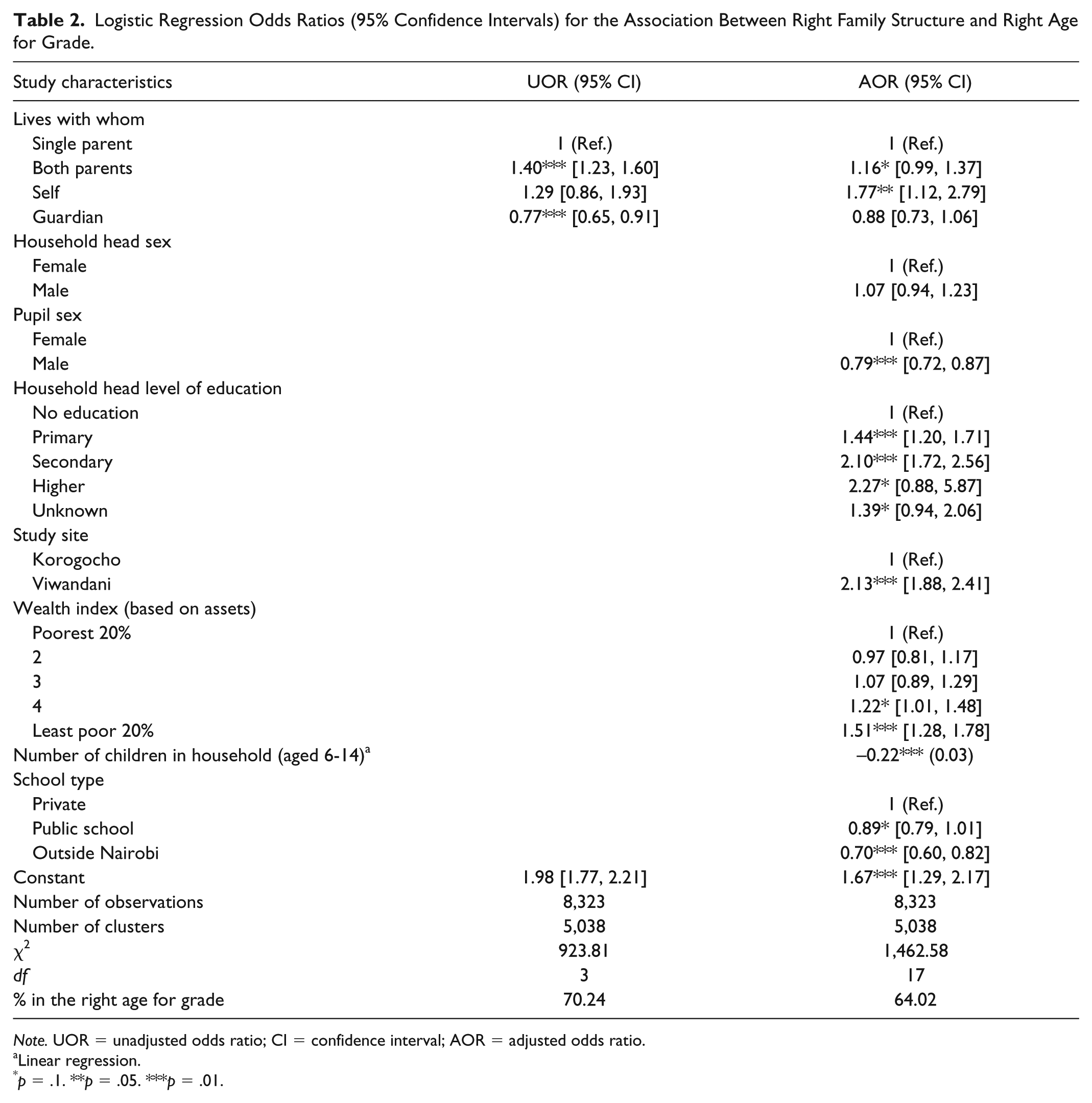
Univariate and multivariate logistic regression models were fitted to predict the effect of family structure on grade attainment. The univariate model presents the effect of family structure on children’s grade attainment. Pupils living with both parents were more likely (UOR = 1.40, p = .01) to be in the right age for grade compared with those living with only one parent; that is, the odds increased by 40% over those living with only one parent. Those living with guardians were 23% (UOR = 0.77, p = .01) less likely to be in the right age for grade compared with those living with only one parent. In the multiple logistic regression model, the aim was to estimate the net impact of family structure on grade attainment, controlling for the household head’s gender, the pupil’s gender, household education level, study site, wealth index, number of children in the household, and school type—the effect of family structure on the children’s educational attainment persisted. In the multiple logistic model, children living in households with both parents were 16% (AOR = 1.16, p = .1) more likely to be in the right age for grade compared with those living with only one parent. Interestingly, findings show that children living alone were 77% (AOR = 1.77, p = .05) more likely to be in the right age for grade compared with those living with only one parent (see Table 2).
Logistic Regression Odds Ratios (95% Confidence Intervals) for the Association Between Right Family Structure and Right Age for Grade.
Note. UOR = unadjusted odds ratio; CI = confidence interval; AOR = adjusted odds ratio.
Linear regression.
p = .1. **p = .05. ***p = .01.
Other factors still play a role. The educational level of the household head was positively associated with the likelihood that a child would be in his or her right age for grade. For instance, children living in households where the head had a primary education were 44% (AOR = 1.44, p = .01) times more likely to be in the right age for grade than those living in households where the head had no education. Children living in households where the head had a secondary level of education (AOR = 2.10, p = .01) were more likely to be in the right age for grade than those living in households where the head had no education.
In addition, the neighborhood where the children live was positively associated with educational attainment. Children living in Viwandani (AOR = 2.13, p = .01) were more likely to be in the right age for grade compared with children living in Korogocho. Moreover, wealth index was significantly related to a child’s educational success. We divided it into quintiles from the poorest (first) to the least poor (fifth). Children living in the fourth quintiles (least poor 20%) were 51% (AOR = 1.51, p = .01) more likely to be in the right age for grade than children in first quintile (poorest 20%) households.
For every point unit decrease in the number of children in household aged 6 to 14 years, a 0.22 (p = .01) unit decrease in the right age for grade is predicted while holding other variables constant. Finally, the type of school was significantly related to educational attainment. Children attending schools outside Nairobi were 30% (AOR = 0.70, p = .01) less likely to be in the right age for grade compared with those attending private schools.
Discussion and Conclusion
The objective of this study was to establish the effect of family structure on the educational attainment of children in the urban informal settlements in Nairobi, Kenya. It was designed to answer the question: Does family structure affect the educational attainment of children in Kenya? We found that two-parent households had a higher percentage of children in the right age for grade (74%) compared with single-parent households (66%). We found that living in a two-parent household is an important predictor for children’s educational attainment. In essence, the effect of family structure on educational attainment of children persists even after controlling for all other variables—gender of the household head, pupil’s gender, the household head’s education level, the study site, wealth index, number of children in the household, and school type.
Children living in households with both parents were 16% more likely to be in the right age for grade than those living with only one parent. Our findings confirm those of studies in Western countries that children in two-parent households typically do better on educational outcomes than children in single-parent and step-family households (Astone & McLanahan, 1991; Bumpass & McLanahan, 1989; Hampden-Thompson & Galindo, 2015; Haurin, 1992; Haveman, Wolfe, & Spaulding, 1991; Heard, 2007; Krein, 1986; McLanahan & Sandefur, 1994; Monserud & Elder, 2011; Mueller & Cooper, 1986; Sandstrom & Huerta, 2013; Sun & Li, 2011; Sutherland, 2015). This could be attributed to the fact that the time and financial resources available in two-parent households are absent from single-parent households, thereby disadvantaging the children living with single parents.
Based on our findings and those of others (Biblarz & Raftery, 1999; Ermisch & Francesconi, 2001; Meier, Musick, Flood, & Dunifon, 2016; Park, 2008; Schiller et al., 2002; Sun & Li, 2011), we conclude that in Kenya, as much as in the West, single parents, particularly mothers, spend more time working and less time enhancing the children’s learning process. As the sole breadwinner, single parents often do not have disposable income to spend on the household resources that reinforce education (Biblarz & Raftery, 1999; Ermisch & Francesconi, 2001; Sutherland, 2015). In two-parent households, income may be greater, and the parents may have more time to spend with their children than single mothers (McLanahan & Sandefur, 1994). Our findings reaffirm the household production function that presupposes that the resources within a family depend on the number of members and the amount of disposable income available to obtain resources for producing achievement (Becker, 1993).
Our findings also show that those children living with guardians were 23% (UOR = 0.77, p = .01) less likely to be in the right age for grade compared with those living with only one parent. This finding suggests poorer education attainment outcomes for those children who live with guardians, who in some cases may not be related to them. This finding is similar to those of McLanahan and Sandefur (1994) whose influential work on the correlation between family structure and children’s outcomes showed that children who grow up in single-parent or stepparent families have lower educational attainment than those who grow up with both biological parents.
Moreover, we found that children in households with a significant number of siblings were 20% less likely to be in the right age for grade than children in households without siblings in the 6 to 14 age group. Evidently, more siblings “dilute” a child’s allocation of parental resources (Blake, 1989). These findings are also consistent with those of the study in Nairobi slums by Ngware et al. (2009), which found that large family size reduces the probability of a child’s enrolment in primary school by 14%.
More interesting is the finding that children living alone were 77% (AOR = 1.77, p = .05) more likely to be in the right age for grade compared with those living with only one parent (see Table 2). Although this seems to be interesting, there is need for a lot of caution in the conclusions we make. We provide two plausible explanations for this finding. On one hand, these children who live alone normally get a lot of support from a wide range of service providers who provide support children living alone in this context. On the other hand, children living in an urban informal context, such as this one, have some parents renting children rooms closer to schools which the children attend, to avoid these children waking up early in the morning. If such children are not linked to the main households that the parents live in, they get categorized as living alone, yet they get support from the parent households.
Our findings cover two sites in Nairobi and may not be representative of the whole of country. Future research should consider the effect of family structure on educational attainment using more cross-sectional data from several sites across the country. If and when longitudinal data become available in the context of SSA, many valuable research questions could be answered.
Nonetheless, this study has significant policy implications for education in Kenya. First, strong family relations are important for children’s educational attainment in developing countries like Kenya as much as in Western countries. Second, the government must find ways and means to give subsidies to single-parent households to strengthen their resources for their children’s education, cushioning them against vulnerability to school dropout. In conclusion, the study calls for strategies to strengthen single-parent households for better educational outcomes for the children. For instance, financial subsidies given to single-parent households will enable such households to increase their resource base to keep their children in school. Other system-wide financial subsidies can be used to enhancing access to free primary education and expanding them to secondary education. Implementing a system guided by policy that ensures all school-going children especially those in primary level of education is warranted.
Footnotes
Declaration of Conflicting Interests
The author(s) declared no potential conflicts of interest with respect to the research, authorship, and/or publication of this article.
Funding
The author(s) disclosed receipt of the following financial support for the research, authorship, and/or publication of this article: The author(s) received funding from Flora and William Hewlett Foundation. However, the views expressed in this article is solely of the authors.
