




Abstract
Researchers have accumulated much social scientific knowledge about the scope, distribution, causes, and outcomes of the physical and sexual abuse of female students in North American institutions of higher learning. However, surveys of technology-facilitated stalking and the dissemination of unwanted sexual messages/images in college campus communities are in short supply. The few that have been conducted do not identify key sociological risk factors associated with these two electronic forms of victimization. This paper, then, has two objectives: (1) to examine the influence of two types of negative peer support and (2) to determine if being the target of technology-facilitated stalking and receiving unwanted sexual messages/images are associated with female students’ intimate partner violence and sexual assault experiences. The results confirm that the two variants of negative peer support examined in this study are significant predictors of digital victimization and that such abuse is strongly associated with intimate partner violence and sexual assault.
Keywords
Research on physical and sexual assaults on North American college women has mushroomed since the mid-1980s. We now know that at least 25% of female undergraduates have experienced one or more types of sexual assault during their college career and that estimates of intimate partner nonsexual violence against college women (e.g., slapping and punching) range from 10% to 50% (Lindquist & Krebs, 2017; Powers & Kaukinen, 2017). One problem in the literature is that while there are a variety of forms of sexual assaults, labels used by researchers have caused confusion. Many readers presume that sexual assaults have to involve attempted or completed sexual acts. Some of these attacks, however, may be those that involve power dynamics and control over women more than overtly physical acts (Geeson, 2018). These behaviors, although widespread and damaging, have not been the subject of extensive research. For example, there are fewer studies of the stalking of college women. The rare ones that do exist provide a dramatic range of prevalence rates (from 13% to 30%) and different samples and variations in operationalizing stalking make it difficult to make useful comparisons (Nobles & Fox, 2017).
Studies of technology-facilitated stalking on college campuses are certainly not plentiful. This is problematic because while nonelectronic forms of stalking (e.g., following a person) still exist and are extensive at institutions of higher learning, it is now possible to stalk a person through newer technology. This could include an unwanted presence on social media, the use of now easily available spycraft techniques such as hidden microphones or cameras, or hidden GPS devices to facilitate learning a person’s location.
Similarly sparse are studies of the dissemination of unwanted sexual messages and images among college students (Crisafi, Mullins, & Jasinski, 2016; Navarro, 2016; Woodlock, 2017). However, it is estimated that there are more than 3,000 sites devoted just to the narrower topic of “revenge pornography” or sexual images posted by men without the permission of the women portrayed (Lamphere & Pikciunas, 2016). The best study, one of the general population rather than college students, is Powell and Henry’s (2016) national Australian survey. Nearly 3,000 people aged 18 to 54 were surveyed and one in 10 respondents reported that someone had posted online or sent to others nude or seminude pictures of them without their permission and 9.6% reported that someone threatened to post such images or to send them to others. Note, too, that in a review of the extant empirical literature on the subject, Henry and Powell (2018) found very little qualitative or quantitative information about adults, such as college students, although there is a growing body of research about children and younger adolescents. What is more, they found almost no reliable data on the nature, scope or impact of technology-facilitated sexual violence. A significant void in this arena is quantitative research on what associations might exist between victimization by electronic means of college women and their accounts of offline sexual assault and intimate physical violence.
Overall, the limited work that has been done on these harms overlooks contextual elements, including the gendered nature of these problems and relationships between survivors and offenders. In this vein, Powell and Henry (2016) report that although women and men report experiencing similar overall prevalence of technology-facilitated sexual violence victimization, the nature and impact of those experiences differ in particular gendered ways that reflect broader patterns in both gender relations and “offline” sexual harassment. Women are more likely to have stronger emotional reactions to this form of victimization, and more likely to suffer negative consequences, especially from those on-line sites that include the woman’s telephone number and email address (DeKeseredy, Dragiewicz, & Schwartz, 2017).
There is an empirical literature exploring technology-facilitated violence, but to date it has mostly focused on “electronic dating violence” among high school and college groups in the Global North (Borrajo, Gámez-Guadix, Pereda, & Calvete, 2015; Dick et al., 2014; Hinduja & Patchin, 2011; Lucero, Weisz, Smith-Darden, & Lucero, 2014; Reed, Tolman, & Ward, 2016; Reed, Tolman, Ward, & Safyer, 2016; Temple et al., 2016; Watkins, Maldonado, & DiLillo, 2018; Wolford-Clevenger et al., 2016; Zweig, Dank, Yahner, & Lachman, 2013). Another body of research centers on “social media surveillance” (J. Fox & Warber, 2013; Lyndon, Bonds-Raacke, & Cratty, 2011; Muise, Christofides, & Desmarais, 2014; Utz & Beukeboom, 2011). These studies mainly consist of lab-based psychological experiments with college students that largely rely on decontextualized question items that do not investigate the context, meaning, or motives of behavior. Moreover, although we know that many such victimizations involve past or present relationships between the victim and the perpetrator, most studies do not draw links to intimate partner violence.
Using data gathered by a large-scale survey conducted at a doctoral institution located in a South Atlantic part of the United States, the main purpose of this article is to help fill some of these research gaps. An important goal is to investigate the extent to which technology-facilitated stalking and unwanted sexual messages/images are associated with the face-to-face physical and sexual victimization of women. Special attention is devoted to exploring the relationship between two types of negative peer support (attachments to abusive peers and pro-abuse informational support) and the above two forms of digital abuse. Since this article only focuses on female survivors of digital and offline abuse, it is not to be expected that the level of pro-abuse informational support would be comparable to the kinds of messages that male peers give to males (DeKeseredy & Schwartz, 2013), but this does not mean that women do not receive these messages, or that the messages are not associated with their victimization. This, of course, is an empirical question that we will investigate. The same applies to the other component of negative peer support: the survivor’s association with abusive peers.
Understanding Technology-Facilitated Stalking and Unwanted Sexual Messages/Images: The Relevance of Negative Peer Support
Researchers seeking to explain (face-to-face, offline) physical and sexual assaults on female college students have suggested many causes or facilitating factors. One frequently identified in survey research is negative peer support (DeKeseredy, Hall-Sanchez, & Nolan, 2018; Hart, 2009). These are messages that mainly come from patriarchal male friends but also occasionally from female friends. There are various definitions of this concept, but here we offer a modified version of DeKeseredy’s (1988a) definition of male peer support: attachments to peers and the resources they provide that encourage and justify violence against college women. The theory based on this definition suggests that men often seek advice from their peers about their problems relating to women, whether they are in a relationship or possibly would like to be in one, or just are dealing with friends. These peers may offer positive and useful advice, but unfortunately some men are instead given advice that encourages them to engage in sexual, verbal, or physical abuse. Schwartz and DeKeseredy (1997) assert that abusive patriarchal men situated in a patriarchal rape-supportive culture develop and maintain friendships with friends who hold similar beliefs and values. These attachments then help these men to develop and then reinforce beliefs and values that promote the abuse of women and in particular those women who represent a threat to male patriarchal authority. These attachments are particularly important to the reinforcement of values that promote and reward abusive behavior toward women.
There are also practical aspects to these friends, in that they also provide resources that involve specific verbal and emotional support. This includes a vocabulary of motive that defines some women as legitimate objects of abuse and sexual assault. DeKeseredy and Schwartz (2013) outline a variety of contexts where male peer support allows some men to feel normal and justified when committing violence against current and former intimate partners.
These friends particularly suggest the legitimacy of such abuse as a solution to the “problem” of women who deny male supremacy through such actions as “talking back” or failing to provide sex on demand. In addition to encouragement, these men are sometimes offered advice on specific techniques to handle these women through abuse. DeKeseredy and Schwartz (2013, 2015) have documented in a wide range of studies conducted over 30 years that male peer support is a powerful predictor of male physical and sexual victimization of college women. Unfortunately, almost all of the empirical research on this to date has been heteronormative (covering male violence against females) and only looks at male attachments to male peers, rather than any support from female members of peer groups that are either meant or taken to legitimate male violent acts.
Another arena where male peer support is associated with violence against women is separation and divorce (DeKeseredy, Dragiewicz, & Schwartz, 2017). For example, many members of patriarchal peer groups view the victimization of women, such as through beatings or sexual assault, as a legitimate and effective means of responding to “damaged” patriarchal masculinity and reaffirming a man’s right to control his female partner (Messerschmidt, 1993; Ray, 2011). Not only do these men privately and publicly state that these forms of abuse are legitimate means of patriarchal authority and domination, they also serve as role models because many of them physically, sexually, and psychologically harm their own intimate partners (DeKeseredy & Schwartz, 2013).
Peer support motivates men to “lash out against the women . . . they no longer can control” (Bourgois, 1995, p. 214). This can be especially clear when looking at lesbian coming out experiences, which often include violence committed by ex-boyfriends or husbands. Bisexual women, the Centers for Disease Control and Prevention (CDC) found, are more likely to experience rape, physical violence, and stalking from an intimate partner compared with heterosexual women or lesbians, with males as almost always the offenders (Messinger, 2017; Walters, Chan, & Breiding, 2013; Walters & Lippy, 2016).
Stalking is another area where negative peer support may be important. There is some support for the claim that non-electronic types of stalking among college students is learned or reinforced through social interactions with peers (DeKeseredy, Hall-Sanchez, Nolan, & Schwartz, 2017; K. Fox, Nobles, & Akers, 2011). However, more evidence is needed to determine whether negative peer support is as influential online as it is offline.
Still, while recognizing that most negative peer support comes from men, the concept was expanded here to include such problematic support from any source. Specifically, it is important to include in any explanation of college life a broader view of patriarchal practices and discourses. Indeed, women in some friendship networks may contribute, legitimate, and support their male friends’ belief that their hurtful behaviors and sexist attitudes are regularized parts of campus life (Gwartney-Gibbs & Stockard, 1989).
The support for expanding our study to mixed-sex college peer groups, or more specifically including women as potential sources of negative peer support, is a very small body of survey work. There is certainly extensive anecdotal evidence and a growing recognition in the literature that some women can be hostilely sexist toward other women (Glick & Fiske, 1996; Sibley, Overall, & Duckitt, 2007). In more recent study, we found that mixed-sex negative peer support was related to offline stalking and sexual assault victimization within the lesbian, gay, bisexual, transgender, and queer/questioning (LGBTQ) community on a college campus (DeKeseredy et al., 2017), while DeKeseredy et al. (2018) found evidence that mixed-sex negative peer support contributed to female college students’ offline sexual victimization. Gwartney-Gibbs and Stockard (1989) found that “the sexual aggression of males within a mixed-sex peer group appears to be an important determinant of the probability that females within the group will be sexually victimized” (p. 198). Similarly, Schwartz and Pitts (1995) found that college women who are sexually assaulted are more likely to have male friends who get women drunk or high to have sex with them.
A major goal, then, of this study is to determine whether the mixed-sex negative peer support discovered by earlier studies exists and influences online victimization in a recent sample of college women. The small number of studies in this field that attempt to test these theoretical speculations was an important reason for this research.
Another reason for focusing on negative peer support is that theory testing in the field of technology-facilitated abuse is limited to evaluating the utility of gender-blind criminological perspectives, such as routine activity theory (Cohen & Felson, 1979) and the general theory of crime (Gottfredson & Hirschi, 1990). The powerful association between gender and women’s risk of being harmed by cyberstalking and revenge pornography cannot be satisfactorily accounted for via the use of these and other “male stream” theories. Such criminological perspectives were not specifically designed to address the gendered nature of these crimes. Thus, we would argue, of the very limited theoretical work done so far, negative peer support theory seems the most promising. Since DeKeseredy and Schwartz’s (2016) theory is shaped by feminist ways of knowing and masculinities studies, measures informed by these discourses were utilized in this study. Moreover, as DeKeseredy and Schwartz (2016) and Dragiewicz (2011) remind us, if pro-abuse peer support has been found to be associated with various types of face-to-face male-to-female victimization, there is ample reason to investigate and propose that it is similarly related to technology-facilitated types of woman abuse.
Method
Sample and Data Collection
Our data are derived from the Campus Quality of Life Survey (CQLS), which was administered online in Spring 2016 to 30,470 students enrolled at the previously mentioned U.S. college. Nearly 20% of the total student population (n = 5,718) completed the questionnaire. For the most part, as described in Table 1, the sample is representative of the entire student campus community. More women than men, however, participated (n = 3,269). Since women are among the highest risk of groups to experience many of the harms addressed in the CQLS, especially sexual assault, it is to be expected that the CQLS elicited a higher percentage of females than that of the school’s general population, as well as a lower percentage of men than that of the wider male student community. Note that for the purpose of this article, the results reported below are limited to women’s responses.
Demographic Characteristics of the Main Campus Population and the CQLS Sample.

Note. Survey respondents from South Asia and Middle East (2.7%) are listed as “Other” along with multi race. CQLS = Campus Quality of Life Survey.
The ethnic category “Hispanic” was considered separate from race in the population column and so the total exceeds 100%. Institutional race data are limited to U.S. citizens which account for 92.1% of students. Data retrieved at https://institutionalresearch.wvu.edu/files/d/a2c20b50-78d9-4,603-8,653-76d93b378d08/wvu_enrollment_trends_fall-2,017.pdf
Recruiting participants involved a campus-wide effort and entailed using multiple methods, including posters, flyers, direct email communication, and in-class announcements. Incentives were also used to recruit respondents. All types of publicity informed students of the prospect of being randomly chosen to get one of 20 $50.00 VISA gift cards (also made explicit in the instrument). Lotteries are widely used in Web surveys and are repeatedly found to be more effective than other enticements (Couper & Bosnjak, 2010; Pedersen & Nielsen, 2016).
Email invitations to participate in the CQLS were sent to 30,470 students, with the first of 4 weekly requests issued on March 28, 2016. In each one was a link to the questionnaire that was administered using Qualtrics software. After clicking the link to the survey in the email invitation and then clicking a button to participate, participants were taken to a screen including a consent form. Students who stated that they did not want to participate were deleted from the email reminder list.
Participants were asked to confirm that they were at least 18 years old and a current student. They were additionally informed that any information they provided would be anonymized. As well, it was made explicit that student confidentiality is a priority and that any information they shared would not be identified. Moreover, they were informed that the research team cannot access their IP addresses or link the survey to their names, student IDs, or email addresses. Furthermore, in line with research protocol, students were told that participation in this study is strictly voluntary, questions can be skipped, and that they could stop at any time.
Regardless of whether they elected to continue, all participants were provided with information on free professional support from counseling services. Every page of the survey that contained sensitive questions had a link to on-campus resources, including one at the end of the instrument. Located below the list of resources at the end of the survey was the option for students to enter their email addresses in a draw for a $50.00 VISA gift card. To further preserve students’ confidentiality, spreadsheets containing participants’ responses are securely stored by Qualtrics and are only accessed by the research team.
Following the first email invitation, three reminders were sent out (1 a week) for a total of 4 weeks of data collection. Couper and Bosnjak (2010) contend that “much of the nonresponse occurs at the early stages before we have a chance to convince them of the importance of the study” (p. 539). This was not the case with the CQLS. Actually, nearly 2,500 students completed the survey within 5 days of the first email invitation.
Measures
Technology-facilitated stalking
Often referred to as cyberstalking, technology-facilitated stalking is defined in this study as “the utilization of information and communication technologies to harass and/or stalk another person” (Navarro, 2016, p. 135). It was operationalized using two items included in a broader measure of stalking included in the Centers for Disease Control and Prevention’s National Intimate Partner and Sexual Violence Survey (NISVS; Black et al., 2011). Listed below, they were introduced with a preamble included in the Administrator-Researcher Campus Climate Collaborative (ARC3; 2015) Survey’s introduction to stalking victimization items. Participants were asked to report how many times they experienced these behaviors and the response categories (also derived from the ARC3 Survey) are “None,” “1-2,” “3-5,” “6-8,” and “More than 8”:
Watched or followed you from a distance, or spied on you with a listening device, camera, or GPS [global positioning system]?
Sent you unwanted electronic messages such as texts, voice messages, emails, or through social media apps?
Unwanted sexual messages/images
One item included in the University of Kentucky’s Research Center on Violence’s (Center for Research on Violence Against Women, 2014) Campus Attitudes Toward Safety (C.A.T.S.) Survey was used to operationalize this variable. It is part of a five-item sexual harassment measure and was introduced as follows: “Since you started at XXX, how often has someone (
Sexual assault
The five items in Table 2 are adapted from some of those in Koss et al.’s (2007) Revised Sexual Experiences Survey (Cronbach’s α = .80). The following introduction was used and the response categories are “yes” and “no”: The following questions concern unwanted sexual experiences that you may have had since you enrolled at XXX. We know that these are personal questions, so we don’t want your name or other identifying information. Your answers are completely confidential. We hope that this helps you feel comfortable answering each question honestly.
Female Sexual Assault Victimization.

Intimate physical violence
The eight items in Table 3 are derived from the C.A.T.S. Survey and the revised Conflict Tactics Scale (Straus, Hamby, Boney-McCoy, & Sugarman, 1996) (Cronbach’s α = .83). These were introduced with the preamble below and the response categories are “Never (0 times,” “Once (1 time),” “Sometimes (2-5 times),” “Often (6+ times),” and “Choose not answer”: We are particularly interested in learning about your intimate or romantic relationships. Since you started at XXX, how many times has someone you were dating or a spouse/partner done the following physical thing to you
Intimate Physical Violence.

Peers’ pro-abuse informational support
This type of negative peer support refers to guidance and advice that influences men to sexually, physically, and psychologically abuse their dating partners (DeKeseredy & Schwartz, 1998). To measure this concept, an index was created by adding male and female respondents’ scores on seven slightly modified items developed by DeKeseredy (1988b) and presented in Table 4 (Cronbach’s α = .80). The preamble below includes a statement found in the ARC3 (2015) Survey’s introduction to peer norms measures, and respondents were asked to answer either “yes” or “no”: The next questions are about the information your current friends may have given you concerning how to deal with problems in intimate or romantic relationships. When the word To the best of your knowledge, did any of your friends tell you that . . .
Pro-Abuse Informational Support.

Attachments to abusive peers
A slightly revised rendition of one of DeKeseredy and Schwartz’s (1998) indices was used to operationalize this form of negative peer support. The response categories were none, 1 or 2, 3 to 5, 6 to 10, more than 10, and don’t know (Cronbach’s α = .81).
To the best of your knowledge, how many of your friends
have ever made physically forceful attempts at sexual activity with dates which were disagreeable and offensive enough that the dates responded in an offended manner such as crying, fighting, screaming or pleading?
have ever used physical force, such as hitting or beating, to resolve conflicts with their dates?
insult their dates, swear at them, and/or withhold affection?
It is unclear how many women in the study received negative peer support from only men, only women, or a combination of both. Yet, DeKeseredy et al.’s (2018) analysis of CQLS data and Gwartney-Gibbs and Stockard’s (1989) study uncovered evidence of mixed-sex negative peer support that predicted female college students’ sexual victimization. Patriarchal practices and discourses occur in mixed-sex college peer groups and women in some such cohorts may influence their male friends to believe that their abusive behaviors and chauvinist attitudes are standardized features of campus life (Gwartney-Gibbs & Stockard, 1989). As well, women can be hostilely sexist toward other women (Glick & Fiske, 1996; Sibley et al., 2007). What is more, Schwartz and Pitts (1995) found that undergraduate survivors of sexual assault are more likely to have male peers who get women intoxicated or high to have sex with them. Another key objective, then, of this study is to establish whether the likelihood found by earlier studies of mixed-sex pro-abuse peer support exists within the area of online victimization.
Results
In total, 34% (n = 1,041) of the female respondents reported being targets of technology-facilitated stalking. Several other studies of U.S. college students uncovered cyberstalking prevalence rates ranging from 1% to 30%, but sound comparisons cannot be made because of different means of operationalizing technology-facilitated stalking and different samples (Navarro, 2016; Nobles & Fox, 2017). Nevertheless, our rate is higher than most estimates of female college student stalking victimization of any sort, which range from 13% to 30% (Cantor et al., 2015; Fisher, Cullen, & Turner, 2002; Fremouw, Westrup, & Pennypacker, 1997; Nobles & Fox, 2017). Fourteen percent (n = 426) of our sample were watched or followed from a distance, or spied on with listening device, camera, or GPS. Twenty-eight percent (n = 855) were sent unwanted messages such as texts, voice messages, emails, or through social media apps.
Twenty-one percent (n = 633) received unwanted sexual messages/images, including pornography. Again, comparing this figure with those uncovered by other studies is difficult because of methodological differences, but it is consistent with those found by studies of similar harms using female samples in the same age group (Powell & Henry, 2017). Moreover, Table 5 shows that women who reported receiving pro-abuse informational support were two times more likely to report technology-facilitated stalking than female respondents who did not receive such support. Respondents with attachments to abusive peers were nearly 3 times as likely to report this form of stalking than those who did not have these associations. Table 6 shows that negative peer support, too, is a determinant of receiving unwanted sexual messages/images, with women reporting both types of this support being more than twice as likely to report being victimized than those who did not report negative peer associations. Thus, as is the case with face-to-face types of female college student victimization, negative peer support is a influential determinant of online victimization, which provides some substantiation of DeKeseredy and Schwartz’s (2016) theory.
Negative Peer Support and Technology-Facilitated Stalking.

Note. CI = confidence interval; LL = lower limit; UL = upper limit.
Negative Peer Support and Unwanted Sexual Messages/Images.

Note. CI = confidence interval; LL = lower limit; UL = upper limit.
Slightly more than 18% (18.2%, n = 551) reported experiencing one or more of the forms of intimate partner violence itemized in Table 3, and 34% of the women reported being harmed by at least one type of sexual assault presented in Table 2. Not only, as described in Table 7, is negative peer support a key predictor of sexual assault (as well as intimate physical violence), but, as Table 8 shows, respondents who report being the victim of technology-facilitated stalking were 2.3 times more likely to report a sexual assault than women who were not victimized. As well, Table 8 shows that participants who reported receiving unwanted sexual messages/images were 3.4 times more likely to state being sexually assaulted than women who did not receive them.
Bivariate Correlations.

P = <.01.
Informational Support, Abusive Peers, Stalking, Unwanted Sexual Messages/Images, and Sexual Assault.
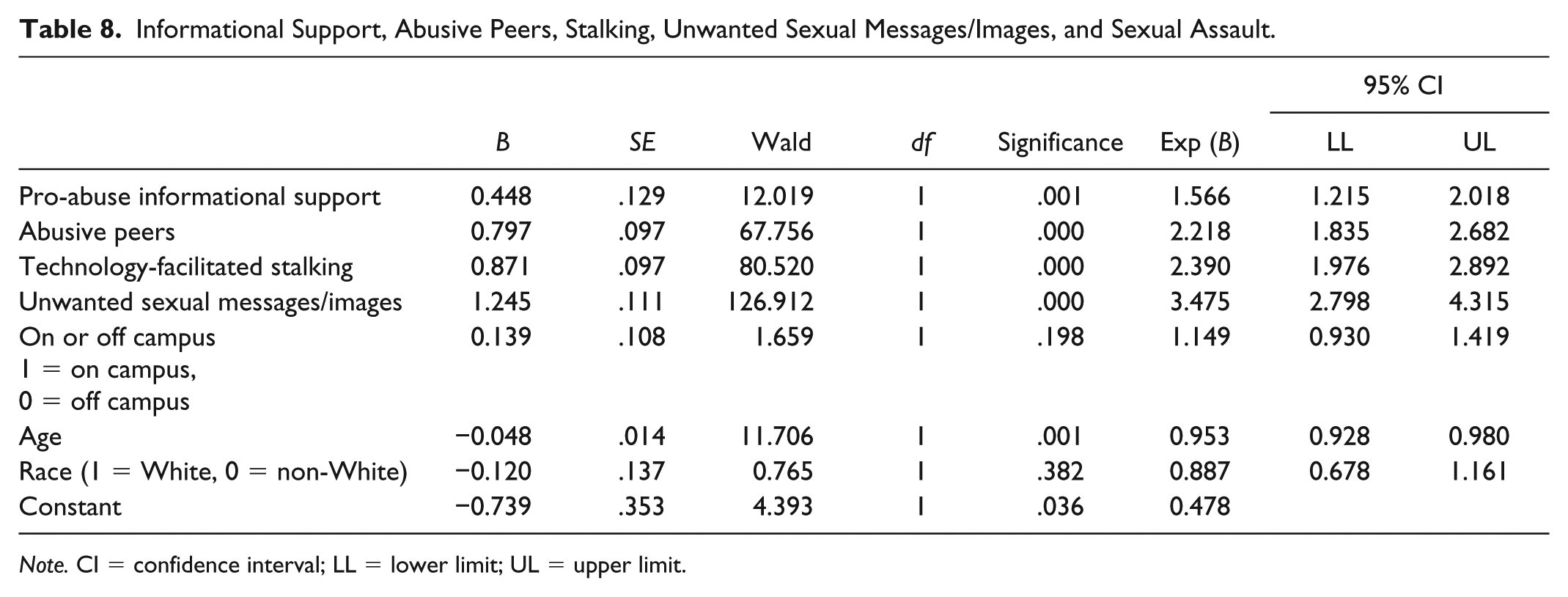
Note. CI = confidence interval; LL = lower limit; UL = upper limit.
Table 9 also includes a multivariate logistic regression model. It shows that respondents who reported receiving pro-abuse informational support were 50% more likely to state having been targeted by intimate physical violence. Similarly, participants who reported attachments to abusive peers were 2.7 times more likely to report such violence. Furthermore, respondents who reported being the target of technology-facilitated stalking were 2.6 times more likely to report intimate physical violence than women who did not report stalking. Finally, Table 9 shows women who reported unwanted sexual messages/images were more than 2 times more likely to report inmate physical violence than respondents who were not sent these things. Several potentially confounding variables were added to Table 9, including race, age, and whether the student lived on campus or in off-campus housing, but none had a significant effect on the table statistics.
Informational Support, Abusive Peers, Stalking, Unwanted Sexual Messages/Images, and Intimate Physical Violence.

Note. CI = confidence interval; LL = lower limit; UL = upper limit.
Discussion
As Henry and Powell (2015) remind us, “as a result of the gender-blindness within studies of virtual or cyber criminality, the conceptualization of technology-mediated harm against women remains significantly underdeveloped” (p. 7). Guided by male peer support theory, the study presented here addresses this concern. Likewise, it is the first survey to examine whether negative peer group dynamics are connected to cybercrimes against women. Certainly, a contribution of this work is providing statistical evidence to support the claim that “peer support for sexual violence against women emerges as a particularly challenging and troubling feature of sexual violence in the digital age” (Powell & Henry, 2017, p. 5). Also, this project provides more empirical support for previous studies, such as Woodlock’s (2017), that found technology-facilitated stalking and abuse in the contexts of face-to-face sexual violence and intimate physical violence.
Several limitations need to be addressed in future research in the fields covered in our research. First, the technology-facilitated stalking and unwanted sexual messages/images measures are rather limited in scope. For example, the messages/images item does not tell us how many women only received pictures, only received messages, or how many received a combination of both. This distinction does not appear because the CQLS was not specially designed to solely examine electronic means of woman abuse and associated risk factors. Indeed, this topic has only recently received social scientific attention, as the uptake of technology and perpetration emerges and escalates.
The next step, then, is to develop a framework that more fully explores the ways in which negative peer support influences, facilitates, and enables electronic means of abusing college women and how these harms are related to and intersect with sexual violence and intimate physical violence. One useful resource is Powell and Henry’s (2016) technology-facilitated sexual violence victimization survey, which measures a much broader range of online sexual, gender, and sexuality-based harassment. As well, as far as we know, there is a dearth of qualitative data on the issues covered here and rich in-depth interviews and ethnographic research are likely to reveal some issues that are difficult, if not impossible, to measure using survey technology. Ideally, though, a multimethod study, like that done by (Woodlock, 2017), is what researchers should strive for when examining the utilization of technology in intimate violence and stalking.
One more limitation should again be addressed. Since we used gender-neutral negative peer support measures, the number of male and the number of female friends of participants who provided informational support and who engaged in abusive behaviors cannot be identified. Consequently, the number of women who were in pro-abuse mixed-sex peer groups cannot be discerned, but many of them were likely in such cohorts (DeKeseredy et al., 2018). Even so, future studies should ask respondents to report the sex or gender identity of peers who gave them informational support and who abuse dates.
Some men victimize women but do not communicate with abusive friends on a face-to-face basis (DeKeseredy & Olsson, 2011; DeKeseredy & Schwartz, 2013). Of course, there still may be other environments/places in which their peers influence them to abuse women. For instance, there are patriarchal online communities with members who never meet in person but often exchange written, audio, and visual communication with their peers (DeKeseredy & Corsianos, 2016; Dragiewicz, 2011; Kimmel, 2008; Salter, 2017). Hence, another essential step for researchers is determining whether peer support for technology-facilitated woman abuse is mainly offline, online, or a combination of both contexts. Related to this new direction is the need to glean data from potential male perpetrators and to inquire about how their online and offline male peers influence them to abuse women.
Peer support for various types of violence against women, especially that provided by males, seems to be ubiquitous and has a long history (DeKeseredy & Schwartz, 2013). Quantitative and qualitative research done so far is highly informative, but there is still much we do not know about the connection between pro-abuse peer group dynamics and technology-facilitated means of abusing women. Nonetheless, preliminary evidence provided by the CQLS strongly suggests that this relationship is an emerging problem, one that could possibly get worse in the future.
What we do know for sure from the data uncovered by this study and similar ones (e.g., Woodlock, 2017) is that “technology is altering, intensifying and facilitating gendered violence” (Vitis & Segrave, 2017, p. 5). Thus, in addition to doing more empirical and theoretical work on technology-facilitated forms of abuse, it is necessary to develop new prevention and intervention strategies. The growing number of experts in the field are collectively emphasizing the importance of avoiding simplistic solutions and the value of a multipronged approach involving legal reforms, education and awareness programs, survivor support services, perpetrator reeducation, and corporate efforts to combat digitized means of gender violence (Clevenger, 2016; DeKeseredy, Dragiewicz, & Schwartz, 2017; Hall & Hearn, 2018; Powell & Henry, 2017). There are, for sure, other initiatives that could be discussed here. Yet, regardless of what solutions are proposed in the future, it is always necessary to keep in mind this point raised by Klein (2012): “Ending abuse is not only about specialized services delivered by trained professionals. It is perhaps more importantly about ‘humdrum’ cultural change in which everyone does things a little differently every day” (p. 127). Indeed, we all have a role to play in making virtual spaces safer spaces (Hall & Hearn, 2018).
Footnotes
Acknowledgements
The authors would like to thank William F. Flack Jr. and Adam Pritchard for their assistance.
Authors’ Note
This is a revised version of a paper presented at the February 2018 annual meetings of the Academy of Criminal Justice Sciences.
Declaration of Conflicting Interests
The author(s) declared no potential conflicts of interest with respect to the research, authorship, and/or publication of this article.
Funding
The author(s) received no financial support for the research, authorship, and/or publication of this article.