




Abstract
Police officers are often exposed to violence and potentially traumatic encounters, but they have not been a focus of research on compassion fatigue or compassion satisfaction. The current study examines compassion fatigue and satisfaction among police officers and how these variables are influenced by negative personality traits. This study’s participants were police officers (n = 1,173) from the National Police of Finland, and its aims were twofold: (a) to explore the prevalence rates and relationships between compassion fatigue, compassion satisfaction, burnout, and personality traits (Machiavellianism, `narcissism, psychopathy) among study participants; and (b) to explore whether compassion satisfaction, burnout, years of police experience, and negative personality traits are predictors of compassion fatigue. The results of the current study indicated that 10% of police officers indicated high levels of compassion fatigue and 40% revealed low levels of compassion satisfaction. In addition, compassion fatigue was found to be negatively correlated with compassion satisfaction (r = −.33, p < .01), whereas negative personality traits were positively correlated with compassion fatigue (Machiavellianism: r = .20; narcissism: r = .19; psychopathy: r = .23; p < .01). Furthermore, negative personality traits (except narcissism) were negatively correlated with compassion satisfaction (Machiavellianism: r = −.22; psychopathy: r = −.32). Structural equation modeling (SEM) was performed to assess predictors of compassion fatigue and it indicated good model fit to the data (goodness of fit index, GFI = .976; comparative fit index, CFI = .934; root mean square error of approximation, RMSEA = .092; standardized root mean square residual, SRMR = .421). In addition, SEM revealed that compassion satisfaction, burnout, and personality traits (Machiavellianism, narcissism, and psychopathy) were significant predictors of compassion fatigue. Clinical and training implications as well as future research recommendations are also discussed.
Keywords
Introduction
Compassion Fatigue
Caregiving professionals (e.g., first responders, nurses, clinicians, therapists, and emergency medical doctors) often respond to potentially traumatic events or incidents and are required to help traumatized individuals as part of their duties (Blau, Bentley, & Eggerichs-Purcell, 2012; Jacobson, 2012; Musa & Hamid, 2008). Exposure to traumatized populations can have a debilitating impact on frontline professionals’ well-being (e.g., Berzoff & Kita, 2010; Collins & Long, 2003; Craig & Sprang, 2010; Jacobson, 2012; Musa & Hamid, 2008). Specifically, trauma researchers have found that caregiving professionals who work with victims of trauma may experience negative effects, such as hopelessness, feeling of helpless and isolation, agitation, and lack of concentration (Randall & Buys, 2013; Salston & Figley, 2003). As noted by Figley (1995), compassion fatigue is experienced by professionals who work with victims of traumatic incidents or experience extreme stress in the line of duty; in turn, compassion fatigue is accompanied by a number of negative consequences in relation to caregiving professionals’ work performance and their personal and professional relationships. Compassion fatigue shares symptoms with posttraumatic stress disorder (PTSD), which is a condition that has been defined by the Diagnostic and Statistical Manual of Mental Disorders (5th ed.; DSM-5; American Psychiatric Association, 2013). Rather than experiencing symptoms as a result of personal trauma, caregivers often develop symptoms of compassion fatigue from their encounters with trauma survivors and secondary traumatization from working in the aftermath of traumatic events. Compassion fatigue is made up of cognitive, behavioral, and emotional aspects (Berzoff & Kita, 2010; Figley, 1995; Hooter, Craig, Janvrin, Wetsel, & Reimels, 2010). The cognitive aspects of compassion fatigue include apathy, lack of concentration, depersonalization, negativity, low self-esteem, and preoccupation with trauma. Compassion fatigue’s behavioral components include sleep problems, hypervigilance, and irritability (Jacobson, 2012; Salston & Figley, 2003). Similarly, the emotional aspect of compassion fatigue includes feelings of powerlessness, guilt, fear, anhedonia, sadness, and rage (Conrad & Kellar-Guenther, 2006; Salston & Figley, 2003). Without intervention or a personal strategy for addressing secondary trauma, caregiving professionals may experience a cumulative increase in compassion fatigue that can have increasingly degenerative effects on their personal and professional lives (Collins & Long, 2003; Craig & Sprang, 2010; Salston & Figley, 2003). If caregiving professionals who work with traumatized populations do not seek help for compassion fatigue, they may experience physical health issues (e.g., headaches, stomach aches), existential angst related to life and death, and burnout (Berzoff & Kita, 2010; Conrad & Kellar-Guenther, 2006; Musa & Hamid, 2008).
Other scholars have emphasized that compassion fatigue can be contagious and can spread from a caregiving professional to the rest of their organization or family members (Hormann & Vivian, 2005; Salston & Figley, 2003). Indeed, if a caregiving organization (e.g., a hospital or a police child abuse unit) is perceived as a systemic entity that aims to help traumatized individuals, then such organizations’ professionals are susceptible to the debilitating impact of compassion fatigue (Burns, Morley, Bradshaw, & Domene, 2008; Hormann & Vivian, 2005). On the contrary, other researchers have emphasized the crucial role of the organization in supporting frontline professionals, which in turn can decrease emotional exhaustion and promote general well-being among its members (Ramarajan, Barsade, & Burack, 2008).
Compassion Satisfaction
Could compassion fatigue’s incapacitating impact on caregiving professionals’ physical and mental well-being be mitigated? Many researchers have emphasized the important role of compassion satisfaction in reversing or preventing the adverse effects of compassion fatigue (e.g., Conrad & Kellar-Guenther, 2006; Salloum, Kondrat, Johnco, & Olson, 2015). Compassion satisfaction refers to the satisfaction that caregiving professionals experience when they help traumatized individuals (Stamm, 2002), and it is viewed as a major protective factor against the impact of compassion fatigue (Collins & Long, 2003; Craig & Sprang, 2010; Wagaman, Geiger, Shockley, & Segal, 2015). Thus, caregiving professionals with high compassion satisfaction experience positive feelings (e.g., recognition, caring, satisfaction, and altruism) by connecting with and supporting survivors of trauma through their caregiving services (Chopko, 2011; Salloum et al., 2015).
Police Compassion Fatigue and Compassion Satisfaction
Police officers are often mandated to respond to critical situations, such as domestic violence, child abuse, and terrorist attacks, and it is estimated that a police officer may encounter more than 900 potentially traumatic incidents over the course of their career (Papazoglou, 2013; Rudofossi, 2009). Police officers may experience direct or vicarious trauma in the line of duty (Burns et al., 2008; Conn & Butterfield, 2013). In a survey study of British police officers (n = 603), Brown, Fielding, and Grover (1999) found that the major traumatic stressors reported by their study participants were exposure to death and disaster, violence and injury, and sexual crime. Furthermore, operational and organizational stress may exacerbate compassion fatigue’s impact on the mental and physical well-being of police officers (Burke & Mikkelsen, 2006; Randall & Buys, 2013). Police officers who work in Internet child exploitation units (e.g., investigation of Internet child pornography cases) are particularly vulnerable to compassion fatigue (Bourke & Craun, 2014; Burns et al., 2008). Nonetheless, officers who investigate Internet child pornography cases and feel that their mission has a positive impact on victims’ lives (or reported experiencing high compassion satisfaction) indicate high professional satisfaction (Perez, Jones, Englert, & Sachau, 2010).
In many instances, police officers must arrest the perpetrator and provide support to the victims until they can receive medical and psychological assistance. For instance, in the mass school shooting that occurred in Newtown, Connecticut, police officers were the first responders on the scene, which required them to provide support to children who had been severely wounded during the attack (Draznin, 2013). Therefore, a police officer often needs to simultaneously adopt the roles of crime fighter and social service worker (Manzella & Papazoglou, 2014). This dual role gives rise to what Chopko (2011) referred to as the “compassionate-warrior mindset,” which is often pervasive in police work. The aforementioned findings from the police trauma literature support the notion that police officers and other caregiving professionals are vulnerable to the adverse effects of compassion fatigue. Previous studies (e.g., Tehrani, 2010) have indicated that police officers are susceptible to high levels of compassion fatigue; however, compassion satisfaction may reverse or prevent the deleterious impact of compassion fatigue among police officers (Andersen & Papazoglou, 2015; Chopko, 2011). Previous research (e.g., Tehrani, 2010) has either included a small sample of police officers (n = 45) as part of their study sample with other caregiving professionals (n = 276), or it has engaged with police compassion fatigue and compassion satisfaction from a theoretical standpoint (e.g., Violanti & Gehrke, 2003). The idiosyncratic nature of police work signifies the fact that the empirical study of police compassion fatigue and compassion satisfaction is of paramount importance (Andersen & Papazoglou, 2015; L. Miller, 2000; Woody, 2005).
The Role of Negative Personality Traits Toward Traumatization
It is interesting—but not surprising—that in the 1960s and 1970s, many scholars argued that police officers were attracted to police work to gain power and authority over the public (White, Cooper, Saunders, & Raganella, 2010). What is even more interesting is that many police scholars contended that negative personality traits (e.g., authoritarianism) may intensify over an officer’s years of service as these traits could allow officers to enforce the law and perform their duties more effectively (Laguna, Linn, Ward, & Rupslaukyte, 2010). Nonetheless, recent research with police officers has demonstrated that authoritarianism does not increase alongside years of service (Laguna et al., 2010), and that the vast majority of officers are motivated to join the police force because of job security/benefits, adventure at work, and the opportunity to help their communities (Carlan, 2007; White et al., 2010). Indeed, power and authority were found by researchers to be at the bottom of the scale of preferences for why police officers entered the police academy in the first place.
What about the role of negative personality traits in police officers’ experiences of trauma? Similar to some research perspectives on military personnel (e.g., Frankfurt & Frazier, 2016), there may be some researchers who support the notion that police officers who are high in certain negative personality traits (e.g., authoritarianism, dark triad [DT]) may experience fewer or none of the effects of trauma exposure compared with officers who are either low in, or do not possess, such traits. Specifically, police officers high in negative personality traits (e.g., authoritarianism, DT) may prioritize their own benefits and feel less empathetic toward victims of crimes and, hence, experience less compassion fatigue than officers who are emotionally engaged in their work or who show empathy toward victims of crimes. To examine the veracity of the aforementioned perspective, empirical research allows us to shed light on the role of certain negative personality traits in the experience (or not) of trauma among police officers.
The DT Personality Traits
The DT refers to a constellation of three subclinical personality traits; namely, narcissism, psychopathy, and Machiavellianism (Jonason, Koenig, & Tost, 2010; Jonason & Webster, 2010). DT personality traits overlap in many ways, and all three are significantly positively correlated; this leads to the assumption that the DT personality traits formulate a cluster of personality traits (Vernon, Villani, Vickers, & Harris, 2008). More specifically, research has suggested that individuals with elevated levels of DT personality traits show low positive emotionality/affect, antisocial behavior, distrust of others, and substance abuse (J. D. Miller et al., 2010). Furthermore, individuals with DT personality traits may be self-centered, dishonest, impulsive, and they may also maintain callous attitudes toward others (Jones & Paulhus, 2011; J. D. Miller et al., 2010). Other researchers contend that individuals with high levels of DT personality traits also tend to exhibit the following common behaviors: exploitation, manipulativeness, sense of grandiosity, and sense of self-importance (Lee & Ashton, 2005), as well as social malevolence, emotional coldness, duplicity, and aggressiveness (Paulhus & Williams, 2002). Therefore, the sense of cooperation, altruism, inclusion, compassion, and other prosocial skills seems to be low or even absent among individuals with DT personality traits (O’Boyle, Forsyth, Banks, & McDaniel, 2012).
Nevertheless, each DT personality trait is distinct in some ways from the other two. Narcissism encompasses excessive love for one’s self, self-centeredness, feelings of superiority, and the tendency toward dominance (Vernon et al., 2008). Machiavellianism is characterized by cold and manipulative behavior as well as insincerity, self-interest, and deception, especially in periods of acquaintance (Jakobwitz & Egan, 2006; Jonason, Li, Webster, & Schmitt, 2009; Jonason & Tost, 2010; Jones & Paulhus, 2011). Psychopathy is distinguished by the tendency to exploit others, a lack of empathy or remorse, high impulsivity, stimulation-seeking behavior, and manipulation of others (Hodson, Hogg, & MacInnis, 2009; Jones & Paulhus, 2011). In addition, individuals with psychopathic subclinical personality traits may exhibit antisocial behavior, selfishness, and a lack of self-control (Jonason et al., 2010; Jonason & Tost, 2010).
In a study with undergraduate students (n = 84), Ali, Amorim, and Chamorro-Premuzic (2009) presented their participants with sad images. Their results revealed that elevated levels of Machiavellianism and psychopathy were positively associated with experienced sadness by other people; that is, the participants in the study experienced (or at least self-reported) pleasurable affect when they looked at images of people who were sad. Furthermore, their findings indicated that, when participants were presented with neutral images, elevated levels of Machiavellianism and psychopathy were both associated with experienced negative affect among study participants. In their meta-analysis, O’Boyle et al. (2012) explored the relationship between DT personality traits and job performance. Their findings suggested that the presence of DT personality traits was often an indication of counterproductive work behavior and poor job performance. Consequently, O’Boyle et al. (2012) posited that elements pervasive in DT personality traits may lead to disrupted workplace relationships and ostracism. Indeed, high levels of Machiavellianism in an individual may be accompanied by a tendency for them to be overpowering in workplace relationships and to manipulate their coworkers. Similarly, narcissism may be manifested in the form of hypercompetitiveness and a sense of superiority in the work environment. Furthermore, psychopathic tendencies may find their outlet in emotionless, violent, and aggressive behavior that jeopardizes the safety of other employees.
DT of Personality Traits and Trauma
Recent empirical research has indicated that individuals with high levels of DT personality traits are more susceptible to traumatization compared with those with low levels (or absent levels) of DT personality traits. In what follows, the author refers to a number of research findings that “connect the dots” and show that individuals with negative personality traits (e.g., dark triad) are indeed vulnerable to trauma exposure. In their study of survivors of a traumatic event, researchers found that survivors with high levels of narcissism were more vulnerable to developing PTSD symptomatology (Bachar, Hadar, & Shalev, 2005). More precisely, they concluded that those high in narcissism “are prone to develop PTSD after an exposure to a traumatic event because they experience the traumatic event as a narcissist injury, as a blow to their narcissist illusion of invulnerability.” (p. 762) It seems that the traumatic event threatens (and perhaps shatters) the narcissist individual’s personal image as being strong, invulnerable, brave, courageous, and able to resist and handle the threat. Other researchers have found that individuals high in psychopathy indicated dysfunctional impulsivity and poor emotional self-regulation (Jones & Paulhus, 2014). Furthermore, self-control and social support are critical in preventing the development of PTSD (Bonanno, Romero, & Klein, 2015; Bonanno, Westphal, & Mancini, 2012; Marmar et al., 2006); however, a lack of self-control, aloofness, and social isolation are prevalent among those with high levels of DT personality traits (Jonason et al., 2010; Paulhus & Williams, 2002).
What is the role of empathy in the picture? As discussed above, the inability to disengage emotionally (or excessive empathy) may make one susceptible to compassion fatigue (Figley, 2002; Salston & Figley, 2003); yet, research has discovered that DT individuals show deficits in empathy (Ali et al., 2009), which supports the expectation that these individuals possess little to no capacity to empathize with others. Wagaman and colleagues (2015) have contended that self–other awareness and emotional regulation are two components of empathy. In their work with caregiving professionals, they found that low self-other awareness and poor emotional regulation were significant predictors of indirect traumatic stress and burnout. Analogously, paramedics who showed less authentic self-expression displayed emotions that they did not feel or made efforts to actually feel certain emotions that they were supposed to feel in certain circumstances. As a result, they experienced more work exhaustion and less job satisfaction than their peers who were genuinely empathic and showed authentic self-expression during traumatic incidents (Blau et al., 2012).
Study Aims and Hypotheses
Aim 1
The present study aims to examine the prevalence rates of the following variables among police officers: compassion fatigue, compassion satisfaction, burnout, Machiavellianism, narcissism, and psychopathy.
Hypothesis 1
It is expected that officers will report elevated compassion fatigue and moderately elevated levels of burnout that are consistent with chronic exposure to trauma. Based on the existing literature, it is also expected that compassion satisfaction will be moderately elevated, and that the prevalence rates of DT personality traits (Machiavellianism, narcissism, and psychopathy) will be low.
Aim 2
To explore the relationship among the following variables: compassion fatigue, compassion satisfaction, burnout, years of experience, Machiavellianism, narcissism, and psychopathy.
Hypothesis 2
Compassion fatigue and burnout will be positively correlated with one another and negatively correlated with compassion satisfaction. Furthermore, it is also expected that all three DT personality traits will be positively correlated. No correlation is expected between the DT personality traits and compassion fatigue, compassion satisfaction, and burnout. We argue that the negative components (e.g., self-centered, manipulative, egocentricism) pervasive among individuals with DT personality traits prevent those individuals from experiencing compassion fatigue, burnout, and compassion satisfaction, as individuals with DT traits may remain aloof and emotionally disconnected from victims of crimes. In addition, we contend that years of experience will be associated with compassion fatigue, compassion satisfaction, and burnout due to the fact that police officers experience multiple potentially traumatic incidents over the course of their career.
Aim 3
To examine the role of certain variables (compassion satisfaction, burnout, years of police experience, Machiavellianism, narcissism, and psychopathy) in predicting compassion fatigue.
Hypothesis 3
It is expected that, unlike DT personality traits, compassion satisfaction, burnout, and years of experience are significant predictors of compassion fatigue.
Method
Participants
All participants were White European (Finnish) individuals who, at the time of data collection, served with the National Police of Finland. There was a total of (n = 1,173) participants, of which (n = 880) were male (Table 1.). The participants in this study were employed in different positions with the organization (e.g., police dispatchers, investigations officers) and reported that they had experienced critical incidents during their police career.
Descriptive Results.

Procedures
Survey responses for this study were collected using an online internal police survey program named “Webropol.” Webropol is a high-security web network that is commonly used to distribute surveys to everyone employed by the National Police of Finland. Survey study weblinks were sent to officers within various police departments in Finland as well as to members of the National Bureau of Investigation, Police University College, and Finland’s Security Intelligence Service. The officers who were included in this study were individuals in positions where secondary trauma may be experienced on a regular basis. Participation in the study was completely voluntary and officers did not receive any compensation for completing the survey. The response rate was 15.24% (1,173 respondents out of 7,695 officers who received the study weblink). After clicking the weblink, participants were asked to give their consent for their participation in the study; once consent had been obtained, the participants were asked to provide demographic information related to topics such as their length of service and their current area of work. Following the demographic questions, they then completed the survey questionnaires, which are described in the following section.
Measures
Compassion Satisfaction and Fatigue (CSF) Test
The “Compassion Satisfaction and Fatigue Self-Test for Helpers” (CSF) was used to assess the CSF variables (Figley & Stamm, 1996). The CSF test is a scale based on self-reporting and consists of three subscales with a total of 66 items that are presented on a Likert-type scale ranging from 0 to 5 (0 = never to 5 = very often). The three subscales measure a participant’s level of compassion fatigue, compassion satisfaction, and burnout, and their score for each subscale corresponds to one of the following categories: extremely low, low, moderate, high, and extremely high. The CSF shows good reliability with high Cronbach’s alpha reliability values on all three subscales; this reliability has been demonstrated in previous research wherein compassion fatigue, compassion satisfaction, and burnout had reliability levels of .87, .87, and .90, respectively (Bride, Radey, & Figley, 2007). Within the measures of this study, compassion fatigue showed a reliability score of .89, compassion satisfaction yielded a score of .92, and burnout had a reliability score of .84.
Short DT of personality (SD3)
The short DT (SD3) is a scale used to measure a cluster of three different personality traits—namely, Machiavellianism, narcissism, and subclinical psychopathy—that provide insight into the individual characteristics of participants (Jones & Paulhus, 2014; Paulhus & Williams, 2002). The SD3 scale is composed of 27 items in total with nine items for each of the three targeted personality characteristics. These 27 items have been found to have good construct, convergent, and discriminant validity in previous research (Jonason & McCain, 2012). In addition, the Cronbach’s alpha reliability scores for this study yielded similar values to those found in previous studies in which narcissism yielded reliability scores of .84 and .86, psychopathy produced scores of .75 and .78, and Machiavellianism scored of .75 and .58 (Jonason et al., 2009; Jonason & Tost, 2010). More recently, research into the reliability of the short DT has shown narcissism as having a score of .68, psychopathy having a score of .72, and Machiavellianism with a score of .74 (Jones & Paulhus, 2014). Within the present study, Machiavellianism received a reliability score of .76, narcissism had a score of .61, and psychopathy yielded a score of .70. 1
Results
Aim 1
The first aim of the present study was to examine the prevalence rates of the following variables: compassion fatigue, compassion satisfaction, burnout, Machiavellianism, narcissism, and psychopathy. The results revealed that 67.46% of the study participants (n = 817) reported low levels of compassion fatigue, whereas 10.24% (n = 124) reported high levels of compassion fatigue. In terms of compassion satisfaction, the results indicated that 40.46% of participants (n = 490) reported low levels of compassion satisfaction, whereas 10.57% (n = 128) indicated high levels of compassion satisfaction. Finally, the majority of study participants (78.03% or n = 945) indicated low levels of burnout. For further information on the estimated prevalence rates of compassion fatigue, compassion satisfaction, and burnout please refer to Figure 1.

Prevalence rates: Compassion fatigue, compassion satisfaction, and burnout.
In terms of the DT personality traits, most study participants (n = 709 or almost 70% of participants) revealed moderate levels of Machiavellianism. Similarly, 94.67% of study participants (n = 959) indicated moderate levels of narcissism. Conversely, most participants (81.44% of participants or n = 825) reported low levels of psychopathy. More information on the prevalence rates of the DT personality traits in this study’s participants is presented in Figure 2.

Prevalence rates: Machiavellianism, narcissism, and burnout.
Aim 2
The second aim of current study was to explore the relationship among the following variables: compassion fatigue, compassion satisfaction, burnout, and years of experience, Machiavellianism, narcissism, and psychopathy. Correlation analyses (Pearson r) revealed that DT personality traits were significantly correlated (positive correlations among DT variables; Table 2). Furthermore, compassion fatigue was found to be negatively correlated with compassion satisfaction (r = −.33; p < .01), positively correlated with burnout (r = .76; p < .01; Table 2), and significantly positively correlated with all DT personality traits (Table 2). Burnout was found to be positively correlated (p < .01) with all DT personality traits (Table 2), whereas compassion satisfaction was negatively correlated with Machiavellianism (r = −.22; p < .01) and psychopathy (r = −.32; p < .01). However, compassion satisfaction was not correlated with narcissism (Table 2). Furthermore, years of police experience was found to have a small but significant correlation with compassion fatigue (r = .16; p < .01) and burnout (r = .10; p < .01; Table 2).
Correlation Results.

Correlation is significant at .05 level (two tailed). **Correlation is significant at .01 level (two tailed).
Aim 3
Structural equation modeling (SEM) with LISREL (Byrne, 1998) was performed to assess the third aim of this study. The results are shown schematically in Figure 3, and they reveal a model (positive values for degrees of freedom, df = 13) to be processed and estimated to fit the data (Meyers, Gamst, & Guarino, 2013). The present structural model assessed the direct and indirect effects of one endogenous latent variable (DT personality traits: Machiavellianism, narcissism, and psychopathy) and three indicator variables (compassion satisfaction, burnout, and years of experience). The model consisted of the following equation (submodels): first, it was predicted that DT personality traits would affect compassion fatigue directly. Given their status as endogenous latent variables, DT personality traits were measured with the following indicator variables (Figure 3): Machiavellianism, narcissism, psychopathy. Second, it was predicted that compassion satisfaction would predict (reversely—negative correlation) compassion fatigue directly. Third, it was predicted that burnout would predict compassion fatigue directly. Fourth, it was predicted that years of experience would predict compassion fatigue directly.
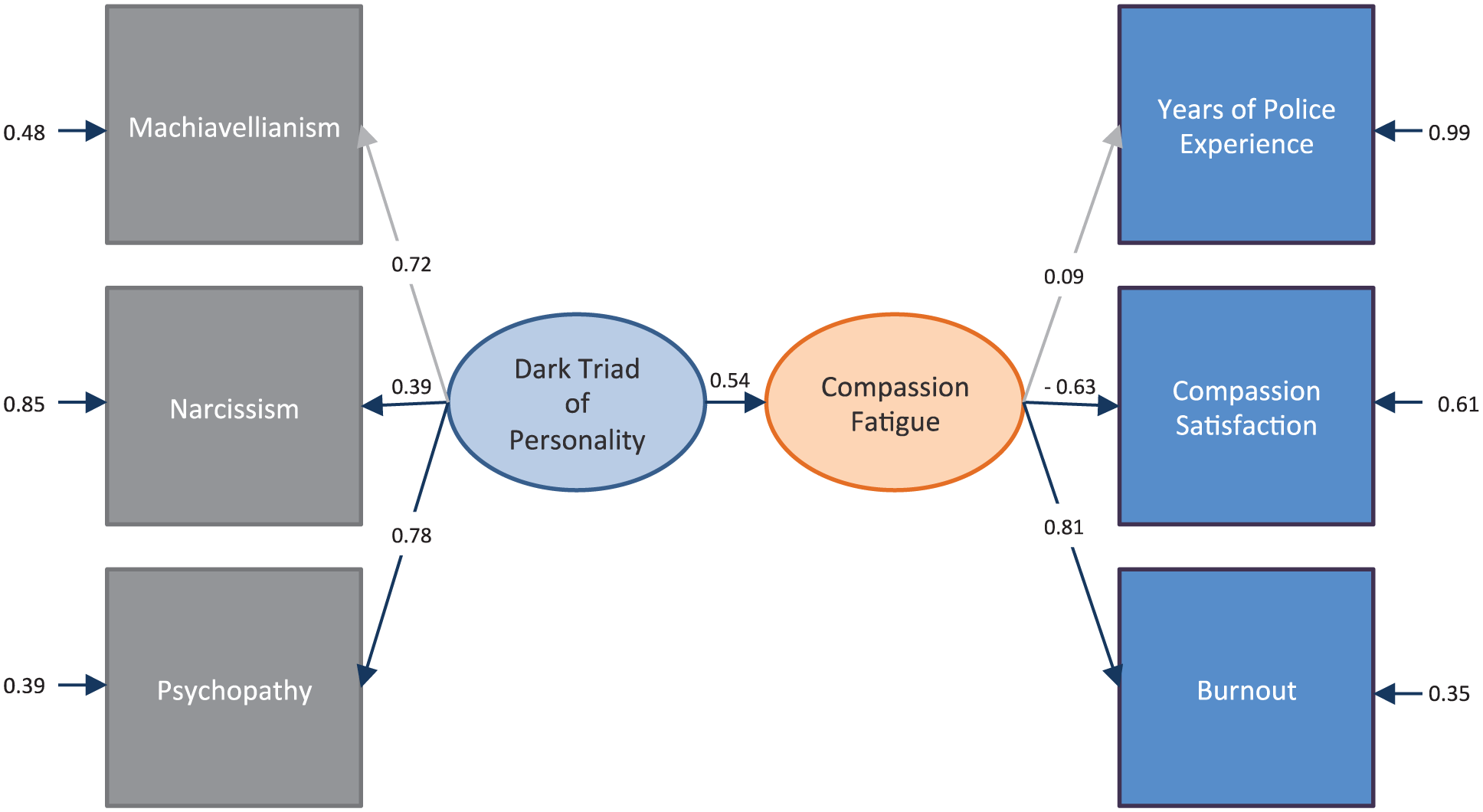
Structural equation modeling.
All coefficients and the correlations between the exogenous variables in the full structural model are presented in Figure 3. With the exception of the path between compassion fatigue and years of experience (with value = .09 < .30), all paths achieved statistical significance (p < .01) and practical significance (with values > .30). Five criteria were employed to assess the measurement model. The chi-square test was statistically significant, χ2(8) = 90.02, p < .000, which suggests that the model failed to fit the data. Nevertheless, the significance of the chi-square might have occurred by chance due to this study’s large sample size (n = 1,173; Meyers et al., 2013; Schumacker & Lomax, 2004). Moreover, the goodness of fit index (GFI) and the comparative fit index (CFI) were .976 and .934, respectively, which indicates an excellent model fit to the data (Meyers et al., 2013; Schumacker & Lomax, 2004). The root mean square error of approximation (RMSEA) was .092 with a 90% confidence interval of 0.075 to 0.11, which suggests an adequate model fit to the data (Meyers et al., 2013; Schumacker & Lomax, 2004). The standardized root mean square residual (SRMR) in the model was .0421, which also indicates a good model fit with the data (Meyers et al., 2013; Schumacker & Lomax, 2004). Overall, compassion fatigue was driven by the direct effect of DT personality traits and the indirect effects of Machiavellianism, narcissism, and psychopathy. Furthermore, compassion fatigue was driven by the direct effect of compassion satisfaction and burnout; however, the direct effect of years of experience on compassion fatigue was not supported.
Discussion: Implications, Clinical and Training Recommendations
The findings of this study revealed that, while the majority of participants reported low levels of compassion fatigue, approximately 10% indicated elevated levels of compassion fatigue. Although this percentage may seem low, in practical terms it means that in a large police department of 5,000 officers, there may be roughly 500 who suffer from compassion fatigue. Therefore, the relatively low percentage of officers with high levels of compassion fatigue should not be ignored; rather, they should be provided with support to relieve their compassion fatigue. In the above scenario, the considerable number of officers who suffer from compassion fatigue are still required to carry out their important duties, and, as such, the organization’s intervention is important if they are to be able to do so effectively. Police organizations should aim to establish systematic assessments and interventions (e.g., workshops, peer support, counseling) to identify officers who are suffering from compassion fatigue and to provide them with adequate psychological support. Indeed, previous research has shown that intervention programs are critical in preventing compassion fatigue or reversing its effects on an individual’s well-being (Cameron & Payne, 2011; Decety, Yang, & Cheng, 2010; Zeidner, Hadar, Matthews, & Roberts, 2013).
Another finding to be emphasized is that almost 40% of study participants reported low levels of compassion satisfaction. This percentage suggests that almost half of the surveyed officers did not experience their role as police officers in a way that gave them job satisfaction. The findings also revealed that a considerable number of study participants did not feel satisfied by helping those who suffer, or that they were not able to appreciate the value of their important work. It is, therefore, important to develop ways of promoting officers’ ability to experience compassion satisfaction. Previous research outcomes have emphasized the important role of compassion satisfaction and empathy training in preventing compassion fatigue and burnout among caregiving professionals (Figley, 2002; Radey & Figley, 2007; Wagaman et al., 2015). Furthermore, training in strengths-based techniques should be offered to new and senior police officers alike, as it may help foster compassion satisfaction and appreciation for the service they provide. Strengths-based techniques have been previously applied to uniformed individuals, such as police and military personnel, with positive outcomes (Kobau et al., 2011; Manzella & Papazoglou, 2014; Reivich, Seligman, & McBride, 2011). The present study’s results showed that compassion fatigue and burnout were negatively correlated with compassion satisfaction. It may be the case that compassion satisfaction training can help to prevent, and even reverse, the adverse effects of compassion fatigue (and burnout) on officers’ well-being.
SEM showed that years of police experience was the only indicator that did not predict compassion fatigue significantly. This may be attributable to officers transferring to non-operational positions after a certain number of years in operational positions to avoid or decrease their exposure to traumatic situations. Alternatively, it is plausible that some officers decide to stop working with the police force prematurely or are forced to do so for either physical or mental health reasons.
This study’s findings revealed that most participants reported low levels of psychopathy. This finding is not surprising as officers undergo psychological assessments during the recruitment process; applicants who score high in psychopathy would almost certainly not be selected to begin their training to become police officers (Cochrane, Tett, & Vandecreek, 2003; Reaves, 2010; Sarafino, 2010). Furthermore, police work is primarily team-oriented, and officers are supposed to maintain close relationships with their peers (Andersen & Papazoglou, 2014; Stephens & Long, 2000). Thus, even if some officers with high levels of psychopathy pass the psychological assessment during recruitment, they would likely find themselves isolated from their colleagues or expelled from the organization due to their inability to work collaboratively in the line of duty.
Interestingly, our results revealed moderate levels of Machiavellianism and narcissism. The fact that those DT personality traits are slightly elevated, but not in highly elevated (moderate vs. high DT personality levels), may be explained by police culture. In the Machiavellianism subscale, statements such as, “It’s not wise to tell your secrets” and “There are things you should hide from other people because they don’t need to know,” are often closely related to some aspects of police work. For instance, the aforementioned items would definitely be endorsed by detectives or intelligence services officers. Similarly, the narcissism subscale includes items that are inherent to police work and police culture, such as, “I insist on getting the respect I deserve” and “I know that I am special because everyone keeps telling me so.” For instance, police officers are supposed (and expected) to be respected by motor vehicle drivers during traffic stops. Likewise, homicide detectives or special force officers may endorse the aforementioned narcissism items because many civilians (especially victims of crimes) praise officers and show their respect (or appreciation) for police services. These plausible explanations as to why police officers may naturally agree to statements designed to detect DT personality traits highlights the necessity for the development of a customized assessment scale (e.g., Police SD3) that considers the unique role and mission of police officers.
In the present study, DT personality traits were positively correlated with compassion fatigue and burnout. Conversely, with the exception of narcissism, DT personality traits were negatively correlated with compassion satisfaction. This last finding lends itself to multiple interpretations. It is possible that officers with DT personality traits may experience distress, isolation, and lack of support from their peers when they face extreme stress or potentially traumatic incidents in the line of duty. Previous research has emphasized the important role of empathy in mitigating the adverse impact of compassion fatigue among caregiving professionals (Blau et al., 2012; Wagaman et al., 2015). However, it is important to note that these last findings were the product of research conducted with non-DT personality participants. Indeed, other studies have suggested that individuals with high level of DT personality traits are unable to experience and show empathy (Ali et al., 2009). Previous research outcomes indicate that individuals with elevated levels of narcissism who are exposed to severe stress and life-threatening stressors were more susceptible to experience PTSD and other acute anxiety symptomatology (Bachar et al., 2005; Besser, Zeigler-Hill, Pincus, & Neria, 2013). Furthermore, other findings suggest that individuals with high level of DT personality traits are more likely to dissociate and employ immature defense tactics when they are faced with extremely stressful experiences (Richardson & Boag, 2016). Moreover, prior research has revealed that individuals with high level of DT personality traits lack the capacity to maintain social support, employ maladaptive coping styles, and make a strong effort to control their emotional reactions when faced with adversity (Birkás, Gács, & Csathó, 2016; Richardson & Boag, 2016). Dissociation, lack of social support, and maladaptive coping strategies were found to be some of the main risk factors for the development of PTSD and other mental-health-related issues (Herman, 1997; Marmar et al., 2006; Regambal et al., 2015). Thus, it may be concluded that the findings of previous research in this field are in accordance with the outcomes generated by the data analysis performed in the current study.
Limitations and Future Research
The present study was conducted with White European police officers from Finland. Future research should explore similar research questions among police officers from different geographical areas (e.g., the United States, Asia, Australia). In addition, future research may employ a culturally diverse sample of police officers to examine whether the present study’s outcomes differ among officers from different cultural groups (e.g., officers from the dominant cultural group vs. officers from racial, ethnic, or sexual minority groups). Another potentially fruitful area for future research would be to explore how the severity of exposure to critical incidents and the resultant degree of experienced suffering affects compassion fatigue and satisfaction among police officers (Cameron & Payne, 2011; Ferguson, Prenzler, Sarre, & de Caires, 2011). Empathy’s role in mitigating the impact of compassion fatigue and promoting compassion satisfaction may also be examined in future studies, particularly among officers with elevated DT personality traits. In addition, trauma researchers have emphasized the understudied roles of moral injury and moral distress experienced by frontline professionals in the development of secondary trauma (Corley, 2002; Litz et al., 2009). Thus, it may be beneficial to empirically examine how moral injury and moral distress contribute to officers’ susceptibility to compassion fatigue and whether personality traits mediate or moderate the relationship between moral suffering and compassion fatigue (Nash & Litz, 2013; Papazoglou & Chopko, 2017).
Based on the results of this study and prior work (Kapoulitsas & Corcoran, 2015; Weidlich & Ugarriza, 2015), it is recommended that police officials and police health professionals develop evidence-based, customized training aimed at improving compassion satisfaction and preventing/mitigating compassion fatigue among police officers. Such training programs should be utilized throughout police officers’ careers.
Footnotes
Acknowledgements
Authors would like to express their gratitude to the following people for their essential contribution in the completion of this study: Monique Herbert, Research Methods and Statistics Expert and an assistant professor at York University, Canada; Emily-Ana Filardo, researcher at Canada Department of National Defense; and the undergraduate research assistants (alphabetical order) at the time of the study completion in the University of Toronto: Pamela Adjei, Farva Batool, Andrew Daoust, Emma King, Hera Murtuza, and Kyle Planche.
Declaration of Conflicting Interests
The author(s) declared no potential conflicts of interest with respect to the research, authorship, and/or publication of this article.
Funding
The author(s) received no financial support for the research, authorship, and/or publication of this article.