




Abstract
This article explores the structure of the male–female interaction in the human mating process from the perspective of the so-called Tie-Up Theory, applying it to the analysis of a cinematic fictional narrative, namely the Shakespeare in love movie. We look at romantic fictional narratives as possible simulations with a social cognition valence, and show that, in the case study under exam, the actual structure of the interaction between the two main characters reflects the basic steps of a successful mating process. In view of this, the fact that the long-term couple is not formed at the end of the story neither jeopardizes its social cognition valence, nor the audience’s need and expectation of an emotional climax, as what makes the difference in terms of social cognition is not the story outcome, but the process that leads to it. Our research makes a case for a renewed interest toward romantic fictional comedies as an interesting source of insight into real mating-related interactions, provided that such narratives are socially validated in terms of audience response and intergenerational transmission.
Introduction
The pursuit of the balance between hedonic (aimed at the search for pleasure) and eudemonic (aimed at the search for knowledge and human development) elements is one of the most critical, delicate aspects of the subtle art of fictional narration (Oliver & Raney, 2011). This is especially true for romantic fiction, where the temptation to lure the audience into escapist fantasies built around unrealistic situations and characters, that merely accommodate their wishful (romantic) thinking, is strong (Johnson & Holmes, 2009), and may have negative effects in real-life (Galloway, Engstrom, & Emmers-Sommer, 2015). The awareness of this potential risk has sparked social attitudes of detachment and skepticism as to the experiential value of romantic fiction (Dowd & Pallotta, 2000). Romantic stories are often associated to a reiteration of patriarchal stereotypes of dominance and female submission (Radway, 1991), and their dismissal has possibly favored a “cooling down” of the frequency of terms relating to inner emotional states within 20th century literature (Acerbi, Lampos, Garnett, & Bentley, 2013).
Such diffidence is not fully justified, however. It is generally true that romantic comedies do not provide a realistic picture of man–woman relationships, and that such representation may be potentially misleading for an inexperienced audience (Shapiro & Kroeger, 1991). However, it is equally true that not all fictional narratives share the same hedonic versus eudemonic valence (Oliver & Hartmann, 2010), elicit the same levels and forms of appreciation, and maintain the same cultural relevance through time (Oliver, Ash, Woolley, Shade, & Kim, 2014). Moreover, not all of them provide equally convincing accounts of the dynamic process leading to the successful or failed emergence of the heterosexual couple (Lucchi Basili & Sacco, 2017). For a romantic comedy to contribute to the cognition of the mating process, what matters is not the realism of the representation of characters or situations, but the consistency of, and the insight into, the intertwined sequence of events and inner states that leads, or fails to lead, to the creation of a couple. Even if characters are patently imaginary, the historical and social context is inaccurately or incorrectly reconstructed, or even nature’s laws are put into question by magical powers, this need not jeopardize the fiction’s capacity to provide the audience with valuable insight into the actual interaction between sexes (Nettle, 2005), or into the relational grammar of couple relationships (Grodal, 2009). Moreover, fictional narratives’ violation of norms of likelihood may have an important evolutionary value of stimulus to creativity and imagination (Subbotsky, 2015).
The history of cinema is replete with examples of romantic comedies that have fascinated several generations of viewers not because of their factual accuracy and reliability, but due to the “credibility” and interest of their characters for audiences from the most diverse social, economic, and cultural backgrounds (Currie, 1998). The appreciation of such characters stems from their rich, stimulating “psychology,” which quietly coexists with their fictional nature, and thus with their belonging to the other-worldly, diegetic space-time of the narrative (Eder, 2010). The present article focuses upon a typical example of a romantic comedy that offers a romanticized, imprecise, unrealistic representation of both a historical and cultural context, that of Elizabethan England, and of the biography and creative activity of one of the most prominent artistic personalities of the time: William Shakespeare. We refer to Shakespeare in Love, a mainstream 1998 Hollywood rom-com 1 directed by John Madden from a screenplay by Marc Norman and Tom Stoppard, with Joseph Fiennes and Gwyneth Paltrow as lead actors and an all-star cast, also including top Shakespearian actors such as Dame Judy Dench. The movie sits in a cinematic tradition of Shakespearian adaptations and derivations that is as old as cinema itself (Brode, 2000).
The reason of our interest in this movie is that it provides a particularly legible example of a romantic narrative that succeeds in its reconstruction of one of the typical paths of man–woman interaction leading to a stable couple. The movie has won major appraisal from the industry (7 Oscars out of 13 nominations, plus an impressive collection of international awards), the inclusion at 49th place in the list of the 100 all-time best British films by the British Film Institute, 2 and a score of 87/100 on Metacritic. 3 The movie has also been strongly appreciated by moviegoers worldwide, ascending to the status of a classic, with a global box office income of almost 290 million dollars—a more than tenfold return on the production cost of 25 million dollars. 4
The movie’s prestigious cast and skillful use of outstanding professional skills in direction, screenplay writing and in all major technical production roles, as well as the choice of the topic and historical setting are not sufficient reasons to explain its success, however. As it is well-known from the literature, forecasting the success of a movie from its production or content features is virtually impossible (Pokorny & Sedgwick, 2010), so that the movie industry is generally viewed as a sector with basically unpredictable returns and outstanding risk factors, calling for specific hedging strategies (Sacco & Teti, 2017). Compared with many other movies dealing with similar themes, with equally flashy casts and highly professional, experienced directors and screenwriters, which did not meet the same audience response, Shakespeare in Love must present specificities that cannot boil down to merely productive parameters. Our research hypothesis is that some such specificities may relate to the movie’s valence in terms of the social cognition of mating in a eudemonic perspective.
Even to the eyes of an expert Shakespearian scholar such as James Shapiro, the narrative rendition of the screenplay, despite its evident inaccuracies and exaggerations, has merit due to its “psychological” credibility:
So do you think the film portrayed a plausible portrait of Shakespeare, the man?
Even having spent decades of my life teaching and writing about his career, especially his early work, I can’t say. But for me, this is as good as any biography of Shakespeare. He must have had an emotional life, but how do you give a sense of that emotional life when no trace of it survives except for what we imagine we find in the words he puts in his characters’ mouths? You have to make it up a little bit. Biographers don’t like to do that, and, like most scholars, I don’t like it when they do. This movie did it in a very intelligent way. (Pietropinto, 1999)
In our view, the reasons behind such a positive resonance, and especially the audience’s one, are not traceable to the story’s focus upon the sentimental vicissitudes of William Shakespeare, with respect to which the movie does not make any claim of historical accuracy, but rather to the movie’s capacity to provide an inspired, punctual fictional representation of the dynamics of human mating. And it is upon such a dimension of “real emotional life” that Shapiro himself seems to rely in declaring his appreciation for the movie, and in arguing that “for me, this [story] is as good as any biography of Shakespeare” (Pietropinto, 1999).
In the present article, this aspect of the movie is examined in detail by means of the theoretical framework offered by the Tie-Up Theory (Lucchi Basili & Sacco, 2016, 2017), which analyzes the dynamic process leading to the formation of the long-term heterosexual couple. The theory’s interaction model builds upon a characterization of sex differences linked to the rewards deriving from couple relationships. Instead of presenting the theory in formal terms, here we introduce its basic concepts along with the presentation and discussion of the case study, referencing the interested reader to the cited papers for a more thorough, rigorous formulation. Our analysis shows how the fundamental steps of the mating process from the viewpoint of the Tie-Up Theory find a precise, recognizable correspondence in the movie’s narrative milestones, so that we can proceed to a consequential presentation of the structure of the theory by simply following the story’s narrative arc. The movie’s social cognition valence for human heterosexual mating processes stands despite it doesn’t meet any objective criterion of reliability from the cultural, historical, or social viewpoint. Therefore, the typical arguments that dismiss romantic comedies, and more generally whole categories of fictional narratives, for their lack of documental accuracy of the represented characters and situations, and in particular for their insufficient (or altogether missing) emphasis on social or gender inequalities, are ultimately ill-posed (Grodal, 1999). Needless to say, compelling analyses of the sociocultural and political conditions that led to the composition and dissemination of a narrative, and of the interplay between such narratives and the emergence and development of certain political and social situations, are necessary (Kendall, 2002). But still, our analysis stresses that reducing the interpretation of fictional narratives to these aspects only, amounts to overlooking the role of equally important channels of impact of such narratives in terms of less explicit, but not less relevant, social cognition mechanisms (Grodal, 2008).
Our analysis invites to a broader, more interdisciplinary approach to cultural studies that recovers, and integrates in its methodological toolbox, some levels of interpretation that are typical of social and behavioral sciences. This shift of perspective helps us to answer a simple, important question: Why still today human beings keep on attributing to stories, or better to some stories, such a major evidential weight and existential meaning despite their explicit fictional nature?
The structure of the remainder of the article is the following. The section “Fictional Narratives and Social Cognition: Why Certain Stories ‛Stick’” presents and discusses some literature on the nature of fictional narratives as a form of social cognition. The section “Shakespeare in Love: The Formation of the Long-Term Couple in the Perspective of the Tie-Up Theory” analyzes the narrative unfolding of the movie in the light of some basic concepts of the Tie-Up Theory. The section “Conclusion” presents a brief final discussion.
Fictional Narratives and Social Cognition: Why Certain Stories “Stick”
The mechanisms of social cognition work by selecting knowledge elements that improve human understanding of the surrounding social environment, to elaborate adaptive cognitive-behavioral solutions to environmental challenges. Such mechanisms help humans to effectively position themselves in their environment (Augustinos, Walker, & Donaghue, 2014) and are culturally transmitted through situated social interaction (Kashima, 2008). Fictional narratives are an important channel of social cognition (Imada & Yussen, 2012), in that they allow the simulation of a wide range of social scenarios and situations without having to experiment with them directly, substantially improving human capacity to cope with a mutable social environment (Oatley, 2016), and contributing to the development of complex socio-cognitive competences (Dill-Shackleford, Vinney, & Hopper-Losenicky, 2016). In this sense, fictional narratives, whose social valence is linked to their potential for extrapolation to relevant social contexts, may be considered “twice as true as facts” (Oatley, 1999), and may acquire an evidential value that is comparable with that of actual news (Strange & Leung, 1999).
In terms of social transmissibility, hedonic narratives would seem to be advantaged, as they are generally more simply phrased and interpreted, and as they elicit more immediate satisfaction response from the audience. This intuition is confirmed by the scarce available evidence on short-term transmission (Oishi, Kesebir, Eggleston, & Miao, 2014). And yet, hedonic narratives tend to be subjected to a quicker cultural obsolescence, as their narrative cues are tailored to be easily picked and appreciated by the public (Vorderer, Klimmt, & Ritterfeld, 2004) and thus to generate an instant reward (Oliver, 2008), rather than to maintain their appeal in the longer term. Therefore, hedonic narratives lose their salience (Tamborini, 2011), robustness (Wirth, Hofer, & Schramm, 2012), and capacity of reward (Oliver & Bartsch, 2010) outside the specific context they have been designed for (Blauvelt, 2017). 5 Eudemonic narratives, instead, pose a much more arduous transmission problem in the short-term, due to their higher informational and interpretational complexity, but tend to maintain in time a higher level of salience both because they keep their capacity to generate a strong emotional activation in terms of moral elevation (Oliver, Hartmann, & Woolley, 2012) and because they refer to situations with substantial existential implications, whose meaningfulness remains stable across generations and sometimes even across different sociocultural contexts, thus surging to a status of “master narratives” (Thorne, 2004). 6 Consequently, in the long-term, eudemonic narratives maintain a capacity for transmission through time and space that is superior to hedonic ones, to the point of becoming, in the most successful cases, no less than reference sources, if not the main source (Cain, 2005), for the development of certain sophisticated social competences such as infantile moral imagination (Guroyan, 1998). Social transmission concerns may thus lead to the consolidation of specialized narrative corpora such as literature for children (Nikolajeva, 2014), whose prosocial implications may grant them a status of community asset (Rappaport, 1995).
In social cognition terms, the fact that certain eudemonic fictional narratives preserve a durable ability to engage different generations belonging to different sociocultural contexts, represents a form of validation of their knowledge content (Moretti, 2013). By applying this line of reasoning to the movies repertoire, we can thus look at the “classics” from a different angle, distinguishing between movies that have simply enjoyed some commercial box office success, and movies that, beyond their immediate commercial return, have maintained in time their social meaningfulness, building up an intergenerational public that keeps on seeing them, sharing them, and regularly re-narrating (re-enacting) them.
In a nutshell, then, when can we call a certain fictional narrative a “good story”? In the terminology of Gubrium and Holstein (2009, chapter 12), a story is “good” if “narratively adequate in the circumstances” (p. 201). This judgment reflects therefore a “situated utility” that is as important as, and possibly more important than, its narrative quality. The fact that a certain story surges to the status of “classic,” being associated with a character of “goodness” par excellence, then implies that its “situated utility” assumes a more universal valence, and may be thought as “situated” not simply with respect to a specific “here and now,” but to a vast array of places and situations. The eudemonic character of “good” stories is associated to that of those life stories through which any individual constructs its own personal trajectory of meaning (Bauer, McAdams, & Pals, 2008) in terms of a narrative identity (McAdams, 2011) which, following the logic of the story, ends up characterizing individuality in terms of a process of self-discovery (Waterman, 2011). A sort of homeostatic balance is thus achieved between the construction of the self and the narrative construction (McLean, Pasupathi, & Pals, 2007): it is the fact that the story transmitted through the social channels resonates and “speaks” to one’s own individual story that makes the former salient for a person. “Good” stories then display a remarkable aptitude to be compatible, and interweaved, with individual life stories, becoming subjectively re-usable, fungible material for the construction of the latter. In this vein, the key difference between hedonic and eudemonic narratives (Rieger, Reinecke, Frischlich, & Bente, 2014) is that hedonic ones are tailored to the regulation of the psycho-physical equilibrium and to the reward for the achievement of predetermined well-being goals (e.g., relaxation and psychological disconnection from stressful situations), whereas eudemonic ones typically entail a procrastination of the achievement of the homeostatic equilibrium to pursue more complex goals of search for meaning, and of exploration of new existential possibilities (Vittersø & Søholt, 2011).
One could be tempted to believe that the social cognition valence of romantic eudemonic fictional narratives is merely that of unveiling and explicating the most effective mechanisms for the building up of a stable couple—that is, to give some more credibility to the final “lived happily ever after” clause. In fact, eudemonic narrations often end up questioning the happy end rather than pursuing it at all costs, as it is instead the case in stories with a more marked hedonic character. Rather, the added value of eudemonic narration stems from a tireless exploration of subtle and even counter-intuitive possibilities, for example, by showing how an apparently ideal type of romantic partner may end up less attractive than an unusual, surprising alternative. In the eudemonic narration, we find a constant tension between the presentation of a model and its debunking and denial, and it is this very dialectic that carries most of the socio-cognitive valence of the story. The eudemonic narration, unlike the hedonic one, does not offer its audience a mere evocation of what they would desire for themselves but questions the nature of one’s own desire in relation to that of others. It does it through a narrative simulation that, even when apparently unrealistic in its contextual conditions, manages to connect to the audience’s life experience, and critically investigates the construction, and the pragmatic interpretation, of the multiple dimensions of human existence: gendered, social, psycho-emotional, sexual.
In the eudemonic narration, consequently, the fact that a couple is formed is less important than the psycho-biological process (Lucchi Basili & Sacco, 2018) that brings someone to choose a specific partner as an individual (Gonzaga, Turner, Keltner, Campos, & Altemus, 2006), and not as a stereotype of certain generically desirable traits (Grodal, 2004). But fleshing out characters with credible, fascinating personality nuances and making them “live” in an interesting, engaging narrative simulation is much more difficult than one might think. And this is the reason why only a relatively limited number of romantic fictional narratives “stick” (Zipes, 2006), that is, acquire, within a given sociocultural context, a universal relevance that is reaffirmed with time, and causes the audience to develop a form of para-social bond toward their characters (Grodal & Kramer, 2010).
From this interpretive vantage point, we are now ready to analyze the Shakespeare in Love case study as a narrative exploration of human mating, where the process of reciprocal attraction is established through the sharing of a common passion, which activates in the most effective way the rewards that prompt each character to “tie up” to the other (Gonzaga, Carter, & Buckwalter, 2010). This path ideally leads to the emergence of a stable couple, but the conditional is necessary here, as in fact the movie’s eudemonic intent introduces a further level of complexity, causing the couple not to form eventually. The final twist does not diminish in any sense the meaningfulness of the mating process portrayed by the story—quite the opposite, in a sense to be clarified below. One of the reasons why Shakespeare in Love still attracts new audiences through the years may be its capacity to present mating in a way that, as Oatley would put it, is “twice as true as fact,” and yet lacks any explicit pedagogical ambition.
In the following section, we will illustrate what makes the movie so special in the perspective of the Tie-Up Theory, limiting ourselves to an informal presentation of some of the basic notions, and referring the reader to the technical papers for a more rigorous rendition, and for a critical discussion of the relevant literature.
Shakespeare in Love: The Formation of the Long-Term Couple in the Perspective of the Tie-Up Theory
The Tie-Up Theory (Lucchi Basili & Sacco, 2016, 2017) is based upon a dynamical model of the interactions between psycho-emotional and sexual processes in the context of human mating. The theory focuses upon two components that govern such interactions for each sex. One is characterized as “active,” that is, orientated to action, decision, and reasoning about action, and ruling anything that concerns other-regarding behaviors in dealing with the opposite sex—that is, with a potential or an actual partner within an already formed couple. Such component is deeply linked to the conscious perception of one’s own gender identity, and of the sociocultural context that shaped it, and in which one lives and relates to others. The other component is characterized as “passive,” not being geared to any conscious, decision-making activity, but rather to the re-elaboration, often below the threshold of awareness, of external stimuli—specifically, of the stimuli coming from opposite-sex subjects, as a function of the subject’s strictly individual psycho-biological nature. In the theory terminology, such components are called Areas, and specifically Active Area (AA) and Receptive Area (RA).
Individuals tend to perceive more, and to relate more often to, their AAs, as they operate at a higher level of awareness with respect to the Receptive ones. It is important to keep in mind, however, that the presence of the RAs may suddenly manifest when their level of stimulation is high enough to make their over-excitement evident. Both Areas can be excited, but for different reasons, and as an effect of different kinds of stimulation. The possibilities of combination between two opposite-sex subjects reflect the fact that each AA will be wired to the opposite-sex RA to create a double active/passive match: as a matter of fact, there is neither an exclusively active nor an exclusively passive subject. It is the passive component in each sex that ties-up to the active component of the opposite sex, with a possible outcome where a Double Tie-Up (D-TU), that is, a tie for each sex emerges and a stable couple is formed.
To understand how, and under what conditions, the active and passive Areas end up being excited, we use the narrative thread offered by Shakespeare in Love in its social simulation valence. The movie tells about a fictional love story between William Shakespeare and a noble woman called Viola, during the composition and first theatrical release of Romeo and Juliet. The screenplay’s re-elaboration of the most famous among the Shakespearian stories, an epitome of romantic love in the collective imaginary of all times, provides an excellent, concrete example of how the AAs and RAs of two opposite-sex partners may perfectly coordinate in their reciprocal quest for connection, causing the launch of the so-called Tie-Up Cycle (TU-C). The movie’s staging of the narration in the golden age of the Elizabethan drama—whose romantic heroines (of whom Viola herself may be taken as a virtual representative—and even, as the story itself eventually suggests, as the ideal model) are typically portrayed at the stage of their life cycle that focuses upon mate choice (Nordlund, 2005)—further reinforces the representativeness of this case study for the purpose of the analysis of the social cognition valence of romantic fictions. At the same time, the screenplay seems to support the thesis that, against the established tradition that tends to regard Elizabethan romance as a pretext or even a smokescreen used by authors to delve into more “serious” issues (e.g., Firestone, 1944; Marotti, 1982), human mating is indeed approached by Shakespeare as the most “serious” of issues, and probably the hardest to deal with given its ubiquity in human affairs. Consequently, the Elizabethans, and Shakespeare in particular, are not only intrinsically fascinated by romance but also interrogate multiple literary sources to explore its “essence” (Felperin, 2015), through “organically developing” literary forms, whose appealing immediacy was derived from oral tradition and popular culture sources (Bradbrook, 1979), and whose subtlety stemmed from a nuanced rather than obvious pedagogical intent like in the conventional “comedy of ideas” (Weld, 1975).
Let’s therefore start from analyzing AA, the Area that is most present to the conscience of any individual. Taking inspiration from the female lead character of our story, Viola, let’s begin to grasp how a female AA (i.e., an F-AA) is characterized, and acts accordingly. Viola is a young woman passionate for theater, not only as an avid attendee of theater shows but also being educated enough—a privilege of her noble birth, although still uncommon for a woman of the Elizabethan age—to be able to read, and appreciate the beauty of, theater plays and their poetic content. Her favorite author, to her the greatest of all, is the young William Shakespeare. She only knows him through his work but has never met him in person. However, as she learns that auditions have been called to choose the actors for his new piece, she feels the time has come to have a closer look at the world she is so fascinated with. On the wings of euphoria, she puts aside all commonsense concerns and decides to participate in the auditions despite she is not an actor, and despite at the time women actors were not admitted on stage.
Here is how we get acquainted with Viola’s F-AA. She is attracted by the intellectual beauty of art, in its capacity to tell stories that resonate in the imagination and show the enchantment of life and of human feelings. All F-AAs mirror the female psycho-emotional world, from the most frivolous and infantile to the most sensitive and refined. When an F-AA gets excited, it expresses an interest for a subjective passion, like in Viola’s case, or for a desire, a long-distilled dream that feeds a personal idea of how one would like to be, or to live. Everything that agrees with the chosen identity model conjures up in defining the course of action driven by the F-AA. Likewise, all that denies or threatens such identity model is contrasted and refused with defensive moves by the F-AA. When the F-AA gets excited by a man, this is not due primarily to a sexual interest (Hayes, 2011), as F-AAs exclusively operate at a psychological, emotional level (Peplau, 2003). The attraction toward a specific male subject will therefore be guided by psycho-emotional reasons, ranging from mere opportunistic interest—for example, interest for the man’s wealth or social status—to personal esteem and admiration, up to a profound resonance of feelings and emotions that the female subject feels to be shared with that particular man. From Tie-Up Theory we say, therefore, that female subjects are emotionally active, that is, they elaborate their attraction toward male subjects from a mental and emotional viewpoint (Penton-Voak et al., 2007).
That of Viola is a psycho-emotional passion for the fictional world that springs from the imaginary of a single man, who she admires above anyone and anything else—for example, above the risk of transgressing the rules of respectability for a woman of her social rank, and above the fear of being exposed, judged, and condemned by her peers. The strength of this feeling is what basically defines her identity—it is the very core meaning she attributes to her existence. Her impulse to act, therefore, admits no escape, and her choice is inevitable, despite the risks it entails. She is attracted by the playwright not as a man, but as a source of thought and emotion that feeds her—an exquisitely mental fascination. The trick of the male disguise that conceals Viola’s true gender identity—an instantiation of the tension between the passive-idealized and proactive-affirmative sides of the social role of women that permeates Elizabethan literature (see, for example, Berry, 1989) is nothing but a metaphor of how an F-AA operates when it acts at the mere psycho-emotional level, without an involvement of its own F-RA, which being still switched off is, in a sense, asleep under the disguise. 7 The F-RA (the female passive Area) has, in the context of the Tie-Up Theory, a sexual nature, and reacts to sensory stimuli, interacting with the opposite sex at a physical level.
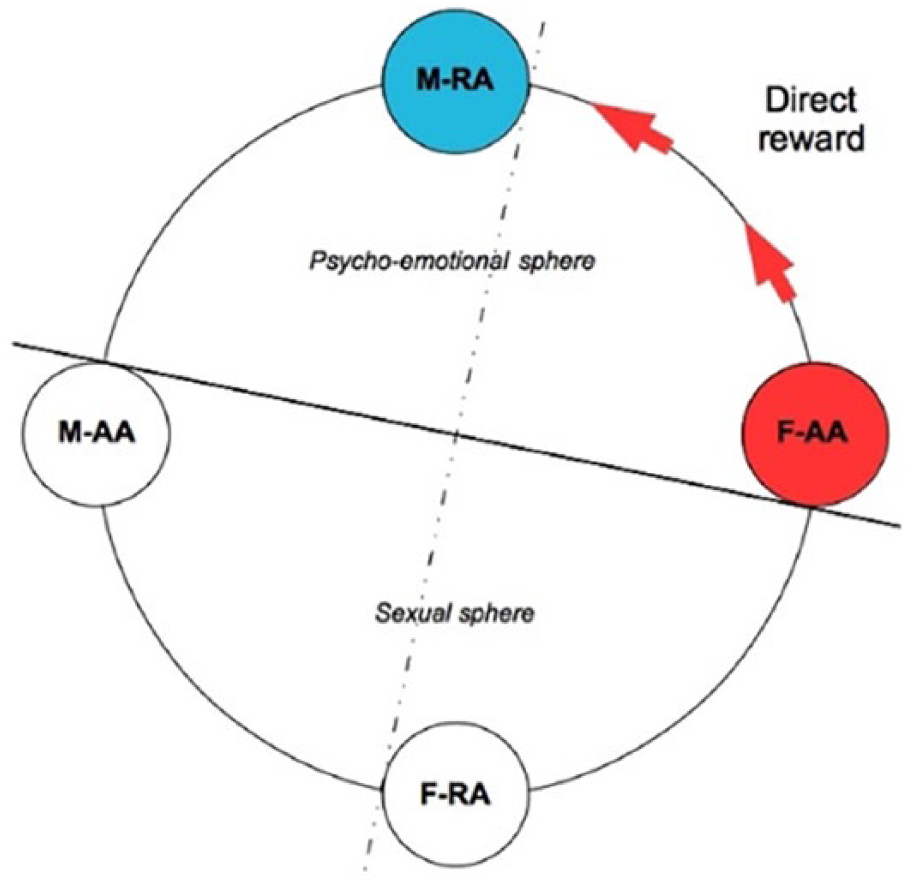
To graphically represent the working of the female and male Areas, we make use of the TU-C diagram, that splits a circle in two hemicycles, respectively, assigned to the two sexes (M on the left and F on the right), and place the male and female AAs and RAs along the circle, in opposite positions along two mutually orthogonal axes. The longitudinal axis separates the male hemicycle from the female one, whereas the horizontal axis separates the psycho-emotional sphere from the sexual one. Each hemicycle contains an AA and an RA. AAs are colored in red and passive ones in blue. The arrows illustrate the flow of communication among the Areas, which, due to the nature and position of the Areas, characteristically proceed anti-clockwise (see Figure 1).

Representation of the Tie-Up Cycle: Male versus female hemicycles, emotional versus sexual spheres.
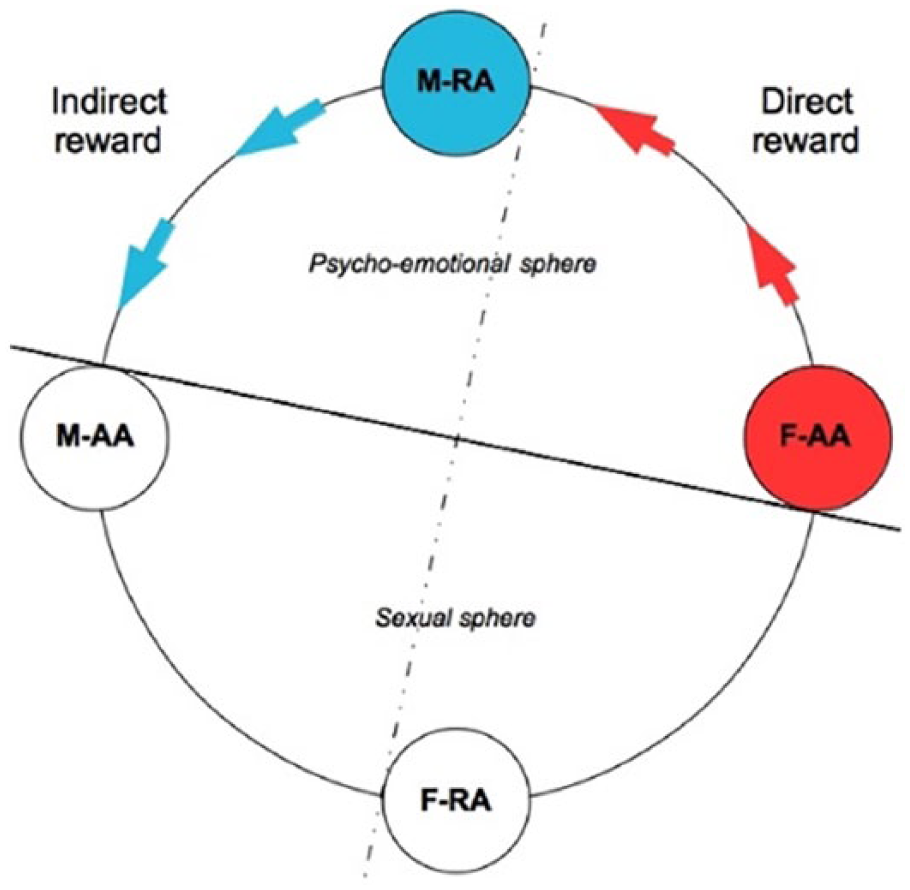
An obvious question then arises: How do Areas communicate among themselves? They communicate by generating for themselves, and sending to the (same or other subject’s) Area they are wired to, a flow of rewards, that will be direct if originating from an AA (red arrows), or indirect if originating from a RA (blue arrows). Rewards within the TU-C are gratifications in terms of pleasure—for example, under the form of a shot of a suitable neurotransmitter (Aron et al., 2005; Takahashi et al., 2015) that sanctions a contextually optimal behavior of either the subject or the opposite-sex one, to (directly or indirectly) confirm it as valid and reinforce it (Jocham, Klein, & Ullsperger, 2011). It is, in other words, a kind of incentive under the form of a reinforcement that orientates behavior, be it instinctual or rational, within a given hierarchical system of priorities (O’Doherty, Lee, & McNamee, 2015).
When Viola acts on the casting stage she is happy, that is, she generates for herself a relevant amount of direct reward: this depends on the fact that her F-AA operates by following her nature and inclinations, that is, it is expressing itself, and as its nature is primarily feminine, it mainly manifests itself in the expression of sentiments. In the case of Viola, in this precise moment in the storyline, this happens through acting. During the audition, Viola’s acting symbolizes the flow of direct rewards that she is sending to Shakespeare’s M-RA. She does not suspect that the man who is listening to her to judge her acting skills is Shakespeare in person. In other words, Viola is not generating her flow of rewards specifically for him, but is merely following an impulse that leads her to produce those rewards with the only intent of making herself feel fulfilled and satisfied (see Figure 2). This is what any AA does: It simply operates by following its own individual and gendered nature, but this does not alter the fact that such actions inevitably end up addressing the external world and causing effects, and especially so when they land on fertile terrain, that is a compatible RA.
Viola, disguised as a male, acts in the audition.
Compatibility is always expressed on a given sphere—be it psycho-emotional or sexual—because whereas it is true that AA “transmits,” the opposite sex’s RA “receives,” and reception obviously cannot take place without a suitable mutual adjustment. The example provided by the movie tells us that the actor (actress) and the playwright focus upon the same channel: that of the representation. The kick-off of the TU-C tells us that Viola and Shakespeare are compatible in their perception and sublimation of the strength of their feelings, and such compatibility reflects into their mutual recognition through the passions they share. Shakespeare’s M-RA is quickly turned on, due to Viola’s expressive intensity which strikes the male character’s artistic sensitivity, provoking a strong emotional response. Clearly, when Viola’s AA realizes it is being appreciated, the flow of direct rewards is further stimulated, and consequently also its reception on the other side, giving us a hint of the spontaneity of the iterative interaction process that lies behind any functioning TU-C.
At this point, let’s turn our attention toward the RA, and specifically the one that has just turned on, Shakespeare’s M-RA. An RA, be it male or female, remains silent below the threshold of awareness until it is stimulated for some reason. The young playwright sits bored and dismayed, and not even looks at the face of the young actor who has just stepped onto the stage. He is by now convinced that the disappointing sequence of mediocre acts he has witnessed so far can only continue throughout the audition, as the available candidates all seem to be amateurs with little or no skills. But a few words pronounced by Viola are enough to knock Shakespeare off his chair and blow his mind: a graphic cinematic illustration of an RA that, out of the blue, starts to fire blasts of indirect reward that hit their target. “Who’s that young man? I never saw him around.” “How does he look like? What’s his name? Where does he come from?” The RA is a passive psychological structure whose function is to evaluate the attraction toward the opposite sex, just like the playwright in this story evaluates the candidates in the audition, submitting them to a thorough test. The playwright’s role, that in the movie scene is annoying due to the bad quality of the candidates’ acts, is a passive one: he limits himself to listen, whereas the candidates play the active part, by interpreting the prescribed character. However passive during the audition, it is Shakespeare’s prerogative to decide who will pass the test, though. An RA functions in the very same way. It sits still and silent, and it is sometimes bored enough to fall asleep, but when a TU-related stimulation effectively hits it, be it purposeful or not like in the case of Viola, the RA immediately turns on and makes its existence known, by starting to generate indirect rewards and launching the test to evaluate the compatibility of the subject from whom the stimulation came. The peculiar feature of this test, which for men is called Psychological Compatibility Test—in that it selects for female psychological traits, emotional intelligence, and personality features (Swami et al., 2010)—is that it is entirely involuntary and automatic, takes place below the subject’s threshold of awareness, and cannot be avoided unless one prevents the occurrence of the necessary conditions for its firing off (e.g., if the female subject to be tested stays clear of it by keeping some psychological distance). The test’s content basically depends upon the sex of the subject who carries it out. The movie clearly shows that Shakespeare’s M-RA, like that of any other man, has an exclusively psychological, emotional nature. Then, M-RA orientates the test toward the mental and psychological sphere, and not toward the sexual one (Fales et al., 2016). In other words, the woman will pass the test if she will be able to emotionally engage the man, by seducing or intriguing him in his imaginary and interests (Little, Burt, & Perrett, 2006).
The possibilities for stimulation of an M-RA are extremely varied, and depend on the specific psychology of the single male subject. In fact, the more the man considers the potential female partner in nonsexual terms, the more concrete the possibility that the Test is carried out (Lewandowski, Aron, & Gee, 2007). Viola’s male disguise has this further benefit: It rules out any possibility that the playwright’s M-RA may have been excited in sexual terms (at least in the case that, the narration clearly seems to convey, he is heterosexual). If the test has a positive outcome, and if the RA keeps on being stimulated, getting excited more and more, a bond, the so-called Tie-Up (TU), will eventually be formed in the RA, psychologically linking the subject to the chosen partner. The link is strong, and exclusive: The TU connects the subject to a very specific partner, who ceases to be a potential mate among many, and becomes the unique center of attention of the RA. An awareness of the test being carried out is probably unnecessary, as the operation of the RA below the threshold of awareness makes in fact the test more effective and truthful, in that it cannot be manipulated by external interferences, and by the subject’s own rationalization.
The immediate consequence of the TU mode of operation is that the active roles of the AAs, those of the actors is our metaphor, are clearly more apparent. In the example, the actors are the ones who materially climb the stage whereas the author sits behind the scenes—that is, the RA that prevalently functions below the threshold of awareness. To say that the man is emotionally passive here, therefore, does not mean at all that he is incapacitated to emotion, easily malleable or insensitive to any psychological situation with emotional implications. In fact, exactly the opposite is true (Harrison & Shortall, 2011). The “discreetness” that is linked to the “passivity” of RAs, both male and female, mainly functions as a protective shield—just like Viola’s disguise—for highly sensitive, and therefore especially vulnerable Areas (Kraemer, 2000), given their role of precision instruments in search of the suitable combination of partner characteristics to spark the TU. Viola realizes she has made an impression, engaging an M-RA, and deduces it must be Shakespeare’s one, in that in some way she is aware, through her knowledge of the man’s oeuvre, of the existence of a strong elective affinity that unites the two of them. Once she has found out the identity of her interlocutor, she is consequently worried about being exposed herself, that is, she fears that her disguise is no longer sufficient to conceal her gender. Viola then flees before Shakespeare manages to stop her, to see her face from close distance and to address her with questions: She flees to protect her sexual identity. Symbolically, the flight aims at protecting Viola’s F-RA, to maintain it hidden, to prevent its exposure at a sphere of interaction with the male character that this time would not occur on the psycho-emotional level, but on the sexual one. Unlike the M-RA, the F-RA has a sexual nature. Viola has now lost her initial boldness and bravery, and clearly perceives the danger—a situation that seems to underline how women, in the absence of specific insecurities or inhibitions, tend to feel themselves more comfortable at the psychological level of interaction when intimacy is at stake, as men instead feel more confident, ceteris paribus, at the sexual level. This shows how each sex feels more at ease in their AAs’ characteristic spheres along the mating process, while being on the contrary more cautious and wary in their RAs’ spheres.
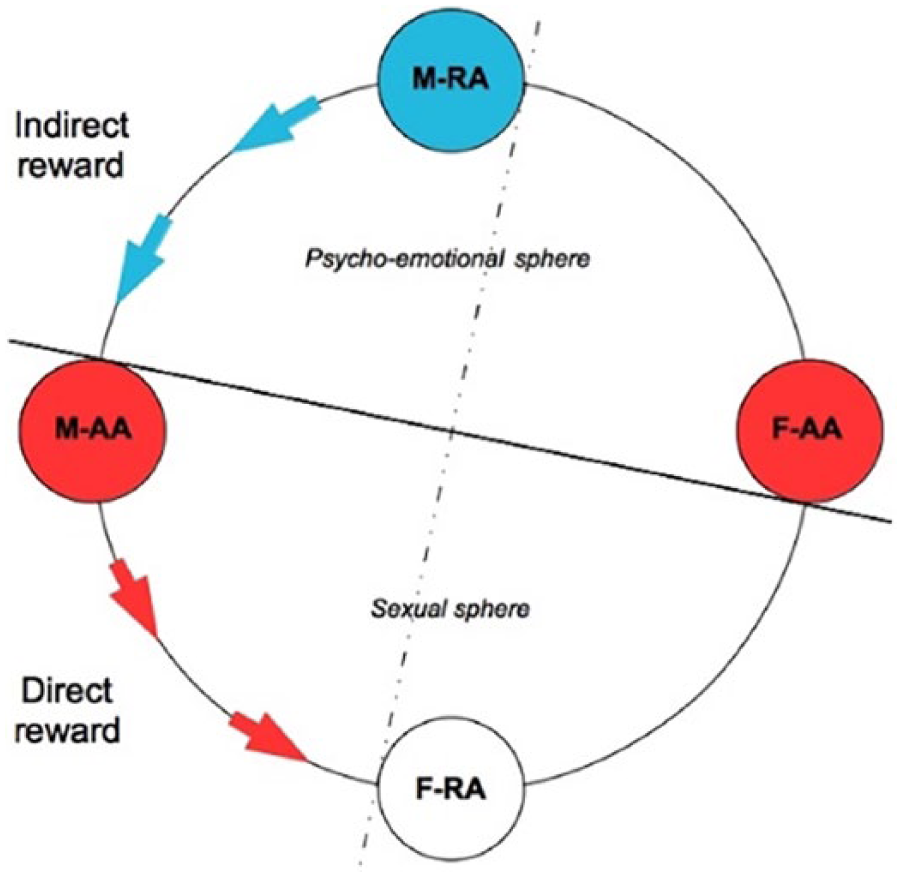
From Shakespeare’s perspective, the young man is the right candidate for the role—and the sexual aspect does not matter here because within the mere psycho-emotional sphere of the TU-C the prevailing relational mode is friendship. The young actor is the chosen one, the perfect interpreter of the author’s soul and of any of its emotional nuances, as if he were on stage himself. The Psychological Compatibility Test has started with excellent possibility of success, and the playwright does not contemplate yet the possibility that the subject he is infatuated to might also be sexually attractive, as if the strong emotional resonance between them were all that mattered. Shakespeare runs after the mysterious, fleeing young man, chasing him (her) as a real sweetheart would do (see Figure 3). The chase symbolizes the Test. When the M-RA turns on due to an effective stimulation, one of the telling signs is the curiosity fueled by a growing indirect reward, the will to know as much as possible about the subject from whom the stimulus comes, so that the Psychological Compatibility Test is fully carried out and completed. Shakespeare chases the young men right into the latter’s house, but there he finds Lady Viola in her shining attire, dressed up for the party that is going on in the halls of her luxury mansion. It is at this point that Shakespeare’s M-AA turns on and goes for the sexual conquest of the fascinating lady.
Shakespeare, impressed by the young man’s acting, chases him to discover who he is.
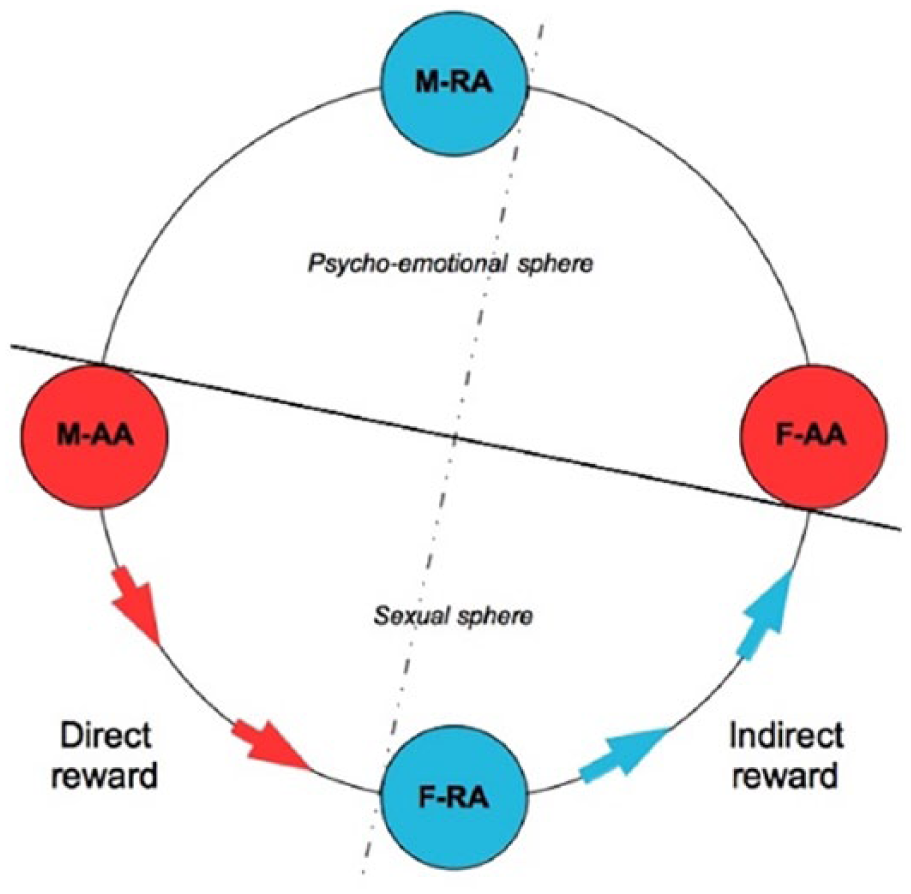
As in a classical comedy of errors, for a while Shakespeare does not realize that the incredibly talented young actor and the beautiful woman are the same person—once again, a perfect Tie-Up metaphor: the TU is always spontaneous and unintentional, and consequently it is inevitable that the awareness of the occurrence of the event is not simultaneous to the event itself, and may arrive at a later stage. For a while, the subjects’ AAs and RAs may fail to communicate, and despite belonging to the same individual they may ignore each other’s state. Accordingly, the young actor and the noble woman initially are two distinct individuals to Shakespeare. At this point of the story, the male hemicycle has been entirely traveled along, and both spheres, the psycho-emotional and the sexual one, with their respective Areas, Receptive and Active, have been engaged. Now, Shakespeare’s M-AA is sending a copious flow of direct, sexual rewards to Viola (see Figure 4), that is, he is dancing with her, while intensely staring into her eyes. Viola’s F-RA turns on (see Figure 5).
Shakespeare meets Viola.
Shakespeare dances with Viola and her F-RA turns on.
What an AA craves the most is the recognition of its gendered identity (Buss & Barnes, 1986). An emotionally active F-AA is then attracted by a man of moral or material worth, who can offer the woman protection to her and to their offspring, as well as status and social recognition, intellectual and emotional stimulus, consideration and understanding—or even just a few of these. A sexually active M-AA will instead prompt the man to seek for women who can excite him, to prove his manhood with an optimal performance (Goetz, Easton, Lewis, & Buss, 2012), thereby also confirming him within his own social reference group, with a recognition that grows with the number of his conquests (Buss, 1989). Viola is beautiful, and Shakespeare has no hesitation: In a blink, his goal shifts from finding the young man to joining the ball to approach the unknown young lady.
The dance is the symbol par excellence, after the kiss, of the female test, which in the Tie-Up Theory is called Biological Compatibility Test, in that it evaluates the male biological characteristics that are transmissible with reproduction (Lucas, Koff, Grossmith, & Migliorini, 2011), and above all the specific compatibility with those of the female subject who carries out the test (Havlicek & Rogers, 2009). The sexual nature of the F-RA, which is entrusted to carry out the test, implies that its stimulation takes place at the sensory level, so that the entire female sensory apparatus is implied in the evaluation of the level of bodily appreciation (Hodges-Simeon, Gaulin, & Puts, 2010). Even minimal signals may be considered, so that their accumulation and intensification—as it happens, for example, with the kiss (Floyd et al., 2009)—bring the test to its conclusion without the need of a full exposure to genital contact (Ferdenzi, Lemaître, Leongómez, & Roberts, 2011). In this regard, couple dances are one of the most ancient methods to test male compatibility (Weege, Pham, Shackelford, & Fink, 2015), in that they allow an ideal physical closeness to probe the dance partner’s chemistry, for example, through olfactory signals, the close-up sight of details such as the skin’s grain, the sound and pace of breathing rhythm and vocal modulation, the haptic contact, the perception of muscular tone and bodily energy, both thermal under the form of bodily heat through the embrace, and kinetic through the vigor and motor alignment in following the music’s beat as one (Roberts & Little, 2008)—where the latter can also be taken as a useful signal of concordance for the male Psychological Compatibility Test. The Test is a pleasant experience for the subject who carries it out, in that every RA, while testing, simultaneously generates indirect rewards to incentivize the longest possible protraction of the conditions that enable the Test’s functioning (Maner & Ackerman, 2015). But these are in fact rewards that are poured into the cycle and activate the TU-C, as each RA communicates with its own AA, transmitting to the latter such rewards and exciting the AA in turn.
During the dance, Viola’s F-RA starts testing Shakespeare, with clear clues of an imminent success (e.g., her luminous gaze and smile). Meanwhile, a first shot of indirect reward reaches Viola’s F-AA, which gets excited in turn and bursts into an exclamation: She pronounces his name, proving that she knows him and taking the chance to make her deep admiration manifest (see Figure 6). The F-AA then sends a further shot of direct reward that fully hits Shakespeare’s M-RA, which is further exhilarated by realizing that not only the beautiful lady gives him attention, but even considers him “the highest poet of my esteem and a writer of plays that capture my heart.”

Viola recognizes Shakespeare and pronounces his name.
This further passage of rewards through the M-RA is now determined by the female lead character, and not by the mysterious young actor. Every TU-C refers to a unique couple at a time, but in this case, being the two subjects of infatuation the same despite Shakespeare believes otherwise, the TU-C is accordingly the same as well. His M-RA has been stimulated several times within a few hours, and Shakespeare vents his excitement into a furious playwriting session, frantically composing his verse on the drive of the big shot of indirect reward that his M-RA, gratified by Viola, has poured into the cycle (see Figure 7). The doubling down of his M-RA stimulation exposes the male character to a concrete prospect of a TU. The fact that a compatibility Test turns out to be successful does not necessarily imply a TU, and especially if, as in this case, the man has not experimented yet a sexual attraction toward the tested subject—as in the case in which Viola would not have been a woman disguised as a man. In the total absence of a sexual interest, the TU would be pointless, and M would then remain merely engaged at the psycho-emotional level, enjoying some indirect reward from a purely friendly relationship. What can be gathered from these examples is that direct and indirect rewards may sum up, reciprocally magnifying their effects and the intensity of the pleasure they elicit. We also realize the difference between them: What is felt by seducing a woman whose beauty makes the man burn with desire is the male direct reward, and by chasing it further, the man goes for the optimal sexual reward achieved with female impregnation (Burriss, Welling, & Puts, 2011). But even at the top of direct reward, an extra element of reward may add up: the male indirect reward, which starts to flow when the attractive woman not only positively responds to the physical approach but also admires and acknowledges the man’s worthiness, and moreover shows a perfect psycho-emotional tuning with him, becoming, for example, an inspiring muse (as in the movie) or much else. Likewise for the woman, she can literally adore a man for his qualities or characteristics—like Viola does with Shakespeare—thereby feeding her direct reward through the sharing of a common imaginary of adventures and even shared dreams, but if on top of this physical attraction adds up, that is, all the sensory experiences that are typical of female indirect reward, the overall reward that is enjoyed is certainly bigger. Thus, Viola’s idol, in addition to being a true “prince” of playwrights, is also so handsome and seducing to make her heart flutter.

Shakespeare, gratified by Viola, shows his excitement and elaborates his emotion into writing.
The first iteration of the TU-C has thus been completed. The two characters are now exposed to a TU as soon as any further flow of rewards passes through their RAs. The intimidating intervention of Viola’s promised mate, who defends his mating territory, does not represent a serious enough threat to compromise the already ongoing TU-C between Shakespeare and Viola. At this point, what is left to analyze is how the two characters’ TUs occur. Viola’s Biological Compatibility Test is over with the first kiss, by means of which the young woman unveils her sexual identity, throwing Shakespeare into confusion as, up to a moment before, he believed she was a male. With the second kiss, that closely follows the first, Viola aligns her F-AA with her F-RA—rather than aligning it to her father’s will that promised her to someone else—and also Shakespeare, in turn, connects the two previously separate figures together, the young actor and the noble woman, by stripping bare the former and loving the latter, together with the conjunction of the two spheres, the emotional and sexual ones, in the male hemisphere of the TU-C. Starting with the third kiss, that follows the first two, we can maintain with some confidence that both are now tied-up (D-TU), as the cycle iterations frantically pile up, a situation that is symbolized by Viola’s whirling as her lover strips her. With the sexual intercourse, Viola’s F-TU becomes apparent, so that she exclaims: “I would not have thought it. There is something better than a play!” That “something better” are the indirect rewards. Viola has achieved the peak of such rewards, starting to realize how they are, in comparison, even more inebriating of direct rewards themselves. To her nurse, the secret witness of their loving night, Viola radiantly confesses: “It is a new world!” For Shakespeare, the timing is different, and his M-TU becomes apparent only the morning after at the theater. In the case of the man, the sexual intercourse does not cause the achievement of the peak of indirect reward, as for the woman, but of the direct reward instead. This moment marks the man’s exit from his hemicycle along the TU-C, with a consequent, physiological drop of the excitement of the M-AA (Hughes & Kruger, 2011), whereas the woman now experiments a further boost of excitement in her F-AA, fully hit by the burst of indirect reward generated by the peak of stimulation of her F-RA (Muise, Giang, & Impett, 2014). But when Shakespeare sees again on stage the one who has now become “his woman” after the night spent together, only at this point—when, having traveled the whole female hemicycle he enters again into his own, that is, when the flow of rewards reaches again his M-RA—he now achieves his peak of indirect reward, by acknowledging the fusion of beauty, grace, intensity, art and erotic love together, something sublime that goes beyond a mere one-night shot of direct reward, no matter how fulfilling. If then for the woman the TU is sexual in nature, for the man it is emotional, and what bigger emotion can there be for William Shakespeare than discovering the extent to which his woman fits his own inner being as a poet and artist?
The scenes that follow in the movie metaphorically represent the dizzying sequence of iterations of the TU-C and the rapid, reciprocal accumulation of the rewards, so that it becomes difficult to tell sex from emotion, as they are melting into a unique, captivating energetic flow that further enhances and aggrandizes Viola’s acting skills and Shakespeare’s creative ones. This is the power of a properly functioning TU-C: the empowerment and personal development of each of the couple’s subjects. Unfortunately, the play Shakespeare is writing is no comedy: “A broad river divides my lovers—family, duty, fate—as unchangeable as nature,” and the characters of the movie are more than aware that their TU-C is “not life [but] . . . a stolen season,” and that their fate will not provide more than that. The TUs have thus been formed and secured, but they would have no chance to be fed without a regular flow of rewards, and therefore they could not survive outside of the TU-C—as Romeo and Juliet, despite their love, cannot survive in turn in the story William is writing.
In the economy of the story, Shakespeare and Viola have no chance to keep their TU-C going, and getting out of it represents a literal suicide for their TUs. Shakespeare will later sublimate this condition in his next work by making it a comedy, and living alternative lives in his imagination, whereas Viola will sail to a new world, this time not metaphorical but real: the shores of the American continent—which suggests that a new series of adventures awaits her, to soothe the agony of the dissolution of her own TU.
In real life settings, we find mates who, despite being tied-up, purposefully give up forming or maintaining a TU-C, and for some of them the TU survives nevertheless, being fed by memories alone. But walking along this path certainly entails significant costs in terms of personal suffering, insofar as the TU does not extinguish itself. The movie’s real happy end is therefore not, as one could expect, the creation of the couple, but the proof that theater (and thus, indirectly, cinematic narration itself) is not a mere fantasy for dreamers, but the real thing: It can teach us “the very truth and nature of love.” In other words, the happy end is the proof of the social cognition valence of romantic stories.
Conclusion
The Tie-Up Theory has been formulated to address the dynamics of interaction in the mating processes of real couples (Lucchi Basili & Sacco, 2016). The fact that it lends itself especially well to the analysis of fictional accounts of the mating process offers us an interesting perspective on the social cognition valence of some romantic fictional narratives. If in fact, as seen in the example analyzed in this article, it is possible to find narratives—and in particular examples that are validated by a high level of social attention and by an intense intergenerational transmission—whose structure is coherent with a theoretical framework that is modeled upon real behaviors, it is possible to consider such narratives as useful sources for the comprehension of the mating-related logic of interaction among sexes. Lucchi Basili and Sacco (2017) find a similar concordance in a small but carefully chosen sample of highly successful romantic Hollywood comedies from different decades, showing how they can be interpreted as narrative simulations of specific variants of a certain repertoire of basic interaction schemes of mating processes. If we associate the potential of romantic fictional narratives in social cognition terms to their eudemonic value (which is a necessary but not sufficient condition for the social recognition of their relevance, and therefore for the establishment of the conditions for their transmissibility), it must be recognized, as it happens in the example of Shakespeare in Love, that the narrative exploration of the mating process is as important as mating itself. In our example, despite the lack of a happy end in the traditional sense, the movie’s end causes a romantic climax that does not disappoint the expectation of the audience, but in a sense provides them with an even stronger and lasting emotional payoff, also because in the economy of the story it is the romance between the main characters that provides them with the energy and drive to walk down their diverging life paths, at the end of which they will meet their respective eudemonic fulfillment.
Likewise, it would be limiting to regard those classical artifices that, according to an apparently hedonic logic, spice up the narrative arc with ludic elements—but also with possible counterfactual subplots, such as in the case of disguises or misunderstandings—as mere narrative expedients. Think, for example, as remarked above, of the misunderstanding that makes Shakespeare believe that Viola is a young man, making the playwright focus upon the activation of his M-RA rather than of the M-AA (as it would have happened if Shakespeare had met from the beginning Viola in her real guise as a beautiful young woman). The misunderstanding here paves the way to a possible TU for Shakespeare, setting the ideal conditions for the launch of the male Psychological Compatibility Test. Likewise, the development of the fictional romantic narration inevitably tends to create occasions where the two main characters end up experimenting some close physical contact. What seems once again a mere hedonic expedient to elicit a momentary peak of romantic excitement in the audience becomes, from a deeper eudemonic perspective, the key narrative juncture that allows the woman to carry out in turn her Compatibility Test—and which, in the cultural contexts where forms of social segregation between sexes prevail, often corresponds, as it happens in our example as well—to a dance scene. Dance can in fact be considered as a true socialized form of reciprocal exploration of the potential partners’ bodily characteristics (Fink, Weege, Neave, Pham, & Shackelford, 2015), and not incidentally it presents a strong cultural universality, and fits within a fundamental trajectory of psycho-physiological development of human beings (Richter & Ostovar, 2016). Such exploration takes, for the above discussed reasons, an especially crucial role for women (Weege, Lange, & Fink, 2012), who in many societies experiment strong restrictions to the possibility of physical contact with men out of wedlock, and who would otherwise have little or no chance to probe male physical and genetic endowments without incurring in possibly serious forms of social sanction. The role of dance as a mate selection ritual is not indeed limited to humans but, as it is well-known, is extremely common in the animal realm.
Some stories carry an aesthetic and knowledge value that also depends on the prowess with which they accurately reconstruct in detail real historical events. But in most instances, and our case study here is an eloquent illustration, a story’s value does not depend on the real-life likelihood of characters and situations any more than a model’s mathematical equations describe each detail of the phenomenon they mean to analyze. Stories are simulations with a high social cognition valence, where restrictions of coherence do not apply to the content of the representation but rather to its structure. This is why we stay passionate about fictional narratives with patently unrealistic settings, or entirely lacking clear geographical and historical references, and that nevertheless capture our attention and imagination more than we would be rationally willing to admit.
If research on the social cognition value of fictional narratives is attracting a growing interest, its specific application in the field of human mating is still in a very preliminary phase, also due to the already mentioned tendency, that prevails not only in the scientific sphere but even in commonsense reasoning, to downplay romantic narratives as cheesy, unrealistic forms of daydreaming with potentially adverse effects on the emotional maturity of those who pay them attention. With this article, we hope to have given a contribution to showing how romantic fictional narratives may be much more complex and intriguing than what could seem at first sight. This is one of the reasons why they still fascinate audiences from different generations (mainly female, being women, unlike men, active on the psycho-emotional level; see Ostrov Weisser, 2013). Interpreting them reductively, without appreciating their social cognition value, then represents a serious analytical limit. On the other hand, our current scientific understanding of human couple relationships is far from exhaustive, and not incidentally such questions remain at the center of attention of many disciplines within the social sciences. The development of a new, unusual theoretical viewpoint like the one proposed here could then provide inspiration for new methodologies and research hypotheses, and maybe even provide a stimulating re-interpretation of already explored research questions. Our hope is therefore that this article may prompt other researchers to develop an intellectual curiosity for romantic fictional narratives, and to improve our understanding of how they contribute to the social cognition of mating processes.
Footnotes
Declaration of Conflicting Interests
The author(s) declared no potential conflicts of interest with respect to the research, authorship, and/or publication of this article.
Funding
The author(s) received no financial support for the research, authorship, and/or publication of this article.
