




Abstract
Contemporary research on prostitution tends to treat it either as a social problem that needs to be solved by criminalizing customers and supportive social programs (exit programs) or as a manifestation of female agency. This article analyzes Danish ethnographic interview and observations with the so-called dominatrices. The theoretical concepts, boundary markers and body schema, are applied to identify dominatrices’ perception of themselves as businesswomen not representing a social problem. The dominatrices are used to discuss tailoring of exit programs, and the article concludes that core elements in these programs need to change if the dominatrices should be provided relevant opportunities to pursue a different profession.
Introduction
In public debates about prostitution, no clear distinction is made between different types of prostitutes (Smith, 2017). By and large, discussions are shaped with reference to a paradigm stressing their oppression, represented here by the prohibitionists (Crowhurst, Outshoorn, & Skrilbrei, 2012). Regardless of whether public debates focus on outdoor street prostitutes, indoor brothel prostitutes, or paid escorts, prostitutes are construed as individual victims of a general social problem (Weitzer, 2010, 2015). In these public debates, street prostitution clearly dominates the social imaginary. The prohibitionist position focuses overwhelmingly on the street prostitutes’ exposure to trafficking to argue that prostitution in general is dangerous for the sellers of sexual services and encourages violence against women more generally (Doezema, 2010; Weitzer, 2015). Consequently, they argue, prostitution should be prevented by criminalizing the purchasers of such services, as well as by supporting social programs (in particular, exit programs) enabling all prostitutes to stop selling sexual services and providing them with opportunities to pursue a different way of life (see also Desyllas, 2013).
However, approaching prostitutes as individuals who are adversely affected by a social problem ignores the fact that some prostitutes do not perceive themselves as the victims of such problems, but as very different from other groups of prostitutes. Indeed, while many theorists maintain that prostitution necessarily involves the exploitation and degradation of women (Bernstein, 2007; Phoenix, 2000), research on some categories of prostitutes, like dominatrices, is approached not in terms of their victimization but rather of their empowerment. 1 Though limited, the literature provides descriptions of their activities as a platform for female sexual liberation and female agency (Lindemann, 2010, 2013; Weiss, 2011). They are described as dominatrices who sell bondage, discipline, sadism, and masochism (BDSM) and types of SM or similar erotically stimulating services from brothels. These brothels are arranged with rooms fitted with torture instruments such as whips and chains for use in these activities (Lindemann, 2010, 2013; Weiss, 2011).
By focusing on the dominatrices’ self-representations, this article adds to our limited understanding of how to tailor exit programs to suit the needs of the different types of prostitutes. To identify the dominatrices’ needs, the first part of this article describes the content of exit programs and explains why Danish dominatrices in particular become the focus of attention when it comes to more general discussions about the tailoring of such programs. The second part of the article applies a symbolic interactionist framework together with Fredrik Barth’s boundary marker concept (Barth, 1969) and the body schema concept (Gallagher, 1986) in the analysis of the ethnographic material. The analysis (the third part) suggests that dominatrices use descriptions of their business, their skills, and their mentality to establish themselves as working in a category of prostitution that is altogether their own. The discussion focuses on (a) the category of the dominatrices and (b) the consequences for the policy on prostitution as formulated and implemented in the exit programs. In the conclusion, I claim that the exit programs must both respect the dignity of a distinct self-image that dominatrices and other groups of prostitutes and sex workers ascribe to themselves and introduce different elements into these programs than those provided for the street prostitutes. I further raise the question about the relevance of exit programs for dominatrices.
Background
Exit Programs
Although they are core elements in prostitution policies, exit programs have received limited attention in public debates and in the literature (Cimino, 2012). The construction of exit programs reflects public debates on prostitution in society; the order of the legal restrictions and supportive elements depends upon whether prostitution is defined mainly as (a) an illegal activity, (b) an immoral activity, (c) a form of violence against women, or, as in Denmark, (d) a social problem (Mayhew & Mossman, 2007). Rarely are exit programs the main focus of research. A general characteristic of these exit programs is that they are primarily based on and tailored to suit the needs and preferences of street prostitutes (Cimino, 2012). Little attention has been devoted to the heterogeneity of work experiences among other categories of sex workers who do not work in the streets, like different types of indoor prostitutes and paid escorts, or to the relevance of exit programs to them (Sanders, 2007). Consequently, only a patchy knowledge is provided about the needs and preferences of groups like the dominatrices when it comes to exit programs. This is surprising as it is a policy objective in many countries to provide all prostitutes and sex workers with the opportunity to leave their profession and as it is assumed that all sex workers aspire to leave their profession (Desyllas, 2013).
Scholars discuss the predominant factors involved in exiting prostitution, for instance, the significance of personal agency and of structural, cultural, and legal factors in the transition (Cimino, 2012; Sanders, 2007). The literature identifies the essential elements of successful exit programs, such as the provision of employment opportunities and alternative accommodation, and the treatment of abuse (Benoit & Millar, 2001; Dalla, 2002; Hester & Westermarland, 2004). A successful exit also requires the prostitute himself or herself to acknowledge that prostitution is not a possible future avenue of employment, and the literature suggests progression through a series of successive stages will end in a final exit (see, for instance, Baker, Dalla, & Williamson, 2010; Månsson & Hedin, 1999). However, even though these factors do interact positively with the prostitutes’ own convictions, leaving prostitution is not a time-limited linear process (Cimino, 2012). Studies like those of Månsson and Hedin (1999) and Baker et al. (2010) suggest that it takes several attempts to leave prostitution. For instance, one Canadian study found that it took on average 5.8 attempts to break from prostitution for 2 years (Benoit & Millar, 2001). Financial problems and difficulties in attending scheduled programs are partly responsible for the fact that a final exit from prostitution may take several attempts (Dalla, 2006; Roe-Sepowitz, Hickle, Loubert, & Egan, 2011). A shift to alternative employment often requires supportive social relations to replace those in the prostitution milieu, as well as, possibly, the creation of a new identity (Sanders, 2007).
Exit programs must therefore be tailored to meet a complex situation for the prostitute who may want to leave the profession. The programs must be flexible and able to address a multiplicity of issues that different types of prostitutes face in seeking alternative employment (Benoit & Millar, 2001; Oselin, 2010; Sanders, 2007). Ideally, the same social worker should be present through the various stages of the exit process, that is, before, during, and after exit from prostitution. This includes creating awareness among the prostitutes of the elements of the program, acting as a broker with the multiplicity of social services that a prostitute may need, and supporting the ex-prostitute to prevent reentry (Mayhew & Mossman, 2007). One of the central services is specialist support to help prostitutes access and maintain work-matching skills and interests to acquire employment opportunities. The support needs to be adapted to different preferences and levels of motivation influenced by, for instance, drug abuse and homelessness (Cimino, 2012).
Nordic and Danish Prostitution Policy
Public debates about prostitution in the Nordic countries often lead to the question of its criminalization. Purchasers of sexual services were criminalized in Sweden in 1999, in Finland in 2007, and in Norway in 2008 (Crowhurst et al., 2012; Tveit & Skilbrei, 2008). In Denmark, prohibitionists and women’s liberation organizations (represented by the Initiative of 8th March, for instance) long argued for this move, pointing to the potentially negative long-term effects of prostitution on the women involved (Hulusjö, 2013). While sex worker organizations (as represented in the Forum for Sexual Policies, for instance) counter that this perspective devalues female agency, the prohibitionist perspective continues to dominate the debate (Bjønness, 2012). The sex worker organizations argue that the problem lies not in the legality of purchasing sex but in the illegality of selling it. Full decriminalization, they argue, would be a better solution, drawing inspiration primarily from the Netherlands.
In Denmark, prostitution is currently legal, although the law is complicated. Although procuring women for prostitution is against the law, a person can legally offer sexual services from brothels, via the Internet, or in the street. Still although prostitution is a legal activity, it is only partially accepted as a profession by law. As a result, prostitutes are denied access to benefits such as unemployment insurance, state pensions, and the right to unionize (Bjønness, 2012). Danish policy also reflects the structural shift in policy approaches in Western Europe and the United States that has led to men’s demand for sexual services being problematized instead (Bernstein, 2007; Gurd & O’Brian, 2013; Huschke & Schubotz, 2016. See also the Committee on Women’s Rights and Gender Equality, 2014). The previous Danish government (2011-2015) included the criminalization of purchasers in their program in 2011, but abandoned this position in 2012, eventually deciding to improve the exit programs that enabled prostitutes to stop selling sexual services. These policy objectives have been taken over by the current government (2015-). Ongoing social work with prostitutes and the provision of exit programs are organized by Danish municipalities and non-governmental organizations (NGOs), who facilitate prostitutes’ access to the labor market and to psychological help and protection from clients (Bjønness, 2012). 2
Dominatrices
Dominatrices require attention when the tailoring of exit programs and theories to better predict exit is discussed. The sexual services provided by this group consist of exposure of clients to violence. The dominatrices’ BDSM services originated in the San Francisco area, and the dominatrices themselves began to appear in the sociological literature in the 1970s (Lindemann, 2010; Weinberg, 1983, 1987; Weiss, 2011). Whether or not dominatrices are prostitutes is a question to which some of the literature has devoted considerable attention (Kamel & Weinberg, 1983; Lee, 1983; Weinberg, 1983, 1987). Some studies define them as sadomasochists and argue that professional dominatrices are not prostitutes. For instance, Gini Graham Scott (1983), who deals with professional dominance in her study Dominant Women/Submissive Men, argues that dominatrices are not prostitutes as they control the male client and are not obliged to fulfill the client’s sexual desires, unlike other prostitutes. In Scott’s study, one client stated that he expected a session to end in a certain way, but was aware that this was ultimately for the dominatrix to decide (Scott, 1983). Scott’s study has been criticized for focusing on novice dominatrices and generalizing about a “population of respondents that only experimented with the behaviour for a short time” (Moser, 1984, p. 418). Other parts of this otherwise sparse literature discuss the hierarchy that exists between the dominatrices, who distinguish between artists (the top end of the hierarchy) and those who only seek a profit (the lower end of the hierarchy). Danielle Lindemann’s study Will the Real Dominatrix Please Stand Up exemplifies this discussion. It describes how some dominatrices speak of their work as “real” or “true,” thus seeking to draw a distinction between dominatrices who work with the sole purpose of making a profit and those who perceive themselves as true artists (Lindemann, 2010, p. 589).
In the present study, the case of the dominatrices is used to pursue the argument that developing exit programs should account for the diversity and heterogeneity of prostitutes. This argument is based on the following analysis and developed further in the “Discussion” section. The next section concerns the methods and data used in this study.
Method
This study is situated in a social constructivist approach to the analysis of the dominatrices’ self-representations. This implies an awareness of the process by which these self-representations were created, negotiated, sustained, and modified in the interviews (Hammersley, 1992; Schwandt, 2003)—an approach to the formation of their separate category of prostitutes as both situational and relational in the interview situation. Thus, this category is not created in isolation, but constructed through the social encounter which the interviews constitute. Furthermore, the study is focused on the practices of the dominatrices to allow openness to the way the dominatrices provide their BDSM services. This approach allows the author to investigate this kind of prostitution as a thing that comes into being in different ways and through a situational analysis (Clarke, 2005) establishes the particular category of dominatrices on the basis of this practice.
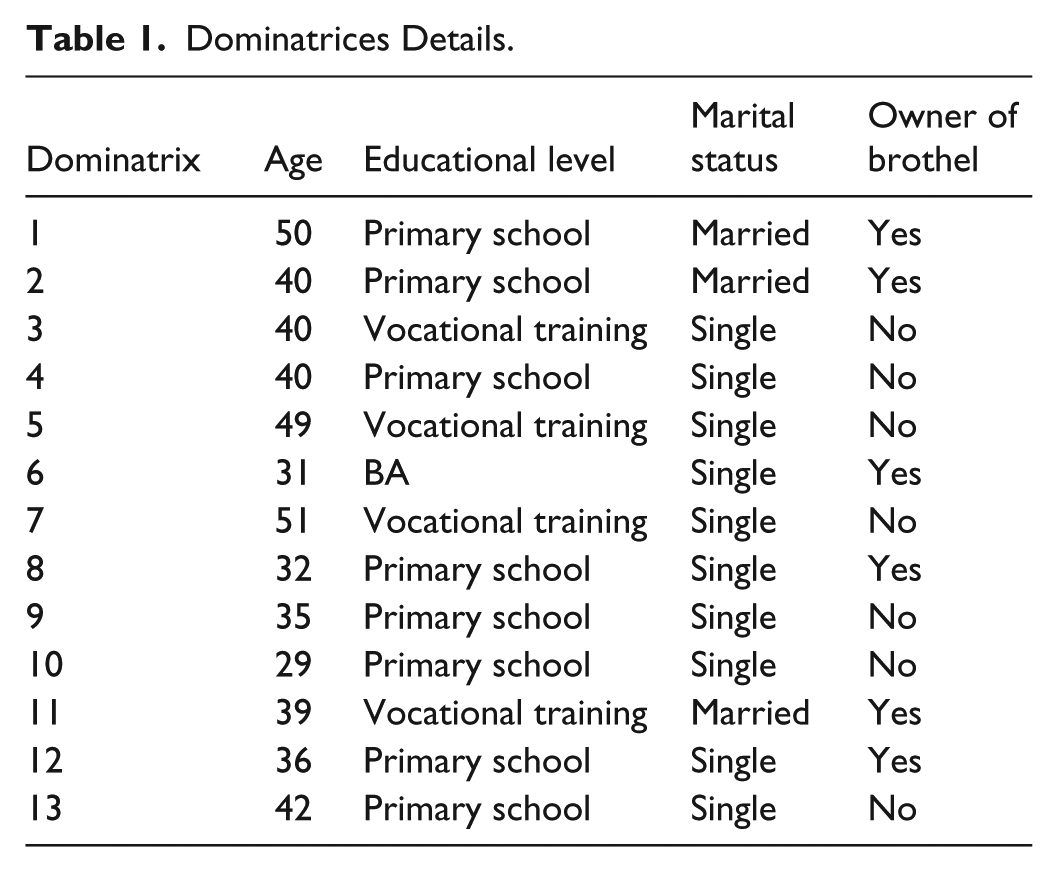
Due to the focus on practice, qualitative methods take priority among the three major data sources used in this study. First, semi-structured interviews were conducted with a sample of 13 women dominatrices. They were located in the Greater Copenhagen Area and in major Danish cities. Ethnically, they were all Danish women aged between 31 and 50 years. Their educational backgrounds varied, and some were married whereas others were single (see Table 1 for details). The interviews were conducted in two periods: First, the author and co-researchers identified six dominatrices from a large sample of 104 semi-structured interviews and 20 brothel observations conducted with prostitutes in 2011. Second, these five interviews were supplemented by an addition of eight interviews undertaken in 2015 to reach data saturation (Denzin & Lincoln, 2008; Kvale, 1996). The first five semi-structured interviews and the following eight interviews were designed to gather information on entrance into prostitution, daily working conditions, social life, and experiences with the municipal authorities. The length of the interviews varied between 45 min and 2 hr. Out of the entire sample of 13 interviews, four follow-up contacts were undertaken to clarify details. All interviews were audio-taped and subsequently transcribed.
Dominatrices Details.
Second, observations were conducted at four brothels to establish an objective record of physical arrangements of the brothel interiors. The author and co-researchers took the roles of participant as observer (Gold, 1958) when the dominatrices walked them through the premises and explained the use of their different tools, utensils, and instruments. Field notes consisted of sketches of the interior arrangements and descriptions of these interiors. The notes contained observations of how the dominatrices elaborated, explained, and made the authors pay attention to the different tools in their brothel (cf. Clarke, 2005). The notes also included a record of participants’ responses and personal reaction to authors’ and co-researchers’ questions. Observations were conducted prior to or immediately after the interview sessions. The interviews were also used as opportunities for observation (Rubow, 2003) when the dominatrices answered their phones or were servicing clients. These opportunities enriched the data by allowing the author and co-researchers more time to add and explain details and expanding on field notes.
The observations documented what tools and utensils established the dominatrices’ practice. The tools and utensils needed explanation, and observing the interior was combined with authors’ and co-researchers’ questions to establish an understanding of how the dominatrices provided their services by specific tools. Explanations opened to the pride the dominatrices attached to their BDSM services, and it allowed them to talk about their clients and how they humiliated these clients and added pain to different parts of clients’ bodies. Observations were documented in notes taken during the observation. These notes were rewritten immediately after the observations had taken place to add more details.
Third, the author had exclusive access to data from a large survey of sex workers in Denmark as they conducted the survey together with co-researchers. The large survey (of 104 semi-structured interviews) covers prostitutes (women and men) from different areas of Denmark, that is, city, town, suburban, and country areas. The study was part of a large research project to estimate the number of prostitutes in Denmark and assess their living conditions (Kofod et al., 2011). To this end, the prostitutes were asked to take part in a socioeconomic survey (n = 329). In combination with qualitative interviews (n = 104) and observations (n = 20), the survey was used to reach an overview of their living conditions. The survey included questions about income, marital status, number of children, schooling, career in prostitution (and possible breaks), number of workplaces in prostitution career, and so on (Kofod et al., 2011). These data allowed the author to compare the different types of brothels and develop the exclusion criteria to include brothels providing BDSM services only.
Data Collection
It is notoriously difficult to gather data about prostitutes through interviews and observations, and indeed it requires patience. To obtain a sample of dominatrices for this study, a combination of purposeful and snowball convenience sampling strategies was utilized (DiGregorio, 2016). The author and co-researchers initially used clients’ methods of establishing contact with the prostitutes, that is, the author and co-researchers called the phone numbers and mailed the e-mail addresses posted in Internet or magazine and newspaper adverts. These requests were (if a reply was obtained) rarely enough to get the dominatrices to agree to an interview. It turned out that phoning and then immediately visiting the brothels afterward was a more successful strategy, although this was of course the interviewee’s place of business. These visits required flexibility and patience. The author and co-researchers needed to wait, often for long periods of time, allowing interruptions in ongoing interviews and postponing interviews until the next day. The strategy proved successful in six dominatrix interviews. Eight interviews were undertaken by telephone/chat.
Data Analysis
For the purpose of data analysis, the interview transcriptions and observation notes were read by the author and co-researchers and used to develop situational and social world/arena maps to identify the issues and themes (cf. Clarke, 2005, p. 87 ff.) that eventually could establish the category of Danish dominatrices. The situational maps identified the relations between the dominatrices and the important tools, utensils, and instruments in their brothels by analyzing what the dominatrices explained about these. The social world/arena maps were used to identify the practice constructed as meaningful by the dominatrices. In this matter, the author and co-researchers also paid special attention to the similarities and differences among the dominatrices. The following section provides the basis for a discussion of consequences for prostitution policy with focus on tailored exit programs.
A Category of Their Own
The dominatrices position themselves as a superior group of prostitutes, thus opposing the social imaginary of the victimized prostitute. Focus in this analysis is on the characteristics that dominatrices consider mark the differences between themselves and the women they call “ordinary prostitutes.” In the data analysis, the author applies two theoretical concepts: (a) boundary markers (Barth, 1969) and (b) body schema (Gallagher, 1986).
The differences between the dominatrices and the “ordinary prostitutes” can be seen as boundary markers by which the dominatrices are able to establish their position as being above that of “ordinary prostitutes.” Boundary markers are not objective differences but only those to which the dominatrices themselves ascribe importance. Barth’s (1969) concept allows the author to identify the descriptions the dominatrices use to distinguish between “them,” that is, women they refer to as “ordinary prostitutes,” and “us”, that is, the dominatrices, by means of the different practices they emphasize, for instance, tools and skills. To conceptualize the importance of the technical artifacts (tools, utensils, and instruments) and the importance the dominatrices ascribe to their skills, the body schema concept is useful. The body schema defines a non-conscious performance of the body . . . (Gallagher, 1986, p. 548) as it actively integrates its position and responses in the environment (Gallagher, 1986, p. 549). When the dominatrices invent and acquire new skills, they alter their body schema. Thereby they alter their potentials for action with their clients, that is, how they can punish and humiliate them. The technical artifacts become incorporated into the body schema and it becomes a means through which the skills are expressed (Bery, 2000, p. 8).
The analysis is structured into three sections: (a) My Business, (b) It Takes Skill, and (c) Mentality.
My Business
To illustrate the dominatrices’ perceptions of themselves as self-responsible businesswomen, observations from Dominatrix 1’s brothel and interview with her are used. (To protect the dominatrices’ anonymity, the terms Dominatrix 1, Dominatrix 2, and so forth are used throughout the analysis.) Dominatrix 1’s statements occupy a prominent position in the first part of the analysis to illustrate the prominence the physical arrangements and technical artifacts take in the dominatrices’ argument about being a particular group of prostitutes. Dominatrix 1’s brothel was along with one other brothel arranged on the ground floor and the basement. The remaining two were on one floor only. Dominatrix 1 has worked as a dominatrix for approximately 10 years. She is 50 years old, married, and previously worked mainly as a waitress. Her brothel is located in a townhouse in a quiet, attractive neighborhood in the center of a large provincial town in Denmark (see Table 1 for further details on the individual dominatrices).
A Danish dominatrix brothel is a long-term business investment for the owner as up to 50% of the profit is reinvested. The dominatrices claim that their investments in this enable them to provide services that meet the clients’ changing wants. For instance, dominatrix 1’s ownership of the house in which her brothel is situated enables her to invest in her business over long periods. To distinguish between a dominatrix brothel and an “ordinary” one, she explains that the latter typically is located in a minor flat on short-term leases. “Ordinary prostitutes” both work in these small brothels and take shifts in larger brothels, in agreement, she claims, with the other dominatrices. They immediately convert their profits into repayments, drugs, or luxury goods, according to Dominatrix 1, whereas she herself reinvests her profits in new advanced tools. What is more, a palpable business vernacular is reflected in Dominatrix 1’s descriptions: It has taken me ten years to establish this place. My brothel is a real business . . . it is proper, clean and nicely arranged in several rooms.
A typical Danish brothel, on the contrary, . . . is arranged with two chairs, a night table, a dustbin and a bathroom if you are lucky. . . . Brothels at the lower end might only have the bed.
Although Dominatrix 1 welcomes the author and a co-researcher in an ordinary brothel dress code of high latex boots, short leather skirt, and a blue push-up bra, the self-responsible business woman pervades her own descriptions. By pointing to her business certificate (her framed Value Added Tax registration), she underlines the pride she attaches to her brothel and its technical artifacts.
Unlike typical Danish brothels, the waiting room in Dominatrix 1’s brothel invites the client to sit in comfortable chairs and listen to soft music while having coffee or tea. Only the price list on the coffee table reveals that this room is not a waiting room in a beauty parlor. Instead of manicures and facials, you choose between “wrapping,” “fixing,” “suspension,” “spanking,” “punishment,” and “humiliation.” The different chambers are arranged with a coffin lined with spikes in the corner, and a big black cross hangs on the wall, surrounded by whips, plumb bobs, leather and gas masks, leashes and chains, all tools, utensils, and instruments used for punishing and humiliating her clients.
The argument about being a business woman also reflects the fact that more recent policies are increasingly geared toward making sex workers self-responsible (Bernstein, 2007). The argument likewise reflects a neoliberal discourse in which welfare state citizens should become “subjects of their own lives” (Burchell, 1993, p. 276; see also Newman & Kuhlmann, 2007; Rose, 1999). The attitude of the neoliberal welfare state toward its citizens is assumed to be grounded in ideas of autonomy and empowerment (Rose, 1999). Core principles of the Danish policy approach to prostitution likewise hold that care for the prostitute should be provided as assistance that supplements the prostitute’s own efforts, and that this encourages her or him to maintain and improve her or his own abilities (cf. Järvinen, 2014).
“It Takes Skill”
The dominatrices ascribe importance to the physical arrangements, buildings, and equipment in marking the difference between themselves and the “ordinary prostitutes.” Their skills and their ability to improve them are other important issues. The descriptions of their technical artifacts can be seen as a means through which their skills are expressed, and they alter their potential for improving their services (cf. Bery, 2000). The palpable business vernacular becomes even more prominent when it comes to the dominatrices’ descriptions of how they maintain and improve their level of skills and their ability to use their tools, utensils, and instruments (see also Lindemann, 2013, for discussions of skills and technical expertise).
Being a dominatrix entails acquiring, maintaining, and improving one’s level of skills. In ordinary Danish brothels, a new prostitute often learns about the services provided as a phone girl, answering clients’ questions, and booking appointments (Kofod et al., 2011). Most of the dominatrices in this study have worked as prostitutes before. Later, they joined another dominatrix as an apprentice. When the basics have been learned, the dominatrices maintain and improve their level of skills by taking part in private networks that share professional experiences about sex work. They together arrange “slave parties,” develop different services and postures for clients, arrange supervision sessions on issues like using breath control to minimize pain, and Japanese Bondage. One can be supervised by another dominatrix who has substantial experience in a particular field, such as inserting needles. Acquiring and improving services can occur in other ways; at times, even the clients teach the dominatrices. Dominatrix 8, for instance, says that a client taught her how to insert a catheter and tie weights to his testicles in a special way. Dominatrix 11 learned to work with needles by reading books on nursing education, as well as following the instructions of her husband, who is a general practitioner (GP). In addition, four of the dominatrices (Dominatrices 1, 2, 8, and 12) maintain files on their clients to establish a knowledge base and use it for training their apprentices.
Performing successfully as a dominatrix also requires physiological knowledge about the human body. Dominatrix 8 explains, You have to know about the consequences. If you leave a client in an uncomfortable posture with his arms tied above his head, for instance . . . the posture (she illustrates with her arms above her head) causes his blood circulation to stop and he will faint eventually.
Basic knowledge of surgery and hygiene is also required, as the dominatrices cut their clients’ skin with knives for torture. Some of these services are indeed dangerous and can eventually harm the clients’ bodies permanently.
The dominatrices also stress the selectivity of their clients. Clients in a dominatrix brothel pay a higher price and appreciate the dominatrices’ specialized services: Our clients are more intelligent than those who just go to a Thai whore and are screwed somewhere in the back premises . . . , says dominatrix 7. She continues: Anyone can lie on their back and smile to a client at any fuck factory, but you can’t just walk in from the street and perform dominance. It takes skill to perform spanking, flogging, verbal and physical humiliation, bondage, cross-dressing, wrapping, fixing, suspension, and punishment.
Clients mostly purchase a combination of two or three services at approximately €260 in total, whereas intercourse in an ordinary brothel can be purchased for approximately €60 (Kofod et al., 2011).
Mentality
In addition to business acumen, skills, and physiological knowledge, the dominatrices’ mentality is another distinction they make between themselves and the “ordinary prostitutes.” Their mentality can be seen as a part of their body schema, that is, a style in the body’s “reactions with the environment for example, it appropriates certain habitual postures and movements . . .” (Gallagher, 1986, p. 548).
The dominatrices argue that their mentality and exposing clients to violence allow them to remain in control and to avoid both the violence and the possible long-term negative consequences of prostitution. They claim that “ordinary prostitutes” have a weak mentality. Therefore, they are unable to resist their clients if they demand additional services apart from those agreed upon at the outset. Eventually they will be more exposed to violence. The dominatrices also emphasize that they need to maintain cleanliness in contrast to the street and brothel prostitutes, a large number of whom have drug addictions. (This may be true concerning street prostitutes in Denmark—Kofod et al., 2011, pp. 135-136—but the author is unable to determine whether a higher percentage of the brothel prostitutes are drug abusers as compared with the average of the Danish population.) The reason is that “This type of sexuality takes place in the brain” (Dominatrix 7). Dominatrices therefore need to concentrate a 100% when providing their services.
BDSM services are not a matter of women’s subordination to men—on the contrary, they are about the client’s submission to the dominatrix: I am the one dominating, and they are the humble ones. These are the rules of the game they need to obey. Or, as dominatrix 7 also elaborates: Although I put on a costume and sell my body, I do something to them. It is not the other way around.
Similarly, Dominatrix 13 sees her opportunity to dominate men as a core reason for being a dominatrix. She elaborates about her dungeon as she laughs, “I can leave a guest down here for hours—he won’t go anywhere.” Their technical artifacts are both means through which skills are expressed and means by which a distance is kept between the dominatrices and their clients and they underline a position as unattainable. Whether BDSM needs to be an essential part of their sexuality is not a matter of agreement among the dominatrices in this study. Some, like Dominatrices 5 and 8, claim that a dominatrix is not a role you can perform but something that you are. Others, like Dominatrix 13, claim that it is indeed just a role.
The dominatrices need to translate their clients’ fantasies into services they can perform. Translating takes empathy and creativity, and a dominatrix needs to be innovative when it comes to near-death games, for instance. Being emphatic enables the dominatrix to remain in control and to provide her services without putting herself in a dangerous situation. Translating clients’ wishes into action also includes rejecting a client who is drunk because the latter needs to be able to feel and express pain.
Danish dominatrices see themselves as superior to the women they call “ordinary prostitutes,” and to mark their difference from the latter, they claim particular importance to their business acumen, skills, and mentality. Consequently, their needs are different from those of the “ordinary prostitutes,” indicating that exit programs for them must contain different opportunities than for the latter.
Discussion
In this section, I both problematize the category of dominatrices and use this discussion to qualify the discussion of tailoring the exit programs.
The Fringe and the Core of the Category
When we look at the fringe of the dominatrix category, it enables us to discuss the possible transgressions into the category (cf. Barth, 1969) and movements within it. The three core aspects marking the boundaries of the dominatrix category are as follows: (a) the ability to establish and run a business, (b) providing a wide range of sophisticated and expensive services, and (c) the mentality. The sexual orientation of the dominatrices is located at the fringe of the category. The disagreement concerning sexual orientations echoes the discussions in the BDSM literature whether providing BDSM services is more than just a role or something that forms a central part of their self-representations. This sexuality is used as a claim for being more or less a real dominatrix and thereby claiming a higher position in the hierarchy.
Looking at Table 1 there are three aspects indicating that the dominatrices hold different personalities and are at different stages in their dominatrix career. First, nearly half of the dominatrices are themselves owner of their brothels. This ownership covers different brothel sizes and interiors reflecting different levels of investments. Furthermore, maintaining locations in the city centers for Dominatrices 1 and 2 requires a higher income compared with the peripheral locations of Dominatrix 6’s brothel. Second, the argument about experience as a condition for becoming a dominatrix is underlined by an average age of 39, 5 (29-50). Third, the level of education is low among the dominatrices. Eight of 13 hold the lowest level of education (primary school), four have some sort of vocational training (for instance, as a nurse), and one only holds a BA degree. These levels indicate that dominatrices learn skills through apprentice.
There can be pragmatic reasons for becoming a dominatrix. At an average age of 39, five clients demanding ordinary sexual intercourse could be reduced. Being a dominatrix can therefore be seen as a way of remaining in business and, following Sanders (2005), a way of improving one’s working conditions as a sex worker. Sanders argues in her article on sex worker strategies that BDSM is the easy way of making a better profit on sex work as BDSM services are better paid as is also claimed by the Danish dominatrices. Providing BDSM services reduce the exposure and bodily contact and enable them to maintain a distance between their body and that of the client (Sanders, 2005, p. 327). The sex workers do not need to touch the clients and they are in control and have a feeling of power (Sanders, 2005).
Where the sexual orientations indicate possible movements within the hierarchy, the skills are another interesting aspect informing our understanding of the top end of the hierarchy. The dominatrices referred to as the top end of the hierarchy are Dominatrices 1, 2, and 11 who are the most skilled. They provide an extended variety of sophisticated services as compared with the other dominatrix brothels. Their large brothels are one aspect. Another aspect is the services provided by expensive equipment like coffins and large metal caves. Holding the position at the top end of the hierarchy requires a combination of providing and developing sophisticated services and supporting these with investments. It is the social value of these skills which put a claim to a position in the hierarchy. A certain number of sophisticated services do not issue this claim. The importance of developing and thereby remaining distinct as a category is important in relation to the broad category of the ordinary prostitutes’ brothels. These brothels provide some basic but limited BDSM services (Kofod et al., 2011).
It is additionally interesting that it is the development of pain issues which holds the highest social value among the dominatrices. These are based on a Western medicine model of knowledge (inserting needles and catheter in combination with references to instructions from a GP). Developing fairytales or other talked humiliations of the clients would form another issue for the development of services. But this was not valued in a similar way.
Tailoring of Exit Programs
The case of the dominatrices adds complexity to the discussion of how to create and tailor exit programs and theoretically explain and predict exit from prostitution. Describing the work of a dominatrix as ordinary prostitution and prostitution as a social problem (as prostitution is defined in Danish social policy; see also Cowan, 2013; Lindemann, 2013; Weiss, 2011) is not a fruitful way for social workers and volunteers to invite dominatrices to consider other employment opportunities. Dominatrices are not likely to identify with descriptions of their work as a form of violence against women, regardless of how accurate that description may be for other prostitutes in the long term (Lowman, 2003; Sanders, 2004; Williamson & Cluse-Tolar, 2002; Williamson & Folaron, 2001). If a dominatrix chooses to leave her profession, this should not be taken as a rejection of that profession, but as a natural part of her ongoing career and self-development. In other words, she should be able to leave the profession as a successful business person with valuable experiences that can be transferred to other careers without any sense of shame. An exit program that does not offer recognition of the dignity that a dominatrix and other sex workers attribute to themselves is not likely to succeed.
The indications from the present study show the importance of developing tailored exit programs suited to the various types of prostitution if the central policy objective is to provide prostitutes with opportunities to leave their profession. The Danish dominatrices’ self-representations suggest that the provision of treatment for drugs or alcohol abuse and of alternative accommodation are not the obvious starting points of a tailored exit program for dominatrices, as they can be for street prostitutes. In the case of the dominatrices’ business experience, leadership, level of skills, and empathy should form the basics of the social workers’ approach. As Dominatrix 6 explains, her need for assistance includes a good accountant and a good lawyer if she is to leave this business, that is, assistance to close down the business and sell her property. Social workers and volunteers should help further by enabling the dominatrices to access and maintain work-matching skills and employment opportunities, although it remains a challenging task to transform their abilities to humiliate clients into other employment opportunities.
The conclusions of Bjønness (2012) concerning the approaches taken to prostitutes by social workers and volunteers also underline the importance of the way in which exit programs are implemented. That is how the formulated policies are implemented as service provision by frontline workers (Winter & Nielsen, 2008). Bjønness concludes that in approaching Danish street prostitutes as radically different from other women, social workers reproduce the stereotype of the prostitute as possessing a “certain kind of personality” (Bjønness, 2012, p. 202; see also Desyllas, 2013, for a similar argument). This counterproductive approach seems to have been influenced by early psychological studies, according to which selling sexual services is motivated by psychopathological factors; personal histories of physical, emotional, and sexual abuse; or neglect of various kinds (cf. Ginsburg, 1967; Logan, 2010).
It is essential to enable social workers and volunteers to improve their approach to the different types of prostitute, as the former in many countries are the first to contact the prostitutes and therefore play a central role in implementing exit programs. As public debates are dominated by opposing positions drawing selectively on the evidence of the possible long-term effects of prostitution and trafficking (Bjønness, 2012; Bjørnholk, 1994; Bodström & von Zweigbergk, 1994; Desyllas, 2013; Høigård & Finstad, 1987), the various research conclusions available should be communicated to social workers and volunteers so that they become aware of the nuances in both the sex worker organizations’ arguments and the prohibitionists’ arguments. They should be aware of conclusions like Pheterson’s (1996), who found that prostitutes may suppress their own feelings when they provide sexual services to avoid suffering long-term emotional consequences or subsequent deleterious effects of a social, psychological, or sexual kind, as well as of studies of self-defence (for instance, Armstrong, 2011; Comack & Seshia, 2010; Shannon et al., 2008). Similarly, they should be aware of studies arguing that the psychological stress inherent in prostitution causes psychological damage for those involved (for instance, McKeganey, 2006).
Not only is the implementation of the exit programs an important issue for future research, so are the ways in which social workers define, explain, and handle the alleged problems of both dominatrices and other types of prostitution (cf. Järvinen, 2014). The dominatrices’ self-representations echo neoliberal policy objectives stressing the individual’s responsibility for one’s own personal development. Similar empowered approaches have been identified among other groups of prostitutes (Augustin, 2008; Day, 2009; Desyllas, 2013; Tomkinson, 2012), who often see themselves as entrepreneurs in business (Bernstein, 2007). What is more, parts of the sociological literature suggest that entering into prostitution is a personal decision—indeed, a perfectly rational choice based on negotiating the pros and cons, despite the constraints of structural factors such as poverty, crime, education, and employment opportunities (Bernstein, 2007). It is argued that prostitutes mitigate the possible long-term negative effects of prostitution through their experience of power over their clients and the potential for developing an active female or male sexuality (Armstrong, 2011; Bernstein, 2007; Kingston, 2010). It is an interesting research question how these empowered approaches are transformed in prostitutes’ and sex workers’ future careers and how prostitution policy will account for this.
The discussion about dominatrices and exit programs raises the question whether exit programs can be tailored to all groups of prostitutes. When, as in Denmark, the approach to prostitution is dominated by the prohibitionist position, one consequence is that all prostitutes have to leave the business, that is, the clients must be criminalized and the exit programs tailored to suit the needs of all dominatrices and thereby provide them the opportunity to leave the profession. However, the basics of the programs identifying the needs of the victims of the social problems miss the dignity and competences of the dominatrices as a group. The dominatrices are well off, especially those who themselves own a brothel. Consequently, for some of the dominatrices the exit programs should mainly focus on the provision of a good lawyer. In terms that are more general: Policy objectives toward prostitution can result in the provision of exit programs for all prostitutes, which are not relevant for some groups of prostitutes.
Limitations of This Research
The author was unable to identify why the clients purchase BDSM services, as interviews with the clients did not form part of this study. (From other reports, for example, Rambøll, 2013, we know that the number of male clients purchasing sexual services is on average 15% of the male population. This figure has remained stable for the past years and similar figures are found in other Western countries.) The indications on clients preferences indicated here stem from the dominatrices and the examples they mention in the interviews. With some pride, they refer to the CEOs from minor and even larger companies who comprise the majority of their clients. These clients head a large number of employees as part of their everyday work. These clients often wear women’s underwear under their suits on the day they attend a dominatrix brothel to be walked like a dog with the only purpose of suffering humiliations.
The use of ethnographic methods and the small sample size (13 dominatrices) limit the conclusions of this study. Basically the dominatrices’ self-representation includes arguments about an empowered person being in control, but I will argue it is also pervaded by techniques of neutralization (Sykes & Matza, 1957). In the interviews, the author and co-researchers presumably present what Scott and Lyman (1968) define as “background expectations”, that is, a position that is taken for granted in Danish society at large. In this case, the prohibitionist dominance of the public debate represents the position that is taken for granted. As a result, the author and co-researchers confronted the dominatrices in the interviews with the prohibitionist position, which seeks to place the dominatrices in a situation in which they are held responsible for their activities and are required to explain their untoward behavior. In the interviews, however, they sought to neutralize the issue by explaining it as unproblematic because they are able to remain in control due to their mentality (cf. Järvinen & Mik-Meyer, 2003, p. 219). The dominatrices’ perception of the researchers can therefore have urged them to underline the empowered aspects in their self-representations.
Conclusion
Danish dominatrices see themselves as superior to the women they call “ordinary prostitutes” in three ways: First, while an “ordinary prostitute” only requires a rented bed (often by the hour) on which to work, a typical dominatrix’s brothel requires a significant long-term investment of capital in both a building and a wide variety of equipment, from hand-held tools to complicated machinery. Second, providing sophisticated and expensive services in a safe and effective manner requires both physiological and psychological knowledge. Therefore, the dominatrix normally enters the profession as an apprentice and engages in continuous professional development throughout her career. Finally, while a prostitute, even a dominatrix, gives her clients “what they want,” a dominatrix is always in charge of the services she provides unlike an “ordinary prostitute.” Although this is most evident when clients are punished and humiliated, it still forms part of the ethos of the trade, even when softer methods are employed. The dominatrices present themselves as businesswomen, while “ordinary prostitutes,” they argue, “just lie down at the fuck factory.”
To foster better conditions for exiting the profession, we cannot lump domination with other forms of prostitution, construing these as a single social problem. Dominatrices will not identify this image with what they are engaged in and are therefore unlikely to respond to exit programs that appeal to them as representing a social problem. Finally, this statement does not ignore the fact that prostitution is a social problem for many prostitutes and that structural factors need to be alleviated by particular elements of exit programs. This study suggests a more empirically informed approach to the tailoring of such programs to better meet the very complex situations prostitutes face if they want to leave their profession. It further questions the relevance of exit programs provided to all groups of prostitutes.
Footnotes
Acknowledgements
I would like to thank the two co-researchers, Theresa Dyrvig (PhD student) and Ninna Lagoni (MA), for their assistance with data collection and our inspiring discussions about this article.
Declaration of Conflicting Interests
The author(s) declared no potential conflicts of interest with respect to the research, authorship, and/or publication of this article.
Funding
The author(s) disclosed receipt of the following financial support for the research, authorship, and/or publication of this article: This research was supported by the Danish Ministry of Social Affairs.
Ethical Approval
All procedures performed in studies involving human participants were in accordance with the ethical standards of the institutional and/or national research committee and with the 1964 Helsinki declaration and its later amendments or comparable ethical standards