




Abstract
Previous studies have shown faster tapping speed and better tapping symmetry in drummers, compared with nondrummers. The present study investigated the effect on tapping frequency of mechanically constraining the joints of the arm on unimanual and bimanual drumming speed across drummers and nondrummers. Skilled drummers were compared with nondrummers on mean maximum tapping frequency under different conditions in which the joints of the arms were mechanically constrained. One condition, the free condition, allowed use of all three joints (shoulder, elbow, and wrist), and served as control. In the other two, joints were mechanically constrained in such a way that participants were allowed use of only the shoulder (proximal) or only the wrist (distal), respectively. Participants performed a rapid tapping task with drumsticks on a drum pad as fast as possible for 15 s. All conditions were performed both bimanually, unimanually with the left hand, and unimanually with the right hand. Drummers produced significantly higher mean tapping frequencies compared with nondrummers in the free bimanual, distal bimanual, and distal unimanual left conditions. No differences were observed in the proximal condition. The results suggest that the drummers acquire refined upper limb joint coordination patterns, especially in the more distal joints of the arm, compared with nondrummers.
Achieving superior performance in any skill may be regarded as domain specific and requires experience that mediates the relationship between task constraints, degrees of freedom, and the level of proficiency and automaticity (Amunts et al., 1997; Edelman & Tononi, 2000; Ericsson & Lehmann, 1996; Gottlieb, 2007; Gottlieb & Halpern, 2002). The development of motor skills can be considered as an unfreezing of the degrees of freedom required to perform a skill (Bernstein, 1967; Sporns & Edelman, 1993; Vereijken, Whiting, & Beek, 1992). In skills requiring the use of the upper limbs, the solving motor problems is dependent on how well one can control the kinetic chain that is the arm (i.e., proximal–distal motor control). Examples of studies on proximal–distal motor control of the upper limbs can be found within the domains of sports and music (e.g., Chow et al., 1999; Furuya & Kinoshita, 2007, 2008; Sakurai & Ohtsuki, 2000; Verrel, Pologe, Manselle, Lindenberger, & Woollacott, 2013b). In drummers, the upper limbs are the most active motor components of drum skills, and drummers practice extensively to achieve skilled motor control and bimanual coordination. Previous studies on drummers have included bimanual and unimanual tapping speed and tapping speed asymmetry (e.g., Dahl, 2011; Fujii, Kudo, Ohtsuki, & Oda, 2009; Fujii & Oda, 2006; Madison, Karampela, Ullén, & Holm, 2013). However, no one has specifically investigated the specific relationship between joint coordination and rapid drumming performance.
Many studies on movement coordination have applied tapping tasks, whereof musicians are ideal candidates due to their domain-specific experiences (Franek, Mates, Radil, Beck, & Poppel, 1991; Munte, Altenmuller, & Jancke, 2002). The application of a simple, drumstick, tapping task combined with different task constraints may provide insights into the motor control and coordination of that task (Madison et al., 2013; Repp, 2005), and perturbing or constraining a part of the kinetic chain is one way of testing how well an individual controls the degrees of freedom required to perform the task. It is worth noting that tapping with drumsticks yields lower intertap variability than finger tapping even for untrained individuals (Madison et al., 2013). Musicians achieve better spatiotemporal accuracy; timing and biomechanical performance during rhythmic bimanual tapping tasks compared with nonmusicians (Bailey & Penhune, 2012; Baumann et al., 2007; Franek et al., 1991; Yamanishi, Kawato, & Suzuki, 1980). Furthermore, variability in bimanual coordination skills is lower in musicians (Fujii, Kudo, Ohtsuki, & Oda, 2010; Verheul & Geuze, 2004; Yamanishi et al., 1980). In addition, skilled drummers tend to have better bimanual movement symmetry compared with novices and nondrummers in tapping tasks (Dahl, 2011; Fujisawa & Miura, 2010). Hand-skill asymmetry in rapid tapping tasks between the unimanual right and left hand performance of drummers is significantly less pronounced compared with that of the nondrummers (Fujii et al., 2010). As previously shown, there is a dominant hand superiority for tapping, whether involving proximal or distal joints, in nondrummers (Hermsdorfer, Marquardt, Wack, & Mai, 1999; Kimura & Davidson, 1975).
Nondrummers seem to display larger movement asymmetry between the hands, and the reduced asymmetry in drummers enables them, biomechanically, to perform rapid hand and arm movements while maintaining the stability of the movement pattern (Fujii et al., 2010; Fujii & Oda, 2006). Although the present study does not include kinematic observations, rapid tapping tasks still provide an element of reliability and ecological validity when studying drummers. Based on the aforementioned literature, one might expect differences between drummers and nondrummers in both bimanual and unimanual performance.
Drum strokes are discrete events linked together with continuous movements, and the strokes are often initiated as early as during the previous stroke (Dahl, 2011). One important aspect of drumming is the mechanical feedback, that is, the rebound, from the drumhead itself (Dahl, 2011; Fujisawa & Miura, 2010). As these studies have shown, nondrummers seem to elicit less feedback control at high tempi, thus each stroke has to be initiated from the very beginning. Skillful players, on the contrary, incorporate the rebound into the preparation of the subsequent stroke, and rebound control enables drummers to be more relaxed, which in turn affects overall energy efficiency. Utilizing the rebound effect of a drumhead in an efficient way requires training, as Trappe, Parlitz, Katzenberger, and Altenmüller’s (1999) tapping experiment on drummers of different skill levels showed.
The world’s fastest drummer can perform drumstick tapping with a frequency of 10 Hz with one hand, while the maximum voluntary tapping frequency for the general population is 5 to 7 Hz (Fujii et al., 2009; Fujii & Moritani, 2012a). Extreme tempi such as 10 Hz require extraordinary motor control, for which the dynamics of the distal components seem to be a crucial element when performing at high speeds (Fujii et al., 2009; Fujii & Moritani, 2012a, 2012b). The electromyography (EMG) activity of the world’s fastest drummer shows patterns of exceptional motor unit recruitment, with higher discharge rate and synchronization compared with that of ordinary drummers and nondrummers (Fujii & Moritani, 2012b). A sharper and less noisy motor unit recruitment of the wrist correlates with years of practice, which facilitate fast, reciprocal, and dynamical distal motor control (Fujii & Moritani, 2012a). In addition, keeping the wrist compliant rather than stiff facilitates stable biomechanical performance and intertap intervals during high-speed tapping (Fujii et al., 2009). Extraordinary distal dynamics might emerge from extensive bimanual coordination experience and correlated central nervous system (CNS) characteristics, such as movement symmetry, antiphase coordination, and lateralization (de Poel, Peper, & Beek, 2007; Fujisawa & Miura, 2010; Peper, Beek, & van Wieringen, 1995; Peper, Ridderikhoff, Daffertshofer, & Beek, 2004; Ridderikhoff, Peper, Carson, & Beek, 2004). Skillful movement of the wrist and fingers depends mainly on extensive innervation of the crossed pyramidal tract (Bloom & Hynd, 2005; Brinkman & Kuypers, 1973; Sigmundsson, Whiting, & Ingvaldsen, 1999).
The current experiment shares several similarities with prior studies, such as tapping experiments carried out by Fujii et al. (2010) and Fujii and Oda (2006). These studies found that drummers had higher tapping frequencies in the dominant arm and a more stable tap–intertap interval, indicating higher levels of dominant arm skill and symmetrical movements. Therefore, the goal of the present study was to investigate the effect of drum skills on proximal–distal motor control in the upper limbs by applying constraints to the upper limb joints during a rapid tapping task. The following hypotheses were postulated:
Method
Participants
Six drummers and six nondrummers (N = 12), all male, volunteered to participate in the experiment. Their ages were 26.83 ± 2.65 (M ± SD), and 24.83 ± 2.28, respectively. The handedness of the participants was assessed using a modified version of the Edinburgh Handedness Inventory (Williams, 2013). The mean laterality quotient (LQ) was 91.67 ± 18.75 in nondrummers and 73.96 ± 36.44 in drummers with no significant difference between groups (U = 11.5, p = .266, r = .321). All participants played the snare drum with their left hand in normal drum rhythms. The drummers, normally, played either jazz, rock, metal, or popular music. The nondrummers had no experience with drumming, whereas the drummers had a self-reported (age of onset) mean drumming experience of 11.5 ± 7.73 years, and typically started playing drums in their teens. Participants comprised a convenience sample, whereof the non-drummer group consisted mainly of university students. The group of drummers consisted of one professional drummer, two students from the university’s jazz program, as well as three band musicians with no formal music education. Informed consent was obtained from all participants.
Equipment
The equipment used in the experiment is listed in Table 1 and depicted in Figure 1. The Drumometer Model II is a patented frequency counter, and the Drum-O-Pad Model II (referred to as drum pad in text) is a patented, internally triggered, drum pad used in international drumming contests. Drum throne and snare drum stand are both Standard Pearl. Vic Firth model 5A drumsticks were used in the experiment.
List of Equipment Used in the Experiment.

Note. L = length; W = width; H = height.

Velcro straps, drumsticks, tape, wrist support, and bamboo mats on display.
Design and Procedure
Experimental design
A between-group design was employed, with two independent samples tested in a repeated measures experiment. One dependent variable, mean maximum tapping frequency achieved during 15-s intervals, was measured in three different conditions (described in more detail below), free, distal, and proximal. Each condition was performed both bimanually and unimanually, with the left and right hands, accumulating nine different experimental manipulations (see Table 2). The condition order was randomly assigned for each participant.
Experiment Conditions.

Note. B = both arms; R = right arm; L = left arm.
Conditions
The experiment included three conditions: proximal, distal, and free (see Table 2). The constraints in the proximal condition included “freezing” or stiffening the elbow joint by means of flexible bamboo mats. Similarly, in the distal condition, the wrist joint was constrained by using Velcro straps and wrist supports. In the present study, the constraints blocked off larger movements of the limbs compared with, for example, Madison et al. (2013) who used cuffs to constrain wrist motion. The fingers were left free from constraints so that participants could hold the sticks properly. The arms were positioned so that the tips of the drumsticks are 5 to 10 cm above the drum pad. In the distal condition, a table was used, on which the underarms from elbow to wrist were fixed to the surface during performance. Velcro straps were used to keep the underarms from moving away from the initial position. The wrists and hands had free movement opportunities, so they could naturally strike the pad with the drumsticks. The free condition included no physical constraints. Before each task the experimenter applied necessary equipment, and during the tasks the experimenter was positioned in a chair perpendicular to the setup, observing the participants’ performance.
Experiment setup
The basic setup for the distal condition is shown in Figure 2, and the proximal condition in Figure 3. The drum throne was adjusted so that the participants sat comfortably in all conditions, with a height ranging from 45 to 60 cm (from the underside of the seat to the floor). The snare drum stand was also adjusted according to the participants’ preference, with a height range of 50 to 64.5 cm (height from striking surface to floor). The distance between the pad and the drum throne was between 20 and 30 cm in the free condition, and 30 to 45 cm in the proximal condition (measured between the seat of the drum throne and the rim of the snare drum stand). In the distal condition, the drum throne was placed on one side of the table (width [W] = 45 cm; length [L] = 120 cm; height [H] = 74.5 cm) and the drum pad was placed on the adjacent side. The distance between the table and the rim of the drum pad was 30 to 35 cm, and the height of the drum snare stand was 10 cm lower than that of the table surface. In all conditions, the pad was slightly tilted toward the participant.

Basic setup for the distal condition.

Basic setup for the proximal bimanual condition.
Experiment procedure
The participants gave their informed consent and completed the revised Edinburgh Handedness Questionnaire upon arrival. The experimental setup was introduced and thoroughly explained. All participants received identical verbal instructions and visual demonstration for each task. When seated on the drum throne, participants were allowed to become acquainted with the setup and tasks with one test trial per task. Participants were instructed to use single strokes, that is, no bouncing or utilization of other techniques (such as specific finger techniques) designed to facilitate higher tapping speeds. During the bimanual tasks, participants were instructed to hold a drumstick in each hand and strike the drum pad in an antiphase pattern as fast and accurately as possible for 15 s. In the unimanual tasks, participants were instructed to hold a drumstick in one hand and strike the drum pad as fast and accurately as possible for 15 s. The experimenter made sure the sticks were held correctly. In the free and proximal conditions, the nonactive arm was positioned naturally without instructions, as long as it did not interfere with the task. During the distal condition, the nonactive hand was rested on the active arm on the table to help maintain the position of the elbow and underarm (in addition to the Velcro straps). Each task was performed three times, to gather data on mean tapping frequency. The participants took breaks between tasks as needed. Tapping frequencies were logged immediately after each trial, and the drumometer (i.e., the frequency counter) was reset. The total duration of testing was approximately 20 to 30 min.
Analyses
Group differences were tested by means of the Mann–Whitney U test, with mean tapping frequency as the dependent variable. Nonparametric testing was applied as participants were not randomly chosen and the sample size was small (N = 12). Because we were interested in group comparisons within each condition, we applied the Mann–Whitney U test in each condition instead of averaging the overall group across all conditions. Mean tapping frequency was calculated based on the three trials. In addition to group differences, descriptive statistics for mean frequency (Hz) in each condition was calculated by dividing the mean tapping frequency observed in each condition by 15 (i.e., the duration of each task in seconds).
Results
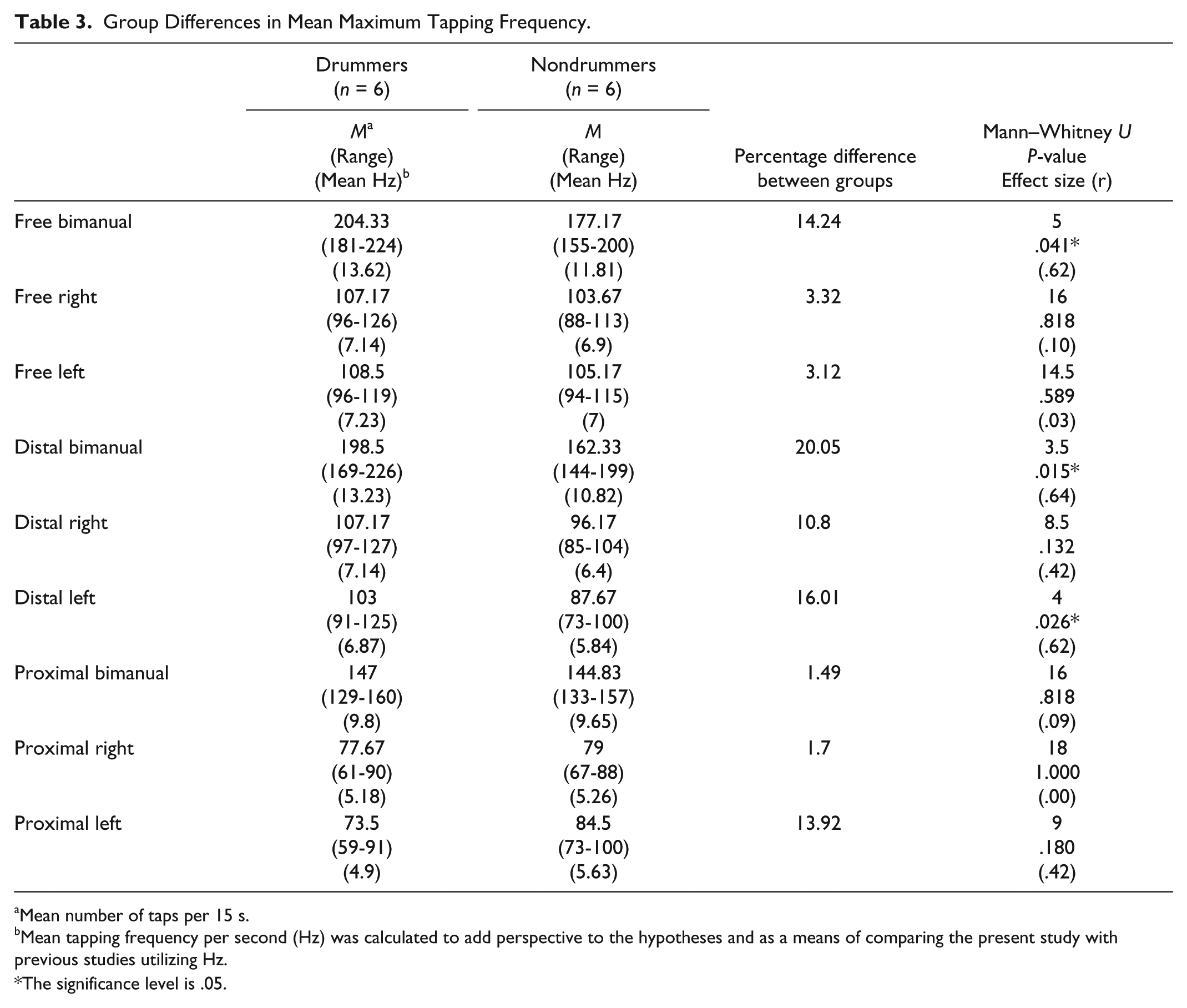
Mean number of taps per 15 s are summarized in Table 3. A high degree of reliability was found for the total of 27 tapping trials within the group of drummers with an average measure intraclass correlation coefficient (ICC) of .812 (α = .805, p < .001) and the group of nondrummers with an average measure ICC of .888 (α = .940, p < .001). Table 3 shows the mean maximum tapping frequency (per 15 s), range (minimum-maximum number of taps within the groups), calculated mean Hz, mean percentage difference in mean number of taps between the groups, and statistics for the Mann–Whitney U group comparisons and effect sizes. The two groups (drummers and nondrummers) are compared in each condition. Drummers had significantly higher mean tapping frequencies in the free bimanual task (U = 5, p < .05, r = .62), distal bimanual task (U = 3.5, p < .05, r = .64), and distal left task (U = 4, p < .05, r = .62).
Group Differences in Mean Maximum Tapping Frequency.
Mean number of taps per 15 s.
Mean tapping frequency per second (Hz) was calculated to add perspective to the hypotheses and as a means of comparing the present study with previous studies utilizing Hz.
The significance level is .05.
Discussion
The findings of the present study suggest that drummers display significantly greater distal motor control compared with nondrummers, in the distal condition (distal bimanual and distal left conditions, however, not in the distal right condition; see Table 3). The results thus, in part, support the first hypothesis. Consistently with the second primary hypothesis, in the free bimanual and distal bimanual conditions, drummers had significantly higher tapping frequencies compared with nondrummers. As for the third primary hypothesis, the distal unimanual left task confirmed left hand proficiency in drumming, although the tapping frequency in the free unimanual left task did not differ significantly from that of the nondrummers. There were no significant differences between groups in any of the proximal conditions, thus indicating that drummers may not possess superior proximal motor control compared with the nondrummers. Furthermore, this finding supports the decision of using the proximal condition as a control test parameter in the present study.
The main theoretical frameworks drawn up in the present study indicate that proximal–distal motor control of the upper limbs in drummers is superior to that of nondrummers even during simple rapid tapping tasks. Although tapping speed is only one of many variables determining drumming performance, one might argue based on the current results, as well as the previously published literature, that the tapping paradigm serves its purpose in measuring fundamental elements of drumming skills and motor control.
The results of the present study, especially the distal condition, suggest that rapid tapping might rely on the stability and refinement of distal motor control, and that the underlying biomechanics seem to be playing a key role in stable tapping performance. This is consistent with the findings of highly refined wrist muscle activity of skilled drummers (Fujii et al., 2009; Fujii & Moritani, 2012a, 2012b). However, as shown by Madison et al. (2013), new movement patterns, when learned by nondrummers, vastly improved after only 1 hr of training, thus illustrating how responsive distal musculature and correlated neural structures are to experience.
Previous tapping studies have shown dominant arm superiority in nondrummers (Hermsdorfer et al., 1999; Kimura & Davidson, 1975). Furthermore, it has been shown that drummers can achieve higher tapping frequencies both unimanually left and right, and bimanually, compared with nondrummers (Fujii et al., 2009, 2010; Fujii & Oda, 2006). In the present study, in contrast to Fujii et al. (2010), or Fujii and Oda (2009), drummers did not produce higher tapping frequencies in the two free unimanual tasks. The large difference between groups observed in the distal left hand task supports previous findings, while the results in the free left condition do not (see Table 3). One explanation might be found in the constraints of the distal condition that might be more limiting to nondrummers’ performance, while the drummers’ movement patterns are flexible enough to withstand the perturbation. These arguments would be supported by Bernstein’s (1967) theory of motor control in which an individual’s skill level passes through three phases: freezing degrees of freedom, releasing degrees of freedom to form more flexible coordinative structures, and controlling the internal degrees of freedom well enough to be able to exploit external forces instead of working against them.
When released from all constraints, in the free conditions, participants can make use of their whole arm, which increases task complexity but at the same time introduces more flexibility for those with sufficient skill to exploit it, namely the drummers. The nondrummers were able to solve the motor problem in the free left condition equally as well as drummers, with regard to number of taps. They were not, however, able to use their wrist muscles with the same efficiency as drummers (cf. Fujii et al., 2009; Fujii & Moritani, 2012a, 2012b), so they would have had to employ strategies involving use of their proximal muscles to greater extent in the free left hand task to achieve high tapping frequencies.
Further explanation might lie in the exploitation of external degrees of freedom. Drummers are used to fully exploiting the external degrees of freedom of the skill, such as rebound of the drum skin (Dahl, 2011; Fujisawa & Miura, 2010), the weight and length of the drumstick (Fujisawa & Miura, 2010), and furthermore to exploit gravitational loads associated with the speed–accuracy trade-off concept, as argued by Standage, Blohm, and Dorris (2014). The ability of mastering external degrees of freedom, that is, use of reactive forces, belongs in the upper end of motor control attainment (Vereijken et al., 1992), and has been observed in experienced drummers (Dahl, 2011; Fujisawa & Miura, 2010), expert piano players (Furuya, Osu, & Kinoshita, 2009), and expert cello players (Verrel, Pologe, Manselle, Lindenberger, & Woollacott, 2013a). In bimanual tapping, drummers utilize the mechanics of the drumstick bouncing of the pad with greater control, initiating the preceding stroke as early as possible (Dahl, 2011). Untrained individuals, on the contrary, might lose some efficiency in the movement dynamics in bimanual tapping due to waiting for the bilateral hand’s biomechanics to restore itself. In the present experiment, the participants were asked to make clean strokes, meaning one stroke per wrist movement, and to avoid using specific finger techniques (or other techniques) enabling them to produce higher tapping frequencies than normal playing would. This, in combination with the unnatural, reduced, elasticity of the drum pad, might have affected the drummers’ performance in the free tasks.
The results from the proximal condition, in the present study, might indicate that the role of proximal motor control in biomechanics is correlated with stability and efficacy of joint movements, as has been shown in previous studies (Chow et al., 1999; Furuya et al., 2009; Sakurai & Ohtsuki, 2000; Verrel et al., 2013b). Drummers and nondrummers solved the proximal task in a similar manner, with both groups displaying stiff and rigid arm movements and excessive energy expenditure due to the constraints. The task may have introduced novelty to such a degree that drummers, in fact, had no advantage of their more specific drumming skills. One might argue that the role of the proximal parts of the upper limbs, in drumming, might be that of stabilizing the mode of coordination, thus enabling the elbows and wrists to reciprocally be controlled with higher automaticity and higher accuracy, and that this part of the task is relatively simple compared with mastering the many degrees of freedom when involving more joints of the arms.
The large differences observed in the free bimanual and distal bimanual conditions suggest that drumming is first and foremost a bimanual skill. The brain asymmetry of drummers might be reduced through extensive practice and drummers have, arguably, more practice playing bimanually than they have playing unimanually. In other words, overcoming the intrinsic asymmetric dynamics of the musculoskeletal system and the CNS is essential in a high-speed bimanual skill. Drummers coordinate and stabilize the motor system in rapid tapping tasks through efficient error corrections related to phase coordination (Daffertshofer, Peper, & Beek, 2005; Fujii et al., 2010; Peper et al., 1995), through timing of bimanual movements (Repp, 2005; Ridderikhoff, Peper, & Beek, 2005) and by controlling the stability of the intertap interval (Fujii et al., 2009). Use of bimanual motor control strategies, which rely on symmetrical activation of flexor and extensor muscles in the forearm (Fujisawa & Miura, 2010), affects the efficiency and stability of the movements of the wrist and fingers.
When reducing the nervous system’s intrinsic interlimb asymmetry, through extensive practice, projections toward, and arising from, the reinforced and refined neuronal groups, correlated with skilled movements (especially in the motor cortex and premotor areas), shoot across the 200 million densely myelinated nerve fibers in the corpus callosum with enhanced efficiency and less neural motor noise (Edelman & Tononi, 2000; Fujii et al., 2009; Fujii & Moritani, 2012b). As Fujisawa and Miura’s (2010) EMG experiments revealed, drummers apply similar motor control strategies in both arms during short-term playing. Thus, skilled motor control in drumming might result in increased symmetry, speed, and accuracy of movements with reduced expenditure of energy and less conscious effort (Amunts et al., 1997; Sporns & Edelman, 1993; Standage et al., 2014; Yang, 2015).
In conclusion, the present results indicate that constraining the joints of the arms affects proximal–distal motor control, in the present study measured as tapping speed. The results from the free condition showed drummers to be faster when both arms are used, although no differences were observed unimanually, which seems to reflect the fact that drummers have more specific training with both arms. In the distal condition drummers displayed faster tapping rates than nondrummers, although not with their right hands, which would be consistent with increased distal innervation in drummers due to experience. The proximal condition introduced novelty and perturbed both groups extensively, yielding no differences in this condition. The results partly confirm our hypotheses, with drummers displaying somewhat more efficient distal, left, and bimanual motor control compared with that of nondrummers. Further studies could advance the knowledge of proximal–distal motor control in drummers by implementing kinematic observations, EMG-measurement, and a focus on training effects.
Footnotes
Declaration of Conflicting Interests
The author(s) declared no potential conflicts of interest with respect to the research, authorship, and/or publication of this article.
Funding
The author(s) received no financial support for the research, authorship, and/or publication of this article.