




Abstract
Arguably, entrepreneurial team formation constitutes an arduous but fundamental task toward venture establishment. Given the relatively scant attention that has been paid to this research topic, this study focuses on founders’ behaviors in their attempt to narrow the gap between their own skills and the ones required for the materialization of their vision. Semistructured interviews with 14 key members of externally funded entrepreneurial teams in Greece suggested that entrepreneurs themselves account for the lack of legitimacy, knowledge, and financial resources through leveraging their social networks, available information resources, and certain cooperation agreements as well as selecting candidates whose profile is aligned with entrepreneurial challenges and goals. Moreover, they revealed that as these challenges are mitigated, they give rise to a wider spectrum of choices with regard to the team formation process; this evolutionary path seems to be facilitated by certain events, which act as triggers of change. These associations are incorporated in a framework which depicts founders’ behaviors and their temporal variations in the context of entrepreneurial team formation.
Keywords
In the midst of market volatility and scarcity of financial resources, embarking upon an entrepreneurial venture incurs considerable challenges which often condemn entrepreneurs’ efforts (Gelderen, Thurik, & Bosma, 2005). Nevertheless, even in troubled entrepreneurial contexts, new ventures emerge and thrive against the odds; they are even regarded as a means to revive troubled economies (Katsoni, 2015). That said, a close examination of the factors that justify the creation and growth of new ventures in adverse contextual circumstances could yield valuable insight on how entrepreneurial challenges are confronted, thus benefiting the ventures’ operating context.
The starting point of a new venture could be set when an individual stumbles upon an unexploited business opportunity (Alvarez & Busenitz, 2001), provided that she desires to act on it (Krueger & Brazeal, 1994; Shaver & Scott, 1991). While the need for opportunity exploitation creates a sense of urgency, the scarcity of human, financial, physical, and social resources hampers entrepreneurs’ efforts to materialize their idea (Ensley, Pearson, & Pearce, 2003). In search of the reasons for successful implementation of certain business ideas over others, the study of entrepreneurial teams is crucial as team members constitute a newborn organization’s most valuable asset (Forbes, Borchert, Zellmer-Bruhn, & Sapienza, 2006). Even investment decisions are heavily dependent on the entrepreneurial team members’ profiles (Brush, Greene, & Hart, 2001; Zacharakisa & Meyer, 1998).
However, academic literature on entrepreneurial teams is heavily focused on Inputs-Mediators-Outcomes models, which underpin the relationship between team inputs and new venture performance but fail to capture its full complexity (Klotz, Hmieleski, Bradley, & Busenitz, 2014). More concretely, they provide little understanding on the way entrepreneurial teams enter the venture life cycle despite the undeniably challenging nature of staffing a barely shaped venture (Brush et al., 2001). What is more, even if there is some knowledge on “how” entrepreneurial teams are formed, there is still much to be contributed with respect to the peripheral aspects that shape this process (Leung, Zhang, Wong, & Der Foo, 2006).
Toward a more profound understanding of the entrepreneurial team formation process, this article addresses the research question “How do entrepreneurs behave when identifying, selecting, and compensating team members?” To explore this research question, a qualitative study was undertaken among externally funded, Greek ventures, which expounds founders’ choices of certain candidate pools, information sources, selection criteria, and cooperation patterns. More specifically, it enriches our knowledge on the characteristics entrepreneurs seek in prospective team members as well as on alternative modes of compensating team members and further elucidates how the choice of certain candidate pools might influence the subsequent choices of candidate selection and compensation.
Interestingly, founders’ choices when identifying, selecting, and compensating team members emerged as dependent on the company’s legitimacy and financial resources as well as the founder’s knowledge, which in turn appeared to vary in the course of time. Zahra, Wright, and Abdelgawad (2014) argue that the temporal fluctuations of the aspects that regulate a venture’s operation imply different context for individual behavior. So far scholars have studied temporal influences in the contexts of new venture formation (Kamm & Nurick, 1993), new venture growth (Adizes, 1979; Greiner, 1998; Kazanjian, 1988), and evolution of entrepreneurial team members (Clarysse & Moray, 2004). In addition, Vyakarnam, Jacobs, and Handelberg (1999) suggest that the entrepreneurial team formation process consists of more than one stage of development and at the same time encourage researchers to pursue “a more in-depth analysis of team formation [and] entry criteria” (p. 163). Following this call along with the indications that derived from interim findings a temporal lens was retrospectively applied to the data collected with the purpose of comprehending the evolving nature of founders’ behaviors when forming a team. Through this process, additional contributions to the temporal context theory emerged. Specifically, this study provides new insight on the role of timing in the team formation process. In addition, it argues that the team formation process follows no specified path to evolution; it rather seems to evolve in an unsystematic way, in accordance with the fluctuations that occur in its contextual aspects.
The following section is dedicated to existing literature on entrepreneurial team formation and temporal influences in this context. In subsequent sections, the research method and findings are presented and key findings are further discussed in the light of existing literature as well as their practical applicability to the entrepreneurial field.
Entrepreneurial Team Formation Literature Review
Whether called new venture teams (Klotz et al., 2014), entrepreneurial teams (Schjoedt & Kraus, 2009), or founding teams (Beckman, 2006; Delmar & Shane, 2006), several attempts have been made over the past years to provide a suitable definition for the teams that drive the creation of a business. Arguably, it is oftentimes difficult to determine who is deemed an entrepreneurial team member. For instance, although investment decisions prevail as far as the shaping of the entrepreneurial ecosystem is concerned (Baum & Silverman, 2004), investors are not actively or exclusively involved in developing a single venture and are thus excluded from the entrepreneurial team (Cooney, 2005).
What is undeniable is that at the very beginning of a venture’s life cycle its ability to grow from the start-up stage to new value creation relies heavily on an intently committed leader (Adizes, 1979), namely a founder or entrepreneur. There is a considerable body of research that has attempted to outline the personality of an entrepreneur, attributing her distinctive traits such as exhibiting a risk-taking attitude (Shaver & Scott, 1991), having a tendency to seek novel opportunities, and approaching situations and challenges in a heuristic way (Alvarez & Busenitz, 2001). However, defining entrepreneurs on the basis of personality traits has received considerable criticism as it reflects a deterministic approach (Alvarez & Busenitz, 2001; McMullen & Shepherd, 2006; Shaver & Scott, 1991) and fails to distinguish entrepreneurs from other business leaders such as managers and small business owners (Carland, Hoy, Boulton, & Carland, 1984). In an attempt to provide a more solid definition, Bruyat and Julien (2001) maintain that an entrepreneur is someone who contributes to a significant extent to new value creation and is free to act on opportunities and set boundaries in her own activity.
Although entrepreneurial ventures can be founded and developed exclusively by a lone entrepreneur (Kamm & Nurick, 1993), in the majority of cases new venture development requires the composition of a team, or in other words, a group of individuals that will be zealously involved in driving organizational evolution (Schjoedt, Monsen, Pearson, Barnett, & Chrisman, 2013) and will contribute their human and social capital to the venture (Schjoedt & Kraus, 2009), to formulate the business strategy and drive the operations of the venture (Klotz et al., 2014). The need for such a team arises from a gap between what the entrepreneur has in terms of education and experience and what the venture needs to grow and evolve (Brush et al., 2001). If the entrepreneur recognizes this need, the next steps are to locate the pools that include such resources, develop a set of selection criteria, and decide upon the pecuniary or nonpecuniary rewards that will be offered to prospective members (Kamm & Nurick, 1993). Based on Kamm and Nurick’s (1993) process for forming an entrepreneurial team, extant literature on the identification, selection, and compensation of entrepreneurial team members is delineated in this section.
Identification
Due to a newborn organization’s limited financial resources and lack of evidence of past success (Cardon & Stevens, 2004; Leung et al., 2006) which might discourage potential candidates from seeking employment there (Ensley et al., 2003) it is desirable that entrepreneurs have industry-related knowledge, are aware of the opportunities that lie in their social networks, and are able to showcase the viability of their business plan (Brush et al., 2001). These qualities are important as entrepreneurs are often urged to approach potential team members in unconventional ways, like using their social networks as a primary pool of candidates (Leung et al., 2006). These can be informal networks such as friends and acquaintances as well as organized networks such as ethnic institutions (Aldrich & Zimmer, 1986). In line with this assertion, Aldrich and Kim (2007) noted that founders rarely add individuals to their team with whom they share no social ties. In literature, a distinction is made among strong-tie networks which include one’s family and close friends and weak-tie networks which include one’s acquaintances through which entrepreneurs locate potential team members (Aldrich & Zimmer, 1986). As far as strong-tie networks are concerned, they are thought to assist founders in mitigating the challenges that stem from the lack of brand legitimacy (Elfring & Hulsink, 2003), but also prevent them from exploring wider, potentially more suitable pools (Ruef, Aldrich, & Carter, 2003). In contrast, weak-tie networks have been associated with access to a wider range of contacts, and therefore greater diversity in the information that is accessible to the founder (Ruef, 2002).
Selection
In the risky and highly uncertain business context of an entrepreneurial venture, building a team that is heterogeneous enough to increase cognitive and social diversity (Klotz et al., 2014; Schjoedt & Kraus, 2009; Shaver & Scott, 1991) and at the same time coherent enough to avoid dysfunctionality (Ensley, Pearson, & Amason, 2002) is a rather strenuous process (Brush et al., 2001). On the one hand, cognitive diversity has been associated with higher creativity and openness to change as more opinions are expressed and evaluated by the team (Boeker, 1997). On the other hand, common value systems and shared cognitions among team members enhance team cohesion which in turn prevents affective conflict, a potentially serious hindrance to team performance (Ensley et al., 2003). Indeed, the members’ personalities, skills, and social capital have a profound impact on team performance (Klotz et al., 2014) and form a unique combination that eventually yields competitive advantage (Barney, 1991). Therefore, the selection process of entrepreneurial team members is of paramount importance for the venture’s future performance.
To select the desired team members, entrepreneurs focus on two aspects, although they usually place emphasis on one of them; these are one’s skills (instrumental perspective) and one’s cultural fit with the team (social-psychological perspective; Aldrich & Kim, 2007; Forbes et al., 2006). In line with these views, Baron and Hannan (2002) found that, indeed, entrepreneurs select team members on the basis of the skills and competencies needed to meet the job requirements and the extent to which they fit the team culture, but they also located the potential the founder sees in the candidate as a criterion.
Leung et al. (2006) argue that a founder’s selection rationale varies based on the venture’s life cycle stage. More concretely, literature suggests that at the very beginning founders primarily need committed team members despite the fact that they oftentimes have limited ability to provide satisfactory compensation (Greiner, 1998). Leung et al. agree that at the outset entrepreneurs tend to scan their environment for individuals whom they can trust and with whom they share a common value system. Ben-Hafaiedh-Dridi’s (2010) research corroborates this view but additionally indicates that founders’ rationale when selecting team members also depends on the stage of the team formation process. More concretely, she found that while founders tend to reduce the size of their candidate pool using primarily relational criteria, they consider mainly instrumental criteria as the decision for the compensation of the candidate approaches. Moreover, it can be maintained that the selection criteria for entering an entrepreneurial team are partly derived by the extent to which there is access to resources. For instance, in family-based ventures, where strong social ties are present, the social-psychological perspective dominates (Klotz et al., 2014). In line with this view, Aldrich and Kim (2007) assume that entrepreneurs assess candidates on the basis of skill within networks that ensure a common affective ground. These assertions hint at a relationship between the selection criteria entrepreneurs set and the pools they exploit for candidate identification.
Compensation
Upon the completion of the selection process, founders face the challenge of creating a compensation proposal that will meet the candidate’s expectations (Ben-Hafaiedh-Dridi, 2010). The compensation level and mix anticipated by candidates may depend on various factors, such as their marital status, the inducements received in previous employment as well as the level of one’s achievement orientation (Tetrick, Weathington, Da Silva, & Hutcheson, 2010). It can be argued that compensation is a vital issue for the formation of entrepreneurial teams as desirable candidates might be reluctant to relinquish existing obligations in their career or family lives or to overcome their proneness to avoid uncertainty to join a venture with no track record (Kamm & Nurick, 1993). Nevertheless, although there is some research on compensation structures that foster entrepreneurial behavior within established firms (Kuratko, Ireland, & Hornsby, 2001), entrepreneurs’ compensation agreements with team members constitute a topic that is in need of further exploration (Schjoedt et al., 2013).
Research Question and Temporal Influences
The multitude of terms found in literature with regard to entrepreneurial team formation, namely founder recruitment (Ruef et al., 2003), partner recruitment (Kamm & Nurick, 1993), founder team member entry (Ucbasaran, Lockett, Wright, & Westhead, 2003), team member addition (Forbes et al., 2006), and recruitment of human resources (Cardon & Stevens, 2004; Dal Zotto & Gustafsson, 2008; Williamson & Cable, 2003), indicates the existence of several ways of forming entrepreneurial teams. Indeed, an entrepreneurial team can be formed by the lead entrepreneur through partnering with other individuals or through recruiting additional manpower (Ruef et al., 2003). Similarly, Vyakarnam et al. (1999) distinguish inner teams, which consist of the partners who started the business, from outer teams, which additionally include subsequent entries to the team. Ben-Hafaiedh-Dridi (2010) argues that when team members are recruited the team formation process involves a compensation agreement among the two parties which is not the case when the team emerges through a partnership. Therefore, it can be assumed that team formation processes met in different ventures or stages of a venture’s development might differ from one another in the ways in which founders choose to identify, select, and compensate team members. To identify and explore the different ways in which founders act when forming a team, the following research question is posed: How do entrepreneurs behave when identifying, selecting, and compensating team members?
Van de Ven and Engleman (2004) suggest that a thorough exploration of a “how” question goes beyond the identification of the steps that compose the process studied, as it requires the revelation of factors that account for potential variations in this process. In search of the determinants of entrepreneurs’ behaviors when forming a team, contextual influences cannot be neglected, as context constitutes by definition the peripheral aspects that affect the studied phenomena (Cappelli & Sherer, 1991; Welter, 2011) or, in further detail, “situational opportunities and constraints that affect the occurrence and meaning of organizational behavior” (Johns, 2006, p. 386). Undeniably, entrepreneurs are constantly urged to act in alignment with the contexts created by the evanescent opportunities and limitations that lie in their organization’s path (Greiner, 1998). Given the evolving nature of the factors that constrain entrepreneurs’ actions, shedding light on the temporal aspects that shape entrepreneurial behavior is crucial for comprehending this phenomenon (Welter, 2011).
Over the years, entrepreneurial behavior has been examined in the light of several temporal variables such as entrepreneurs’ past or future orientation (Rauch, Wiklund, Lumpkin, & Frese, 2009), preferred speed of working, entrepreneur’s attention to time boundaries (Bluedorn & Martin, 2008), and the timing of entrepreneurial decisions (Choi & Shepherd, 2004; Forbes et al., 2006). In addition, Zahra et al. (2014) referred to organizational learning and evolution as aspects of temporal context that require further investigation.
In the context of entrepreneurial team formation, scholars have identified timing as a variable that has a considerable effect on new member addition (Cooney, 2005; Forbes et al., 2006). More concretely, Forbes et al. (2006) contend that the probability of adding a member to the entrepreneurial team increases right after the occurrence of certain events, which may concern the venture’s macro-environment or directly affect the venture. An example of the former case is the invention of new technologies, whereas an example of the latter one is the reception of a new funding round. In addition, the temporal evolution of key elements of the entrepreneurial team formation process, namely the founders’ selection rationale and social networks (Hoang & Antoncic, 2003; Leung et al., 2006), indicates that at different instances of a venture’s trajectory different behavioral patterns might be exhibited. In this regard, Vyakarnam et al. (1999) found that the team formation process unravels in two temporal phases; during the first phase team members are found serendipitously or approached through founders’ own networks, whereas during the second one new members are acquired through either informal networks or a more standardized recruitment process.
Among the various developmental theories that have been introduced over the years, Van de Ven and Poole’s (1995) teleological model seems to provide the most suitable explanation on why and how the entrepreneurial team formation process evolves. According to this model, organizational development is steered by an actor’s or unit’s attempt to accomplish an anticipated goal and is constrained by contextual or intrinsic aspects (Van de Ven & Poole, 1995). Similarly, entrepreneurs’ search for additional workforce is driven by their goal to acquire the complementary skills needed to realize their vision (Brush et al., 2001) and constrained by the venture’s lack of a track record, knowledge, and financial capital (Adizes, 1979). As far as the pace of change is concerned, Weick and Quinn (1999) differentiate between episodic change, which refers to a sudden interruption of organizational inertia, often triggered by failure and continuous change, which occurs on a constant basis as a result of the organization’s sensitivity to environmental changes.
In conclusion, this research attempts to identify how founders act when identifying, selecting, and compensating team members. In this attempt, a better understanding of the dynamic nature of the team formation processes they shape is also sought.
Method
The aim of this research is to capture the viewpoint of the population studied and analyze primary data with the purpose of answering “how” questions. In consequence, qualitative research methods are used (Pratt, 2009).
Participants
As the behaviors that concern the team formation process in the new venture context can only be communicated by those who participate in it, the individuals interviewed were core members of entrepreneurial teams. What is more, given that this research deliberates on the identification of successful behaviors toward team formation, the ventures selected constitute “survivors”; in other words, they operate in a turbulent business environment, the Greek one and yet they have succeeded in attracting investors, which can be viewed as a preliminary indication of success (Baum & Silverman, 2004). Although entrepreneurial success could also be interpreted as having reached a state of financial independence, the attribution of this meaning is not suitable for the scope of this research as it does not refer to startups. Reynolds and Curtin (2009) set the beginning of the startup process when “entrepreneurs took their first steps towards the establishment of the new firm” (p. 307). However, this definition fails to yield explicit criteria on which organizations qualify as startups. According to Leung et al. (2006), the startup stage of venture development consists of the discovery of an unexploited business opportunity (Alvarez & Busenitz, 2001) and the efforts to overcome the lack of financial viability; the next stage of growth is reached when a straightforward strategy for growth has been set. Based on Leung et al.’s (2006) definition of a startup, the organizations selected constitute externally funded organizations. Finally, for the purpose of collecting meaningful data, they included at least one member that was recruited to the team rather than partnered with the founder.
With regard to the selection of interviewees, the founders’ viewpoint was crucial for answering the research question, as they provided direct information on team formation behaviors. Next, the perspective of other team members was needed to corroborate and enrich findings. In this study, Bruyat and Julien’s (2001) definition is used to clarify who qualifies to be deemed a founder. According to this definition, a founder constitutes the individual who contributes the most to the venture and has complete freedom of action, so she also has full ownership of the identification, selection, and compensation decisions.
In respect of the companies selected, the sample includes six newborn organizations that operate in different industries and are in the process of creating information technology products. At the time the interviews took place, 2 to 5 years had elapsed since the idea was conceived and the ventures had received one or two funding rounds. Based on the team type, the ventures are divided as follows: one was started by a lone entrepreneur (Alterstay), one was initiated by a team of entrepreneurs (Kiddocentric), whereas the rest were started by a lone entrepreneur who decided to share his or her decision-making power with other individuals during the team formation process. In the latter case, although team leadership is shared, only one individual has full decision-making power. Therefore, five companies consist of one founder and four and seven team members, whereas Kiddocentric consists of three cofounders and four team members. A comprehensive list of the organizations included in the sample is available in Appendix A. Furthermore, five of the companies were located and approached by the researcher via electronic mail and the remaining company had at that time employed the researcher for 8 months. This research project was conducted independently of the researcher’s employment status with the startup. To prevent the identification of the research participants, the real names of the startups have been changed to protect their privacy.
Materials and Procedure
Research data were collected through 14 in-depth, semistructured interviews, which were all conducted in person and were audio recorded and transcribed. The data collection process was completed during a time period of 6 months. All the participants were informed about the purpose and the scope of the interview as well as the fact that the interview would be audiotaped and remain confidential, prior to consenting to participate. Whereas 10 of the interviews were conducted in English, the remaining four were conducted in Greek and were then translated into English. In addition to the data that emerged from the interviews, “invisible” data were depicted through observation of the behaviors of the interviewees during the interviews (Farber, 2006).
With respect to the interviewees, six of them were the company founders, while the remaining eight constituted members that were subsequently added to the team. Following this distinction, two interview protocols were developed (see Appendix B). The first protocol was used for depicting the founders’ perspective whereas the second one aimed at capturing the nonfounders’ perspective. Given the exploratory nature of the interviews, the interview protocol was used in conjunction with the thought flow of the interviewees and was adjusted following the findings. Overall, the ongoing reevaluation and challenging of findings was achieved through constant comparisons and contrasts among different transcripts. Publicly available data, such as company websites, were also used to corroborate interviewees’ statements in relevant areas.
Naturally, interview data pointed to various directions, as they consisted of the participants’ opinions, feelings, and actions. The most prominent theme that emerged from the very beginning was the overarching challenges faced in the identification, selection, and compensation of team members. Specifically, interviews with founders and team members allowed for the clarification of the aspects that initially hindered entrepreneurial team formation (contextual aspects). It became clear though that, despite adversity, forming a team was essential for venture evolution due to a gap between the founders’ skills and the ones required for the materialization of their idea. In other words, the necessity of acquiring complementary skills emerged as the founders’ primary drive toward overcoming adversity (Goal). As soon as the landscape that shaped entrepreneurial behavior during team formation was outlined, the focus was deliberately placed on how founders acted. As this landscape proved to be hardly static, a better understanding of how this dynamic entity is formed and affects entrepreneurial behavior was sought. The coding scheme that emerged from this process is depicted in Figure 1.
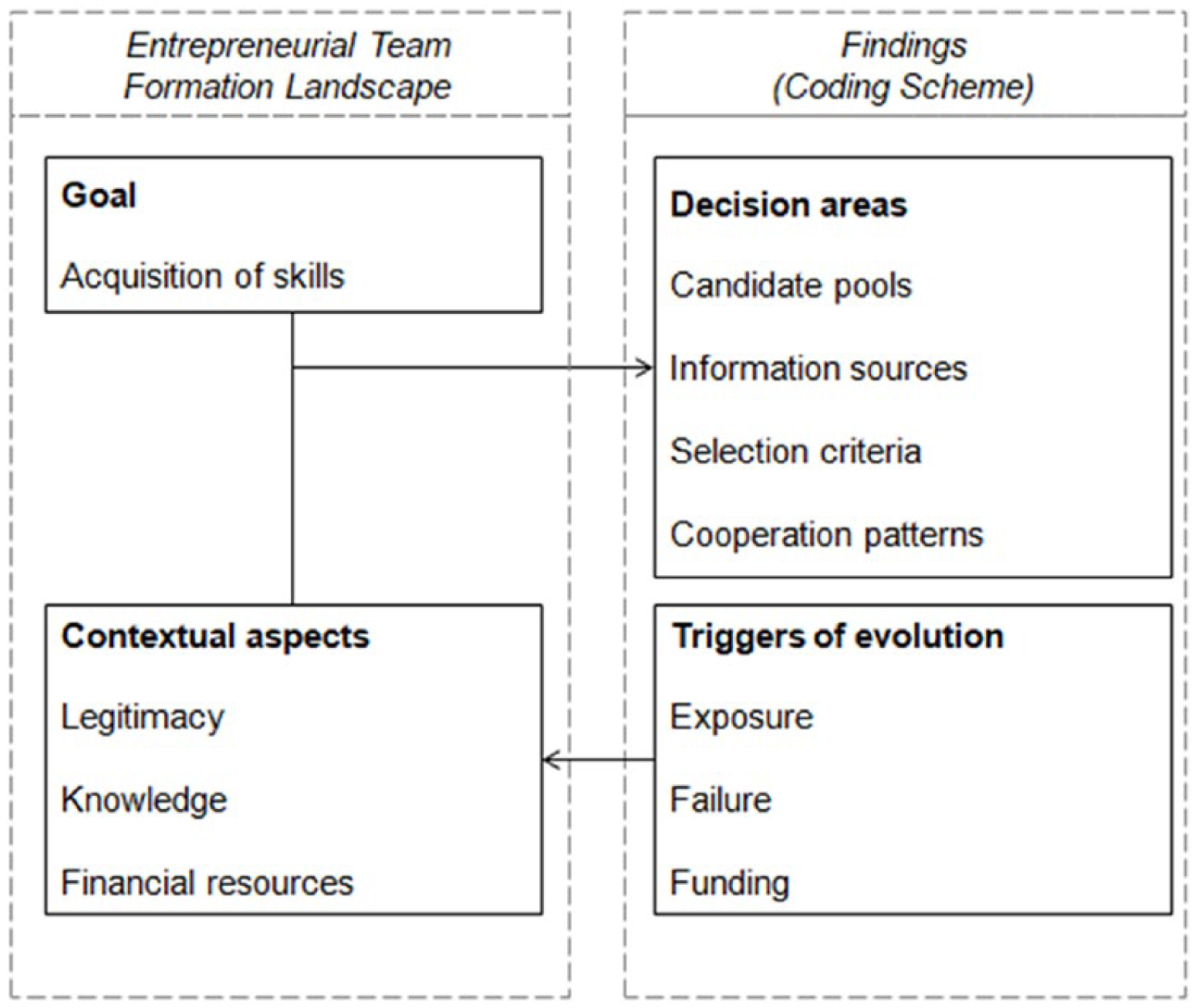
Unraveling entrepreneurs’ behaviors when forming a team.
Data Analysis
Following the “analytic hierarchy” of Ritchie and Lewis (2003), raw data were first organized in thematic categories and labeled based on the interviewees’ statements to produce first order codes (Pratt, 2009). For example, the subcategories candidate pools, information sources, selection criteria, and cooperation patterns were developed under decision areas, denoting that these were the main areas where founders’ behaviors toward forming a team were manifested through the choices they made in each of the areas outlined. Themes and codes were sought in paragraphs, phrases, or words (Farber, 2006) and similarities and differences among founders, team members, and teams were identified.
To move from the descriptive to the explanatory phase of analysis (Ritchie & Lewis, 2003) or axial coding (Pratt, 2009), relationships among different categories or codes of the same category were sought and viewed in the light of academic literature. For instance, it was observed that the evolution of contextual aspects was triggered by certain events; therefore, the code triggers of evolution was linked to contextual aspects. In addition, the data set was searched for data that do not match or contradict the categories built. In such cases, either the categories changed to include the new codes or explanations for the outliers were sought. Coding was processed manually, using tables, and personal reflections and the codes were noted in a journal.
The analysis relied primarily on inductive reasoning which allowed for categories to emerge through data and it was iterative which means that the coding was revisited and the relative significance of certain themes over others was revealed as additional data were collected and analyzed; the sampling decisions followed these iterations. The sampling process was terminated when few new codes emerged from data which was a sign that theoretical saturation was reached (Ritchie & Lewis, 2003). Following this observation, the last couple of interviews served the purpose of corroborating the codes that had been developed.
Findings
According to founders’ narrations, the entrepreneurial team formation process emerged from a conspicuous gap between the founders’ own skills and the skillset required for the creation of a product prototype.
We needed a developer because none of us was a developer and a designer because none of us was a designer. We simply had an idea, a vision and we needed to find the right people to implement it with our guidance. (Founder, Kiddocentric)
In their attempt to find the right people, entrepreneurs were challenged by the venture’s lack of brand legitimacy and financial resources as well as their limited knowledge on selection practices. Hence, founders were compelled to search for potential candidates through limited pools, seek information that would assist them in selecting the right candidates, select individuals whose profile would be in line with the penurious entrepreneurial context, and form feasible cooperation agreements despite their limited financial ability. Nevertheless, interviews suggested that in the course of time, these predicaments were tackled, giving rise to new possibilities in the context of team formation. As a venture’s legitimacy and financial ability frame and influence entrepreneurial behavior when identifying, selecting, and compensating team members, they are regarded as contextual aspects of entrepreneurial team formation (Johns, 2006). Knowledge can also be construed as contextual to entrepreneurial behavior, as it constitutes a resource for founders (West & Noel, 2009).
In the following subsections, founders’ behaviors when identifying, selecting, and compensating team members are delineated. These become evident through the founders’ choice of certain candidate pools, information sources, selection criteria, and cooperation patterns. Table 1 provides an overview of founders’ choices and links them to the entrepreneurial team formation process phases as well as to the contextual aspects that appeared to affect their manifestation. A distinction is made between the choices that emerged as feasible from the very beginning of the team formation process and those that did not seem to constitute an option before contextual aspects had become more favorable.
Entrepreneurial Team Formation Behaviors and Contextual Influences Per Decision Area.

Candidate Pools
From the founders’ viewpoint, the identification of team members is hindered by a newborn organization’s lack of legitimacy in the eyes of potential candidates. The challenging nature of seeking team members without having established a respected brand name was explicitly mentioned by three founders but also reflected in the founders’ actions when pursuing team members. The difficulty to lure and engage potential team members through conventional job advertisements is illustrated below.
Startups have a handicap. If you go out and say “I want a developer” and you are nobody, nobody knows you and you have nothing, it is very difficult to build trust. So maybe some people will come but these are the desperate ones. You cannot pitch people who should be really interested to join the company and you are only given this opportunity through your personal acquaintances. (Founder, Alterstay)
The lack of a company track record, which could constitute the founder’s pitch toward potential candidates, limits one’s pool to her own social network. In accordance with existing research findings (Aldrich & Kim, 2007; Leung et al., 2006), founders overcame this obstacle by relying on their personal or professional connections to locate candidates. Escaping this pattern, a couple of founders went beyond their own networks and leveraged skills-based events as well as entrepreneurial networks to find competent developers.
I went to the Ruby festival, I even pitched there. I was the only nonprogrammer there, so I was very enthusiastic. I finally had five-six leads that said “ok, this is not totally bullshit” and I remember that I found a developer there. (Founder, Edulove)
Although such differences in founders’ behavior could be due to possible variations in their personal characteristics (Bird, 1988; Ucbasaran et al., 2003), in this case, the founder’s “deviant” behavior could be a result of his strategic focus. At a different time during the interview he noted, We are seeking for people who have complementary skills. We don’t want to bring our friends and family in it. We want people that bring something different because we want to go after international markets. (Founder, Edulove)
Therefore, the founder quoted above appeared to consciously exclude strong-tie networks as candidate pools, as he aimed for diversity within the team.
While entrepreneurs’ first endeavors to identify suitable candidates included “searching through startup networks [. . .] and asking for help from anywhere” (Founder, Kiddocentric), interviews with founders and team members revealed that in time most founders managed to target wider pools of candidates without external support. In this regard, founders referred to successfully attracting candidates through posting job advertisements but also finding team members who contacted them even in the absence of an open position.
More specifically, in four out of six cases, founders narrated that in time they managed to access wider pools of candidates through job advertisements as a result of having built a track record or having an increased financial ability. In other words, it seems that apart from the initial lack of track record, which prevented candidates from applying to a position in a newborn venture, founders were also reluctant to approach candidates without the mediation of their network, as they lacked the financial means needed to form an attractive compensation proposal.
Regarding our first two hires, the first one came through a startup network and the second one through our personal acquaintances. [. . .] [Later on] we found a great designer via a job advertisement; I wish we had her from the start. [. . .] We were not known at the time [but] she believed in the project and found the salary attractive. For me everything is a matter of budget. When you can pay someone a fair amount of money you can also have higher expectations. (Founder, Kiddocentric)
Contrary to most cases, the founder of DevLand described that every member he added to the team was identified through his own network, while the founder of TransferMe clearly stated that he hadn’t managed to find “anything really good from job advertisements.” Given that all the ventures studied operated in the same spatial context and marketed technology products, the “deviant” behavior of these two founders could be attributed to the extent of growth achieved by each of these ventures. According to Hanks, Watson, Jansen, and Chandler’s (1994) taxonomy of growth stages in the high-technology industry, the number of individuals employed by a venture as well as the venture’s age are indicative of the organization’s development state. In relation to this, Gilbert, McDougall, and Audretsch (2006) maintain that a venture’s growth levels are measured by the extent to which human as well as financial resources are available. Interestingly, both teams, DevLand and TransferMe, consist of five team members, whereas the rest of the companies included in the sample consist of seven or eight individuals (see Appendix A). In addition, TranferMe is indeed among the youngest ventures. On the other hand, DevLand counts more years of operation but it constitutes the only venture in the sample that had not yet obtained access to externally provided financial resources at the time of the interview; as the Marketing and Sales Executive of DevLand stated “we are not paid yet, [. . .] the money of the agreed funding round have not been deposited.” Therefore, it is possible that the two outlier responses are explained by the fact that the corresponding ventures had achieved the lowest levels of growth and therefore a less developed track record and financial ability at the time of data collection.
Next, candidate-initiated contact emerged as a result of an increase in the venture’s publicity.
When Kiddocentric’s name started to become more recognizable, people who had subscribed in our platform started calling us and telling us that they wanted to work for us. [. . .] They were persistent; they were calling us and telling us what they wanted to work on. (Founder, Kiddocentric)
Interestingly, the founders of the ventures that exhibited this behavior relied significantly on events that aimed at increasing the venture’s exposure. As the founder of Kiddocentric commented when talking about an international competition in which their team participated, “It brought us lot of publicity, many new applications and investors. We achieved the growth rate that we expected to achieve in six months within just one night.” Therefore, events that increased the ventures’ exposure seemed to play a pivotal role in candidate attraction.
Last year I participated in organizing a career fair. [The founder] was also there representing Edulove. When the career fair was over I searched for a new activity so I approached [the founder] and told him that I wanted to do something related to Edulove. He responded that there was an open position. (Community manager, Edulove)
Information Sources
Another constraint to team formation was entrepreneurs’ limited knowledge on certain technical skills such as coding skills that were essential for product development or selection practices. These knowledge gaps derive from product novelty, from a gap between the founder’s skills, and the product implementation needs, but also from the fact that entrepreneurs seem to lack experience in forming entrepreneurial teams. As the founder of Smar(ke)t phrased it: “I had the experience to hire a person that would work for a big company but not for a startup.”
Entrepreneurs responded to this challenge by exploiting the external information sources that were available to them, setting a trial period of cooperation with prospective team members and trusting their instinct.
In terms of external information sources, founders placed confidence in their acquaintances’ recommendations to decide whom to add to their team. Referrals were mainly provided by people who had cooperated with the candidate in the past. In one case, a founder with a nontechnical background referred to a friend with a technical background who assisted him in the assessment of developers. Moreover, two founders stated that they were supported by startup networks, which connected them with potential candidates.
Next, the initiation of collaborations for a trial period emerged as an additional approach toward maneuvering uncertainty. In other words, founders and prospective cofounders or team members started cooperating with each other before establishing an agreement on their cooperation terms.
It wasn’t an interview, it was a “do you want to cooperate with us, do we want, let’s see how it works.” And we started to cooperate to see if we could form a team. And that’s . . . I think everyone does it. They always work with someone, even if it’s called a trial period or an internship. At first you need to see if you can stand seeing the other guy for twelve to fifteen hours per day. (Founder, TranferMe)
Next, five founders referred to their gut or instinct as an important factor that influenced their decision making irrespective of the startup’s growth stage.
So practically, the first people were selected based on a gut feeling. [. . .] As we moved on we put a lot of extra processes in hiring and there is much screening on CVs, we put certain criteria, like studies, prework, and projects that potential employees should have completed but the most important thing still remains the gut feeling. (Founder, Smar(ke)t)
Overall, founders’ narrations reveal that the experience they obtained through adding the first members to their team equipped them with improved judgment. More concretely, five out of six founders explicitly mentioned or implied that in time they felt more confident and self-reliant with regard to selecting team members, which in turn appeared to reflect on the efficiency of the selection process.
Today, because of our experience so far, I would do everything in less time. We wasted a lot of time because we hadn’t ever done this before. So, today [. . .] I wouldn’t waste time in seeing people that you know from the beginning that are not suitable. I would judge quicker. (Founder, TrasferMe)
Interviews suggested that founders’ increased self-reliance dwells in their gradual awareness on the skills needed for each position. It appears that their perceptive ability matured as a result of acknowledging their mistakes.
[Today] I would define the role better before covering a need. I mean there is a need, you need someone to cover it. But you need to first define the role that covers the need and not think of the candidate that you have in front of you as the ideal person to cover this need. If you haven’t defined the role there is a danger that you’ll find a person that you only think is good. (Founder, Edulove)
Selection Criteria
Regardless of the nature of a venture’s product, founders seemed to converge toward specific criteria for the assessment of entrepreneurial team members although they prioritized them differently. Overall, two categories of criteria can be distinguished: those aimed at mitigating the constraints and challenges of the startup environment and those directly linked to team effectiveness.
To begin with, in terms of competencies, three founders attributed importance to resilience, defined as the ability of the candidate to tolerate an exacting business environment and persevere during difficult times. Another criterion that was mentioned and associated with the risky and uncertain operating context of new ventures was the significance of having team members that are open to change.
She was reluctant to try new things, she did not want to change and adapt to this environment. And we are talking about a startup; you don’t know how things will turn out. It is important to be flexible and if you are not that kind of person you cannot be incorporated in this environment. (Founder, Kiddocentric)
Another competency that emerged as important is teamwork which constitutes a prerequisite for effective cooperation among team members rather than a competency that acts as a countermeasure to a certain constraint. On the contrary, modest salary expectations from part of the candidates were mentioned in relation to the limited financial ability of a startup. Finally, some founders placed particular emphasis on the candidate’s alignment with the purpose of the startup or enthusiasm about the project prior to adding them to the team.
This is what we are looking for: people who have been serving, even as volunteers, the cause that we are serving in our education technology company. This is the first thing. Other things are very similar to anybody else’s priorities in the startup world: people who know how to cooperate and have proven that, people who are open to change and are not afraid of criticism. (Founder, Edulove)
Interestingly, the aforementioned criteria, namely resilience, openness to change, good cooperation skills, passion for the project, and modest salary expectations constitute either soft skills or motives. These criteria either derive from contextual factors, such as the volatility of the external environment and the scarcity of financial resources or serve the purpose of forming a functional team. Consequently, founders’ effort appeared to be oriented toward mitigating the penurious environment and building a resilient team, rather than matching the requirements of a certain job role.
Founders’ focus on nontechnical skills could be owed to the fact that there was a gradual increase of their awareness on what the venture needs were in terms of hard skills, which was discussed in the previous section. In addition, two founders implied that achieving a fit between one’s skillset and specific position requirements is tied to the venture’s financial capability. This conclusion was reached by founders as a result of having failed to add a competent member to the team in the past.
When we moved to our new offices, we needed to find a full-time developer that would support our part-time one. The new developer started in May and resigned in September. [. . .] He did not fit the role, but we were giving him time. [. . .] Eventually, we realized that he was too junior for this role. This is the problem with startups: You are trying to hire people in key positions but you have scarce financial resources. In the long run this will bring problems and bugs. If you choose to save money on labor costs, this will be reflected on your employees’ competence. It’s a tradeoff. (Founder, Kiddocentric)
Nevertheless, as ventures grew and evolved, they achieved to receive higher amounts of funding as well as to increase their revenue. As the founder of Kiddocentric commented, “We are not a startup anymore. [. . .] We are now accountable to not only our investors, but also our customers.” It can thus be assumed that upon the mitigation of contextual challenges, founders’ attention shifts toward hard skills while the significance founders place on criteria that derive from the initial constraints, such as modest salary expectations, decreases.
Notably, one interviewee neither made any statements that indicate that he faced difficulties with regard to selecting team members nor referred to any of the responses outlined in the section Information Sources. In his case, the unique selection criterion mentioned was the candidate’s enthusiasm and overt motivation for the project. This is illustrated below.
We were talking about the project and he really, really liked it. He thought that it can make profit in the current market. And because I saw he was really, really motivated, I was like “Ok, join the team. Let’s be a part of this.” (Founder, DevLand)
Contrary to the rest of the startups, where team formation was deliberate, instructed by a lack of essential skills for the idea materialization, in this case new members were identified rather serendipitously, through exhibiting enthusiasm about the startup. This could be due to the fact that this founder had a coding background, so the acquisition of additional skills was not absolutely essential for product implementation (Brush et al., 2001): “I write code, I go and speak with potential customers, I do a lot of emailing stuff. [. . .] Despite dealing with the business itself, I am a developer as well.” (Founder, DevLand)
Cooperation Patterns
In the founders’ first endeavors to involve individuals with complementary skills in the venture, financing was not available to them. Interviews revealed that founders managed to overcome their limited ability to compensate team members by concluding partnerships or flexible cooperation agreements with them.
More specifically, in some cases negotiations were based on the imminent company success. As four founders stated, they shared their decision-making power and share on prospective earnings with individuals who complemented their skills. Through such synergies, they achieved to end up with the first tangible forms of their ideas which yielded further needs for human capital.
So we started working on the product every day for fifteen hours and we ended up having all the designs and flows. So we had the mocks of the product and we said “we like it, we will continue, let’s partner, because I have no money to give you” and this is how we ended up working on building the team step by step after that. (Founder, Edulove)
Moreover, in two startups, team members mentioned contributing to the project without being offered monetary rewards. In both cases, founders were university freshmen, who, inspired by their in-class experiences, initiated their own project and appointed other students to it.
The feasibility of this cooperation pattern could be due to the fact that team members considered their involvement to the project beneficial in nonpecuniary ways. Indicatively, the chief technical officer (CTO) of TransferMe stated, “I wanted to code something that would go into production.” However, although the team’s work experiences during the time interval of unpaid contribution to the project was described as enjoyable and intrinsically motivating, the lack of financial compensation was experienced as a hardship.
When I started working with the guys, we didn’t have to be here every day because we started as a project. The switch to working full-time and working every day and waking up earlier and earlier to get to the office happened naturally. Nobody planned it. We just started working more and more every day. That’s one of the great things for motivation. Because I don’t have to be here, I choose to be here. [. . .] Not being paid was a real problem. And it still is. Because getting paid now means we have to catch up with all the liabilities we opened up earlier. (CTO, TranferMe)
Finally, part-time employment was a common theme in the data; it was identified in four startups at the beginning of their trajectory. The purpose of part-time employment seems to be twofold: the workload as well as the financial situation of early age startups neither required nor allowed for the recruitment of employees who are fully committed to the project.
We just hired [. . .] our art director. He was part-time but demands started growing so we needed somebody full-time and he was a great hire. [. . .] [Not being able to hire someone like him before] was a matter of instability, it was matter of [the fact that] we didn’t have money. (Founder, TranferMe)
Unsurprisingly, as the ventures’ financial resources and workforce needs increased, founders seemed to be able to employ team members full-time and to lure candidates by offering them an attractive compensation proposal. Below, an interviewee who was hired after the company had received its second round of external financing comments that he accepted the founder’s job offer due to the high compensation provided.
I found a job description on a job board. I applied for it, I had a couple of interviews and I accepted the offer. [One of the reasons I decided to work for Smar(ke)t] is the money; they offered me more than my previous company.(Android/iOS Developer, Smar(ke)t)
Overall, findings are consistent with the assertion that the reception of a funding round is a potential trigger of changes in the entrepreneurial team (Forbes et al., 2006). As the founder of Edulove narrated, “We were about to secure some funding, which meant that we could have other people jump in full-time, so I made an offer to everybody, starting with the people that had joined [the team] first.”
Discussion
Team formation in new ventures constitutes a research area that is both meaningful and relatively unexplored (Schjoedt et al., 2013). This article achieves a deeper understanding of entrepreneurial team formation by outlining founders’ behaviors in their first attempts to acquire team members and exhibiting their temporal variations, which are regulated by three contextual elements: financial resources, legitimacy, and knowledge.
In further detail, semistructured interviews with key members of externally funded entrepreneurial teams that operated in Greece revealed founders’ choices of certain candidate pools, information sources, selection criteria, and cooperation patterns and suggested that at the outset the lack of financial resources, legitimacy, and knowledge mandate entrepreneurs’ choices in the aforementioned categories. Nonetheless, data suggested that the temporal evolution of these constraints opens up new horizons for candidate identification, selection, and compensation. Interestingly, events where venture exposure was achieved, cases of failure to select an appropriate candidate as well as funding emerged as triggers of Weick and Quinn’s (1999) episodic change in the entrepreneurial team formation process. These findings are illustrated in Figure 1 and result in several contributions to the entrepreneurial team formation as well as the temporal context theory.
To begin with, this research enriches the existing list of skills, competencies, and drives entrepreneurs seek in prospective team members. Extant literature lists prior experience in the entrepreneurial field, technical expertise, and profound knowledge on a specialty that was missing from the team up to that point among the qualities founders wish their team members to have (Vyakarnam et al., 1999). This article adds resilience, openness to change, good cooperation skills, and passion for the project among the characteristics that might appeal to founders during candidate selection. Interestingly enough, most of these criteria are primarily instrumental. Given that, at first, most founders identified prospective team members through their network, this observation further bolsters the assumption that there is a contingency between the candidate pools leveraged and the selection criteria set (Aldrich & Kim, 2007). Another explanation for the lack of relational criteria is that they are assessed later in the team formation process (Ben-Hafaiedh-Dridi, 2010), through the conclusion of flexible and informal cooperation agreements at the beginning of a collaboration in order “to see if you can stand seeing the other guy for twelve to fifteen hours per day” (Founder, TransferMe).
With regard to compensating team members, this work presents a typology of the different forms of cooperation that counterbalance the lack of financial resources by offering decision-making power (partnership) and future prospects (negotiation of future earnings), reducing labor costs (part-time employment) as well as eliminating them (unpaid employment). Findings suggest that the use of the founder’s social network during team formation has an impact on the first cooperation agreements formed. Notably, unpaid employment would probably not be tolerated if the team members had pecuniary priorities at that time, or if they were at a different life stage which would possibly involve family obligations (Kamm & Nurick, 1993; Tetrick et al., 2010). This finding suggests that when it comes to team formation, timing matters; it determines the social groups that are available to the entrepreneur and, therefore, the spectrum of choices she can make.
In general, the findings of this study are in accordance with existing research on the role of timing in new member addition (Forbes et al., 2006) but also shed light on the role of timing in shaping entrepreneurial behaviors in all aspects of team formation. For instance, in the case of candidate selection, this research implies that technical expertise (hard skills) is more likely to be considered as a selection criterion at a more evolved version of the team formation process, when founders’ experience has equipped them with a better understanding of the roles’ requirements and acquired financial resources allow them to match the compensation expectations of more proficient candidates.
Next, findings in this article are consistent with the assertion that the entrepreneurial team formation process evolves over time (Hoang & Antoncic, 2003; Leung et al., 2006; Vyakarnam et al., 1999). However, unlike Vyakarnam et al. (1999) who argue that this occurs in distinct temporal phases, this work shows that the temporal evolution of the contextual aspects that frame founders’ behaviors during team formation—which could even be construed as the aftermath of these very same behaviors—“unlocks” certain options for founders while it renders others obsolete. A strong indication that the team formation process evolves in a fluid and context-dependent manner is that change in the various elements of the entrepreneurial team formation process seems to occur asynchronously. For instance, in the case of TransferMe, the founder gained the knowledge needed to judge quicker but still was not able to find someone really good from job advertisements. Another observation that contradicts the assertion that the team formation process evolves in distinct stages is that there seem to be temporally sensitive and temporally stable pools, criteria, and information sources. For example, as already mentioned, the founder of Smar(ke)t added more instrumental criteria as time went by but he kept making decisions based on his intuition. It can thus be argued that such discrepancies prevent us from drawing a solid picture of what the team formation process looks like during each development stage.
Indeed the presented view seems to resemble the teleology theory, according to which the path to evolution is created by each actor in accordance with the evolution of the goal that drives her actions (Van de Ven & Poole, 1995). Although the acquisition of complementary skills emerged as the most conspicuous goal, findings also hint the existence of various subgoals that seem to follow the variations in the ventures’ financial resources, knowledge, and legitimacy. For example, while founders’ initial search through their own networks aims at locating individuals who will accept to contribute their skills to a venture with no track record and unattractive earnings, the emphasis they start placing on candidates’ technical competence as the venture’s increased financial ability and legitimacy renders it more attractive indicates that are driven by a new target: locating individuals who are experts at what they do.
Limitations and Future Research
Although this research presents novel findings on entrepreneurial team formation and temporal context, it has to be examined in the light of the shortcomings that are inherent to data collection and analysis.
First of all, founders narrated the team recruitment process in retrospect, as the interviews were conducted after the entrepreneurial teams were formed. Therefore, their memory could be distorted by their subsequent experiences with the team. This prevents us from drawing conclusions on the temporal evolution of other aspects that shape founders’ behavior in the team formation process, such as their attitude. This could be prevented by studying entrepreneurial team formation through longitudinal studies.
Moreover, research data were drawn from a rather homogeneous sample; the selected startups belonged to the high technology industry, operated at the same location, and had all been financially dependent on investors for up to 2 years. Although this homogeneity is useful for drawing conclusions on the discussed areas, it might prevent us from safely generalizing the findings of this research to other types of ventures than the ones included in the sample of this research, such as self-funded ones. For instance, the work of Wright, Hmieleski, Siegel, and Ensley (2007) indicates that venture capital (VC)-backed ventures differ in their human capital needs from self-funded ones. Moreover, there is evidence that VC-backed ventures tend to grow faster than standalone ones (Engel & Keilbach, 2007).
Next, data emerged from a subset of each team, which implies that a limited number of perspectives were depicted. Toward mitigating this limitation, six ventures were studied and at least two interviews per venture were conducted—three in the case of ventures that consisted of eight members, which was the maximum team size encountered in the sample—to enhance the reliability of findings (Fusch & Ness, 2015).
Finally, the data interpretation and analysis as far as the startup Edulove is concerned was susceptible to the researcher’s own bias, due to the fact that, as already mentioned, she was employed by this organization during data analysis. That said, the researcher was not involved in and thus biased toward any other company included in the sample.
Future research could take this work one step further by applying quantitative methods to the links identified and drawing sound conclusions on the extent of correlation. In addition, it could test the findings suggested by this study in different national contexts and new venture typologies, such as company spinoffs.
Footnotes
Appendix A
Sample Overview.
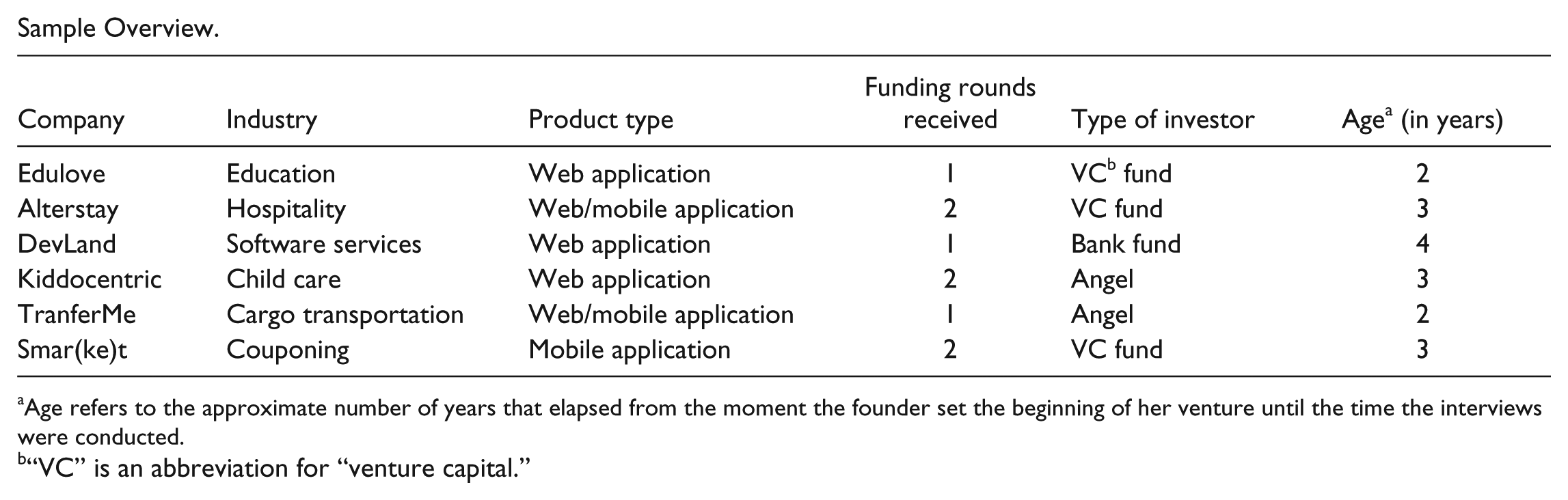
| Company | Industry | Product type | Funding rounds received | Type of investor | Age a (in years) |
|---|---|---|---|---|---|
| Edulove | Education | Web application | 1 | VC b fund | 2 |
| Alterstay | Hospitality | Web/mobile application | 2 | VC fund | 3 |
| DevLand | Software services | Web application | 1 | Bank fund | 4 |
| Kiddocentric | Child care | Web application | 2 | Angel | 3 |
| TranferMe | Cargo transportation | Web/mobile application | 1 | Angel | 2 |
| Smar(ke)t | Couponing | Mobile application | 2 | VC fund | 3 |
Age refers to the approximate number of years that elapsed from the moment the founder set the beginning of her venture until the time the interviews were conducted.
“VC” is an abbreviation for “venture capital.”
Appendix B
Interview Protocols.

| Core interview questions | Protocol 1 (founders) | Protocol 2 (team members) |
|---|---|---|
| Why/how did you decide to start your own company? | Yes | No |
| How did you go about forming a team? | Yes | No |
| Remember a time when you added a new member to the team. | Yes | No |
| With regard to the whole formation process, what would you have done differently today? | Yes | No |
| Tell me about the team and your role in it. | No | Yes |
| Can you describe your current work routine as a team? | Yes | Yes |
| How/Why did you enter the team? | No | Yes |
| Remember a time when a new member incurred important changes in the way the team worked. | Yes | Yes |
| Remember a time when you really enjoyed working with the team. | Yes | Yes |
| Remember a time when the outcome of teamwork was a significant improvement of the product. | Yes | Yes |
| Remember a time when the team was in conflict. | Yes | Yes |
| Remember a time when the team was ineffective. | Yes | Yes |
| What characteristics of the team members do you see as critical to the venture’s success? | Yes | No |
| If you went back in time and wrote your first business plan for your startup again, to what extent do you think that it would be similar to what you had written back then? | Yes | No |
| From your perspective, how has the team changed over time? | No | Yes |
Acknowledgements
This research was conducted with the support and guidance of Dr. Charalambos Mainemelis, Associate Professor of Organizational Behavior, ALBA Graduate Business School at The American College of Greece.
Declaration of Conflicting Interests
The author(s) declared no potential conflicts of interest with respect to the research, authorship, and/or publication of this article.
Funding
The author(s) received no financial support for the research, authorship, and/or publication of this article.