




Abstract
Human engagement in pro-environmental action is necessary for mitigating the effects of climate change. However, psychological barriers, such as feeling that the problem is distant in time and that any personal actions would only be a “drop in the bucket,” reduce people’s motivation to engage in pro-environmental behaviors that are essential for the future of the planet but that incur short-term personal costs. In the present study, we drew on theory and research regarding the subjective experience of temporal distance and the effects of social norms on action. We used an experimental methodology in which we presented scientifically predicted outcomes of climate change expected around the year 2100, then manipulated the degree to which these future consequences felt proximal or distant. We also altered whether people perceived pro-environmental action to be normative in society, reasoning that people would be more motivated to take on a subjectively looming threat if they believed they were part of a collective who were also taking action. Results indicated that after considering far-off, large-scale climate outcomes, neither subjective proximity nor social norms were sufficient in isolation to motivate behavior, but in combination, they effectively increased pro-environmental intentions and behavior. Those who were induced to feel that these objectively distant future outcomes were subjectively imminent, and who were also led to believe that pro-environmental behavior was normative, reported more intentions to engage in environmentally responsible behavior, and actually reported more sustainable behaviors in the weeks following the study.
Climate change is one of the most serious global problems of our time, a potential future calamity that warrants (but often fails to receive) our immediate attention (Höhne, Eisbrenner, Hagemann, & Moltmann, 2009; Swim et al., 2009). Despite an increasing awareness of the need to modify human behavior to mitigate environmental problems (Pew Research Center, 2007), there has been little increase in the level of engagement in environmental behaviors (Höhne et al., 2009; Morales, 2010). Engaging in environmentally sustainable behaviors can possibly mitigate climate change effects in the future (Höhne et al., 2009), but there seem to be several psychological barriers that hinder people from engaging in these behaviors. Environmental scientists, biologists, and geographers have provided compelling information documenting the deteriorating state of the environment around us, and the media provides an outlet to inform the public about the necessity of taking action; however, it is the role of social and behavioral scientists to provide tools for overcoming any social and psychological barriers and effecting change in human behavior (Gifford, 2008, 2011; Kazdin, 2009; Koger & Scott, 2007; Pelletier, Lavergne, & Sharp, 2008; Soliman & Wilson, 2017; Swim et al., 2009). In the present study, we focus on two psychological processes that may hinder people from environmental engagement. Climate change can be a daunting problem in part because people often perceive it to be a temporally distant problem—and we know that people tend to underrate the severity of risks that are remote in time, undermining willingness to act (Lorenzoni, Leiserowitz, De Franca Doria, Poortinga, & Pidgeon, 2006; Pahl & Bauer, 2013). Compounding this problem, because of the magnitude of climate change, people tend to perceive that the acts of any single individual seem too trivial to make a difference: This “drop in the bucket” perception may discourage people from making significant personal changes when they feel they can have little true impact on a problem of this scale (Bonniface & Henley, 2008). As environmental activist George Marshall (2014) describes it, climate change has the perfect storm of features that decrease the likelihood of an effective human response to threat. Recognizing how these two factors can hinder environmental action can also suggest some possible solutions. In the present research, we target these two central barriers to action and examine, using an experimental methodology, techniques that may help circumvent them.
Temporal Distance
Time is central to the understanding of environmental problems, such as climate change, and to the provision of sustainable solutions (Baptista, 2014). One reason for a lack of willingness to adopt positive environmental behaviors is that climate change consequences seem so temporally distant (Lorenzoni et al., 2006; Spence, Poortinga, & Pidgeon, 2012). Behaving in environmentally sustainable ways involves a willingness to incur short-term costs and inconveniences to achieve long-term benefits. Behaviors with this temporal asymmetry are often challenging to people because immediate desires loom large, and distant outcomes can be difficult to keep in focus (Hall & Fong, 2007). These asymmetries occur in many domains where short-term costs must be incurred to achieve long-term benefits such as health behaviors (healthful eating, exercise, avoiding smoking, and drug abuse, etc.), financial planning, and environmentally sustainable actions. Research on temporal discounting suggests that people regularly undervalue the importance of long-term consequences while being more heavily swayed by their proximal concerns (Frederick, Loewenstein, & O’Donoghue, 2002).
Although there are clear psychological barriers that discourage concern over distant, long-term consequences, recent research suggests that perceptions of temporal distance are quite malleable. Social psychological research demonstrates that even using subtle experimental manipulations such as altered verbal descriptions or spatial representations along a timeline (Peetz, Wilson, & Strahan, 2009; Pennington & Roese, 2003; Ross & Wilson, 2002; Wilson & Ross, 2001, 2003) can temporarily alter people’s perceptions of temporal distance, making certain events feel close in time—or still very remote—regardless of how far they actually are in terms of chronological or calendar time. Similarly, although we cannot change the objective time scale of certain climate change consequences, we may be able to change the subjective proximity and felt connection to these outcomes using well-established experimental research techniques. Indeed, holding calendar time constant, the same point in time can be induced to feel subjectively quite imminent or remote (Peetz et al., 2009; Pennington & Roese, 2003). Given that individuals are more influenced by proximal than distal concerns, inducing subjective feelings of proximity can lead to greater motivation to take action. Accordingly, when people are exposed to experimental approaches that lead them to feel more closely connected to a future time point, they show more motivation to make decisions that result in positive future outcomes even while incurring immediate costs (Ersner-Hershfield, Wimmer, & Knutson, 2009; Peetz et al., 2009). However, past work on subjective temporal distance has primarily focused on personal goals and outcomes such as academic performance and financial planning (Ersner-Hershfield et al., 2009; Peetz et al., 2009). Recently, Bashir and colleagues were the first to examine the impact of experimentally manipulating the perceived temporal distance from future climate change on pro-environmental motivation (Bashir, Wilson, Lockwood, Chasteen, & Alisat, 2014). Using a simple experimental procedure to temporarily alter subjective temporal distance (adapted from Peetz et al., 2009), they found that by inducing subjective proximity to future climate change consequences taking place a decade into the future, they increased participants’ pro-environmental motivation and engagement in environmentally responsible actions. Bashir et al.’s (2014) experimental procedure was effective in inducing psychological proximity to consequences of climate change that would likely happen within participants’ lifetime (10 years from now). However, there is considerable scientific evidence regarding consequences of climate change that are expected to happen over an even longer time frame (i.e., likely to be outside the life span of current adults). Events that are only expected to occur to future generations may be even more intensely vulnerable to the demotivating effects of distance. Would it be possible to induce subjective proximity toward events that are expected to happen that far into the future, using a similar psychological manipulation? It is possible to subjectively alter people’s subjective distance to historical events that occurred to past generations (Peetz, Gunn, & Wilson, 2010), but we are unaware of any attempts to alter subjective distance to catastrophes expected to occur to future generations. The present study extends past research by testing whether even very distant future events—those that are expected to happen outside of one’s own lifetime—may be induced to feel close enough to influence pro-environmental intentions and actual engagement in environmentally responsible actions. If subjective proximity to future generations can be altered, this represents an important potential solution to a significant psychological barrier to climate action (Gifford, 2011).
A Drop in the Bucket?
Even if people can be led to feel that a future climate crisis is subjectively imminent and urgent, this might be insufficient to motivated action. Indeed, by increasing the problem’s urgency, people may feel even more acutely that their individual actions are simply not sufficient to make a difference. Another psychological barrier to engaging in environmentally sustainable behavior may be the perception that any personal behavior cannot have much impact on such a large-scale, long-term outcome. Because of the scale of the problem, it may be difficult for people to feel like any pro-environmental action they engage in would be meaningful and would make a significant difference in isolation from other people’s actions. Individuals may feel that their personal actions are just a “drop in the bucket” (Bonniface & Henley, 2008) and that there is no point in making the required sacrifices. However, just as people’s perceptions of temporal distance can be temporarily altered using experimental procedures, it is also possible to shift people’s feelings that their personal actions are too singular to address such a collective problem. Specifically, by using social influence techniques that emphasize that others have similar concerns and are currently engaging in similar actions (Abrahamse & Steg, 2013), the demotivating effects of this psychological barrier might be attenuated.
Social norms are known to have a powerful effect on individual’s behavior across a range of domains (Cialdini, Kallgren, & Reno, 1991; Fishbein & Ajzen, 1975; Kinzig et al., 2013); environmental behavior is just one of many domains affected by people’s perceptions of what others around them are doing. Indeed, in an evaluation of a wide-spread public information campaign about global warming, Staats, Wit, and Minden (1996) found that knowledge and problem awareness were not sufficient to encourage individual engagement in activities to mitigate the effects of climate change; rather, personal behaviors were strongly correlated with normative beliefs about what other people were doing. This is consistent with research that has examined the causal impact of social influence on behavior. A number of studies have examined the role of social norms in influencing environmental behaviors. After receiving messages that positive environmental behaviors were prevalent among others, people showed positive changes in behaviors such as sustainable transportation (Kormos, Gifford, & Brown, 2015), curbside recycling (Schultz, 1998), resource conservation (See Abrahamse & Steg, 2013 for a review; Göckeritz et al., 2010; Lapinski, Rimal, DeVries, & Lee, 2007), littering (Kallgren, Reno, & Cialdini, 2000), and hotel towel reuse (Goldstein, Griskevicius, & Cialdini, 2007). Although many of these studies focus on very specific single behaviors (e.g., littering), other research has demonstrated that social norms can have a broader influence on a suite of pro-environmental actions (Fritsche, Jonas, Kayser, & Koranyi, 2010; Reno, Cialdini, & Kallgren, 1993), which is important for fostering long-term impact (Lucas, Brooks, Darnton, & Jones, 2008). In much of this research, the effect of norms is described as a relatively straightforward, automatic social influence process. People go along with what others are doing, often without much conscious consideration (Nolan, Schultz, Cialdini, Goldstein, & Griskevicius, 2008). Of course, norms provide people with complex information, which can motivate behavior for a variety of reasons. As described in early theorizing (Deutsch & Gerard, 1955), when people learn that a majority of people engage in a particular behavior, they may consider it useful information about an effective and correct way to act (informational influence), or they may decide to conform to the norm to be accepted by others (normative influence). Norms can be descriptive (pertaining to what people do) or injunctive (reflecting what people endorse or disapprove of). Göckeritz et al. (2010) found that people’s conservation behavior was predicted by their beliefs about how much other people in their communities tried to conserve but that this relationship was especially strong for those who also held injunctive norm beliefs (that others approved of conservation efforts). Notably, although the literature recognizes that norms may motivate behavior for varying reasons, little research directly examines the possibility that social norms may motivate behavior by instilling the belief that their efforts will be part of a collective. Given that people may feel demotivated by believing that their efforts are just a drop in the bucket toward a problem of such great magnitude (Bonniface & Henley, 2008), and since feelings of collective efficacy have been shown to be important to motivating environmental action (Jugert et al., 2016), we speculated that believing that others are also engaging in social action may be important for increasing people’s beliefs that their efforts could matter. This should be especially important when the threat is felt most urgently.
The present study uses an experimental procedure that alters perceptions of social norms to lead people to believe that a majority of Canadians engage in pro-environmental action. We expected that a belief that many people were working toward a common goal might help individuals overcome the feeling that their personal pro-environmental actions are just a “drop in the bucket” and insufficient to make a difference. By experimentally increasing the perception that environmental behavior is common, in combination with our manipulation inducing people to see the future threat as subjectively near, we are able to examine the causal effects of combining these two psychological strategies aimed to target barriers to climate action.
The Current Research
In the present study, we used well-established experimental techniques that can effectively alter both feelings of temporal distance from a future environmental crisis (in Canada) and perceptions of whether environmental behaviors are currently normative in Canadian society. We evaluated the effects of these two techniques on intentions to behave in an environmentally responsible way and on reported behaviors. Using an experimental research method, which involved randomly assigning participants to different messages and procedures, enabled us to isolate the causal role of each of these variables, and to examine their combined effect in a 2 (distance) × 2 (norms) between-participants design (Aronson, Ellsworth, Carlsmith, & Gonzalez, 1990).
To ensure that all participants began with identical information about the potential for catastrophic outcomes due to climate change, we first presented participants in all conditions with a message about predicted climate change outcomes that are expected to take place by the end of the century (i.e., the year 2100; outside their own life time). This message was designed to be threatening, geographically relevant (it focused on outcomes in their region), and as accurate as possible (i.e., based on scientifically supported predictions). Participants were then exposed to a subjective temporal distance induction, which has been shown to shift people’s perceptions of the imminence of a future outcome (for instance, making a year or a decade seem close or far). This technique was adapted from past research (Bashir et al., 2014; Peetz et al., 2009), but as noted previously, we targeted a much longer time scale than past work has investigated, attempting to make the year 2100 seem close or far away. We tested whether those who were induced to feel closer to this very distant environmental future would report more environmental intentions and behaviors than those who were induced to feel distant from this future outcome.
Next, perceived social norms were manipulated by simply informing half the participants that the majority of Canadians were engaging in environmental behaviors (and providing no prevalence information in the control condition). We tested whether participants would report more pro-environmental intentions and behaviors when they believed that they were not a “drop in the bucket” but rather that environmental engagement was the norm.
Most importantly, the present study design allowed us to test whether combining the two strategies (inducing temporal proximity and presenting environmental behavior as normative) would be even more effective than using either of them alone. Some past research has demonstrated that social norms are sometimes only effective when combined with other psychological mechanisms motivating pro-environmental focus (Fritsche et al., 2010). Temporal distance manipulations have never been examined for a future outcome outside participants’ lifetimes, but we speculated that although heightened perceived imminence of the problem might increase motivation, it could also make individual action feel insufficient due to the urgency of the problem of such magnitude. Accordingly, although we thought that each manipulation could have some effect on their own, given that we are examining such a large-scale, long-term outcome, it seems plausible that the effectiveness of the manipulations would be enhanced when they are combined: People would be most motivated to act when the future threat seemed proximal, and they felt that they were part of a collective effort to mitigate the threat. These hypotheses are stated formally below:
Method
Participants
Session 1 participants were 155 undergraduate university students who were recruited through the undergraduate research participant pool at a Canadian university and compensated by course credit. A computer glitch affected the results of eight participants, such that it was not possible to determine which experimental condition they had received, so they were excluded from all analyses. Of the remaining sample (N = 147), 117 were female and 30 were male. The mean age of participants was 18.8 years (range = 17-25 years). Of this sample, 102 participants (69% of Session 1 participants) completed the follow-up portion of the study (86 female, 16 male). Proportionally more female than male participants completed the follow-up session, χ2(1, N = 147) = 4.57, p = .03. Participants who completed the follow-up did not differ significantly from those who did not complete it on any other variables of interest (ts < 1.59, ps > .11). Completion of Session 2 was not affected by the experimental condition that participants were randomly assigned to in Session 1 (ps > .34).
Procedure
Session 1
Participants were told that the purpose of the study was to examine people’s attitudes, behaviors, and thoughts about social issues including the environment. Session 1 was an online research session. In the beginning of that session, participants provided demographics (gender, age) and completed a premeasure of engagement in environmental behaviors. The environmental behavior inventory was administered to provide a baseline measure of pro-environmental engagement over the past year. On a 5-point scale, from 0 (never) to 4 (a lot), participants indicated how often in the past year they have engaged in each of 13 “green” behaviors, such as “eat food which is organic, locally grown or in season,” and “turn off lights when not in use” (Cronbach’s α = .85 for the baseline administration of this scale).
After the completion of these background measures, participants were randomly assigned to one of four conditions in a 2 (distance: close vs. distant) × 2 (social norms: norms vs. no norms) between-participants experimental design. All participants were told that the researchers would like to assess their perception of environmental messages in the media. Participants read a pro-environmental message about the consequences of climate change that could occur by 2100, and the resulting impact on food shortages (e.g., “Scientists agree that if our current behavior does not change immediately, Canada will be experiencing severe food shortages by the end of the century”). The message ended with the statement that all Canadians need to conserve their natural resources to reduce the risk of these dire outcomes.
Subjective temporal distance
After reading this passage, participants were invited to complete a timeline task, and were told that the purpose of this task was to help them mentally visualize the time of the impending crisis. The timeline task was used to introduce the manipulation of perceived temporal distance. Participants placed a mark on a timeline that extended from TODAY to either “100 years from now” or “1,000 years from now.” The timeline with the 100-year span induces participants to place the 2100 crisis relatively further away from TODAY, compared with the timeline with the 1,000-year span. Thus, the timeline with the 100-year span was designed to make the year 2100 feel subjectively further in time, compared with the timeline with the 1,000-year span (see Figure 1). This experimental method of temporarily altering subjective temporal distance by inducing people to visualize a future time as spatially proximal or distant from today has been successfully used in other research, people tend to mark the future spatially either closer or further away from “TODAY” on the timeline, and subsequently judge subjective time differently (e.g., Peetz et al., 2009). Following this task, we assessed whether the manipulation was successful at temporarily shifting people’s perceptions of how subjectively near or distant the year 2100 felt. To assess this, participants completed two manipulation check items assessing subjective temporal distance to the predicted environmental crisis. Specifically, we introduced participants to the concept of subjective temporal distance by telling them that people experience time in different ways; the same point in time might seem quite close to one person but far to another. Then, they were asked to think of the predicted climate change outcomes that they read about and to indicate how far away the year 2100 felt to them. On the first 11-point scale, participants indicated their rating from 0 (“almost like tomorrow”) to 10 (“very distant future”), and on the second, they indicated their rating from 0 (“feels extremely close”) to 10 (“feels extremely far away”).
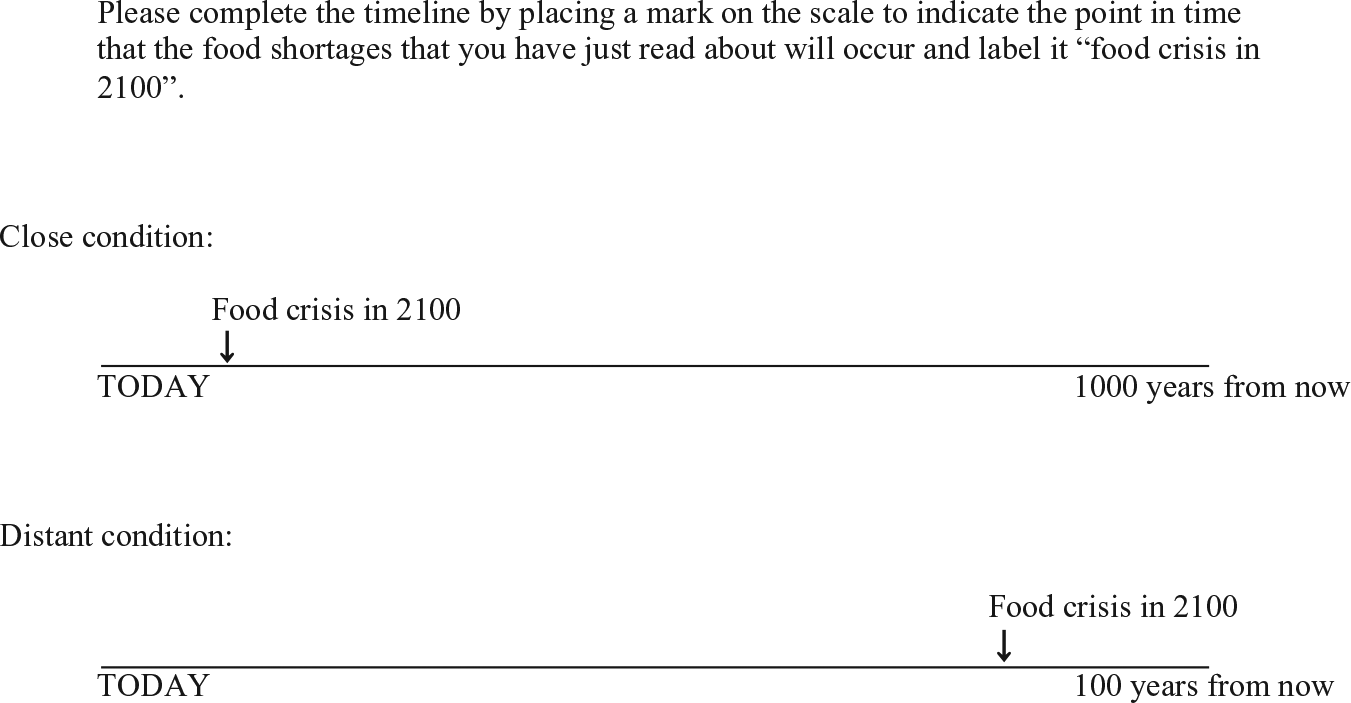
Subjective temporal proximity manipulation.
Social norms
Next, participants received the social norms manipulation. Participants in the norms condition read a statement indicating that the majority of the population was motivated to live more sustainably (e.g., “Canadians are quite concerned about this type of environmental devastation. In a recent survey, the results suggested that 85% of people living in Canada have already begun to take actions to conserve our natural resources and live in a more environmentally sustainable way”). Participants in the no norms control condition did not read any passage indicating the prevalence of sustainable behavior. To assess the effectiveness of the social norms manipulation, participants were asked to estimate the percentage of Canadians they thought were making significant efforts to act in environmentally sustainable ways by providing a percentage estimate. Note that we asked participants for their opinions about social prevalence, not for them to report precisely what was reported in the article. We expected that the article’s report that sustainable behavior was a concern to most Canadians and highly prevalent would increase people’s beliefs in action prevalence over what they would typically believe in the absence of such normative information.
Drop in the bucket?
Furthermore, we sought to directly assess our contention that emphasizing social prevalence should attenuate people’s feelings that their personal actions are too singular to address collective problems; participants responded to the item, “I feel like any action I take to be environmentally responsible is only a “drop in the bucket” and won’t make a difference” on a scale ranging from 0 = strongly disagree to 10 = strongly agree. We expected that people who were led to believe that sustainable action was normative among Canadians would feel more optimistic that their efforts were not just an ineffective drop in the bucket.
Environmental intentions
Participants then read the same 13 items from the environmental behavior inventory that they completed at the beginning of the study, but here they were asked to rate their intentions to engage in these behaviors in the next 2 weeks using the same scale ranging from 0 (never) to 4 (a lot; Cronbach’s α = .89).
Session 2
Approximately 2 weeks after completing Session 1, participants were invited by e-mail to complete the follow-up online survey. Session 2 was completed between 2 and 5 weeks after Session 1. In Session 2, participants again completed the environmental behaviors inventory. This time, it was completed with reference to the preceding 2-week time period. Thus, it was used as a measure of self-reported actual behaviors in the time period since Session 1 (Cronbach’s α = .87).
Results
Manipulation Checks
As a first step, the effectiveness of the manipulations was examined. The two manipulation check items assessing feelings of subjective distance from the future 2100 environmental crisis were highly correlated, r(144) = .88, p < .001, and so they were aggregated. A t-test revealed that participants in the close condition reported that the future point in time (the year 2100) felt significantly closer (M = 5.51, SD = 2.30) than those in the distant condition (M = 6.41, SD = 2.64), t(145) = −2.21, p =.03.
Next, we examined the effectiveness of the norms manipulation. The manipulation successfully led participants to estimate that a higher percentage of Canadians were engaging in environmentally sustainable action in the norms condition (M = 44.91%, SD = 23.29) than in the no norms condition (M = 36.14%, SD = 18.37), F(1, 134) = 6.18, p = .01, ηp2 = .04, although participants’ estimates fell short of the very high majority indicated in the article. Furthermore, our prediction that social norms would attenuate the feeling that individual actions were only a drop in the bucket was supported: Participants reported feeling that any action they took was a “drop in the bucket” to a marginally greater extent in the no norms condition (M = 4.92, SD = 2.80) than in the norms condition (M = 4.12, SD = 2.44), F(1, 143) = 3.58, p = .06, ηp2 = .02. As expected, these items were not influenced by the temporal distance manipulation or by the Distance × Norms interaction.
Environmental Behaviors
Intended environmental behaviors
Self-reported environmental behaviors over the past year were measured prior to the manipulations, allowing us to use this baseline as a covariate. Recall that we expected that both temporal distance and norms manipulations might affect environmental intentions on their own, but in particular, the greatest effect was expected when temporal proximity and high prevalence norms perceptions were combined. A 2 × 2 analysis of covariance (ANCOVA) controlling for baseline environmental behaviors revealed that neither main effect was significant, Fs < 2.40, ps > .12, but, consistent with the key Hypothesis 3, a significant Distance × Norms interaction emerged, F(1, 140) = 4.10, p = .05, ηp2 = .03 (see Table 1). This analysis included all participants who completed Session 1 regardless of whether they completed Session 2. Simple effects revealed that, as predicted, the subjective distance manipulation had the expected effect in the norms condition (people planned more green behaviors when the future felt close), F(1, 140) = 4.44, p = .03, but did not affect intended environmental behaviors in the no norms condition, F < 1, p > .40. Similarly, the effect of the norms manipulation had the expected effect when the future felt close, F(1, 140) = 6.56, p =.01, but not when the future felt distant, F < 1, p > .70.
Environmental Intentions and Self-Reported Behaviors at Follow-Up by Condition.

Note. Means that share the same subscript in each row do not statistically differ from one another, p > .05.
Reported environmental behaviors at follow-up
Next, we examined whether the effects of these two relatively subtle manipulations (how people perceive the temporal proximity of future climate crisis, and the prevalence of other Canadians working toward mitigation) might have an effect beyond the momentary increase in environmental intentions. Could these techniques to combat the psychological barriers to climate change action have an effect on action over time? A 2 × 2 ANCOVA controlling for baseline environmental behaviors revealed a significant Distance × Norms interaction, F(1, 97) = 9.05, p < .01, ηp2 = .09 (once again neither main effect was significant, Fs < 1.80, ps > .13; see Figure 2). Simple effects revealed that the subjective distance manipulation had the expected effect in the norms condition (people reported engaging in more green behaviors over the past 2 weeks when the future felt close), F(1, 97) = 4.09, p = .04. There was a marginal reversal in the no norms condition, F(1, 97) = 2.91, p = .09, suggesting that people actually engaged in slightly more environmentally sustainable behaviors when the future was depicted as distant rather than close. Similarly, the effect of the norms manipulation had the expected effect when the future felt close, F(1, 97) = 10.54, p < .002, but not when the future felt distant, F(1, 97) = 1.09, p < .29.

Joint effects of social norms and temporal proximity on pro-environmental intentions and behavior.
Discussion
The present study illuminates one possible approach to aligning environmental concerns and behaviors by inducing temporal proximity and highlighting pro-environmental social norms. Despite the fact that the message used in this study described an objective timeframe that was beyond participants’ lifetime, increasing the temporal proximity of the consequences described and highlighting social norms about pro-environmental behavior not only produced an immediate boost in participants’ motivation but also increased their reported pro-environmental behaviors during the weeks following the study.
The study integrates two separate areas of research in social psychology that previously have not been investigated in combination: subjective temporal distance and social norms. Importantly, we examined the extent to which each of these two relatively subtle psychological manipulations could be effective in addressing a collective large-scale problem with outcomes that go beyond participants’ lifetime. Although previous research has suggested that both subjective proximity and social norms could independently have some impact on behavior, neither manipulation alone was sufficient to influence behavioral intentions or outcomes in the present study. Using an experimental research approach enabled us to isolate the causal effects of each manipulation and their impact in combination, while holding other aspects of the communication (e.g., the nature of the climate threat and the year 2100) constant.
The present study contributes to research examining temporal factors influencing sustainable behavior. Past research (Bashir et al., 2014) on the power of subjective time is limited and has focused solely on outcomes that were relatively closer in time (e.g., 10 years), whereas the present study targeted outcomes that were considerably more remote (outside participants’ own lifetimes). Because many of the outcomes of climate change are expected to happen in the very distant future, more research is needed to understand the psychological processes underlying people’s reactions to events that are expected to occur outside their lifetimes. Our findings contribute to the literature by demonstrating that normative messages can even be effective in inducing change to address problematic outcomes that are expected to happen in the very distant future, so long as the problem feels subjectively imminent. However, feeling close to a future climate catastrophe of great scope and magnitude was not enough on its own to induce greater action; people also needed to believe that their efforts were part of a collective. A subtle shift in how people see the time of a future event, combined with a single message about how sustainable behaviors are normative and prevalent among Canadians, were enough in combination to increase behavioral intentions, and, several weeks later, actual reports of sustainable behaviors. Our findings show that inducing minor changes in perception using subtle psychological manipulations can have an impact on behavior regarding climate change, which is a collective societal problem with expected long-term outcomes.
More broadly, this research contributes to work on climate change and psychological distance, which is still at its nascent stages (e.g., Bashir et al., 2014; Spence et al., 2012). Although the present research focused on subjective temporal distance, there are other types of psychological distance including spatial (or geographical) distance and hypothetical distance (i.e., distance from reality, Trope & Liberman, 2010). Despite their differences, varying types of distance can also have parallel effects on people’s perceptions of climate change and their willingness to engage in mitigation behaviors. Numerous factors can influence distance perceptions relating to climate change, and disentangling these factors can provide a rich avenue for future research. It is possible that regardless of the particular “type” of distance, distance may alienate people from the problem and dampen their motivation to engage in collective action (and vice versa). For instance, direct experiences with consequences such as health and extreme weather events may induce feelings of (relative) psychological proximity to climate change, as they bring climate change closer to people’s immediate experienced reality and make it seem less like a distant hypothetical scenario (e.g., Spence, Poortinga, Butler, & Pidgeon, 2011). In the present study, we altered only one type of distance (subjective temporal distance) while holding constant many others (geographical location, calendar time, and the hypotheticality of the prediction), allowing us to zero in on the causal effects of a single type; however, we acknowledge that each of these types of distance is likely to play a role in real-world scenarios.
In the present research, climate change effects were described quite broadly, and environmental behaviors included activities as diverse as choosing sustainable transportation, using scrap paper, and composting kitchen waste. These kinds of global changes (and many others) are necessary to begin to address the looming environmental devastation—but we recognize that individual action is not sufficient to address climate issues that are global, politically charged, and tied to many economic factors. Although promoting individual sustainable action cannot be construed as a complete solution to the problem, we contend that the more people identify with sustainable lifestyles and entertain the possibility of behavior change, the more they may also push for larger scale action through collective action, political engagement, and the like. Individuals who feel that they are simply drops in the bucket who cannot effect change are likely to accept the political, industrial, and societal status quo to continue. The study targeted two psychological barriers to environmental action and successfully increased people’s intentions to behave pro-environmentally. Oftentimes, people report having the best of intentions, but these do not always translate into subsequent behaviors (Webb & Sheeran, 2006). However, the findings of the present study suggest that the experimental manipulations continued to influence behavior, even when they were not immediately salient, in the 2 to 5 weeks following the first session. Of course, these behavior effects were based on self-report measures: Future research should replicate these findings using objective behavioral measures of environmental engagement. We also acknowledge that although we included a range of pro-environmental behaviors in our measure, this is just a subset of behaviors that people can engage in to help address environmental problems. Future research can examine a broader range of pro-environmental behaviors, such as making long-term purchase decisions, engaging in activism, or making voting decisions with pro-environmental concerns in mind.
One limitation of the current design is that social norms were established briefly using a single piece of numeric evidence (85% of Canadians beginning to take action), as opposed to providing more complex social information or persuasive communication that might more closely reflect what people are exposed to in everyday life. However, this streamlined approach corresponds with other methods used in the literature (e.g., Göckeritz et al., 2010; Goldstein et al., 2007), allowing researchers to clearly communicate a specific, precise norm to test its causal effect without forcing people to estimate its magnitude and independent of any other features of a persuasive message. Importantly, this approach has also been used as an intervention in field experiments and policy settings (e.g., Cialdini, Martin, & Goldstein, 2015; Goldstein et al., 2007), demonstrating that—despite its simplicity—this technique can be used effectively to influence people’s behavior outside the lab. Of course, people’s real-world perceptions of social norms are likely to also come from multiple information sources and observations of others’ behaviors and attitudes in their social environment. Nonetheless, we contend that regardless of how normative beliefs are developed, they are likely to produce important effects on behavior. The present research focused on one form of social influence, which is the presentation of descriptive social norms, in combination with the subjective temporal proximity induction. However, this research goes beyond past work or informational and normative influence by investigating an additional reason that norms might increase environmental action. Specifically, believing there is a social norm may be a powerful motivator in the face of overwhelming odds because it induces a feeling that one’s efforts are part of a more prevalent set of collective actions that are needed to effectively make change. Future research can also examine whether other social influence technique—such as communicating the message through block leaders, modeling, or getting people to make public commitments—can also reduce the feeling that one’s actions are “just a drop in the bucket” and contribute, along with temporal proximity induction, to greater willingness to participate in sustainable actions. Indeed, a review and meta-analysis of social influence approaches (Abrahamse & Steg, 2013) indicated that social influence techniques that are more resource-intensive and involve face-to-face interactions (e.g., interactions with block leaders) may even be more effective than social norms, at least in the domain of resource conservation.
Another factor to consider in future research is the degree to which the information that participants read about was threatening. Although we did not measure how negatively the information was perceived in this study, we did select severe, but scientifically supported, expected future consequences of climate change. However, it is quite plausible that the same negative information in the description would seem more negative when the time period seemed close rather than far (Van Boven, Kane, McGraw, & Dale, 2010); this may have played a role in why subjective proximity increased action (in combination with social norms). Future research can utilize different manipulations and directly measure the role of perceived valence and severity of the threat. Finally, it would be useful to conduct future research including participants from different age groups and with more variable sociodemographic characteristics to examine the generalizability of the findings.
As environmental scientists are reaching a consensus about the seriousness and severity of climate change and about human behavior contributing to the problem, social scientists need to take their role by studying the factors that can lead to greater pro-environmental engagement (Swim et al., 2009). The present study provides useful insights to encourage greater environmental engagement. The insights gained from this study can be used to develop and evaluate interventions to change environmental behaviors (Steg & Vlek, 2009). They also highlight the need for research that examines joint effects produced by combining different messaging techniques or psychological interventions. With problems of the magnitude of climate change, it is likely that a combination of interventions may prove more effective in changing people’s behavior. Future research can examine how to translate these insights into public communications that are designed to influence human behaviors in a way that may contribute to the sustainability of our earth in the long run.
Footnotes
Author’s Note
All authors contributed equally to this research. Any views expressed in this paper are those of the authors. They should not be interpreted as reflecting the views of their respective organizations.
Declaration of Conflicting Interests
The author(s) declared no potential conflicts of interest with respect to the research, authorship, and/or publication of this article.
Funding
The author(s) disclosed receipt of the following financial support for the research, authorship, and/or publication of this article: This research was supported by a Social Science and Humanities Research Council of Canada grant to the fourth author.