




Abstract
Aims of the current study were to explore teachers’ background, beliefs, attitudes, and sense of self-efficacy, as well as instructional supports and innovative practices in response to cultural and linguistic diversity in classrooms serving Spanish-English speaking children of migrant workers. A total of 22 teachers participated in semi-structured interviews regarding linguistic diversity in the classroom. Their responses were transcribed and qualitative analysis procedures were utilized to deconstruct units. Individual units were then clustered by similarities and differences into themes and subcategories of themes. Teacher responses to the interview questions produced themes: awareness of cultural and linguistic diversity, issues and challenges, and innovative instructional supports and practices. Participating teachers commented on general supports designed to assist communication between English Learners (EL) and the teacher or peers, facilitate communication with parents of ELs, and embrace and promote responsiveness to cultural linguistic diversity (CLD) in the classroom. Teachers identified specific supports to intensify instruction, including (a) employing multiple modalities, (b) increasing experience and exposure, and (c) providing individualized support. Additional resources and support are warranted to identify and disseminate effective practices to provide intensified instruction and support to ELs.
Keywords
Lexical diversity is at an all-time high, particularly with regard to Spanish-speaking English Learners (ELs) in elementary schools in the United States. At least 45% of the nation’s teachers have ELs in their classrooms (McCloskey, 2002). The National Clearinghouse for English Language Acquisition reports that there are 5.1 million ELs in U.S. schools, with more than 80% speaking Spanish as a first language. It is estimated that more than half of the EL population of the United States live in rural communities, particularly within the six states with the largest populations of ELs: Arizona, California, Florida, Illinois, New York, and Texas.
Children from migrant family backgrounds represent a subgroup within the larger population of ELs who face unique challenges in schools, often residing in rural areas and/or migrating between schools. Rural areas, in particular, have shown growing prevalence of ELs from migrant backgrounds. Teachers in these schools may have varied background experiences and education related to lexical diversity and adapting to the needs of culturally and linguistically diverse learners. The Education Alliance at Brown University reports that 44% of America’s EL students live in rural communities where enrollments are often too low to establish bilingual education programs. Furthermore, according to the Education Alliance, rural schools lack credentialed EL teachers and, therefore, may have inadequate knowledge of EL methodology, multiculturalism, EL curriculum development, EL assessment, and second language acquisition.
Considering the diverse backgrounds and lexical experiences of ELs from migrant backgrounds, it is not surprising that they may present with differences in language learning styles and needs during early elementary school grades. Research findings show Spanish-English speaking ELs from migrant backgrounds often present with below average vocabulary skills in both English and Spanish (Jackson, Schatschneider, & Leacox, 2014), which may present challenges on the teacher-child interactions or a mismatch in expectations. Additional demands or mismatch may also influence teacher attitudes. Teachers’ attitudes and biases can affect classroom opportunities, responsiveness, and teacher-child interactions and ultimately impact child outcomes (Mitchell, 1976). Numerous investigators have suggested that teacher-child mismatches in cultural backgrounds may impact teachers’ attitudes, expectations, and behaviors toward children (Connor & Craig, 2006; Green, 2002; Wolfram, Adger, & Christian, 1999), with negative attitudes associated with lower efficacy and expectations (Pang, 2001). There is, however, a resurgence of growing interest in teachers’ reactions, attitudes, and practices given the trend toward increasing diversity in the modern classroom.
In response to the rich linguistic diversity in educational settings today, the aim of the article is to examine current practices, particularly in instructional strategies and innovative supports, however, while also recognizing and discussing potential influencing factors, including (a) attitudes toward diversity and (b) teacher training. Within teacher training, we will consider recommended practices and supports for teaching ELs.
Attitudes and Beliefs
Walker and colleagues examined teachers’ beliefs and attitudes about ELs in their classrooms (Walker, Shafer, & Liams, 2004). They conducted interviews with six EL teachers and surveyed 422 teachers. Most teachers (62%) felt their schools welcomed ELs and embraced cultural linguistic diversity (CLD), although many of the teachers interviewed (70%) did not want ELs in their class. The investigators reported that some teachers felt negativity or resentment toward educating ELs, at times, stemming from the belief that the responsibility was on ELs to adapt to American culture and school life. Of teachers interviewed, 87% reported that they never received any professional development regarding working with ELs, and 51% said they would not be interested in receiving training.
Research suggests experiences and education are among influencing factors on teachers’ attitudes and biases (Reeves, 2006). Investigators have identified additional factors that were associated with teacher attitudes, including teacher in-service and training on working with ELs, previous experience with ELs in their classroom, teachers’ ethnic background, and teachers’ experiences traveling abroad (Walker et al., 2004). The literature identifies several potential moderators, including administrators’ attitudes (Levine & Lezotte, 2001; Wrigley, 2000). Positive administrator attitudes about CLD are thought to be associated with positive attitudes of teachers toward CLD.
Teacher Training
Historically, classroom teachers have reported minimal training in adapting the curriculum for ELs (García, 2008; Youngs & Youngs, 2001). Silverman et al. (2013) examined teachers’ use of strategies for third- to fifth-grade bilingual students by observing 274 bilingual students in their classrooms. Teachers appeared to focus on definitions and word relations during vocabulary instruction, and apply words in various contexts. In general, the observers noted the occurrence of, “very little instructional differentiation for bilingual students in the classrooms” (p. 20). The investigators called for more research on how to support teachers in differentiating instruction for bilinguals.
According to García (2008), most teacher education programs do not focus extensively on multilingual differences as an integrated thread throughout the curriculum, but at most require one isolated course in bilingual education. As a result, teachers may not acquire teacher language awareness (Andrews, 2001; Svalberg, 2007) or what García (2008) terms as multilingual awareness (MLA). The construct of teacher MLA in the delivery of educational instruction has been the topic of a great deal of the literature on professional preparation for foreign language teachers, and teachers of English as a second language (Ellis, 2004, 2007). However, as García (2008) notes, there are a group of teachers who are not specialized “language teachers” but who are charged with delivering the general curriculum to students who may have different levels of proficiency with multiple languages that differ from their school community. As such, MLA has been conceptualized as the knowledge that all teachers need to have to effectively deliver the school curriculum to students who may use multiple and different linguistic systems than the standard language variety used in the classroom.
Various models for teacher MLA suggest that there are three primary tenets and roles that are important for educating multilingual students: knowledge about language/proficiency (the user), knowledge about language/subject matter (the analyst), and pedagogical practice (the teacher; Andrews, 2001; García, 2008). The teacher as the user should demonstrate a general proficiency with the language of the curriculum. Furthermore, the teacher as the analyst should demonstrate knowledge about the form and content aspects of linguistic systems. In addition, the teacher should have the ability to adapt or modify content information and utilize instructional practices that are matched with knowledge about individual student learning styles (Schulman, 1987). This level of competence relies rather heavily on interaction of general teacher knowledge, expertise, and pedagogical practices (Tsui, 2003, 2009). García (2008) also suggested that there is a fourth tenet/role, the activist, which must be incorporated by teachers of multilingual students. The teacher should be able to demonstrate an understanding of the socioeconomic and political underpinnings of language practices within and across communities of diverse language users (Fairclough, 1999; Shohamy, 2006). Several other investigators identified specific practices that linguistically responsive teachers employ for effective classroom instruction with ELs, including but not limited to, increasing teacher knowledge base about ELs, identifying language demands necessary for classroom tasks, and scaffolding learning for ELs (Freedson-Gonzalez, Lucas, & Villegas, 2008).
Recommended Practices
Although training and professional development varies greatly, there are published guidelines and educational supports for teachers with recommended practices for teaching academic content and literacy to ELs (Baker et al., 2014). Guidelines by the Institute of Education Sciences have identified instructional supports that have a high level of empirical evidence (Baker et al., 2014). Among recommended practices, evidence supports teaching a small set of targeted words and integrating them across multiple days in varied educational contexts and daily activities. In addition, evidence supports the effectiveness of integrating oral and written language instruction into content area teaching contexts rather than teaching skills in isolation. Furthermore, the use of small-group differentiated instruction is supported by high levels of evidence, for facilitating English language and literacy progress (Baker et al., 2014).
Research Aims
The extent to which recommended practices or other adaptations and supports are utilized is not known. In response, the primary purpose of this investigation was to explore teachers’ attitudes about linguistic diversity in the classroom, particularly the attitudes and relevant background of elementary school teachers serving Spanish-English speaking children of migrant farmworkers. The second purpose was to examine how teachers viewed their own teaching practices and innovative supports in educating ELs. Specific research questions were,
Method
Participants
The investigators invited participation of classrooms that included Spanish-English speaking students from migrant family backgrounds. At the beginning of the school year, the investigators distributed invitations of participation to classroom teachers who had agreed to participate in a larger randomized control trial vocabulary intervention project for ELs in their classroom. Children in the classroom were invited to participate in an e-book vocabulary learning study, and teachers received a monetary token of appreciation of $200 for participating in the 22-week program. The token of appreciation was related to the larger intervention study and not contingent on agreeing to the interview; however, gift cards may have positively influenced their willingness to participate. In addition, graduate students working as interns in the same school settings were asked to share invitations for the current interview study with other teachers who had ELs in their classrooms. As a result, additional teachers (n = 8) consented to participate but were not part of the larger intervention project, and they were included in the current study. In total, the final sample included 22 teachers who had ELs in their classrooms and agreed to participate in interviews.
School characteristics
Participating schools were in low socioeconomic communities based on a high percentage of eligibility for free and reduced lunch. Many of the schools were targeted for participation because the student body was comprised of a high percentage of Hispanic children, and the majority of the students were eligible for free or reduced lunch. In total, 14 of the teachers worked in three schools in the same district. The community zoned for these three schools is rural and reported on Census data to be 49.3% Hispanic, 27% African American, and 23% Caucasian. Overall, 39% are reported to be foreign born from Latin America. The median household income ($24,198) is approximately half that of the statewide average household income.
Teacher characteristics
The educational background and experience of the teachers varied for the 22 participating teachers (refer to Table 1). A total of 14 of the teachers taught kindergarten or first grade (those involved in the larger intervention project), and the other eight teachers taught third, fourth, sixth, or seventh grade. The teachers were from a variety of educational backgrounds and professional experiences they had obtained in working with students from linguistically diverse backgrounds. The majority of the teachers reported bachelor’s degrees as their highest degree (82%), and the remainder had obtained master’s degrees (18%). Teachers ranged in their number of years of experience from 1 to 30 years (M = 12.75 years), and all had students who were ELs in their classroom. Of the teachers who reported their racial or ethnic backgrounds, 41% indicated African American, 18% Caucasian, and 5% Hispanic/Latino. The teachers estimated that the racial composition of students in their classrooms was comprised of students from Mexican, African American, and Caucasian ethnic/racial backgrounds.
Characteristics of Participating Teachers.
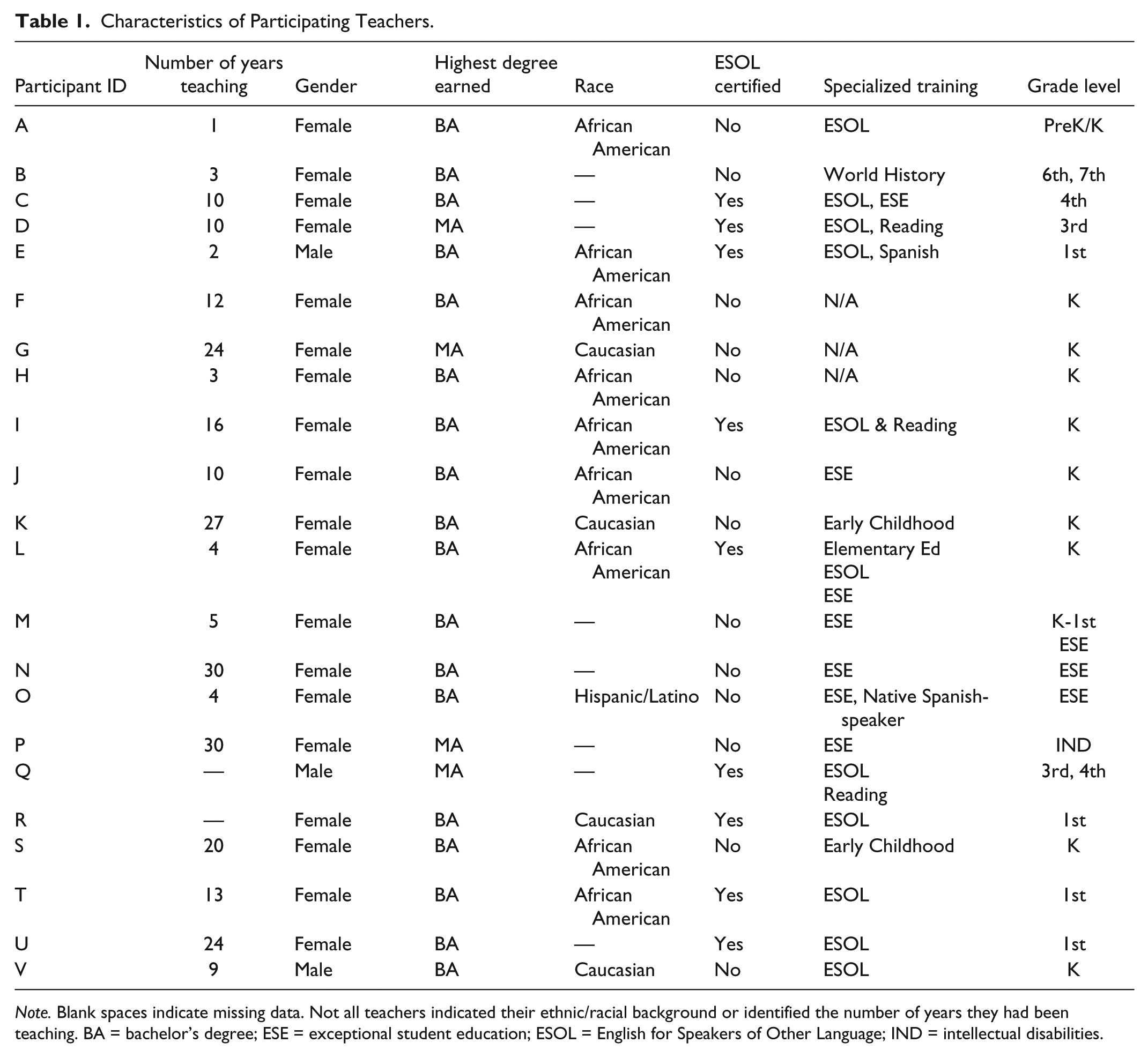
Note. Blank spaces indicate missing data. Not all teachers indicated their ethnic/racial background or identified the number of years they had been teaching. BA = bachelor’s degree; ESE = exceptional student education; ESOL = English for Speakers of Other Language; IND = intellectual disabilities.
Procedures
The investigators conducted semi-structured interviews to examine teacher attitudes about language diversity and their own self-efficacy in adapting the academic curriculum to serve ELs. The investigators allowed the teachers to steer the conversation. Teachers varied in their communication style with some predominantly responding to questions only and others initiating more than responding. During the interview, the investigators used a digital recorder to record responses to allow for later transcription and analysis. The investigators took notes during the interactions to aid in the later transcription and analysis of digitally recorded interviews. The length of individual interviews ranged from 20 to 30 min, and they were conducted in the teacher’s classroom after school or during their allotted planning period while students were not in the classroom.
The interview protocol was comprised of nine questions, listed in the appendix, which were based on a review of the literature and identification of studies that have examined teacher preparation, attitudes, beliefs, and knowledge about cultural and linguistic diversity (Karabenick & Noda, 2004; O’Neal, Ringler, & Rodriguez, 2008; Walker et al., 2004). Investigators then formulated additional open-ended questions based on teachers’ responsiveness, allowing teachers to steer the direction of the conversation. All of the teachers provided responses to each of the interview questions listed in the appendix. However, the amount of talk or length of response for each question varied by each of the teachers. As a result of this variability, the investigators reviewed the transcripts and segmented responses into units or thoughts provided by each teacher, which were then coded. The investigators utilized an iterative process of content analysis to identify and define codes for response types (Krippendorf, 2012; Schreier, 2012).
Analyses
The investigators discussed descriptions and examples of each code to refine the codes as new examples were applied. The units were coded with a subject or meaning code. This initial phase of the iterative process led to identification of primary categories that were assigned codes that were used to characterize the teachers’ responses. The investigators employed a constant comparative method to determine if a response was similar to another category code or warranted a new category (Creswell, 1998).
Adequate responses that could be assigned to the individual category type were those in which there were at least three units/ideas expressed during an interview (regardless of original question posed). The data from the coded interviews were used to identify larger, overarching themes in the teacher’s responses (Creswell, 1998). As one of the primary aims of the current article was to explore innovative supports, the investigators noted any resources, strategies, and instructional supports that were mentioned in the interviews with teachers. The investigators allowed teachers to steer the conversation. When an instructional support, accommodation, or teaching strategy was identified by a teacher, the investigators listed it in a separate database to compile a list and quantify the number of times it was identified and the number of teachers who initiated the instructional support in their interview. The approaches were quantified to allow the investigators to consider if certain innovative practices were more widely occurring or unique to teachers with certain backgrounds.
Results
Participating teachers’ comments and responses clustered around the following themes: awareness of cultural and linguistic diversity, issues and challenges, and instructional supports and practices.
Awareness of Cultural and Linguistic Diversity Theme
The teachers who participated in the study provided reflections on their own communication patterns, the communication patterns of their students, and their beliefs about the role of language in the identity of students who are ELs. Each of the classroom teachers acknowledged that they used English the majority of the time to communicate with their students. In addition, two of the teachers spoke more explicitly and extensively on their own communication patterns, specifically with their use of non-mainstream dialect. For example, Teacher E, who reported a background in Linguistics and Spanish, said,
I try to stick as close to standard American English as possible. I would probably say that in the educational setting this would be Midwestern, typical standard dialect, but a lot of people colloquially have more of a southern vernacular. African American vernacular speaking style when I’m around friends and family and I guess you could say that I kind of code switch between the two. In the classroom it’s typically Standard English, unless we are talking about something that is not educational.
When asked about the communication patterns of their students, each of the teachers spoke about the limited English proficiency of their EL students. Teacher G noted, “At the beginning of the school year I notice with the children, they are very reluctant to speak to you . . . I had a lot of them come in with no English at all.” Teacher E noted, “My Spanish students, try to explain to me things they did at home but they don’t always have the vocabulary.” He also offered the following discussion points:
I’d say my students who just speak a more southern dialect, more slang, for them it’s just that they haven’t been exposed to what would be considered the correct or more academic vocabulary verses my Spanish speakers, it’s more a language barrier. . . . So they are having to learn the pronunciation and learn what it means and they also have to separate in their head, this is Spanish this is English.
Three of the teachers with English for Speakers of Other Languages (ESOL) endorsement shared comments that indicated that they also had a general understanding of what Fairclough (1990) refers to as “critical language awareness,” the fourth tenet of Garcia’s MLA model. As demonstrated by Teacher E,
Just ’cause he knows English, doesn’t always mean he knows how to express himself. Maybe I am just a little more sensitive being that I took Spanish. . . . what I wanna say, I am able to express it, but if you ask me a question, I have more difficulty.
Each of the teachers expressed the opinion that the language that children bring to school is very important to the development of a child’s identity. At least three of the teachers expanded on their response and expressed how important it is for teachers to provide instruction without devaluing the child’s home language. Creating an environment that is supportive of cultural difference in conjunction with efforts to build trust with Spanish-speaking students, as mentioned above by Teacher G, seem to contribute to the idea of building rapport with culturally different students as a teaching strategy. Home language use by the teacher in the classroom extended to teachers with emerging Spanish-language knowledge in these data. As mentioned by Teacher A, “I’m all English. But with the Hispanic kids this year I’m having to use a little more of the Spanish that I know. I use most of the basics.” Integration of home language in the classroom is supported by prevailing linguistic theories that second language concepts are reinforced by connection to the native language (Cummins, 1981; Kroll & Stewart, 1994).
Issues and Challenges Theme
The largest proportion of comments that related to issues and challenges involved (a) barriers to providing adequate support for the heterogeneous group of students and (b) language barriers. An example of the difficulties in providing differential instruction is demonstrated in the following comment by Teacher K:
We have one little box that we want everybody to fit in because we measure them exactly the same. We want this cookie-cutter thing [ESOL] done immediately when we forget that there are some kids that come from homes where they don’t even own a book and would never even dream about going to the library and then you have families that no matter what language they speak they read to their kid all the time.
Teachers commented on the language barrier as one of the greatest challenges. As Teacher L said,
It’s difficult to get them to do exactly what they are supposed to and understand concepts that I’m teaching if they don’t understand the directions that I am giving them . . . then that’s a big barrier in [students] learning what they need to learn.
In addition, Teacher E talked extensively on the complexity of language diversity and heterogeneity of students and families who are ELs, even though he spoke Spanish:
That’s probably the biggest challenge as well as the ability to communicate with parents because while I do speak Spanish their variety is different than what I learned because . . . I speak a more Castilian dialect and they speak a more vernacular version.
Related to language barriers, the majority of the teachers commented about the essential need for additional personnel support, particularly support staff who were proficient in the children’s first language. The need for personnel who speak Spanish was noted by Teacher A, who commented, “because they [students] do much better with the Spanish speaking sub then they do with someone else.” Similarly, the importance of ESOL staff with first language knowledge was noted in the comment by Teacher I who identified concerns about the language proficiency of the ESOL assistant when she said, “I don’t think she speaks Spanish that well. . . . You know, you need somebody who’s more proficient in the language that could help you and even maybe something more parent-friendly . . . to get that trust.”
Instructional Supports and Resources Theme
Participating teachers identified numerous instructional supports and resources that they perceived to be helpful in addressing the individual needs of children, recognizing children’s diverse cultural and linguistic backgrounds, as displayed in Table 2. Although teachers varied in the supports and resources they initiated discussion about, there were a number of frequently reoccurring instructional supports or language facilitation techniques based on the interviews. The comments that appeared to share similarities were grouped in subcategories including general supportive practices and specific supports to intensify instruction. Among the general supportive practices, comments related to supports to (a) assist communication between ELs and the teacher or peers, (b) facilitate communication with parents of ELs, and (c) embrace and promote responsiveness to CLD in the classroom. Within specific supports to intensify instruction, teachers’ comments included those related to (a) employ multiple modalities, (b) increase experience and exposure, and (c) provide individualized support.
Frequency of Occurrence of Instructional Supports Identified by Teachers.

Note. EL = English Learner; CLD = Cultural Linguistic Diversity; L1 = first or native language; RTI = Response to Intervention.
General Supportive Practices Subcategory
Teachers’ comments referred to strategies to assist in communication between ELs and the teacher or peers. Strategies that facilitated communication between the EL and the teacher included use of gestures and facial expressions, but also slowly and clearly articulated teacher speech. Teachers also communicated in a more direct way with their EL students, presumably to reduce the cognitive demand on the student. Adapting communication was exemplified by Teacher J who stated, “I try to use words that you can relate to, but as far as speaking clearly and pronouncing words correctly, I try to do that all the time.”
Shifting the communicative load to the student, teachers reported that they also instructed students to speak more slowly or clarify when communicative challenges were met. Furthermore, some teachers reported use of Spanish-speaking peers in the classroom to interpret when a student encountered difficulty. An example of this was noted in a quote by Teacher S when she said,
What I do when they don’t know, I say to talk slowly so I can understand or I get one of their friends to come and translate. If you have a good person in your class who can translate you got it made.
Interviews revealed that teachers strategically accepted certain errors to support communication with their students. This included accepting linguistic transfer errors or translation equivalents in classroom conversations without stopping to correct an error or translate a student’s verbalization. Multiple teachers reiterated the importance of showing acceptance of communication attempts despite transfer errors or dialectal differences to build confidence and show acceptance, avoid suppressing ideas, and/or avoid disrupting comprehension. Some teachers reported accepting home language answers to give ELs a larger participation role in the classroom conversation. This is demonstrated by Teacher E when she commented,
I just told them if you don’t know the word in English you can tell me in Spanish, so I at least know you have that knowledge paradigm there and I’ll give them the English word for it . . . I just don’t want them to feel like they are not able to participate in class because it’s not fair to say “you’re wrong,” because you don’t know it in English. It’s not that you don’t know it; it’s just that you don’t know how to express it.
A similar sentiment was expressed by Teacher U in the following comment:
I’m learning this in my class that I just finished . . . you shouldn’t over correct—so I just rephrase it. A lot of times, maybe some of the directions, they might have not understood, I’ll try to put it into my own words. I try not to pound them but just gently rephrase it. I don’t want them to feel stupid. I want them to know they are smart and still learning.
Facilitate communication with parents of ELs
Teachers identified several strategies for engaging families or caregivers of ELs to support communication between all parties. Extending invitations to meet with parents of ELs was one opportunity for teachers to communicate issues.
Multiple teachers (n = 4) reported that they used Spanish-speaking personnel in their respective schools to communicate with parents. Examples named office assistants most frequently, but also mentioned other parents, grandparents, or teachers as options for interpreting necessary information to families or students. Teacher T explained one example,
Well normally what I do is I have [secretary] in the front office or if another parent is around they translate or sometimes I ask the student because what I find is that if the child is in trouble, they don’t say anything, so sometimes I ask other students to translate.
Teacher J also remarked on the use of office personnel to communicate both orally and in written language to families, saying,
Of course anytime we needed help and needed to speak to them in Spanish . . . but we had someone on staff to assist in that and one thing they would do when we needed to have a letter, all we had to do was type it up, send it to them and then they would translate it and contact the parents.
When written notification was required, teachers noted that it was helpful to have homework or notes translated into the home language. Sending notes in the home language informed family members of classroom activities and aids in carryover of academic activities in the home environment. Teacher T provided an example stipulating that English was the required language of the classroom, saying, “When we send notes home we send in both English and Spanish but if they are going to be in an English setting it is important they [students] have a strong foundation in the language.” Teacher R commented on the open linguistic environment in her school: “I think the school is doing fine. And we send home every notice, front and back in English and Spanish. That’s the language here. I guess if there were other languages they would put that on there too.”
The importance of communication with children’s families was also illustrated by the comments of Teacher V. He made translated resources available to parents not only for implementation in the home environment but also explaining school roles and expectations. He remarked that informing parents of activities, as well as vocabulary targeted in the classroom was helpful for student engagement, as exemplified in his interview excerpt:
We send out a weekly . . . newsletter. And it tells them what they’re doing . . . But having available resources for the parents is important to me as well. . . . Have someone there to translate for the students this is [what] is required of your student, this is when they come to school, this is what time, this is my discipline, this is what I do and don’t do, they have no idea.
Embrace and promote responsiveness to CLD
According to teachers surveyed in this study, knowledge and use of the students’ home language was an asset to teachers in communicating effectively with their EL students. Examples included reports of Spanish use by native Spanish-speaking teachers and teachers who learned Spanish as a second language. Teacher O said, “There are times when I speak in Spanish to the girls especially when I need to get their attention.” Similarly, Teacher V commented, “I speak enough Spanish to get through to them . . . but I’ve learned the Spanish from them over the years. I never took a class. But the main thing that I think is essential is for me to slow down.”
Although knowledge and use of Spanish is helpful in the class, Teacher E noted that he believed placing boundaries on the contexts in which Spanish may be spoken is necessary for maintaining English as the primary language in the classroom. He explained his classroom policies:
You know with my Spanish students typically the rule is, within these four walls English, but the rule is PE, bus, and lunch can be Spanish or English, or if we are talking about something that is not pertaining to what we are covering. So if they are telling me what they did over the weekend it can be Spanish or English or a combination of both but if they are asking a question about math or a test they know they have to use English.
Another strategy reported by several teachers was the use of culturally sensitive materials in the classroom. When asked what types of supports were needed by the teacher to help ELs with reading and writing, Teacher H stated that “the kind of education things that cover both languages” were necessary, highlighting that academic materials should be provided in both the home language and the majority language. When these resources were not available, teachers reported creating them.
Teachers reporting either use of Spanish in the classroom or use of culturally and linguistically relevant materials explained that first language use were effective strategies because they motivated and engaged ELs. Teacher O commented,
I also believe that the teacher has to be fluent and knowledgeable in the culture and language in order to teach those students English to, you know, gain their attention and motivation. I think it would be good to have books and resources from that child’s culture to draw them in.
Teacher Q reported a similar intention: “I tried to make them understand what I was teaching so that they would feel included and motivated to learn.”
Teachers reported that both within their classrooms and within their schools they attempted to highlight cultural identity. At the school level, Teacher R reported cultural events and an overall sense of support for ELs families:
And we have different cultural activities, the Little Mexico Dance Team. I think this school does fine for the students. At PTA meetings there is always someone standing up front by whoever is talking and translating. It is very supportive. This community is a Hispanic community.
In addition, Teacher E observed that different ethnic groups in his class begin to share information about their linguistic background. He reported, “I actually watch them now and my Black kids will go up to my Hispanic kids and ask them about words in Spanish . . . So as they are starting to realize the difference, they are open to sharing each other’s cultures.” Teacher E further explained that the school sponsors a Hispanic heritage month to educate its own students about Hispanic cultural identity.
Specific Supports to Intensify Instruction Subcategory
Employ multiple modalities
The majority of the teachers interviewed initiated at least one comment about using visuals or multiple modalities, as demonstrated by one teacher who expressed, “You have to show them what you are saying so they can understand.” Bidirectional use of visuals was exemplified by Teacher V, who noted, “I use pictures to teach but then I will turn around and let them draw me a picture of what you think you just learned.” The value of visuals was particularly emphasized by Teacher R, who stated, “some things are universal that with any language you can learn, draw pictures, reword, act things out and it works with whatever language the children come with.” Another example of the use of additional visual supports through technology was illustrated by Teacher T, who shared the example, “I had one student who didn’t know what a raccoon was and it was much easier to just pull it up online.”
The use of technology was the most frequently discussed, with 31 comments across 22 interviews. Teacher Q described the widespread use of technology, saying,
. . . I would use technology to translate everything that I didn’t know how to say in Spanish from Lunch Menus, to homework, math word problems, etc. I had computers set up next to those students and translated things prior to needing them and throughout the day while teaching.
Another teacher mentioned incorporating Pixons as visuals through the use of technology. Similarly, Teacher K used a Google translator on her phone throughout the day, saying, “I got the phone everywhere I go, and that was the tool . . .” In addition, she described the use of the Smart Board during instruction, noting that, “technology is almost like a common ground. . . . common things that [students] recognize no matter what language I’m speaking.”
Increase experience/exposure
Among frequently occurring themes in the interviews, teachers emphasized the need to increase ELs’ exposure to English through repetition, scaffolding, expansions, peer-to-peer support, and manipulatives. In particular, multiple teachers commented on increasing experience and exposure to synonyms and idioms. Teacher U illustrated her rationale for explicitly teaching idioms when she explained,
We are used to using these like “it’s raining cats and dogs” . . . but the children from other countries might not know what that means. They might think it literally. So we had to have a discussion about various common idioms.
Provide individualized support
At least half of the teachers expressed some reservation about their abilities to effectively tailor the general curriculum to ELs; however, multiple teachers indicated that they adapt to the child’s individual level by adjusting the vocabulary and syntactic complexity and slowing their own rate of speech during classroom instruction. This was exemplified in Teacher C, who commented,
I use a lot of words and I know I need to change my vocabulary and match where they are at . . . I use shorter sentences. Have to talk over their availability. I guess I use a lot of gestures and facial expressions. Just really have to stay at a basic level and build on what they give me. You have to adjust for each child.
The largest number of comments (n = 30) relating to differentiated or individualized instruction included some recognition of the importance of having additional support personnel to assist with implementation of individualized supports, which was noted by 22 different teachers. Teachers varied in the types of support personnel they identified as critical to individualizing support, including paraprofessionals, teaching assistants, grandparents, and other volunteers. Others commented about the importance of extra time, such as Teacher U, who stated, “Give them time since they need time to go from one language to another; take time to take tests; sometimes descriptors in writing is hard so I might give more help in that area.” In other interviews, comments about individualized instruction were framed within the Response to Intervention (RTI) infrastructure at their school, as illustrated by Teacher T, who noted, “we present it with the team and then we decide to meet with the parents to decide what would be the best decision and take the next step.”
Discussion
The primary purpose of the current study was to examine instructional adaptations and innovative support practices within schools challenged to meet the needs of a culturally and linguistically diverse classroom. The investigators share teachers’ responses highlighting their background and awareness of cultural linguistic diversity, issues, and challenges, and their use of instructional supports and resources in educating ELs.
Awareness of Cultural and Linguistic Diversity
There is a substantial amount of research indicating that mainstream classroom teachers are likely to hold negative views and attitudes about teaching ELs and feel inadequately prepared to teach ELs (Walker et al., 2004). The responses of the teachers in the current study indicate that they did not demonstrate negative views and attitudes about teaching ELs. The participants’ responses did indicate that as a group, they were highly aware of the changing demographics in their school classrooms, and sensitive to whether or not their educational backgrounds had prepared them for working with ELs in the regular classroom.
The teachers’ comments showed positive responsiveness to the diversity in their classrooms. For Spanish-speaking ELs, the teachers’ comments indicated that they believed that including materials in the class pertinent to their family’s country of origin may not only engage the students, but also connect academic language experiences to experiences in their home environment. Teachers’ comments reflected dedication to provide opportunities for ELs to succeed with familiar and authentic content relevant to their surroundings to increase the likelihood of carryover into the home environment. The responses of the ESOL-endorsed teachers support the findings of previous research, that teachers with some training in pedagogical strategies for ELs are more likely to have positive attitudes about ELs in their classrooms (Reeves, 2006; Walker et al., 2004).
Issues and Challenges
The literature reports that among the greatest challenges are professional development and funding for additional resources and qualified personnel for ELs, and educational policies (Batt, 2008; Jimerson, 2005a, 2005b). The teachers in the current study shared positive comments about the support that they receive in trying to meet the needs of ELs in their school but still felt the need for additional classroom support. The teachers’ comments in the current study also reflected that some of their challenges were related to dealing with diverse levels of proficiency among the ELs in their classrooms, and establishing and maintaining family-child partnerships. Several of the teachers in the current study acknowledged that ELs arrive with various levels of language proficiency, and the teachers were concerned that this challenge made it more difficult for them to effectively teach content. This is disheartening given that differentiated instruction is an effective strategy for facilitating literacy, and that differentiated instruction for ELs should take into account language proficiency (Lawrence-Brown, 2004; Silverman et al., 2013).
Numerous investigations have addressed the topic of parental involvement for language minority students, but in general there are very few sources that address this issue for migrant populations in rural communities (Lee & Bowen, 2006; Lopez, 2001). ELs from migrant communities and rural school districts may be likely to face additional challenges with family-child partnerships given low parental educational levels and lack of previous exposure or knowledge about school culture and processes (Arias & Campbell, 2008). The teachers in the current study provide additional evidence that parental involvement is of great importance to teachers of ELs. A large proportion of the comments during interviews were focused on adaptations teachers used to be able to communicate effectively with parents and provide informational resources in families’ first language.
Innovative Instructional Supports and Resources
Teachers described numerous supports and instructional adaptations, some of which could be considered novel or innovative depending on the resources of the program, and many of which may be considered universal supports by other programs. The use of technology was a reoccurring response in teacher’s interviews despite the fact that none of the interview questions explicitly asked about the use of technology. Teachers identified promising practices such as integrating technology for translation, visual supports, and peer tutoring. Although we sought to explore innovative practices, teachers’ current practices did not appear highly innovative at first impression; however, we also acknowledge that this is subject to individual perception. Using technology for translation may be considered innovative in some contexts, and the teachers’ quotes may be insightful to other teachers without backgrounds in serving ELs.
Among instructional supports and teachers’ comments, there was a strong focus on language or linguistic supports. Promoting responsiveness to cultural and linguistic diversity was widely apparent in teachers’ comments. At times, the desire to be responsive to linguistic diversity was somewhat conflictive with district policies to promote English-only instruction. Despite the language barrier, several of the instructional supports that teachers identified were consistent recommended practices for differentiated instruction for teaching academic content and literacy to ELs (Baker et al., 2014). Several teachers noted that they carefully selected targeted words and were integrating them across varied educational contexts and daily activities. Furthermore, the use of small-group differentiated instruction is supported by high levels of evidence, for facilitating English language and literacy progress (Baker et al., 2014), which was initiated by several teachers but not all of the participants.
The supports initiated by teachers were reconfirming that teachers are adapting to meet the unique needs of children in their classrooms; however, the extent to which best practices are implemented remains concerning. The responses of participating teachers are concerning in light of the four tenets and roles of effective teachers described and discussed in the literature review (Andrews, 2001; García, 2008). For review, the four tenets include knowledge about language/proficiency, knowledge about language/subject matter, pedagogical practice, and activism for systems change. Considering these four skills, the first three were common topics in the interviews, but activism or efforts toward systems change did not surface in the interviews with teachers. Many of the teachers in the current study noted shortfalls in their ability to adapt content information and deliver instruction in a manner matched to the individual student’s learning style and background knowledge. Gaps between teachers’ preparation/abilities and classroom demands were noted in the current study by the fact that at least half of the teachers expressed reservations about their ability to effectively educate ELs. This finding is somewhat consistent with the reported findings of Walker and colleagues (2004), in which not all teachers reported adequate professional development.
According to the literature, mainstream teachers with ELs in their classrooms are more likely to be effective teachers if they have a general understanding of the second-language learning principles (Freedson-Gonzalez et al., 2008; Samway & McKeon, 2007). Half of the teachers in the current study indicated that it was difficult at times to determine if they were effectively delivering the general curriculum to ELs in their classrooms given the language mismatch that exists between their students and themselves. It has been suggested that teachers also are more likely to be successful with ELs when they are willing to modify or adapt their classroom pedagogy to accommodate the needs of ELs (Reeves, 2004). Those teachers with specialized ESOL training and endorsement appeared to be more clearly articulating the types of strategies that they use to adapt or supplement classroom content and instruction to meet the needs of their ELs students. Educational training and professional development may have played a significant role in how teachers might have perceived their ability to teach ELs. The findings from the current study are supported by survey-based studies indicating that coursework and training on the needs of ELs is likely to have not only a positive impact on educator attitudes about ELs but also on whether or not educators are willing to adapt or modify their instruction for ELs (O’Neal et al., 2008; Reeves, 2004; Youngs & Youngs, 2001).
Limitations
Findings should be interpreted cautiously, recognizing that the perceptions and practices reported by the participating teachers may not reflect other teachers and or generalize to teachers in other states or educational contexts different than those of the current participants. Due to the open-ended nature of the semi-structured interview, it cannot be presumed that the teachers who indicated any particular support are the only teachers in the current sample who utilized that support. The numbers reported in the current findings reflect the number of teachers who initiated that they use the instructional practice; however, further member checking across participants may have resulted in more teachers confirming use of practices that had been nominated by other teachers. Given the limited interview data, the data should be interpreted cautiously because there was not prolonged engagement, member checking across participants or focus groups that would have allowed for group discussion. The instructional supports and resources identified by teachers are not intended to be an exhaustive list of innovative practices, but intended to be a positive step toward sharing and highlighting positive supports and practices that may warrant further examination of effectiveness.
Implications—Teacher Multilingual Language Awareness
Despite recognized limitations, responses from teachers interviewed offer ideas for instructional supports and resources to address the needs of early school-age children from culturally and linguistically diverse backgrounds. Teachers identified promising practices such as integrating technology for translation, visual supports, and peer tutoring. Teachers also identified important supports, such as additional personnel, that they believed necessary to implement intensive individualized instruction.
The current findings suggest there continues to be a need for teacher in-service training to provide additional training to facilitate multilingual awareness among mainstream teachers, particularly in rural school districts. Although suggestions about specific training practices are beyond the scope of the current study, other investigators such as García (2008) offer suggestions for enhancing teachers’ understanding and enactment of multilingual awareness, including authentic situated practice, overt instruction in multilingual awareness, active critique of practices, and guided practice in implementing innovative or transformed practices. Given that the fourth tenet, activism, was not a theme in interviews, in-service training may also be warranted to build the capacity of teachers to increase empowerment and promote activism and systems change. Additional research is needed to examine and identify effective resources, strategies, and supports to prepare rural teachers to provide high-quality instruction to ELs.
Footnotes
Appendix
Acknowledgements
The authors are grateful to Ramonda Horton who provided support during early drafts of the article, as well as graduate students who inventoried supports and conducted onsite observations in the classrooms.
Authors’ Note
The opinions expressed are those of the authors and do not represent views of the Institute or the U.S. Department of Education.
Declaration of Conflicting Interests
The author(s) declared no potential conflicts of interest with respect to the research, authorship, and/or publication of this article.
Funding
The author(s) disclosed receipt of the following financial support for the research, authorship, and/or publication of this article: The research reported here was supported by the Institute of Education Sciences, U.S. Department of Education, through Grant R305A130460 to Florida State University.