




Abstract
In this study, YouTube videos concerning public education were identified and evaluated. The researcher typed the term public education into the YouTube search bar and then analyzed the first 60 videos provided by the site. Two coders (the researcher included) independently coded the videos as either negative, neutral, or positive in light of the following question: “Is public education portrayed in this video in a negative, neutral, or positive manner?” The theory of Internet information gatekeepers and the theory of social construction of reality provided the theoretical framework for the study, and the results were discussed through the lenses provided by these theories.
Keywords
Introduction
Public education has long been a lively debate topic both in public and in academic spheres. With the invention of the Internet, the debate on public education has become even bigger. The Internet has become more than just a platform to obtain information or make purchases; it has become an “interactive and participatory” arena (Freeman & Chapman, 2007) in which lively debates take place. One of the most visited websites in the world is YouTube, which started in 2005.
YouTube allows billions of people to discover, watch and share originally-created videos. YouTube provides a forum for people to connect, inform, and inspire others across the globe and acts as a distribution platform for original content creators and advertisers large and small. (YouTube, 2016)
While YouTube has become a significant vehicle for rehearsing public discussions (Burgess & Green, 2013), it has not always been the case. The first video was uploaded on YouTube by one of the YouTube founders, Jawed Karim, on Saturday, April 23, 2005. This video’s title was “Me at the zoo,” Mr. Karim simply talked about the elephants in the zoo by saying, “All right, so here we are in front of the elephants, the cool thing about these guys is that they have really, really, really long, umm, trunks and that’s, that’s cool.” This 18-second video now has more than 45 million views and over 350 thousand comments. Even though YouTube started with a frivolous video, it now covers a vast range of topics, some of which deal with serious matters such as medical practices and the purpose of education. The nature of YouTube videos changed along with its motto, from “Your Digital Repository,” to “Broadcast Yourself” (Burgess & Green, 2013). The participatory aspect of YouTube enabled its content to be expanded. In its participatory culture, the users are invited to actively participate in the discussion, which increases the existing content and creates new ones (Jenkins, 2006). For cultural studies theorists, the value of the bottom-up participation and popular participation seldom lies in the substance of the participation but in the idea of democratic participation (Burgess & Green, 2013). Due to the popularity of YouTube in social media, people are increasingly watching videos that are not professional media production. As a dynamic platform for democratic participation, YouTube is mostly filled with amateur videos made by people who are not in the TV or movie industries. This online platform provides a venue for lively expression of emotional and social experiences, including current sociocultural politics (Strangelove, 2010).
Theoretical Framework
To understand the role of YouTube in social discourse, the theory of social construction of reality (Berger & Luckmann, 1991) and the theory of Internet information gatekeepers (Laidlaw, 2010) were utilized. Both theories provide a beneficial theoretical framework for this current study. According to the Internet information gatekeepers theory, the Internet gatekeepers take part in shaping the discussion in society by controlling the flow of information via selection and inhibition (Laidlaw, 2010). The Internet gatekeepers select which content is to be delivered for the purpose of shaping the perceptions of others and which content is to be eliminated or pushed aside for the purpose of inhibiting access. Through delivery, elimination, and inhibition process, the Internet gatekeepers affect the democratic discourse in a society. YouTube engages in this gatekeeping activity when it ranks, promotes, adds, and deletes videos. The perceptions of the YouTube viewers is influenced when certain videos are ranked higher than others providing high visibility for such videos.
Another way the discourse in a society could be explained is with the theory of social construction of reality, which states that individuals construct reality based on collective interactions (Berger & Luckmann, 1991). Human reality is, according to this theory, beyond the person’s immediate time and daily-isolated circumstances. It involves an “intersubjective” world in which the person engages with others whose realities are not identical to his or her. While there is an interaction between the meaning that belongs to the individual and the one that belongs to others, there is a continuous process of generating a shared meaning about reality among the members of the society. Therefore, this theory posits, reality is socially constructed, rather than a result of the isolated meaning-making of an individual. This does not mean that reality is totally divorced from the immediate physical environment that the person is in (Berger & Luckmann, 1991; Peoples & Vaughan-Williams, 2015); still, the socially constructed realities powerfully influence what an individual accepts as knowledge.
When applying this theory to help us better understand the role of social media, more specifically the role of discourse that takes place on YouTube, one should consider how the interactions on YouTube shape people’s perceptions. Because of the prevalent power of media in modern society, the perception of any social group or concept is heavily dependent on how it is portrayed in the media, such as YouTube. Ideas about public education are not just limited to one’s personal experiences. Such ideas are now heavily influenced by certain debates that take place on media, more specifically on YouTube, as the largest and most popular video sharing/watching platform.
Academic and professional journals contain very few articles dealing specifically with YouTube videos and education. Most of those mentioned in studies are medical in nature. A very limited number of articles examined education in terms of the social science context. For instance, Tan and Pearce (2011) examined the benefits and shortcomings of using YouTube videos in the classroom setting, for teaching introductory sociology. Jeff Young (2011) discussed some popular negative videos on YouTube about the value of higher education. Even though the debate about public education on YouTube is very lively, there is no research examining the videos about public education. Due to its significant role in democratic discourse, examining YouTube videos is a worthwhile effort for understanding the multifaceted discussion regarding public education.
It is valuable to find out what YouTube videos say about public education, when YouTube videos are not only watched but also promoted in the name of innovative practices in public school settings. Many teachers not only post YouTube videos of their teaching but also assign instructional YouTube videos as assignment (such as the videos posted by the Khan Academy). This current research identifies and analyzes the ways public education is portrayed on YouTube.
Method
Studying YouTube has its unique challenges. As noted by Burgess and Green (2013), YouTube is an unsteady platform in which constant change is the norm. YouTube is a very lively platform; videos added and removed in a speedy manner and the ranking of the videos keep changing. Because of this, it is hard to make sense of the main culture of YouTube (if there is any; Burgess & Green, 2013). The ever changing nature of YouTube makes it difficult to study it.
In this content analysis, a similar method used by Rittberg, Dissanayake, and Katz (2015) was utilized. The term public education was typed in the YouTube search engine on May 31, 2016, at 10:26 a.m. Central Time and about 8,200,000 videos found. The first three pages (60 videos) of the search results were analyzed independently by two coders. Three aspects of the videos were examined: the title, the thumbnail image, and the content. With regard to the title and the content of the videos, coders (the researcher included) independently coded the videos as either negative, neutral, or positive in light of the following question: “Is public education portrayed in this video in a negative, neutral, or positive manner?” With regard to the thumbnail image aspect, the following question guided the coding: “Does this image evoke a negative, neutral, or positive feeling?” A third coder was introduced when there was a disagreement between the two coders.
Results
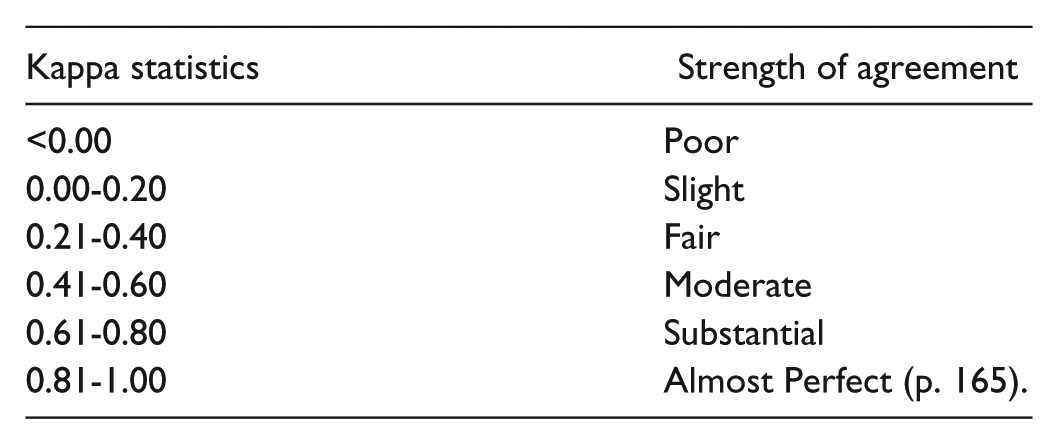
In the first three pages of the search results, there were 60 videos. Out of 60 videos, 59 were evaluated because one repeated video was not included in the final data set. There were coding disagreements between the first rater and second rater for nine of the 59 videos. For these nine videos, a third coder’s opinion was obtained. Based on the third coder’s opinion, the coding was decided and the final coding set was generated. The initial interrater reliability, determined by computing Cohen’s (1960) kappa coefficient, was 0.80 for the content of the videos, 0.86 for the cover (thumbnail) image of the videos, and 0.89 for the title of the videos. The following information provided by Landis and Koch (1977) shows the interpretation of kappa values:
The content coding of the YouTube videos on public education is reported in Figure 1, the cover image coding of the YouTube videos on public education is reported in Figure 2, and the title coding of the YouTube videos on public education is reported in the Figure 3.

The content coding of the YouTube videos on public education.

The cover image coding of the YouTube videos on public education.

The title coding of the YouTube videos on public education.
Discussion
The results show that a majority of the selected videos examined in this study presented public education negatively. A substantial amount of these videos contained blunt attacks on public education. The following video titles provide clues about the nature of these attacks: “Planned Failure: Why No Amount of Money Can Fix Public Education,” “Abolish Public Education: Privatize All Schools,” “How Public Education Controls Your Perception—Mind Control,” “The Truth About Public Education! (A Systemic Destruction of Human Ingenuity),” “Public ‘Education’ Has Become Indoctrination and Distraction,” “Against Public Education,” “Common Core: UN Agenda 21, Communitarianism & The Public Education Plan to Destroy America.” Many of these videos claim that public education is a tool created by the government and is used to indoctrinate people. Such videos also emphasized that there is no hope for public education due to its inherently evil and malevolent design that destroys the country and human creativity. The severe negativity of such videos continues to pose barriers for teachers and public education overall.
It is worth noting that because of its appeal to young generations, YouTube has a significant and unique effect on epistemology of youth. I argue that YouTube affects the students’ epistemology through personalization of the experience. Consider a brief discussion of epistemology. Epistemology deals with “the relationship between knower and the known” and “is concerned with what counts as legitimate knowledge and what can be known. ‘Epistemology’ is defined not only as ‘theories of knowledge’ but also as ‘theories of knowledge production’” (Letherby, 2003, p. 5). Alistair Campbell (2006) claimed it is really not the case that the type of knowledge obtained through empirical/experimental evidence is placed on the top of the hierarchy of knowledge, and the type of knowledge obtained from personal experiences is placed the bottom of the hierarchy. Therefore, misinformation present in YouTube videos about public education might be perceived as legitimate knowledge for some viewers. This is because watching videos might appear more personal than reading articles written about this subject. Because of this personal nature of videos, information (or misinformation, for that matter) provided by such videos might be considered facts rather than opinions by some viewers. It should also be noted that because of the widespread use of YouTube in school systems, YouTube might be seen as semilegitimate source of information for many students. If a person is exposed to YouTube as a legitimate informational platform in a school setting, videos that one might encounter outside of school settings might be perceived by some as credible. The theory of the social construction of reality is helpful in explaining this point. This theory poses a question as to whether there is a reality independent from us. It claims that subjective experiences become internalized and become “objective facts” constructed through social interactions. Thus, a social constructivist would state, our understanding of the world around us arises from the social interactions (Jones, 2013), not from isolated, independent facts. Subjective experiences or explanations of the factual world are eventually forgotten with time and become “objective facts” (Jones, 2013). In this current research study, such experiences or interactions refer to virtual interactions that take place on YouTube. People not only watch videos but also have a chance to participate in a public debate regarding the specific video content. These virtual interactions play a role in the formation of the reality in society with regard to public education. It appears that frequently repeated, heavily one-sided, opinionated ideas overwhelm the public discourse about public education and then it is plausible to suggest that such biased ideas are treated as if they are “facts” rather than opinions. Therefore, YouTube is not only an Internet platform to share and watch videos but also possibly the one of the most influential platforms in which young generation’s epistemology is being shaped. Patricia Lange reminds us that anybody who is doubtful about the importance of online expression and the power of social media on public discourse should remember the role of social media in the U.S. presidential elections of 2008 and 2012 (Lange, 2014).
The logic behind YouTube’s selection and elimination of the videos on the search results or on the suggested video list is a mystery. A quick look at any search result on YouTube will reveal that the number of hits does not always accurately reflect the highest ranking videos. Therefore, it is not clear why certain videos are selected and provided a high rank on the search results and why certain videos are eliminated from such results. The impact of this selection fits well with the framework provided by the theory of Internet information gatekeepers (Laidlaw, 2010). Internet gatekeepers, in this case YouTube (more precisely the algorithm used by YouTube), shape the public discourse by the selection and elimination of certain videos. This may lead to unfairly structured virtual public discussions. Most people may think that when an algorithm is used for a ranking or selection, it cannot be biased. However, it is worth noting that “algorithm bias” exists and algorithms are only as unbiased as the persons who are writing them. Not making algorithms available to the public limits the ways in which we explore the extent of the bias embedded in the algorithm.
Applying pressure on YouTube, and other virtual platforms, to utilize a more fair methodology (or algorithm) for public discourse is only one side of the story. The other side, which is even more important, is to educate the public, especially students, about critical literacy. What is the evidence for the claims made in this video? Does the evidence presented in the video make sense? Could the evidence provided in the video be verified? What are the ways to look for the legitimacy of the claims made in this video? Whom these claims serve? Whose perspective is included/promoted and excluded/demonized in this video? Who are victims of the claims made in this video? Who or which group is disregarded in this video? Who or which group is behind the production and the promotion of this video? Are these people or groups connected to certain political movements? Is the language used in this video biased? Are there logical responses which can be used to counter the claims made in this video? Some of the questions mentioned above were formed in light of the work of Ginette D. Roberge (2013).
Another important aspect of this discussion is how the people involved in public education might engage in these discussions and provide their experience and understanding related to the issues presented. Because some of the debate on public education takes place on social media sites such as YouTube, the perspective of the education workforce would provide a valuable contribution to the discussion. Teacher education departments in higher education institutions should focus more on teaching critical thinking, critical literacy skills, and different ways of being advocates for public education.
Wherever the discussion on public education is taking place, the public educators need to be more visible in such platforms. Public educators regularly and frequently need to take the pulse of what is happening in YouTube discussions of public education. Teacher education programs should not only focus on teaching best teaching practices but also the effective ways in which public educators can advocate for public education. The achievements made through public education need to be covered widely in social media including YouTube. The attacks on public education cannot simply be labeled as absurd and thus, dismissed. Educators should not only take the criticism directed at public education seriously but also address these criticisms with well-articulated, creative answers, focusing on the significance of public education in a free society. The idea of free and democratic society cannot be separated from the idea of providing education for all people who may not be privileged to have fair opportunities compared with the ones who are privileged. Public education should not only be practiced but also advocated.
Footnotes
Declaration of Conflicting Interests
The author(s) declared no potential conflicts of interest with respect to the research, authorship, and/or publication of this article.
Funding
The author(s) received no financial support for the research, authorship, and/or publication of this article.
