




Abstract
This article explores issues related to science, technology, engineering, and mathematics (STEM), participation and underrepresentation specifically in regard to women of African descent. Drawing from a larger qualitative, grounded case study, the article examines the experiences of Panamanian Afro Caribbean women in STEM and their successful navigation of race and gender barriers related to education and employment in STEM. Ogbu and Banks are used to inform the discussion regarding the formation of group identity. Data were collected and triangulated by interviews, surveys, observations, and documents. The findings revealed that socio-cultural values and strategies from their Caribbean community provided the support needed to build a positive self-identity. In addition, middle-class values that included educational attainment and hard work further supported their persistence through STEM education and their participation in STEM careers. A new model, the Self-Actualization Model (SAM), emerged as graphic representation for presenting the findings.
Historically, women have faced systematic barriers with regard to their participation in science, technology, engineering, and mathematics (STEM) education and careers. In the United States, there still remains the belief that women do not possess the intelligence to be successful in science and math subjects (Good, Aronson, & Harder, 2008; Gornick, 1990). Furthermore, the belief that Blacks are less intelligent creates barriers to access (McGrady & Reynolds, 2013; Smith, 1990; Tettegah, 1996). This serves to perpetuate the underrepresentation of Blacks in STEM education and careers (Hill, Corbett, & Rose, 2010; National Academy of Sciences, 2007; National Science Foundation [NSF], 2013).
The study addresses the following question:
Understanding how these women successfully maneuvered through these hegemonic and misogynistic systems may lead to supportive strategies for all women of African descent who are presently underrepresented in STEM. These women not only participated in STEM but also rose to leadership and management positions in their respective fields.
Fries-Britt, Mwangi, and Peralta (2014) assert that racial and ethnic identities are formulated from one’s home country, and their unique construction regarding race/ethnic identification affects individual and group identity. This study argues that socio-cultural factors and beliefs form the self-identity of the women, and this influenced their tenacity toward their STEM vocation. It does not rely on a science identity model for women of color because (even within those models) the authors conclude that further research is needed to understand why students engage in those specific identity behaviors (Carlone & Johnson, 2007). Borrowing from the works of Ogbu (1978, 1992, 2008) and Banks (2004), a theoretical framework on identity is proposed to understand the construction of group or collective identity but not to assert that group identity formation are the same for Afro Caribbean and African Americans; they are not.
This study relies on ethnic and cultural markers to define the term Black rather than relying on racial constructs. It therefore uses the terms Black women and women of African descent interchangeably. Race constructs attempt to create social structures that provide privilege for those who possess comparatively lighter skin (Burton, Bonilla-Silva, Ray, Buckelew, & Freeman, 2010; Machery & Faucher, 2005). Based on these constructs, those who are defined as Black experience the limitations in their educational attainment, occupational attainment, and social mobility (Coleman, 1988; Reid, 1938; Wilson, 1987).
Furthermore, critical race theory (CRT) will be used as a lens for data analysis. “CRT is a framework that can be used to theorize, examine and challenge the ways race and racism implicitly and explicitly impact on social structures, practices and discourses” (Yosso, 2005, p. 70). The text considers Collins’s (2000) critical social theory to interrogate the ways in which identity that is prescribed by others serve to define those of African descent. From the experiences of these Afro Caribbean women, insights are gleaned into the specific challenges that exist for women of African descent.
STEM careers are lucrative and tend to include high salaries and economic opportunities (Ong, 2011; Saxenian, 1999). Using the STEM Occupation Classification, STEM careers include all those employed in computer, mathematics, engineering, life science, physical science, and social science. STEM-related occupations include health care professionals, architects, and technicians to name a few (Landivar, 2013). Furthermore, Sadler, Sonnert, Hazari, and Tai (2012) use a survey to assess the responses of those in STEM and their direct support to students to interrogate the gender inequities in STEM. They classify STEM workers as those with research and expertise in science (i.e., biologist, engineers); they include scientists and science teachers because of their STEM knowledge and direct influence in supporting students through STEM pipelines.
In this study, I will use STEM with this broad definition to include all those in science, technology/computer science, engineering, mathematics, health professions, and those teachers who specifically teach science and influence those who aspire a STEM career.
Review of the Literature
There has been a steady increase in the representation of women in STEM since the 1970s, nonetheless women only occupy 26% of STEM jobs, and men hold 74% (Landivar, 2013). The NSF (2013) reported that although gender continues to be an issue for STEM membership, disparity continues in racial classification as well. The findings revealed that in 2010, White males represented 51% of all science and engineering jobs, and White women represented 18%. This indicates that Whites represent 69% of all STEM jobs and represent 63.6% of the U.S. population. Asians had a combined gender membership of 18% in STEM, although they are 5% of the population (for this reason, they are not classified as underrepresented in STEM). Blacks are 12% of the population but only 5% of STEM members.
The pattern of underrepresentation is especially disheartening when focused on Black women, or women of African descent. Although these women are 6% of the total Black population in the United States, they held only 2% of science and engineering jobs. This is a significant underrepresentation in gender as well as race (NSF, 2013).
In 2005, 40% of all full-time faculty in colleges and universities in the United States were women (McNeely & Vlaicu, 2010). However, of the 7,000 computer science doctoral faculty in 2006, only 60 were reported as African American women. Also, less than 1% of the 17,150 postsecondary teachers in engineering were African American women. African American women appeared to fare only slightly better in the biological sciences holding 380 out of 25,000 faculty positions (Hill et al., 2010). There remains a gap between women of African descent and the remaining tenured faculty.
However, the data cited does not differentiate African Americans from foreign-born Blacks. Therefore, it may be the case that the numbers cited do not solely represent the percentage of African Americans present in STEM in comparison with foreign-born members of African descent. Instead, these statistics may be representative of all Black women inclusive of immigrants employed in STEM careers within the United States (i.e., Afro Caribbeans and Africans).
Harvard University admissions data reported that of the 530 Black undergraduates enrolled in 2003-2004, only 180 were not foreign-born. This reflected an increase in the population of African and West Indians on their campus (Roach, 2005). This challenges Affirmative Action assumptions regarding access and diversity among African Americans or Native Born Blacks. Diversity on such campuses may have increased for those of African descent, but there is not a significant increase among the African American community. What seems to be emerging is a pattern of inclusion in STEM educational pathways and careers among foreign-born Blacks from the Afro Caribbean immigrant population (Glenn, 2007).
Although literature continues to highlight the underrepresentation of African American and Hispanic females in STEM, there remains a gap. Literature has not considered the inclusion of immigrant women in STEM who are of African descent and Hispanic. This population is racialized as Black and experience similar struggles for inclusion as African American women (Burton et al., 2010; Fries-Britt et al., 2014; Quiros & Dawson, 2013).
The term Hispanic is not a racial term but an ethnic one, and therefore, a female may be of African descent and of Hispanic heritage; it means they speak fluent Spanish and are acculturated in the Hispanic culture (Quiros & Dawson, 2013; Tatum, 1997). The racialization rooted in American society and the emphasis on race is often unfamiliar to Black immigrants because their racial identity is shaped from a country other than the United States (Fries-Britt et al., 2014). In many of the countries that Black immigrants arrive, identity is shaped by ethnicity rather than race.
Afro Caribbean Immigrants
Afro Caribbeans are the largest Black immigrant population in the United States, comprising 9% of the overall immigrant population (McCabe, 2011). Of this number, about 8% are from Spanish-speaking countries, including the Dominican Republic, Mexico, Panama, and Cuba. With regard to Panama, one third of those who immigrated to the United States in 2005 self-identified as Black (Kent, 2007). Furthermore, Panamanians have the highest reported educated adults or those with at least a bachelor’s degree at the time of emigration (Stoney & Batalova, 2013).
Tseng (2006) found that first-, second-, and third-generation immigrants who were European, African, Afro Caribbean, Asian, and Latin American entered math and science fields at similar rates. However, in the second and third generation, students from each ethnic group showed a significant decrease in selecting math and science fields of study. Thus, the more assimilated the immigrant population becomes in the American educational system, the greater the likelihood that they will abandon the pursuit of STEM-related subjects and careers (Tseng, 2006).
One concern is the ways in which the educational system begins to marginalize students based on skin color once they become assimilated into American culture. This may result in a disparity between new immigrants and those who may look and sound like African Americans. For the second generation and those who arrived in the United States very young, there is pressure from their African American peers to conform in speech and behavior (Woldemikael, 1989). In addition, because Afro Caribbeans share the same racial classification as African Americans, they are vulnerable to the same forms of racial discrimination (Rogers, 2006).
Afro Caribbean women in particular have a long history of STEM participation as nurses in the United States (Clarke & Riviere, 1989). In contrast to the findings in the underrepresentation of Blacks in STEM careers, Afro Caribbean women from Panama have navigated STEM education successfully and advanced into STEM career pathways. Afro Caribbean women were the highest earners when compared with African Americans and African, French, and Spanish immigrants of African descent (Corra & Kimuna, 2009). This earning advantage could be due to their career choice in STEM-related fields. However, the careers were not disaggregated. Nevertheless, Afro Caribbean women seem to be realizing greater success in some areas of STEM (i.e., nurses and other health professions). Furthermore, when compared with African Americans, Afro Caribbean immigrants had higher household incomes and were more likely to own their own homes and to have completed at least a college degree (Manuel, Taylor, & Jackson, 2012).
Theoretical Framework
Collective Identity
To explain the racialized structure in the United States that many Black immigrants encounter, I draw on the work of John Ogbu, a researcher and Black immigrant to the United States. John Ogbu (1978, 1992) argues that social structures are designed to privilege one group (high caste), while others are assigned to service-level castes (low caste). He explains that in the United States, those who are characterized as the dominant class, or high caste, are of European decent or Caucasians. Those who are characterized as minorities or are non-White are often relegated to low-caste status. Ogbu (1978, 1992) identifies two groups with regard to minority status: involuntary and voluntary minorities. Involuntary minorities are those who were subjugated against their will. According to Ogbu, U.S. involuntary minorities include African Americans, Native Americans, and Hispanics of the Southwest. They are tasked with learning the language and culture of the dominant group to assimilate. Furthermore, this assimilation into the dominant culture system is often necessary to participate in the socio-cultural structure; however, the dominant group is not compelled to learn the culture or language of the involuntary minority group (Ogbu, 1978, 2008).
Conversely, voluntary minorities moved from their home country to the host country by choice. They are able to leave of their own volition and select another host country at will (Ogbu, 1978; Rogers, 2006). They often believe that stereotypes imposed by the dominant culture do not necessarily include them (Waters, 1999).
Voluntary minorities to the United States who are of African descent often do not share a history that includes a hegemonic structure that perpetuates a low-caste involuntary minority identity. Collective identity (Ogbu, 2008) is shaped by the socio-cultural structures that constrain agency (Hays, 1994). Collective identity is ultimately expressed in the form of the beliefs, feelings, and cultural symbols that inform a shared sense of belonging. Afro Caribbeans began as slaves or involuntary minorities in their island homes. However, during and after slavery, they took advantage of economic opportunities to create better educational and economic outcomes for future generations (Klein, 1986; Newton, 2004). These opportunities provided for their movement in class status through economic and educational attainment within the Caribbean social system (Beckles, 1999; Klein, 1986).
Social Structure and Identity Construction
Weber (1994) describes class as any group of persons who occupy the same situation. He describes two class structures: the property class and the acquisition class. The property class owns property, and has political control and access to resources. These resources include the ability to take advantage of educational opportunities for themselves and their children. In contrast, the acquisition class does not possess the advantages of the property class. Instead, they use opportunities to acquire the services and goods that are available to the property class.
Acquiring an education is valued by the property class. By extension, due to their persistence for education, it appears that Afro Caribbean immigrants are striving for membership in the property class. Although some Afro Caribbean immigrants may not have the economic wealth to be proper members of the property class, it appears they adopt the behaviors and values of the property class to move out of the acquisition class.
Class and caste membership structures are a reflection of the social structure (Ogbu, 1978; Rothstein, 2004; Wilson, 1987). The U.S. social structure appears to support Whites as the primary members of the property class, or dominant group. It also distinguishes African Americans from Afro Caribbeans and other immigrants of African descent who are Black because of the ways in which the hegemonic structure served to constrain the African American population.
After slavery, Jim Crow laws determined where Black Americans could eat, shop, walk, and live. These laws imposed a structure that confined Black Americans to a low-caste, second-class citizenship. This hegemonic structure defined the boundaries and social movement. Thus, “Blacks did not become over-represented in the lower class in America because their genetic make-up was inferior, but because they were enslaved, then segregated and barred from equal opportunity for more than another century” (Rothstein, 2004, p. 17). At its foundation, this structure was designed to ensure that those of African descent, who were brought to the country as involuntary minorities, were assigned to the low caste. In contrast, Afro Caribbeans who entered the United States as voluntary minorities personified a collective identity exempt of the confines of the class membership that African Americans fought to resist (Rothstein, 2004; Thernstrom & Thernstrom, 1997).
To further articulate the conundrum for African Americans, James Banks (2004) identifies typologies that have affected African American collective identity. The goal of Banks’ typologies is ultimately to support the individual so that the result will be an increase in self-esteem that produces positive academic performance. He identifies five stages of cultural identity typologies.
The first stage is cultural psychological captivity. The individuals possess internalized negative stereotypes and beliefs about their cultural group. As a result, they express self-rejection and self-hatred. The second stage is cultural encapsulation. Individuals participate in limited interactions with their cultural group. They may choose to isolate themselves from their culture and community group. The third stage is cultural identity clarification. Individuals develop positive attitudes toward their cultural group. The fourth stage is biculturalism. Individuals develop a healthy sense of cultural identity and psychological characteristics that support successful participation in their own cultural community, as well as in others. The final stage is multiculturalism. Individuals who have developed a healthy sense of their own cultural identity are now empowered to participate in the global community (Banks, 1997, 2004).
Banks (2004) asserts that the five stages may not be linear. There may be times when an individual may return to a stage that he or she had previously mastered. He ultimately promotes a multicultural curriculum in which African Americans can see themselves positively portrayed and achieve academic success.
Several important implications emerge from the assertions made by Ogbu (1978, 1992, 2008) and Banks (1997, 2004), as well as the empirical evidence from the literature. Both agree that history and hegemony affect individual identity development that may lead to a collective identity. Ogbu explains that as involuntary minorities, African Americans have made social resolutions that affect their identity to resist the low-caste membership (i.e., changes in speech and language). The resistance to the hegemonic structure has resulted in identity fragmentation that is exhibited in Banks’ typologies.
In contrast, identity for Afro Caribbeans as voluntary minorities to the United States is reflected in their choice to enter and submit to the hegemonic system and structure. Their decision to enter such systems is rooted in the belief that inclusion will produce greater access to occupational and educational opportunities that will serve to benefit future generations (Mortimer & Bryce-Laporte, 1981). From Banks’ typologies, Afro Caribbeans may be considered in Stage 4, biculturalism. They participate in the culture of the United States while still maintaining their Caribbean culture (Waters, 1999). It is from this socio-cultural system and collective identity that their persistence in STEM education and careers gains its potency.
Significance of the Study
As a result of slavery and colonization, there are differences in culture and identity formation for Afro Caribbeans and African Americans with regard to work that affects their access and inclusion to STEM careers (Waters, 1999). Research has not unpacked the strategies of persistence of Afro Caribbean females in STEM. It is essential to be cognizant of their strategies to encourage all females of African descent in their pursuance of STEM careers. The goal of this study is to expound on the cultural identity characteristics and strategies that will support STEM education training and subsequent careers for underrepresented populations.
Method
This study is drawn from a larger qualitative case study. In case study research, the issue is explored through one or more cases within a bounded system (Creswell, 2007). The data sources for a case study may include observations, interviews, or reports and documents (Creswell, 2007).
The selected qualitative approach is the most beneficial way to address my research question and exploration of the experiences of how this group of Afro Caribbean women from the country of Panama navigated the barriers of race and gender that often limit access to STEM careers. Using a case study approach allowed for the exploration of the lived experiences of this particular group of Afro Caribbean women. My goal was to better understand the strategies that enabled these women to persist in their STEM training and participate in their STEM career. The selected case study approach affords the opportunity to focus on this small group, to thickly describe their reported strategies, and to see what concepts and theories emerge from the data.
Participants
Five Afro Caribbean women from Panama were selected for the study. Panamanian women were selected because of the historical relationship their families had with White Americans in the building of the Panama Canal. New York City was selected because it is a major city of entry for all immigrants in general and Afro Caribbeans in particular (Advincula, 2007). It is one of the cities with the largest Afro Caribbean populations (McCabe, 2011). Participants were recruited from members in the Afro Caribbean community through churches, schools, and neighborhood hospitals. A purposive sample (Bogdan & Biklen, 2007; Creswell, 2007; Lincoln & Guba, 1985) was determined to best meet the needs of this research. All participants were from a specific immigrant population representing a specific community in the United States with information and strategies to amass an understanding of the research question that would lead to a grounded theory design analysis (Lincoln & Guba, 1985). Three selection criteria for the purposive sample were used.
The first criterion was that the women had to be currently or previously employed in a STEM career. STEM careers were defined by the STEM Occupation Classification list of the NSF to include science teachers, nurses, and psychologists (Landivar, 2013). The second criterion for selection was the participants had to verify that their parents or grandparents had voluntarily immigrated to Panama from varying Caribbean islands to work on the Panama Canal building project with the American government.
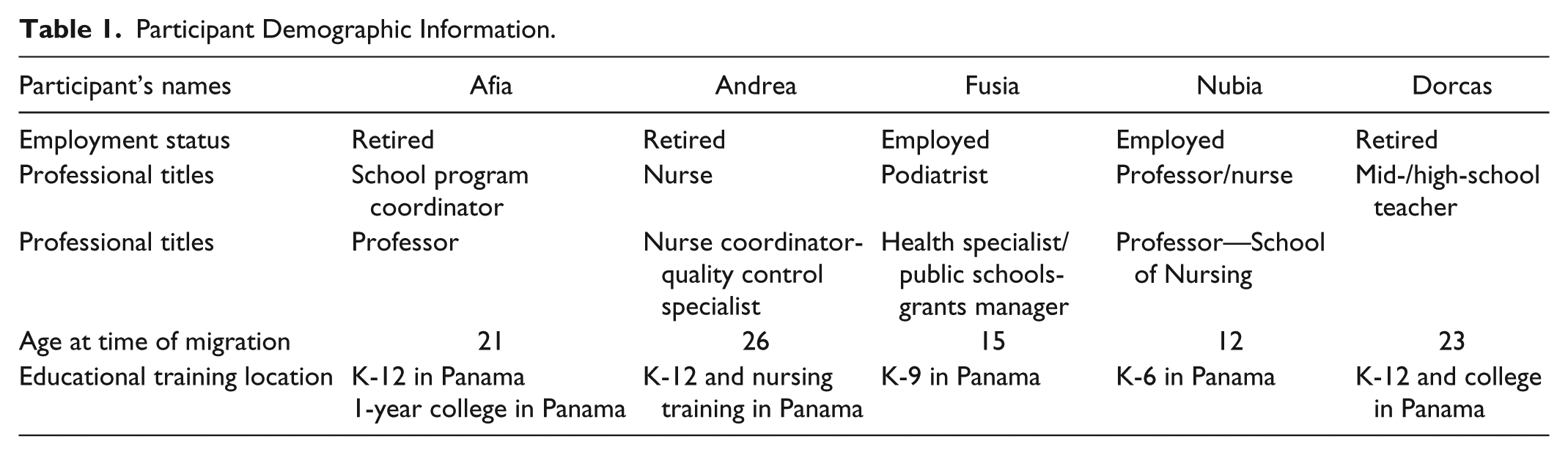
Each of the study participants had voluntarily migrated to the United States from Panama between 1965 and 1975. All participants were bilingual speaking both English and Spanish, and were born in the Central American country of Panama. They lived either in Colon, the port city of entry for Caribbeans, or in Panama City. Participants selected their own pseudonyms for the study as shown in Table 1.
Participant Demographic Information.
Data Sources
Interviews
In qualitative research, knowledge is produced through social interactions (Kvale & Brinkmann, 2009). In this process, an interview is “an interchange of views between two persons conversing about a common theme” (Kvale, 1996, p. 44). Interviews were conducted individually in a location agreed on by the researcher and participant. The interviews were at their homes, restaurants, or work places. There were over 50 open-ended interview and probing questions used throughout the individual interviews. The interviews lasted 5 to 8 hr over 3 days. The questions focused on (a) the socio-cultural elements of Afro Caribbean identity, (b) strategies and skills from their culture that enabled them to negotiate the barriers in STEM education and careers, (c) strategies and skills from their experiences that can be used to inform work with other females of African descent.
Demographic survey
The survey was emailed to those participants who were presently employed; it was given in person to those who were retired and were traveling between the United States and Panama at the time of the inquiry. The protocol for writing this survey was taken from several sources. I drew on LeCompte and Preissle’s (1993) description of a confirmation survey, which uses structured questions to gather key information. The questions were closed and quantifiable (Marshall & Rossman, 1989). The survey also included nominal questions about age, school attendance, and college major and degree (LeCompte & Preissle, 1993). Table 1 presents this information.
Field notes and observations
I used an ethnographic approach to data collection through fieldnotes, which included jottings, headnotes, and memos (Emerson, Fretz, & Shaw, 1995; Mason, 1996; Schatzman & Strauss, 1973). I employed two forms of fieldnotes: key word jottings and whole text jottings (LeCompte & Preissle, 1993). For participants who were presently employed, I visited their work sites and observed them in situ. I recorded over 8 hr of observations per participant. I typed memo journals after each interaction with each participant, which included the date, the participant pseudonym as per the Institutional Review Board, and a brief overview of the interaction from my perspective as the researcher (Emerson et al., 1995; Schatzman & Strauss, 1973).
Data Analysis
Data were triangulated using open-ended interview questions, fieldnotes and observations, the qualitative survey, and documents (Emerson et al., 1995; Kvale & Brinkmann, 1996; LeCompte & Preissle, 1993; Patton, 1980; Schatzman & Strauss, 1973). The documents were derived from public sources. It consisted of recognitions and awards attesting to the participants’ level of work-related success. All interviews were personally transcribed and coded by the researcher (Lincoln & Guba, 1985; Schatzman & Strauss, 1973; Strauss & Corbin, 1990). The preferred language of the participants was respected, and translations are provided where necessary (Myers-Scotton, 2006).
The study employed a grounded theory approach, and the procedures and protocol for such a design (Strauss & Corbin, 1990). Data analysis began from the time of initial collection or interviews, and categories were developed from constant comparisons derived from the theoretical memos written by the researcher. Categories were formulated based on emerging themes resulting from open coding, axial and selective coding (Strauss & Corbin, 1990). Constant comparisons included comparing incidences, stories, and descriptions that were grouped and then structured into the model for clarity (Lincoln & Guba, 1985). Furthermore, I contacted all participants for member checking to ensure that they were in agreement with my analyses (Glesne, 2006; Lincoln & Guba, 1985).
Research Findings
The analysis of the emergent themes contributed to the STEM Attainment Model (SAM; see Figure 1) as a graphic representation of the data. The SAM model emerged from evidence of the strategies that helped them navigate race and gender barriers to enter their STEM career. The model consists of five levels. The discussion, which follows, begins with the base of the model and progresses upward. There is a hierarchical structure, with the base having the foundational elements that are needed for the upper levels to build on.

STEM attainment model.
Strong Family-of-Origin and Male Presence
Understading the influence each family had in the participats’ career choices was a concern of the study. This proved tobe a major factor for the women and forms the base of the SM model. What emerged from their narratives were continuous references to family members who supported and made intentional investments in their lives. Family members were concerned about their positive development and supported their hopes and dreams. However, this circumstance did not mean that the parents or caretakers were educated (Afia’s grandmother was illiterate), or had all the social and financial means needed to support the women. Nevertheless, they used what cultural and social assets (i.e., capital) they had to invest in the lives of these women.
There was great interaction with family members in the home and with extended family. Andrea reported that “Colon only had 16 streets . . . everybody knew each other.” This small community provided parameters for the women. They knew that others were watching and would report to their families. The influence of family will be reflected in subsequent narratives.
Four of the five participants described their families’ as “poor.” However, in discussing this notion of poverty, the women agreed that it was relative to the situation.
We were poor, but we never saw ourselves as poor, we ate every day, nobody ever came and cut off our lights, nobody ever came and removed a piece of our furniture because it wasn’t paid for. (Andrea)
“Poor” implied the families lacked economic resources, and educational attainment was made through financial sacrifices by the families.
In concert with these findings, the women all identified and valued the presence of a male authority figure in their home. For example, Andrea in speaking about her self-confidence credits her father saying, “My father was a very strong believer in himself.” The males in the household also apparently interacted with their daughters and transferred values and principles to them. Dorcas offered in this regard, “We always had a book shelf . . . my father always brought books home.” Andrea also shared that her father did not allow his daughters to read romance novels or comics but only literature from reputable writers. By guiding the printed reading material their daughters were exposed to, these fathers influenced their learning outcomes.
These fathers also helped with the process of education. Nubia shared that at noon when her father arrived home for his lunch, each child would have to share their lessons from school (the children also came home for lunch). She remembered, “If we were having a problem we told him . . . he said, OK, if I don’t have an answer by tonight, I will bring somebody that has the answer.” Again, all participants lived with a male in the home whether he was their father or grandfather or both. In cases where they were from single-parent mothers, these mothers lived in their parents’ home with their child, thus exposing the child to the grandfather/father.
Strong Cultural Identity
Strength in their cultural identity was a second factor and is the second level in SAM. This emerged as the second tier because it stems from the values transmitted from the family of origin. All the women affirmed that they identified themselves primarily by phenotype or ethnic markers (i.e., Black, Black Panamanian, Black Hispanic, Jamaican Panamanian, and African American [as in from the Americas]).
The term Black referred only to their skin color. Fusia states that as a Hispanic Panamanian, “Black has to do with the color of my skin . . . but my culture will be one influenced by the Spanish culture, heritage and beliefs.” Afia self-identified as Black because, “it’s the first thing people see is this” (she points to her arm indicating the skin color).
The women described instances when the term Black was seen as exclusively for African American to the exclusion of themselves. Dorcas’s explained that she corrected her Hispanic students when they tried to tell her that she was not Black, meaning she was not African American because she spoke Spanish and was from Central America. Sometimes they too were of African descent but did not consider themselves Black. The term Black, in their minds, was reserved for African Americans. She remembered, “They would say, ‘pero maestra [but teacher], you are not Black.’ I tell them, ‘No, you are Black too.’”
This problem was exacerbated when she found that even the White teachers at the school where she taught biology identified her as other than Black. They reserved the term Black for African Americans only.
They would tell me, “You are different” . . . I would say, “What are you talking about?” . . . “Different from American Blacks” . . . I said, “No, Black is Black no matter what” . . . They would say, “You have an accent” . . . I said, “You do too . . . why do you criticize the ones that came from the South with their accent? Their accent is like the children’s [African American students’] accent.” (Dorcas)
Dorcas found that not only Black immigrants but also White Americans reserved the term Black for African Americans, while categorizing Black immigrants by their ethnicity (i.e., Jamaican, West Indian, and African). Afia explained that this strategy to separate Black immigrants from African Americans is used as a tactic to divide those of African descent.
I see “African American” in the broader sense . . . when the cop stops you he’s not identifying your accent, but your race. I think the business of saying, “Those people from America” is a divide and conquer strategy because ultimately you are Black. (Afia)
The women in the study were taught about the founding Black leaders such as Marcus Garvey (Jamaican) and the Pan-African movement (Crawford, 2004), as well as Stokely Carmichael’s (Trinidadian) Black Power Movement (Carmichael, 1971). Afia describes her family by saying, “Those people were all Garveyites . . . those people who were conscious.” Garvey made a tremendous impact on the Caribbean community. Similarly, Dorcas in response to the Jewish teachers attempting to create a wedge between her and her African American colleagues responded with a quote from Carmichael: “Black is Black no matter what.”
The collective identity of these Afro Caribbean women seemed to be grounded in cultural roots that was shaped in a Black identity constructed by other Blacks and not by members of the dominant group.
Banks (2004) explains the importance of this by stating that interaction with Whites in American society has produced levels of dysfunction in the African American community resulting in some individuals being in a state of psychological captivity. Conversely, for Afro Caribbeans, their apparent inoculation against some of the psychological dysfunction may be attributed to the fact that they are historically from islands or communities in which they were the majority. Nubia, for example, recognized that there was a psychological difference between herself and her African American counterpart. African American women had survived a social system that used fear to keep Blacks in their caste through “images of lynchings” and “‘Whites only’ signs,” thus maintaining the hegemonic structures of caste and class.
I wasn’t raised in the U.S.; I wasn’t raised under a Jim Crow experience. I don’t have those images in my head . . . That’s not part of my psyche. I think I was telling him [referring to her husband], I was recounting an issue that I had with a policeman in Brooklyn, New York. I refused to move. And he told me that I had to move, and I told him no, I was not moving . . . and there were quite a lot of people around me . . . and I told him that he needed to move because he was on the wrong side of the steps . . . He said, “I’m a police officer.” And I said, “I’m not moving” . . . My husband said, “No other Black person in America would have done that” . . . He said, “You just don’t do that, you don’t buck the system” . . . I did not see him [the police officer] as White versus Black, I saw him as violating a basic rule, courtesy. (Nubia)
The absence of the negative mental images and fears instilled by White authorities allowed Nubia to question the officer who happened to be violating the rules of the subway. She was confident enough to challenge his discourteous behavior in spite of his skin color and position.
Andrea also challenged the belief of her sister who was complaining that “people made her feel less than.” She offered, “‘They make’ . . . and I come away with what I KNOW and I BELIEVE and if I believe what ‘they’ say. It’s not, ‘they made me.’ It’s because I believed it.” This is a powerful statement about her self-identity and self-affirmation. Her response further reflects the choice she made in negating the hegemonic structures that attempt to define and limit her racial membership.
Transferable Values, Strategies, and Skills
Transferable values and strategies was the next level of STEM Attainment that emerged from the data. This was derived during the analysis by constantly comparing the stories and the words used to describe the values and the skills deemed important to the women. By the term transferable values, I mean values or skills that were conveyed verbally and nonverbally by the family and Caribbean community. Four examples were identified:
The first value was commitment to education. All of the women shared that education was valued and its importance instilled by their families. Andrea and Nubia mentioned that they routinely discussed their daily lessons with their parents who were actively involved in the learning process. Dorcas also recounted that as a child, she would attempt to listen to her father and the eruditos [educated men]. She recalled, “They were talking about the war, Dubois, and different Black Americans who were struggling.” Her father and the men gathered around the newspaper to discuss world affairs and specifically those that affected people of African descent.
Second, each of the participants had parents or grandparents who were determinants in their academic success. That is, they worked to establish continuity between home and school values, linguistically and socioeconomically. For example, Fusia’s grandparents sent her to a school that had the reputation for training females whose goal was to attend college. Nubia’s mother and father both attended parent meetings regarding her academic progress. Because there was no program available in Panama, Afia would be allowed to travel to the United States to earn a degree in psychology. All the women learned English for communication in their home and community, and learned Spanish for academic instruction and interactions outside of the Caribbean community.
Literacy was a third value. Being readers and supporting reading and literacy skills was inductively derived from the stories of the women. All of the participants’ male caretakers demonstrated the importance of literacy by either reading to these women or procuring books for them to read. Apparently, these books included substantive literature, as Andrea reported. All of the women shared that they saw the men and some of the women in their homes reading. Literacy was overtly communicated as a value. Nubia’s grandparents were instrumental in her reading in the home. She explained, “I learned English from my grandparents . . . they taught us to read and write English at home . . . you had to read the Bible.”
The fourth notable value was using free time for informal education and skill building. All of the women engaged in extra curricula activities including crocheting, sewing, playing an instrument, and swimming. Afia indicated that her mother took her to the ballet although she did not have the extra income for such luxuries. She recalled, “Some of the family members used to laugh when she took me to the ballet.” These educational enrichment opportunities extended beyond sports to skills that could be used to support themselves. Andrea used her cosmetology skills to earn extra money to pay for college.
These middle-class values and awareness of interactions in a world that is influenced by the dominant White society meant that these women learned the rules and behavior for Caribbean culture, but they also learned dominant culture rules, values, and behavior. These appeared to influence how they behaved and dressed to affect their public image. For example, for our interview at her home, Dorcas was dressed in business casual attire with dress shoes. She said it was inappropriate to wear “pumps” (gym shoes) for our meeting at her home. These standards regarding dress and appearance seemed to help build the overall self-confidence that seemed to exude from each participant.
Self-Confidence
Self-confidence is the next level of SAM. All of the participants noted the importance of believing in self as key to their reaching STEM membership. Fusia agreed stating that the nurturing received from her family served to “build my self-esteem . . . .” Nubia also added, “I think that my mother and father never discouraged me from accomplishing what I wanted to accomplish.”
Perhaps self-confidence was cultivated for these women in part because they were not constantly compared with Whites or any other dominant group. Their parents or grandparents were from nations where they were the majority. These women were able to enact significant self-determination. Their personal success was measured by their perceptions about how they were doing in the United States as compared with the opportunities for advancement they would have experienced in their country-of-origin (Bryce-Laporte, 1972).
Having self-confidence and support of family was demonstrated by Fusia in her response to her school counselor. The counselor tried to encourage her to become a nurse instead of a doctor. Although she followed his advice and took the entry exam for nursing school, she also took the exam for the school of podiatry where she was accepted. She did not want to be limited to the gender stereotype for women in STEM careers.
Hard Work and Perseverance Leads to Opportunity
The next two levels of SAM are valuations of hard work and opportunity. Three of the five women interviewed stated that hard work and perseverance were the reasons for their success in STEM. Dorcas echoed the American work ethic by stating that hard work is a path to becoming “Whatever you want to be.” Andrea seemed to agree with this but added that persistence is also important. She declared, “Believe in yourself, set your goal and make sure everything that you do is something that is going to accomplish that goal.”
These women came from households where all of the males except one were entrepreneurs and had their own businesses in Panama. They had observed their parents or grandparents work. All the women caregivers in their households worked and contributed to the income of the family. Afia affirmed that this was an African value where women are expected to contribute to the economic wellness of the family. She recalled that this was also evidenced in Caribbean societies where men worked in the fields, but Caribbean women went to the marketplaces to sell the produce.
In this social structure, women’s work is important and distinct from the work of men. Even those who were retired continued to be involved through entrepreneurial endeavors or serving on committees both in the United State and in Panama. Andrea, in her work as wife, mother, and Senior Vice President of New York City Health and Hospital Corporation explained, “. . . it almost killed me physically.” Andrea became the first Quality Control Specialist for the hospital systems in New York City because she chose to pursue a certification program beyond her master’s degree. By challenging herself academically, Andrea had the credentials needed when opportunities presented.
STEM Attainment
STEM attainment is the highest level of the SAM. The five participants clearly exemplified all the requisites necessary to reach this final stage. They were employed in or retired from STEM careers. Each participant reported that she had received encouragement from parents, grandparents, and the community that instilled the self-confidence needed to pursue their STEM career.
All of the participants had the distinction of being the first person of African descent to hold their respective positions. This means that, daily, they were challenged with dispelling the myths regarding intelligence and STEM inclusion for women of African descent. Nubia recounted a struggle with her White supervisor when she was the only Black nurse on the day shift at her hospital. This verbal exchange reflected the difficulties of fighting for inclusion: So I am the invisible nurse . . . I was not raised to think that you define me, you don’t define me . . . My father and mother raised me to know who I am and what I am capable of and it doesn’t start with you. (Nubia)
Earlier in this altercation with her supervisor she had asserted, “You do not define me, my parents define me.” From Nubia’s response, we glean that her identity was not determined by the opinions of her White co-workers. It was grounded in an internal belief created by the many conversations and interactions with her family. Often being the first to break the “color barrier” means dispelling myths regarding Blacks. It also can mean absorbing negative interactions while doing the work with an excellence that is not required of others.
Second, for STEM attainment, the women noted the importance of teachers and an educational system that believes in children of African descent. Afia exhorted, “teachers need to know every pupil doesn’t learn the same way.” She further questions the over-inclusion of Black students in special education classes. Rather than embracing a belief based on intellectual differences, Fusia adds that “teachers should be a cheerleader who will mentor Black students and be a good source to . . . take them to the level to achieve that STEM profession.” All of the women believed that the educational system is responsible for the attrition rate of females of African descent in STEM education and careers.
Discussion
The question for this study focused on how Afro Caribbean immigrant women from Panama successfully navigated the barriers through STEM education into their STEM career. From the analysis, what emerged from the narratives of the women was a graphic model reflecting the sources that led to their ability to obviate the barriers due to race and gender. The model began simply as an analytical tool to discuss the data. However, after reflection, what surfaced were strategies and skills that did not develop in isolation. Thus, the need for a closer analysis of the SAM model was imperative.
STEM Access: First Things First
At the foundation of the SAM model is the importance of family and a male presence in the home or life of females. The male presence is important for academic encouragement and support for daughters (Goossen, 2009). When comparing low-income boys and girls living in a home with their fathers or father figure to low-income boys and girls living with mothers only, the group that lived with their father or father figures scored higher on standardized tests (Vandamme, 1985). Saathoff (2015) found that among Mexican and Mexican American families, education included the transmission of family values, morals, and the skills to live in society. There is much research stating that access to STEM requires strong support from parents, teachers, and access to STEM educational programs (Carlone & Johnson, 2007; Russell & Atwater, 2005; Tan & Calabrese Barton, 2008).
However, this study finds that in addition to these factors, there seems to be further elements at work for Afro Caribbeans. These include a cultural identity that is defined by the members of its own community and not constructed by the dominant group. This cultural identity is reflected in their collective identity (Ogbu, 2008). When there is constant comparison to the dominant group, the Black–White binary is strengthened, and Whites are used as the measuring rod for success (Wiggan, 2007). This limits the formation of a collective identity derived from the members of ones’ own group.
The next distinguishing element is the presence of cultural values that include education and its supplemental structures (i.e., literacy, positioning for success skill building). It became evident through these narratives that the parents and guardians’ intentional preparation (i.e., taking them to extra classes and lessons, strategically selecting the schools that will help in the accomplishment of their goals) is an integral component in their success. These values and component structures served to build self-confidence so that the women would work hard and take advantage of opportunities as they presented themselves.
The values and strategies from these families were similar to middle-class families. Middle-class parents were more likely to be concerned with giving their children opportunities and exposures that would provide them with socio-economic advantages (Lareau, 2011). Their children are more likely to engage in dance, music lessons, or sports (Lareau, 2011; Rothstein, 2004). In concert with this, the families of my participants demonstrated that although they did not have the discretionary income to fully participate and provide all that middle-class children may receive, they nevertheless attempted to provide their daughters with middle-class opportunities when they could. They taught them middle-class cultural habits through their exposure to ballet programs, formal cultural events, and dances. They taught them the dress and behaviors expected for these events. Through this informal education, they taught them how to be comfortable in these divergent settings as well as showing support for the academic institutional formal training.
Developing Self-Confidence for STEM Access
Parental support and encouragement are understood to be important aspects of fostering self-confidence, which is key to the success of females in STEM (Rayman & Brett, 1995; Scott & Mallinckrodt, 2005). They managed to avoid a major hindrance for Blacks and females in the United States—specifically accepting the belief that they were less intelligent and less able to succeed in math and science (Wortham, 2006). In the United States, females of African descent, in addition to stereotype threats regarding race, also encounter boundaries based on gender. These threats rooted in gender bias send messages that females are less intelligent in math and science subjects than males (Johnson, 2007). This is apparent when Fusia was being persuaded to be a nurse rather than a doctor. These threats to gender and race affect self-confidence and lead to cultural psychological captivity (Banks, 2004).
The Afro Caribbean collective identity seemed to insulate the women from the systemic preconception of stereotype threats regarding intelligence. Instead, it fostered and supported their desires to excel in arenas that are often designated for Whites only. When challenges arose academically, they did not question their ability, but reported that they used tutors and sought help. This seems to reflect a growth rather than gift-oriented notion of intelligence (Dweck, 2007). Beilock (2010) found that African American college students chose to study alone rather than be perceived as less intelligent by teachers and tutors. This belief system serves to erode self-confidence and increase STEM attrition among Black students. Until cultural identity clarification is reached, individuals are stuck in a structure that accepts self-hatred and self-rejection (Banks, 2004).
STEM Open Doors
Manski’s (1993) theory of endogenous effects states that individuals in a community tend to reproduce what they witness from other members in the system. So as the women saw hard work modeled, and women’s work valued, they imitated this behavior. Waters (1999) found that Afro Caribbeans held differing views regarding work than their African American co-workers. They felt that African Americans often did not take advantage of available work and designated some jobs as beneath them. In contrast, Afro Caribbeans often will take menial positions. They do not perceive these jobs as defining their sense of self. Rather, they are stepping stones to a better position. Afro Caribbeans are stereotyped as working several jobs and taking the ethic of hard work to an extreme. When African Americans were interviewed about the work ethic of Afro Caribbeans, some agreed that they were more hard-working and ambitious (Waters, 1999). Kasinitz (1992) also identified, “In the case of West Indians hard work certainly does play a role, as does a reluctance to take public assistance” (p. 97).
These studies support the supposition that there is a difference in work ethic and beliefs about work for Afro Caribbeans. One reason is minorities immigrate to a country to improve their economic position and gain access to better education for their children (Mortimer & Bryce-Laporte, 1981). A second reason is that Afro Caribbeans have been able to realize tangible benefits from their hard work (i.e., economic wealth, improved social status). This creates ideological differences; Afro Caribbeans have experienced a payoff for their hard work and perseverance. In contrast, African Americans have not always experienced the compensation for their work or educational attainment (Rothstein, 2004).
Ogbu’s (1978) theory of a collective identity is a relevant lens to consciously take note of Afro Caribbean immigrant behavior in STEM. First, as a voluntary minority group, their choice reflects a level of freedom and power. Second, their identity is shaped based on their ability to garner power from their former colonizers. Their ability to effect changes in their social position reflects their sense of agency. However, their identity is rooted in family, community, and country of origin.
Collins (2000) supports the assertions the women make for self-identity. They are proud to be defined by ethnicity and that of those from their own community. Collins (2000) states that, “Self-definition speaks to the power dynamics involved in rejecting externally defined, controlling images of Black womanhood” (p. 114). For collective identity to be one that is reflective of the group, it must be formulated by the members of the group and not by outsiders. This resonates Nubia’s strong cry to her supervisor: “You don’t define me.” She recognized that her self-definition came from her family, community, and country. Collins (2000) adds, “Self is not defined as the increased autonomy gained by separating oneself from others. Instead, self is found in the context of family and community” (p. 113). For those of African descent, self-definition is couched in the context of the family of origin and the ethnic heritage; members recognize and accept their connectivity to the group is the strength that is needed to persist.
Banks (2004) provides another lens to scrutinize the challenges for African American females who aspire to STEM attainment. The hegemonic structure has adversely affected their level of self-confidence. Teachers and institutions must not use comparisons nor explanations that reduce the success of varying social groups to hard work and persistence only. Banks (2004) demonstrates that socio-cultural factors have affected the self-efficacy of members of the African American community.
From a CRT lens, the psychological and emotional persistence that is needed by women of African descent is made clear. Their struggle is not in acquiring the academic skills alone but also in convincing others that they are worthy of an opportunity to acquire such skills. Students of African descent need to feel that those who are guiding their academic progress believe in them and have high expectations of them (Cholewa, Amatea, West-Olatunji & Wright, 2012; Tucker, Dixon, & Griddine, 2010; Wiggan, 2007). Fusia’s decision to defy her school counselor and pursue becoming a doctor is evidence of this.
Yosso (2005) articulates six forms of cultural capital that is used by people of color that is often not recognized. Embedded in each step of the STEM Model, we find these. Five of the six are highlighted. The first is Aspirational capital, which is the hopes and dreams for the future instilled by the family. Each family communicated that they believed and expected the women to succeed.
The second, Linguistic capital, is evident in that all the women were bilingual and saw it as a benefit to have this additional skill. Next was Familial capital, which was observed as the importance of family inclusive of extended family. Many of the women mentioned their grandparents and other relatives being a support to them. Social capital is the emotional support needed to navigate through the hegemonic structures that exist. Finally, Resistant capital was evidence by their ability to fight injustice. We see this through Nubia and the police officer. Black immigrants are exposed to similar incidences of injustice as Native Born Blacks and must fight to challenge the systemic structure.
Conclusion
Too often, females in the United States are sent the message that math and science are male fields of study. Females of African descent are sent messages that math and science are not attainable because of limited intelligence due to racial constructs. Thus, there is an underrepresentation of women of African descent in STEM.
However, the women in this study showed persistence through STEM education to participate in a STEM career. They drew on a collective identity that was not prescribed by the dominant culture. Their identity formulation gave them the needed ability to invalidate the racialized restrictions imposed on their gender and race. The data supports the importance of self-identification, values and strategies from family, as well as community to build self-confidence. From their narratives, all females of African descent can be encouraged in STEM education and careers.
The SAM Model served as a graphic organizational tool that illustrated the resources needed by these women to navigate the barriers of race and gender. Further research is needed to verify if the SAM Model can support the access of all females of African descent in their STEM attainment. This study is limited in that it drew on a small purposive sample of Afro Caribbean Hispanic women. However, it does reveal evidence that identity formation developed from the individuals’ cultural group promotes self-confidence that is needed to persist in STEM.
There is a shortage of STEM workers for U.S. companies in general and a dire need to hire science and math teachers in the 48 of 50 states (Westerlund, Radcliffe, Smith, Lemke, & West, 2011). There is, therefore, an imperative to look at those from underrepresented groups who have gained access to STEM and draw from their toolbox to open access to others. Parents, teachers, and community members are encouraged to acknowledge their important roles and responsibilities in supporting females of African descent into STEM. These females, much like my participants, represent a multitude of untapped potential. In the voice of one of these women, ultimately, “we are scientists, we are artists, we are creators” (Nubia).
Footnotes
Declaration of Conflicting Interests
The author(s) declared no potential conflicts of interest with respect to the research, authorship, and/or publication of this article.
Funding
The author(s) received no financial support for the research, authorship, and/or publication of this article.