




Abstract
Many of the publications on achieving high performance have been written by North American researchers and consultants, and the case companies they described originate mainly from the United States. However, there is a lack of long-term studies that subject the described techniques to rigorous evidence-based management research in North American companies, to test the ideas in practice over a period of time to evaluate their relevance to managerial practice. In this article, we evaluate the high performance organization (HPO) Framework, a scientifically validated technique for helping organizations become high performing, in the North American context. This framework evaluates the strengths and weaknesses of the internal organization of a company, using a questionnaire. This questionnaire was applied in 2013 at seven Swagelok locations in the United States and Canada. From the questionnaire improvement opportunities were identified on which the locations subsequently worked. In 2015, the questionnaire was repeated to evaluate the effects of these improvements on the locations’ performance and to identify the most effective interventions. The study results show that the application of the HPO Framework had different outcomes depending on local circumstances. Some locations experienced a growth while other locations used the framework to battle the consequences of adverse economic circumstances. All locations agreed that the HPO Framework had been instrumental, in a positive way, to the development of their organization and its people.
Keywords
Introduction
Since the 1960s, practitioners and academics alike have become interested in what makes organizations perform better. This “quest for excellence” received a major boost by the work of authors such as Tom Peters and Jim Collins, who wrote bestsellers on high performance (Collins, 2001; Collins & Porras, 1994; Peters & Waterman, 1982). Since their pioneering work, many publications on excellence and high performance have appeared, in which the authors claim that the techniques they propose will help organizations improve their performance. Many of these publications have been written by North American researchers and consultants, and the case companies they described originate mainly from the United States. It is therefore noteworthy that studies that subject these techniques to evidence-based research in North American companies, to evaluate the ideas in practice over a period of time to gauge whether they had sustainable positive effects and thus proving their relevance to managerial practice, seem to be missing (Kieser, Nicolai, & Seidl, 2015; Pfeffer & Sutton, 2006). This is a shame as, after all, time is a scare resource in every organization, and managers are already overwhelmed by a plethora of initiatives. So they need to spend their scarce time and resources on those activities, which with a certain degree of certainty could help them and their organizations forward.
A way to evaluate the effectiveness of an improvement technique, that is, whether it helps increase organizational performance in a significant and sustainable way, is to subject it to a longitudinal study. A longitudinal study can be defined as “research in which data are collected on one or more variables for two or more time periods, thus allowing at least measurement of change and possibly explanation of change” (Menard, 2008, p. 3). With a longitudinal study, one can evaluate whether a technique has a positive and lasting effect over time. However, this type of research is hardly done when evaluating improvement techniques (Camfield & Duvendack, 2014), which is a severe drawback as it turns out that many of these improvement techniques in practice seem to have at most a short-term positive effect (Axson, 2010; Parnell, Dent, O’Regan, & Hughes, 2012). One reason for this lack of longitudinal research is the difficulty researchers often encounter in getting access to an organization for a prolonged period of time, so they can measure effects at various points in time making this “real” longitudinal research (Ployhart & MacKenzie, 2015). An alternative is to perform a pre-test post-test examination of a phenomena, in which the effects of a certain intervention are measured before and after the intervention took place (Eesley & Wang, 2017; van Wingerden, Bakker, & Derks, 2016). This type of research design is less rigorous than longitudinal research because basically only linear change can be measured between two points in time, but it does provide an indication of the effectiveness of the applied improvement technique.
However, even this type of research does not take place often. This is especially true in the case of improvement techniques aimed at creating a high performance organization (HPO). Such an organization is defined as
an organization that achieves financial and non-financial results that are exceedingly better than those of its peer group over a period of time of five years or more, by focusing in a disciplined way on that what really matters to the organization. (de Waal, 2012, p. 5)
Techniques and frameworks that create an HPO hold great promise for organizations and managers, and it is no wonder that this topic has received much attention in the past decades. It is therefore a real shortcoming that there are so few longitudinal evaluation studies, especially since famously many of the HPOs mentioned in the “In Search of Excellence” and “Good to Great” books have either vanished or barely survived, casting great doubts on the validity of the techniques described in these books (Kirby, 2005; Niendorf & Beck, 2008; Resnick & Smunt, 2008; Raynor, Ahmed, & Henderson, 2009).
In this article, we evaluate the workings of the HPO Framework (de Waal, 2012), a technique for helping organizations to become high performing, in the North American context. The effects of this framework, which was developed based on a 10-year study in multiple countries around the world including the United States and Canada, on organizational performance has been so far extensively evaluated in pre-test post-test research. As such the HPO Framework is unique in the world as no other holistic framework (i.e., looking at and encompassing all important facets of an organization) has ever been evaluated in such a rigorous manner. However, the HPO Framework has not been evaluated in detail on its effects on organizational performance in North American organizations. Thus, the research question we attempt to answer in this article is
The study results will add to the extant literature as the effects of de Waal’s HPO framework on organizational performance is studied over time at North American organizations. The study results will show whether and under which circumstances the HPO Framework is an effective tool to analyze and improve organizational performance in the North American context, which is different from the other contexts in which the effectiveness of the HPO Framework has been previously studied (mainly the European, Asian, and African contexts). Also, knowledge will be added about the effectiveness of interventions applied during a change process at North American organizations, in this case the transition to high performance, where current knowledge is mainly anecdotal of nature. The research also has practical implications because an effective HPO framework can be of great help to North American companies in their efforts to become high performing.
The remainder of this article is organized as follows. In the next section, the literature on longer-term research into improvement techniques conducted in the North American context is reviewed. This is followed by descriptions of the HPO Framework and the case companies. Then, the research approach and results are given, followed by the analysis. The article ends with the conclusion, limitations of the research, and opportunities for future research.
Longer-Term Research Into Improvement Techniques
In the literature, quite a few evaluation studies over time, both longitudinal and pre-test post-test, of high performance and excellence in the North American context can be found, albeit many of these are not of a holistic nature but look at a specific aspect of high performance. For instance, Bozarth and McCreery (2001) looked at the relationship between market focus (e.g., cost, quality, delivery reliability and speed, product range, design capabilities) and manufacturing performance in U.S. automotive supplier plants over the period 1995-1999, and found that an increase in focus was related to an increase in performance while a decrease in focus was related to decreasing performance. Bhattacharya and Wheatley (2006) investigated whether organizational risk and capital investments decisions jointly influenced organizational performance. They showed on the basis of 12 years’ data that North American organizations, which faced greater organizational risk but at the same time were more flexible with their capital investments outperformed organizations that were less flexible. Saïd, Le Louarn, and Tremblay (2007) examined the impact of workforce reductions on labor productivity and operational indebtedness of U.S. and Canadian companies over the period 1990-1996, and found that organizations that cut the highest proportions of their workforce had a significant deterioration in their operational indebtedness and a nonsignificant change in their labor productivity. Tsikriktsis (2007) studied the impact of operational performance and focus on the profitability of U.S. domestic airlines over the years 1987 until 1998, and found that the better capacity utilization of focused airlines made them outperform full-service airlines in terms of profitability. Reichmann and Sommersguter-Reichmann (2010) compared the performance of university libraries from different countries over the period 1998-2004, and found that North American libraries were more productive than the European libraries. Edwards (2013) evaluated the adoption and use of clinical peer review as quality assurance process models to improve quality and safety in U.S. hospitals over the period 2007 until 2009, and found that self-reporting of adverse events, near misses, and hazardous conditions was no longer rare in hospitals. Wayhan, McCallum, and Golyer (2013) investigated the relationship between implementing total quality management (TQM) techniques and financial performance in U.S. firms that won supplier quality awards in the period 1985-1993, and found an indirect effect between the two. Johnson, Shafiq, Awaysheh, and Leenders (2014) conducted a study on the supply roles, organizational structure, chain responsibilities, and involvement in major organizational activities and their relation with the performance of U.S. firms over a 24-year period, and found that firms in the “underperforming” category more frequently changed their supply organizational structure, and these changes were more likely directed toward greater centralization, compared with the “growing” and “profitable” firms. Yeniyurt, Henke, and Yalcinkaya (2014) found, based on 10 years’ data that in the U.S. automotive companies, the quality of buyer–supplier communication, trust, and interdependence all had a positive effect on organizational performance of both parties. Botner, Mishra, and Mishra (2015), utilizing aggregated U.S. firm-level data over the period 2000-2009, time pledges from prospective donors to an actual charity, and a longitudinal panel with donor-specific monetary and time measures, found that in the long run, a nonprofit organization with a supportively oriented positioning (e.g., promoting a cause) survived longer and achieved higher revenue compared with a nonprofit with a combative orientation (e.g., fighting against something). In research that had a slightly different angle, Chen, Delmas, and Lieberman (2015) looked at better ways to measure corporate performance to identify top performers in an industry and their sources of competitive advantage. They proposed using frontier methodologies, specifically Data Envelopment Analysis and the Stochastic Frontier approach, and illustrated the workings of these methods using longitudinal data over the period 1977-1997 from U.S. and Japanese automobile producers. Using 20 years’ data from U.S. manufacturing companies, Dong (2016) showed that firm-specific managerial experience (developed via accumulation of experience internally over time) was associated with superior performance if it was combined with slack resources and if the firm faced high uncertainty. Hale, Ployhart, and Shepherd (2016) investigated the effect of individual-level turnover event on collective performance over a 12-month period at the branches of a U.S. bank, and found that turnover events led to an immediate and negative change in branch-level performance, while branches recovered more quickly after losing an employee than after losing a manager. Finally, Sirén, Patel, and Wincent (2016) studied the effect of CEOs’ change-oriented leadership and CEOs’ passion on organizational performance, using survey data collected from CEOs and their followers and archival longitudinal firm performance data (2010-2013), and found that change-oriented CEOs with a harmonious passion strengthen performance while CEOs with obsessive passion do not benefit from higher firm performance.
There were a few holistic studies, dealing mainly with the workings of excellence awards. Jones (2014) looked at which factors from the Malcolm Baldrige National Quality Award (MBNQA) matter most when predicting the success of quality management programs, using a long-term and cross-sectional data mining analysis on data originating from the award applicants, and found that MBNQA Category 4 (Measurement, Analysis, and Knowledge Management) and Category 1 (Leadership) were the only contributing, while none of the other MBNQA factors mattered. Mellat-Parast (2015) investigated the relationships among the MBNQA criteria over the time periods 1992-1994 and 2003-2005 using the independent reviewers’ scores, and found that the MBNQA model was not that good in predicting organizational results for the participating organizations, suggesting that usage of the model might not lead to competitive advantage over time. The researchers attributed this finding to the fact that the MBNQA model failed to provide an integrative perspective on organizational processes.
Although these studies are interesting, they basically looked at what the effects of the excellence awards had on the improvement efforts of organizations, and as such, these studies did not look per se at the working of the improvement techniques these organizations actually employed. Therefore, long-term research into the workings and effects of a holistic improvement technique at North American organizations is still missing in the literature. One such holistic improvement technique is the HPO Framework (de Waal, 2012), which is described in the following section.
The HPO Framework
The objective of developing the HPO Framework was to identify in a holistic manner the factors that affect the sustainable high performance of an organization and to incorporate these in a framework, which could be used by organizations in an easy way to evaluate and improve themselves. The research was conducted in two phases (de Waal, 2006). The first phase constituted a literature review on high performance studies. Only studies that met specific criteria, the most prevailing being that the study had to include an account and justification of the study approach and how the study population was selected; and a clear overview and detailed analysis of the research results. This information had to make it possible to assess the quality of the research. In this way, the wheat was separated from the chaff as there were many HPO publications around which did not offer any evidence of the improvement claims made in the publication. Having identified 290 studies that fulfilled the criteria, the HPO characteristics were identified as follows. First, elements were extracted from each of the publications that the authors of these studies regarded as essential for high performance. As authors used different terminologies for these elements, similar ones were placed in groups—later to be termed characteristics—which were given an appropriate description. In total, 189 characteristics were identified. The next step was to calculate the “weighted importance” for each characteristic: how many times a characteristic occurred in the publications, that is, the more the characteristic appeared the more “weight” it got. The characteristics with the highest “weighted importance” were selected as potential HPO characteristics, in total 54 characteristics.
In Phase 2, these potential HPO characteristics were included in a questionnaire that was distributed during workshops, courses, and lectures delivered by the author in many global locations. The questionnaire respondents were asked to indicate how well their organization performed on each of the various HPO characteristics—on a scale from 1 (very poor) to 10 (excellent)—and also how their company’s results compared with those of its peer group. This subjective measure of organizational performance is a scientifically accepted indicator of real performance (Bommer, Johnson, Rich, Podsakoff, & MacKenzie, 2005; Dawes, 1999; Dess & Robinson, 1984; Vij & Bedi, 2016; Wall et al., 2004). The questionnaire yielded 2,015 responses from approximately 1,470 profit, nonprofit, and government organizations. With a statistical analysis, 35 characteristics with both a significant and a strong positive relation with organizational performance were extracted, identified, and categorized into five factors. Since their identification, the HPO factors have been validated many times, showing that they basically remained unchanged regardless of the country, industry, or type of organization.
The HPO factors are described below (de Waal, 2012; see Online Appendix 1 for the detailed characteristics):
HPO Factor 1: Management Quality. In an HPO, managers are trusted by employees. They value people’s loyalty, treat smart people with respect, encourage belief and trust, and treat employees fairly. They have great integrity and are a role model to others by being decisive, action-focused decision-makers. They coach and facilitate employees to achieve increasingly better results by being supportive, holding them responsible for results and being decisive about nonperformers.
HPO Factor 2: Openness and Action Orientation. In an HPO, management engages employees frequently in dialogue, to exchange ideas and opinions. They consciously involve employees in important business decisions and processes. HPO management encourages employees to experiment and the inevitable mistakes which then will be made are allowed as they are seen as an opportunity to learn. People in an HPO spend a lot of time on dialogue, knowledge exchange and learning in order to obtain new ideas to improve their work.
HPO Factor 3: Long-Term Orientation. In an HPO, long-term sustainability gets more priority than short-term profit. In practice this means that an HPO builds and maintains good long-term relations with all the stakeholders of the organization (which are the shareholders, employees, suppliers, clients, and society at large). An HPO grows through entering into partnerships with key suppliers and customers. Management of an HPO stays with the organization for a long time, while growing new management by encouraging staff to become leaders and promoting from within. An HPO creates a safe and secure workplace by giving people a sense of safety (physical and mental).
HPO Factor 4: Continuous Improvement and Renewal. An HPO develops a unique strategy (both in the content of the strategy as in the execution of this strategy) that sets the organization apart from its peers. The organization continuously simplifies, improves and aligns its processes to improve its ability to respond to events efficiently and effectively. It also measures and reports everything that matters, so it measures progress, monitors goal fulfillment and confronts the brutal facts. An HPO is continuously strengthening its offerings to the market by improving and introducing new products and services. Hereby the organization focusses on its core competencies and outsources non-core competencies.
HPO Factor 5: Employee Quality. An HPO has a diverse and complementary workforce with people who are flexible and resilient. This makes it possible for the organization to deal quickly and innovatively with problems and take advantages of opportunities that present itself in the marketplace. An HPO inspires its workforce to accomplish extraordinary results while at the same time holding them accountable for their performance. (pp. 24-26)
An organization can evaluate its high performance level by conducting an HPO Diagnosis. In this diagnosis, all managers and employees complete the HPO Questionnaire, which consists of statements based on the 35 HPO characteristics. Respondents rate their organization on a scale of 1 (not at all) to 10 (very much so) on these statements. Based on the individual scores, an average score on the HPO factors for the complete organization is calculated. The low scores indicate the organization then needs to initiate improvements in order to become an HPO.
As de Waal (2012) states,
the HPO Framework is a conceptual, scientifically validated structure which organizations can use for deciding what to do to improve their performance and make it sustainable. It isn’t a set of instructions or a recipe which can be followed blindly. Rather it is a framework that has to be translated by organizations to their specific situation in their current time, by designing a specific variant of the framework fit for their organization and its context. (p. 5)
Thus, after the “what” provided by the HPO Framework (as in “we now know what has to be improved”), the tailoring of the organization, the “how” (as in “how we should improve depends on the organization”), is done by the organization itself (de Waal, 2012). This way, the HPO Framework takes into account the contingency theory, which states there is no best way to structure an organization, what is optimal is contingent on situational factors (Gomes, Mendes, & Carvalho, 2017; Horgan & Muhlau, 2003; Lawrence & Lorsch, 1967). Hence, the HPO Framework isn’t a “silver bullet” and doesn’t provide a blueprint for high performance; it merely indicates the areas in the organization that are important for achieving excellent performance.
The effectiveness of working with the HPO Framework has, since its inception in 2007, been evaluated in several studies: in the British information and communication technology sector (de Waal, 2012; de Waal & Goedegebuure, 2017), the Dutch retail sector (de Waal, 2012), the Tanzanian education sector (de Waal & Chachage, 2011), the Nepalese banking sector (de Waal & Frijns, 2011), the Philippine food sector (de Waal & de Haas, 2018), and the Dutch cable and media sector (de Waal, de Mooijman, & Ferment, 2015a). In all these cases, the performance of the evaluated organizations increased over time (de Waal & Chachage, 2011; de Waal & de Haas, 2017; de Waal & Frijns, 2011; de Waal & Goedegebuure, 2017; de Waal et al., 2015a). In some of these studies, the interventions applied during the HPO transformation were also evaluated on their effectiveness. In this study, the working of the HPO Framework, and the interventions applied, is evaluated at North American organizations, consisting of eight Swagelok Sales and Service locations.
The Swagelok Transformers
Swagelok is a privately held international company, which manufactures and services fluid systems components for critical gas and liquid applications. Founded in 1947 by Fred Lennon and Cullen Crawford, the company expanded its operations to Canada in the 1950s and the rest of the world in the 1970s and 1980s. Swagelok now manufactures many products for many markets such as the chemical and petrochemical, power generation, oil and gas production, alternative fuels, chemical processing, biopharmaceutical, and semiconductor industries. These products include tube fittings, valves, filters, regulators, and hoses. In addition to manufacturing, Swagelok has developed services to help the industries they support reduce their energy and production costs due to leakage, improper installation, poor design, or misapplication of the products. Swagelok’s products have been used in many different projects including almost every space project and deep sea submersible (Swagelok, 2016).
Swagelok’s products are made available in more than 70 countries through 225 independent sales and service locations. These businesses receive products made by Swagelok, and purchase additional components and materials as needed, to supply, design, fabricate, or assemble to customers’ specifications. In North America, a group of these businesses—Swagelok Denver Swagelok Edmonton, Swagelok San Diego, Swagelok Calgary, Swagelok Central Canada, Swagelok Central Ontario, Swagelok Northern California, and Swagelok Northwest—have joined in a group called the Swagelok Transformers, with the aim to exchange information and knowledge about all things Swagelok and all processes to leverage the best of each organization and further improve their overall performance. These businesses are all held privately, and their CEOs are part of the Transformers group that meets regularly to discuss topics of value. One such topic was the HPO Framework, and after a skype call in 2013 with the author, the group decided to conduct an HPO Diagnosis and start the HPO transition.
The First HPO Diagnosis
Because de Waal’s HPO Framework had not been studied in-depth in the North American context yet, an exploratory research method was deemed appropriate as we dealt with a new phenomenon in the research area of organizational improvement (Robson, 2002). A case study strategy was used to empirically investigate the effects of the HPO Framework (Saunders, Lewis, & Thronhill, 2009). The case study strategy is often used when researchers want to explore development and change processes in-depth (Dubois & Gadde, 2002; Shih & Linné, 2016; Yin, 1994). The single case study method uses data obtained from what basically constituted one company (albeit with seven distributorships) through intensive data collection over time. As Harrington and Velicer (2015) state, the advantages of using a single-case design is that this design focuses on examining individual-level data, allowing for highly accurate estimates of within-subject variability and longitudinal trajectories of individuals’ behavior in the case organization. Single-case designs thus provide an accurate assessment of the impact of interventions on individuals (Velicer & Molenaar, 2013).
In 2013, the Internet-based HPO Questionnaire was distributed to all personnel at the Swagelok Sales and Service locations, with an accompanying note from the CEO explaining the reason for the diagnosis. In total, 219 fully completed questionnaires were received. 1 In Figure 1, the average HPO scores for all locations have been summarized.

Average HPO scores for all locations.
The average overall HPO score for the Swagelok locations is 8.3, which was very close to the area where high performance begins (which starts at 8.5; see de Waal, 2012). Compared with the average HPO score of all the U.S. organizations or that of manufacturing companies worldwide, as collected in the HPO database which is maintained by the author, the Swagelok locations already performed on a higher level. Looking in detail, of the seven participating locations, there are three that already had a score higher than 8.5 and could therefore be denoted as being HPOs (Figure 2). 2

HPO scores for the individual locations. 2
Subsequently, a workshop was organized in Los Angeles, with the CEOs and their key associates, during which participants worked in groups, one per location, on the attention points of their business. Topics discussed were as follows: What are the causes of the HPO scores? What can be done to improve the scores to and above the HPO threshold? What is needed for that (time, resources, knowledge)? What is the priority of the improvement actions? How can the associates (as employees are called at Swagelok) be involved? and What are the various locations already doing, which can be applied at the other locations. There were several main HPO attention points that were basically valid for all seven locations. This can be seen from the graph shapes in Figure 2 which are all more or less the same, meaning that the people in each location looked at its strengths and weaknesses in the same way, indicating that there seems to exist something like a “Swagelok sales and service culture.” These attention points were as follows:
Does the organization have the discipline to reach the finish? This attention point referred to HPO Characteristics 2 (“In our organization processes are continuously improved,” score 8.3), (“In our organization processes are continuously simplified,” score 7.0), and 4 (“In our organization processes are continuously aligned,” score 7.8). Questions discussed were as follows: Is the organization starting too many projects? Are the desired results of improvement projects clear (enough)? and Do we cooperate enough?
Does the organization make it possible for its people to perform? This attention point referred to HPO Characteristics 5 (“In the organization everything that matters to the organization’s performance is explicitly reported,” score: 7.7) and 6 (“In the organization both financial and non-financial information is reported to organizational members,” score: 7.1). Questions discussed were as follows: Is the organization on top of its critical success factors and key performance indicators? and Does everybody then get the information they need?
Does the organization use all the intellect and knowledge in the business? This attention point referred to HPO Characteristics 10 (“Organizational members spend much time on communication, knowledge exchange and learning,” score: 7.7) and 11 (“Organizational members are always involved in important processes,” score: 7.6). Questions discussed were as follows: “Does the organization ‘profit’ enough from the knowledge of the associates and of the other locations?” and “Does the organization involve its associates enough in important activities?”
Is the organization too nice? This attention point referred to HPO characteristic 25 (“The management is decisive with regard to non-performers,” score: 7.7). Questions discussed were as follows: “How many people does the organization have that it expects cannot make the transition to HPO?” and “How should the organization handle these people?”
During the discussions, the strong points all locations shared became obvious: having good management, a strong external focus on customers and stakeholders, a high degree of innovativeness, and a high change and performance drive. In addition, per HPO factor “best ideas,” which were already applied at a location, were collected. The discussion results are summarized underneath, per HPO factor.
Management Quality
Rigorously develop the business’s leadership, by training all managers in situational leadership; providing ongoing education for high potential associates, with the company paying for this; constantly seeking feedback from associates and colleague managers; challenging people to progress upwardly in the organization and giving them the freedom to make mistakes to learn; and installing a mentorship program that matches high performers with medium to low performers, to show these low performers what is expected of them to move up to the next level. Develop good communication skills, by having nonconfrontational communication, based on having a dialogue with associates without attacks of the person; backing issues up with facts; addressing issues in a nonconfrontational way; and always referring problems back to processes and vision/mission/values, not to individuals. Emphasize good managerial skills, by setting clear expectations so associates know what is expected from them; encouraging associates to make decisions and not be afraid of failure; regularly and consciously giving recognition for jobs done well, and particular recognition for associates that are doing the extraordinary. Deal better with nonperformers, by establishing metrics that clarify what low performance is and what the consequences of this low performance will be, and then discussing these metrics regularly during the weekly meetings with all associates; respectfully communicating to the entire team when poor performance was not tolerated and which corrective actions were taken; and identifying the medium to low performers and challenging them to identify what they like to do, while holding them accountable for their results. Finally, developing good personal skills, by never compromising on values, ever; making sure integrity is a core value and is part of the vision and mission statements of the business; and being a role model by doing philanthropic work.
Employee Quality
Develop associates, by creating a learning and growing environment, which creates leadership at all levels, by providing leadership development training to all associates; establishing a peer group based on performance of associates that are perform better than the norm, to inspire extraordinary results in all; creating broader perspectives for associates through experiential learning; prioritizing learning opportunities and matching these to the deficient skills of individual associates; and getting a better understanding of where associates need more knowledge and subsequently actively searching for internal and external training.
Continuous Improvement and Renewal
Improve, simplify, and align processes, by taking on fewer projects and reserving resources and accountability for only the highest priority and most critical projects; always first looking at available capacity to know the resources available for projects; and making line managers responsible for improvement of processes as improvements always take place somewhere in the line. Create better awareness and understanding of the company’s results, by implementing quarterly shop talks where financial goals and progress against key objectives are discussed; posting quality system metrics visibly on boards so nobody has to guess as to how the company is doing; and conducting more dialogue on key performance indicators, explaining what they are and how they should be used. Also conduct general continuous improvement efforts, such as conducting customer satisfaction surveys from multiple touch points for input into continuous improvement efforts; making continuous improvement discussions part of sales meetings, tailgate meetings (a meeting of all associates for a quick 10- to 15-min discussion on what’s happening that day in the business), business review meetings, and management review meetings; having a “continuous improvement manager” to lead, log, and implement ideas during the meetings; benchmarking with non-Swagelok companies, like customers; and creating an internship where associates join in as part of the customer’s team for a week on an internship basis, to get a feel for some of the best ideas these customers are applying.
Openness and Action Orientation
Allow making mistakes, by clarifying and discussing what kind of mistakes there are and what consequences each type has; having a dialogue about how to deal with mistakes and how to learn from these mistakes; conducting a check of management behavior when a mistake has been made, for discrepancies between saying “it’s okay” and a negative body language; and having daily stand-up meetings where the goof-ups of the day are discussed. Foster good communication and dialogue between management and associates, by conducting weekly transactional conversations between management and associates where progress and actions on strategic objectives are discussed; this helps everyone to focus on those objectives; conducting Friday morning “all-hands sessions” where improvement ideas for the organization are presented by the associates; and making it possible for managers and associates to sit in the same office space, so dialogue is easy. Promote welcoming change, by regularly challenging the status quo, with the motto, “If you’re standing still, you’re left behind. You’ve got about 15 minutes to catch up otherwise that bus has left the station.” Involve associates actively, by creating buy-in from them by keeping them better informed through putting up visual boards with information (in different areas, creating a daily, weekly, and monthly picture as to what’s happening), involving associates in improvement initiatives, training associates in processes for better comprehension, and providing more feedback to associates on the results of processes; and creating early engagement: if something comes up, communicating this as soon as possible and then having the dialogue, rather than waiting until “the house is burning.”
Long-Term Orientation
Put customers central to everything the company does, by creating a vision that “our company is the customer’s favorite story,” measuring quality of service weekly through customer surveys, and making sure there is follow-up on the results; being highly responsive to requests-for-quotations and orders by getting back to customers the same day; making sure all associates are highly knowledgeable about the products and their applications; segmenting customers according to strategic importance, and tailoring service levels accordingly; participating in quality initiatives, like vendor-managed inventory, lean 6-sigma projects, and customer tailored training; celebrating heroic acts and heroic recoveries in regard to safeguarding customer satisfaction; becoming the trusted advisor of the customer: any associate in the organization, no matter what position he or she is in, is developed to be an expert and a trusted advisor to the stakeholders of the organization; and incorporating customer satisfaction into internal reward metrics. Strengthen the collaboration with customers, by segmenting the customers, to choose who is important enough and has the right values and culture for establishing a high performance partnership (HPP, see de Waal, Goedegebuure, & Hinfelaar, 2015b), then agreeing with them on a long-term partnership and on the goals for the partnership; and identifying a pilot opportunity, with a friendly customer, to create an HPP to evaluate the resource allocation and level of effort needed. Encourage people to stay a long time with the organization, by creating an environment that allows associates to grow through new challenges; and moving people regularly around and thus creating new opportunities for them.
The Swagelok Location as an HPO
As part of the communication to all associates, and to create enthusiasm for the HPO transition, the workshop participants made a description of how their location would look and how they would behave when they became an HPO. Some of these descriptions are given underneath, as they illustrate nicely the general feeling among the participants about HPO:
As a company, we have internalized the fact that we are an HPO, that it is not a flavor of the month nor a project, it’s how we do business. We experience overall gains in continuous improvement, we have an open and continuous dialogue, we have identified and agreed upon our core competencies, we defined the difference between processes and task/activities, we are sharing financial and nonfinancial information with our associates, and we continue to hold associates accountable and act decisively with nonperformers. When we are an HPO, the scores on all five HPO factors are 9.0 or above. The HPO framework is fully engrained in our culture, especially with those associates who have the most interface with the customers. All associates understand, are aligned with, and execute to drive the framework forward and to achieve HPO results. We have better aligned our high performance partnership with Swagelok Company and have formalized a high performance partnership with key strategic customers. We achieve HPO financial results: 10% or better profitable CAGR, and HPO performance in ROA, ROE, Return on Sales, and Total Shareholder Return. We are recognized as an HPO and are admired for the way we conduct business. We are focused like a laser on customers and are tightly aligned with our strategic partners. We are fast, lean, and precise. We operate with integrity, are highly profitable, and are not dependent on one person. We have created a culture that attracts outstanding associates; they are nurtured and inspired to accomplish extraordinary results. They are inquisitive, open to learning about themselves, frequently engaging in meaningful conversations, and are exceptional at executing against their plans. Our HPO management is combining integrity and coaching leadership with fast decision making, is taking a resolute approach to nonperformers, and is results driven while always focusing on the long term. The organization is comprised of associates who are inspired to deliver extraordinary results to all stakeholders, through unselfish sharing of their talent. Everybody is disciplined in what they focus on. All associates are continuously contributing to renewing processes, services, and products, while always striving to improve and innovate our core competencies.
The Second HPO Diagnosis
At the end of the workshop, it was decided that the locations would install HPO Coaches. These coaches consisted of people from different organizational levels, and their task was to promote an HPO culture and support management in its endeavors to make their business an HPO (de Waal, 2012). They acted as central coordination of the HPO activities; provide the channel of communication between their organizational unit, other units, and central transition management; report the progress of the attention points and HPO activities; communicate best ideas between locations; coordinate activities with the HPO Coaches of other locations to exchange improvement ideas; and arrange and conduct follow-on HPO Diagnoses. Early 2014 in San Diego, these HPO Coaches were trained in a deeper understanding of the HPO Framework and its practical workings, the HPO diagnosis results, and ways to start working on the attention points.
At the end of 2015 a second HPO Diagnosis was conducted, in a similar vein as the first. This time, 254 fully completed questionnaires were received. Table 1 shows the HPO scores from 2015 compared with those from 2013, for each location. T-test were conducted on the data to evaluate whether the differences in cores between the two diagnoses were significant. In addition, Cohen’s d was calculated, as an effect size metric with smaller than .2 being a very small effect, between .2 and .5 a small effect, between .5 and .8 a medium effect, and bigger than .8 a large effect (Baguley, 2009; Cohen, 1977).
Average HPO Scores for the Individual Locations, for 2013 and 2015.

Note. HPO = High Performance Organization.
As can be seen from Table 1 for most locations, there is not a significant difference between the HPO scores of 2013 and 2015. There are two exceptions, however. For the two locations that have experienced the largest positive difference (Locations 3 and 7), these differences did turn out to be significant, with Cohen’s d indicating that there are indeed (small) effects to be noticed.
Figure 3 and 4 show the scores for the managers, respectively, associates of all locations.
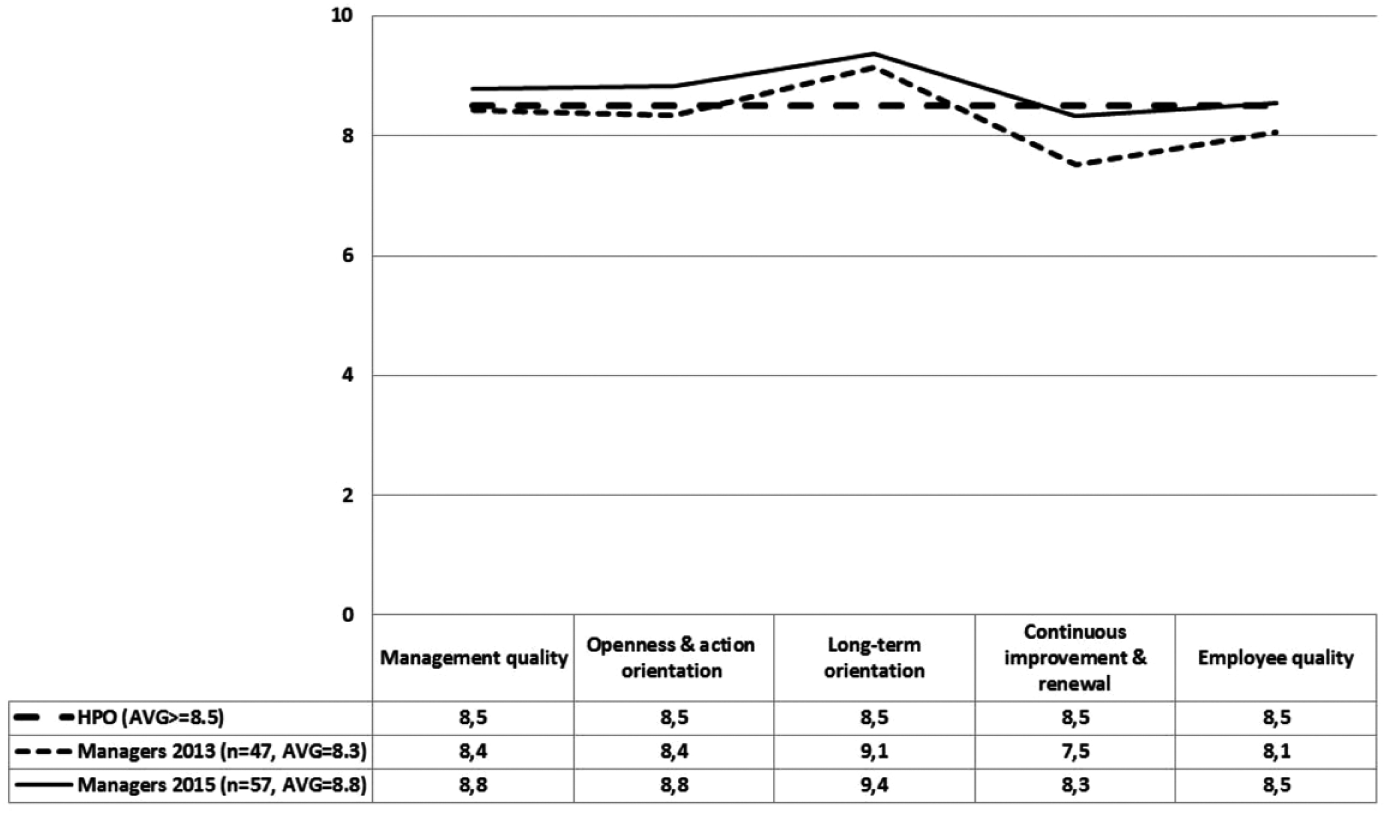
Average HPO scores for all managers, for 2013 and 2015.

Average HPO scores for all associates, for 2013 and 2015.
Analysis of the Second Diagnosis Results
Early in 2016, a meeting was organized, again in San Diego, with the CEOs and the HPO Coaches of each location to discuss and analyze the HPO results. Each location prepared and gave a presentation on its situation, HPO scores, interventions conducted in the past 1.5 years, and organizational results achieved. The HPO research shows there is a direct relation between the HPO score and organizational performance (de Waal & Goedegebuure, 2017), so an increase in score points should be accompanied with an increase in nonfinancial and financial performance. In respect to nonfinancial performance, all locations reported increased operational performance, such as simplified and therefore more efficient and less costly operational processes, increased associate involvement and engagement in the location’s affairs, enhanced relationships between associates and between departments, and improved alignment of individual and departmental efforts and the strategic plan, and better servicing of the customers.
In regard to financial performance, it has to be noticed that most locations had been suffering from adverse economic circumstances because the industries they mainly operated in—automobile and oil and gas production—were experiencing declining sales in the North American market. As a consequence, these clients were forced to delay projects, causing them to purchase less products from the Swagelok locations, which in turn had a dampening effect on the turnover of some of the locations. Other dampening effects were that several locations moved to a new location, which caused some upheaval among their people, and some locations implemented a new sales model, causing some uncertainties in operations and among the people. Finally, some locations experienced a higher turnover in associates than normal, caused by associates realizing they were not equipped enough to deal with the higher performance bar and therefore left; this could be called “functional turnover” and constitutes a dampening effect in the short run. However, in the longer run, this can be advantageous to the performance of the organization as these people are replaced with individuals that can meet the HPO standard (Johnson & Futrell, 1989; Wallace & Gaylor, 2012).
Interestingly, the locations with an increase in HPO score (2, 3, 6, and 7) still reported a (significant) growth in sales, albeit sometimes a lower growth rate than in past years (but nonetheless still a growth). The locations with no increase or a decrease in their HPO score (1, 4, and 5), however, reported a decline in growth, caused by a combination of the adverse economic circumstances and the effect that high-volume contracts expired around this time. The general consensus among these locations was that these adverse circumstances were (partly) offset by the HPO behavior people in these locations displayed. As one of the CEOs put it, “It could have been much worse, without HPO, many of us would have suffered financial losses.” The CEOs and HPO Coaches stated that the focus on the long term in the HPO Framework helped the organization to maintain the right direction and discipline regardless of “the headwinds” it faced, and that the communication and collaboration improvements, which took place as a result of the HPO transition made their organizations more agile in the face of a poor economy.
An interesting observation from Figures 3 and 4 is that the managers’ score increased with 0.5, while the score of the associates stayed the same. Several reasons for this were suggested: In most locations, there had been more dialogue on HPO on the managerial level than with associates, managers received more HPO training and development, many of the improvement efforts had not specifically been branded under the “HPO banner,” making it for associates more difficult to recognize the importance of HPO, and associates had not been involved enough in HPO activities. In addition, several locations relocated their offices, and the accompanying upheaval in associates’ displacements and associate turnover did not help HPO transition.
Interventions
The HPO Coaches were asked to list the interventions they conducted at their locations. These interventions were aimed at either becoming a full-blown HPO (Locations 1, 2, 3, and 4) or at even further strengthening the organization (Locations 5, 6, and 7). In total, 73 interventions were listed. During the workshop, the Coaches designated the three most effective interventions, with effectiveness meaning the degree to which the intervention helped the business and its people to be(come) high performing. Table 2 summarizes these 21 interventions and groups them into types.
Overview of the HPO Interventions Conducted at the Locations.

Note. HPO = High Performance Organization.
Table 2 shows that the interventions varied widely over each location, as even from the 21 most important interventions from the original 73, only two interventions were mentioned more than once. This shows that, although all locations basically carry the same range of products, local circumstances dictate the specific interventions that are needed and which are going to be effective. At the same time, Table 2 shows that interventions that increased the engagement of people with HPO were the most effective at all locations, with the intervention which created opportunities for communication and dialogue being the most effective. This finding ties in with a similar finding at a Philippine organization where the most effective intervention was the one that created occasions where managers initiated dialogues with the employees to understand current performance levels and discuss ideas on how to improve toward high performance (de Waal & de Haas, 2018).
Lessons Learned
The HPO Coaches also collected the lessons they and their colleagues learned while addressing the HPO attention points. These lessons were shared during the workshop and then summarized in the lessons learned that most locations had experienced. These are as follows:
Realize that becoming HPO takes time. It takes time for management and HPO Coaches to mutually get the ball rolling, it therefore takes time to get momentum for HPO in the organization. And as there is no secret recipe to make HPO successful, it is just plain hard work, which has to be carried out with discipline. Because becoming HPO takes time, HPO work and accomplishments have to be regularly reinforced.
Convey that HPO is “here to stay.” Treat HPO as a process, not a project. Convey the message in the organization that HPO is never ending as it is not a project but a mind-set. Stay consistent and make HPO part of the daily habits and activities. Devote enough time and effort toward HPO initiatives.
Involve everybody in the organization in the HPO effort. HPO has to be introduced to and disseminated throughout the entire organization, not only to managers. Involvement leads to ownership, pride, and support for HPO across the organization. Create HPO representation across all areas of the company, for instance, by appointing HPO Coaches from all organizational levels. Associates’ input is vital to gain support and collaboration, so consult them on the critical elements necessary to achieve the desired culture change.
Be aware that dialogue is imperative. Communicate, communicate, communicate, with dialogue. Create time for meaningful dialogue, but first understand as management what associates really want before “jumping in.” Therefore, think deeply about questions to ask, to get a meaningful dialogue. Make sure confidentiality is a priority during consultations with individual associates. Keep HPO in the forefront by regularly giving updates on the progress of initiatives. Get trust from associates by engaging them in dialogue and following through on commitments. Also give associates the opportunity to regularly engage in dialogue with the company’s CEO.
Hire and train the right people that fit the HPO culture from the start. Potential hires should fit the HPO culture so take the time to hire better associates, and realize not everyone will be a fan of HPO. After that, proper on-boarding with lots of information on HPO is imperative.
Be a role model as management. Lead as manager by example, be patient, open up, and do not be afraid to change at the executive level when managers are not up to par with what HPO requires. Do not be satisfied with mediocrity, and personally only hire and promote high performers from now on.
Take a strategic and system’s view on HPO. Tie HPO directly to the strategic plan, by including the HPO factors in the strategy and make the link between HPO initiatives and implementation results more explicit. Review even the smallest changes in the organization on HPO consequences. Include HPO as a strength in customer conversations.
Guard the quality of the HPO implementation. Assign ownership of improvement initiatives to people in the organization. HPO Coaches need to remind themselves regularly that they are not the problem owners and solvers, they are the guardians of the quality of these initiatives. In this respect, consistency is key, small group engagements are the most productive, and initiatives should not be too elaborate and complicated. Balance the learning during the HPO transformation with the fun, and celebrate successes. Focus on one HPO characteristic at a time. Take an annual break to refresh and re-evaluate objectives, and conduct sanity checks on key items even if the organization has performed well. Have new people join the HPO Coaches for fresh perspective and new ideas. Involve HPO Coaches if an improvement effort has to be recognized as an HPO effort, and use visual aids to support the HPO initiatives.
Conclusion, Limitations, and Future Research
The research question, dealt with in this article, was, “Can the HPO Framework be used to analyze and improve organizational performance of North American organizations in a sustainable manner?” We looked at a group of North American–based sales and service businesses who operated in several industries that in recent years had seen a decrease in their fortunes, adversely affecting the sales at some of the locations. The study results showed that the effects of the HPO Framework were different depending on local circumstances. Some of the locations experienced a growth in sales because of applying the HPO Framework, something that was expected on the basis of previous HPO research (de Waal, 2012; de Waal & Goedegebuure, 2017). At the same time, other locations used the HPO Framework to battle the consequences of the adverse economic circumstances they found themselves in. The latter has only seen twice before during HPO research, once at a distributor of building materials (de Waal, 2012) and once at a health care institution (de Waal, 2017). All locations agreed on the fact that the HPO Framework had been instrumental, in a positive way, to the development of their organization and its people. The study results thus show that the HPO Framework can not only be used in an offensive manner, that is, increasing the performance of the organization, but also in a defensive way, that is, safeguarding the current organizational performance levels. The study results also show that interventions that have to be undertaken during the HPO transition depend on the specific circumstances of the organization, indicating that there is not a “one best way” or recipe to achieve high performance. So the practical implication of this research is that managers of other North American organizations with confidence can start using the HPO Framework to strengthen their organization in a sustainable way, but that they should be careful to tailor their transition approach to the context of their organization. The theoretical implication of the study is that future researchers now have a validated framework at their disposal, so they can cast aside the plethora of unproven improvement frameworks and start focusing on the next stage questions in HPO research: What are effective interventions, how can high performance be made sustainable, what can strengthen the discipline inside companies to not only become but remain high performing, how can high performance behavior in employees be promoted, and how can suppliers and customers also be enticed to become HPOs and thus mutually create high performance value chains?
The main limitation in this study is the relative limited time span between the two diagnoses, making it difficult to evaluate the real long-term effects of the HPO Framework. Future research should therefore keep following the Swagelok Transformers, by regularly conducting an HPO Diagnosis, to see how organizational performance will develop. This type of longitudinal research will also reveal which interventions are the most effective in the long run (Ployhart & MacKenzie, 2015). Another limitation is that the research only took place in one profit industry; thus, future research should extend to more North American companies in more industries, also in the nonprofit and governmental sectors. The research also did not look specifically at potential differences between the United States and the Canadian locations, so this could be the topic of further research.
Footnotes
Declaration of Conflicting Interests
The author(s) declared no potential conflicts of interest with respect to the research, authorship, and/or publication of this article.
Funding
The author(s) received no financial support for the research, authorship, and/or publication of this article.