




Abstract
The basic purpose of this research was to explore certain dimensions of creative potential in university students who assessed their scholastic skills using self-ratings of the symptoms of learning disabilities. The learning disabled (LD; n = 47) group revealed lower levels of self-reported scholastic skills, whereas the non–learning disabled (NLD; n = 52) group showed higher levels. Both female and male undergraduate students of Maria Curie-Sklodowska University (MCSU), who majored in special education, participated in the study. The creative potentials of the LD and NLD groups of MCSU students were compared. The creative potential was investigated in two ways. First, the subjects were asked to think of as many uses as they could for a paperclip and a pencil (Alternative Uses Task by Guilford). Second, they were asked to complete a Creative Behavior Questionnaire (KANH) by Popek. Furthermore, the subjects were asked to complete a Rating Scale for Intensity of LD Symptoms. Thus, they were requested to self-report the intensity of their LD symptoms. It was found that nonconformity and heuristic behavior were the factors that differentiated the university students with self-reported LD from their peers in the NLD group. In general, taking into consideration the scores that were obtained in the KANH, the LD group obtained a lower level of creative potential, compared with the NLD group. The effects of gender, self-reported LD, and instrument selection on our research outcomes are also discussed.
Keywords
Introduction
Learning disabilities (LD) as well as other handicaps appear to play a pivotal role in the research on human giftedness and creativity. As for the meaning of giftedness or genius in our society, many people find it difficult to understand that a child or an adult can be both gifted and learning disabled. Moreover, students with special needs that result not only from their high ability but also from LD are often misdiagnosed or poorly served by the school system (Brody & Mills, 1997; Meisgeier, Meisgeier, & Werblo, 1978). This judgment is probably true regardless of educational level, which is under discussion (preschool; elementary, middle, high school; college; university). Historically, such “twice exceptional” children such as Helen Keller, Franklin Roosevelt, Winston Churchill, Ray Charles, Thomas Edison, Albert Einstein, and William Butler Yeats became famous, creative, and highly able adults (Bogdanowicz, 2008; Pledgie, 1982; Silverman, 2009). Creativity has always been “a common characteristic of those people who have made outstanding artistic and scientific contributions, social improvements or technological breakthroughs” (Torrance, 1984, p. 153). Another reason for the significance of this topic is the assumption that LD does not exclude giftedness and creativity in both schoolchildren (pupils) and adults (university students). Moreover, regarding the adult group, the adjustment difficulties of special education students at the highest educational level (university) may stem from their learning disabilities (Wyczesany, 1999). This notion is noteworthy because maladaptive behavior may have something in common with both LD and giftedness and/or creativity. In the light of these facts, it seems obvious that the creative potential of learning disabled university students should be regarded as a vital topic.
The conceptualization of learning disabilities is a complex issue due to a plethora of definitions, terms, and criteria that are used by LD researchers. The following words can be associated with the LD field: dyslexia, alexia, hyperlexia, slow learner, passive learner, dyscalculia, acalculia, specific learning disabilities/disorders/difficulties (SLD), learning disabilities/differences/problems, attention deficit hyperactivity disorder (ADHD), conduct disorder (CD), oppositional defiant disorder (ODD), and emotional and/or behavioral disorders (EBD). It seems that LD is the key word in this field. Thus, it must be defined.
One of the LD definitions that is the most popular and respected by researchers is the definition that has been worked out by a team of American specialists—the National Joint Committee on Learning Disabilities (NJCLD). According to the NJCLD,
learning disabilities is a general term that refers to a heterogeneous group of disorders manifested by significant difficulties in the acquisition and use of listening, speaking, reading, writing, reasoning, or mathematical abilities. These disorders are intrinsic to the individual and presumed to be due to central nervous system dysfunction. Problems in self-regulatory behaviors, social perception, and social interaction may exist with learning disabilities but do not by themselves constitute a learning disability. Although a learning disability may occur concomitantly with other handicapping conditions (e.g., sensory impairment, mental retardation, social and emotional disturbance) or environmental influences (e.g., cultural differences, insufficient/inappropriate instruction, psychogenic factors), it is not the result of those conditions or influences. (NJCLD, 1994, pp. 65-66, cited in Shaw, Cullen, McGuire, & Brinckerhoff, 1995)
Scanning the content of the above-quoted NJCLD definition, we can find the criteria for LD. The first criterion is heterogeneity because LD can be manifested in many different ways. Some of the symptoms of this disorder concern basic scholastic skills (reading, writing, arithmetic). Other signs pertain to both the cognitive and the language domains (listening, speaking, and reasoning). The second criterion is the neurobiological nature of LD. This means that genetic and congenital factors usually contribute to this problem. The third criterion involves comorbidity. The co-occurrence of learning disorders can be observed in the developmental relationships between listening, speaking, reading, spelling, writing, and mathematics (e.g., coexistence of dyslexia and dyscalculia, dyslexia with comorbid speech disorders). Another aspect of comorbidity is LD that co-occurs with certain behavioral or emotional disorders (e.g., overlap among LD, ADHD and EBD, the concomitance of LD and adjustment difficulties; Lyon, 1996; Rock, Fessler, & Church, 1997). The remaining LD criteria concern the discrepancy standard and exclusionary practice (for further discussion, see Lyon, 1996).
To understand what “creative potential” is, we should also consider the meanings of the words creativity and potential. Creativity “is the interplay between ability and process by which an individual or group produces an outcome or product that is both novel and useful as defined within some social context” (Plucker & Zabelina, 2009, p. 6). Potential is often used as a shortened form of potentiality. It is a present set of circumstances that are used to infer that some property and talent that are not currently manifested will develop or be learned (Reber, 1985). Creative potential might refer to every creative act that is possible but not yet realized or that is capable of being, but not yet in existence. However, this definition arouses controversy over the link between potentiality and creativity (see Martin, 2011). There are some confounding factors that should be discussed. First, in the study of creative potential, one may become confused because the recognition or judgment of a creative act is a necessary condition of the label creative (universal definition). Second, in the process of conducting research on both creative potential and creativity, some social or environmental context should be included. An effective approach would be based on the assumption that creativity can exist prior to recognition (e.g., the importance of hand-washing before surgery and the efficacy of hypnosis that was discovered by Mesmer are now regarded as creative discoveries, and yet both were rejected as such by contemporaries: Koestler, cited in Martin, 2011). Third, another compounding factor in this debate is associated with the following citation:
limiting the conception of potential to that of the abilities of already creative people, one is both creating a selection bias (more people may be potentially creative than actually become creative) and emphasizing the importance of empirical data when the object of enquiry is not always capable of empirical existence, as it is with potential. (Martin, 2011, p. 305)
Thus potential is not exceptional. Furthermore, it can be intrinsic to every human being, not only to those people who are already regarded as being creative.
Another important issue is creative potential as an essential component of creativity. The close association between potential and creativity is a distinguishable feature of the most current definition. It states that
creativity is the human potential, power or capacity to make discoveries about the pre-existing potentials and powers of the world and to bring those discoveries into being through the actualizing of a potential or the revealing of a power, or a combination of both. (Martin, 2011, p. 307)
It should be remembered that the word discoveries in this definition is substituted with novelty. This last term was commonly used in previous definitions of creativity.
What Do We Know About Giftedness, Creativity, and LD?
Although we know a great deal about this relationship, there is still more learn. The linkage between giftedness and LD has been investigated over the last several decades, especially among school-age children and youth (Al-Hroub, 2011; Brody & Mills, 1997; Hearne & Stone, 1995; Pledgie, 1982; Reis & McCoach, 2000). The most popular criterion for LD that is used in these studies is a “discrepancy model” for the factor of unexpected underachievement (e.g., there is a difference between aptitude and achievement; Shaw et al., 1995). It has also been noted that certain differences are common characteristics of a gifted underachiever. However, gifted underachievement is not only a discrepancy between potential and performance that really matters, but it can also be associated with specific IQ and/or ability test scores and predicted and/or expected versus actual achievement (McCoach & Siegle, 2003; Reis & McCoach, 2000). Nevertheless, underachievement can be a factor that is associated with both LD and giftedness. Among other characteristics of underachievement in LD and gifted pupils is low academic self-concept and self-perceptions, negative attitudes toward school, problems in motivation, and self-regulation or goal valuation (McCoach & Siegle, 2003).
Moreover, a gifted learning disabled pupil is a common example of dual or twice exceptionality (Al-Hroub, 2011; Nicpon, Allmon, Sieck, & Stinson, 2011). In the U.S. educational system, there are approximately 300,000 students who simultaneously possess a gift and a disability. In this way, a close relationship between giftedness, LD, and other developmental disabilities can be confirmed. Nonetheless, unrevealing twice exceptionality, the academically gifted students with either ADHD or autism spectrum disorder (ASD) should also be mentioned (see Nicpon et al., 2011). It seems that double exceptionality resembles the comorbidity criterion of LD.
Due to the twice-exceptional conditions, the identification of gifted students may be a challenging and complicated task. In other words, dual-exceptionality can make the diagnosis of giftedness more complex. In Poland, the current thinking is that the process of identifying gifted and talented children is multifaceted. The recognition of such traits is based on school achievement test scores, out-of-school competition results, informal classroom observations, IQ scores, and parent, teacher, peer, or expert nominations. Polish specialists usually argue that a gifted child has a high IQ and yields exceptional achievement in one or more domains. Moreover, Polish scholars concur with the assumption that the presence of a learning disability does not exclude giftedness, talent, or creativity (Limont, 2012; Palak et al., 2008-2009; Kirenko, Gindrich, Kazanowski, & Pielecki, 2009). Therefore, another issue involves the question, “How is creativity linked to giftedness and LD?” Taking into account the educational implications of creativity for the gifted that are identified by Torrance (1968), it should be noted that not only LD but creativity can also contribute to giftedness. His ideas of the creatively gifted disadvantaged and the creatively handicapped may have been controversial in the late 1960s (Torrance, 1968). However, the most current research suggests that they facilitate our comprehension of exceptional conditions such as giftedness and LD.
The next significant theoretical consideration refers to the three-pronged conception of giftedness that was proposed by Renzulli. Apart from above-average general and/or specific abilities and motivation (task commitment), this conceptualization also involves creativity. The conception is grounded in a four-part theory of talent development (see Renzulli, 2012).
With regard to the relationship between LD and creativity, we may also consider the 10 culture commandments that block creativity. Although they were formulated over 40 years ago, they may still show us how the American culture has had an effect on human creative activity. These commandments or rules addressed many aspects of cultural influence that have hampered creativity. Among these, we note the following topics:
placing emphasis on practicality
a success-oriented culture
the notion that the production of a perfect product is the only way to avoid failure and disapproval
the need for universal acceptance and popularity
distinguishing between healthy solitude and morbid withdrawal
using a “spotlight mind” instead of a “floodlight mind”
paying too much attention to culturally determined sex roles (e.g., because creativity requires sensitivity, a boy who manifests this trait can be regarded as being more “effeminate” than his peers. In the same way, an independent and creative girl can be looked upon as being more “masculine”)
society’s unwillingness to accept certain results of autonomy (excessive emotional feeling, rebellious behavior) which are creative in nature but fail to comply with established cultural norms
inability to tolerate ambiguity, paradoxes
paying little attention to the inner life and the child’s secret world of dreams, imagination, and fantasy (see Krippner, 1967).
Skimming through the commandments, we notice the factors that are crucial for an understanding of the social determinants of creativity, creative potential, and noncreative attitude. However, we appear to be less familiar with the nature of the relationship between creativity and LD. Creativity can be hindered by societal pressure in many ways (e.g., by valuing the usefulness and perfectness of a product, demanding conformity and dependence, striving for success and popularity).
Undoubtedly, the issue in the LD field, which pertains to the research on creativity and culture, concerns the meaning of success in our society. Krippner (1967) claimed that in an achievement-oriented culture, children may be discouraged from displaying their creative products for fear of ridicule and censure. Given that LD students are usually unsuccessful at school, we can expect that they are assumed to be less creative than their highly achieving and successful peers. However, as the academic failures of LD individuals can lead to negative attributions, low self-esteem, or even social isolation, it may be a reason for hiding both their creative products and talents. Thus, this recent remark is of value when the creative potential of LD students is investigated. It also appears to be true that not only creative schoolchildren but also adults may be afraid to discover their potentialities and hidden talents. Also connected with the stereotyped view of sex roles in our society are the assumptions that, to be creative, a man must be sensitive and a creative woman must be independent. These two features both in children and adults may interfere with their desire to disclose their creative potential in terms of common gender expectations.
The Dimensions of Creative Potential
Importantly, many variables or even variable clusters can contribute to the complex nature of both creative potential and creativity. As described above, both culture and society can inhibit a person from being creative. However, it is clear that except for social contributors, creative potential involves both individual and cognitive factors (personality). Strictly speaking, to conduct an investigation of the nature of creative potential, a multivariate approach to the observed confluence of several distinct but interrelated resources is required. Such factors may be conceptualized as the specific aspects of intelligence, knowledge, cognitive style, personality, motivation, affect, and physical and sociocultural environmental contexts (see Lubart, Zenasni, & Barbot, 2013).
As for the linkage between personality traits and creativity, we should focus on the conclusions that can be drawn from the meta-analysis on this topic that was published in 1998. The study showed that creative people in general are more autonomous, introverted, open to new experiences, norm-doubting, self-confident, self-accepting, driven, ambitious, dominant, hostile, and impulsive. Of these, the largest effects were related to openness, conscientiousness, self-acceptance, hostility, and impulsivity (see Feist & Barron, 2003). At least some of these characteristics of creative individuals (autonomy, self-confidence, self-acceptance, ambition, and openness) can be attributed to the nonconformity dimension of the creative potential measure—Creative Behavior Questionnaire (KANH) by Popek. With regard to the cognitive domain, both heuristic behavior and divergent thinking should be taken into account because they are considered to be the essential ingredients of creativity (Guilford, 1968; Lubart et al., 2013; Popek, 1990). From this short introduction, three independent dimensions of creative potential emerge. They can be examined with two instruments (KANH by Popek and Alternative Uses Task by Guilford). More information on this topic is presented in a separate section of the article (see “Method” section).
The Aims of the Study
In summary, this study serves two basic purposes:
To evaluate the creative potential of university students with self-reported learning disabilities (LD) in comparison with their counterparts who perceive themselves as being non–learning disabled (NLD).
To investigate certain dimensions of creative potential in the sample.
As for the second purpose, the three dimensions of creative potential are explored:
Conformity versus Nonconformity
Algorithmic versus Heuristic Behavior
Divergent Thinking.
Method
Research Sample and Measures
A total of 99 students of Maria Curie-Sklodowska University (MCSU) in Lublin agreed to participate in this comparative study. They were assessed based on creative potential measures (KANH by Popek and Alternative Uses Task by Guilford) as well as on a learning disabilities self-reported measure (Rating Scale for Intensity of LD Symptoms). The age of the university students ranged between 21 and 25 years (a mean age of 23 years). The MCSU students included both men and women who majored in special education. They were in their second and third year of studies at the university. The questionnaires and other tests that were used in our study were supplied with some guidelines and suggestions for how respondents should mark their answers to complete the assessment. The copies were printed exclusively in Polish because all of the participants were Poles. The empirical study was conducted collectively. Every participant received a copy of the answer sheet. No one identified problems concerning the comprehension of the questionnaire or test content. Moreover, it was not necessary to change anything about the standard procedure of the assessment. The research actions took place after the students had finished their classes at MCSU, Institute of Pedagogy in Lublin. We used the LD symptoms self-perception results as the independent variable, and we divided the university students into two groups (see the next section).
Rating Scale for Intensity of LD Symptoms
Based on the self-report measure that was constructed by P.A.G., the participants were classified as either learning disabled (LD group) or NLD group. They were asked to mark an appropriate number or digit with respect to the intensity of self-observed LD symptoms. They were asked to respond by choosing one out of five responses (a symptom of LD is observable: 1 = never; 2 = rarely; 3 = sometimes; 4 = frequently; 5 = very frequently). Thus, the symptoms were assessed by the students on a 5-point scale. The Rating Scale for Intensity of LD Symptoms comprised 12 items concerning the self-assessment of specific scholastic skills (reading, writing, and counting) as well as the self-perception of certain cognitive and language abilities (remembering, reasoning, listening, and speaking). The internal consistency reliability and split-half reliability of the instrument were quite good (Cronbach’s α for the entire scale = .68; the Guttman split-half reliability = .67). The detailed item-reliability analysis of the scale is available in Table 1. Considering the item–total score correlations, it seems that only “Item1” and “Item12” show a lower correlation with the sum scale than any of the other items. Deleting either one of the items would result in a reliability of .70. Finally, it was decided to leave these items because erasing them would not improve the scale reliability as much as might be expected. To summarize, the measure is quite reliable.
Rating Scale for Intensity of LD Symptoms—Outcomes of Statistical Item-Reliability Analysis (N = 99).

Note. LD = learning disabilities; Item1 = My handwriting is illegible; Item2 = I forget what I have just been told by someone; Item3 = I have a headache when I read; it is not a pleasure for me; Item4 = What I have read about in a textbook is easy to understand; Item5 = I find it difficult to express my thoughts verbally, I stutter, I mispronounce longer words, or I reverse and twist phrases when I am speaking; Item6 = I cannot remember the topic that was discussed during the last academic classes; Item7 = I am a low achiever, a poor test taker; Item8 = I have difficulty telling others about something I have just read; Item9 = I do not listen carefully to what other people say; Item10 = I find it difficult to express my thoughts in writing; Item11 = I hardly focus my attention on the issue that is under discussion during academic classes; Item12 = I do not make spelling errors.
As for the results of the rating scale, a descriptive, statistical procedure was used that aimed at dividing the sample into two distinct groups of university students on the basis of mean, median, and lower and upper quartiles. The statistical values were computed for the total scores of the Rating Scale for Intensity of LD Symptoms, including all of the students (N = 99). For example, if the total score was above not only the median or mean, but it was also over the lower quartile, a university student would be qualified for the “self-reported LD group.” There were 47 students who met the statistical criterion (NLD = 47). Those who did not fulfill the conditions were classified as the “self-reported NLD group” (NNLD = 52). Therefore, self-observed LD served as the independent variable.
Short Demographic Survey
This measure’s purpose was to gather the demographic information of a sample. It required the subjects to answer questions about their gender, age, family (education of parents, family income, number of family members, birth order), and school achievement.
KANH
The Creative Behavior Questionnaire, which is abbreviated as KANH, is the instrument that allows us to measure adolescent and adult creative activities, which are also referred to in terms of “a creative attitude” by Popek. The theoretical basis for the construction of the questionnaire is the “interactive model of giftedness” by Popek. Taking into consideration this conceptualization, it has been assumed that abilities can either be noticed in human actions or perceived as their outcomes, specifically as products. In Popek’s opinion, abilities are situated within a personality domain in which the opportunities for the realization of ideas are referred to as creative attitude (Popek, 1990). The questionnaire is also based on the assumption that creative attitude is composed of two dimensions: cognitive and characterological. The first dimension is the cognitive sphere, which is defined as a heuristic behavior because the scope of measurement is beyond divergent thinking. The opposite, convergent type of behavior, which is known as algorithmic behavior, is also assessed on the questionnaire. The second dimension concerns the set of characterological traits that secure the realization of human potential. Active involvement with cognitive predispositions is only possible when the collaboration with other personality traits, which are commonly labeled as nonconformist or conformist attitudes, comes into play. As a result, the creative attitude model contains four components: conformity (K), algorithmic behavior (A), nonconformity (N), and heuristic behavior (H). Each value on the measurement scale for abilities is treated as a continuous characteristic (continuum; Popek, 1990).
The questionnaire contains 60 items that constitute grammatically and formally declarative sentences. The items pertain to a subject’s behavior that involves the situational contexts of learning and action. Its layout prevents a subject from realizing which behavioral sphere is under control in any specific case. The system of responses includes three categories: true = 2 points, partially true =1 point, and false = 0 points. The raw scores are computed by adding the results estimated for particular items that correspond to the specific scales, components, and subscales. It is also possible to add the points of the scales in two ways: K + A noncreative, reconstructive attitude; N + H creative attitude (Popek, 1990).
The KANH was reported to have good internal consistency (Cronbach’s α for Conformity–Nonconformity Scale = .87; Cronbach’s α for Algorithmic–Heuristic Behavior = .83). Furthermore, test–retest reliability was computed for each of the four subscales (Pearson’s r for Subscale K = .917; Subscale A = .907; Subscale N = .921; Subscale H = .903). The results prove that the KANH is a reliable measure. The questionnaire construct validity was reported, with the KANH being positively correlated with the HDYT (How Do You Think) test by Davis, which is a measure of intelligence (Pearson’s linear correlation coefficients r ranged between .40 and .70). The questionnaire construct validity indicates a significant relationship between the scores that were obtained by both measures (Popek, 1990).
To conclude, the KANH is a reliable research tool that enables us to investigate not only creative potential but also noncreative attitudes. Tables 2 and 3 show the key variables and relative items that are common characteristics of the bipolarity of which one should be aware in the process of conducting research on creativity.
Creative Potential Versus Noncreative Attitude—An Overview of Nonconformity Versus Conformity Key Variables of KANH.

Note. KANH = Creative Behavior Questionnaire.
Creative Potential Versus Noncreative Attitude—An Overview of Heuristics Versus Algorithm Key Variables of KANH.

Note. KANH = Creative Behavior Questionnaire.
Alternative Uses Task
In completing this well-known test by Guilford, the subjects are encouraged to list as many uses for a common household item as possible. The two everyday objects (a paperclip and a pencil) were used for the analysis. The Alternative Uses Task is a popular measure of the divergent versus convergent thinking dimension. The higher the scores for originality (uniqueness of solution), fluency (total of ideas), flexibility (categories of usage), and elaboration (amount of details) the higher the level of divergent thinking of the task’s performer.
The Short Demographic Survey data that were collected from the participants are summarized in Tables 4, 5, 6, 7, 8, 9, 10, and 11. Table 4 illustrates gender distribution concerning self-assessed learning disabilities (LD group) and the self-reported absence of LD symptoms (NLD group) in the university students. There are more women than men in both groups. In total, the male students constitute a minority regardless of self-reported LD in this sample (10.10%). The chi-square does not reach a significance level; hence, gender does not have an effect on self-reported LD.
The Gender of University Students Classified as LD and NLD Groups.

Note. Pearson’s χ2 = 0.028; df = 1. LD = learning disabilities; NLD = non–learning disabled.
The Education of Fathers of University Students Classified as LD and NLD Groups.

Note. Pearson’s χ2 = 1.61; df = 4. LD = learning disabilities; NLD = non–learning disabled.
The Education of Mothers of University Students Classified as LD and NLD Groups.
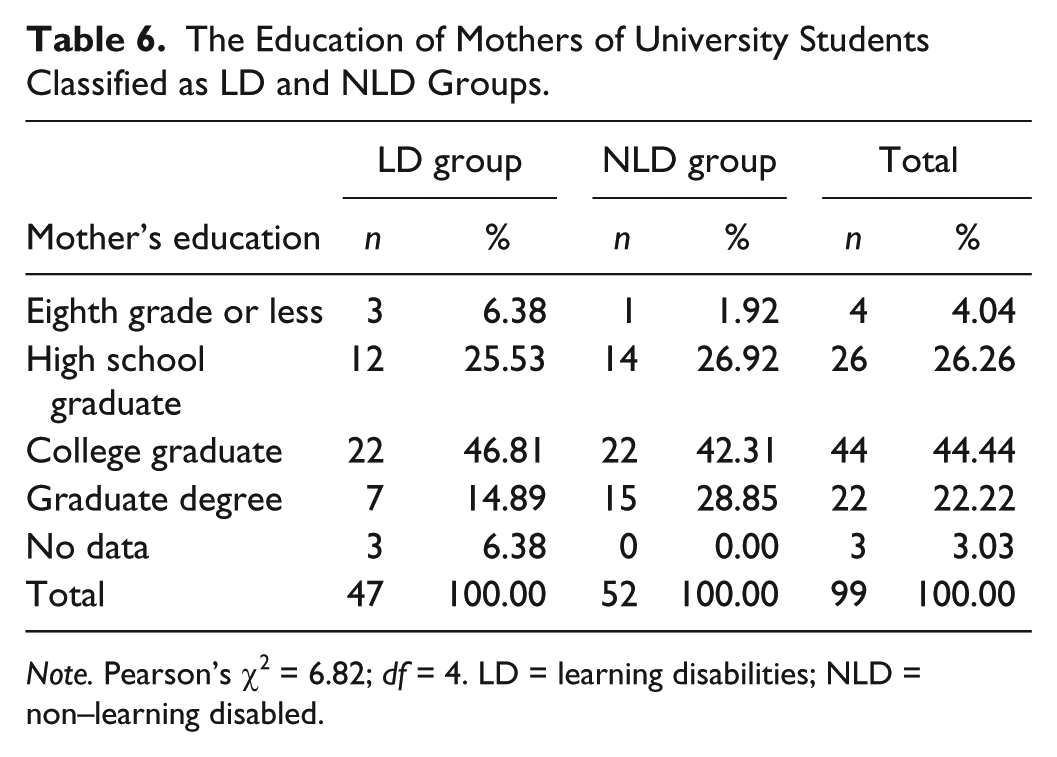
Note. Pearson’s χ2 = 6.82; df = 4. LD = learning disabilities; NLD = non–learning disabled.
The Number of Siblings of University Students Qualified for LD and NLD Groups.

Note. LD = learning disabilities; NLD = non–learning disabled.
The Birth Order of University Students Qualified for LD and NLD Groups.
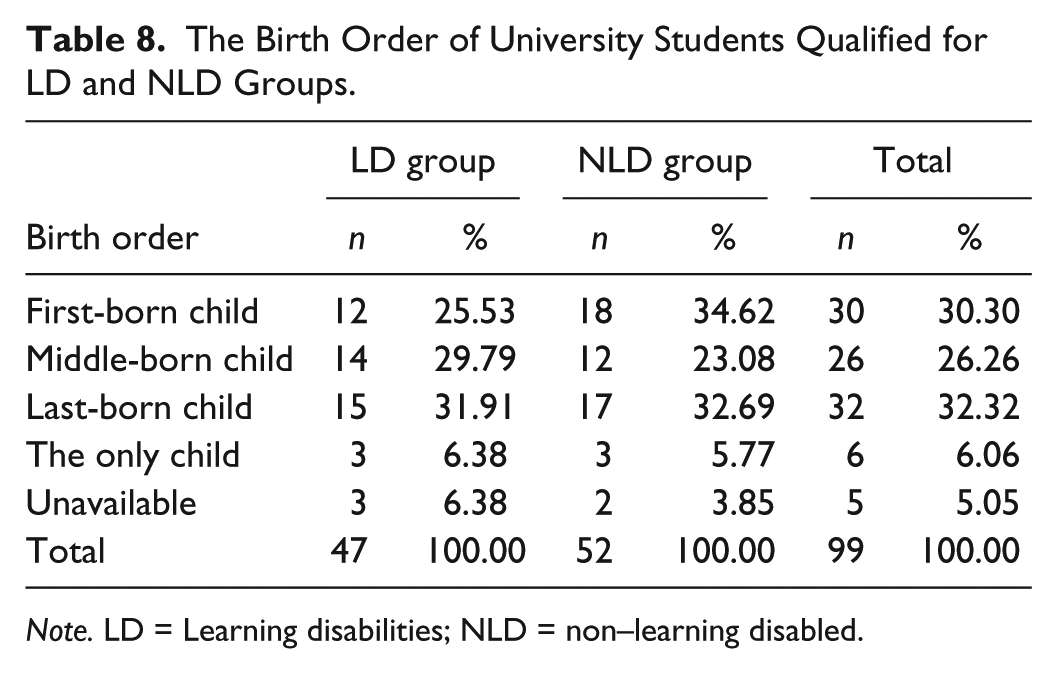
Note. LD = Learning disabilities; NLD = non–learning disabled.
The Family Income Level of University Students Qualified for LD and NLD Groups.

Note. Pearson’s χ2 = 15.09; df = 4; p < .004 (statistically significant). LD = learning disabilities; NLD = non–learning disabled.
The Type of Family of University Students Qualified for LD and NLD Groups.

Note. Pearson’s χ2 = 1.07; df = 3. LD = learning disabilities; NLD = non–learning disabled.
The Levels of Achievement at High School of University Students Qualified for LD and NLD Groups.
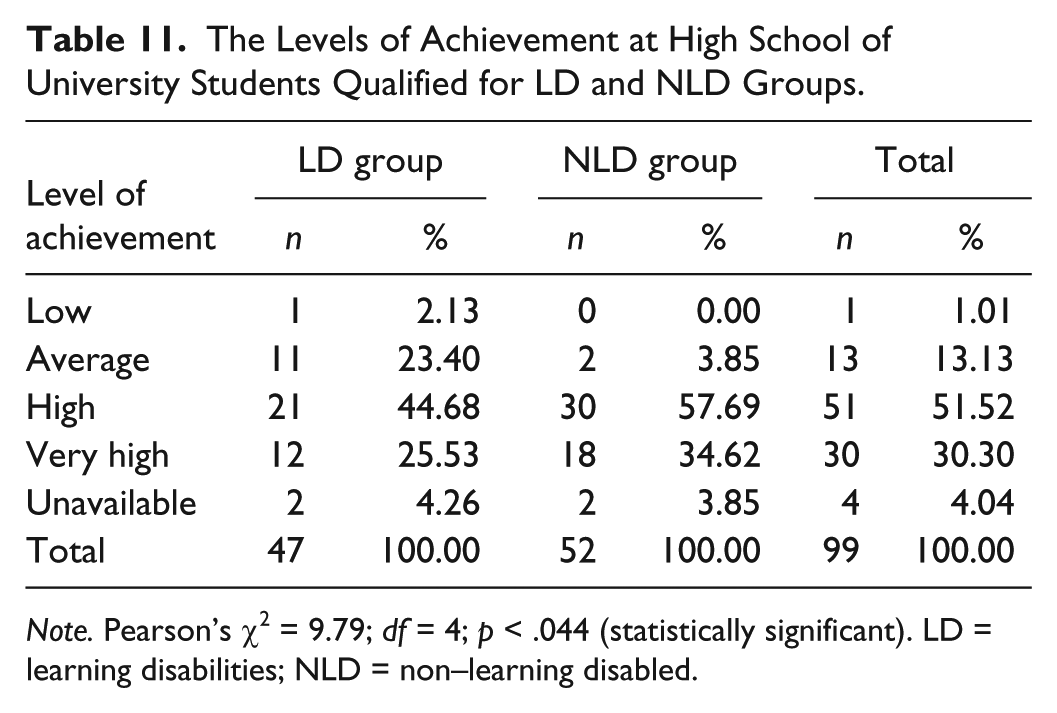
Note. Pearson’s χ2 = 9.79; df = 4; p < .044 (statistically significant). LD = learning disabilities; NLD = non–learning disabled.
Analyzing the education of fathers (Table 5), we may notice that slightly more students of MCSU in the LD group, compared with those in the NLD group, have fathers whose educational level is very low (finished eighth grade or less). It should also be noted that slightly fewer fathers of the self-reported LD students graduated from college in comparison with the fathers of those without self-rated symptoms of LD (LD = 34.04%; NLD = 42.31%). However, these facts are not likely to lead us to conclude that self-assessed LD in the university students co-occurs with lower levels of their fathers’ education. The differences between the observed frequencies in both groups are clearly not significant.
As for the education of the students’ mothers, there is a noticeable difference between the LD and NLD groups with regard to mothers with graduate degrees. There are fewer students with self-reported LD than those without it who were raised by mothers with such a degree (LD = 14.89%; NLD = 28.85%). However, it is apparent that the Pearson’s χ2 values are not significant. Thus, discrepancies between the university students that can be associated with the education of their mothers and fathers cannot be confirmed in this sample.
The next variable to explore is number of siblings. The respective percentages and frequencies are displayed in Table 7. Almost twice as many university students of the LD group as those of the NLD group have only one brother or sister (LD = 29.79%; NLD = 46.15%). For all of the other categories that include the number of siblings, the respective percentages in both groups are nearly identical.
Taking into consideration the birth order of the subjects, we find equal percentages in both groups. The only difference concerns the number of special education students who are first-born children (LD = 25.53%; NLD = 34.62%). There is also small number of university students in the LD group who are eldest siblings, compared with their peers in the NLD group. The numbers of the subjects who were last born or middle children are almost identical across the groups. The percentages of only children in both of the groups are nearly the same (see Table 8). In sum, birth order is similar in both of the groups that differ from each other in terms of self-reported learning disabilities.
Regarding socioeconomic status (SES), the LD group differs from the NLD at a statistically significant level. Only those of the LD group consider their family income to be low (LD = 4.26%; NLD = 0.00%). Furthermore, the medium SES is more apparent among the students with self-assessed LD (LD = 51.06%; NLD = 21.15%). A high level of family income is the most popular choice that is made by the students without self-reported LD (LD = 31.91%; NLD = 65.38%). In general, family income level is associated with self-reported LD in this sample. Moreover, the relationship is strong because the Pearson’s χ2 value is statistically significant (see Table 9).
Regardless of self-assessed LD, the most popular type of home environment in which the university students were brought up is an intact family. This factor constitutes the majority of the sample (77.78%). There is no marked relationship between type of family and self-reported LD in the subjects (see Table 10).
Last but not least, the variable that was estimated with the descriptive statistics measures of the sample is the level of high school achievement. The data on this point are summarized in Table 11.
In general, the achievement of the students who were classified in the self-reported learning disabled group achieved lower levels in high school compared with their peers in the non-self-reported LD group. The differences between the groups can be observed in terms of “high,” “average,” and “very high” levels of achievement (see Table 11). The correlation between the level of high school achievement and self-reported learning disabilities in the university students is strong (Pearson’s χ2 value is statistically significant). It is likely that school achievement level accompanies the self-perception of learning disability (LD).
Results
The Levels of Creative Potential Assessed With KANH
To determine significant differences between the two groups of university students (LD and NLD) on the KANH measure, T-test values were computed. The choice of t test for the independent samples was made in line with the statistical requirements that were set by the type of empirical data that were collected. The dependent variable distributions for each of the two research groups resembled a normal shape. The variances and frequencies for the respective samples also appeared to be similar. In addition, the dependent variable was assessed on a quantitative scale. The self-reported LD versus NLD was a grouped, independent variable.
Table 12 presents the results of the T-test analysis. It shows the mean scores (M), standard deviations (SD), T values, and p levels that were obtained by the students in the LD and NLD groups for each variable of both creative potential and noncreative attitude.
The Dimensions/Variables of KANH.

Note. The results of T tests comparisons between LD and NLD groups. KANH = Creative Behavior Questionnaire; LD = learning disabilities; NLD = non–learning disabled.
p value is approaching significance level; *p value is statistically significant; ns = nonsignificant.
Skimming the data that were collected in Table 12 reveals that the mean differences between the LD and NLD groups were statistically significant with regard to two variables for the KANH: Nonconformity (t = −2.55; p < .01) and Heuristic Behavior (t = −2.56; p < .01). These variables accounted for creative potential. The university students with self-reported LD were lower than their counterparts in the NLD group in Nonconformity and Heuristic Behavior. It showed that the creative potential of the university students who self-reported LD symptoms was lower in comparison with the NLD group. The mean differences between the LD and NLD groups were not statistically significant for the two remaining variables of KANH: Conformity (t = 1.82; p < .07†) and Algorithmic Behavior (t = −0.41; p < .67 ns). Both of the variables pertained to noncreative attitude.
The Levels of Divergent Thinking Assessed With the Alternative Uses Task
Divergent thinking, which was also examined by means of the Alternative Uses Task, is regarded as an essential dimension of creative potential. Thus, we implemented T tests for the independent samples to compare the means of the university students with self-reported LD and those who were without self-assessed symptoms of this disorder on each of four variables of Alternative Uses Task. The comparisons are illustrated in Table 13.
The Variables of Alternative Uses Task.

Note. The results of T tests comparisons between LD and NLD groups. LD = learning disabilities; NLD = non–learning disabled.
p value is approaching significance level; ns = nonsignificant.
The LD group students do not differ from their NLD group peers with reference to all of the components of divergent thinking. However, originality approaches a level of statistical significance (t = 1.73; p < .08). Although the difference is not statistically significant, the mean score for originality is higher for the LD group. Thus the university students with self-assessed LD might be described as those who tend to show special ability in the area of “originality and/or uniqueness.” It is also notable that although the subjects of the LD group do not differ from the NLD group on the three variables of Alternative Uses Task, as shown in the perspective of statistical level, the means for fluency, elaboration, and flexibility with regard to the LD group are higher than the respective average scores for the NLD group. This finding proves that the university students with self-reported LD tend to be slightly more creative than their peers in the NLD group.
Discussion
To attain the first goal of this research, we should claim that the university students with self-reported learning disabilities (LD) reveal lower levels of creative potential than their counterparts who are not likely to self-report LD symptoms (NLD). Thus, self-reported LD in the participants of this study is the key factor that contributes to the decrease in their nonconformity and heuristic behavior scores. The cause may be the occurrence of several factors that are supposed to hinder creativity in the sample of the university students who perceive themselves as being learning disabled. Simply put, it is not only the negative impact of various social aspects of culture, as described by Krippner (1967), but also the deleterious effect of self-reported LD. However, if we focus exclusively on the NLD group, such an influence is not found.
It must be said that the statistically significant group differences in creative potential of the MCSU students can be recognized only in the analysis of the KANH results. Taking into consideration the scores of the Alternative Uses Task, there are no marked differences between the LD and NLD groups. However, it may be noted that for the variable of divergent thinking (originality), the mean score for the LD group is higher than for the NLD group (t value is nearly at significance level; p < .08). This finding shows that the university students who self-report LD symptoms, compared with those who do not, are more inclined to develop unusual solutions, come up with new ideas, and invent unique products. This fact can also be found in several studies that concern creativity in LD individuals (Tarver et al., cited in Hearne & Stone, 1995).
Bearing in mind the second goal of this analysis, it should be stated that the measurement of creative potential is not homogeneous by nature. Its heterogeneity was reflected in the type of measure that we were able to use to achieve our empirical analysis. Therefore, the variables of divergent thinking that were assessed with the Alternative Uses Task may be relevant exclusively to the cognitive domain of creative potential. Nevertheless, another measure (KANH) allowed for the investigation of both cognitive (heuristic vs. algorithmic behavior) and personality dimensions (nonconformity vs. conformity). The obtained results with regard to the group differences are not the same because we sought to assess the levels of creative potential using two different research tools.
Our research study must acknowledge several limitations. The first limitation is the university students’ gender. As female persons constitute the majority of the sample (approximately 90%), our findings suggest caution in their interpretation. The in-depth analysis of creative potential in the female university students with self-reported learning disabilities is likely to be convincing. However, with regard to the male sex, it does not appear to be credible. In our attempt to explain the unequal gender proportion in our sample, we acknowledge that in Poland women who study special education have historically outnumbered men (http://stat.gov.pl; the database of Central Statistical Office of Poland). This tendency was duplicated in the current study. Such a demographic trend with respect to a preservice special education teacher’s gender is still visible at all Polish universities. Nevertheless, if our sample comprised more men or an equal number of men and women, we might have obtained different results on the creative potential measures.
Another limitation of this study is associated with the incomplete diagnosis of LD. We do not know whether the university students have been clinically diagnosed either with learning disabilities (dyslexia, dyscalculia) or co-occurring disorders (ADHD). Thus, it was impossible to examine the impact of the professional, psychological LD assessment in conjunction with self-observed LD on creative potential. Nonetheless, the results may be valid, given that solely self-reported LD in university students were used. It is also the case that apart from the intensity of LD symptoms, the participants, who completed the Short Demographic Survey, were encouraged to report on the level of their academic achievement in high school. This fact seems to be crucial for their self-perception of LD because learning difficulties may coexist with low achievement. This is evident on the basis of a few research studies (see Gresham, MacMillan, & Bocian, 1996).
Nevertheless, irrespective of the considerable female sex dominance and the lack of clinical diagnosis of LD in our sample, the findings of our research do not suggest that the LD and NLD students are alike in terms of creativity or giftedness (see Hearne & Stone, 1995). It is possible that creativity is a feature that the university students, who are honest about their LD symptom occurrence, are afraid to disclose at the moment. Perhaps they will dare to do so in the future. Thus, the phrase “creative potential,” which implies that something is not yet in existence, is suitable for the LD field and for adults with learning difficulties. However, more empirical attempts, including various groups of university students, must be made by researchers to test the validity of this assumption. It would make sense to investigate the effects of self-reported LD, clinical diagnosis, the psychoeducational evaluation of LD, and twice exceptionality in adult students on both creative potential and holistic development.
Considering the educational implications of our study, we should note that once the obtained KANH results for creativity are opinion-forming, they may be useful for parents, teachers, students, researchers, and the community. However, as long as this function of the KANH requires evaluative competence with respect to the interpretation of the data that are collected, the elaborated opinion on the creative potential can be understood in terms that are available, clear, and precise. While conducting research on creative or noncreative abilities (reconstructive behavior) with the KANH, there is no risk of assigning a pejorative label to someone because of the components or spheres that are assessed: conformity, nonconformity, algorithmic behavior, heuristic behavior, do not hold negative connotations. As for human functioning, both noncreative (reconstructive) and creative abilities are relevant, not merely one or the other. For the elaboration of comprehensive opinion on an individual, it is necessary to invoke the traits that describe each scale or subscale and each sphere of human behavior (Popek, 1990).
To conclude, the future research on the human creative potential and learning disability should take a holistic approach to examine a series of complex issues such as giftedness, twice exceptionality, gender, age, special education, conformity, nonconformity, creativity, and reconstructive behavior. From a scientific perspective, such a challenge is certainly worth accepting.
Footnotes
Declaration of Conflicting Interests
The author(s) declared no potential conflicts of interest with respect to the research, authorship, and/or publication of this article.
Funding
The author(s) received no financial support for the research and/or authorship of this article.