




Abstract
This article investigates an innovative approach that has as its aim to ensure that more students complete secondary education. The national program, called Competence for Diversity, puts emphasis on children with minority language background, that is, children with another first language(s) than the Norwegian national languages. In this article, we report on how educators participating in this program understand the term diversity and how they work to enhance diversity in their local contexts. The study applied mixed methods, where questionnaires (n = 86) and interviews (n = 40) were used to collect data. In addition, document analyses were performed. The results suggest that there is a significant gap between the educators’ and the educational authorities’ understanding of diversity as outlined in official documents. We claim that there is a need to define diversity, rather than implicating and addressing “the Others” when launching and implementing a national program on diversity.
Introduction and Contextualization
The present study explores how educators participating in an innovative program in Norway view and work with diversity in schools and kindergartens and how their understandings of diversity correspond to that of the educational authorities. In 2013, the Norwegian Directorate for Education and Training launched a government-initiated 5-year program, Competence for Diversity, with the aim of increasing the competence for tackling challenges which children, youth and adults from minority language background meet in their education. The program is regarded as innovative because it is the first of its kind in the field of diversity and education in Norway. The background for the program was the parliament’s white paper “A Comprehensive Integration Policy: Diversity and Community” (Ministry of Children Equality and Social Inclusion, 2012). The first sentence in the parliament’s proposal on how to work with diversity is as follows: “Immigration has led to a more diverse population in Norway” (Ministry of Children Equality and Social Inclusion, 2012, p. 7). The demographic changes due to immigration are, in other words, the fundament for the government-initiated innovative professional development program Competence for Diversity. Two challenges are specifically targeted: (a) immigrant students score lower in average on local and national tests compared with majority students and (b) more immigrant students drop out of school than majority students. Thus, Competence for Diversity aims at decreasing the educational achievement gap between students with an immigrant background and majority students by focusing on educators’ competence in handling issues related to culturally and linguistically diverse classrooms (Miller, Kostogriz, & Gearon, 2009).
Seven percent of the students in the basic education system in Norway receive linguistically adjusted teaching (Norwegian Directorate for Education and Training, 2015/2016). 1 Children with minority language background is a legal category in the Norwegian education system, granting children specific rights, such as extra second language support. It is also the only category in addition to gender and age that schools are allowed to register in official statistics. “Children with minority language background” is the most widely used term in Scandinavian educational contexts when targeting the group of children discussed in this article. It is defined as children with a mother tongue other than the official national languages of the country, in this case, any other language than Norwegian or Sami (the language of the indigenous people in Norway).
Apparently, the educational authorities are right in pointing at a more diverse population in Norway. Others have long ago claimed a need for professional development to deal with student diversity in classrooms (cf. McLaughlin, 1994). However, the Norwegian population, as other populations around the world, has always been diverse culturally and linguistically. Indeed, the parliament’s proposal has been criticized for its narrow, top-down—and partly stigmatizing—definition of “diversity” by focusing on the Others, here meaning immigrants, rather than seeing diversity as a normal state of affairs among any population (Arendt, 1998; Biesta, 2006; Nyléhn & Biseth, 2015; Westrheim & Hagatun, 2015). The question is, then, how the enactors of the policy understand and work with diversity within the national framework. Thus, the following two research questions are posed in this article:
The local historical and contemporary practices and views of diversity are important to investigate to understand the response to the professional development work in schools and kindergartens.
There is little knowledge about how this type of politically initiated program corresponds to participants’ understanding and work with diversity (Westrheim, 2014). To our knowledge, this article is the first account of research doing this in the context of the innovative national program Competence for Diversity. Research focusing on diversity issues related to gender, class, and ethnicity does exist (Nielsen, 2014), but that is outside the scope of Competence for Diversity.
In an early evaluation report of the program Competence for Diversity (Lødding, 2015), mapping of existing competence among participating educators was included. Many participants had previously attended in-service professional development related to issues of diversity. Interestingly, they still considered the need for further development of their competence. This may indicate that attending short-term courses, not in and of themselves, results in professional development. It seems that knowledge about diversity may increase, but how to implement it into the everyday work with linguistically and culturally diverse children is not an easy task. Internationally, an innovative and targeted approach in professional development is recommended to improve academic results for students from culturally, linguistically and economically disenfranchised communities (Zyngier, 2014). As such, this study provides new knowledge on the topic by critically analyzing an innovative approach, which also sheds light on how education internationally can cater for the challenges that are posed by diverse groups of children. In the following, we will elaborate on the concept of diversity in education, explain the methods that were used in this study, and finally report and discuss the findings.
Education and Diversity
Cultural and linguistic diversity is a de facto characteristic of almost all contemporary societies, although in different degrees. This is not a new phenomenon, but the historical contexts, cultural compositions, and different patterns of relations are (Parekh, 2006). The composition of different cultural groups is not necessarily equal since some cultural groups are more dominant than others (Gutmann, 2003). Furthermore, it is important to keep in mind that members of a society, even those who identify with the dominant culture, cannot completely be described through this culture. All people are individuals who are characterized by more facets than only the cultural group they associate with. However, it is imperative to point out that dominant cultures also create disadvantaged groups. Those who belong to minority groups and do not feel at home in the dominant culture tend to not be provided with equal freedoms and opportunities as others (Gutmann, 2003; Milner, 2010). Scandinavian countries can be described as linguistically and culturally diverse due to the fact that people with different cultures live within the borders.
In discussing diversity, we find it imperative to connect debates on the potential link between recognition and identity. Taylor (1994) describes it in this way:
The thesis is that our identity is partly shaped by recognition or its absence, often by the misrecognition of others, and so a person or group of people can suffer real damage, real distortion, if the people or society around them mirror back to them a confining or demeaning or contemptible picture of themselves. (p. 25; emphasis in original)
Although recognizing that identity creation takes place in exchanges with others, he questions the need to do so in the public sphere, for example, in school. Taylor advocates a politics of equal dignity where rights and entitlements are universal—embracing all human beings. Politics of recognition is then related to what is universally present, namely, an individual identity. Hence, the acknowledgment of the specificity of individuals is favored and rights only present themselves individually. Do we in public need to acknowledge and give status to traits or characteristics that are not universally shared? Giving more resources or rights to disadvantaged populations, being it based on gender, religion, or ethnicity, can be inherently discriminatory, according to Taylor (1994). That being said, it is quite possible to question Taylor’s lack of emphasis on culture in discussing multiculturalism. This is essential as culture comes into existence in an interaction between people, not in solitude. Appiah (1994) points this out when he remarks that the characteristics of cultures are not that they are different, but that they are related.
Coming from a more communitarian perspective, Kymlicka (cf. 1995, 2001) argues in favor of granting minority groups in democratic states particular rights. However, claims for such rights must always be seen as a response to nation building in which minorities might experience their culture or existence threatened (Kymlicka, 2001). Kymlicka makes a distinction between multiculturalism for national minorities in a nation-building process and immigrant multiculturalism. The different groups require various political moves. However, a commonality is that a multicultural, democratic society is one in which minority rights coexist with human rights in addition to being limited by principles of individual liberty, democracy, and social justice. Injustice can be defined as arbitrary exclusion from the dominant institutions of society, and equality is a matter of non-discrimination and equal opportunity to participate. Therefore, accommodating diversity is part and parcel of the struggle for a tolerant and inclusive democracy, according to Kymlicka (1995, 2001). Both Kymlicka and Taylor concur that when a society is diverse, it will only stay together as long as citizens value deep diversity in itself, with its diverse forms of cultural and political membership (Gutmann, 2003; Honneth, 2003; Kymlicka, 2001). The substance of the discourse surrounding the politics of recognition is a struggle for freedom, self-determination, and dignity and against ideologically biased and oppressive views and practices (Parekh, 2006).
In societies with a high degree of historical ethnic unity, the Scandinavian countries being but one example, the sense of a common bond has been bound up for so long with common languages, culture, history, ancestry, and so on, that the general population may feel a certain uneasiness with including fellow citizens of other origins (cf. Taylor, 1998). This is in fact visible in contemporary Scandinavia where it is possible to observe a growing skepticism of diversity noticeable through, for example, the increased support of right wing political parties such as Dansk Folkeparti (the Danish People’s Party) in Denmark, Fremskrittspartiet (the Progress Party) in Norway, and Sverigedemokraterna (the Sweden Democrats) in Sweden. Their party platforms focus on the strengthening of national culture, a reduction in immigration as well as “integration” of immigrants. This is not unique to Scandinavia, but is also a European trend, where at least one obvious target is, according to Modood (2007), Muslims and Islam, particularly after 9/11 (cf. May & Sleeter, 2010), hence, making religion an important characteristic of identity in the ongoing public discourse on multiculturalism (cf. Andersen & Linengaard, 2008). We must add, however, that limiting diversity to religious diversity is a narrowing of the concept, which makes it too simplistic for the analysis in this research. It also includes linguistic, cultural, political, and economic complexities of society (Gearon, Miller, & Kostogriz, 2009).
The concept of diversity used in this research is based on the assumption that there is a need for recognition of individual differences in all classrooms. These differences can be a result of personal choices as well as group identities (e.g., social class, religion, gender). The education sector is but one arena, maybe the most important one, in which we foster tolerance for diversity. 2 It is important to emphasize that democracy in and of itself fosters diversity since individual freedom facilitates human development in different directions. Therefore, it is plausible to argue that diversity is an expected and likely outcome of democracy. The fact that “we”—that is, in plural, not singular—live together in society and interact, inevitably creates communities of diversity. It is also important to note that the term interculturalism is frequently used in research, especially in Europe (cf. Gundara, 2000; Kiwan, 2008). Nevertheless, we choose to use the term diversity in the present study as we discuss, analyze, and respond to a political initiative using the same term.
Milner outlines important concepts that contribute to what he calls “teachers’ conceptual repertoires of diversity” (Milner 2010, p. 118). By that he means “. . . the collection of thoughts, ideas, images, and belief systems that teachers build to more deeply understand diversity and its multiple relationships to teaching and learning” (Milner, 2010, pp. 118-119). The concepts are color-blindness, cultural conflict, meritocracy, deficit conceptions, and expectations (Milner, 2010). By adopting a color-blind perspective, neglecting children’s racial background, teachers miss important features of children. This is particularly important in a more mono-cultural Scandinavian setting, since children are expected to become part of the White majority culture as soon as possible (Ministry of Education, 1998, § 2-8). The concept of cultural conflict appears when teachers act mostly or only from their own cultural references, leading to a more alien environment for minority children. Systematic institutional barriers as a consequence of belonging to a minority are what is meant by the myth of meritocracy. Deficit conceptions refer to teachers’ negative conceptions of minority children, for example, that they lack language (when in reality they often are multilingual). Finally, the concept of expectations refers to teachers’ belief that minority children do not have the capability to excel and succeed.
Method
Mixed methods (Creswell & Plano Clark, 2011; Leech & Onwuegbuzie, 2009) were used to collect, analyze, and integrate the results to gain a richer picture and fuller understanding of the phenomena studied. Questionnaires, interviews, and document analyses were the methods used. The goal of the quantitative strand of the study was to obtain a broad picture of how the educators understand and experience work with diversity. The goal of the qualitative strand of the study was to gain a deeper understanding of how the educators define and work with diversity and how the educational authorities define diversity for the educators. The rationale for integrating quantitative and qualitative methods in this study was to achieve fuller understanding than we would do using one method only, and thereby detect possible tensions or contradictions in the data.

Respondents at educational level (N = 86).
Sample
The present study is part of a 2-year research and development project in the region of Buskerud in Norway. Buskerud is a large region with 21 municipalities, covering almost 15.000 square kilometers, and bordering to Oslo in the east and Vestfold in the west. The population in this region per April 1, 2016, was 277 684, approximately 5% of the total population in Norway (Statistics Norway, 2016a). Immigrants and Norwegian-born to immigrant parents constitute 18% of the population in the region. Of those with an immigrant background, 44% are from European Union/European Economic Area, United States, Canada, Australia, and New Zealand. The remaining 56% are from the rest of the world (Statistics Norway, 2016b).
Participants were selected according to purposive sampling (Creswell, 2013), meaning that the target group was all educators participating in the program Competence for Diversity in the region of Buskerud. On the questionnaire, there were 91% female (n = 78) and 9% (n = 8) male respondents, mostly (70%) between 30 and 60 years old. Eighty percent of the participants work in kindergartens and primary schools, which mirrors the composition of gender in kindergartens and primary schools in the sample. Respondents from kindergartens, primary schools, and junior high schools were selected for interviews according to the topics they chose to work with within the developmental program (cf. Item 10 in Appendix A). 3 The respondents at these levels chose to focus more on content-related topics than the higher levels that focused more on organizational topics.
All the participants in the kindergartens and schools were informed about the interviews. The ones that were available took part in one-to-one and focus group interviews. There were 87% (n = 35) female and 13% (n = 5) male interviewees. Furthermore, documents pertaining to the education sector were also selected for analysis. The Education Act (Ministry of Education, 1998) and the Kindergarten Act (Ministry of Education and Research, 2005) are legislative documents assigning the broad scope and content of education in Norway. The Core Curriculum for schools (Royal Ministry of Education, Research and Church Affairs, 1997) and the Framework for kindergartens (Ministry of Education and Research, 2006) constitute legislative regulations and are therefore included in our analysis. The white paper “A Comprehensive Integration Policy: Diversity and Community” (Ministry of Children Equality and Social Inclusion, 2012) initiating the professional development program Competence for Diversity (The Norwegian Directorate for Education and Training, 2013) is included in our document sample due to its significance for our research project, but it must be noted that this document has no judicial status.
Data Collection
The study complies with the national ethical guidelines for research (The National Committee for Research Ethics in the Social Sciences and the Humanities [NESH], 2006). All the kindergartens and schools agreed to participate in the study. The participants were informed about the research study and its aims at the beginning of the questionnaire and were told that participation is voluntary. Using Questback, an electronic questionnaire with 12 items (Appendix A) was distributed to the participating schools and kindergartens in the region of Buskerud (N = 120). Following a reminder to the participants to respond to the questionnaire, a total response rate of 72% was achieved (n = 86). The questionnaire contained five closed items and one open item tapping the respondents’ background, such as gender, education, and teaching level. In addition, six open items asked for participants’ understanding of the term diversity, their past and present experiences with working with diversity in their school or kindergarten. The next step sought to gain an in-depth understanding of the questionnaire data. Thus, semi-structured interviews were conducted at seven schools and five kindergartens (n = 40). Unless there was only one participant available for participating in the interviews, we chose to conduct focus group interviews to encourage discussion and gain a deeper and broader understanding of the discussed topics. Eleven of the 40 interviewees engaged in one-to-one interviews, and the rest in focus group interviews. The interviews lasted 30 to 45 min and were guided by a set of questions (Appendix B). The interview guide was developed based on the research questions, responses to the questionnaire items, and core topics in the analyzed documents. All interviews were recorded and transcribed.
Data Analysis
Mixed-methods sequential analysis was used (Creswell & Plano Clark, 2011). We approached the data inductively, using in vivo categories (Glaser, 1978) to answer how the participants understand and experience diversity. The analysis also intended to reveal the level of correspondence in how to understand diversity when comparing government documents and the responses from educators in our study. NVivo was used to prepare the analysis. First, the quantitative strand of data was analyzed. The questionnaire data from the open items were analyzed qualitatively by categorizing them into meaningful categories. The responses revealed a relatively superficial description of how the participants work with diversity, but informed the qualitative strand of data. Second, the interview data were analyzed using the constant comparative method of analysis (Corbin & Strauss, 2008). Each emerging concept in the data was compared with other emerging concepts for similarities and differences. Tables 1 and 2 show the results of the analysis. Third, we investigated the statutory objectives in the two acts (the Kindergarten Act and the Education Act) because they provide the framework for educational objectives. In the other documents, we searched for the word “diversity” using NVivo to investigate the context and the content ascribed to the concept.
Representation of the In Vivo Categories on How the Participants Understand Diversity.

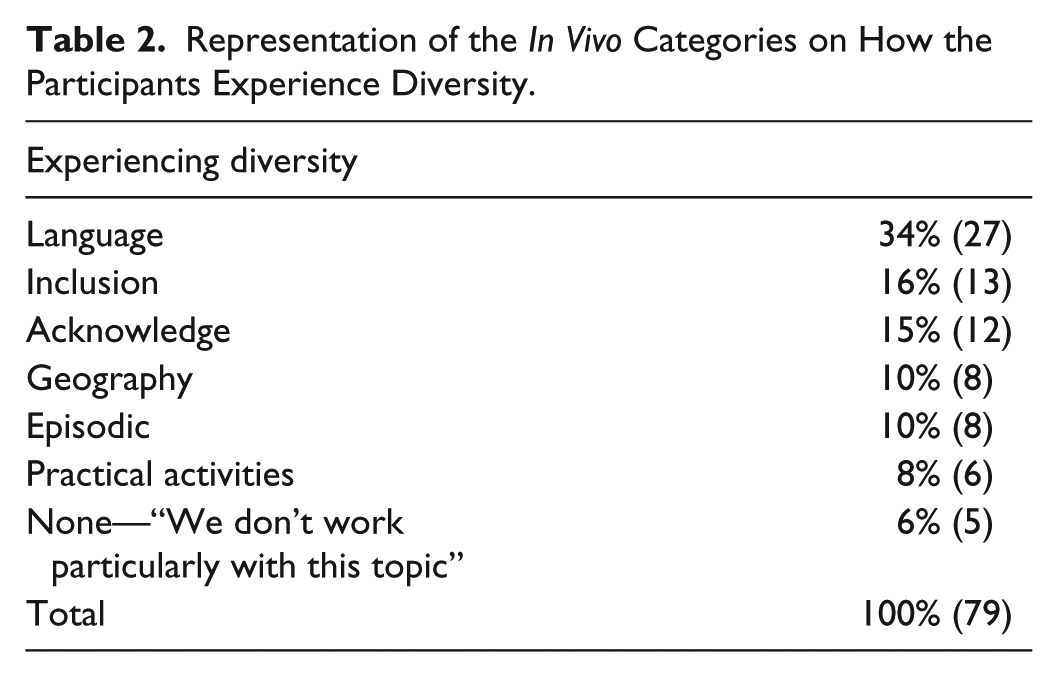
Representation of the In Vivo Categories on How the Participants Experience Diversity.
Results
First, we will look at how the participants understand the term diversity, before elaborating on how they experience their work with diversity. We integrate the results from the questionnaires and the interviews when presenting the participants’ understandings and experiences with diversity. The percentages and results shown in the tables are from the questionnaires, whereas the quotes from the participants are from the interviews.
The questionnaire data reveal that almost half (48%) of the participants associate diversity with differences, 42% with culture, and 30% with religion. Other associations reported by more than 10% were respect (22%), language (17%), and ethnicity (15%). The responses ranged from “When I hear the word diversity, I think about people with minority language background and other religions and how we should help them to understand and function in the Norwegian society” at one end, to “Have respect and appreciate that that everything and everyone is different and that we need and fulfill each other” at the other end. The qualitative analysis of the open-ended item in the questionnaire led to eight categories defining how the participants understand diversity. The categories are listed according to their frequency and thus importance in Table 1. Some of the in vivo categories are at a more abstract level than others, for example, “culture” versus “geography.” We will, in the following, exemplify the categories that are not self-explanatory by referring to representative quotes from the interviews.
The first category “differences” concerns children’s different background, as illustrated by the following quote from an interview:
Diversity implies several things, but in general I think about differences. Despite this tolerance and appreciation are important. Regardless of who you are, what you are or your values, it is about respect and equality. We have differences in language, cultures and background, but tolerance is still to be present. (Educator, kindergarten)
The category “language” is about the minority children having other languages than Norwegian or Sami as their mother tongue. Several of the participants mention “culture” in the interviews, like in “. . . the cultures that come together form diversity” (Educator, school), but none of them define the term. The same goes for “ethnicity.” Furthermore, “Inclusion” has to do with “students feeling included in the society” (Educator, school), and “Geography” relates to students’ home country, like, for example, “by using flags at our school” (Educator, school). Finally, the category “Attitudes” relates to participants valuing respect and equality: “When talking about diversity I think about respect, about human dignity and equality” (Educator, school).
When asked about their past and present experiences with diversity through questionnaires, several of the participants mention who their target group is (e.g., minority children) and their work experiences at specific institutions, but few answers indicated how they actually work with diversity. One third of the participants reported that she or he “has not worked with diversity” (9%), respect and acknowledgement of different cultures and religions (9%), marking of official/religious anniversaries and food from other cultures (6%), and Norwegian language courses (6%). The analysis of the open-ended item in the questionnaire led to seven categories answering how the participants experience their work with diversity (see Table 2).
In the interviews, we asked them to give examples of how they actually work with diversity in their everyday contexts. The following quote from an interview indicates the importance many of the participants ascribe to speaking Norwegian:
It’s very important that the children speak Norwegian so I force them to do it. Although they are new they have to start saying things like “I don’t know,” “I don’t remember,” everyone has to say something in Norwegian. And I try to think that it is important that I acknowledge the language they already know. (Educator, kindergarten)
The participants work with inclusion, acknowledgment, and children’s background by showing appreciation of differences relating to language, country of origin, or cultural characteristics: “We show that we appreciate diversity, e.g. the hijab” (Educator, kindergarten); “. . . by being genuinely interested in where they come from” (Educator, school); “we mark the founding day of United Nations” (Educator, school). When the participants during the interviews provided examples of practical activities, they did with children with minority language background, they talked about using pictures and other artifacts to work with language issues and to visualize where the children come from:
I value their language, listen to fairy tales in their language, let them tell stories from their home country in class. Earlier this year we had a map on the wall including pictures of the children. Then we put a string between their country and Norway to indicate the distance and where they are from. We show them that they have arrived in Norway and that they want to be here, but that they are from a different country and that we appreciate this country for its good qualities, not only the war and horrible things happening there. So I try to appreciate them as individual human beings, in a way. (Educator, kindergarten)
Finally, there were some participants who said they did not have any experience working with diversity.
In this last section, we present the main results from the analyses of the educational authorities’ views of diversity as explicated in the official documents pertaining to the education sector. The Education Act (Ministry of Education, 1998) and the Kindergarten Act (Ministry of Education and Research, 2005) do not use the term “diversity” explicitly, but the scope and objective of education are described similarly in both acts as to develop fundamental values and virtues among children. Those values are considered as based on both Christian and humanistic heritage and traditions, converging respect for human dignity, equality, and solidarity. It is also acknowledged that such values appear in other religions and beliefs and are rooted in human rights. Democracy, equality, and prevention of all forms of discrimination are seen as inextricably bound to this work. Advancement of such values constitutes strong normative indicators as to how diversity is to be handled in Norwegian education. Kindergartens are, for example, in § 2 instructed to “ensure that all children experience joy and ability to cope in a social and cultural community” (Ministry of Education and Research, 2005). This is further developed in the Framework for Kindergartens in which it is recognized that “social, ethnic, cultural, religious, linguistic and economic diversities in the population” (Ministry of Education and Research, 2006, p. 7) shape the social life in a kindergarten. The educators are expected to support children in their development based on such cultural and individual conditions. Expressions of art and culture are assessed in the framework as core in developing a sense of belonging to a variety of cultural expressions. The Core National Curriculum for schools (Royal Ministry of Education, Research and Church Affairs, 1997) maintains that social diversity is generated by the individual distinctiveness of children. Education is, therefore, expected to nourish individual growth and see individual distinctions as something that enrich our world. The education sector is assigned to “foster equality between the sexes and solidarity among groups and across borders” (p. 8). These individual features include nurturing children that “meet other cultures openly in order to find pleasure in the diversity of human expression and to learn from contrast” (p. 40).
Moving from the more general terms and appraisal of diversity, the white paper on “A Comprehensive Integration Policy: Diversity and Community” (Ministry of Children Equality and Social Inclusion, 2012) narrows the understanding of diversity as it clearly states that immigrants are those constituting diversity, not only contributing to it. Nevertheless, multilingualism is to be considered an asset for the Norwegian society, linguistic, and cultural diversity as something natural and positive in contemporary kindergartens and schools.
Discussion
Initially in this article, we asked how educators participating in the innovative approach Competence for Diversity understand and experience their work with diversity and how their views of diversity correspond to the educational authorities’ views of diversity. Not surprisingly, the analyses show that the educators have different ways of understanding and working with diversity. However, there are significant gaps between how they understand diversity and how they experience their work with diversity. Furthermore, there is an overlap between the white paper forming the basis of the developmental work with diversity (Ministry of Children Equality and Social Inclusion, 2012) and the educators’ understanding of diversity, but we find a discrepancy between the white paper and how the educators experience their work with diversity. Finally, there is a significant gap between diversity as outlined in the mentioned white paper and diversity as outlined in the other documents that were analyzed. These results shed light on the juxtaposition of policy and practice and can have implications for how the two areas can better be equipped to meet the challenges of increasingly diverse classrooms. In the following, we will discuss this in two sections, each relating to one of the two research questions in this article.
Educators’ Understanding of Diversity Versus How They Experience Their Work With Diversity
The educators participating in the innovative national program Competence for Diversity mainly understand diversity as revolving around differences within and between children, concurring with a broad definition of diversity (Miller et al., 2009). In addition, a substantial amount of the educators relate diversity either to language, similar to the educational authorities’ understanding of diversity (Ministry of Children Equality and Social Inclusion, 2012), or to religion (Andersen & Linengaard, 2008), or culture. The latter is a term that is not defined or elaborated on by the educators in the present study. The same goes for the term ethnicity. However, they frequently use these terms when discussing diversity among children. Thus, the terms are part of the educators’ conceptual repertoire, or rather the lack of such a repertoire, pertaining to cultural conflict and color-blindness (Milner, 2010). In defining the Others as belonging to a “common culture,” educators may—consciously or subconsciously—contribute to what Milner (2010) refers to as cultural conflict. This is a worrying finding, since educators may add to the burden of cementing cultural references within cultural borders that in reality are more dynamic and transformative. They become carriers of the target language culture and its national community (Bianco, 2009). Ethnicity is the other problematic term, which is frequently used by the educators, but not defined. It is, in fact, a part of the Scandinavian discourse to use the term ethnicity rather than “race,” “skin color,” or “birthplace.” By doing that, we believe educators miss important features of children’s racial background—a pitfall we are warned about by Milner (2010).
It is noteworthy that the educators’ understanding of diversity in many ways is not in line with, or even contradicts, their experiences of working with diversity. Too many of the educators state they do not work with diversity, and too many of those who say they do work with diversity, do not mention how they work with diversity. Nevertheless, some examples of work with diversity are mentioned, typically pertaining to second language support, including and acknowledging differences, and visible differences such as food or national anniversaries (what Banks and Banks [2001] refer to as “episodic”). Thus, the educators’ experiences with diversity is less in line with the white paper that lays the foundation for the innovative approach to enhancing work with diversity in schools and kindergartens: “A Comprehensive Integration Policy: Diversity and Community” (Ministry of Children Equality and Social Inclusion, 2012). However, the educators seem to have more reflective experiences with diversity by not working with the Others, but taking care to include and acknowledge all children. The latter is the stated goal of the overall education in schools and kindergartens in Norway (Ministry of Education, 1998; Ministry of Education and Research, 2005).
Diversity in Policy Documents Versus Educators’ View of Diversity
The Kindergarten Act (Ministry of Education and Research, 2005) and the Framework for kindergartens (Ministry of Education and Research, 2006) provide a normative basis for the work with diversity in Norwegian kindergartens, as the Education Act (Ministry of Education, 1998) and the Core Curriculum (Royal Ministry of Education, Research and Church Affairs, 1997) do for schools. All the four policy documents seem to value diversity and promote virtues such as respect, tolerance, inclusion, equality, and solidarity. Human rights are considered core values in the entire education system and should contribute to prevent discrimination. In addition, the recognition of diversity is associated to the individual child and judged as an important factor in advancement of an identity embracing civic values (Taylor, 1994). What the individual child brings into the common society is not only to be valued but also to be assessed as an asset to society. As such, it appears that these judicial documents provide minorities with individual rights and freedoms and even appreciation for their individual contributions to society (Gutmann, 2003; Honneth, 2003; Milner, 2010).
The white paper can be understood slightly different. First of all, the attention of the white paper is on recognizing diversity by focusing on one group, not on individuals (Kymlicka, 1995). The common trait of individuals in this group is that they have an immigrant background. It is possible to argue that this is a necessity as the white paper’s objective is to sketch out foundations of new policies for integration of immigrants. However, by claiming in the introduction of the document that diversity in the Norwegian society is due to immigration, it gives a signal that prior to immigration or without immigrants, Norway is, or has been, a homogenous society. The rhetoric cements an understanding of immigrants, and hence, diversity, adding to contemporary societal problems, problems that can find “solutions” through an improved integration policy. The chapter on education (Chapter 4) in the white paper points to two central elements of diversity that, to some degree, limit the understanding of the concept of diversity: language and culture. Interestingly, this is more in line with the educators’ understanding of diversity in contrast to their experiences of working with diversity.
Figure 2 illustrates the identified overlaps and tensions or contradictions we have discussed so far. The straight thick lines symbolize overlap, whereas the lightning bolts symbolize tensions or contradictions.

An overview of the analyses, showing which domains are in line with each other and where there are possible contradictions or tensions.
Concluding Remarks: A Call for Action
There is no doubt that classrooms are getting more and more culturally and linguistically diverse (Miller et al., 2009). Increased globalization and internationalization have an impact on economy, environment, culture, and education. Norway, like many other European nations, is experiencing increased immigration and thus a more culturally and linguistically diverse population. However, diversity needs to be addressed within groups of people, instead of among groups of people, because diversity is a fundamental part of human development (Nyléhn & Biseth, 2015, p. 315). The national program, Competence for Diversity, proposes work with children who have a minority language background, and thus, portrays diversity as a concept related only to immigrants, that is, the Others. This is in conflict with the documents that have a judicial status and with the educators’ views of how they work to enhance diversity.
As we see it, the starting point of the innovative approach, Competence for Diversity, has been detached from the field of practice. Even though it does not have a judicial status, it does lay the foundation for how educators are expected to understand and act on issues of diversity among children. However, as our analyses and discussion above have revealed, there are significant gaps between the stakeholders that need to be addressed to achieve a change of practices in the education sector. The findings contribute to understanding possible tensions and suggesting how such innovative approaches to diversity could be enhanced to have a significant impact on professional practice. The educators’ actual experiences of work with diversity tend to be in line with a broad understanding of diversity. This concurs with the judicial framework for the education sector. Hence, an innovative and sustainable approach to advancing diversity in education should be based on an overlap between the innovative approach and the judicial documents, which operate with a broader definition of diversity. Thus, avoiding “bipolar” teachers with a significant gap between their understandings of diversity and experiences of work with diversity. Furthermore, such an innovative and sustainable approach should be based on a bottom-up strategy in which the educators’ actual experiences of work with diversity are in focus. We propose that this can be achieved through long-term school-based research and development work in close collaboration between educators, teacher educators, and researchers working with issues of diversity in education (Elmore, 2004; Florian, 2012; Mensah, 2013).
Paradoxically, we wish we had not written this article with the focus we have. Often research tends to emphasize the Other, in education, preferably children with a minority background (Gearon et al., 2009), as if those constitute the major problem. Our analysis of the national document laying the foundation for the innovative approach discussed in this article shows that it also focuses on children, and a particular group of children, namely, those with a background linguistically and culturally different from the alleged Norwegian mainstream. Too little attention is on diversity among teachers, as if they are one group, unified through their profession. This kind of diversity may have implications for activities in classrooms and, hence, call for further research.
Footnotes
Appendix A
Appendix B
Acknowledgements
The authors thank MPhil student Jocelyne Muhayimana von Hof, for her help with conducting some of the interviews and transcribing them.
Declaration of Conflicting Interests
The author(s) declared no potential conflicts of interest with respect to the research, authorship, and/or publication of this article.
Funding
The author(s) received no financial support for the research and/or authorship of this article.